Author: HCNewton Page 362 of 624

(belated) COVER REVEAL: Zodiac by Anamaria Lonescu

Welcome to The Irresponsible Reader’s part in the Cover Reveal for Anamaria Lonescu’s Zodiac! I don’t know why my [expletive deleted] scheduled post didn’t go up on the 27th like it was supposed to. I apologize to Lonescue, Corylus Books, and Love Books for not noticing that until this morning–this makes the 2nd tour I’ve ever missed (sadly, the third was on the 28th, but more on that in a few minutes), and it’s not the way I try to run around here. “Irresponsible” is supposed to refer to my reading ethos, not my approach to commitments.

Technically, this isn’t so much a Cover Reveal as much as it is, “here’s a nifty cover for a book that looks promising from a publisher that has a great idea”. Hope you enjoy!

Book Blurb

When investigator Sergiu Manta is handed the investigation into a series of bizarre murders, he can’t sure what he’s getting involved in as he has to work with regular detective Marius Stanescu, who has his own suspicions about the biker he has been told to work with, and wants to get to the truth. The twists and turns of their investigation takes them from the city of Bucharest to the mountains of rural Romania, and back.

Buy Link

https://amzn.to/32pjB2s


Corylus Books

Corylus Books is a new venture aiming to publish fiction translated into English. The people behind the company have very different backgrounds, but what brings us together is a deep appreciation of crime fiction and a strong interest in books from countries that so have been under-represented in English.

It took a while before it turned out that everyone’s thoughts had been on similar lines – that we wanted to take a chance on presenting some of the great European crime fiction that wouldn’t normally make its way into English. With a mixture of language, translation and other skills between the four of us, it seemed the logical next step to take.

The first Corylus books are a pair of Romanian crime novellas, Living Candles by Teodora Matei and Zodiac by Anamaria Ionescu.

There’s more to come in 2020 – starting with Romanian novelist’s Bogdan Teodorescu’s Sword, a powerful political thriller that has already been a bestseller in Romania and in its French translation. Sword will be available in May and will be followed later in the year by the first of two books by Icelandic crime writer Sólveig Pálsdóttir. The Fox will be available in the second half of this year, followed by Shackles in 2021.

And there’s more to come, with a novel by Bogdan Hrib set partly in Romania and partly in the north-east of England, a second novel from Teodora Matei, and we’re talking to more exciting writers from across Europe about what we can do together…


Without further ado…

The Cover


That just jumps out at you, doesn’t it? Wouldn’t it look spiffy on your Kindle screen?

You can get your hands on this cover (and the promising looking novel!) at https://amzn.to/32pjB2s and keep an eye on Corylus Books, I think it’ll be well-worth your time.


My thanks to Love Books Group for the invitation to participate in this reveal and the materials they provided.

Love Books Group

Top 5 Saturday: Books Inspired by Mythology


The Top 5 Saturday weekly meme was created by Amanda at Devouring Books.

Rules!

  • Share your top 5 books of the current topic—these can be books that you want to read, have read and loved, have read and hated, you can do it any way you want.
  • Tag the original post (This one!)
  • Tag 5 people (I probably won’t do this bit, play along if you want)

This week’s topic is: Books inspired by Mythology. Which you’d think would be super-easy—and it was fairly easy—but coming up with a fifth took a little more work than I expected.


Bad Blood
by
Lucienne Diver

An Urban Fantasy featuring a strong, snarky, female PI who doesn’t believe the family legend that she’s descended from Pan and Medusa. But when Apollo himself shows up to hire her, she starts to come around . . . I admit I don’t remember a lot of this (I read it 7 years ago), but it was one of the first I thought of when I decided to do this list and I do keep asking myself why I never got around to reading the rest of the series.


American Gods
by
Neil Gaiman

Honestly, not my favorite Gaiman (maybe on a second read that’d change). But man, there are passages in this book that are pure magic. Epic in scope, but filled with fantastic characters, and Gaiman’s prose, you can absolutely understand why it’s beloved and so widely-read.


The Long Dark Tea-Time of the Soul
by
Douglas Adams

Unless I read something I cannot recall, this was the first book I read that made use of mythological characters in a contemporary setting. I absolutely loved the idea and wondered why more people didn’t do that. Clearly, they do (just see the rest of this post and the others posting on this theme today), but at the ripe old age of 15, it was revolutionary to me. Odin, Thor, Loki and a few other Norse dignitaries are flitting about London and the area, inflicting damage, killing innocents, and driving nursing home staff crazy. Throw in Dirk Gently and Adams at his best and you have a killer read.


Hunted
by
Kevin Hearne

Members of five (I think) pantheons show up in this book—in what’s probably Hearne’s finest use of them all. A good story for Atticus, Oberon, and Granuaile (Oberon has his best dramatic moment, as I recall) aside from that, but a great way of blending the various pantheons into the Iron Druid’s world. One of my Top 2 in the series.


The Lightning Thief
by
Rick Riordan

How can you have a list like this and not include this book (or one of the legion it spawned)? The book that started a craze and gave Riordan the ability to quit teaching. This set the template for all of Riordan’s myth-inspired books (be it Greek, Roman, Egyptian or Norse mythology) and is just fun (unlike some of the latter books which got a bit preachy and tedious). It’s not quite Potter-level of fame/influence, but it’s the closest we have in the States, a nice collection of kids, a creative way of brining myths to the 21st Century, and a rollicking good time.

The History of Tom Jones, a Foundling by Henry Fielding: BOOK III., vii.-x.

Fridays with the Foundling
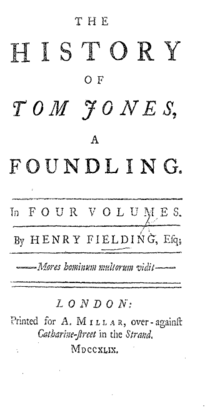
Tom Jones Original CoverAs I noted last week, Mrs. Blifil’s affection toward Tom was increasing (perhaps too much), and as that happened, her regard for her own son decreased. This keeps happening throughout this book—I’m not sure why everyone’s affections operate like seesaws here, but that’s the way it seems to be.

Case in point, when Mr. Allworthy saw Master Blifil being disliked by his own mother, “began, on that Account only, to look with an Eye of Compassion upon him.” Seeing “every Appearance of Virtue in the You thro’ the magnifying End, and viewed all his Faults with the Glass inverted, so that they became scarce perceptible.” And as that happened, guess what changes with Tom?

that poor Youth, (however innocent) began to sink in his Affections as he rose in hers. This, it is true would of itself alone never have been able to eradicate Jones form his Bosom; but it was greatly injurious to him, and prepared Mr. Allworthy’s Mind for those Impressions which afterwards produced the mighty Events, that will be contained hereafter in this History; and to which it must be confest, the unfortunate Lad, by his own Wantonness, Wildness, and Want of Caution, too much contributed.

In other words, this is going to prove to be important later—though ol’ Tommy Boy doesn’t do himself any favors.

This leads our Author to make an appearance in the text “by way of Chorus on the Stage,” to inject an important Life Lesson or two. It was nice of him to admit that’s what he was doing—even nicer that he did it with style.

Following this we see Tom get in trouble again, and Blifil helps make that situation worse. It doesn’t do the latter much good and, again, Tom’s good-heartedness is seen in the midst of this, giving Allworthy reason to respect him (we know from the quotation above that it’s not enough…). But in the end, Tom’s Game-keeper friend and his family are hurt by the results of all this, and Tom can’t get Allworthy on his side.

However, Mr. Western is the injured party (because the Game-keeper poached from him), and

Tom applied to Mr. Western’s Daughter, a young Lady of about seventeen Years of Age, whom her Father, next after those necessary Implements of Sport just before mentioned, loved and esteemed above all the World. Now, as she had some Influence on the Squire, so Tom had some little Influence on her. But this being the intended Heroine of this Work, a Lady with whom we ourselves are greatly in Love, and with whom many of our Readers will probably be in Love too before we part, it is by no Means proper she should make her Appearance at the End of a Book.

Maybe it’s just me, but that last sentence cracked me up. We’ll have to wait a week to meet her.

A slight improvement on last week, mostly because I enjoyed the Narrator’s voice in these chapters. But hopefully in Volume II, things’ll pick up.

Highfire by Eoin Colfer: Enter the Dragon (the Drunken, Netflix-binging, Lousiana Swamp-Dwelling, Crotchety one)

Highfire

Highfire

by Eoin Colfer

Hardcover, 373 pg.
Harper Perennial, 2020

Read: February 18-24, 2020
Grab a copy from your local indie bookstore!

He knows where I live. And Momma, too.

Squib was marked and he knew it.

I gotta sort this out, he thought. I gotta get out from under that dragon.

Which is not a problem most people have to solve in their lifetimes. In general, most folk who get to meet a dragon only get to think about it that one time for about five seconds.

Here’s the punchline: I’m not sure I’ve read another book this year that was this much fun. It’s a great mix of comedy and action, with just a smidgen of heart. But best of all, it’s got a dragon. A fantastic dragon character. Sure, it’s been less than 2 months, so that compliment rings a bit hollow. Let me try again: pound-for-pound, this is one of the most entertaining books I’ve read in the last two years.

Vern (short for Wyvern) isn’t your typical dragon. In fiction, dragons tend to be old, wise creatures that act as sages who occasionally light something/someone on fire. Or they’re incredibly violent, greedy things (frequently incapable of thought). Not Vern. He’s over three thousand years old and has lived all over the world. He’s on the small side (relative to dragons, not humans), and is a little sensitive about it—and fictional depictions of dragons. When he’s asked about, for example, Game of Thrones, he responds:

Game of Thrones? Are you tryin to push my buttons, kid Game of [expletive] Thrones! Those dragons are like servants—you see me doing any [expletive] mother of dragon’s bidding? I’d never serve humans!…[Expletive] lapdog CGI [expletive] fire lizards. Heap of [expletive]”

Most of Vern’s time is taken up by avoiding detection by humans, hanging out in a swamp near New Orleans, drinking Vodka and watching a lot of Netflix. He’s doing a Keto diet, loves Flashdance and the music of Linda Ronstadt. Like I said, not your typical dragon.

It’s not a great life, but it’s a safe one. Up until the day a fifteen-year-old known as Squib stumbles onto Vern’s existence while trying to avoid the local constable (who Squib just observed doing something very illegal).

Through some bad timing and a real sign of guts by Squib, Vern doesn’t kill him immediately. He eventually will bring Squib on as his go-between to the outside world. He’ll primarily be responsible for providing things that Vern can’t get— booze, food, etc. From this, a friendship of sorts develops between the two.

Which is great, because Squib needs a friend like Vern. You see, the constable has figured out that it was very likely Squib who witnessed his criminal act on the swamp, and now he hs to get ride of the boy before he finds a more honest legal authority to spill his guts to. While he’s at it, he’ll use Vern to advance his criminal career.

These two are going to have to lean on each other pretty hard if they’re going to get out of this okay.

That’s pretty much all you need to know.

I should talk a little about Squib (and his mother), but I’m not going to—he’s a fun character, but I want to focus on Vern.

In general, Highfire focuses on the biology, the history, and the life of dragons and those associated with them. In particular, it focuses on Vern’s his fire. Typically, I don’t remember getting a whole lot of information about a dragon’s fire. Colfer gives us a pretty thorough description of where it comes from, how a dragon can produce it, how it’s unlike the fire that humans are accustomed to, and so on. For example:

My fire don’t burn slow. No one ever got mildly scalded from dragon flame.

“Fulminated” was the word, or used to be.

A few pages later, he gets into a great description of how Vern lights his breath, and eventually, he’ll describe the effect that it has. We don’t get a lot about his flying ability (Vern doesn’t really get it either, beyond that the practical).

There are two action scenes in this book—they are both fan=fracking-tastic. It’s been months since I’ve read a fight/battle/action scene that grabbed me the way these did (pre-the last Lee Child, possibly the last two). The pacing, the detail . . . everything is just what you might hope it would be. The book is worth the time just for those two scenes.

There’s a great reference to Pete’s Dragon, The Princess Bride, and others. Vern’s a veritable font of pop culture references. Vern may be a crotchety old guy, he’s a great character. I really enjoyed that about him. There’s something to at least grin about on practically every page. Between the voice, the comedy and the great action scenes? This is a must-read for dragon friends (or just about anyone else).

Now, Colfer has written a few other Adult novels—I’ve read three of them. Plugged and Screwed share a similar voice (but are heavier on the violence), And Another Thing… couldn’t be more different, but he was playing in Adams’s sandbox with that one. But for people who’ve read his adult work, you’ll appreciate this if you don’t mind a dash of fantasy. If you’ve read this and liked it–and you don’t mind the lack of fantasy–get on his other adult work. I wouldn’t say that Highfire is appropriate for most of Colfer’s younger readers, but a mature teen reader could handle it as long as he realizes this isn’t going to be along the lines of the Artemis Fowl books.


4 1/2 Stars

2020 Library Love Challenge

This post contains an affiliate link. If you purchase from it, I will get a small commission at no additional cost to you. As always, opinions are my own.


Down the TBR Hole (2 of 24+)

Down the TBR Hole

Back for Round Two!

This meme was created by Lia @ Lost in a Story—but Jenna at Bookmark Your Thoughts is the one that exposed me to this, and as my Goodreads “Want To Read” shelf is scarily long, I had to do this.

The Rules are simple:

  1. Go to your Goodreads to-read shelf
  2. Order on ascending date added.
  3. Take the first 5 (or 10 if you’re feeling adventurous) books.
  4. Read the synopses of the books.
  5. Decide: keep it or should it go?
  6. Keep track of where you left off so you can pick up there next week! (or whenever)

What distinguishes this series from the Mt. TBR section of my Month-end Retrospectives? Those are books I actually own while Goodreads contains my aspirational TBR (many of which will be Library reads). The Naming of the two is a bit confusing, but…what’re you going to do?

(Click on the cover for an official site or something with more info about the book)

Monster Hunter Vendetta Monster Hunter Vendetta by Larry Correia
My Thoughts: I read and enjoyed Monster Hunter International years ago, probably would’ve jumped on this follow-up if my library had a copy of it—or if I’d had the cash for it then. I liked International enough, and have heard primarily good things about the rest of the series. Gotta give it another shot.
Verdict:
Thumbs Up
City of the Sun City of the Sun by Daid Levien
Blurb: A P.I. with a dark past hunts for a missing child.
My Thoughts: I don’t remember what attracted me to this. Looks perfectly decent, but I have so many mysteries that I know why I want to read, I’m going to pass on this.
Verdict:
Thumbs Down
Unicorn Precinct Unicorn Precinct by Keith R.A. DeCandido
My Thoughts: See what I said about Monster Hunter Vendetta.
Verdict:
Thumbs Up
Jack Reacher's Rules Jack Reacher’s Rules by Lee Child
Blurb: “…this one-of-a-kind book compiles timeless advice from maverick former army cop Jack Reacher, the hero of Lee Child’s blockbuster thrillers…”
My Thoughts: Why haven’t I read this yet?
Verdict:
Thumbs Up
Two Pints Two Pints by Roddy Doyle
Blurb: “Two men meet for a pint in a Dublin pub. They chew the fat, set the world to rights, take the piss… They talk about their wives, their kids, their kids’ pets, their football teams and – this being Ireland in 2011–12 –about the euro, the crash, the presidential election, the Queen’s visit.”
My Thoughts: Doyle going the comedic route? (which is what it seems like) A sure-fire win. (and there are two sequels…)
Verdict:
Thumbs Up
Memoirs of an Imaginary Friend Memoirs of an Imaginary Friend by Matthew Dicks
Blurb: “Budo is lucky as imaginary friends go. He’s been alive for more than five years, which is positively ancient in the world of imaginary friends. But Budo feels his age and thinks constantly of the day when eight-year-old Max Delaney will stop believing in him. When that happens, Budo will disappear.Max is different from other children. Some people say he has Asperger’s, but most just say he’s “on the spectrum.” None of this matters to Budo, who loves Max unconditionally and is charged with protecting him from the class bully, from awkward situations in the cafeteria, and even in the bathroom stalls. But he can’t protect Max from Mrs. Patterson, a teacher in the Learning Center who believes that she alone is qualified to care for this young boy.

When Mrs. Patterson does the unthinkable, it is up to Budo and a team of imaginary friends to save Max—and Budo must ultimately decide which is more important: Max’s happiness or his own existence.”
Verdict:
Thumbs Up

A Ticket to the Boneyard A Ticket to the Boneyard by Lawrence Block
My Thoughts: The first seven of these were compelling, and I’m not sure why I ran out of gas with these. A friend has been castigating me for that choice for a few months now. Gotta get back on that horse.
Verdict:
Thumbs Up
Dixie City Jam Dixie City Jam by James Lee Burke
My Thoughts: I admired and respected the first six of these more than I enjoyed them. I’m betting this would be the same. Life’s too short.
Verdict:
Thumbs Up
The Nightgown The Nightgown by Brad Parks
My Thoughts: A 32-page prequel to the Carter Ross series seems like it’d be 20 or so minutes of fun, but I can’t see me getting around to this (unless Parks writes another Ross book or two—might renew my interest, but even then…a singular short isn’t my style)
Verdict:
Thumbs Down
Trouble in Paradise Trouble in Paradise by Marcia Clark
My Thoughts: See above, but re: the Rachel Knight series.
Verdict:
Thumbs Down

Books Removed in this Post: 4 / 10
Total Books Removed: 7 / 240

Anyone out there read any of these books? Did I make the right call with any of them?


(Image by moritz320 from Pixabay)

(half-baked) Top Ten Tuesday: The Ten Characters I’d Follow On Social Media


The topic for this week’s Top Ten Tuesdays is the Ten Characters I’d Follow On Social Media.

I’m posting this even though I’m not really done with it, because…well, it’s a Tuesday thing, right? I intended to add at least a couple of sentences saying why I’d want to follow them, but ran out of time. But I put enough time narrowing down this list to the magic 10, that I wanted to get some value out of it.

10 Kirby Baxter from Duncan MacMaster’s mystery series.
9 Beast from Faith Hunter’s Jane Yellowrock series (who incidentally has a great Facebook page that I do follow).
8 Molly Carpenter from Jim Butcher’s The Dresden Files
7 Lon Cohen from Rex Stout’s Nero Wolfe/Archie Goodwinseries.
6 Peter Grant from Ben Aaronovitch’s The Rivers of London series.
5 Nina Hill from The Bookish Life of Nina Hill by Abbi Waxman
4 Nell Ingram from Faith Hunter’s Souldwood series (if she talks about food primarily).
3 Stephanie Plum‘s Grandma Mazur from Janet Evanovich’s books.
2 Oberon from Kevin Hearne’s Iron Druid Chronicles/Oberon’s Meaty Mysteries
1 Ford Prefect from Douglas Adams’s The Hitchhiker’s Guide to the Galaxy Trilogy

Hi Five by Joe Ide: A Criminal for a Client, an Unreliable Witness, and a Larger Number than Usual that Want Him Dead. IQ has his work cut out for him.

Hi Five

Hi Five

by Joe Ide
Series: IQ, #4

Hardcover, 339 pg.https://www.mulhollandbooks.com/titles/joe-ide/hi-five/9780316509534/
Mulholland Books, 2020

Read: February 10-16, 2020

Grab a copy from your local indie bookstore!


Isaiah has tried to move on after the heartbreak of Wrecked, and has a new girlfriend. This is unfortunate for her—not because IQ is a bad boyfriend or anything—it’s just that when a low-life gun dealer needs Isaiah to investigate something for him, he threatens the poor girl to insure that Isaiah will do it.

What he needs Isaiah to do is clear his daughter of murder. She’s the only witness to the event, but can’t give the police (or our hero) much information about it, despite being in the same room as the murder. Why? Well (and this feels like spoiling something, but it’s on the book jacket), she has Dissociative Identity Disorder (DID)—what we used to call Multiple Personality Disorder—and given the stress and danger presented by a man being shot in her shop, Christina wasn’t “there” for most of what happened. Now, did her father bother mentioning this to Isaiah? Nope. but he thankfully figures that out fairly quickly. So now our intrepid investigator has to look into a murder with an eyewitness/prime suspect who didn’t see anything, and who can’t convince anyone who did see something to say something—and if he doesn’t succeed, someone he cares about will pay the penalty (and he assumes he’ll pay, too).

This is such a fantastic idea for a murder case—it could easily be a sloppily executed idea, but if someone does their homework and does a responsible job depicting DID, this is a wonderful fodder for drama. Please, if there are other examples of mystery writers doing this, fill up the comments with titles. I’d love to read other versions of this—and can’t believe that Ide’s the first to do this.

Most authors would be content to fully develop this idea and run with it for the whole novel. But not Ide. In fact, as interesting as it is, the murder case is not the most interesting thing about Hi Five. I’m pretty sure that’s impressive. To take a concept like that and say, “well, sure, but what’s important is the trouble that Isaiah finds himself in because of the investigation.” That’s bad enough, but Isaiah has recently run afoul of a gang of white supremacists after gang violence has hit someone that Isaiah and Dodson (particularly Dodson) respect and admire.

Oh, and Grace is back.

Ide also finds a way to work in some lighter stories and even a little sweetness. And the book never feels crowded, and everything gets dealt with in the space it needs. Sure, I’d have preferred to spend more time dealing with Christina and her “alters,” but that’s a personal taste thing. I’m a sucker for a good DID story. But what Ide wanted to focus on justifies cutting that storyline some of the space I’d prefer it get.

The tension is high and Isaiah has never seemed more human and fallible (including when he was being waterboarded because of some foolish moves).

Some of the reviews I’ve read about this book seem to think that Ide’s wrapping up the series here. I can see why they’d say that, Hi Five could certainly serve as a fitting end to the series. but it seems to e that Ide has more he wants to say. The way he left things with Isaiah points to a triumphant return. Also, toward the end of the novel, something pretty significant happens to Deondra and I just don’t see Ide leaving things where he did and just walking away—the scene is extraneous unless he’s coming back to follow up on it. I hope I’m reading things right, but if I’m not, this is a solid way to go out.

This is not my favorite of the series, but it is so, so good, that it doesn’t bother me too much. It’s just a pleasure to be back in this prose, in this world, with most of these characters. A great mystery (with a better hook), some great character development, a client you can’t help but loathe—but a subject that you’ll pull for (and want to see more of). Hi Five is just one more proof that Joe Ide is one of the best writers in the genre right now. This is a decent entry to start with, but you’d be better off starting with IQ. But honestly, just grab the nearest book by Ide and enjoy.


4 Stars

2020 Library Love Challenge
This post contains an affiliate link. If you purchase from it, I will get a small commission at no additional cost to you. As always, opinions are my own.

Classic Spenser: The Godwulf Manuscript by Robert B. Parker

Classic Spenser

The Godwulf Manuscript

The Godwulf Manuscript

by Robert B. Parker
Series: Spenser, #1

Mass Market Paperback, 204 pg.
Dell, 1973

Read: January 25-27, 2020

Grab a copy from your local indie bookstore!

Driving back to Boston, I thought about my two retainers in the same week. Maybe I’d buy a yacht. On the other hand maybe it would be better to get the tear in my convertible roof fixed. The tape leaked.

I came to this series about thirteen (possibly fourteen) years late, but to be fair, I would have been thirteen (possibly fourteen) when I started reading it. I wouldn’t have been able to appreciate Spenser without having spent some time with Leroy Brown, Jupiter Jones/Peter Crenshaw/Bob Andrews, Tabitha-Ruth Wexler and others (as I’ve invoked Brown, I hope I remember to draw a line between Sally Kimball and Spenser’s version when I discuss Promised Land). The Godwulf Manuscript wasn’t the first novel I read in the series, I’m going to guess I’d read three or four others before I found this in a used book store. I did find, I now know, a copy with the original cover (as seen above). A year or two later, I loaned it to a friend who proceeded to lose it. I got over it (probably because I didn’t care about things like early editions then) and despite losing that copy, that friend later became my first college roommate, and I didn’t kill him in his sleep for it. Not even once.

That excursus down memory lane means nothing to you, but I put it there in case that friend reads this post. I hope he remembers the Klingon proverb, bortaS bIr jablu’DI’ reH QaQqu’ nay’.

I’ll hold off on talking more about my background with this series for now, but the fact I’ve been reading, and re-reading, and re-re-reading, and re-re-re-reading these books since 1986 (possibly 1987) probably gives you a pretty good idea what I think of them. I could probably write lengthy posts on the first twenty novels in this series without reading them again—but where would be the fun in that? Of the twelve Spenser novels I’ll be revisiting this year, this one is in my bottom two and I’ve read it at least fifteen times, and I don’t see me stopping reading it anytime until I start sleeping the big sleep.

Yeah, that was a purposeful Raymond Chandler allusion. Why? Because this whole novel is a giant Chandler allusion*. From naming his main character after a British poet; to Spener’s attitude, demeanor, voice, etc.; to the opening paragraphs; and so, so much more this whole book screams Parker’s debt to and affection for Raymond Chandler. Spenser as a Shadow of Philip Marlowe will ebb and flow over the years, but I don’t think it’s ever more pronounced than it is in these pages.

* Yeah, there are other influences afoot in these pages, I realize. But Chandler is the primary influence, and this isn’t a dissertation. I don’t have the time to be exhaustive, I have at least 9 other posts I want to complete this week and if I don’t cut a corner or two, I won’t be able to get to them.

So what are these two retainers mentioned above? The first comes from an unnamed university that bears a striking resemblance to Northeastern (Parker’s employer when this was released). An illuminated manuscript has been stolen and is being held for ransom. The problem? (or at least one of them) The University doesn’t have the kind of cash the ‘script-nappers want. They do have a suspect, however, a radical political group on campus: SCACE (Student Committee Against Capitalist Exploitation). Catchy, eh? Spenser starts looking into the group, focusing on a couple of the leaders.

Within a few hours, one of those leaders is dead and another is the prime suspect for the murder. She’d called Spenser for help right after the murder, and he believes her (for compelling reasons you should read for yourself). This leads to the second retainer, her father—a pretty successful capitalist, it should be noted—hires Spenser to clear her for the murder.

The hunt for the manuscript and the murder will end up involving a cult, a couple of very dysfunctional marriages, drug dealing, a couple of hitmen, and a mob boss. Basically, Spenser has his hands full.

While there are many aspects of this novel that Parker will tweak for future installments, there’s a lot that he establishes here that he’ll revisit. Spenser gets fired because of his attitude (as demonstrated by his ignoring—rightly—the University’s insistence that he leave faculty alone), his being fired doesn’t stop him from sticking with the job, however. There’s a shootout in an unpopulated area near Boston*. Spenser cooks a pretty decent meal for himself (not quite Fritz Brenner’s level, but close enough for a guy cooking for one), and proves himself more literate than anyone looking at him would assume. The climactic fight will be echoed in upcoming books, featuring someone who has no business fighting anyone taking on a hardened criminal of sorts solely on the basis of love and desperation. Parker does get away from this, which is good—if only for the sake of variety—but man, I love it every time he uses this.

* My knowledge of Massachusetts geography comes wholly from the novels of Parker, William Tapply and Dennis Lehane, so I can’t be more specific than “unpopulated”.

Spenser physically roughs up a couple of college kids and verbally pushes around an older man. Each incident is followed by Spenser berating himself. This is the kind of thing that you don’t see a whole lot in the hardboiled world before Spenser’s debut. Parker will do a more subtle job in the future of showing that while Spenser will resort to violence when necessary, he doesn’t relish it (except when he knows the recipient is guilty of something) and regrets the act. But here, it’s pretty clear that Parker’s trying to show that Spenser isn’t unfeeling about acts of aggression.

There are things that show up here that will disappear—Spenser sleeps with two different women and is fairly casual about it. He’ll later become a paragon of monogamy, but that’s a couple of years away. Still, he’s less of a player next time we see him. He’s also a bit more antagonistic to most of the police that he encounters than he’ll be in books to come. Some of that is a shift in Spenser, some of that is a growth in the relationships he develops with individual members of BPD.

The main thing that sticks around in the future are some of the characters—we meet people here that Spenser still knows and interacts with on a regular basis. Spenser flirts a lot with the secretary for the head of Campus Security, and we’ll see her later. A reporter for the Campus newspaper gives Spenser a lot of help and information about various people/groups on campus, her name is Iris Milford and when Ace Atkins brought her back in 2015, I may have let out an audible whoop. We meet Spenser’s lawyer, Vince Haller, who not only helps Spenser, but the college student being framed. Haller will eventually disappear from the stage (I realize as I write this), but he’s a frequent presence for a long time to come.

But the three big recurring characters are Lt. Martin Quirk, Sgt. Frank Belson and Joe Broz. Spenser and Belson (a homicide detective) have some history and clearly respect (and even like) each other. Belson’s smart, appears lazy (appears), perpetually has a cheap cigar in his mouth (I think that’s a characteristic in this novel, if not, it will be next time we see him). Belson’s superior is Lt. Quirk. Quirk is a very no-nonsense cop, he’s driven, almost humorless, and has no use for private investigators, but sees a little value in Spenser and begins to trust him a bit over the course of this novel. Joe Broz, on the other hand, couldn’t be less a homicide detective if he tried—you could argue Broz (and his employees) are responsible for the continued careers for a handful of homicide detectives. He’s a crime boss of some notoriety and viciousness. At this point (and for some time to come), he’s the most powerful mobster in Boston (although we will soon meet competition). Spenser will be a thorn in Broz’s side for a long, long time.

It occurs to me that I haven’t described Spenser himself. He’s a former professional boxer (not that good, but he did get his nose broken by someone who was very good); a Korean War vet; a former Massachusetts State Trooper, assigned to the DA’s office in a County that fluctuates depending on Parker’s memory; and now a Private Investigator. He’s very literate, he likes to cook (as I mentioned), he drinks a lot, thinks he’s funnier than anyone else does (except the readers of the novels)—which brings him a lot of grief. We don’t get a lot of insight into it in this novel, but honor’s very important to him and it will influence the way he deals with clients, victims, criminals and everyone else along the way. He’s very much a latter-day knight.

I’m not sure that the mystery is all that clever, but the strength of this book is riding along with Spenser as he goes around annoying people until someone does something that he can catch them at (a strategy he’ll spell out in the future, but follows here). I love the voice, I enjoy the character, and watching him go about his business is a pure joy for me.

I haven’t discussed the action/fight scenes yet, and Parker’s approach to them (particularly in the first 15-20 of the series) has always greatly appealed to me. Parker has to address violence, given his chosen genre–and Spenser is a violent man. But in months to come, we see the character address that in such a way to give us insight into why Parker uses it the way he does (I think). So I’ll put a pin in this for now (also, this is long-winded enough at this point that I’ll take any excuse to wrap things up).

I, obviously, highly recommend this book—but I’ll be the first to say that the second is much better and the fourth and fifth in this series are better yet. You don’t have to start with this one for future books to make sense—in fact, you might appreciate Spenser more if you start later on. But for my money, you’re not likely to find many characters as compelling in contemporary (or at least late-Twentieth Century) hardboiled fiction. For introducing the character to the world/the world to the character of Spenser, The Godwulf Manuscript is well-worth the time. Even if it wasn’t the start of something big, it’s still entertaining enough for me to encourage you to read it.

This post contains an affiliate link. If you purchase from it, I will get a small commission at no additional cost to you. As always, opinions are my own.
Saturday Miscellany—2/22/20

Running late today, my normal time for assembling this post was taken up by a valiant attempt at a little DYI around the house. The results speak loudly about my fitness to spend my time reading and talking about books and far away from tools.

But from the better late than never department, here are the odds ‘n ends over the week about books and reading that caught my eye. You’ve probably seen some/most/all of them, but just in case:

    A Book-ish Related Podcast Episode you might want to give a listen to:

  • Author Stories Podcast Episode 810 | Roxanna Elden Interview—I read a little about this book a few months ago (as I recall), but had forgotten about it until this great chat with Garner. I really appreciated her take on the audiobook narrator.

    This Week’s New Release that I’m Excited About and/or You’ll Probably See Here Soon:

  • A Deeper Song by Rebecca Bradley—the newest DI Hanna Robbins, the last two in this series have been among the best procedurals I’ve read in the last couple of years, I expect this will join the list. Bradley’s last novel is still collecting virtual dust on my Kindle, but I might read this one first.

Lastly, I’d like to say hi and extend a warm welcome to Wednesday Reads, Eamon, Graphic Design Eye and ARJung for following the blog in some format this week. Don’t be a stranger, and use that comment box, would you?
The History of Tom Jones, a Foundling by Henry Fielding: BOOK III., ii.-vi.

Tom Jones Original CoverAfter enjoying things so much last week, I hate to see things slip downward again this week–but I do understand why Fielding’s doing what he’s doing (at least I think I do). But yawn. It’s not that it was bad, it’s just the kind of thing that you need to read to establish one or more things so that future chapters/events will be interesting and make sense. It wouldn’t have occurred to me at all to evaluate these chapters if it weren’t for my reading schedule making them the only things I had to read.

We start with a long disclaimer/apology from Fielding for some of his content about religion/religious people–he’s not trying to focus on the failings of the religious or the virtuous, he says. On the contrary, those who come off poorly in his writing have a lack of real religion or virtue (despite their claims) and that’s what he’s highlighting. Whether or not this is sincere on his part I don’t know (I could probably read a lot about that if I cared to), but I like the approach, and it seems to apply to those we have seen/will see in these pages.

Basically, there’s an altercation between Master Blifil and Tom, resulting in Blifil getting his nose bloodied. To draw attention away from the fact that he provoked Tom, Blifil rats him out on some of the details of Tom’s earlier hijinks (recounted as evidence that he’s the sort “born to be hanged”). Tom had refused to name his accomplices at the time, but Blifil spilled the beans. Thwackum takes this as a sign of virtue in Blifil and proof of Tom’s hooligan status. Mr. Allworthy, on the other hand, sees honor in Tom’s refusal and commends it–but even better for Tom (I imagine), this act earns him a lot of fans within the servants.

The widowed Mrs. Blifil picks up a couple of other suitors, who misreading the situation, go out of their way to prefer her son to Tom and target him for condemnation. But all the while, her affections toward Tom grow and grow.

That’s the chapters in a nutshell, not a lot actually happens. I get the impression that Master Blifil is going to be a pain in Tom’s side in the way rich, preppy kids are to plucky middle/lower-class protagonists in 80’s movies. Not a lot happens, but I’m willing to bet all this comes up later. If not in the next chapter, soon enough.

Page 362 of 624

Powered by WordPress & Theme by Anders Norén