Author: HCNewton Page 443 of 633

Saturday Miscellany – 8/25/18

Wow. Who knew that coming back home and trying to get ready to resume our lives was going to be more disruptive to finding stuff for this post/reading and other bloggy things? Turns out that running hundreds of errands and meeting with all sorts of folk doesn’t leave as much time for bookish pursuits as sitting in doctor’s lobbies, hospital rooms, or hotel rooms. Go figure.

Honestly, I went 2 days in a row without reading any book this week. Finding 30 minutes one morning to fix that made me feel so much better.

So it’s a small list this week, but there’s some interesting stuff here, I think.

Without further ado: The odds ‘n ends over the week about books and reading that caught my eye. You’ve probably seen some/most/all of them, but just in case:

  • Why Irish crime fiction is in murderously good health — The subtitle, “If Irish crime fiction has a signal crime it is corruption – public and private, spiritual and secular” sums it up well. I haven’t read a lot of Irish Crime Fiction, but what I have fits this — and is really good.
  • 10 Little-Known Children’s Books by Famous Writers: Featuring at Least Two of the Best Titles Ever Written — worth reading for those two titles alone. I’m not kidding. There is one book on this list I am going to have to try to track down.
  • Don DeLillo’s Novels, Ranked — I really got into DeLillo in college, and still want to read him (I have more than a few to catch up on), but ever since Falling Man and The Body Artist I haven’t been able to make myself. Still, this is good TBR fodder — and a good way for me to point out that White Noise and Underworld are two of the best things you’ll ever read.
  • Yes, a short list this week. But that just gives you plenty of time to read this. August 22 was the 125th anniversary of Dorothy Parker’s birth — which led to her trending on Twitter. I had to do a double take when I saw that, because I was pretty sure she was dead already (1967, to be precise). Take a bit to read some of these great tweets about her.

Lastly, I’d like to say hi and extend a warm welcome to RABT Book Tours and PR for following the blog this week.

BOOK BLITZ: Shadow Games by Jim Lester

 photo Shadow Games_zpsutlxortm.jpg

Coming of Age
Date Published: June 2018
 photo add-to-goodreads-button_zpsc7b3c634.png
Danny McCall loves basketball more than anything in the world. So why would he risk his basketball scholarship, the love of his life and his entire future to fix the point spread in a series of college basketball games?
Set in the early 1990s, Shadow Games is an exciting page-turner, filled with fast-paced hoops action. A topical novel for readers of all ages, the book is a powerful portrayal of the loss of youthful innocence.


About the Author

 photo Shadow Games Author Jim Lester_zps3ykf5nop.jpeg

Jim Lester is the author of three successful young adult novels: Fallout, The Great Pretender and Till the Rivers All Run Dry. He has a Ph.d in history and is the author of a non-fiction book entitled Hoop Crazy: College Basketball in the 1950s.
Contact Links
Purchase Link


RABT Book Tours & PR

Flashback Friday: The Summer that Melted Everything by Tiffany McDaniel: The Devil Goes Down to Ohio?

Long, tiring, but good week. But there’s just nothing left in the tank for something new, so I’m going to repost about couple of books from the past that I loved. I’m pretty sure that it was McDaniel’s prompting that got me to join NetGalley so (was a few more months before I really started using it).
—

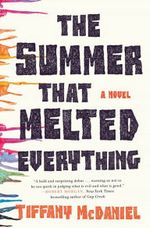
The Summer that Melted EverythingThe Summer that Melted Everything

by Tiffany McDaniel
eARC, 320 pg.
St. Martin’s Press, 2016
Read: July 18 – 19, 2016

The greatest trick the Devil ever pulled was convincing the world he didn’t exist.

Yeah, Keyser Söze’s paraphrase of C. S. Lewis’ appropriation of Charles Baudelaire isn’t part of this book, but it might just encapsulate it. Maybe.

It’s the summer of 1984 in Breathed, OH, and it’s hot. Really hot — and about to get a lot hotter. 1984 is a big year — HIV is identified as the virus that leads to AIDS, Apple releases the Macintosh, Michael Jackson’s Pepsi commercial shoot, and the following advertisement runs in the local newspaper, The Breathian:

Dear Mr. Devil, Sir Satan, Lord Lucifer, and all other crosses you bear,

I cordially invite you to Breathed, Ohio. Land of hills and hay bales, of sinners and forgivers.

May you come in peace.

With great faith,
Autopsy Bliss

Autopsy Bliss is the local prosecutor, who wants to see for himself what evil looks like. Hence the advertisement.

So who shows up in response? A bruised, short black boy dressed in tattered and torn overalls who simply seems to want some ice cream and to say hi to the man who invited him. Autopsy’s son, Fielding, is the first one in town to meet the boy and takes him home to his father (sadly, no ice cream is available in town — unbelievably — for the remainder of the Summer). The Bliss family ends up taking the lad in, and starts calling him Sal. He and Fielding become fast friends and are almost inseparable for the rest of the summer. One by one, almost everyone in this sleepy community is touched by the appearance of Sal — either first-hand or by proxy — demons (figurative), troubled family and personal histories are exposed, latent corruptions come to light, and accidents strike many. No one in Breathed will be the same after the day Sal first appears to Fielding.

The book is narrated by Fielding about 70 years after that summer looking back on the time, thinking of all the regrets he’s had since then and all the ways his time with Sal has overshadowed the ensuing decades. It honestly reminded me of A Prayer for Owen Meany because of this — little kid who talks oddly, is smarter than any of his (apparent) peers, and divides a community, while leaving an indelible mark on his closest friend (who’s not always a friend).

Almost every name (maybe every name, and I’m not clever enough to get it all) is rich in meaning and symbolism — there’s symbolism all over the place, but McDaniel gets her money’s worth with the names in particular. This book will reward close readings, and probably repeated readings as well.

There are so many depictions and descriptions of child abuse and spousal abuse that it’s almost impossible to believe that there households in that world where someone isn’t getting hit on a pretty regular basis. Thankfully, we’re spared watching characters going through it (the vast majority of the time), but there are many mentions of it.

This is not fun read, really, but I loved the whole experience, it is a rewarding read. McDaniel writes with such richness, such depth, there are phrases throughout this that will knock you out. There’s one sentence that I went back to at least a half-a-dozen times one evening — not because I needed to try to suss it out, but because I just liked it so much. The variety of ways she can describe the horrible and debilitating heat wave that struck that part of Ohio those months is pretty astounding — I’m just glad I had some sort of air conditioning most of the time I spent reading the book. Sal’s descriptions of Hell and his fellow prisoners there are full of haunting images that will stick with me for a while (some good haunting, some less-so). I’m troubled by some of what this book said about God, but since the Devil is the one who told about God, I’m not sure we’re supposed to trust his characterizations. On the other hand, just about everything that the book says about the devil seems to be spot-on.

There are no easy answers to be found here — is Sal the devil? Is someone else in town? Is there a devil at all? Are the naturalistic explanations offered here and there throughout enough? I just don’t think you can think about this book without dealing with the Baudelaire/Lewis/Söze thought.

Can’t help but wonder how things would’ve gone if he’d just gotten a little ice cream.

Disclaimer:I received this eARC via NetGalley at the author’s invitation in return for this post. My thanks to NetGalley, St. Martin’s Press, and Tiffany McDaniel for this.

N.B.: As this was an ARC, any quotations above may be changed in the published work — I will endeavor to verify them as soon as possible.

Flashback Friday – Thank You, Goodnight by Andy Abramowitz: A book about a one-hit wonder by an author who I hope has a few more in him.

Long, tiring, but good week. But there’s just nothing left in the tank for something new, so I’m going to repost about couple of books from the past that I loved.
—

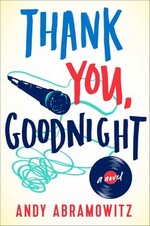
Thank You, GoodnightThank You, Goodnight”

by Andy Abramowitz
Hardcover, 338 pg.
Touchstone, 2015
Read: June 30 – July 3, 2015

In most instances, space between people grows like mold, neglected just long enough to be noticed. You intended to wipe it clean, but the more of it there is, the more daunting a task it becomes to erase it. Not so with me and the band. I’d discontinued those people as if they were a premium cable channel that I’d finally realized was broadcasting nothing I wanted to watch.

From passages like that, a nice mix of thoughtful, sentimental, with a bit of a grin; to the out-and-out funny, like the funniest suicide attempt I’ve read in a long time, possibly ever (something worthy Save Steve Holland’s Lane Myer, but longer); this book covers the spectrum. Not only covers it, but does so with assurance and panache. It’s one of those first novels that makes you wonder what could possibly be done as a follow up.

Teddy Tremble is a successful enough lawyer for someone who’s heart isn’t really in it, while still being good at it. He’s sort of coasting through life — being good enough at his job, good enough with his girlfriend of forever, good enough for his social circle, but not good enough for his father (but after meeting him, you understand that’s just a given). He’s forty-ish and realizes that life is going to pretty much stay this way. On the whole, he seems okay with that — but in the back of his mind he knows he’s not. He won an Academy Award. His band was huge for a little while in the 1990’s, before his hubris ruined things. Sure, things are good enough now, but once upon a time they were great.

Then through a truly humbling and bewildering set of circumstances, Teddy comes across a group of huge Tremble fans. Seriously, die-hard doesn’t begin to describe these people. Think something akin to the kind of people that organized the first Star Trek convention back when it wasn’t a cultural phenomenon, just a short-lived and then canceled show. This changes everything. The adulation, the attention, the satisfaction of performing gets under his skin and he starts writing music for the first time in a long time.

Pretty soon, he’s (forgive the cliché) trying to get the band back together — his agent and producer are on board, convinced that what he’s written exceeds his former quality. Incidentally, both of these characters are the kind that we readers hope to come across — supporting characters that threaten to steal the entire novel, but when used properly just make the whole thing better.

Anyway, with these two on board — Teddy just has to convince the rest of the band to give it a shot, to trust him. Maybe even to forgive him for what he did to them so long ago. Then he has to convince music fans to take them seriously. Neither of these tasks is going to be easy. Both are practically impossible, really.

The book starts out as pretty entertaining, definitely amusing. But it doesn’t stop there — it gets better, deeper, emotionally richer all the while. By the time I got to (and through) Chapter 20, I tweeted that, “Not sure I need to read another word (am going to), but that was as close to perfect as it gets.” I’m still thinking about it a month later.

At various places through the novel, Teddy observes: “One day I’ll die, and this will be one of the things I did with my time.” I’m not sure if I’ve ever seen one sentence used so many different ways with so many different meanings depending on the context. Sometimes he’s says it wryly, sometimes caustically, sometimes wistfully, sometimes with pride. It’s one of those writerly things that when you see it in action, you wonder why more people don’t try it.

Each of these characters — the agent, the producer, the bandmates, their (sometimes very odd) families, Teddy’s girlfriend, associates in the law firm, and others — are well-drawn. Occasionally familiar, without being stock characters or cliché, each character ends up being strong enough that you want to spend at least a little more time with them. But Abramowtitz is too capable of steward of his resources and gives us just enough to leave us wanting more.

I’ve seen a lot of comparisons of Thank You to Hornby’s High Fidelity and Tropper’s This is Where I Leave You. I don’t get that. Maybe it’s just because these people haven’t read anything else by these authors — they should be comparing this to Hornby’s Juliet, Naked and Tropper’s One Last Thing Before I Go (to be fair, I have seen a little of this comparison, but no one else that I’ve seen has tagged Juliet). These three cover some of the same territory, and Abramowitz comes out looking really good in that company. Don’t get me wrong, I really liked Juliet, I know I liked it more than most people I know. But I don’t think it was as good as it wanted to be or as it thought it was. Thank You seems to do the things that Juliet was wanting to do but didn’t get done. I’m not necessarily saying it’s a better book (I might lean that way), but this is more successful in the areas they overlap. Similarly, while I wouldn’t say that One Last Thing is a bad book, it can’t hold a candle to this one. I’m not trying to make this a competition, but for this first-time novelist to get things better than old pros like Hornby and Tropper says so much about him.

One day I’ll die, and reading this will be one of the things I did with my time. I’m so glad it was.

—–

4 1/2 Stars

Jade City by Fonda Lee: Immerse yourself in this world of Magic, Crime and Family

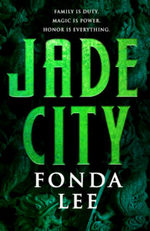
Jade CityJade City

by Fonda Lee
Series: The Green Bone Saga, #1

ARC, 444 pg.
Orbit, 2017

Read: August 15 – 16, 2018

So Fonda Lee has a great idea — others have employed it as well, don’t get me wrong, but the way she does it is great — instead of setting an Urban Fantasy in this world, just a version of it with some magic; you set it in a world a whole lot like this one — but you infuse the world with some sort of magic. A world where technology/science and magic co-exist. It’s enough like this world that you can get your hands around cultural mores and norms.

There’s this stone, a mineral, called jade. It looks a lot like our jade (from what I can tell, Hank Schrader, I’m not). Certain people are sensitive to it, and it enables them to channel magic, some become addicted to the mineral and what it does to them — others (“stone eyes”) are completely insensitive to it and are therefore the ideal candidates to shape it, transport it, and mine it. Only people from Kekon have this relationship with jade (not that unexpectedly, they’re also the world’s source for it).

There are other countries that want jade and what it can do to a person — military uses, primarily. But their people aren’t natively sensitive, so they’re working on ways to engineer the sensitivity. There’s a lot of money to be made controlling the Jade. Years ago — a generation or so — a group of “Green Bone” warriors drove foreign powers from Kekon and assumed control of the Jade trade. Working with the legitimate government, these Green Bones rule Kekon.

They are, for all intents and purposes, a criminal organization — or would’ve been were it not for a divergence of vision — they’re now two rival criminal organizations — with their own rules, laws, rituals, educational systems and cultures. There’s a Cold War between them — a perilous truce, with the citizens of Kekon stuck in the middle (paying tribute, currying favor, and occasionally serving as cannon fodder).

But then something shifts the balance of power — plans that have been brewing for years start to come to fruition and conflict erupts.

We focus on the Kaul family, their soldiers, their leadership, their friends and fortunes. There’s the aged warrior struggling with the weight of glory and past success in the face of the end of their life, there’s the new generation of leadership, trying to live up to the glories of the past and finding it more difficult than they expected. Some have tried to forge new paths in a new world, others are trying to recreate the past.

This is one of those that I can’t think how to describe without ruining everything — so that’s about as much as I’m going to say. The back cover blurb describes this as “The Godfather with Magic.” It’s easy to see why. It’s also incredibly easy to start casting various characters ___ is Michael (clearly), ___ is Tom, and if ____ isn’t Sonny, I’ll eat my hat. I do have real answers for those blanks, but I thought I’d better not give everything away. It is more than just The Godfather with Magic — but you can’t get away from that (unless you’re not that familiar with that particular work — and then you’re not missing a thing).

There’s magic, there’s a mob story, there’s family, love, loyalty . . . you name it, this book has it. Better yet, at the helm of this world you have Fonda Lee who does a great job building this world and populating it with people that the reader can relate to.

This is a rich world full of intrigue, danger, family and magic. It’s a fantastic piece of worldbuilding and you can tell that Lee has great plans in store for these characters, and I can tell that they have no clue what’s coming — and frankly, the readers have less of a clue. I’m looking forward to seeing just what it is.

Note that’s close to a disclaimer, yeah, I said ARC for a book that was published last year. How’d I manage that? Time travel? Well, no. I won the ARC at Indie Bookstore Day (or something like that). So, there be a couple of changes between what I read and the final product, but probably nothing major.

—–

3 Stars

The Mail I Get – While I was Out Edition

More than a few book bloggers, bookstagrammers, and other book types that I follow here and there will occasionally post pictures of the books they get in the mail — I’ve never done that, because usually the stuff I’m given is in e-form, and it’s hard to get a good picture of those (not that I’m a fantastic source of good pictures — I’m working on it).

But, while being gone for 30+ days, I got a few books/book-related items in the mail, so I figured I’d share a picture–

So, that’s a copy of Kill the Farm Boy by Deliah S. Dawson and Kevin Hearne (and some pins the publisher sent because I preordered); The Annotated Big Sleep which I’m really looking forward to diving into; a copy of The Lobster Boy And The Fat Lady’s Daughter by Charles Kriel with a snazzy new cover; ditto for A Mint Condition Corpse by Duncan MacMaster, Pugs Unleashed by Dave Kellet (and some nifty postcards I got for Kickstarting it); and that furry fella — (a better picture is below) is Oberon from the Iron Druid Chronicles (via Worldbuilders) — I wish I could take a better picture of him, because he’s adorable (and a little larger than I assumed), click the link for a photo taken by a capable photographer.

I may leave home more often if that’s what’s waiting for me when I get back.

Looking for some recommendations

I’ll admit it, I’m in trouble with one of my reading challenges for the year. I need to fill a few slots — this is all stuff that I figured would be simple, and that I’d come across in the normal course of things. Well, it’s late August, and I haven’t. So…a little help from my friends? Anyone think of something that would fit these categories?

  • Read a book that takes place in one day.
  • Read a memoir or biography of a musician you like.
  • Read a collection of poetry.
  • Read an audio book with multiple narrators. I have a thought, but I’m open to suggestions.
  • Read a book written by an author from Idaho.
  • Read a book with your favorite food in the title.
  • Read a book with a child narrator. I have a thought, but I’m open to suggestions.
  • Read a book you chose based on the cover.

BOOK BLITZ: Aldo by Betty Jean Craige

 photo Aldo_zps9jszqjlp.jpg

Suspense
Date Published: March 2018
Publisher: Black Opal Books
 photo add-to-goodreads-button_zpsc7b3c634.png
Aldo is a mystery/thriller/love story in which a brilliant and dangerous ideologue attempts to eliminate a university’s genetics institute by holding the university’s president hostage.
On the same day that Isabel Canto, associate director of Pembrook Atlantic University’s Institute for Genome Modification, discovers she is pregnant with IGM post-doc Frank Marks’s baby, Pembrook’s president Mary Ellen Mackin receives a letter from “Aldo” threatening harm if she does not dissolve the institute and fire its director. Aldo claims to represent “ethical people across the world concerned with the detrimental consequences of germline genetic modification in humans” who fear not only “designer babies” but also the unintended consequences of changing human DNA for future generations.
The institute’s director, Linus Winter, conducts research into germline gene modification, which is the controversial modification of a gene in reproductive cells to affect descendants. Linus hopes to use genetic therapy to eliminate Huntington’s Disease, for which he has tested positive, and other horrific hereditary disorders.
Isabel suspects that Frank, who has disclosed his opposition to germline genetic therapy, is willing to sabotage Linus’s project. She finds her loyalties divided between Frank and Linus.
President Mackin refuses to dissolve IGM. The next evening Aldo kidnaps her.
This story is embedded in a letter Isabel writes to her son Lino on his sixteenth birthday.
 photo Aldo print front and back_zpsdwsxt1pw.jpg
About the Author

 photo Aldo Author Betty Jean Craige_zpspvgv6za8.jpg

Since graduating from Pomona College in 1968, Betty Jean Craige has been a teacher, scholar, translator, columnist, and mystery writer. She retired from the University of Georgia in 2011 as University Professor of Comparative Literature and Director of the Willson Center for Humanities and Arts. After retiring she published a Sunday column in the local paper about animal behavior titled “Cosmo Talks” and a book titled Conversations with Cosmo: At Home with an African Gray Parrot. Then she began writing fiction. Her Witherston Murder Mystery series, set in north Georgia, includes Downstream, Fairfield’s Auction (First Place in Chanticleer Book Awards’ category of Mystery and Mayhem), Dam Witherston (Honorable Mention in the 2017 Royal Dragonfly Book Awards for Mystery, and Distinguished Favorite in 2018 Independent Press Awards), and Chieftains in Witherston (scheduled to be published in 2019). A suspense novel, Aldo, came out in 2018.

Contact Links
Purchase Links

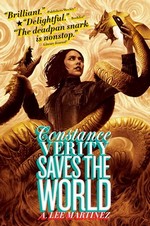
Constance Verity Saves the World by A. Lee Martinez: Connie Verity is trying to have it all — a personal life while saving the world on a regular basis

Constance Verity Saves the WorldConstance Verity Saves the World

by A. Lee Martinez
Series: Constance Verity, #2

Trade Paperback, 385 pg.
Saga Press , 2018<br/
Read: August 18 – 20, 2018

“It’s a problem I have. When you’re ten years old and dangling from a cliff while rabid hyenas circle below, you learn to be stubborn. You can’t quit, because quitting isn’t an option. You dig your fingernails and pray that root doesn’t come loose. And if it does, you plan how best to fend off hyenas when all you have is a Pez dispenser and a priceless diamond in your pocket. I fight. It’s what I do. It’s how I survive. When people turn and run, I go forward. It’s kept me alive so far, but it’s skewed how I look at things.

“Somebody tells me I can’t do something, I want to do it more. Want isn’t a strong enough word. I need to do it. Give me that big red button labeled DO NOT PUSH in bright neon letters, and I’ll push it every time.”

Having fought for the ability to have a normal life in The Last Adventure of Constance Verity Connie’s out to try to have one. Which is harder than saving the world a few times a week. She’s still saving the world regularly, as well as having all sorts of adventures. She’s trying to settle down with her boyfriend Byron the accountant, while relying on her best friend/sidekick Tia some more (all the while, Tia is trying to strengthen her relationship with her ninja-thief boyfriend, Hiro). There are evil geniuses, aliens, robots, and vampires living in her condo — all of them behaving themselves, thank you very much.

One of the activities that takes most of Connie’s time right now is trying to help out an old friend cleanup the supercriminal organization that he’s in charge of now that his mother has apparently died. There’s a lot of rogue agents, assassins and experiments that need cleaning up if the organization is going to be come a legitimate force for good — or at least not a force for evil and chaos in the world. Connie’s tempted to spend more time doing that than she should, to the detriment of her relationship with Byron. Thankfully, Tia’s there to help keep her priorities in order. Hopefully, that’ll be enough.

You ever find yourself eating something — say, some cake — and you’re not sure if it’s too rich, if the frosting is too sweet? And then you realize how stupid you sound? Wondering if the cake is too good? Well, that’s the experience I had with this (and, I’m pretty sure with the previous Constance Verity book) — where there too many quips? Too many (seemingly) random ideas, aliens, evil masterminds, robots, henchmen of a variety of stripes, strange occurrences? What a stupid thing to ask. Yeah, there’s a lot going on, but it actually doesn’t get to the overload status. It may come close, but it stays on the right side. It’s like asking if there are too many animated personages in Who Framed Roger Rabbit?, if there are too many Easter Eggs in whatever your Super-Hero movie of choice is. No, there’s not — there’s a lot of good things that are fun. Shut up and enjoy.

Really, that’s the worst thing I can say about the book — occasionally, there are too many fun things happening. The pacing is great, the characters are rich, lively, and well-developed (including many of those only around for a page or so), you’ll laugh, you’ll be moved, you might even have a thought provoked. It’s just a charming book set in a delightful world.

Do not make the mistake of thinking this is a romp, just a free-wheeling ball of fun, snark and self-referential humor. It’s an A. Lee Martinez book, so yeah, there’s a lot of that — but laying underneath that is a good story, some interesting ideas about relationships, about trust, about fate. A whole lot of other things, too, I’m sure, but let’s stick with those. Too many people will read this, focus on the “fun” stuff and will miss the very thoughtful portions — it’s Martinez’ strength and weakness that it’s so easy to do with his works. There’s nothing wrong with a silly adventure story, and there’s nothing wrong with a book that’s about something. But when you have a novel that’s both — you should pay attention to both.

I knew Martinez could write a series if he wanted to — I had no idea what it was going to look like when he did. I’m glad I got the chance to find out. Constance Verity Saves the World is equal to its predecessor in every way that it doesn’t outdo The Last Adventure of Constance Verity — which is no mean feat. It’s fun, the characters are better defined and have grown some, and there’s never a dull moment. Constance Verity, the caretaker of the universe, the Legendary Snurkab, possibly the only woman with more titles than Daenerys Targaryen, is a character you need to get to know. Her sidekick Tia is, too. I cannot wait to see what the two of them do next.

—–

4 Stars

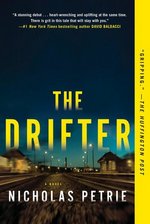
The Drifter by Nicholas Petrie: A Near-Perfect Thriller Debut that You Won’t Want to Miss

The DrifterThe Drifter

by Nicholas Petrie
Series: Peter Ash, #1

Trade Paperback, 371 pg.
G. P. Putnam’s Sons, 2015

Read: August 16 – 17, 2018

Peter pushed the truck hard toward downtown, the city roads rough with potholes, trying to get to Lake Capital begot they closed the doors for the day.

One eye on the rearview, watching for the black Ford. But it would be easy to miss in heavy traffic. And Peter’s truck would be easy to follow. Unless he was willing to rent a beige sedan, he couldn’t do anything about it.

He didn’t have a plan for Lake Capital. But the principle wasn’t complicated. It was the same principle he’d operated under for years.

Poke a stick into something and see what happened.

This approach to problem solving isn’t new — Philip Marlowe employed it, Spenser loves it, Harry Dresden has invoked it — and I’m pretty sure a certain homeless former MP has mentioned it a time or two. It may be tried and true — but that’s only because it works really well (at least in fiction). Peter Ash is one of the leading candidates for “the next Jack Reacher,” so he might as well employ it, too. It’s a very effective stick in this instance, I should add.

Now Reacher, as you probably know, was a career Army MP, the son of a career Marine officer — he’d spent his entire life living on military bases until his discharge following the Army’s downsizing after the fall of the Berlin Wall. In reaction to that kind of living, he’s taken to walking all over the US, getting to know the country. Peter Ash is a recently discharged Marine Lieutenant, with a couple of degrees in economics, who is wandering around the country a little bit. His reason for it differs from Reacher’s, since coming back to the States after tours in Iraq and Afghanistan, Peter has panic attacks anytime he’s indoors — he calls it “white static.”

This has led to him essentially living in the woods for the past few months, until he heard that his former sergeant and friend, Jimmy Johnson, has killed himself. Peter quickly came to Milwaukee to visit Jimmy’s wife, Dinah. He wasn’t around to help his friend, but maybe he can assuage his guilt by helping out with some much needed home repairs on his behalf.

He starts with the front porch — and while he’s working on it, discovers a hidden suitcase filled with money, and four bricks of plastic explosive. This seems strange, Peter hides the bricks, and gives the money to Dinah. Around the same time, a mysterious figure comes by looking for something (probably the suitcase, but he never mentions is). The two of these together gets Peter’s curiosity piqued — and he sets out to find out what his friend was up to before he died. He barely beings this before someone tries to kill him.

Peter survives, and becomes even more certain that something is going on — Jimmy was on to something just before he died. Peter has to find out what — to honor Jimmy’s memory, protect Dinah and her two sons, and maybe get a little peace for himself — maybe find some forgiveness for failing to help Jimmy.

This isn’t just guy wanders into town, finds trouble and starts hitting/shooting things and people until the problem is solved. Peter has to think, he has to investigate, he takes wrong paths, he really needs to find a shower and a way to clean a very large dog — which isn’t saying anything about the investigation, it’s just another thing he has to do along the way (still, harder problems than you might expect when you throw in his white static). There’s plenty of hitting and shooting, but it’s not the focus.

Yes, Peter is very much in the Reacher mold — but he’s different in very significant ways. The ways in which he’s not Reacher make him a fascinating character on his own. He has a sense of humor, he’s lonely, he’s a bit more self-reflective — he knows that he didn’t come back from the wars whole and intact, and is seeking to fix that. Maybe. He’s got a different kind of education, and a different way of looking at the world. The ways he’s similar to Reacher (good with weapons, devastating to hand-to-hand combat opponents, fast thinking, strategic, etc.) simply ensure that he’s fun to read about. Both of these sides together give us a Thriller protagonist that’s a sheer pleasure to read.

So Peter has “White Static”, Jimmy clearly had problems adjusting to being back home, but they’re not treated as the only ones — there are many others seen and talked about in this book. It’s not done exploitatively, it’s done to highlight the problems and the many, various ways they can be addressed successfully. Nor are they talked about in a way that suggests everyone who comes back from combat service comes back damaged. Nothing is universalized or generalized. I’m certainly not speaking from any kind of first, or even second-hand, experience here — but it appears to me that Petrie dealt with these psyches in just the right way — compassionate, understanding, and accepting.

As there is an element of mystery to the story, I’m not going to talk about the villains much. But they are just as good as the rest of the book — wide-ranging motivations, differing levels of commitment to the enterprise, they’re not all cookie-cutter types. They are not cartoonish, they are not super-villains. They are straight-from-the-headlines evil though. I could absolutely see something like this happening and it working.

I could have spent more time with just about every other supporting character — not in a “hey, you could’ve developed them better” way, but in a “I liked them and enjoyed Peter’s interactions with them” kind of way. Sure, that would’ve involved more character development, but not because they were lacking anything, it just would have worked out that way. Dinah’s an ER nurse with a lot of grit, and isn’t sure what to think of her late husband — but is dedicated to being the best mom she can to their kids. Charlie, their oldest, has learned a lot from his dad and is trying his pre-teen best to live like he should and be “the man of the house.” There’s a woman from the Veteran’s group that tried to help Jimmy who is a wonderful character, too. I could say more about her and the other supporting characters, but you should meet them yourself.

The last advantage that this one has over any of the Jack Reacher novels — and frankly, most Thrillers, is Mingus. He’s a very large dog that Ash finds living under the porch at his friend’s house (that porch led to the discovery of a lot) — he’s a bigger, nastier version of Walt Longmire’s Dog. Just as friendly, too — toward people not being threatening, anyway.

Okay, I obviously found this fantastic. The tension was high throughout; the pacing was fantastic; the actions scenes were fast, furious and believable; the story was clever and yet sensitive to current events, and the people represented by the characters; the stakes were real and believable; Peter’s code and the code(s) of those around him are wonderful to think about, examine and possibly try to adopt. They don’t get much closer to perfect than this — I’m definitely picking up the next two in the series as soon as I can, and I can’t wait to talk about them without nearly so many references to Jack Whatshisname.

—–

4 1/2 Stars

Page 443 of 633

Powered by WordPress & Theme by Anders Norén