 |
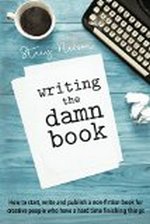
Writing The Damn Book: How to Start, Write And Publish A Non-Fiction Book For Creative People Who Have A Hard Time Finishing Things
by Stacy Nelson
Kindle Edition, 83 pg.
BadAss Publishing Co., 2016

Practical Magic for Alchemists Who Like to Play in the Esoteric Sandbox
by Erika Nall
(I had the privilege of reading this book before it was released to the masses.)
The “Who Is Your Reader?” section is the MOST IMPORTANT section. It stopped me dead in my tracks!
I’ve bought countless courses and trainings but something always felt off. I couldn’t quite put my finger on it. All of them had me “start with the end in mind.” I was painting these beautiful pictures of my days, my 3 months from now, my 1 year from now, and beyond. It was so yummy. It tapped into my superpower of visioneering. It satisfied my romanticism. It validated my idealism. Then I reversed engineered to create that in the present.
However, when it came to my readers and clients the “guru” always had me start at the beginning of their journey. “What are her pain points?”
EVERY. SINGLE. TIME. I start there my stomach clenches and my heart shrinks. Inside I feel small and powerless. I get confused and lack clarity. OUCH! It’s painful.
I can hear it now:
Guru: “Lean into your discomfort. Just push through it. This is good for you. This is an opportunity to grow.”
Me: “Um, I don’t think you understand this is not uncomfortable like my shoes are a little too tight or I have a bit of indigestion from the pepperoni pizza I just ate. This is killing me inside.”
Guru: “Well, that’s just a thought. Notice the thought. Let it go back from where it came. Back into nothingness.”
Me: “I don’t think you heard me. THIS IS LITERALLY KILLING ME INSIDE! I avoid death as much as possible thank-you-very-much.”
(And as an alchemist, I know I can excel in the dark art of manipulation to get what I want. I always felt like I went there when I started with pain. “I can help you. Or, better yet “I can save you.”)
Why do I die inside when I start with pain?
My reader is me. I am her. When I talk about her beginning, I am talking about my beginning. When I talk about her insecurities, I am talking about my insecurities. And believe me, they like to show up and be a part of the show anytime they can.
Now, I understand why the beginning is a terrible place to start. Brains are pretty clueless. Whatever it’s thinking, it perceives as reality. That’s its job. And, mine does it very well.
Now I understand that those sensations. That experience is also what happens when I am insecure.
When I wanted to share my message through writing, my self-assurance, my self-confidence, my self-trust was nowhere to be found. Frozen, I just stared at that incessant blinking damn cursor for hours as the insecurities played and had their fun in my head. Frustrated and feeling rather poorly about myself, I would give up. I’d walk out of my office thinking, “What’s wrong with me? How can I usually write so freely and unabashedly with great perseverance one minute, but not the next.”
I wrote the answer, “who is your reader going to BE at the end of the book?” (Honestly, I wasn’t sure if this was going to work.)
And, I felt it. For the first time I felt that what I wrote was coming from a deep place inside of me and not my head. I expected the sensation to be like a blast of, or at least a pulsating, bright light. (Well, that what I thought was suppose to happen when you are passionate and empowered.) Instead, my stomach was relax and I felt a gentle pressure across my chest. It was a constant glow and warmth like after the fire burnt up the firestarters -the tender and the kindling- and it’s just being a fire, doing what fires do. Sure there was an occasional popping of pitch, but I didn’t stop. My fingers just pounded a bit harder on the keyboard.
My breath deep and long. Every once in awhile tears would run down my face. My mind quiet. There was no judging. I just typed. I didn’t set a timer like I usually do to keep me on track. When I felt like I got up into my head, I paused, looked out the window and watched the birds for a little bit, took a few deep breaths, and went back to writing. When all that I had inside was out in black and white -unedited and raw- I looked at the clock and only 50 minutes had passed – talk about flow, baby.
I took a deep breath, exhaling slowly, coming back to my surroundings. Then my intuition said, “Is this making her BE EMPOWERED?” And, I cried.
Several times since then, I’ve tapped back into empowered and I’ve cried every time. Not because I am sad, or happy, or relieved because now I can feel the glorious ginormity of it. How badly, how passionately I want that for my readers AND for me.
You see, I was asking the wrong question. I was starting in the wrong place.
Now when I begin with the energetics of empowerment, I write within the place of security. My assurance, confidence, and trust will be front and center. And, when the writing gets hard and there is a call to perseverance, THIS is what will pull me through the challenges of spreading my message in whatever form I choose.
—–

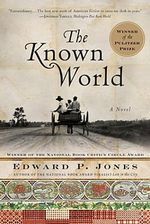
by Edward P. Jones
This week takes us to Virginia with The Known World by Edward P. Jones. Entertainment Weekly says – This award-winning examination of man’s ownership of man refuses to succumb to the calcifying effect of history, presenting Virginia’s past as raw, urgent and human.
Synopsis from Goodreads – One of the most acclaimed novels in recent memory, The Known World is a daring and ambitious work by Pulitzer Prize winner Edward P. Jones.
The Known World tells the story of Henry Townsend, a black farmer and former slave who falls under the tutelage of William Robbins, the most powerful man in Manchester County, Virginia. Making certain he never circumvents the law, Townsend runs his affairs with unusual discipline. But when death takes him unexpectedly, his widow, Caldonia, can’t uphold the estate’s order, and chaos ensues. Jones has woven a footnote of history into an epic that takes an unflinching look at slavery in all its moral complexities.
Review

The Known World by Edward P. Jones is a read that made me question. It made me question if editors actually read the whole book. It made me question if the Pulitzer judges read the whole book. It made me question if I had picked up the wrong book, because this could not be the book with all of those rave reviews. This novel won a National Book Critics Circle Award and the Pulitzer Prize for Fiction in 2004. In 2005 it won the International IMPAC Dublin Literary Award and it was a finalist for the 2003 National Book Award. In 2009, the website The Millions polled 48 critics, writers, and editors; the panel voted The Known World the second best novel since 2000. The book I read was a disjointed mess. No seriously, I can read difficult books. I like non-linear time lines and twisty prose but this took it to a whole new level. The synopsis tells us that this is the tale of Manchester County in Virginia during the antebellum era and a black former slave who is now a slave owner himself. This sounds like a deep and thought provoking read right? It would have been if it was actually readable.
There were approximately 80 characters, so I had no idea who anyone was.
The white man at the front door was from the Atlas Life, Casualty and Assurance Company, based in Hartford, Connecticut. His talking to Calvin at the door was what kept Bennett so long. Calvin eventually came back with Bennett and when Moses told him, Calvin went back and returned with Caldonia, followed by Maude, and Fern Elston.
The time line skipped back and forth often times decades in the future to tell what happened to just one person or object and then skipped back.
This series was Anderson’s most successful, and nothing was more successful within that series than the 1883 pamphlet on free Negroes who had owned other Negroes before the War between the States. The pamphlet on slaveowning Negroes went through ten printings. Only seven of those particular pamphlets survived until the late twentieth century. Five of them were in the Library of Congress in 1994 when the remaining two pamphlets were sold as part of a collection of black memorabilia owned by a black man in Cleveland, Ohio. That collection, upon the man’s death in 1994, sold for $1.7 million to an automobile manufacturer in Germany.
There was so much unnecessary description.
Clarence sat beside his wife and after a time he put a hand, the one not stained with milk, to the back of his wife’s head and rubbed her hair. The cow swung its tail and chewed its cud. It farted.
His horse, Sir Guilderham, was idling two or so paces behind his master. And just as the horse began to wander away, Robbins turned and picked up the reins, mounted. ‘No more visits for a month,’ he said, picking one piece of lint from the horse’s ear.
Seriously, I do not care about lint on a horse and a cow farting. This really detracted from the story for me. The Known World by Edward P. Jones could have and should have been a powerful read. Instead I got bogged down in the minutia and was not able to process the tale.
I had originally picked this up at the library and then, when I found the style to be so odd, I got the Audible version. I really want my credit and the 14 hours I spent listing to this back.
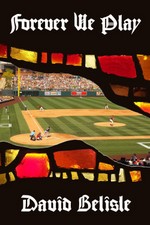
by David Belisle
Kindle Edition, 95 pg.
David Belisle, 2016
Read: August 6, 2016
It’s been a few years since I’ve been able to watch a game, but at one point I was a semi-serious baseball fan. So when given the opportunity to read a novella where baseball is a religion, I had to try it. Especially when I’m told it’s a satire.
Now, I’ve known a few people for whom sports are a religion (see Fever Pitch — book or movie), but nothing like this. In a nutshell, Heaven is overcrowded and so entry has to be limited. Upon death, people have to pick a team and they will remain in Purgatory until that team wins the World Series. It’s more complicated and convoluted than that, but there’s the essence.
Naturally, there are a lot of Cubs fans in Purgatory.
Also, there’s a thin-ly disguised Devil running around (actually, I didn’t realize it was a disguise for a while — that’s how thin it was). He’s plotting and planning and stirring up trouble.
There’s a lot of goofiness, jokes that land, jokes that just don’t, a convoluted plot involving the last Cubs’ series win, a strange mix of various religions, and an attempt at a love story or two. I don’t think anything was as developed as it should’ve been to really tell a winning story — the characters were sketchy, the plot details too vague, and many of the jokes didn’t have enough meat to them to really get the point across. Everything came close to working, but not much did.
In the end, I enjoyed this. But man, it was a mess. A mess with a heart and wit, don’t get me wrong.
Disclaimer: I received a copy of this from the author in exchange for this post.
—–

Odds ‘n ends over the week about books and reading that caught my eye. You’ve probably seen some/most/all of them, but just in case:
This Week’s New Releases I’m Excited About and/or You’ll Probably See Here Soon. Okay, that’s a lie — I don’t have time for all these this month (ignoring the stack of things on my shelf and Kindle I do need to get to) — you probably won’t see these soon, you’ve either seen them here, or maybe later this year. But I’d like to read them all now.:
- Harry Potter and the Cursed Child: The Official Script Book of the Original West End Production Special Rehearsal Edition by J.K. Rowling, Jack Thorne, John Tiffany — Good thing that I mentioned this, right? None of you has heard of it. Picked up my copy today, I may get to it this coming week (assuming I have the time and my daughter lets me near it)
- Blood of the Earth by Faith Hunter — I blabbed about this before, if this isn’t the best thing that Hunter’s done, it’s in the running. I just hope book 2 is almost as strong.
- Repo Madness by W. Bruce Cameron — I did not expect The Midnight Plan of the Repo Man to get a sequel, it didn’t need one. But I’ll gladly read it.
- Enter Title Here by Rahul Kanakia — No, that’s not my placeholder text, that’s the actual title. It’s supposedly Gossip Girl meets House of Cards, but looks better than that.
- Spiderlight by Adrian Tchaikovsky — a subversive traditional fantasy. If it’s 60% as good as Jeff Somers says that it is, I’ve gotta give it a shot.
- Amaryllis and Other Stories by Carrie Vaughn — I like non-Kitty Norville Vaughn stuff, just not as much. Still, this collection of her shorter works from across genres seems pretty appealing.
- The Hike by Drew Magary — Wired says: “It’s kind of a more cynical version of The Phantom Tollbooth mixed with a game of Dungeons & Dragons.” ‘Nuff said.
- The Bad Decisions Playlist by Michael Rubens — a little more YA material. I liked Rubens’ SF work from a couple of years ago, will give this a glance when I can.
- The Coaster by Erich Wurster — Again, I’ve already talked about this, so read that if you’d like. This first novel is promising enough to make you want more from Wurster.
Lastly, I’d like to say hi and welcome to alittlebirdtweets, kmelerine , and Peter Ranger for following the blog this week.
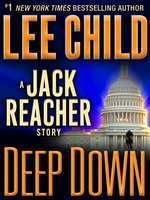 |
Deep Down
by Lee Child, Dick Hill (Narrator)
Series: Jack Reacher, #16.5Unabridged Audiobook, 1 hr, 43 min.
Random House Audio, 2013
Read: August 4, 2016 |
Ahh, this is more like it — I was afraid that I was going to have to give up on these shorts to preserve my appreciation for the novels. But Lee Child and Dick Hill pulled it off.
Its the mid-80s, Reacher’s a Captain in the Army and is called to Washington to go undercover as an Army sniper. Someone is leaking information from a Congressional investigation into whether the Army and Marines need a new, super-cutting-edge sniper rifle. The Army’s got it narrowed down to 4 suspects, they want him to narrow it down. Reacher is repeatedly assured that this will just be talking and that there is “no danger.” So, yeah, things are going to get dicey.
The suspects are four women on the fast track to the top of the Army — if not Commander-in-Chief (Child apparently likes the idea of women on the Fast-Track in the Army) — we get to spend a little time getting to know them with Reacher. His handler wants Reacher to try to use his masculine wiles with one or all of them. Reacher has a pretty good idea who is target is, and then plunges in, pretty sure he’ll have to come up with something better than attempting to seduce superior officers.
Interspersed with the early portions of this story are snippets of two different individuals heading toward the center of D.C. — it’s not immediately clear what’s going on with either of them, but you get plenty of opportunities to guess. They do a decent job of increasing the tension, though.
Reacher does get enough clues (naturally) to identify the leak — not only that, he’s able to uncover a whole lot more. Best yet, the book includes a fantastic Reacher fight scene (don’t get me wrong, I love it when he uses his brain, but the last two short stories I listened to didn’t have a lot of action.).
Some of Hill’s female voices leave a little to be desired. But I have no other complaints — good stuff (he has sort of a Stan Lee quality to his voice from time to time — if Child ever made him say “true believers,” I’d flip).
Good, strong story. Capable narration — a great way to spend 100 minutes.
—–
It almost seems as though any book that gets famous enough is going to earn some complaints and criticism. These usually come from parents looking to protect their children from topics and material they deem unfit for consumption. When a complaint is formally submitted with the intent to remove reading material from a library or required reading list, it is known as a challenge. A successful challenge results in a ban.
Although it may seem like a positive thing from the outside, challenges are usually met with much resistance from educators and faculty member. The team at Readers.com researched and illustrated a timeline of some of the most feared and banned books in history and tracked why people wanted to get these works banned in the first place. Check out the graphic to see the entire list! How many of your favorite books actually made it on that list?

(thanks to Bryan from Readers.com for asking me to post this and for writing the intro)
I just posted my thoughts on Cathy Kennedy’s Meeting of the Mustangs, and now I’m glad to present her first interview-ish thing. Hope you enjoy — I probably chuckled more at these answers than I have any of the other Q&A’s I’ve done.
| What initially prompted this story (if you can recall, that is)? Why did you come back to it years later? |
|
My dad gave me an Olivetti electric typewriter and a ream of nice, thick paper. I rolled a piece of paper into the typewriter and just started typing. After moving away from that house in the country where we owned horses, the story was abandoned. That was about a hundred years ago and I still have that old manuscript.
Coming back to it was very difficult. I was dealing with a nasty case of writer’s block. Even though for years I knew in my head (mostly) how the story would end, I just couldn’t get it into words. I eventually moved back to the country and now have horses for neighbors. That helped tremendously, and once I got going again, I was okay.
I suppose I should also give some credit to my sister, who never left it alone ~
“Are you working on your book?”
“Are you working on your book?”
“Are you working on your book?”
etc., etc., etc… |
|
| What kinds, if any, of specific research did you do? |
|
There wasn’t much research involved, really. The one thing that sticks out to me was looking at a map of the United States. I wanted to have the horses traveling through more than one state and tried keep the original manuscript as intact as possible. I had to look at the map to find where several states were in close proximity so the horses wouldn’t get too tired.
|
|
| What’s the one (or two) book/movie/show in the last 5 years that made you say, “I wish I’d written that.”? |
|
Oh, no. I’m kind of an old soul. I don’t watch or read much of anything new.
Do commercials count? I like the Neosporin commercial where the little girl is telling her friends about how she jumped the rapids on her bike. That’s really cute writing. |
|
| What was the biggest surprise about the writing itself? Either, “I can’t believe X is so easy!” or “If I had known Y was going to be so hard, I’d have skipped this and watched more TV”. |
|
Okay, that one’s easy. If I had known marketing was going to be so hard, I’d have skipped this and watched more TV. Ugh. Let’s just say I have a new respect for successful salespeople that I’ve never had before this. Getting an unknown author’s story into the hands of readers is an ongoing struggle. /td>
|
|
| What’s next for Cathy Kennedy, Author? |
|
Well, I’ve had more than one person tell me they’d like to see a sequel. Please don’t tell my sister. |
|
|
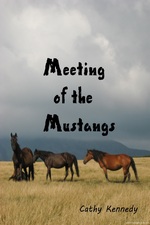
by Cathy Kennedy
Kindle Edition, 80 pg.
Cathy Kennedy, 2015
Read: August 1, 2016
It’s been forever since I’ve read an animal book, particularly one focused on a horse. I remember reading The Black Stallion and Black Beauty, some Jack London stuff, and whatnot as a kid, but nothing really since. As I recall, most horse stories are about a horse moving from owner to owner, some good, some bad. Most wild animal stories are just a series of mini-crises where the animal bounces along from event to event and occasionally (by coincidence) runs into an animal he knows. Meeting of the Mustangs is a hybrid, doing both.
We meet our central character when he’s a few months old and follow him for a couple of years — he’s on his own a lot, and then falls into the hands of some humans — bounces around a little and eventually comes into his own. Pretty straight-forward animal story, but told with a lot of heart.
Amazon’s description puts this at 10-12 year old level — I think it’s probably 7-9, but what do I know about stuff like that? Most of what I was reading when I was 12 wasn’t on anyone’s age-appropriate list. The writing was crisp and clear, things moved along a a good clip and never dragged on. Kennedy is better at writing animals than people, but it wouldn’t take much to fix that (and since the book like something like 80%+ animals, who cares?).
I am absolutely, positively not the audience for this book — but it wasn’t bad, and I enjoyed it. If I was a younger kid who was into animal stories? I’d have really had a great time with it. It’s charming, solid and I have no problem seeing it as someone’s favorite.
Disclaimer: I received a copy of this from the author in exchange for this post.
—–
</a
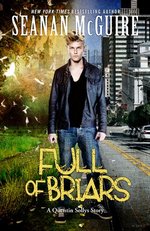
by Seanan McGuire
Series: Toby Daye, #9.3 (but it takes place before The Winter Long)Kindle Edition, 44 pg.
DAW, 2016
Read: August 8, 2016
I’m pretty torn about this one, to tell you the truth. Toby’s squire, Quentin, is our narrator this time out — and it’s worth reading just to see Toby, May, and Tybalt from his perspective. His parents have come to make everything official with the new Queen of the Mists — and while they’re around, they might as well check in on him and maybe bring him home.
There’s no action, no violence, Toby doesn’t come close to dying — it was so weird. There was a lot of talking — which was fun. Toby was Toby, being irreverent and nigh-disrespectful to Quentin’s parents, as she argued for them to leave him where he is. Tybalt was more Tybalt-y than usual, making sure that Quentin’s folks knew how little he cared about their status. Quentin’s growth as a character, as a person — his maturation, thanks to age and his service to Toby — is what’s on display here.
It was fun to read, and I wouldn’t discourage anyone from it — but I’m not sure it added a lot to my understanding of Toby or anyone else (including the central character). This is the first non-full length story I’ve read in this universe, and it doesn’t really make me think about trying another one. Still, it was entertaining enough — and had one killer line (and a few that were really good) — so I might.
—–
|


 Lady Cop Makes Trouble