Author: HCNewton Page 535 of 625

United States of Books – The Accidental Tourist (Audiobook) by Anne Tyler, George Guidall

The Accidental TouristThe Accidental Tourist

by Anne Tyler, George Guidall (Narrator)

Author: Serena Agusto-Cox at Savvy Verse & Wit

The Accidental Tourist by Anne Tyler, narrated by George Guidall, was a finalist for the Pulitzer Prize and won the National Book Critics Circle Award for Fiction in 1985 before being made into a movie with William Hurt, Kathleen Turner, and Geena Davis. Maryland resident, Macon Leary, is a very particular man, he likes things to be orderly and things to be pronounced just so. Even though he is a travel writer, he hates traveling and much of his column and his books are how-to guides on how to bring home with you when you vacation. His marriage to Sarah falls apart following the tragic death of their son, and she moves out. Following a freak accident at home with his dog, Edward, Macon moves in with his brothers and sister — all odd ducks in similar, yet different ways. How anyone could handle of the weirdness is something the wives have talked about before and some have even given up their marriages to escape.

Macon is tough to take throughout the novel until his world is thrown into a spin when he meets dog trainer and jack-of-all-trades Muriel. In addition to Macon, Tyler has a cast of vivid characters, including Macon’s boss Julian. However, the pacing here is slow and Macon is slow to evolve, which is frustrating. His routines in life are so far ingrained into his character that it is very difficult for him to adjust to even the smallest changes. When he’s thrown into a different way of living, he’s still clinging to the old life he had and even as he opens up and moves forward with his life, he is completely unaware. Tragically, he takes no action of his own accord and things just happen to him and he adjusts as best he can.

In terms of place, as this is the book picked to represent Maryland, there is very little of my current home state in its pages. While Macon is referred to as a resident of Baltimore on a few occasions, there is very little of the city I’ve come to know in these pages. The descriptions given could be of many towns across the United States, and where he and his family live doesn’t even seem like Baltimore, a city with its downtrodden, littered streets and high crime as well as its cultural connection to Edgar Alan Poe and Frederick Douglass, one of the most gifted activists during the Civil War era.

Douglass learned how to read in Baltimore, and while Macon and his family are quirky and troubled, they do not speak to the civil rights struggles in a state between the sides, nor do they speak to the other leaders of social movements, including Gertrude Stein. There is a great sense in Maryland’s literary heritage that lives change here, their perspective evolve and they move on to greater things. There is not sense of that here, just as there is no sense of suburban life in Maryland, which is as varied as the cultures and incomes found within its borders.

The Accidental Tourist by Anne Tyler, narrated by George Guidall, is a slow moving novel, much like its main character, Macon, as it is slow to evolve and move beyond the humdrum routines of a rigid travel writer who hates to travel. The narrator does well in his portrayal of Macon, and his voice and timber set the tone that Tyler has given in her prose. While there are some amusing moments with the quirkier characters, Macon is hard to like and his slow evolution is tough to take.

Rating: Couplet

Saturday Miscellany – 3/12/16

I didn’t think this new job would have quite as big of an impact on the blog as it has. Next week should be better.

Still, I was able to track down a few odds ‘n ends over the week about books and reading that caught my eye. You’ve probably seen some/most/all of them, but just in case:

    This Week’s New Releases I’m Excited About and/or You’ll Probably See Here Soon:

  • Fire Touched by Patricia Briggs — no clue what it’s about, honestly. Who cares? New Mercy Thompson, ’nuff said.
  • Stop the Presses! by Robert Goldsborough — The only reason I haven’t read the last one yet is because the library didn’t get a copy, hopefully they get this one, so I can read it and hate myself.
  • The Stone Bearer by Jacque Stevens — a great looking fantasy — on sale for the next few days!

Lastly, I’d like to say hi and welcome to the Defined Introvert (overdue, actually) and mpatraiko for following the blog this week.

Changes (no, not THAT Dresden Files book)

(there’s far less bloodshed here)

So, I started a new job today — which is exciting, and stressful, and good news and many other things. For the first time in almost a decade, I won’t be working the Graveyard Shift anymore — I get to sleep when it’s dark and be awake during the day like a Real Person™ (further proof that my life is not, alas, Urban Fantasy).

What does this mean for the blog? Hopefully, not much — after a period of adjustment. But last week’s minimal posting was due to me running around trying to get ready for this change, and I anticipate the same this week. Next week? I don’t know . . . time will tell.

Please bear with me, I’ve got a lot of balls in the air when it comes to this thing — a lot of plans and hopes, I’m not walking away, just making some adjustments.

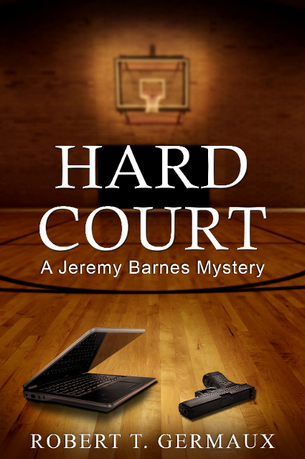
Cover Reveal: Hard Court by Robert Germaux

Author Robert Germaux is releasing his third novel, Hard Court, on April 11, 2016, and we have the Cover Reveal here!

About Hard Court:

Miles Bradshaw, the dot-com billionaire owner of Pittsburgh’s first NBA franchise, hires private detective Jeremy Barnes to look into what appears to be a simple case of harassment of one of the team’s players. But when Jeremy (JB to his friends) begins his investigation, the case proves to be anything but simple, eventually involving a local businessman with suspected criminal ties, a major FBI task force, a computer geek in California and a mob boss in Erie.

Along the way, JB, who can quote Shakespeare as quickly and easily as he can land a solid left jab, uses his wits and his ever-present sense of humor to wend his way through a cast of characters who range from the ridiculously inept to the ruthlessly lethal.

As Hard Court unfolds, there are numerous surprises and plot twists, culminating in a dramatic confrontation that neither JB nor the reader could have predicted.

About Robert Germaux

Both my parents were readers. I’m talking stacks-of-books-on-their-nightstands readers. So it’s no surprise that at an early age, I, too, became an avid reader. Everything from sports books (especially baseball) to Nancy Drew to the Hardy Boys to almost anything about distant and exotic places.

Although I’ve always enjoyed putting words on paper, the writer in me didn’t fully emerge until I retired after three decades of teaching high school English. I quickly wrote two books aimed at middle school readers, at which point my wife urged me to try a novel for adults. As is usually the case, Cynthia’s idea was a good one.

Over the next few years, I wrote several books about Pittsburgh private eye Jeremy Barnes. I took a brief hiatus from the detective genre to write Small Talk and The Backup Husband. Now I’m back and will be releasing my first Jeremy Barnes novel, Hard Court, on April 11.

In our spare time, Cynthia and I enjoy reading (of course), going to live theater productions, watching reruns of favorite TV shows such as “Sports Night” and “Gilmore Girls,” and traveling to some of those distant and exotic places I used to read about as a child. So far, we’ve been fortunate enough to walk in the sands of Waikiki, swim in the warm waters of the South Pacific and share a romantic dinner in Paris.

I love interacting with my readers and getting their input on my characters and stories. Please feel free to contact me via my website.


*Cover Reveal media prepared by Susan Barton, My Book Tour

United States of Books – True Grit by Charles Portis

True GritTrue Grit

by Charles Portis

Author: Wattle at Whimsical Nature

3 Stars
Synopsis: There is no knowing what lies in a man’s heart. On a trip to buy ponies, Frank Ross is killed by one of his own workers. Tom Chaney shoots him down in the street for a horse, $150 cash, and two Californian gold pieces. Ross’s unusually mature and single-minded fourteen-year-old daughter Mattie travels to claim his body, and finds that the authorities are doing nothing to find Chaney. Then she hears of Rooster – a man, she’s told, who has grit – and convinces him to join her in a quest into dark, dangerous Indian territory to hunt Chaney down and avenge her father’s murder.

Review: I must admit, I saw this on my list of books to read and sighed. I hate westerns, and had the misfortune (in my opinion) of seeing half of the most recent movie based on True Grit. So it was with dread that I opted to read it first, deciding to read in order of least want to read to most interesting.

How wrong was I?! The writing sucked me in from the start, it wasn’t stuffy and formal as I assumed it would be. However, at times the dialogue felt a bit stilted; and the deeper into the story I got, the more I realised that it had no real complexity. It is simply about wanting revenge to (in Mattie’s eyes) right a wrong.

Mattie is feisty and strong willed. She felt older than her 14 years, no doubt because of the setting she was in; the late 1800s, her father has been killed and she’s the oldest child, so needs to take care of his affairs. Which in her mind, means finding her father’s killer and watching him die. To do this she needs help, and sets out to recruit the best and worst Marshal she can find – which leads her to the drunken and often too quick to shoot Rooster Cogburn.

I liked Rooster (what you see is what you get, and he’s a bit of a brute – though showed great patience with Mattie) and did not like LaBoeuf (an arrogant Texas Ranger who happens to be after the same man).

It was a fine story, but the ending to their adventure felt contrived – and I can’t say I was a fan of the ending proper either. I felt a little cheated that all we really got of Mattie was her experience as a 14 year old, and then many years in the future, and nothing in between. I suppose there was some character growth for her throughout the story, given she had just lost her father and wanted justice; but it was somewhat lost in the details of the story.

Not being from Arkansas (or even America) I have absolutely no idea what the place is like, but I got the feeling that back in the 1800s it was a bit dusty and a bit rundown, with lands that criminals could easily disappear into? There was apparently quite a few of them in the same place (which I suppose is fortunate for the Marshals tracking people).

All in all, this was a quick and easy read but didn’t have the complexity I was expecting and fell a little short for me, but it was still a good read and got me out of my comfort zone!

Saturday Miscellany – 3/5/16

Odds ‘n ends over the week about books and reading that caught my eye. You’ve probably seen some/most/all of them, but just in case:

    This Week’s New Releases I’m Excited About and/or You’ll Probably See Here Soon:

  • The Passenger by Lisa Lutz — I’m hearing good things about this, and the description sold me even without hearing anything. I just messed up and got my dates wrong, so I didn’t have this ordered. Hoping to get my hands on this soon.
  • Chaos Choreography by Seanan McGuire
  • Borderline by Mishell Baker — A little bit of Genrenauts, a little bit of Fringe, a little…I don’t know what. Just go read the description I linked. If nothing else, the Seanan McGuire blurb at the bottom of this page should be enough to convince you if you’re on the fence.
  • East Of The City by Grant Sutherland — I’ve been wanting to get to the previous novel for a couple of months, if Fahrenheit Press would just slow down a minute so I can catch up, that’d really help.
  • Who Wants To Be The Prince Of Darkness? by Michael Boatman — a reality show to find Lucifer’s replacement? Should be good for a laugh or three.
  • The Courier by Gerald Brandt — a little SF, a little thriller . . . looks like a lot of fun.
  • Arkwright by Allen Steele — this looks like the most realistic SF novel since . . . Clarke or Crichton, maybe?

Lastly, I’d like to say hi and welcome to Fernando Ortiz, Jr. and ebookbump for following the blog this week.

Morning Star by Pierce Brown

Morning StarMorning Star

by Pierce Brown
Series: Red Rising, #3

Hardcover, 518 pg.
Del Rey, 2016

Read: February 24 – March 3, 2016

“There is no pain. Only joy,” they chant, deep in the embrace of the god’s bread. Sefi begins the war bellow. Her voice higher than Ragnar’s. Her two wing-sisters join her. Then their wing-sisters, until dozens fill the com with their song, giving me a sense of grandeur as my mind tells my body to flee. This is why the Obsidians chant. Not to sow terror. But to feel brave, to feel kinship, instead of isolation and fear.

Sweat drips down my spine.

Fear is not real.

Holiday deactivates her safety.

“Njar la tagag . . . ”

My razor goes rigid.

PulseWeapon shudders and whines, priming.

Body trembles. Mouth full of ashes. Wear the mask. Hide the man. Feel nothing. See everything. Move and kill. Move and kill. I am not a man. They are not men.

The chanting swells. . . “Syn tir rjyka!”

Fear is not real.

If you’re watching, Eo, it’s time to close your eyes.

The Reaper has come. And he’s brought hell with him.

And when The Reaper, Darrow of Lykos, says he’s brought hell with him, you’d best believe it.

With books that come later in a series — especially with the last volume — there are huge expectations and hopes. Sometimes the book’s a disappointment; sometimes it’s as good as you hoped — every now and then, it’s better than you’d hoped. And then there are the times you get something like Morning Star. I want to avoid hyperbole, and I don’t want to over-sell, so let me just say that Pierce Brown delivered. I’m not sure how to talk about this book — one of my most anticipated reads of 2016 — other than to say it did not disappoint in the slightest, and if it doesn’t find its way to my favorite reads of 2016, I’d be flummoxed (although that would mean we have an unbelievably good 9 months ahead).

We pick up about a year after Golden Son — well, that’s not true. We start off with one of those aggravating teases for events later in the book before starting the actual story. If I’m going to complain about it in Freedom’s Child a couple of weeks ago, I’d better complain about it here. Thankfully, it’s a brief tease and you can forget it quickly because Chapter 1 doesn’t wait too long to get to the brutality that this series is so capable of bringing, making you forget about trivial things like bad ways to start a novel. I’m not going to get into the plot — if you’re curious, start with Red Rising and catch up. If you’ve read one or two of these books, I just want to assure you that you should grab this.

Red Rising was like the love child of Ender’s Game and The Hunger Games hopped up on amphetamines, steroids and too much Red Bull. Golden Sun was a roller coaster of stomach-lurching twists and turns and shattered hopes. Morning Star has elements of both, but it also reads like a series of climatic scenes from epic novels and movies stacked on top of one another — Jackson’s The Lord of The Rings + Gladiator + The Patriot + a few more things like that on the day that Michael settles all family business. Somehow, Brown keeps the tension mounting from chapter to chapter, in a way that every battle, every encounter feels like it could be the novel’s climax. Yet when the actual climax happens you’re not prepared.

Having been trained by Golden Son, I spent a lot of time expecting a betrayal, waiting for the sucker punch I knew was coming. But it wasn’t that kind of book* — it was a book of hard choices — even compromises (the good kind) — of people doing the right thing, to the best of their understanding. Not always the best for themselves, but the best for their principles, their loved ones, their people. Family — biological family, extended family, found family — is a major theme throughout. It shouldn’t be surprising considering that this all started with a husband and wife, but when you think of The Red Rising Trilogy, family isn’t one of the first words that come to mind. Well, after you read this, it might be.

Lieutenant Commander Worf, son of Mogh, would’ve approved of so much of the action here (on both sides). The pages dripped with honor and nobility (in both classic and more modern understandings of the concepts). Despite it being a mainstay in fiction, I have a hard time buying the concept of noble deaths, but man . . . there’s one roughly midway through the that got me in just the right way. The dying was a little more protracted than Brown’s typical practice, giving him time to do more with it narratively. It was such a good piece of writing (even if all the individual elements in the scene were cliché), it’s one of the most effective parts of the series. Once it starts, you know what’s happening, you know how the effects of it will play out, but it still works. It’s like the da da da dummm at the beginning of the 5th — everyone knows it, but if an orchestra does it right? It’s powerful stuff.

Like a good general — Brown’s always a few steps ahead of the reader, well, me. As before, he surprised me all the time. There were a couple of times that I came close to seeing his play — technically — but his actual move was so much better than I’d guessed, I might as well have been moving checkers around his chess board.

Before I came across the section I quoted in my opening, I was going to use:

Now I remember hate.

I’m glad I didn’t. Morning Star isn’t about that. After Golden Son (or after Eo’s death), that’s what you expect: Darrow going all John Wick/Beatrix Kiddo/Frank Castle, but that’s not what the book is. Darrow is much more than a vengeance-machine. He’s more than rage, more than hatred — he’s full of both, no mistake. But that’s not all that’s driving him.

And because there’s more to him, the book — the series — is elevated to something beyond a great SF/Action romp. When Darrow, his friends and/or his army say something, do something to send a message, more often than not, it’s inspiring, at the very least, stirring. In the end, Darrow’s mission isn’t about destroying the Golds (although there is plenty of destruction), it’s something more.

The question is, can he fulfill this mission? What would that look like? It is so close to the final page when you get the actual answers to those (and all the other) questions you have.

Oh yeah, and Brown made me laugh out loud once. There were heartwarming moments, moments of joy, moments of awe. In the midst of the chaos, the violence, the destruction, and all the blood? Rays of humanity everywhere.

Simply put, this is the perfect conclusion for this fantastic series. I can’t think of a more fitting way for Brown to have concluded things. If you liked Red Rising and Golden Son, you’ll love this.


* Which isn’t to say that there aren’t gut punches.

—–

5 Stars

No Problem, Mr. Walt by Walt Hackman

No Problem, Mr. WaltNo Problem, Mr. Walt: A Memoir of Loss, Building a Boat, Rebuilding a Life, & Discovering China

by Walt Hackman

ARC
Publish Authority, 2016
Read: February 18 – 26, 2016

Walt Hackman led an interesting life — sometimes, too interesting. At the age of 55, while trying to decide how to move forward from some major life changes and recover from a great tragedy, he decides to fulfill a long-held dream and move onto a boat. The question was only: what kind of boat?

He decides on a Chinese Junk. And then proceeds to figure out how to get one built for him — not a replica, not a used Junk — but an authentic, Chinese, made they way they’ve been made for centuries, built just for him.

As mid-life crises go, it’s a lot more creative and original than a red Porsche. *

The process was long, involved, troubled, and confusing. Which is works out well for the reader, because it makes for an interesting story for Walt to tell. He walks us through the process involving banks, embassies, multi-national shipping, translators (professional and not), engineers, trans-pacific flights, and a whole lot of tea.

But it’s not just a story about getting his Junk built — it’s a story about Hackman learning how to get things done in China, what he learned about the culture, and how he applied that. For me, this was the most appealing part (really, as interesting as it was, the boat portion of his tale was pretty straightforward).

Hackman did a lot of research into Chinese culture and history — and shares that with his reader. You could get a quick and dirty understanding of Chinese history just by reading the little his chapter introductions. But it’s not just about the big things like the Great Wall, the history of Chinese shipbuilding, various leaders, and whatnot — he talks about culture — the need to make sure everyone saves face in a discussion (and how to ensure that), and even Chinese singing and fighting (??) crickets — which are sometimes kept as pets, in tiny little boxes.

It wouldn’t be a book about international travel, business, and misunderstandings without some travel horror stories — but wow, he had some doozies. Which is probably why those kind of stories are so ubiquitous, they’re great bits of temporary drama that everyone can relate to. They’re also great reinforcement for those of us who aren’t that into travel to stay home.

Second only to travel horrors, are stories about food when it comes to narratives about other countries/cultures. Hackman described both restaurant and home-cooked meals. He gave a lot of detail about home-cooking — both by his Chinese-American friend and her family in China. Also, thanks to an encounter Hackman had walking around and talking to strangers, I learned more about the traditional way to prepare duck than I ever wanted/needed to know.

Most of us have seen enough travel shows, documentaries, etc. about China to get the idea just how foreign a land it is to Western eyes (even The Drew Carey Show sufficiently demonstrated that), and Hackman’s descriptions helped reinforce that. But more effective was his bringing things like coming home to the aftermath of the L. A. Riots (that he had no idea were happening) demonstrated the contrast with his time in China and underlined how otherworldly it can be over there (although in the age of 24-hour news cycles and smartphones, that might not be as stark now.).

It’d be easy to expect this book to be an exploration of Hackman’s dealing with the emotional and familial hardships in his life — but nope. It’s just what it promises: a story about a man trying to get a boat built. That other stuff happens, you can tell, but that’s not what this book is about — part of me would’ve like to see how his construction project helped him find the distance or whatever he needed — but I just found it refreshing that he didn’t use this story as an excuse to deal with all that in print.

Actually, now that I think of it — that’s pretty typical of Hackman — he doesn’t share his thought process (by and large) with the reader. We don’t really get an explanation for his choice of Chinese Junk, just that after some thought, he picked that. We see the results of his thinking, we see some of what his research (both via book and being around the culture) have taught him — but we get almost nothing of the process. Now, that’s a strange approach for this kind of book (at least by current standards), but it works.

The book’s subtitle is: “Building a Boat, Rebuilding a Life, & Discovering China.” Well, Walt Hackman does all three, but we really only get to see two of those. Building his boat and discovering China are enough to carry the book, and allow him to do the rebuilding. This is not the kind of book I normally read, but when Hackman contacted me about reading an ARC, something about it made me sign on — and I’m glad I did. It’s a fascinating book and an easy, rewarding read. Give it a shot, I think you’ll be pleasantly surprised.

Disclaimer: I was provided an Advance Reader Copy in exchange for an honest review – I still might end up getting a hard copy, just so I can have that cover to look at easily (can’t tell much from that thumbnail, but it’s great – click through to the website and check it out).

* I’m not trying to make light of everything Hackman was going for, his crises were a lot worse than most.

—–

3.5 Stars

February 2016 Report

So, here’s what happened here in February.

Books Read:

The Miracles of Jesus The Prince of Tides Guardians
4 Stars 2 1/2 Stars 3.5 Stars
Confessions of a Clumsy Christian: Unqualified The Highly Capable The Batgirl of Burnside
2 Stars 3.5 Stars 3.5 Stars
The Relic Master Thing Explainer</a The Restaurant at the End of the Universe
DNF
4 Stars 4 1/2 Stars
Glory Veiled & Unveiled Some Assembly Required Talking to the Dead
3.5 Stars 3 Stars 4 Stars
No Problem, Mr. Walt Freedom's Child Steal the Sky
3.5 Stars 3 Stars 4 Stars
The Story of Lucius Cane        
3 Stars        

Still Reading:

Reformed Dogmatics, Volume 1 Morning Star    

Reviews Posted:

How was your month?

United States of Books – The Absolutely True Diary of a Part-Time Indian by Sherman Alexie

The Absolutely True Diary of a Part-Time IndianThe Absolutely True Diary of a Part-Time Indian

by Sherman Alexie, Ellen Forney (Illustrator)

Author: Elisha at Rainy Day Reviews

Entertainment Weekly says about their Washington state pick– “Alexie grapples with serious issues through the not-always-serious voice of a 14-year-old caught between his life on the reservation and his entry into an all-white high school.”

Synopsis:

Bestselling author Sherman Alexie tells the story of Junior, a budding cartoonist growing up on the Spokane Indian Reservation. Determined to take his future into his own hands, Junior leaves his troubled school on the rez to attend an all-white farm town high school where the only other Indian is the school mascot.

Heartbreaking, funny, and beautifully written, The Absolutely True Diary of a Part-Time Indian, which is based on the author’s own experiences, coupled with poignant drawings by Ellen Forney that reflect the character’s art, chronicles the contemporary adolescence of one Native American boy as he attempts to break away from the life he was destined to live.

Review:

I was intrigued with this book once I learned that this story was based on the author’s own experience. I was not aware of the coarse language in the book until I began reading it; which in my opinion makes this read inappropriate for younger readers. However, that said, I did appreciate that even though this teenager saw a lot of heartache and injustice, including racism and death, there is a lot of laughs throughout the story.

I like the narration of the book, hence the title. That was different than the typical read. Gave it a different feel from a story being told. Even with the racial divide in the story that the boy dealt with, I think this story is very relatable to other young adults out there (tragedy in life, being bullied, and the instability that life can bring with its ever-changing twists that life tends to do to all of us. All in all, a good book and a quick read that I would definitely recommend to everyone to read.

* Disclaimer: language may be coarse for some readers*

Page 535 of 625

Powered by WordPress & Theme by Anders Norén