Synopsis: In Las Vegas to cover a motorcycle race, Raoul Duke (Thompson) and his attorney Dr. Gonzo (inspired by a friend of Thompson) are quickly diverted to search for the American dream. Their quest is fueled by nearly every drug imaginable and quickly becomes a surreal experience that blurs the line between reality and fantasy. But there is more to this hilarious tale than reckless behavior, for underneath the hallucinogenic facade is a stinging criticism of American greed and consumerism.
Review: I’ve been to Las Vegas exactly once, I thought it was a bit odd, a bit dirty and not a place I would like to spend any considerable amount of time in.
I felt similar things toward this book. I’ve tried to read it before in paperback, and I put it down after five pages or so. I have seen the film and hated it; so when I saw this on my list for review I was a little worried.
Rightly so, it turns out.
I opted to listen to the audiobook in the hope that I would find it more engaging than if it were text. Ron McLarty did a wonderful job with the narration, I really liked listening to him, but Fear and Loathing in Las Vegas was such a tedious story. The 6 hours I spent listening to it felt like 6 years.
This story is meant to be hilarious and surreal. I think I laughed once, and it was more of a derisive snort than actual laughter. I’m still not entirely sure what the point of the book was, there was such excess and stupidity and vastly irresponsible behavior.
If it was trying to teach me a lesson, I failed to see it (unless that lesson was – don’t do drugs). The characters were all unlikable; the story felt like it was just a rambling bunch of sentences thrown together with little direction. The content was definitely not for me (I don’t even drink, so the characters desire to be constantly wasted was beyond me), I felt the casualness of their drug taking and ridiculous behavior in general was more worrying than amusing.
I gave it two stars, 1.5 for the narration (which was really very good) and 0.5 for the work itself – it was much too far out of my comfort zone and just a bit too strange for me to get into. A pity, because I think if it had been written in a different way, it would have been a much more engaging work.
Marjorie Thelen, an author I talked about last month asked if I’d be interested in guest reviews, and sent this one along — which is great, because I’ve just been too busy this week to come up with a post for today. Hope you enjoy it — and be sure to stop by her page and look at her books, would you? Thanks, Marjorie!
Oh yeah, probably obvious, but the opinions expressed in this post are all Marjorie’s, and do not necessarily reflect mine.
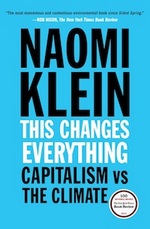
by Naomi Klein Paperback, 532 pg. Simon & Schuster, 2015
If you think you are not responsible for combatting global warming, think again. You better read this book. It has “radicalized” me into becoming an environmental activist.
With notes and acknowledgements this book is 532 pages (paperback) and jammed packed with information, facts, and opinion. Naomi Klein makes the compelling case that unfettered capitalism as a way of life is destroying the environment and is a big contributor to global warming. The faster we-the-people regulate large corporations, particularly the extractive industries like oil and mining, the better chance we have of reversing climate change. She outlines case after case after case of the harm the oil industry has done to the environment. Extreme extraction like fracking is especially harmful to land, water, and people. If you haven’t heard of the earthquakes in Oklahoma caused by fracking, you are living in a vacuum.
Our church book study group read the book, it is on the recommended reading list for the Episcopal Diocese of Eastern Oregon, and it has top reviews from a number of organizations and individuals. I had to make a tremendous effort to read the book, because in the first two sections, Klein paints a pretty dismal picture. Her writing is dense with fact and opinion. She is often repetitive but she gets her points across with facts. In part one she outlines how free market fundamentalism helped overheat the planet in a chapter by that name. She gives extensive coverage to the climate deniers, to scientists who think creating clouds will cool the planet, to the environmental groups she calls Big Green, some of whom, as it turns out, are in bed with Big Oil. In chapter seven she tells us that there are no messiahs, that the green billionaires won’t save us. She beats up on Richard Branson, the airline magnate, at length and points out that even though he talks a good green game, he and other green billionaires don’t follow through on their promises.
Klein gets more hopeful in part three with the chapter on the new climate warriors, who are ordinary citizens blockading the advance of the extractive industries. She sees hope in the Blockadia movement and gives examples of the development of the movement, like the protest to stop the Keystone XL pipeline. She says that extraction and refining has always required sacrifice zones and usually it is the underrepresented and poor who pay the price. “Through various feats of denialism and racism, it was possible for privileged people in North America and Europe to mentally cordon off these unlucky places as hinterlands, wastelands, nowheres . . . . the people reaping the bulk of the benefits of extractivism pretend not to see the costs of that comfort so long as the sacrifice zones are kept safely out of view.” (p. 311) Throughout the book she does not mince words.
She applauds the effort of Indigenous peoples to prevent tar sand development, open pit mines, fracking, and pipelines from destroying their lands and livelihoods. White people are glad to see this push back from the Indigenous people, but they can’t think that Indigenous people can carry on the fight by themselves. Everyone has to join in. Ironically, we now need the Indigenous on “our” side, whereas their concerns and battles were invisible to us before.
Klein advocates much more regulation of the extractive industries, read here Big Oil, Big Coal, Big Copper, think the development of the Pebble Mine in Briscoe Bay in Alaska. I don’t see that in today’s political climate more government regulation is in the cards, but I’d be happy if someone proves me wrong.
And when we keep oil in the ground we affect the love affair that American have with their trucks and SUVs. When are we going to stop buying them and go to more fuel-efficient vehicles? It would also affect plastics and related industries. When will the American consumer stop buying products that are not environmentally friendly? The consumer price index is a huge indicator of the health of our economy and what happens if and when Americans stop consuming so much? There are far-reaching implications of what Klein proposes in combatting global warming, and time is of the essence.
The divestment movement is another way to combat contributors to climate change. Institutions, colleges, organizations can divest in the stock of these companies that they hold. This is making headlines now. International laws and moratoriums can prevent and rollback expansion of carbon polluters. (p. 353). Some of the groups involved in the new wave of anti-fossil fuel activism are Food & Water Watch, 350.org, Greenpeace, Rainforest Action Network and Friends of the Earth. “It is this corroded state of our political systems that is fast turning Blockadia into a grassroots pro-democracy movement.” (p. 361) Needless to say, Klein is not kind to political systems controlled by big industry.
Klein says that filling out surveys, signing petitions, and giving money isn’t enough. We have to get out on the front lines and demonstrate, let our voices be heard. She says if you think that someone else is going to fight to combat climate change and things will turn out fine, you are wrong. (I was in this group.) We-the-people are responsible and have to make our voices heard. In our book study group, we asked ourselves what can we do, a small group in a small, rural town. We decided to start by showing the DVD documentary of This Changes Everything to raise awareness. I have ordered the DVD, and we will have a showing and discussion of it at our Senior Center and invite the public. Many people are simply not aware of the direness of the global warming situation. Through education we might create more activists.
“The task is to articulate not just an alternative set of policy proposals but an alternative worldview to rival the one at the heart of the ecological crisis — embedded in interdependence rather than hyper-individualism, reciprocity rather than dominance, and cooperation rather than hierarchy. This is required not only to create a political context to dramatically lower emissions, but also to help us cope with the disasters we can no longer avoid.” (p. 462)
If you are concerned about the future for your children, grandchildren and great-grandchildren and planet Earth, you must read this book and take up the cause of combatting climate change.
“One of the interesting things about space,” Arthur heard Slartibartfast saying . . . “is how dull it is?”
“Dull?” . . .
“Yes,” said Slartibartfast, “staggeringly dull. Bewilderingly so. You see, there’s so much of it and so little in it.”
Between General Busy-ness and having a hard time locating a reading copy of this book (I have one leather-bound edition of the “trilogy” pre-Mostly Harmless that I’m trying not to further abuse and a 1st edition that I really don’t want to abuse at all), I didn’t get to reading this one on schedule. I was briefly tempted to write this up from memory — and I think I’d have hit 80% of the same things, but that seemed dis-honest, somehow.
Also, I really wanted to read the Belgiuming thing (if you’ll pardon the expression)
Thankfully, the Nampa Library came through. So, yeah, a little late and without further ado…
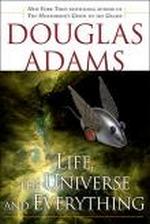
Sigh. This one just doesn’t work as well as its predecessors, does it? You can sense how hard Adams is trying to recapture the sensibility of the previous two novels — but it just comes across like someone trying (or locked in a hotel room by his editor until he’s done, which I believe is what happened here). For example, look at the concept of Bistromathic Drive, if that’s not a desperate attempt to remake the Infinite Improbability Drive, I’m a frood who doesn’t know where his towel is. And then the whole Krikkit saga? Don’t get me started with that.
Which is not to say that this doesn’t have some good moments — most of Ford’s dialogue is great. The whole thing with Agrajag is both a great call-back and a fun diversion. The best part of the book (both in concept and execution) has to be:
The Hitchhiker’s Guide to the Galaxy has this to say on the subject of flying.
There is an art, it says, or rather, a knack to flying.
The knack lies in learning how to throw yourself at the ground and miss.
It goes on for quite a while after this — and I love every bit of it.
I had forgotten Marvin’s arc in this — I enjoyed that more than the rest (even if it wasn’t as good as his arc in Restaurant). It’s the best use of Trillian in the series, bar none. So, it wasn’t a total wash. Still, it felt forced, his heart didn’t seem to be in it. Which made us even, I guess, my heart sure wasn’t. Still, Adams on an off-day is better than most things.
Here’s Part Deux of the Book Tour for Adam W. Jones’ Fate Ball — the review posted not too long ago, and Mr. Jones was gracious enough to keep participate in a Q&A with me. There were a bunch of questions about the book I wanted to ask — I was only 49% or so done with the book, so I didn’t ask most of them.
A quick look at his author bio shows that he has too much on his plate to spend too much time with me. Thankfully, I try to keep these brief, so he didn’t have to. I do appreciate the time he gave — as well as the A’s he provided to my Q’s. Hope you enjoy.
What prompted this particular story? What was the genesis of the book?
Fate Ball is loosely based on a past relationship. It was a life-altering relationship that stayed with me for years after we split up. Fate Ball began as a way to work through some emotions and put the relationship behind me. After it sat on the shelf for many years I decided to turn it into a work of fiction. It’s 80% fiction and 20% fact. The real Ava is alive and well…although still fighting her demons.
I almost phrased the question, “How much of this is autobiographical?” But was sure that if I did, he’d respond with something like, “It’s all imagination . . . ”
In the writing of Fate Ball, what was the biggest surprise about the writing itself? Either, “I can’t believe X is so easy!” or “If I had known Y was going to be so hard, I’d have skipped this and watched more TV”.
Once I decided to make Fate Ball fiction it really became easier to write. I found that my imagination would flow easily and I could get into a groove when I wasn’t trying to be factually correct. It started out in first person and the conversion to third person was a bit of a struggle, but once there things came easily.
I see you’ve done some articles and short pieces before this, what got you into writing? Who are some of your major influences? (whether or not you think those influences can be seen in your work — you know they’re there)
I’ve always enjoyed writing and telling stories. I consider myself a storyteller more than a pure writer. In 7th grade I won a national award for a poem I wrote and, Ms. White, my teacher really encouraged me to keep writing. I wrote for my high school newspaper, then studied Journalism at Carolina..getting several class projects published which bumped your grade a full letter. After college I did some freelance writing and had several travel and children’s stories published. I don’t believe I have a writing influence…if anything, I was influenced by my extended family who were always telling stories around the table or on the porch at the beach.
Fate Ball strikes an almost impossible balance between romance, humor and drama, why did you select that approach, and how did you pull it off (if you know)?
I guess I got lucky. As I said, I am just telling a story and everything fell into place. I did not have a specific plan when I began writing Fate Ball other than telling the full story…full of emotion both good and bad.
Your author bio says this is your first novel — what’s next for you (if you know)?
Originally, I was planning a trilogy with the Able character and having the other two books be prequels to Fate Ball. Those prequels would be “The Headman Chronicles” which is Able’s coming of age story during his trek across Europe after high school; and “The Rabbit Field” which is Able’s childhood experiences with young friends. Since Fate Ball is now out there I have considered an alternative by doing a non-Able story. My most recent thought is a love story entitled “Trailer Bride” set in Charleston. It’s a story about a young man from a socially elite family who falls in love with a girl from the other side of the tracks.
Welcome to Part One of our participation in the Fate Ball Book Tour — a brief interview will follow in a couple of minutes. Hope you enjoy both of these posts half as much as I enjoyed this book.
by Adam W. Jones PDF, 279 pg. Wisdom House Books, 2016
Read: April 14 – 15, 2016
Parents always seem to think that saving the day is a good thing, but really it just postpones the inevitable. Sometimes, they should just let their kids crash and burn, so they learn their lesson the hard way. Parents can be the biggest enablers of them all when they’re acting out of love and kindness, but that usually just makes things worse.
That’s not the most dazzling piece of writing in Fate Ball, nothing catchy or inherently memorable, like I try to start with — but this is the heart of the book. People trying to help an addict not ready to be helped, and inadvertently making things worse.
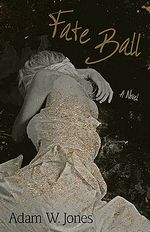
In the prologue, Able Curran receives news that Ava Dubose has died — Chapter One takes us back 14 years to 1980 to meet her. In Chapter Two (one of the best chapters I’ve read this year), Able meets her — and falls for her almost instantly (and many readers will, too). Over the next few chapters, you see the two falling deeper and deeper in love — one of the cutest couples you’ve read.
All the while, you know that things are leading to the fateful phone call Able receives in 1994. We start to see some signs of trouble (well, those started before this) long before Able does. When he finally gets clued it, it destroys him — and they don’t see each other for some time. From there we watch these two lives intersect from time to time over the next 15 years (usually, Able trying to help her), as well as getting glimpses of their lives between the intersections.
This is really the story of two addicts — one who lets their dependency control and destroy them. The other who learns how to live with the problem, controlling and eventually overcoming. And even as you know it’s happening, you still hold out hope for Ave to shake things off, to achieve the serenity — or at least the contentment that she so desperately needs. Things get worse and worse — yet Jones is able to keep things from despairing, there’s a lightness to the prose that keeps things moving. While things fall apart for Ava, they move on for Able and their friends — success, new love, children, life.
In some hands, you’d be beaten over the head with the contrast, Jones doesn’t do that however. It all spools out naturally, easily (the kind of ease that takes work to pull off). You like everyone here enough that you’re pulling for them, no matter what stupid choices they make. Jones as come up with a perfect blend of humor, romance, drama, and tragedy.
There are plenty of little touches along the way to keep things light, to immerse you in the world — which is good because the book could become too fixated on Able and Ava.
His mother was always asking, then answering her own questions. That’s why she was always right. She could have a whole conversation with herself, even a fight depending on the subject matter, and no one had to say a word. All Able needed to do was just nod his head once in a while and she would take care of the rest.
This is not the best book I’ve read — not even the best novel on addiction. But it works well enough that it doesn’t matter. I’m not saying it’s a bad book, or there are glaring problems — but objectively, I just think it could be better. But when you’re reading it? It delivers everything you want, and some things you don’t expect. I really enjoyed this and think you will, too.
Disclaimer: I received a copy of this book from the kind folks at Wisdom House Books in exchange for an honest review.
“. . . we went through. We came out on this moor that seemed to go on forever, between the mountains and the angry sea. And that sky! I’d never seen so many stars before, or such a red, red moon. The door slammed shut behind us. We couldn’t have gone back if we’d wanted to — and we didn’t want to. We were twelve. We are going to have an adventure if it killed us.”
“Did you? asked Nancy. “Have an adventure, I mean?”
“Sure,” said Jack bleakly. “It didn’t even kill us. Not permanently anyway. But it changed everything.”
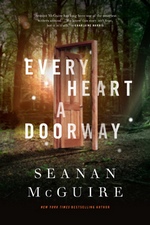
One of my favorite book bloggers to read (and not just because our tastes are similar) began his take on Every Heart a Doorway by saying:
Sometimes we either meet a book (or a novella, in this case,) that is precisely the right fit for your soul, (at the moment,) or just happens to be original enough right when you need it, that it fills your life and your mind with brightness and joy.
For me, this is one of those pieces. To muddy the waters even more, I’m an unabashed fan of the author and I’m likely to pick up all of her writings without even checking the subject matter because I simply trust the woman to steer me to any shore.
If I didn’t start off by quoting that, I’d end paraphrasing/plagiarizing it.
So here’s the deal in a world where portal fantasies are possible, and children all over the world are going through them — à la Lucy Pevensie et al., Dorothy Gale, September, Quentin Coldwater, Alice, Jason Walker, etc. — and, sadly (?) most of these children end up back home. Some of them are glad to be back in this world and want to put their adventures behind them — a lot of them don’t want to be here anymore and want to return to wherever it was they went. Both kinds of children have a hard time coping in this world and need help. Eleanor West’s Home for Wayward Children is for the latter kind.
Nancy is a girl recently returned, and is very different than the girl her parents have been missing. They want her fixed, they want their daughter back — not whoever this person is with different attitudes, actions, clothes, etc. — West doesn’t promise that (but she may have allowed them to think she’ll do that, just so she can help Nancy), but she can help Nancy adjust to this world. So she joins the small student body at the private school/treatment center. The last thing Nancy wants is to be fixed, to be that girl again — which just means she fits in here, with returned kids from all over the country, who’ve been in all sorts of worlds. As Nancy begins to understand the nature of these other worlds, the effects they have on children, and why many of them want to leave again, so do we.
It turns out, all of the residents of West’s Home are going to learn that you can have plenty of adventures here, too. And that’s all I’m going to say about that.
I really liked all of these children — the adults we met, too, actually — Jack in particular. But every one of them — even the less-than-nice ones — are great characters and I’d have gladly spent another 200 pages with them, easy.
The writing is incredible — not that I’ve ever had any real problems with McGuire before, but she kicked it up a notch here — and is writing a different kind of story than I’m used to, so she writes differently. This book took me longer to read than it should’ve, because I had to go back and reread several sentences/lines/paragraphs — not because I needed to read them again for clarification, but because they were so perfect, so quotable, so . . . something. I’m not going to start quoting beyond what I opened with, because I don’t know if I could stop — Laura got two of them I made notes about. You could literally be amused, melancholy, horrified, feeling whimsy, and nervous within a couple of paragraphs — only to turn the page and start all over again. Not because she was jerking you around or anything, it’s just that kind of story, that kind of playing with language, just that kind of broken reality.
McGuire gave us such a satisfying ending — complete, tidy, fitting, bittersweet, heartwarming — and then I read another paragraph or so, and it’s so much better (and all of the above to the next degree) once you got to the actual ending. Then I closed the book and I teared up a little — for no reason at all, really, but it felt really appropriate.
Can I say this is positively Gaiman-esque without making it sound like McGuire’s derivative in any way? I don’t want to even hint at suggesting that — but man, if you like Neil Gaiman’s stuff — get this. If you’ve ever read a portal fantasy and wondered what happened to the kids afterwards– get this. If you like things that are good, and don’t mind magic in your reading — get this.
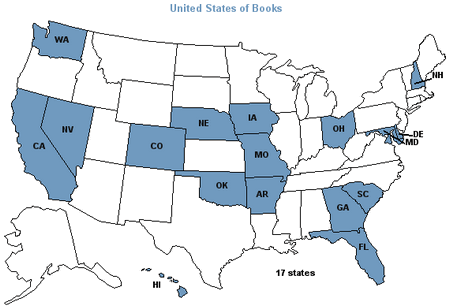
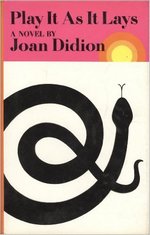
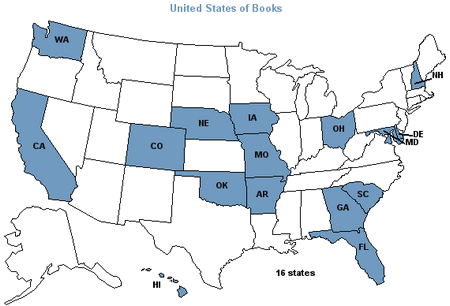
Welcome to another installment of the United States of Books! See full details here. Today we will visit California with Play It as It Lays by Joan Didion. <b?Entertainment Weekly says “Didion’s 1970 classic, about a woman and a marriage breaking down, is both an ode to the freedom of the freeways and a eulogy for dreams shriveled by the sun.”
SYNOPSIS
(From Goodreads.com)
A ruthless dissection of American life in the late 1960s, Play It as It Lays captures the mood of an entire generation, the ennui of contemporary society reflected in spare prose that blisters and haunts the reader. Set in a place beyond good and evil – literally in Hollywood, Las Vegas, and the barren wastes of the Mojave Desert, but figuratively in the landscape of an arid soul – it remains more than three decades after its original publication a profoundly disturbing novel, riveting in its exploration of a woman and a society in crisis and stunning in the still-startling intensity of its prose.
REVIEW
I don’t think this book is your typical read, like a James Patterson or Jodi Picoult…not saying they are typical because they are amazing and talented authors. But Joan Didion is not a Jodi Picoult type author. Joan grabs you with this story from the very beginning, waiting for the other shoe to drop. With school, my child, and life in general, it took me a couple weeks to read this “can’t put this book down” book because I wanted to see if this ‘sad female with nothing but time and money’ would do something with herself and stop feeling sorry for herself. I did have empathy for her as the story continued because as the reader can tell she is truly sad and can’t pull herself out of it. You want to go into the book and shake her but hug her at the same time. There was twists and turns in this story I was not expecting but was pleasantly surprised by. I tend to be a cynical person (in the Miranda from Sex in the City kind of way) so when I started reading Maria’s character, I thought oh good Lord…but then, something happens (no spoilers!) This was a memorable read, for sure. It is also one that I would recommend to others.
Odds ‘n ends over the week about books and reading that caught my eye. You’ve probably seen some/most/all of them, but just in case:
Lighting It Up with Fahrenheit Press — I haven’t read as many of Fahrenheit Press’ books as I want to, but I really dig their approach to marketing, publishing, and their zeal for their books. Even more than that, I like the books of theirs that I’ve read. Good piece about them.
The most famous book set in every state — A different (but with similar results) approach than the one we’re using for the <a href="http://125pages.com/united-state-of-books/ " target="_blank" United States of Books project .
This Week’s New Release that I’m Excited About and/or You’ll Probably See Here Soon, odd that there’s only one, but it’s bound to be a good one:
Strike by Delilah S. Dawson — Sequel to Hit, which is enough to get me stoked. But when she tweets about it, saying that it includes “A villain based on Boyd Crowder” – I’s amazing that I haven’t read it three times already this week.
Lastly, I’d like to say hi and welcome to Stormy Vixen for following the blog this week.
I’d like to welcome Deek Rhew to the blog today to promote his thriller, 122 Rules (and other things), as part of The Rhew 2 Rhew blog tour. 122 Rules looks like a heckuva read, I’ll add, be sure to check it out. After you read his post, of course — and enter the drawing.
—
I’m so excited to be on The Irresponsible Reader! Thanks for having me on, H.C., and hello to all you readers of The Irresponsible Reader!
Today, H.C. let me post on whatever I’d like to write about, so I’ll pick something near and dear to my heart: Flying!
To start off with, let’s spin up a little tune that can grace your ears while you peruse this post and the rest of H.C.’s blog.
When I was three, my family and I lived in Great Falls, Montana. If you know anything about that state, it’s famous for beautiful skies, open space, cold winters, and strong winds. We lived in a mobile home park high up, overlooking the Missouri river. One of the storms the area is so famous for came blowing through. Super high strong winds swooped around our trailer, rocking it on his frame. I, not liking to be cooped up, wanted to play outside. My mother told me not to go. That it was too stormy.
Of course, being three, I knew better, so I opened the door, grabbed the screen handle and twisted. To this day, I can still remember sailing over the front lawn thinking, This was not a good idea after all. It’s funny, years later, I wrote a scene in my short story, “Norman and the Demon,” which is very similar to this first memory.
So you see, flying and I go WAY back. If I had my druthers, I’d fly like Superman. No plane required and really not that much different than my stormy day back in Montana.
Alas, that’s not very likely to happen anytime soon. But man would it be cool to fly to work, fly over traffic, and carry my beautiful bride to exotic destinations just by raising my arms and wishing to go there!
In high school, I wanted to follow my father’s footsteps and join the military.
I wanted to fly! To see the world from the clouds and fight the bad guys like Maverick. Sigh, alas the military had no use for people who are colorblind. Something about the good guys are green on the radar and the bad guys are red. I don’t know, silly stuff.
To wrap up this segment, I’ll include the scene from Norman and the Demon I mentioned earlier. Enjoy!
The civil servant grasp the handle on the heavy security screen, took a deep breath, and twisted. The door did not open. He pushed, but it refused to budge. He looked at Owen, who watched with a mixture of apprehension and sadness.
Norman tried again. Still nothing. Shoving harder, he threw his appreciable bulk against the door. One second, Norman Philip Templeton the Third, USPS delivery man and essential service provider for the government of the United States of America, stood red-faced and grunting. A heartbeat later, he had vanished as if a magician had commanded him to do so. Except no magician’s assistant ever squealed like a little girl who’d just found a spider in her shoe.
Caught in the guaranteed unbreakable glass, the gale force winds yanked the security door open. The screen’s hydraulic failed, disintegrated into a cloud of metal and rivets, and allowed the handle to smash through the bungalow’s siding. It hurled the dandy of a man, his cry becoming the primary soloist in the choir of winds, while he sailed over front yard as graceful as a flying manatee. Momentum and air pressure no longer capable of supporting such bulk, his impromptu trip ended, and he splatted unceremoniously in the middle of the rain-sodden lawn. The impact drove the breath from his lungs, removing his falsetto soprano from the choir at the crescendo of the concert.
Norman stared up into the dark, angry sky. Leaves and debris swirled and dove overhead like roving gangs of demented birds. The end had come. He would die here. Another soldier fallen while serving his country. The broken-hearted would weep during “Taps” as Marines lowered his casket into the frozen ground of Arlington Cemetery. He required no accolades, no statues or monuments. He only wished to leave his country a little safer—the children, women, and citizens of his great nation more secure—than when he joined it.
Norman shed a tear in sympathy as the scene continued and his partner fell to his knees—sobbing into the folded United States flag clutched to his breast. I’ll miss you too, honey.
His dolorous mental screenplay abruptly ended when strong hands grabbed him under the armpits. Owen. The real life Owen—not crying but looking both frightened and angry at the same time—towered over him and dragged the sodden freedom fighter towards the safety of their bunker. The large man forded the civil servant across the lakes and rivers of their lawn and through the ruined threshold of the house. Owen dumped his life partner against the wall and leaned against the door, forcing it closed one small step at a time until he snicked the latch in place.
Thank you SO much H.C. for letting me share my history of flying! Readers, are you ready to learn a bit about our books and enter to win a $50 Amazon gift card? Woop! Let’s go!
Rhew 2 Rhew Blog Tour – 122 Rules Book Blitz Extravaganza! How’s that for a catchy title? What a crazy adventure this has been FIVE years in the making, and it has finally arrive: 122 Rules has been born unto the world. The stories I could tell just so I could tell you this story…well, let’s just say it’s been an interesting, educational, and life-altering adventure.
This has been a grand journey, filled with hardships, fun, learning, and growth. But of all the things that have happened on the writing road, meeting the love of my life is the most unlikely and easily the luckiest, most blessed things to have ever happened to me.
Ahhhh, it’s cold out here!
Do ya feel lucky punk? Well, do ya?
Erin Rhew and I started out as critique partners, became friends, and now she’s my bride. She’s my best friend and partner in all things. Even if I don’t sell a single copy of my writings, I’ll always be a smashing success because I met Erin.
Book Blitz
On this half of the Rhewination tour, I am visiting blogs all over the globe, from Australia to the farthest corners in Canada. Next week, on the second half of the tour, Erin will be gracing the pages of 50+ bloggers!
Today, we are announcing my adult thriller novel, 122 Rules.
Synopsis In his black and white world, Sam Bradford–former Marine turned government assassin–finally sees a speck of grey. He has always followed orders without question, but his latest assignment threatens to disrupt the precision of his universe and may either severe or redeem his last remaining sliver of humanity.
Using his mastery of the 122 Rules of Psychology, Sam hunts down everyone The Agency sends him to find and eliminates them. Just as he has his rifle scope focused on his latest victim, Monica Sable, a SoCal girl entangled with the mob, his long-dormant conscience reappears for a final performance…one last ditch effort to save the sinking ship of Sam’s soul. He’s killed innocents before, but tarries on pulling the trigger this time.
When Monica escapes his crosshairs and fumbles her way across the country in a pathetic attempt to elude capture, Sam gives chase. But he’s not the only one after her. Ruthless henchmen, hired by the mob, froth like bloodhounds and nip at Monica’s heels. Now Sam is faced with a choice: turn his back on the rules and jeopardize his way of life by helping her or join the pack and rip her to shreds.
What are readers saying?
122 Rules is a fast-paced thrill-ride, filled with rich characters living in an expertly woven world of mystery and suspense. Deek Rhew’s debut novel will take readers by storm, and keep them coming back for sequels.
~Michelle K. Pickett, Bestselling and award-winning author of PODs and Unspeakable.
The perfect, fast-paced novel for fans of kick-butt heroines, creepy killers, and getting caught in the wrong place at the wrong time. An absolute must-read!
While you’re on Deek’s site check out Birth of an American Gigolo.
Synopsis
An old party girl shoehorned into domestic divaship, infuriated by her husband’s cheating and his holier-than-thou, tree-hugging, no-tits and no-hips girlfriend, inflicts her wrath by training a local boy in the fine art of seduction. She and her new boy toy turned love god start a gigolo business as a distraction for the neglected and mistreated housewives of Alabaster Cove.
Take a selfie with your ebook or paper copy of Birth and post it on social media with the tag #BirthSelfie. We’ll post you on the Rhewination web site!
Deek Rhew
Deek lives in a rainy pocket in the Pacific Northwest with the stunning YA author bride, Erin Rhew, and their writing assistant, a fat tabby named Trinity. They enjoy lingering in the mornings, and often late into the night, caught up Erin’s fantastic fantasy worlds of noble princes and knights and entwined in Deek’s dark underworld of the FBI and drug lords.
He and Erin love to share books by reading aloud to one another. In addition, they enjoy spending time with friends, running, boxing, lifting weights, and exploring the little town–with antique shops and bakeries–they call home.
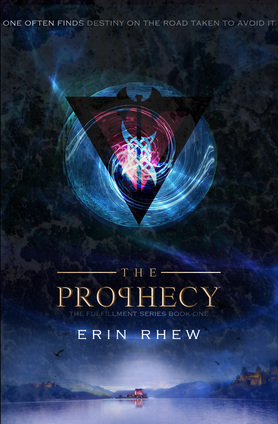
Erin Rhew is an editor, a running coach, and the author of The Fulfillment Series. Since she picked up Morris the Moose Goes to School at age four, she has been infatuated with the written
word. She went on to work as a grammar and writing tutor in college and is still teased by her family and friends for being a member of the “Grammar Police.”
A Southern girl by blood and birth, Erin now lives in a rainy pocket of the Pacific Northwest with the amazingly talented (and totally handsome) writer Deek Rhew and their “overly fluffy,” patient-as-a-saint writing assistant, a tabby cat named Trinity. She and Deek enjoy reading aloud to one another, running, lifting, boxing, eating chocolate, and writing side-by-side.
Artwork
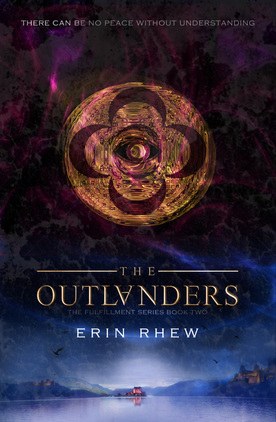
Authors, do you think the artwork for The Prophecy, The Outlanders, The Fulfillment, Birth of an American Gigolo, and 122 Rules is as stunning as we do? Visit Race-Point.com to find out how you can get the amazing Anita to work on your book as well!


 Fear and Loathing in Las Vegas