Author: HCNewton Page 543 of 629

Lessons from Tara by David Rosenfelt

Lessons from TaraLessons from Tara: Life Advice from the World’s Most Brilliant Dog

by David Rosenfelt

Hardcover, 227 pg.
St. Martin’s Press, 2015

Read: January 23 – 25, 2016


One of my resolutions this year was to read more Non-Fiction — I’m going to try for 1 a month, in addition to “whenever I see something that catches my eye.” So, I marched up to the New Release shelf at the Library and started browsing — hope sinking fast, a whole lot of diet, productivity and political books. Ugh. Just not in the mood, then I got to the 600’s and David Rosenfelt’s name jumped out at me. Had to do it, Rosenfelt talking about Tara (the inspiration for Andy Carpenter’s dog) might be cheating a little, but it was good enough.

I was expecting a little Marley & Me-ish type story about the Rosenfelts and Tara. I couldn’t have been more wrong — thankfully (this meant I sniffled far less than I would’ve otherwise). This is a collection of short (no more than 5 pages), mostly humorous, essays about their life and work with Rescue Dogs. Tara is mentioned frequently, as the work they do with Rescue Dogs was inspired by her, but she’s not the focus of this book. It’s their entire menagerie, those they’ve rescued that aren’t part of their pack, the humans they’ve worked with — and even a few they decidedly haven’t — and the lessons Rosenfelt has learned from them.

While every chapter has a joke or two, some are pretty serious — Rosenfelt talks earnestly about the way people treat dogs — particularly older dogs. The focus of The Tara Foundation is on older/senior dogs who aren’t that likely to be adopted from shelters. I know that he’s made me rethink what dogs I look at when we go to adopt next.

Fans of the Andy Carpenter series will be happy to hear that Andy’s voice is Rosenfelt’s — the book at times feels like an Andy Carpenter book without all the muss and fuss of a plot, murder, or trial. I laughed, I chuckled, I learned a thing or two, and I even got misty more than I wanted to. All in all a really strong read. If you’re a dog lover, or just someone who likes to read good things, find some time for this one.

—–

4 Stars

Opening Lines – Staked by Kevin Hearne

Head & Shoulders used to tell us that, “You never get a second chance to make a first impression.” That’s true for wearing dark shirts, and it’s especially true for books. Sometimes the characters will hook the reader, sometimes the premise, sometimes it’s just knowing the author — but nothing beats a great opening for getting a reader to commit. This is one of the better openings I’ve read recently. Would it make you commit?

I didn’t have time to pull off the heist with a proper sense of theatre. I didn’t even have a cool pair of shades. All I had was a soundtrack curated by Tarantino playing in my head, one of those songs with horns and a fat bass track and a guitar going waka-chaka-waka-chaka as I padded on asphalt with the uncomfortable feeling that someone was enjoying a voyeuristic close-up of my feet.

from Staked by Kevin Hearne

Three Slices by Kevin Hearne, Delilah S. Dawson, Chuck Wendig

Three SlicesThree Slices

by Kevin Hearne, Delilah S. Dawson, and Chuck Wendig; Galen Dara (illus.)
Series: The Iron Druid Chronicles, #7.5

Kindle, 166 pg.
2015
Read: January 25 – 26, 2016

No man who is master of his fate should ever reek of cheese.

Criminy Stain’s observation may seem a bit out-of-place given the authors and characters in this anthology. Shouldn’t it be more visceral or blood-related than cheese? Actually, no. Kevin Hearne explains:

I can’t recall precisely where I heard that tyromancy was actually a thing, but methinks it was during the summer of 2012. As soon as I knew it existed I knew I had to write about it, the way some people have to climb mountains or crack safes once they see them. And if I could find another couple of authors brave enough to do it, maybe we could produce the world’s first tyromancy-themed anthology. So my quest began and now here is the spiffy MacGuffin: THREE SLICES, or rather three stories where somebody along the way predicts the future via the coagulation of cheese.

So, he got a couple of other writers to contribute a story et voilà, they’ve got themselves a pretty unique book. Honestly, I think if I knew the theme, I’d probably have picked this up earlier, rather than waiting until the release week for Hearne’s Staked (and really only then because he insisted his story was “vital” to read before the new book).

A Prelude to War

This happens within a week of Shattered (and ends a few hours before Staked, I think). And yeah, it turns out to be pretty vital for starting the latter. Sure, you could’ve pieced things together, I think (I’m only on page 10, so that’s a guess) — but why work that hard, when you could just spend a little time with Atticus, Oberon, Granuaile and Orlaith (especially Oberon, always especially Oberon)?

I sorta want to talk about all of it, but the story is so short, I’d end up spoiling too much. So let me just stay that this is fun, it’s exciting, and the table it sets for Staked looks great.

Not My Circus, Not My Monkeys

It took me a little work to really get a handle on what was going on here in this Blud story (and I’m pretty sure I only achieved B+ level of comprehension). I’m not sure if this is prequel-y or if it fits into the continuity of the series — but it feels prequel-y.

It was creepy, dark, and moody. The tyromancy fit into a Twilight Zone-like part of the book. Then Criminy got into one of the more disgusting (appropriately so) fight scenes that I’ve read in the last few years.

On the one hand, I wouldn’t object to spending more time in this world, but I can’t see myself expending a whole lot of effort, either. Just not my thing. I think I’ll stick to the Hit books for now.

Interlude: Swallow

Good, ol’ reliable Chuck Wendig — he can write dazzling sentences, character descriptions that I will dwell on for days, and yet I can barely stand to read him. I keep waiting for the lightning bolt that will change things and he will become one of my favorite readers. But I can’t even get a static shock to make him someone I want to read — particularly Miriam Black. Interlude: Swallow ain’t gonna change that. Sorry, Mr. Windig. (I did chuckle mightily at Miriam’s quoting Ralphie Parker). Miriam’s rants about mornings, and then her comments on breakfast and then breakfast sandwiches probably made the time I spent worthwhile.

Overall, for me, this was really only worth the effort for Hearne’s story — but fans of Dawson’s Blud series or Miriam Black should have plenty of reason to pick this up, too. If you happen to be a fan of all three series, you’ll probably love this book.

—–

3 Stars

Reposting: Where It Hurts by Reed Farrel Coleman

It’s Publication Day for Where It Hurts, so I thought I’d better throw this up again. Go get your hands on it.

Where it HurtsWhere It Hurts

by Reed Farrel Coleman

Series: Gus Murphy, #1
ePub, 353 pg.
G.P. Putnam’s Sons, 2016

Read: November 26 – 27, 2015

I honestly don’t know where to start with this, once again Reed Farrel Coleman has provided me with a book that I really want to talk about, but I’m not sure how to proceed, beyond saying that this is really good.

Where It Hurts is gritty, bleak, tragic, and tense with a strange sense of hope filtering though the depression, pain and grief. If that miasma makes sense to you, you’ll get the feel for this book. If it doesn’t, you’ll understand why I struggled for almost a month with this.

Gus Murphy is a retired uniformed police officer — retired young, I should add. His life has been shattered by a calamity that struck without warning and without mercy; bringing an end to his career, his marriage, his faith, and his relationship with his daughter. His ex-wife and daughter aren’t faring too well in the aftermath, either — you could make the case that Krissy, his daughter, is worse off than Gus.

Two years after his world came to an end, it’d be nice to say that Gus has started to put his life back together — he hasn’t. He has, however, figured out how to exist, and honestly that’s about it.

It’s into this state of mind, state of being that we first encounter Gus and from there Where It Hurts really gives us two stories. The first is a story about an ex-cop being asked (and agreeing) to look into a months-old homicide on behalf of a father — who has a record long enough that the Suffolk County PD isn’t that interested in helping him or taking any evidence he might have gathered for them. Enter Gus. The other is a story of a grieving father dealing with the aforementioned fallout of the tragedy and — thanks to other story — a renewed interest in life beyond this grief and anger. In the end, both stories end up feeding the other as Gus remembers what living was like, what being a cop was like.

As well-written and plotted as book is — with a well-done mystery, your appreciation for this book will come down to the question of what you think of Gus. If you don’t care about him, aren’t interested in what makes him tick — the rest isn’t going to maintain your interest. If you do care, are curious, are sympathetic, are fill-in-the-blank, there’s no reason you won’t be satisfied with it.

I’ve only read 5 or so of Block’s Matthew Scudder books — and that was a while ago — but Gus reminded me a lot of Scudder. Instead of battling his addiction, he battled his loss (and, yes, I realize both are probably doing the same thing — but Scudder identifies as a drunk, Gus doesn’t). I found it particularly interesting — and on the whole, original — the way that Coleman dealt with and explored Gus’ lack of faith. Because it’s not just your garden variety atheism/agnosticism — Gus is angry about his God not existing anymore (or at least his faith in Him). He talks about it a lot — so much so that you know it’s self-delusion to think of it as a loss of faith, while it’s anger at God for what happened to him. Gus isn’t Job, he has neither the patience or the faith to react like Job — and in his grief, he lashes out at the God who would do this to him/his family. To me, this felt genuine, I think I know this guy (or at least that reaction).

The supporting characters were great — the criminals suspected of the murder, the criminals adjacent to the murder, the police (although one bordered on being a cartoonish lout — but that seemed intentional), the people from Gus’ old life, those from his new. On the one hand, I didn’t think I got a great picture of his ex-wife, but on the other, I don’t think I needed to. A little more time with Krissy, however would’ve been good. Everything else was great, character-wise.

That was actually much easier than I thought it would’ve been. Where It Hurts strikes me as the kind of book that I could go on and on for pages about, but apparently not today. It might have to wait until book two comes out, so I can see where Gus goes from here. Does he remain in essentially the same spot, or does he make big, sustained steps out of mere existence and into a new life? The last few pages suggest that he does, but I know better than to expect that to remain the case. I actually could see me revising everything I said here about this book based on the sequel.

Regardless, a heckuva book — one that could appeal to thoughtful mystery readers, or general fiction readers willing to have a hefty dose of crime in their reads.

—–

4 Stars

—–

Note: I received a digital copy of this book from the nifty people at First to Read, as grateful as I am to them, that didn’t alter my appreciation of the book or what I said about it.

Winter by Marissa Meyer

WinterWinter

by Marissa Meyer
Series: The Lunar Chronicles, #4

Hardcover, 824 pg.
Feiwel and Friends, 2015

Read: January 19 – 22, 2016

So, the first book I really blog about is the conclusion to the tetralogy — not the best way to go about it, but it’ll have to do.

Primarily because I started this blog after I’d read the first two books in this series, and only slightly due to laziness, I’ve only blogged about one other of The Lunar Chronicles — the “.5” preceding this one, Fairest. Which makes this a little hard to do, but not that much. Basically, what Meyer has done is combining and intertwining the stories about Cinderella, Little Red Riding Hood, Rapunzel and Snow White; removing the magic, inserting computers, cybernetics, and space ships; and setting the entire thing in a future where Earth and the Moon are on verge of war. Couple that with Meyer’s voice and skill? This series is a crowd pleaser.

During Part I, I felt like The Grandson in The Princess Bride, “Is this a kissing book?” There was just so much smooching, significant looks, and avowals of affection that it got close to annoying. That said, it was so nice reading a YA book where (almost) everyone was open and honest about their attractions and (almost) everyone had their feelings reciprocated. Those that weren’t that open might as well have been, they were all pretty horrible at keeping things secret. Over all, it was sweet, it was cute, it was like a fairy tale.

What are the odds, right?

But after that? A great mix of character moments and action. On the one hand, Meyer takes her time setting things up — but on the other hand — she doesn’t have to take time and introduce anyone knew this time. All the players are known quantities, the relationships are set up between all of them, and there are two major goals at work — Stop Levana, or Stop Cinder. Everything else is frosting.

Clear directions, clear motives, it’s a crisp, well-paced adventure story at this point — yeah, there’s a little politics, there’s a little subterfuge — but basically, it’s “Let’s raise an army and storm the castle.” Which doesn’t mean everything’s a cake walk, of course. There’s some tension, real hardships and peril — am I allowed to say that there were a couple of times when thing seemed pretty Grimm?

This is based on a fairy tale, and that needs to be borne in mind as you read it. That being said, Meyer makes it very easy to forget that and by the time that the part of Winter that was the most-Snow White-y, I’d forgotten that’s what this novel was about. You’d have thought between a. the cover, and b. the time I’ve spent in the world of Indexing lately, I’d have seen it coming. But I didn’t until I was right in the middle of the scene — which made it much more effective for me.

Meyer is great with her characters, and you can get attached to even those we meet for the first time in these pages — for those who’ve been around since the beginning? Hate to say good-bye to them, especially Iko the android. In the end, I think this is one of the more emotionally satisfying series conclusions I’ve read recently.

—–

4 1/2 Stars

United States of Books – The Adventures of Huckleberry Finn by Mark Twain

The Adventures of Huckleberry FinnThe Adventures of Huckleberry Finn

by Mark Twain

Author: Laura at http://125pages.com

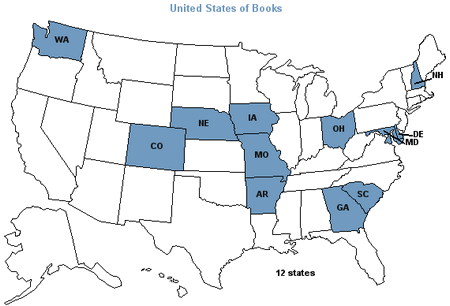
Welcome to another installment of the United States of Books! See full details here. Today we will visit Missouri with The Adventures of Huckleberry Finn by Mark Twain. Entertainment Weekly says “Twain’s masterpiece about Missouri’s most iconic literary contribution, Huck Finn, will resonate for as long as America’s rivers flow.”

I’m not sure how I never read The Adventures of Huckleberry Finn before now. I read The Adventures of Tom Sawyer in high school and upon looking on my shelves I discovered I already owned both of them. Finn takes place soon after the events of Sawyer, with both boys wealthy and Finn living with the Widow Davis as his alcoholic father has not been seen in a year. Stifling under the rules, Finn seeks adventure. He rejoices when he is able to sneak past Jim, a slave who keeps watch over the house, to join his friends as they play robbers at night. When his Pap finds out about his windfall, he returns to town seeking the money. He kidnaps Huck and locks him in an isolated cabin. Huck the stages his own death to escape and sets off down the river. He happens upon Jim, who is also running after hearing about plans that he is to be sold. A series of madcap adventures follow, including grifters pretending to be royalty, cross-dressing, family feuds and an elaborate plan to save Jim.

This was a hard book to rate as it is not on the same level as current books. The six distinct dialects used made it not flow as modern literature does, but added a unique aspect to each word said. The writing was humorous and full of heart. Yes, at times, the words used do not match what we consider proper, but for the time it is accurate. The plot was all over the place, but always made its way back to Huck at the center. The pacing was quick and the story never lagged.

A true classic in terms of setting, language and speech patterns, The Adventures of Huckleberry Finn, is a unique look at a not so shiny time in our country’s past. That being said, the correlation between Huck running from what he considered slavery, and an actual slave running with him for real freedom was powerful. Seen from a child’s eyes, what was normal became unthinkable, as Huck learned to count on Jim. Mark Twain crafted a nuanced picture of such a specific time frame, I think The Adventures of Huckleberry Finn will never not be read by those seeking to understand the past.

Favorite lines – It was kind of solemn, drifting down the big, still river, laying on our backs looking up at the stars, and we didn’t ever feel like talking loud, and it warn’t often that we laughed—only a little kind of a low chuckle. We had mighty good weather as a general thing, and nothing ever happened to us at all—that night, nor the next, nor the next.

Biggest cliché – “Running away will be super easy and fun.”

Have you read The Adventures of Huckleberry Finn, or added it to your TBR?

—–

4 Stars

Songs of a Suffering King by J. V. Fesko

Songs of a Suffering KingSongs of a Suffering King: The Grand Christ Hymn of Psalms 1–8

by J. V. Fesko

Kindle Edition, 123 pg.
Reformation Heritage Books, 2014

Read: January 17, 2016


This is a “small survey” (his words) of the first 8 Psalms, looking at them as testifying of Christ — His experiences, His heart, His prayers, His praise. Fesko doesn’t ignore the original author or context, but his focus is reading them through the filter of John 5:27/Luke 24:27. With that filter, it’s easy to see how the first 8 Psalms (as a microcosm of the Psalter as a whole) testify to Jesus Christ.

This book was just “oooohkay.” Maybe I came in with too high of expectations. I get that Fesko was writing for a more popular audience than some of this other work — but this seemed very shallow. There wasn’t a whole lot to sink my teeth into. I’m glad he made this material very accessible — it’s the kind of thing the Church needs more of. I’m just afraid he didn’t hit the right balance of content and ease of understanding.

The content was good, I do think each chapter helped me understand the Psalm in question a little better (more than that at least twice). The conclusion is very strong — probably the best chapter in the book. I just wish he’d brought some of that strength to bear on the earlier chapters.

The book contained some great insights, but it was primarily surface-level material. I just wanted more from the book. Maybe I wanted too much, but I don’t think so. There were a couple of “wow!” moments for me that lead me to rate this at 3-stars rather than 2 1/2 (but if he’d developed those ideas for more than the one or two sentences he gave them I’d have gone with 4). It’s a nice, quick easy read with some good devotional material, but it could’ve been more without making it too technical.

—–

3 Stars

Saturday Miscellany – 1/23/16

Odds ‘n ends over the week about books and reading that caught my eye. You’ve probably seen some/most/all of them, but just in case:

    This Week’s New Releases I’m Excited About and/or You’ll Probably See Here Soon:

  • Orphan X by Gregg Hurwitz — The premise alone makes this worth a look. When you add in the endorsement’s on this (Crais, Baldacci, Child, etc.), the comparisons to Bourne, Reacher and others . . . this has got to at least be worth a try.
  • The Rogue Retrieval by Dan Kobold — shades of Terry Brooks and Christopher Stasheff help this debut fantasy sound like a winner.

Lastly, I’d like to say hi and welcome to Dr. Joseph Suglia for following the blog this week.
(cat is absolutely not necessary)

Top Ten (and a bonus) Books from My Childhood

I was bemoaning how long my current read was the other day and how it was going to leave me without a post for today, and my ever-so-clever daughter suggested, “Why don’t you list the Top 10 Books from your childhood?” That sounded pretty fun, so I figured that I might as well. It turned out to have been better than I thought, so kudos to her.

Ranking them really would be impossible, but then 11 came to mind really without any effort, and I couldn’t axe one of them, so there’s a bonus entry to the list. All of these I read more than I can count — if they’re part of a series, these were the ones that I came back to most often. The links are to Goodreads pages because I can’t find good official pages for all the books/authors (a true sign of my age, I guess).

Enough of that, on with the trip down Amnesia Lane:

The Castle of LlyrThe Castle of Llyr

by Lloyd Alexander

The Chronicles of Prydain taught me most of what I needed to know about Fantasy (augmenting The Chronicles of Narnia‘s lessons). Fflewddur Fflam here is at his best, I think it’s here that I fell in love with Eilonwy, Taran’s more of a real hero than before, and you get plenty of Gurgi (who I just have to mention because thinking of him makes me smile). There’s peril, the characters grow more than they have before, a hint of romance . . . it’s not the most important book in the series, but I think it’s pivotal.

Danny Dunn and the Anti-Gravity PaintDanny Dunn and the Anti-Gravity Paint

by Raymond Abrashkin and Jay Williams

I didn’t know until today that this was the first in the series, I always figured it was mid-series. It’s the only one of the series that I owned — thankfully, the library had a few more — so it’s the one I read most. It was also my favorite — I just loved the stuff at the edge of our solar system and Prof. Bullfinch and Doctor Grimes making musical instruments from their hair — stupid as all get out, but it worked for me.

The Mystery of the Dead Man's RiddleThe Mystery of the Dead Man’s Riddle

by William Arden

While Encyclopedia Brown (see below) got me reading mysteries, it was The Three Investigators — Jupiter Jones, Bob Andrews and Pete Crenshaw (btw, the only thing there I had to look up was Pete’s last name — not bad for a series I haven’t touched since the late 80’s) got me hooked on reading detective series. The Dead Man’s Riddle was one of my favorites — and I think the first or second I read — something about the Cockney slang kept bringing me back to it. I read what I do today because of this series, really.

SuperfudgeSuperfudge

by Judy Blume

I remember Tales of a Fourth-Grade Nothing being funnier, but this was a better story — the Fletchers leaving NYC, Peter maturing, Fudge being a real pain, not just a cute nuisance. Blume taught me a lot about how to read non-genre stuff, probably paving the way for Hornby, Tropper, Weiner, etc.

The Last of the Really Great WhangdoodlesThe Last of the Really Great Whangdoodles

by Julie Edwards

What a great world, what a great magic system . . . I’m not sure I can express what this book meant to me as a kid, and the copious warm-fuzzies the memory brings up. I remember that it was in the pages of this book about a magic kingdom that I first learned about DNA and RNA (and what those letters meant) — thanks, elementary school science classes. The creatures’ names in this are great (and, as an adult, I can “hear” Andrews saying them in my mind for an added layer of fun). There’s a great deal of whimsy here, a sense of play that permeates this — even when it gets silly. The kingdom’s motto, “peace, love and a sense of fun” really sums up the spirit of the book.

Me and My Little BrainMe and My Little Brain

by John D. Fitzgerald, Mercer Mayer (illus.)

Sure, the series was supposedly about Tom, but J. D.’s the real hero of the books. He has a conscience, a better moral compass than his brother — and is probably just as smart. This is the book that lets him shine as he ought to have all along. All the books had their strong points, and were fun, but this ruled them all.

The Phantom TollboothThe Phantom Tollbooth

by Norton Juster, Jules Feiffer (illus.)

Such wordplay! What a great, twisted way to teach how important words and ideas are. Seriously, just a wonderful book. The humor is so off-kilter, any appreciation I have for puns came from this book (and it set the standard that a pun must achieve for me not to groan). If you haven’t seen the documentary about it, The Phantom Tollbooth: Beyond Expectations, get on it. (I contributed to the Kickstarter for it, I should add).

The Voyage of the Dawn TreaderThe Voyage of the Dawn Treader

by C. S. Lewis

I remember the bookstore where I bought this, the date and month that I bought it, and reading a good chunk of it before I got home. I read this one more than the rest of the series (Prince Caspian a close second). I just love this one — you get Reep at his bravest and funniest, some really odd creatures, an epic story, and Eustace’s redemption (back when I did crazy things like this, I almost got a tattoo of Eustace as Dragon). Who could ask for more?

Alan Mendelsohn the Boy from MarsAlan Mendelsohn, the Boy from Mars

by Daniel M. Pinkwater

Pinkwater has funnier and stranger books (both before and after this one), but there was heart, there was depth — there was length! — to this story about a kid who didn’t really fit in until he made a friend who didn’t want to fit in. This is another one where I can peg the place and time I bought it. Science Fiction-y in a real world (didn’t know you could do that!), comic book geeks as heroes, and real non-sanitized-for-kids emotions. There’s no way this wouldn’t be a favorite. More than the rest on this list, I’m thinking of finding my old copy and taking it out for another spin (because I just read the next one a couple of years ago).

The Westing GameThe Westing Game

by Ellen Raskin

If I had to pick one off this list (and I don’t), this would probably be my favorite. I re-read it two years ago, and it was one of my favorite experiences that year with a book. The characters are great, the story was so clever, the writing so crisp. There’s nothing wrong with this book at all.

I saw a hardcover reprinting of this on Monday, and had to fight to resist buying a new copy. Kind of regretting that now.

Encyclopedia Brown Boy DetectiveEncyclopedia Brown, Boy Detective

by Donald J. Sobol

Summer after second grade, we were on a forever-long road trip and I was bored, so I demanded my parents buy me something to read. I must’ve been a real snot about it, because at the next town, they did. I got two books, this one and Sugar Creek Gang Screams in the Night (not the best in the series, but it was good enough to read several times). It blew me away — I loved the puzzles, the characters, the idea. I wanted to be a P. I. This was my first mystery book, and it clearly set the stage for most of what I’ve read since (about a third of what I read).
Were you a fan of any of these as a kid? What were some of your faves? Have you read them lately?

Bookish Podcasts

I listen to a lot of podcasts — while driving, shopping, doing chores, etc. Last year, one of my favorites ended, and The Nerdist just dialed back their releases, so I’ve tried to find some new ones with a book/reading focus to round out my listening (and maybe help the blog). I’ve listened to occasional episodes of some over the years when there’s been a guest I’ve wanted to hear, but other than The Once & Future Podcast, nothing’s really stuck for more than an episode or two. O&F has introduced me to more than it’s fair share of authors, so I definitely intend on staying up with it. Even when the author isn’t someone I’m interested in, it’s pretty entertaining.

Penguin Random House’s Beaks & Geeks is a lot of fun. Brief interviews with authors of all genres — I’ve really enjoyed plundering their archives for some of my favorites. The episodes with authors I have no interest in don’t do anything for me, but if it’s an author I’m curious about or already appreciate, these quick podcasts are pretty good.

Since they were nice enough to follow this blog, I’ve listened to a few episodes of Crime Time Podcast. Is an off-the-wall discussion of crime fiction old and new. My 16 year-old son, who isn’t a big crime fiction fan, listened to one episode with me and really enjoyed it, which I figure is a good sign. You really never know what you’re going to get with this one, but it’ll be fun and funny. The most recent episode had a featured a discussion on tension in fiction, in addition to the specific books they talked about (and the amount of human waste on Mt. Everest, too).

I’m trying a couple of others, but will hold off mentioning them until I decide if they’re keepers. In the meantime, I’m looking for suggestions — what kind of book-ish podcasts do you listen to?

Page 543 of 629

Powered by WordPress & Theme by Anders Norén