Author: HCNewton Page 573 of 625

Saturday Miscellany — 7/26/14

Thin week overall, but what I have to offer, I really liked.

Odds ‘n ends over the week about books and reading that caught my eye. You’ve probably seen some/most/all of them, but just in case:

  • Things I Understand Now that I’ve Finally Read the Harry Potter Series — It’s nice to see an adult who didn’t read these back then tackle the series and respond. I found it a good reminder of what I liked about the series — good incentive, also, for adults who haven’t taken the time to read these books.
  • Favorite Crime-Fighting Duos — Janet Evanovich and Lee Goldberg, noted for their new Fox & O’Hare series list their favorite duo’s — I don’t know 1 off each list, and other than Evanovich’s last item, I’d second every word of those I do.
  • The 20 Best Paranormal Fantasy Novels of the Last Decade — I’ve read a lot of these, and while I might quibble with the placement of a couple items on the list, this is a pretty good line-up. I do not understand, nor share, Allen’s estimation of Harrison’s Hollows series — that aside, good list, good place to start if your interested in the genre.
    This Week’s New Releases I’m Excited About and/or You’ll Probably See Here Soon:

  • Hounded by David Rosenfeldt — The newest Andy Carpenter book will feature dogs, banter, legal tension, humor, and more dogs. Just a hunch, really, all I know is that there’s a new Andy Carpenter book, the rest is just a guess.
  • The Forsaken by Ace Atkins — Book 4 of the Quinn Colson series. Atkins is becoming a real favorite of mine, and the only thing he does better than aping Robert B. Parker is write these Colson books. Can’t wait to get my hands on this.


Categories: Books, News/Misc.
Tags:

Dad is Fat by Jim Gaffigan

Dad Is Fat

by Jim Gaffigan

Published May 7th 2013 by Crown Archetype
Read: July 19 – 22, 2014

It’s been years — almost decades since I last read a book by a stand-up comedian. I used to love them — you get their act, usually expanded — if not, at least more of it then you got to see on TV in Idaho. If you were familiar enough with the comedian, it was almost automatic to hear their voice in your head as you read. Always liked them, just ran out of time/money.

But I’ve been feeling the pull towards Jim Gaffigan’s Dad is Fat for awhile now, so when Blogging for Books offered me a copy, I jumped on it. Which was a good move on my part — this is a funny book.

Not a a surprise, I realize. Still, it is good to see that he can transfer his humor to the page (you can never be sure). A good deal of the material — but not all — is adapted from his stand-up, and that’s funny enough. But the rest is just as good — if not better, because it’s fresher and in a different medium, so he can do other kinds of humor. I laughed out loud more than a few times, and had to resist reading the entire thing to whoever happened to be near-by.

But frequently, Gaffigan sets the jokes aside to talk about being a parent, the choices that women and men make to do that — how so many don’t understand why people do that. He defends the choices his family made to have kids, to have as many as they have, and to have home births. He doesn’t stop joking as he does this, but they do take a back seat to what he’s talking about though (while serving as the proverbial spoonful of sugar to help). These points are where the book is the strongest, he doesn’t attack those who disagree, rather he says this is what they’ve decided to do, let them follow their own convictions and stay out of their way. Which doesn’t seem so much to ask, but we all know better. He takes a simple, commonsense approach to this stuff — he doesn’t get too esoteric or philosophical, just a simple, pragmatic “this is what we did, and it works for us.” My esteem for he and his wife/writing partner increased after reading this book.

They’re short essays, and I wouldn’t recommended reading too many of them in one sitting — just a few at a time to keep it fresh and funny.

If anyone in the world actually remembered the book, I’d compare this to Paul Reiser’s Babyhood but from a different angle. It has a similar mix of humor and sentiment on the same topic. Dad is Fat has a lot of laughs, some warming of the heart, and so many lines that I want to quote, I’d cross into copyright infringement if I tried. Give it a whirl, even if you don’t have kids, you’ll probably enjoy this.


Note:I received this book for free from Blogging for Books for this review. Which was generous and cool of them, but didn’t impact what I said about the book.

—–

4 Stars

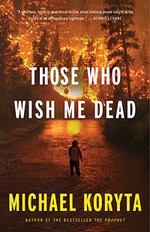
Those Who Wish Me Dead by Michael Koryta

Those Who Wish Me DeadThose Who Wish Me Dead

by Michael Koryta

Hardcover, 388 pg.
Little Brown, 2014
Read: June 21, 2014

Once Koryta left Lincoln Perry behind and started writing stand-alones, I read one and never got around to the rest — but something about this one drew me in (and it doesn’t look like my typical suspense preference) — and now I’ve got to find time to go back and pick up the three or four I’ve missed. It was just so good.

The elements are all here: characters, plot, pacing, setting. As cliché as some of the characters may be in theory, they really aren’t that in Koryta’s hands — the 13 year-old murder witness, the scarred (emotionally and physically) hero firefighter, the survival expert being pushed beyond his limits, the hapless federal Marshall, the troubled teens on the wilderness survival course, the pair of killers who are possibly creepier and deadlier than Breaking Bad‘s Salamanca Cousins. All of these are drawn sensitively and realistically.

The first couple of chapters were enough to keep you reading, but that’s about it — set up the story, establish the main characters, typical stuff. But it takes almost no time at all to go from that to shut-off-the-phone/ignore-the-wife-and-kids exciting. Gritty, fast-paced, visceral, with a strong sense of character and realism. Exactly what you want in this kind of book.

I don’t know if this particular bit of Montana actually exists — but Koryta gives you a strong enough sense of place that it might as well. From the Serbins’ home, to the trail the teens travel, to Hannah’s look out tower, to the mountain the bulk of the action takes place on, I feel like I could hop in the car, drive a few hours and be right there in the midst of them. Not now, during fire season, obviously — don’t need that level of realism.

Koryta has so many opportunities to drown us in details about the backstory of the characters — which is not to say that he doesn’t give us enough to get to know these people. But most authors would’ve given us a lot more about the history of everyone — particularly Ethan and Allison. He hints at things, the characters are still acting in response to what’s gone on before these events, but we’re only told a bit more than we need to know. His restraint is commendable, and only adds to the immediacy of the action and the pace.

From the point where Koryta kicks things into high gear to the gut-wrenching climax, this is an edge-of-your-seat thriller that delivers exactly what it promises — action, suspense, and as much entertainment as you can squeeze into just under 400 pages. How good was it? Just writing this up has whet my appetite for a re-read.

—–

4 Stars

The Rise & Fall of Great Powers by Tom Rachman

The Rise & Fall of Great PowersThe Rise & Fall of Great Powers

by Tom Rachman

Hardcover, 384 pg.
The Dial Press, 2014
Read: July 15 – 19, 2014

He raised his menu.
She consulted hers. “You don’t like sweet-and-sour, do you.”
“No,” he confirmed. “I want food that can make up its mind.”

I had a real difficult time connecting to the people, the story, this book — but early on, I came upon this exchange between a man and a young girl — Tooly, the protagonist. That was enough to keep me going — that, and Rachman’s previous work, The Imperfectionists.

There are three storylines running through most of this book — Tooly in 1988, Tooly in 1999, and Tooly in 2011. We see her as a child, still growing up; we see her all grown, but still figuring out her place in the world; and then as an established adult who’s made a place in the world — but she’s still expecting/looking for the same one she tried to find in ’99.

I spent most of the novel not really sure where any of these stories were going — maybe 2/3 of it. It didn’t take me too terribly long to come to the conclusion I wouldn’t be sure for awhile, so I decided to just enjoy the ride. Which was so easy to do — Tooly spent her life surrounded by a great menagerie of people — Paul, a traveling computer technician working for various U.S. embassies in the 80s; Venn, a very charming con man; Humphrey, a Russian ex-pat and armchair intellectual; Fogg, a small-town bookseller; Sarah, a — I don’t know how to describe her, a histrionic woman with a short attention span (I guess, you eventually learn a lot more); a lout of a lawyer (whose name escapes me at the moment), who really isn’t that much of a lout; and others. It doesn’t matter what they’re talking about, you want to hear them talk, you want to see the interactions between these people and each other, or these people and Tooly. The actual plot seems secondary as long as you get bits of conversation like this (like the above quotation, this is from 1988’s story):

“I know exactly what you’re like,” Sarah affirmed.
After a long pause, Tooly responded, “What are you like?”
“Me? Well, I like bread with strawberry jam and believe raspberry jam ruins everything. I think those who joke around with such matters are barbarians. And I’m right about everything. Except in the morning, when I’m wrong.”

Each chapter moves the various stories along, bit by bit — and you get one or two strange encounters between Tooly and the other characters, you hear some strange theory about the way the world works, or how someone decides to do something, or some scheme to make sense of it all — and I can’t describe it for you better than that — just give it a read.

Eventually, Rachman decides to let you see the pattern he’s stitching — and then it all comes together, each piece falling into place and while there was no way to see all of it coming, it all feels like it fits. Not a “ohh, sure, I should’ve guessed that;” but “well, naturally — there was really no other way for that to work, was there?”

For Fogg, Humphrey, and Tooly (and most of the other characters to some extent) books are a vital part of their existence — or at least their way of thinking. They’re how they connect to the world, to people, to their experience. The various ways the characters interact with, describe, and use books are just fascinating and are right up my alley. Just for exposure to the various things this novel says about books, it’s worth slogging through all the “what’s going on?” of this read.

For example — shortly after young Tooly first meets Humphrey, she asks to see his books (he always has stacks by him, but they keep changing, so she knows he has a stash somewhere). He takes her to a closet bursting with books.

“Books,” he said, “are like mushrooms. They grow when you are not looking. Books increase by rule of compound interest: one interest leads to another interest, and this compounds into third. Next, you have so much interest there is no space in closet.”
“At my house, we put clothes in the closets.”
He sneered at this misapplication of furniture. “But where you keep literature?”

That compound interest line is a great one, isn’t it?

The Rise & Fall of Great Power is a lovely little book I can’t really talk about without over explaining. Filled with great characters; plausible, yet implausible events: an embarrassment of riches when it comes to quotable lines; interesting philosophies; stacks of books; and a dash of hope mixed a hint of existential despair. More than worth your time.

—–

4 1/2 Stars

The Silkworm by Robert Galbraith

The Silkworm (Cormoran Strike, #2)The Silkworm

by Robert Galbraith
Series: Cormoran Strike, #2

Hardcover, 455 pg.
Mulholland Books, 2014
Read: July 2 – 5, 2014

Cormoran Strike is back, and I couldn’t be much happier. After the events described in The Cuckoo’s Calling, Strike’s enjoyed a few minutes of fame — a degree of notoriety with the police, and a profile big enough to land him bigger clients, plus his fair share of would-be clients with a weak grasp on reality and/or not a lot of money. Leonora Quine certainly appears to be in the latter camps when she comes to hire Strike to find her missing husband — but he sees an opportunity to collect eventually, and he likes her. The missing husband, Owen Quine, is a writer of some measure of success and renown. He’s been known to disappear for a few days every now and then, but this time seems longer, and with a special needs child at home, Leonora needs her husband back. Something’s fishy, and his soon-to-published next book is at the heart of it. While juggling his other clients — the ones with large checkbooks — Strike starts poking around, and it doesn’t stay a missing person’s case for long.

Cormoran Strike continues to be reminiscent of several mystery fiction types and specific characters — yet he still feels mostly fresh. There’s your typical hard-boiled loaner (Spillane, Spenser, Marlowe, Cole, etc.), the armed services background (same list, come to think of it), the troubled family history, and so on. There were a couple of detectives that I kept coming back to this time around (and I’m probably alone in this, I realize). Strike’s musings on the way he still works like he did in SIB removed me of the way Danny Boyle talks about John Ceepak. It’s odd to see the two ex-military men in the same light, while on opposite sides of the Atlantic. Yet, it’s also incredibly fitting. Strike and Robin also remind me a great deal of Yancey’s Highly Effective Detective and his assistant. Except Strike actually is highly effective.

The description of Quine’s new book in question was fantastic — it is not a book I want to read, in any shape or fashion, but I really enjoyed reading about it. Galbraith is able to give us enough to get the idea without having to take the time to compose another book in the process — very well done there.

This is slow, yet deliberately moving (like the protagonist, really) until it doesn’t need to be any more — once the pieces are in place and it’s time to reveal and trap the killer, then it moves on at a brisk clip and forces the reader to pick up the pace, too (or at least it felt that way). But it never drags, never meanders — it’s always on point, and is building to something.

It’s tough to say that Strike develops much over the course of this book — we grow in our understanding of him, but he’s pretty much the same man at the end. Not so for Ellacot — she grows and becomes stronger throughout, and its only a matter of time before she’s going to be a 50-50 partner in the agency, I bet — and maybe Strike’s partner in other ways, too. I’m looking forward to watching Galbraith develop this character more in the books ahead, but I can tell I’m already getting impatient for it to happen, rather than trusting him and his timeframe. The other supporting characters not involved in Quine’s disappearance are great additions and make everything better, helping us understand the characters more (e.f., Strike’s family, Ellacot’s family — still not the fiancée, Strike’s old friends).

The biggest selling point (for me) with this book is an intangible quality — a je ne sais quoi — about one-third of the way in I noted I was enjoying it. It was a good, solid detective novel — but in a real sense, nothing I hadn’t seen before. Yet — I noticed I was really “into” the book. I couldn’t explain why I was invested as much as I was — but my goodness, I was in whole hog. I have to chalk it up to Rowling’s super power — she can tell a story that grabs you in a way you just can’t explain. If you’ve read her, you know the effect.*

As I read the last couple of paragraphs and closed the book I noticed something — I was smiling. Not a usual reaction for me as I complete a book, no matter what it is. That has to say something, doesn’t it?

—–

* Unless, of course, she’s talking about a little town called Pagford and its residents. Then there’s nothing at all that will grab you.

—–

4 Stars

Dusted Off: Government Bullies: Americans Arrested, Abused, and Terrorized by Rand Paul

Government Bullies: Americans Arrested, Abused, and TerrorizedGovernment Bullies: Americans Arrested, Abused, and Terrorized

by Rand Paul

Hardcover, 272 pg.
Center Street, 2012
Read: October 16 – 29, 2012

Great read. This book angered me, made me want to change the world, and filled me with despair–certain that things’ll only get worse. Frequently within the same paragraph (if not the same sentence). These tales of bureaucracy run amok should (and likely will) cause any freedom-loving patriot’s blood run cold.

I can see where a lot of people would get tired of Paul bringing himself into the book as often as he does–as a candidate or Senator. But honestly, it’s only as Senator/candidate that Paul gets this information, gets this perspective. Besides, he’s got to look toward re-election and this is part of his work earning that.

—–

4 Stars

Dusted Off: Dirty Martini by J. A. Konrath

Dirty Martini (Jack Daniels Mystery, #4)Dirty Martini

by J.A. Konrath

Hardcover, 292 pg.
Hyperion, 2007
Read: October 15, 2012

Not that I had a lot of complaints (or any, really) with Jack Daniels #2 & #3, but this one seems fresher, tougher, more clever. Jack gets herself into some really hairy territory here. I’ll be honest, I thought I had it figured out right up to the point where the bad guy’s identity was revealed–and couldn’t have been more wrong.

There were a couple of new characters introduced here, one of which was so over the top and annoying I was dreading reading on. But Konrath knew what he was doing after all, shame on me.

A taught, nail-biter of a read. Good stuff.

—–

4 Stars

Saturday Miscellany — 7/19/14

Odds ‘n ends over the week about books and reading that caught my eye — apparently I spent more time at io9.com than I realized. You’ve probably seen some/most/all of them, but just in case:

    This Week’s New Releases I’m Excited About and/or You’ll Probably See Here Soon a.k.a: Half a King and a couple of other things:

  • Half a King by Joe Abercrombie — one of my favorite epic fantasy writers steps into YA, and it sounds great.
  • Traitor’s Blade by Sebastien de Castell — This one sounds like a good time. Read the Big Idea about it here
  • MindWar by Andrew Klavan — this first installment of the trilogy of the same name may not be my thing, but I’m sure I’ve got a couple of teens who’ll eat it up (as they did his Homelander’s series)
  • The Outsorcerer’s Apprentice by Tom Holt — this sounds like a hoot and a half

All Fall Down by Jennifer Weiner

All Fall DownAll Fall Down

by Jennifer Weiner

Hardcover, 400 pg.
Atria Books, 2014
Read: July 10 – 12, 2014

Out for the day with her daughter, our protagonist encounters a homeless woman about her own age. A few minutes later, on their way to suburbia, she thinks:

I was a world away from the woman we’d seen. That woman — she was what addiction looked like. Not me. Not me.

And that, my friends, is what heavy-handed irony looks like. When Chapter 1 ends this way, you know it’s going to be a rough ride.

I wasn’t sure what to expect out of this one — from the description alone, it was clear that Weiner was going for something out of the norm for her — this wasn’t going to be comedic, not that romantic. Instead it’d be dark, dealing with a very serious subject matter. The prose wouldn’t be as breezy, the character probably wouldn’t be that likeable. Sounded good to me — I wanted to see how she could pull it off. It’d be different, but I figured she could (and I welcomed that). Would this be the thing that got her that literary cred she seems to be looking for?

It was a valiant effort. But it just didn’t work for me.

She was close though. Really close. Which just served to underline how she didn’t reach her goal.

Allison Weiss (who I couldn’t help but seeing as an out-of-shape version of Orphan Black‘s Alison Hendrix) is a mom (of an impossible child), a successful blogger (possibly too successful to believe), wife, daughter of a man in early stages of Alzheimer’s, and a pill-popper in deep denial.

Part 1 sets the scene for us — introduces us to the major characters, Allison’s friends, family, and boss — and her pills. Part 2 shows how the wheels start to come off for her — in terms of work, her marriage, her family and her addiction. Part 3 gets her into rehab and coming to terms with her problem. Part 4 picks up following that in a rushed wrap-up.

Part 1 was okay enough — it got the job done. Part 2 was rough — it’s hard enough watching a character you like, that you’re invested in run into trouble — but an unsympathetic character surrounded by characters she hasn’t let us get to know well enough to like? It’s just so rough. I had to force myself through this part, knowing that rehab was on the horizon. That part was worse — the rehab facility, clients, workers, counselors — all of that jibed with what I know about rehab facilities and 12-step programs; and even Allison’s reaction seemed textbook. But something about that part bothered me. Maybe because it was all so textbook. Weiner’d done her homework and she let it be shown. But it’s more than that — here was her chance to make us like Allison, see her doing the work she needed to do. For the reader to start to like her. But it didn’t happen.

Part 4 was the worst. In her rush for a conclusion, Weiner left a lot of things hanging. Which isn’t the same as unresolved — I’m not talking about a need to tie everything up in a pretty little bow. Weiner simply abandoned so many things in that it took away from the closure she gave (or at least strongly suggested).

I actually had a laundry list of complaints and problems with this, but I’m going to forgo it. It’d be hard to avoid spoilers and I just don’t think it’d be that interesting to read. Let me just leave it as — I was disappointed in this one and would advise passing on it.

—–

2 Stars

Shield and Crocus by Michael R. Underwood

Shield and CrocusShield and Crocus

by Michael R. Underwood

Paperback, 391 pg.
47 North, 2014
Read: June 26 – July 02, 2014

The level of detail in this world is astounding, it reads like it could be the 4th installment or so in a long-running series — the worldbuilding is just fantastic. I don’t know for a fact that Underwood has the history of Audec-Hal, of these races all mapped out for centuries before, and these characters lives detailed going back to birth — but it reads that way. He seems to know them all that well — but best of all, he doesn’t share all the homework he’s done with you, but you can tell he’s done it. The care, the detail, the intricacy, the strangeness of all of this — I mean strange in a good way, that somehow makes total sense in context — is so impressive. I don’t think I can adequately express my appreciation of the imagination and craft here.

We come into this city which is a shadow of itself — no longer in the heyday of its republic, it’s now a city controlled by competing tyrants. Where the citizens live in a sort of fearful servitude, a new generation being raised to know only this reality, and their elders in danger of forgetting what came before. Now where most writers would put a scrappy insurgency here, made up of soldiers, former government officials, and young ideologues, Underwood zigs instead of zags. Instead? We get the Justice League — or maybe the Justice Society (last time I checked, JSA was more welcoming of elderly heroes) — a band of costumed vigilantes doing what they can to destabilize the tyrants and protect the citizenry.

Right there, that’s enough. I’m in. I’m buying the T-shirts, pre-ordering any sequels, seeking out fanart (feel free to direct me to any shirts or art, btw).

The team’s leader, the Fist Sentinel is a Batman/Blue Beetle (Ted Kord)-esque figure. Getting by on his wits, fists and gadgets (tho’ some of his are magic, something that Batman and Beetle couldn’t say). He’s advanced in years, and doesn’t have much fight left in him, but he’s too stubborn/committed to quit. Then there’s the Shield — a sort-of guardian of the city, a mystic mantle that passes to new bearers after the death of the previous — a literal shield, which gives the bearer increased strength, etc. is the mark of the mantle. The current Shield is the Sentinel’s adopted son — think Captain America dosed by magic instead of revolutionary science. There’s a speedster, a woman with super-strength, someone who can control rocks with her mind, someone with mental powers — and a loosely organized group of mundane types who act as spies.

I’m getting into recapping too much here — this should be enough to whet your appetite. And there’s so much more to say in the setup, the details, the people.

Wonderfully told, well-plotted, well-paced. It’s everything I hoped and expected from Underwood.

But.

I didn’t care about these people. I was curious how things would turn out, I was pulling for The First Sentinel and the Shield. But honestly? I didn’t care about them. I know Underwood is capable of making me care about characters — seemingly effortlessly. But something here was off. I’m able to rave about this as a display of care, skill, and imagination — but there’s a distance between the reader and the characters and I just don’t think he bridged it.

A couple of items other things worthy of note: Both before and immediately upon release, I heard a lot of talk about the map in this book — which seemed a bit odd, but then I saw the map. It is so cool. Possibly the greatest map in the history of fantasy fiction — it’s like nothing you’ve seen before. Underwood states, “It all started with a doodle on the back of a grocery list. Now, rendered by a professional, it is amazing. :)” He’s right. The cover art’s pretty great, too.

Basically, this is a book I admire more than I enjoyed. What Underwood constructed here was fantastic, I just couldn’t connect with it emotionally the way I wanted to (the way I can with most of the people in his Ree Reyes series). His care for the world, for his characters is more than evident. He just didn’t do enough to get me to share that. Your results may vary, you might think I’m out to lunch here. That could be — I still really recommend this novel, just not as strongly as I’d expected to.

—–

4 Stars

Page 573 of 625

Powered by WordPress & Theme by Anders Norén