

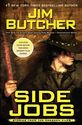
 I’m not big on the short story form. Outside the Nero Wolfe short story collections, I could count on one hand the number of short stories I’ve read in the past 5-10 years. Lately, there’s been a decent number of my favorite Urban Fantasy writers contributing to short story collections–usually on a theme, and usually using characters I really want to read about. But being short fiction, and being surrounded by stories about characters I don’t care about/don’t know/don’t have time to get to know even if I wanted to, I don’t get around to getting my hands on them.
From what I can tell, that’s resulted in me missing some interesting stuff–even the start of a series I’m invested in (maybe more than one, come to think of it, but I’m not going to double check now).
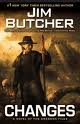
Which is a whole lotta rambling set up to saying why I was very happy to hear that Jim Butcher was going to release a collection of previously published and new Harry Dresden stories. And even happier to get my hands on it last week.
Being short works of fiction, basically every story was this–some sort of problem, Harry investigating rather quickly and then moving right on to the fireworks, usually dazzlingly so. Wham, blam-o, thank you, sir. Each of them also tended to focus on at least one member of the supporting cast in a way we don’t get enough of in the novels. I really appreciated getting to spend a little time with each of these people in this setting.
It was, admittedly, a mixed-bag. The first story, “Restoration of Faith,” was the first Dresden story, and it’s clearly that. There’s a lot to our favorite wizard PI that is recognizable here, and a lot that get’s tossed before Storm Front. A fun read, but I’m glad Butcher tweaked things the way he did.
The rest were better executed–mostly because Butcher’s grown a lot as a writer since then, all were good reads, some better than others.
A couple of other stand-outs for me were the lighter, “Day Off” about Harry’s fruitless quest for a quiet, relaxing day; “The Warrior” in which we get to see post-Small Favor Michael in action–even if it was a tad preachy, Butcher pulled it off, and I was so, so glad to see Michael like this; and “Love Hurts,” which is the kind of story we’ve seen/read countless times about what happens when two will-they/won’t-they friends fall under a spell/temporary delusion/whatever and fall madly, temporarily in love–it’s been done a lot, frequently poorly, but not here.
“Love Hurts” was also a perfect set-up to the novelette Aftermath, which starts up hours after the jaw-dropping/rage-inducing last page of Changes and was, for me, worth the purchase price. If I’d remembered that this was going to be at the end of this collection, I’d have finished the thing in one setting, rather than over a period of days. Great, great story, both for the plot/characters itself, and for what Butcher shows us about how these characters will act without the man in the duster around. Loved it.
Now, this hasn’t convinced me to get these other collections I mentioned earlier–but I just now have hope that some of my other favorite authors will get in gear and publish collections like this one.
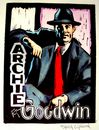 On Oct 23 in Chillicothe, Ohio, Archie Goodwin entered this world–no doubt with a smile for the pretty nurses–and American detective literature was never the same.
 What’s this? Chick Lit here?
 I’ve often felt conflicted about my appreciation for protagonists/leading characters who are murderers–professional hitmen (Peter Brown, Jimmy the Tulip, Martin Blank, Hawk, Jules Winnfield) or serial killers (Dexter Morgan, early Hannibal Lecter), but I can usually get over it because of what their creators do with them. But Angela S. Choi’s Fiona Fi Yu, from Hello Kitty Must Die, doesn’t get to join their ranks in my book. There’s little to commend her, or the book, if you ask me (which is sort of implied if you’ve read this far).
 It takes a certain kind of skill to write a boring book about a character like Zorro, and apparently, Isabel Allende possesses such. It also takes a certain brashness to pronounce your protagonist as “fun” in the first paragraph–and several times following that–and then fail to produce any real evidence of it.
  Victoria Jurgen is an honor student, a budding photographer with a heck of an eye, a social misfit, a movie geek (there’s a correlation of the two), who’s nicknamed herself after a SciFi movie character. All this makes her (a goal for her, a criticism for her mother) “boy proof.”
  Dan Wells has pulled off quite a feat with his debut novel, I Am Not A Serial Killer–he’s written probably the creepiest book I’ve read this year (and since I’ve read 3 Val McDermid novels this year, that’s saying something), but more importantly he got me to care for and root for the creepy protagonist. (I’ll try to stop using forms of the word ‘creepy’ now). He got me to read the book with the hook, and the promised thrill, but he won me over with charm and characters.
 and would like to thank you for one of the best reads I’ve had in months. And by thanks I mean to say that I hope you die a slow, agonizing death. Not anytime soon, mind you, it needs to be after you’ve completed the next novel (if not the whole series). Still, I hope it happens, and I hope you dread its coming.
 Alright, once again, picking up after a pointless break in a surely vain attempt to catch up with my little project, this time looking at the classic, Too Many Women. Like The Silent Speaker, this one gets re-read more than others in my collection, and is still fun to read every time.