Category: Dave Barry Page 1 of 2

Class Clown by Dave Barry: A Chuckle-Filled Peek Behind the Curtain

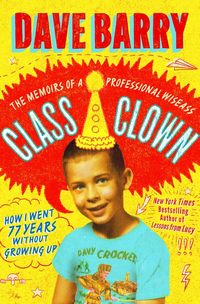
Cover of Class Clown by Dave BarryClass Clown:
The Memoirs of a Professional Wiseass: How I Went 77 Years Without Growing Up

by Dave Barry,

DETAILS:
Publisher: Simon & Schuster
Publication Date: May 13, 2025
Format: eARC
Length: 256 pg.
Read Date: May 4-6, 2025

Buy from Bookshop.org Support Indie Bookstores

What’s Class Clown About?

It’s really all there in the subtitle: it’s Dave Barry’s memoirs about his career as a professional wiseass—primarily through his humor column, but he’s found other outlets for it, too.

Here’s some of the jacket copy to help beef that up:

America’s most beloved wiseass finally tells his life story with all the humor you’d expect from a man who made a career out of making fun of pretty much everything.

How does the son of a Presbyterian minister wind up winning a Pulitzer Prize for writing a wildly inaccurate newspaper column read by millions of people?

In Class Clown, Dave Barry takes us on a hilarious ride, starting with a childhood largely spent throwing rocks for entertainment—there was no internet—and preparing for nuclear war by hiding under a classroom desk. After literally getting elected class clown in high school, he went to college, where, as an English major, he read snippets of great literature when he was not busy playing in a rock band (it was the sixties).

He began his journalism career at a small-town Pennsylvania newspaper where he learned the most important rule of local journalism: never confuse a goose with a duck. His journey then took a detour into the business world, where as a writing consultant he spent years trying, with limited success, to get corporate folks to, for God’s sake, get the point. Somehow from there he wound up as a humor columnist for The Miami Herald, where his boss was a wild man who encouraged him to write about anything that struck him as amusing and to never worry about alienating anyone…

Class Clown isn’t just a memoir; it’s a vibrant celebration of a life rich with humor, absurdity, joy, and sadness. Dave says the most important wisdom imparted by his Midwestern parents was never to take anything too seriously. This laughter-filled book is proof that he learned that lesson well.

His Origin Story

The first four chapters are the most autobiographical part of the book—a little less than 50% of it. Here we cover his parents, his childhood, schooling, and early career—from his first newspaper job, his detour through business education, and then finding his way back to journalism and becoming a humor columnist.

This is all the nitty-gritty stuff—what were his parents like? (nothing like you’d guess) What did his childhood entail? (bad jokes and throwing things) What did he write before making money with booger jokes? And so on.

This was the more educational—in a good way, I stress—part. He wrote about is parents, in particular, with warmth and humanity. He was open about some of their struggles, but with sensitivity. I really appreciated the way he talked about his marriages—past and present—very briefly, yet definitively. There is some humor, but it’s largely self-directed, or at the culture he and his parents were in.

This is really the kind of thing you come to a memoir for, and Barry did it well. He quotes some of his more serious (and some of his less-serious) columns here to show what he’s said about these things in the past.

Topical Memories

A little over half the book is devoted to what I’m describing as “Topical Memories”—he has a chapter on things like “My Readers,” “Politics,” and “Books, Music, and Movies.” In these, he relates a collection of stories and anecdotes from all over his career along these lines.

So we get stories about the great things his readers have sent him—and some of the less positive things they’ve said. Scandals he created—inadvertently or not. How he was involved in Obama’s first inaugural parade, or had Bruce Springsteen sing backup for him, how he accidentally offended an audience of Russians by screening one of his films. I particularly enjoyed him talking about his feud with his Neil Diamond-loving readers (I’m a pretty big Diamond fan, but thought Barry’s jokes were good and deserved, for what it’s worth)

There are several extended quotations from his columns here—and we get a lot of the stories behind the columns, too. Not the nuts-and-bolts of how he wrote them, but what led to them.

If the Origin Story chapters were educational—this was recess. Just a lot of fun and goofing off, telling wild stories and recounting past glories (and blunders). It was exactly the kind of thing that Barry readers pick up his books for.

The Appendix

I don’t frequently talk about appendices; they’re supplemental material, and I prefer to focus on the main portion of the book, but every now and then, one comes along that demands attention.

For example (as you might have guessed), this appendix. It was a hoot—its title is “A Good Name for a Rock Band.” Barry (like many of us) will frequently pick up on a phrase from something he quoted and say it would be a good name for a rock band (also known by the super-easy and memorable acronym WBAGNFARB). After discussing this practice a bit, Barry gives a non-exhaustive, but extensive list of some of those bands.

I think reading them in context is best—but you definitely can appreciate them in a different way with no context whatsoever. They are definitely more ridiculous that way.

It’s worth picking the book up from the shelf at your local bookstore/library just to read those few pages. (Of course, you’d be better served by reading the whole thing). Even people who don’t have a background with Barry will find some laughs there.

So, what did I think about Class Clown?

I’m fairly certain at this point in my life that I’m hardwired to enjoy Davy Barry’s writing, and that I don’t have the neuroplasticity to change that. No matter what apps for seniors I try. So maybe take this with a softball-sized grain of salt.

I really enjoyed this book. A lot—and on several levels.

Part of me would’ve liked a little more depth, a little more digging into details of his life, maybe his approach to writing. But it’d just feel strange knowing that much about Barry—and we all know what happens to a joke when you dissect it, knowing too much about how his sausage is made might not be that entertaining. Really, for Dave Barry—this is about as deep as we want. Every time I started to say “I wish he’d given us more about X,” I stopped myself and realized that no, this was just the right amount.

So no, it’s not as self-revealing as say, Patrick Stewart’s or Matthew Perry’s books—and that’s good.

This is a great way to get to know Barry a little better—given the nature of his work, a lot of us have had a para-social relationship with him before that was a phrase people used. It’s nice for us to deepen that relationship to a degree—before we get back to jokes about exploding cows, questionable song lyrics, or whatever.

I heartily encourage readers of Dave Barry to pick this up—even casual readers will have fun with this, you don’t have to be a die-hard like me. He’s one of a kind, and it’s great to bask in that for a little while.

Disclaimer: I received this eARC from Simon & Schuster via NetGalley in exchange for this post which contains my honest opinion—thanks to both for this.


4 1/2 Stars

This post contains an affiliate link. If you purchase from it, I will get a small commission at no additional cost to you. As always, the opinions expressed are my own.

Irresponsible Reader Pilcrow Icon

REPOST: Lessons From Lucy by Dave Barry: America’s Funniest Human Tries to Learn a Few New Tricks from an Old Dog

I remember reading this in July 2018, thinking that Barry was preparing to say goodby to Lucy. I mention this only because he only said goodbye to her this week. Color me flummoxed. But also, how could I not dust this post off in her memory?


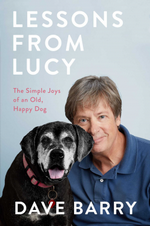
Lessons From LucyLessons From Lucy: The Simple Joys of an Old, Happy Dog

by Dave Barry

eARC, 208 pg.
Simon & Schuster, 2018
Read: July 19, 2018

Before I say anything else, Barry has set up an Instagram page (well, probably not him, actually — he states in the book he doesn’t understand Instagram) for his dog, Lucy. You should absolutely check it out and then come back to read what I have to say about the book. Dog Pictures > my blog. Pretty near always.

With that out of the way . . . Dave Barry has been a dog person for most of his life, one of the many reasons I like him. I distinctly, and fondly, remember columns and/or references to Earnest and Zippy (the emergency backup dog) years ago. Those two make a brief appearance in this book, but they aren’t the focus. The focus (if you can’t tell from the title) is his dog, Lucy. At the time of writing, Barry and Lucy are the same age — 70 (or 7 times 10 in her case), which means that both of them have many fewer days ahead of them than behind — which sounds awfully morbid for Dave Barry to talk about, but he does so frequently and purposefully.

As they’re at similar stages in life, Barry notices a huge difference between the two — Lucy is far happier and seemingly better adjusted than he is. So he sets out to try to learn a few lessons about life from her, which he passes on to his readers. Things like Pay Attention to the People You Love; Don’t Let Your Happiness Depend on Things; and Don’t Stop Having Fun. None of these, Barry knows, are original or ground-breaking — they’re pretty much common sense. Yet, they’re the kind of common sense things that he (like many/most humans) doesn’t actually do a great job at.

The result is a mixture of a Self-Help book and a Humor book — humor about himself, his life, as well as dogs. Sometimes the swing between the two genres can be jarring, but that’s pretty rare. For the most part, he moves easily between the two, taking the readers along with him on this ride. I can’t tell you how many times I went from grinning, chuckling or laughing out loud to getting misty-eyed within a couple of pages. It seems that Barry has learned a little bit about writing over the decades.

I’ve loved Barry’s humor longer than either of us would probably care to admit. One of his strengths is finding a way to take an old joke, or at least a joke everyone’s made before — like, say, I dunno, dogs sniffing each other’s hind-quarters — and make it feel fresh and new. More importantly, funny. He’s also able to make jumps from premise to punchline that no one expects. There is, for example, a Hugh Hefner joke where one doesn’t even come close to belonging — and it works perfectly. Even knowing that, you won’t see it coming until you’re snickering at it.

As for the heart-felt material? It works pretty well, too. I don’t think anyone will walk away from this book thinking “Wow! That was insightful. I never would have thought of it on my own!” Nor do I think Barry was trying for it. But, readers will appreciate the reminders to live like Lucy (or their own dog), and the way Barry phrases things might add some freshness to the concept. Which is all anyone can really ask.

I really don’t know if this is Barry’s best — but it’s up there. The ratio of Attempted Joke to Funny Joke is pretty high, I’m not sure if I can think of a higher one in his ouvre. Lessons From Lucy is, without a doubt, his most mature, thoughtful and touching work (that’s a pretty low bar, I realize — a bar he’s worked hard to keep low, too). Couple that with me being a sucker for a Dog Book — even if it is a semi-Self Help book — and I can’t help but give it 5 Stars. This is a winner, no matter what.

—–

5 Stars

Disclaimer: I received this eARC from Simon & Schuster via NetGalley in exchange for this post — which is my honest opinion and pleasure to give — thanks to both for this.

I’m Curious: What Are Some of the Funniest Books You’ve Read?

I know, I know, this can be a moving target (and should be, depending on where you are in life)…

But I’m still going to ask: What is the funniest, or what books are amongst the funniest, you’ve read? I’m looking over the books I have coming up for the rest of the year, and by and large, we’re talking about some dark reading. I could use some laughs…so help me find an idea or three, will you?

Here’s my rather incomplete answer (that I ripped off from something I told K.R.R. Lockhaven last year). I should probably tweak this list before I publish, but I don’t have the time…

Off the top of my head…
bullet The Hitchhiker’s Guide to the Galaxy by Douglas Adams (well, everything Adams wrote)
bullet Mechanical Failure by Joe Zieja
bullet The Fran Lebowitz Reader
bullet The Android’s Dream by John Scalzi
bullet Heartburn by Nora Ephron
bullet Dave Barry Slept Here by Dave Barry
bullet The Spellman Files by Lisa Lutz
bullet White House Mess by Christopher Buckley
bullet Sir Apropos of Nothing by Peter David
bullet Is Everyone Hanging Out Without Me? by Mindy Kaling
bullet High Fidelity by Nick Hornby
bullet You’ll Never Believe What Happened to Lacey: Crazy Stories About Racism by Amber Ruffin,
Lacey Lamar
bullet The Tales of Pell by Delilah S. Dawson, Kevin Hearne

Incidentally, you should read the entire series of interviews Lockhaven did about humor in fiction–some great things were said, and then there was my entry, too.

I look forward to your recommendations!

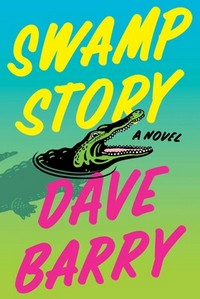
Swamp Story by Dave Barry: Florida. Just say it’s Florida.

Swamp StorySwamp Story

by Dave Barry

DETAILS:
Publisher: Simon & Schuster
Publication Date: May 2, 2023
Format: eARC
Length: 320 pg.
Read Date: April 19-21, 2023


What’s Swamp Story About?

This is hard to summarize, really. Which is part of the beauty of the book.

Most of the characters in this book aren’t what you’d call likable. They’re not really villains or antagonists, they’re just…people you don’t want to spend time with in real life, people with more greed/ambition than common sense (or decency). There are a couple of guys living in a cabin in the Everglades trying to assemble enough footage for a reality show pilot (basically, the good-looking one of the pair walking around shirtless interacting with native wildlife). Their weed dealer owns a failing convenience store/bait shop and has a “so stupid it just might work” plan to put his family’s store on the map. There’s a would-be talent agent (or just anything to ride the coattails of his buddy who happens to make a little money). Oh, and there’s a lawyer and a cabinet secretary/presidential aspirant, too—can’t forget them.

On the villainous side, there’s the weed dealer’s supplier—a former football player who is still large enough to intimidate active linemen who will not tolerate missed deadlines. Two ex-con brothers who are the textbook definition of nasty are also running around. There’s also an Eastern European gangster and some of his employees from the old country who should make everyone quake with fear.

On the likable side, you have the shirtless would-be star’s girlfriend and mother of his child (who really regrets ever giving him the time of day, no matter how pretty he is). The weed dealer’s brother who really needs something to motivate him to do more than play games on his phone, might have found that motivation in her. You’ve also got a couple of aides to the secretary, who really need a better job. An alcoholic ex-reporter desperate to make a buck is just what the weed dealer wants for his idea. I can’t forget either the aging TV reporter desperate to cling to her former relevance or the champion snake hunter.

Put all these characters in a small geographic region, throw in a large amount of buried Confederate gold and a couple of viral videos, shake well, and serve. Swamp Story is the result.

This Book Could’ve Been Shorter

Around the 70% mark (I’m keeping it vague because I don’t know how it’ll go in the final edition), a couple of the characters have an exchange that essentially goes along these lines:

Character A: I hope nothing else happens.
Character B: What else could happen?
Character A: …

and then there’s a map showing the immediate vicinity and some of the major buildings/landmarks of the story, making it very obvious that, based on what we know, all the characters are really near each other and that the likelihood of them running into each other in the very near future is pretty high. The reader will not be able to look at this map and not start imagining how all that running into each other is going to go.

I made a note at this point, that Barry could’ve ended the novel at that point—that exchange, the map, and the reader’s imagination—and it’d have been a fun and satisfying read.

However, odds are, your imagination isn’t as good as Barry’s is (mine sure isn’t), and as zany as I thought things were going to get from this point, the truth was far zanier. His conclusion to the novel (not just the immediate every character and storyline coming together in one spot, but everything that followed) was better than any of the ideas I came up with (and I liked most of my ideas a lot).

Still, there’s part of me that wishes he’d left things with that line and the map. I’d have laughed hard at that.

So, what did I think about Swamp Story?

I really enjoy reading Barry’s novels, and Swamp Story is no exception. It’s a different kind of humor (largely) than Barry’s columns or books, but it’s just as satisfying. I’d want to say that it’s more subtle, but that’s not true at all. There’s more character-based humor, and some of it’s the dialogue—which strikes you differently than the straight humor pieces he’s best known for.

Now, that said, there’s a scene at the beginning—involving a rich child’s birthday party, a couple of costumed performers, and a difficult-to-crack piñata, that absolutely cracked me up and I’ve been replaying it in my head since I read it—it’s perfect slapstick.

Putting aside the humor, all the story arcs worked really well and I can see toned-down versions of all the arcs working well together in a grim version of this story. I’ve argued recently that a good test of a comedic novel is if the plots would work without the laughs—in this case they largely wood. But they’re so much juicer and more enjoyable in this comic and heightened versions.

There are genuine bad guys, some actual threats, several characters in search of a good idea,* and a couple of people you hope catch a lucky break and escape from everything they’re surrounded by relatively intact. Throw in some good laughs, and some clever writing, and you’ve got yourself a fun few hours of reading. That’s likely what the reader looks for in a Dave Barry novel, and that’s what Swamp Story delivers. Strongly recommended.

* Apologies to Pirandello.


4 Stars

Disclaimer: I received this eARC from Simon & Schuster via NetGalley in exchange for this post—thanks to both for this.

This post contains an affiliate link. If you purchase from it, I will get a small commission at no additional cost to you. As always, the opinions expressed are my own.

Catch-Up Quick Takes: Best. State. Ever.; Live Right and Find Happiness; You Can Date Boys When You’re Forty (Audiobooks) by Dave Barry, Dick Hill

I’ve mentioned before here that I think that Dave Barry is just about the funniest writer around—I used to gobble up his stuff in the newspaper and bookstore as quickly as it came out. I’m not sure what changed, but there are a handful of books by him that I haven’t gotten to yet. Thankfully, my Library had a few of them available to listen to last month. Here are a few thoughts about each of them. Quick reminder: the point of these quick takes post to catch up on my “To Write About” stack—emphasizing pithiness, not thoroughness.

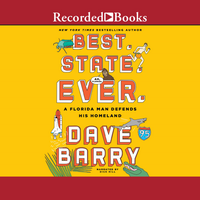
Best. State. EverBest. State. Ever.: A Florida Man Defends His Homeland

by Dave Barry, Dick Hill (Narrator)
Unabridged Audiobook, 4 hrs., and 47 mins.
Recorded Books, 2016
Read: November 21-22, 2019

(the official blurb)
The best parts of this one for me were the introduction (explaining some of the phenomena behind the widespread mockery of Florida) and the chapter giving a history of the state. I chuckled a lot at both of those.

When he moved onto looking at various tourist attractions and or locations in the state, it lost a little bit for me. There was something in each chapter to make me grinmaybe even laugh. But not as much as I’m used to from Barry. The Key West chapter came close, but even that stumbled. I do think if I’d ever been in the state to get a feel for some of these places it might have been better.

The biggest revelation for me from this is just how funny Dick Hill can be. No offense intended, but the voice of Jack Reacher and other thrillers is just not what you think of when it comes to silliness. But man, he was really, really good at this.
3 Stars


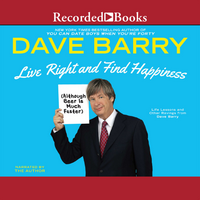
Live Right and Find HappinessLive Right and Find Happiness (Although Beer is Much Faster): Life Lessons and Other Ravings from Dave Barry

by Dave Barry
Unabridged Audiobook, 3 hrs., and 39 mins.
Recorded Books, 2015
Read: November 26, 2019

(the official blurb)
This is more like it: pieces of wisdom (and other things) Barry’s passing on to his daughter and grandson. The driving tips for his daughter were fantastic (not just because my daughter is in the process of getting her license right now). The letter to his infant grandson was funny and touching.

Barry also looks at his parents’ generation (the Mad Men generation) and their ability to party, Google Glass, and a trip to Brazil for the World Cup (not being a sports guy, I didn’t think that last one would do much for me, but it was really funny). Oh, yeah, then he talks in-depth about a trip that he and Ridley Pearson took to Russia to talk about writing.

As much as I liked Dick Hill, Barry’s a better narrator of his own stuff.
3.5 Stars


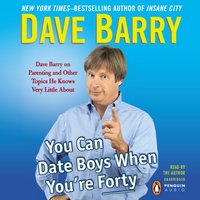
You Can Date Boys When You're FortyYou Can Date Boys When You’re Forty: Dave Barry on Parenting and Other Topics He Knows Very Little About

by Dave Barry
Unabridged Audiobook, 3 hrs., and 22 mins.
Penguin Audio, 2014
Read: November 8, 2019

(the official blurb)
This one ticked all the right boxes for methe stuff about his daughter dating was the kind of thing that fathers everywhere can relate to and second; taking his daughter to a Bieber concert was even better. It was probably not a good idea for me to listen to his chapter about Fifty Shades of Grey at work, thankfully no one asked me why I was laughing (I did not want to have to explain that). Oh, and his funeral instructions were priceless.

Something I wasn’t prepared for was a long piece about a trip his family took to Israel. Listening to Barry juggle travel humor (searching for A/C and Wi-Fi in the midst of historic/cultural wonders), sensitive political discussions, and even getting close to the spiritual was fantastic. It’s not the kind of writing that you often see from Barry, and it’s easy to forget he can be really effective doing things that aren’t just verbal slapstick.

This is probably one of my favorite collections from someone I’ve been reading for decades. This is just great.
4 Stars

2019 Library Love ChallengeHumor Reading Challenge 2019

Pub Day Repost: Lessons From Lucy by Dave Barry: America’s Funniest Human Tries to Learn a Few New Tricks from an Old Dog

Lessons From LucyLessons From Lucy: The Simple Joys of an Old, Happy Dog

by Dave BarryeARC, 208 pg.
Simon & Schuster, 2018
Read: July 19, 2018

Before I say anything else, Barry has set up an Instagram page (well, probably not him, actually — he states in the book he doesn’t understand Instagram) for his dog, Lucy. You should absolutely check it out and then come back to read what I have to say about the book. Dog Pictures > my blog. Pretty near always.

With that out of the way . . . Dave Barry has been a dog person for most of his life, one of the many reasons I like him. I distinctly, and fondly, remember columns and/or references to Earnest and Zippy (the emergency backup dog) years ago. Those two make a brief appearance in this book, but they aren’t the focus. The focus (if you can’t tell from the title) is his dog, Lucy. At the time of writing, Barry and Lucy are the same age — 70 (or 7 times 10 in her case), which means that both of them have many fewer days ahead of them than behind — which sounds awfully morbid for Dave Barry to talk about, but he does so frequently and purposefully.

As they’re at similar stages in life, Barry notices a huge difference between the two — Lucy is far happier and seemingly better adjusted than he is. So he sets out to try to learn a few lessons about life from her, which he passes on to his readers. Things like Pay Attention to the People You Love; Don’t Let Your Happiness Depend on Things; and Don’t Stop Having Fun. None of these, Barry knows, are original or ground-breaking — they’re pretty much common sense. Yet, they’re the kind of common sense things that he (like many/most humans) doesn’t actually do a great job at.

The result is a mixture of a Self-Help book and a Humor book — humor about himself, his life, as well as dogs. Sometimes the swing between the two genres can be jarring, but that’s pretty rare. For the most part, he moves easily between the two, taking the readers along with him on this ride. I can’t tell you how many times I went from grinning, chuckling or laughing out loud to getting misty-eyed within a couple of pages. It seems that Barry has learned a little bit about writing over the decades.

I’ve loved Barry’s humor longer than either of us would probably care to admit. One of his strengths is finding a way to take an old joke, or at least a joke everyone’s made before — like, say, I dunno, dogs sniffing each other’s hind-quarters — and make it feel fresh and new. More importantly, funny. He’s also able to make jumps from premise to punchline that no one expects. There is, for example, a Hugh Hefner joke where one doesn’t even come close to belonging — and it works perfectly. Even knowing that, you won’t see it coming until you’re snickering at it.

As for the heart-felt material? It works pretty well, too. I don’t think anyone will walk away from this book thinking “Wow! That was insightful. I never would have thought of it on my own!” Nor do I think Barry was trying for it. But, readers will appreciate the reminders to live like Lucy (or their own dog), and the way Barry phrases things might add some freshness to the concept. Which is all anyone can really ask.

I really don’t know if this is Barry’s best — but it’s up there. The ratio of Attempted Joke to Funny Joke is pretty high, I’m not sure if I can think of a higher one in his ouvre. Lessons From Lucy is, without a doubt, his most mature, thoughtful and touching work (that’s a pretty low bar, I realize — a bar he’s worked hard to keep low, too). Couple that with me being a sucker for a Dog Book — even if it is a semi-Self Help book — and I can’t help but give it 5 Stars. This is a winner, no matter what.

—–

5 Stars

Disclaimer: I received this eARC from Simon & Schuster via NetGalley in exchange for this post — which is my honest opinion and pleasure to give — thanks to both for this.

Lessons From Lucy by Dave Barry: America’s Funniest Human Tries to Learn a Few New Tricks from an Old Dog

Lessons From LucyLessons From Lucy: The Simple Joys of an Old, Happy Dog

by Dave Barry

eARC, 208 pg.
Simon & Schuster, 2018
Read: July 19, 2018

Before I say anything else, Barry has set up an Instagram page (well, probably not him, actually — he states in the book he doesn’t understand Instagram) for his dog, Lucy. You should absolutely check it out and then come back to read what I have to say about the book. Dog Pictures > my blog. Pretty near always.

With that out of the way . . . Dave Barry has been a dog person for most of his life, one of the many reasons I like him. I distinctly, and fondly, remember columns and/or references to Earnest and Zippy (the emergency backup dog) years ago. Those two make a brief appearance in this book, but they aren’t the focus. The focus (if you can’t tell from the title) is his dog, Lucy. At the time of writing, Barry and Lucy are the same age — 70 (or 7 times 10 in her case), which means that both of them have many fewer days ahead of them than behind — which sounds awfully morbid for Dave Barry to talk about, but he does so frequently and purposefully.

As they’re at similar stages in life, Barry notices a huge difference between the two — Lucy is far happier and seemingly better adjusted than he is. So he sets out to try to learn a few lessons about life from her, which he passes on to his readers. Things like Pay Attention to the People You Love; Don’t Let Your Happiness Depend on Things; and Don’t Stop Having Fun. None of these, Barry knows, are original or ground-breaking — they’re pretty much common sense. Yet, they’re the kind of common sense things that he (like many/most humans) doesn’t actually do a great job at.

The result is a mixture of a Self-Help book and a Humor book — humor about himself, his life, as well as dogs. Sometimes the swing between the two genres can be jarring, but that’s pretty rare. For the most part, he moves easily between the two, taking the readers along with him on this ride. I can’t tell you how many times I went from grinning, chuckling or laughing out loud to getting misty-eyed within a couple of pages. It seems that Barry has learned a little bit about writing over the decades.

I’ve loved Barry’s humor longer than either of us would probably care to admit. One of his strengths is finding a way to take an old joke, or at least a joke everyone’s made before — like, say, I dunno, dogs sniffing each other’s hind-quarters — and make it feel fresh and new. More importantly, funny. He’s also able to make jumps from premise to punchline that no one expects. There is, for example, a Hugh Hefner joke where one doesn’t even come close to belonging — and it works perfectly. Even knowing that, you won’t see it coming until you’re snickering at it.

As for the heart-felt material? It works pretty well, too. I don’t think anyone will walk away from this book thinking “Wow! That was insightful. I never would have thought of it on my own!” Nor do I think Barry was trying for it. But, readers will appreciate the reminders to live like Lucy (or their own dog), and the way Barry phrases things might add some freshness to the concept. Which is all anyone can really ask.

I really don’t know if this is Barry’s best — but it’s up there. The ratio of Attempted Joke to Funny Joke is pretty high, I’m not sure if I can think of a higher one in his ouvre. Lessons From Lucy is, without a doubt, his most mature, thoughtful and touching work (that’s a pretty low bar, I realize — a bar he’s worked hard to keep low, too). Couple that with me being a sucker for a Dog Book — even if it is a semi-Self Help book — and I can’t help but give it 5 Stars. This is a winner, no matter what.

—–

5 Stars

Disclaimer: I received this eARC from Simon & Schuster via NetGalley in exchange for this post — which is my honest opinion and pleasure to give — thanks to both for this.

Dave Barry’s History of the Millennium (So Far) (Audiobook) by Dave Barry, Patrick Frederic

Dave Barry's History of the Millennium (So Far)Dave Barry’s History of the Millennium (So Far)

by Dave Barry, Patrick Frederic
Unabridged Audiobook, 4 hrs., 29 mins.
Penguin Audio, 2007

Read: April 10, 2017


Back in high school, I worked at a public library (shock, right?), and I kept shelving this book — Dave Barry Slept Here, and eventually succumbed and took it home — several times. I fell in love with Barry’s humor, and read him a lot over the next decade — every book, as many columns as I could find, etc., etc. But I eventually stopped, for no good reason that I can think of (it’s probably not Harry Anderson‘s fault) — and have really only read his novels since then.

Still, when I saw this audiobook on the library’s site, it was an automatic click — without even reading the description. This is essentially a reprinting of his “Year in Review” columns for the first few years of this millennium and a review of the previous 1,000 years of human history.

It was hilarious. Just that simple. There’s nothing more to say, really.

In the beginning Frederic played it straight — which surprised me a bit, but I liked the effect. A serious reading of Barry’s goofiness worked remarkably well. Later on, Frederic seemed to loosen up — he even did a couple of decent impressions. I really enjoyed his work on this.

Yeah, the humor’s a bit dated, but funny is funny. This is a great look back at the early part of the 21st Century (and before). I laughed a lot, remembered a few things, and generally had a good time with this.

—–

3.5 Stars

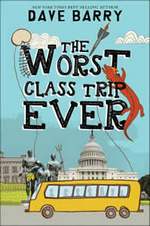
The Worst Class Trip Ever by Dave Barry

The Worst Class Trip Eve

The Worst Class Trip Eve http://www.davebarry.com/book-page.php?isbn13=9781484708491
by Dave Barry

Hardcover, 211 pg.
Disney-Hyperion, 2015

Read: May 19, 2015

There’s not a whole lot to say about this one — this is the story of some of clever (and yet dopey) 8th grade students from Miami on a field trip to Washington, D. C., who fall into a strange predicament involving international intrigue, kidnapping, an attack on the White House/President and very, very petty theft. The only other thing you need to know is that Dave Barry wrote it, so it’s goofy and very funny.

The humor is juvenile — even for Barry. Adults who remember the target audience, and can adjust their standards appropriately, should be able to chuckle at this few times. At the very least, you can appreciate the jokes. It’s perfect for the Middle Grade crowd, probably leaning towards the male perspective (or whatever the demographic is that appreciates flatulence-based humor). This is not to say that all kids won’t enjoy it — it’s just that it’ll score better with kids with a particular sense of humor.

It’s silly, fast-paced, some good action, and some ridiculous characters/plotlines. A lot of fun, definitely what anyone who read Big Trouble should expect from the author writing to MG audience. I’m glad I read it, but I suspect that my 11-year-old will enjoy it more than I did.

—–

3 Stars

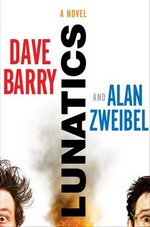
Dusted-Off: Lunatics by Dave Barry, Alan Zweibel

LunaticsLunatics

by Dave Barry
Hardcover, 320 pg.
Putnam Adult,2012

How does one write a book like this? First, you take a couple of characters, that while not exactly people you can meet each day, are close enough that you can buy them as characters in a novel. Then you put them in a relatable, if exaggerated, bad situation. Then you let that situation spin wildly, and hilariously, out of control and right into a worse situation–and let that one spin wildly, and hilariously, out of control and right into another–and repeat. Several times.

If you do that juuuust right, you might come close to capturing the brilliantly wacky madness that is Lunatics.

More than once, I laughed, guffawed, choked, chuckled, cracked-up, cackled, and did a spit-take. I’m sure my wife was as glad I was done with the book as I was disappointed it was over–a day and a half of my very loud reactions to this book were little more than she could tolerate.

Find yourself a nice, secluded little spot and read this. Soon. Sooner, even.

—–

4 Stars

Page 1 of 2

Powered by WordPress & Theme by Anders Norén