Category: A-B Page 8 of 23

Authors A-B

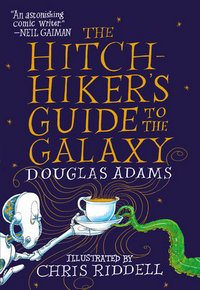
A Quick Look at the Wonderful The Hitchhiker’s Guide to the Galaxy: The Illustrated Edition by Douglas Adams, Chris Riddell (Illustrator)

The Hitchhiker's Guide to the Galaxy

The Hitchhiker’s Guide to the Galaxy:
The Illustrated Edition

by Douglas Adams, Chris Riddell (Illustrator)

Hardcover, 291 pg.
Del Rey, 2021

Grab a copy from your local indie bookstore!

As soon as I picked up this book this weekend, I just knew that I had to talk about it today on Towel Day. And then I sat down to write about this—and I’m not really sure what to say. Anyone who’s read this site much knows how bad I am at describing art. But, what else am I going to talk about today?

For the 42nd Anniversary of the publication of the novel The Hitchhiker’s Guide to the Galaxy, the publishers commissioned noted illustrator and political cartoonist Chris Riddell to tackle this classic. And wow, what a great choice.

Contents

The book starts off with “A Guide to the Guide” a short piece Adams wrote about the series in its various forms shortly after the release of So Long, and Thanks for All the Fish. Then we get the text of the novel—attractively laid out, with illustrations scattered throughout.

One of the best things included in this edition is a large, full-color illustration on the inside cover—it’s a collection of some of the more obscure characters mentioned (largely in passing) throughout the novel—and the book ends with a key to that illustration. Which is just great, I’ll be the first to admit that I didn’t give almost any of these any thought. And now I don’t have to, Chris Riddell did it for me.

Some of the Characters and Scenes Depicted

By and large, the illustrations don’t really match what I had in my head (although the Ravenous Bugblatter Beast of Traal was pretty close), but almost every time I look at one, my reaction is “yeah, he’s nailed it, that’s what _____ should look like.”

I’m not going to go over all of them, but I’ve had a blast flipping back and forth through the book looking at the pictures. The small furry creature from Alpha Centauri (a real one) was adorable, Slartibartfast was…perfect, Marvin looks nothing like the TV show or movie—thankfully. Eddie the Shipboard Computer is odd, but I can buy it. Eccentrica Gallumbits looks, well, you know. Trillian’s mice and (particularly in their native universe) and The Heart of Gold was just great. Deep Thought was another surprise but absolutely worked. Gag Halfrunt looks just like a private brain-case specialist should look. Last, but not least, the falling sperm whale and the poor bowl of petunias got a two-page spread, and I’d absolutely love to have a print on my wall of it.

Trillian

My biggest beef about the book is the small number of illustrations of the core characters—I liked what I saw, but we really only got more than one illustration of Trillian (although Zaphod, or should I say…Phil? is in the background).

I’m sure most of us can figure out why they’d include another picture of the attractive mathematician and astrophysicist, rather than the bumbling human, the two-headed egomaniac, the oddball researcher, or the morose android.

Some examples

So, I wasn’t really sure what I could get away with as far as showing samples from the book, so I didn’t want to just take some pictures of a few of the illustrations (besides, it’s clear that my photographic ability isn’t that great). But I was able to find this drawing for some original art to celebrate the publication. The art shown isn’t exactly what you find in the book (the book version of Prostetnic Vogon Jeltz, for example, is far more disgusting), but these sketches give you an idea of what you’ll find here. That’s about the best I can do.

It’d take a lot for me not to like an edition of this novel, I realize, but I absolutely love Riddell’s work on this. Which is great for me—if I’m going to bring another edition into my house, it’d better be great. It is, the illustrations capture the feel and flavor of the novel, and make it feel fresher. I strongly recommend it for fans new, old as well as those who are still on the verge of being fans.

This post contains an affiliate link. If you purchase from it, I will get a small commission at no additional cost to you. As always, opinions are my own.

Towel Day ’21: Do You Know Where Your Towel Is?

(actually updated and slightly revised this 5/25/20!)

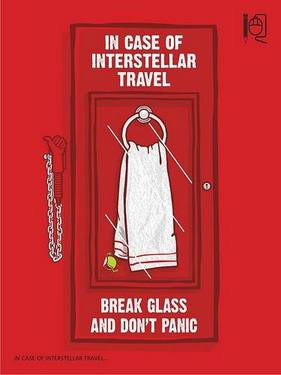
The Hitchhiker’s Guide to the Galaxy has a few things to say on the subject of towels.

A towel, it says, is about the most massively useful thing an interstellar hitchhiker can have. Partly it has great practical value. You can wrap it around you for warmth as you bound across the cold moons of Jaglan Beta; you can lie on it on the brilliant marble-sanded beaches of Santraginus V, inhaling the heady sea vapors; you can sleep under it beneath the stars which shine so redly on the desert world of Kakrafoon; use it to sail a miniraft down the slow heavy River Moth; wet it for use in hand-to-hand-combat; wrap it round your head to ward off noxious fumes or avoid the gaze of the Ravenous Bugblatter Beast of Traal (such a mind-bogglingly stupid animal, it assumes that if you can’t see it, it can’t see you); you can wave your towel in emergencies as a distress signal, and of course dry yourself off with it if it still seems to be clean enough.

More importantly, a towel has immense psychological value. For some reason, if a strag (strag: non-hitch hiker) discovers that a hitch hiker has his towel with him, he will automatically assume that he is also in possession of a toothbrush, face flannel, soap, tin of biscuits, flask, compass, map, ball of string, gnat spray, wet weather gear, space suit etc., etc. Furthermore, the strag will then happily lend the hitch hiker any of these or a dozen other items that the hitch hiker might accidentally have “lost”. What the strag will think is that any man who can hitch the length and breadth of the galaxy, rough it, slum it, struggle against terrible odds, win through, and still knows where his towel is is clearly a man to be reckoned with.

Hence a phrase that has passed into hitchhiking slang, as in “Hey, you sass that hoopy Ford Prefect? There’s a frood who really knows where his towel is.” (Sass: know, be aware of, meet, have sex with; hoopy: really together guy; frood: really amazingly together guy.)

Towel Day, for the few of who don’t know, is the annual celebration of Douglas Adams’ life and work. It was first held two weeks after his death, fans were to carry a towel with them for the day to use as a talking point to encourage those who have never read HHGTTG to do so, or to just converse with someone about Adams. Adams is one of that handful of authors that I can’t imagine I’d be the same without having encountered/read/re-read/re-re-re-re-read, and so I do my best to pay a little tribute to him each year, even if it’s just carrying around a towel.

Some time in 7th or 8th grade (I believe), I was at a friend’s house—his brother let us try his copy of the text-based Hitchhiker’s Guide game, and we were no good at it at all. His brother had a copy of the novel, however, and we all figured that the novel held the keys we needed for success with the game (it did not). It was decided that I’d be the one to read the book and come back in a few days as an expert. Adams’ irreverent style rocked my world—could people actually get away with saying some of these things? His skewed take on the world, his style, his humor…and a depressed robot, too! It was love at first read. One of those experiences that, looking back, I can say shaped my reading and thinking for the rest of my life (make of that what you will). If carrying around a (massively useful) piece of cloth for a day honors his memory? Sure, I’m in.

One of my long-delayed goals is to write up a good all-purpose Tribute to Douglas Adams post, and another Towel Day has come without me doing so. Belgium.

Next year . . . or later. (he says for at least the 7th straight year, a work ethic I like to believe Adams would recognize).

In the meantime, here’s some of what I’ve written about Adams. A couple of years back, I did a re-read of all of Adams’ (completed) fiction. For reasons beyond my ken (or recollection), I didn’t get around to blogging about the Dirk Gently books, but I did do the Hitchhiker’s Trilogy:
bullet The Hitchhiker’s Guide to the Galaxy
bullet The Restaurant at the End of the Universe
bullet Life, The Universe and Everything
bullet So Long, and Thanks For All The Fish
bullet Mostly Harmless
bullet I had a thing or two to say about the 40th Anniversary of The Hitchhiker’s Guide to the Galaxy
bullet (this link will go live later in the morning of 5/25/21) I took a look at the 42nd Anniversary Illustrated Edition of The Hitchhiker’s Guide to the Galaxy
Also, I should mention the one book Adams/Hitchhiker’s aficionado needs to read is Don’t Panic by Neil Gaiman, David K. Dickson and MJ Simpson. If you’re more in the mood for a podcast, I’d suggest The Waterstones Podcast How We Made: The Hitchhiker’s Guide to the Galaxy—I’ve listened to several podcast episodes about this book, and generally roll my eyes at them. But this is just fantastic. Were it available, I’d listen to a Peter Jackson-length version of the episode.

I’ve only been able to get one of my sons into Adams, he’s the taller, thinner one in the picture from a few years ago.

TowelDay.org is the best collection of resources on the day, recently posted this pretty cool video, shot on the ISS by astronaut Samantha Cristoforetti.

Even better—here’s an appearance by Douglas Adams himself from the old Letterman show—so glad someone preserved this:

Love the anecdote (Also, I want this tie.)

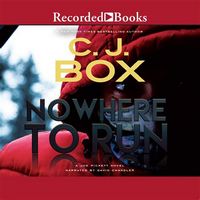
Below Zero (Audiobook) by C. J. Box, David Chandler: Joe Pickett’s 9th Adventure is Almost Impossible to Believe

Before you read on—if you haven’t read the third book in the Joe Pickett series, Winterkill, you probably shouldn’t read anything else in this post. Really, it’s impossible for me to not ruin Winterkill and talk about this book.


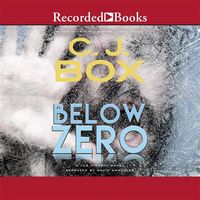
Below Zero

Below Zero

by C. J. Box, David Chandler (Narrator)
Series: Joe Pickett, #9

Unabridged Audiobook, 10 hrs., 22 min.
Recorded Books, 2009

Read: March 24-25, 2021
Grab a copy from your local indie bookstore!


Don’t say I didn’t warn you if you haven’t read Winterkill…

What’s Below Zero About?

Joe Pickett’s daughter starts getting text messages from a very unlikely source: April, her foster sister. The sister that Joe watched die in a fire during a horrific FBI raid on a group of survivalists. Joe and Marybeth are skeptical at first—Sheridan is a little skeptical, but she wants to believe. Eventually, they provisionally accept that it is April texting them and Joe heads off to rendezvous with her.

The difficulty comes with April’s traveling companions—she’s fuzzy on the details, but the men she’s with are hurting people. Joe’s able to construct a path of where they’ve been (where they’re headed is pretty murky, though) and pieces together some sort of motive. The victims have been significant polluters in their own way—and he’s pretty sure that one of the killers is an environmental activist and the child of a notorious mobster, who might have been learning a lesson from his father.

Joe now has two goals—track down the person claiming to be April and see if she really is who she claims to be—and learn how she survived, and stop the killings.

The Balancing Act

Behind the murders stands a discussion about environmental concerns vs. real-world solutions vs. way of life in West. This is a theme of the last few books in the series (probably all of the books, it just feels more pronounced). Generally, when I’ve encountered this kind of thing it’s not dealt with very well—the novel preaches at readers about the environment, an unrealistic solution is approved/implemented, or the whole concern is shrugged off (either because it’s too late to do any good* or because the characters don’t accept the legitimacy of the concerns. I love the way Box does this and I wish more authors would learn from him.

* Yes, I realize that it might be too late, but we’re not going to focus on that right now.

Poor Old Lu

I don’t want to say that I’ve disliked Lucy, Joe’s younger daughter. But I’ve never been taken with her as I have been with the rest of the family. She’s too much like her grandmother I guess. She’s about clothes and nice things, not about wildlife or her family or whatever it is that makes Sheridan an interesting character.

But her reaction to the possibility of April being alive? What’s more, her reaction to Sheridan being the sole point of contact between Joe and April? It just broke my heart. I actually wanted her to get to tag along with her dad and sister for a change. I hope this is a sign of things to come and that I finally get the chance to get invested in the character.

David Chandler

I’ve got nothing to say here that I haven’t said before. Chandler is Pickett in my mind. When the TV series starts, I’m going to be comparing Michael Dorman to him (and I think Dorman’s not going to fare too well).

So, what did I think about Below Zero?

I hated, hated, hated the way that Box brought April back. This isn’t General Hospital or Days of Our Lives, after all. Also, it ruined some of the gut-punch of an ending of Winterkill. But by the end, Box had won me over and convinced me that it wasn’t the worst idea he’d ever had.

I do wonder how the traveling murderer story would have worked without the April aspect—part of me would have liked a closer focus on that. But I don’t know how much I’d have cared about them without April as a point-of-entry into that story.

I’m curious about where Joe and the family go from here. It’s possible I’ll totally get over my antagonism toward the April story within a book or two, it all depends on what Box does from here.


3.5 Stars

2021 Library Love Challenge 2021 Audiobook Challenge

This post contains an affiliate link. If you purchase from it, I will get a small commission at no additional cost to you. As always, opinions are my own.
Blood Trail (Audiobook) by C. J. Box, David Chandler: Who Hunts the Hunters?

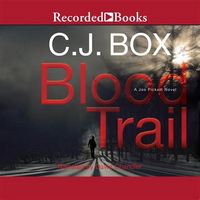
Blood Trail

Blood Trail

by C. J. Box, David Chandler (Narrator)
Series: Joe Pickett, #8

Unabridged Audiobook, 9 hrs, 5 mins.
Recorded Books, 2008

Read: February 10-12, 2021
Grab a copy from your local indie bookstore!

What’s Blood Trail About?

Since Governor Rulon re-hired Joe Pickett and made him sort of a Game Warden-at-Large, his life has improved—he and Marybeth have their own home, no longer living in State housing, or at his father-in-law’s. Nor is he really as subject to the whims of Randy Pope, his director. But there’s a price to be paid for this: he’s pretty much at Rulon’s beck and call.

This time, thankfully, he’s called to his former territory—a hunter has been found dead. It’s the beginning of Elk Season, so it’s not that surprising. But…this isn’t your typical dead hunter. This man has been shot and field dressed like an elk. Joe’s garnered a reputation for stumbling into a solution for things like this, and Rulon needs that quickly—people are getting antsy about the killings and pressure is mounting to cancel Elk Season (which would have horrible consequences on Wyoming’s economy). Joe’s been named to a task force with the FBI, and the local sheriff. Not only are they out to preserve hunting season, but they also need to head off a mounting anti-hunting protest movement that is taking advantage of this situation.

Randy Pope decides that this is important enough that he comes to supervise Joe personally—and takes an oddly active and proactive role in fieldwork (which no one has ever accused him of being fit for). I don’t know about anyone else who reads this series, but there isn’t a time that Randy Pope has been around when I haven’t wanted Joe to punch him in the nose (or Marybeth, or Sheridan even), and that’s taken to the nth degree for most of this book.

So not only does Joe have to find a killer (not really his job, ubt he seems good at it) for political and social reasons, he has to put up with antagonism from local law enforcement who resent his role, get micromanaged by an officious twerp who is even less suited for this than he is, and he ends up having to deal with two individuals from his past that he’d rather expected never to have to deal with again over the course of the investigation. I’m not going to identify these people, but neither Joe or Marybeth are prepared to have them in their lives again, frankly, I wasn’t ready either.

We Should Talk About Nate

I get into a spoiler in a vague way here. Feel free to skip to the next header.

For various and sundry spoilery reasons, Joe decides that he needs Nate Romanowski’s tracking help. Now, Nate’s been in FBI custody for a few months, ever since the FBI double-crossed Joe at the end of Free Fire. Given the urgent nature of things, Rulon is able to finagle a release into Joe’s custody.

And then Nate ditches Joe for days. Joe, the good friend, covers for him (he’s also covering for himself and his own ability to maintain custody). Sure, he ultimately comes back and pitches in. But it’s pretty clear he didn’t need that much time to do his thing—I get that Nate has his own way of working and that Nate isn’t that terribly concerned with people who aren’t him (what does he care if someone’s killing hunters?)—but he should care about his friend and the deal that got him out of custody, right?

I lost a lot of sympathy for Nate here. And a good deal for Joe, too, later in the book when it comes to Nate.

A Low-Stakes Antagonist

Now that Joe lives in town, in a normal house with a yard and no need to consult a government budget officer for upkeep on his home, it falls to Joe to take care of things. He has a neighbor now (I forget his name, one of the hazards of audiobooks is that I can’t look it up easily). This man is retired and is far too concerned with his own yard and upkeep, and carries that over to Joe’s.

We don’t spend a lot of time with him, but it’s easy to see that he’s a burr in Joe’s side—a constant problem, a constant annoyance. Sure, Joe’s off working for the governor and trying to stop a killer, but surely he could take the time to mow his lawn, like a decent citizen.

This book needed a little lightness, and this crank delivers it.

A Word About the Narration

At this point, I really don’t know what to say about David Chandler, he’s great at this.

However, ,I have one thing to say. For most of the book, I assumed the killer was one of two people. And despite the fact that we get the killer’s POV frequently, it was still pretty unclear which one of the two it was (assuming I was right). Until about halfway through in one scene, Chandler makes 1 choice when he reads one line. And we “hear” the character in a voice Chandler would use for that character, not just the generic Killer’s POV voice he’d been using throughout. And then I knew exactly who it was.

I understand why he made that choice. But, man. It ruined things a little bit for me.

So, what did I think about Blood Trail?

This was, hands down, my favorite entry in the series. The tension, the huge character events, the motive for the crime, and the way it ended…I can’t explain all my reasoning without ruining the novel.

But man…this is the standard I’ll be judging books in this series by. Is it going to be that impactful for new readers? No, but it would work as a jumping-on point if you’re not in the mood to read the seven previous books.

Blood Trail is a great entry in this solid series, with entries like this, it’s easy to see why it’s lasted for twenty-one (so far) books. Check it out.


4 Stars

2021 Library Love Challenge 2021 Audiobook Challenge

This post contains an affiliate link. If you purchase from it, I will get a small commission at no additional cost to you. As always, opinions are my own.

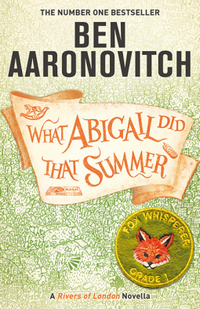
PUB DAY REPOST: What Abigail Did That Summer by Ben Aaronovitch: Peter Grant’s Cousin Searches for Missing Kids

What Abigail Did That Summer

What Abigail Did That Summer

by Ben Aaronovitch
Series: The Rivers of London, #5.7 (or so, I’m not sure how it’ll get numbered)

eARC, 232 pg.
Subterranean Press, 2021

Read: March 1, 2021

There are a few, uh, provisos, a, a couple of quid pro quos.

I almost feel like I need to go back and do a lot of re-reading before writing much about this book. I’d have thought that Abigail’s involvement with the Folly and Peter wasn’t this developed until later in the series.

Also, I know there’s a connection between Abigail and the talking foxes, but I don’t remember exactly when it comes about and how much of this book is Aaronovich filling in the backstory that he just breezes past in one of the novels.

I didn’t feel at a loss for context while reading the book, but I tell you what, I’m feeling it as I try to talk about the novella. So, I guess I’m saying, be nice and forgive any lapses in what’s to come:

What’s What Abigail Did That Summer About?

This novella is set during the events of Foxglove Summer and Peter’s not in London. But never fear, Abigail does talk to Nightingale a couple of times.

Abigail has a strange interaction with someone she used to know and sees someone else acting slightly strangely. She starts, not really investigating, but taking a close look around at everything. Then when the police start asking questions of kids in the park, showing pictures of those same people, she knows something’s up.

Not that she tells the police that, because they’re not going to believe her. She’s told that these children (and others) have gone missing, but then reappear at home, with fuzzy memories of the last couple of days. If Abigail, she thinks, with the help of some of the local talking foxes, can figure out what’s going on, she can point Nightingale in the right direction—which might help convince him that she’s ready for training.

But mostly, Abigail’s curious about what’s happening and has to figure it out.

Postmartin’s Contribution

Abigail’s first-person account is littered with footnotes by the Folly’s archivist, Harold Postmartin. Largely, these footnotes are to explain some of the more slang-y terms Abigail uses (although sometimes it’s a more technical note). He seems to go to great lengths to make sure that American readers can get what she’s saying. I halfway wonder if in UK editions those notes have differences.

I think I could’ve worked out the terms I wasn’t already familiar with, but the footnotes were entertaining enough that it doesn’t matter if I could’ve. This was a better way to deal with it.

So, what did I think about What Abigail Did That Summer?

This is absolutely a Folly-story, one that belongs in this series, but there’s no way that Peter Grant was the right character to use for this story, Aaronovich needed to use someone like Abigail to tell this, conveniently enough, there she was. She has a different way of thinking than Peter—and while there’s humor to her narration, it’s not the same as Peter’s (even if it’s occasionally similar). Seeing things from her perspective, it’s a great way to see how she’s similar to her cousin, while very much being her own person.

Frequently, with novellas, I walk away wondering why couldn’t we get a full novel out of it? This isn’t one of those times—the story is as long as it needs to be—it’s complex and satisfying. Also, we get a lot of development out of Abigail and get a better degree of understanding of her than we’ve had before.

That said, there are just so many things I want to know more about, but just making this novel-length wouldn’t take care of it. For example, we learn right off the bat that there’s something…different…about Simon’s mom—and Aaronovich teases us with a couple of more things. I want more of this. I want to know just what it is that Abigail’s doing for her. I want more adventures with Abigail and the foxes.

I’ve always wanted to see more Abigail in the novels—this underscores that for me.

In short, this was a fun story—a strange one at times, but fun—that makes me more curious about a character I already enjoyed, but now I want more of her—both on her own (like this) or in the main novels. I had a similar reaction to the novella The October Man, too. Although that probably is my reaction to anything in this universe (at least so far)—”I enjoyed that, can I have more like it?”

This would be an interesting jumping-on point for the whole series—I’m not sure I’d recommend it, but it might be enough to convince you to dive into the rest.

Disclaimer: I received this eARC from Subterranean Press via NetGalley in exchange for this post—thanks to both for this.


3.5 Stars

What Abigail Did That Summer by Ben Aaronovitch: Peter Grant’s Cousin Searches for Missing Kids

What Abigail Did That Summer

What Abigail Did That Summer

by Ben Aaronovitch
Series: The Rivers of London, #5.7 (or so, I’m not sure how it’ll get numbered)

eARC, 232 pg.
Subterranean Press, 2021

Read: March 1, 2021

There are a few, uh, provisos, a, a couple of quid pro quos.

I almost feel like I need to go back and do a lot of re-reading before writing much about this book. I’d have thought that Abigail’s involvement with the Folly and Peter wasn’t this developed until later in the series.

Also, I know there’s a connection between Abigail and the talking foxes, but I don’t remember exactly when it comes about and how much of this book is Aaronovich filling in the backstory that he just breezes past in one of the novels.

I didn’t feel at a loss for context while reading the book, but I tell you what, I’m feeling it as I try to talk about the novella. So, I guess I’m saying, be nice and forgive any lapses in what’s to come:

What’s What Abigail Did That Summer About?

This novella is set during the events of Foxglove Summer and Peter’s not in London. But never fear, Abigail does talk to Nightingale a couple of times.

Abigail has a strange interaction with someone she used to know and sees someone else acting slightly strangely. She starts, not really investigating, but taking a close look around at everything. Then when the police start asking questions of kids in the park, showing pictures of those same people, she knows something’s up.

Not that she tells the police that, because they’re not going to believe her. She’s told that these children (and others) have gone missing, but then reappear at home, with fuzzy memories of the last couple of days. If Abigail, she thinks, with the help of some of the local talking foxes, can figure out what’s going on, she can point Nightingale in the right direction—which might help convince him that she’s ready for training.

But mostly, Abigail’s curious about what’s happening and has to figure it out.

Postmartin’s Contribution

Abigail’s first-person account is littered with footnotes by the Folly’s archivist, Harold Postmartin. Largely, these footnotes are to explain some of the more slang-y terms Abigail uses (although sometimes it’s a more technical note). He seems to go to great lengths to make sure that American readers can get what she’s saying. I halfway wonder if in UK editions those notes have differences.

I think I could’ve worked out the terms I wasn’t already familiar with, but the footnotes were entertaining enough that it doesn’t matter if I could’ve. This was a better way to deal with it.

So, what did I think about What Abigail Did That Summer?

This is absolutely a Folly-story, one that belongs in this series, but there’s no way that Peter Grant was the right character to use for this story, Aaronovich needed to use someone like Abigail to tell this, conveniently enough, there she was. She has a different way of thinking than Peter—and while there’s humor to her narration, it’s not the same as Peter’s (even if it’s occasionally similar). Seeing things from her perspective, it’s a great way to see how she’s similar to her cousin, while very much being her own person.

Frequently, with novellas, I walk away wondering why couldn’t we get a full novel out of it? This isn’t one of those times—the story is as long as it needs to be—it’s complex and satisfying. Also, we get a lot of development out of Abigail and get a better degree of understanding of her than we’ve had before.

That said, there are just so many things I want to know more about, but just making this novel-length wouldn’t take care of it. For example, we learn right off the bat that there’s something…different…about Simon’s mom—and Aaronovich teases us with a couple of more things. I want more of this. I want to know just what it is that Abigail’s doing for her. I want more adventures with Abigail and the foxes.

I’ve always wanted to see more Abigail in the novels—this underscores that for me.

In short, this was a fun story—a strange one at times, but fun—that makes me more curious about a character I already enjoyed, but now I want more of her—both on her own (like this) or in the main novels. I had a similar reaction to the novella The October Man, too. Although that probably is my reaction to anything in this universe (at least so far)—”I enjoyed that, can I have more like it?”

This would be an interesting jumping-on point for the whole series—I’m not sure I’d recommend it, but it might be enough to convince you to dive into the rest.

Disclaimer: I received this eARC from Subterranean Press via NetGalley in exchange for this post—thanks to both for this.


3.5 Stars

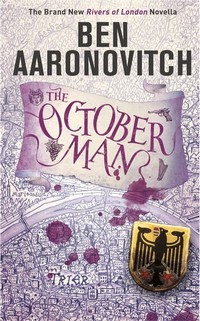
REPOST: The October Man by Ben Aaronovitch: Meeting Peter Grant’s German Counterpart

The last of the “I’m too tired to post about What Abigail Did That Summer” inspired reposts. I’m revisiting this one because it’s another Subterranean Press Rivers of London book that could inspire an entire non-Peter Grant-focused series.


The October ManThe October Man

by Ben Aaronovitch
Series: The Rivers of London, #7.5

Hardcover, 208 pg.
Subterranean Press, 2019
Read: June 19 – 21, 2019

So about the time that the one German Magic Practitioner hears that Nightengale has taken on an apprentice in Peter Grant, she decides that it’s time for Germany to do the same — keeping the playing field level, and all — she finds that apprentice in a second generation police officer, Tobias Winter. We meet Tobias a few years into things when he’s called away from leave time to investigate something that may be supernaturally related.

He recognizes vestigia right away — although I think the manner of death would be a pretty big tip off, no matter what. A mysterious fungal rot that covers him in precisely the way that fungus doesn’t cover people. I can’t do justice to how creepy it sounds when Tobias narrates it for us — you’ll have to read it.

Tobias is teamed up with Vanessa Sommer, a local police officer who knows the area, knows a bit about the particular fungus, and is super-curious about magic. Naturally, there’s an encounter with a River or two, and an interesting take on regional history — because this is a Rivers of London novel, what else are you going to get?

It’s a quick read with great story and the kind of people that Aaronovich fills his books with — these just happen to speak German and look at things in a different way from Peter and those he usually runs with — Tobias isn’t as funny as Peter, but he’s amusing to read and handles things in ways that Peter doesn’t. Still, at the end of the day, Peter’d be happy getting the same result (and probably would be jealous how little property damage that Tobias inflicts before wrapping up the investigation).

We’ve been given glimpses of what Nightengale and his fellows got involved in during WWII, but here we get more details — from the German point of view. It’s always been clear that happened wasn’t pretty — but I didn’t realize just how devastating it was until now. It’s also interesting to see just how significant it was for Nightengale to make Peter an apprentice. He essentially kicked off an international magical arms race (of sorts). Don’t get me wrong, the main point of this book is to be introduced to new characters, to see how magic is dealt with somewhere that isn’t London — but man, what we learn about things in London is fascinating.

I don’t know how this qualifies as a novella — even a “long novella,” as I’ve seen it marketed. I have several novels within reach of me right now that are smaller than this. It’s a semantic thing, but book nerds are supposed to be into words — so I don’t get it. Two hundred eight pages does not mean novella to me. If someone can explain it (or point to where Aaronovitch or Subterrerean Press explained it already), I’d appreciate it. Just to scratch that intellectual itch.

Aside from what to call this book, I enjoyed it. Tobias is an good character, he’s no Peter Grant, but he’s not supposed to be (in either Aaronovitch’s mind or the German practitioners’). I’d like he and Peter or he and the Nightengale to brush up against each other — or to have extended contact (like FBI Agent Reynolds and the Folly have had). If Aaronovitch decides on writing another novella/novel/adventure with him, I’d jump on it. But I’m not going to be waiting expectantly — if he doesn’t want to write another (or sales don’t justify it), I can be satisfied with just this much that we’ve been given here.

This’d be a great jumping on point for someone who wants to get a feel for the Rivers of London and Aaronovitch’s style. It’s also a great way for devoted fans of that series to dabble in something new, get a fresh perspective and realize that Peter Grant’s world is smaller than he realizes — while enjoying a creative and fun story.

—–

3 Stars

Tales from the Folly by Ben Aaronovitch: Entertaining Quick Dips into the Rivers of London

I’m reposting this one because I thought of it during What Abigail Did That Summer because Abigail gets to shine a little bit in this collection—and because it was short Rivers of London stories, just like the (fairly long) novella).


Tales from the Folly

Tales from the Folly: A Rivers of London Short Story Collection

by Ben Aaronovitch
Series: The Rivers of London

Kindle Edition, 139 pg.
JABberwocky Literary Agency, Inc., 2020

Read: August 1-3, 2020


If asked, I’d have thought I posted about this book weeks ago, so imagine my surprise this past weekend when I saw this title still on my “To Be Written” list when I was checking for something else. Better late than never…

What are the Tales from the Folly?

The subtitle pretty much gives it away, really. These are shorter works set in the Rivers of London series. The Folly is the unofficial name for the recognized British magical organization, following in the first formal study of magic made by Sir Isaac Newton (no known relation, but that doesn’t stop me from claiming him as an uncle), it’s currently formally organized as the Special Assessment Unit of the Metropolitan Police. The Folly is also the nickname for their headquarters. Either use works for this collection.

There are seven short stores (or one novella and six short stories) told from Peter Grant’s perspective—just like the series. Then there are four stories from the point of view of other characters in the series and three “moments” (Aaronovitch’s term for “something that is more of a mood than a story, something that will last a page or two and conjure an atmosphere).

Peter Grant Stories

Obviously, this is Peter’s series (at least so far…), so he gets the bulk of the space. Most of these take place around the time of the first few books in the series, but at different stages of Peter’s development. I enjoyed them all and most of them are good enough to justify the purchase price on their own.

I can’t put my finger on why, exactly, but the first story “The Home Crowd Advantage” is my favorite. It’s about a French practitioner who got up to no good during the 1948 London Games who revisits the scene of the crime in 2012 when rookie apprentice Peter Grant is the only one around to deal with him.

The last entry in this section is the novella, A Rare Book of Cunning Device that I talked about when it was released as an Audible Original in 2017. It’s rare for me to go from hearing a work to reading it, so it was interesting that way. I enjoyed it just as much this time around, but I think Holdbrook-Smith’s voice is a better one for this series than whatever is echoing around in my skull.

Everyone Else

The fact that Aaronovitch is able to tell stories outside of Peter’s perspective shows the strength of the series in my book, he’s built the world and the characters out enough that they can carry the weight of a narrative for at least a little bit.

We get a story from the perspective of one of the Rivers, one from Abigail’s perspective that will warm the cockles of your heart (and maybe make you a little sad for a bit), a nice one featuring Vanessa Sommer from Germany (making me hope we get back to Germany for another novel soon), the answer about what happened to the River Lugg after Foxglove Summer. Then there are the moments, one featuring Nightengale, one with Reynolds and one with Sommer’s pal Tobias Winter years before The October Man

So, what did I think about Tales from the Folly?

That’s easy, I thought it was great. I’d buy volume 2 tomorrow, and volume 3 next month. If Aaronovitch wrote that quickly, anyway. They’re like the comic series in a way—a nice way to spend some time in this universe without having to put in the time of a novel.

The collection covered the gamut of emotions and types of story typical of the series with Aaronovitch’s evident charm and skill. It’s a must for every Rivers of London fan.


4 Stars

REPOST: Foxglove Summer by Ben Aaronovitch

So the plan was, read What Abigail Did That Summer by Ben Aaronovitch on Monday and post about it Tuesday. What happened was: read What Abigail Did That Summer Monday, do some parenting things and have no energy left for anything else. Whoops. So, I’m going to repost a couple of Rivers of London books I thought of while reading the upcoming novella and we’ll try again tomorrow. This novel explains why Peter wasn’t around to give Abigail a hand (not that she’d have asked for it).


Foxglove SummerFoxglove Summer

by Ben Aaronovitch
Series: The Rivers of London, #5


Mass Market Paperback, 323 pg.
Daw Books, 2015
Read: January 9 – 10, 2014

“Hail the conquering hero,” said Beverly and held up her bottle to clink.
Sic transit Gloria mundi,” I said, because it was the first thing that came into my head — we clinked and drank. It could have been worse. I could have said, “Valar Morghulis” instead.

It’s always a pleasure to spend some time in the pages of a Peter Grant/The Rivers of London novel, but Foxglove Summer is probably the most pleasurable entry in the series since Midnight Riot (The Rivers of London for non-US types). I’m not sure I can put my finger on why that’s the case, but that’s not something I’m going to worry about. Unlike Peter’s mother, who

never saw a gift horse that she wouldn’t take down to the vet to have its mouth X-rayed — if only so she could establish its resale value.

Two young girls have vanished in a small village slightly north of London, and Peter’s sent to make sure that the (supposedly) no longer active wizard in the area had nothing to do with it. Having done so, he decides to stick around and see if he can help with some of the routine/mundane work needed.

Naturally — well, I should say, Supernaturally, it’s not long before The Powers That Be ask him to see if there’s an angle to the case that’s more up his alley than theirs. Peter finds some undeniable evidence of magic at work and things get going from there.

Nothing against London — but loved this breath of fresh air in this novel. For example, Peter’s dealing with different superior officers to not want to deal with magic/supernatural — these don’t have the antagonism that usually shows up in London, they just don’t want anything to do with it. The town is full of interesting types — including traveling fair ride owners, tavern keepers, farmers, and vacationing journalists.

As always with this series, the sheer amount of British Police acronyms and assumed knowledge of structure and procedures are a hurdle many US readers won’t want to try (I’ve been told this by a few who I’ve tried to get to read these books) — it’s a little effort, and easily worth it to overcome.

My major — only? — gripe is that Peter’s not making a lot of progress with his magic, he seems to be pretty much where he was three novels back. Yes, he’s more confident, yes, he’s able to apply his knowledge of magic with some good old-fashioned police ingenuity — but his abilities and skills are still rookie-level. Without Beverly as magic back-up, he’d be in trouble. The two of them — plus one local cop out of his depth, but committed to work — are able to handle things.

Yeah, it was nice not to focus on Lesley and the Faceless One (which isn’t to say their shadows don’t loom over a good chunk of the book), but it’s clear that they’ll be back in a really big way soon. Which I’m looking forward to, as nice as it was to have this mental palate cleanser here. Foxglove Summer was great mix of police procedural, Urban Fantasy and Folklore — both traditional and contemporary (the area’s obsession with UFOs is great) — with Aaronovitch’s deft humor, pop culture references and tight plotting. We’ve got ourselves a winner here.

—–

4 Stars

He Drank, and Saw the Spider (Audiobook) by Alex Bledsoe, Stefan Rudnicki: LaCrosse’s Break from His Vacation Changes History

Like with the previous Eddie LaCrosse audiobook, The Wake of the Bloody Angel, I can’t think of much more to say than I did in 2014 when I read the book. But, this is the last one in the series, and I can’t just let this pass unremarked. So I shuffled it a bit, cleaned a couple of things up, and added bit here and there. That’s not cheating too much, is it?


He Drank, and Saw the Spider

He Drank, and Saw the Spider

by Alex Bledsoe, Stefan Rudnicki (Narrator)
Series: Eddie LaCrosse, #5

Unabridged Audiobook, 9 hrs., 6 min.
Blackstone Audio, 2014

Read: February 16-19, 2021

Grab a copy from your local indie bookstore!

I felt that little knot in my belly that meant a mystery was taking its irrevocable hold. Usually this was a good thing, because usually I got paid for it. But here and now I was on vacation, and the last thing I wanted to do was spend it unraveling the truth of the strange prince, his rotund protector, and the girl I’d once saved from a bear. But damn it, I knew that’s exactly what I was going to do.

What’s He Drank, and Saw the Spider About?

After a couple of adventures that aren’t quite typical in their nature, Eddie La Crosse gets back to basics with a fairly straightforward case. Well, that’s not exactly true—it’s just that the last was more grand-adventure-y, less LaCrosse-as-sword-jokey, and the one before that took on this epic nature by the end. This is Eddie doing what he does best. But still, there’s magic and monsters, and all the other trappings that keep this from being something that Sue Grafton or Dennis Lehane would’ve written.

Sixteen years ago, Eddie promised a dying man on the run that he’d take care of the baby that the other man was running to protect. He found a seemingly-trustworthy family willing to take the infant in, and went on his merry way, and actually forgot all about the incidents surrounding that. Years later, Eddie and his girlfriend, Liz, are on vacation in that area and suddenly it all comes back to him and he decides to try and track down the (now) young woman and see how she’s doing.

Naturally, things start to go poorly about there. He does find her—pretty easily, too—it is a small community, with an economy largely-based on sheep-herding and farming, so it’s not really a bustling metropolis where no one knows anyone else. But there’s a whole lot of interesting things happening around the young woman—royalty in disguise, a meddling sorceress, an untrustworthy mercenary-type, an over-protective mother, a dose of sibling rivalry, and some sort of articulate and super-strong inhuman creature with a healthy interest in the girl.

Even though he was just supposed to check on her and not interfere with her life—he had no intention of even introducing himself to her. Eddie can’t help himself, and before you know it, he’s neck-deep in intrigue and danger.

Biggest Magic Yet

When you think about Fantasy novels (or maybe I should just say “I”, who knows what you think) you think about magic all over the place. But if it’s really that ubiquitous, that takes away some of the special-ness of magic. In LaCrosse’s world, almost no one believes in magic. Eddie sure wouldn’t if magic, deities, and supernatural creatures hadn’t rubbed their existence in his face on repeated occasions.

That’s certainly the case here—most of the people that Eddie is around in this novel (and by most, I mean an overwhelming majority) refuse to admit that what they are seeing—some of them on multiple occasions—has anything to do with magic. I think this is a great choice—it’s another hurdle for Eddie and Liz to get over, it adds some real tension when you’d be tempted to think we’re done with tension, and it keeps the magic mysterious.

Rudnicki’s Narration

I think this is probably Rudnicki’s best work in the series. he nails every character—particularly the character of Billy Cudgel (the aforementioned untrustworthy mercenary-type). He captures the humor, the drunkenness, the misery, the madness, and everything else. I thought the choices he makes in the narration (he and/or the director) and tone were spot-on. He’s definitely a narrator I’m going to seek out in the future.

So, what did I think about He Drank, and Saw the Spider?

On the whole, this is a fun, brisk novel—a lot of humor, some good action, nice banter, and interaction between the characters (especially Eddie and Liz). Yet, even as the answers to the questions surrounding the girl’s mysterious origins become obvious, and some of the characters get to the point where they seemed irredeemable, Bledsoe (as he can every so well) keeps you completely drawn in and even tugs the heartstrings a bit as the truth is revealed to the characters. Just really, really well done.

There’s a lot of nice little touches along the way. For example, towards the end of the book, Eddie and those he’s traveling with encounter a preteen who joins their little band for a while. She’s pretty new to swearing and tries to get in as much practice as she can while with them. At first, I thought she was an odd (but entertaining) and pointless distraction. It didn’t take too long to see she was a perfect tension-breaker, just what that part of the novel needed to keep from being too tense and so much more serious than what had come before.

Eddie’s narration has never been better—humor-tinged and hard-boiled, a medieval Philip Marlowe or Elvis Cole. I liked all of these characters, and really wanted to spend more time with each of them—I don’t know how Bledsoe could’ve pulled that off without getting the whole thing too slow and ponderous (which would’ve sucked the fun out of 60-70% of these characters). This is really such a well-done and fully realized series.

Either Bledsoe or his publishers decided that was enough, and it doesn’t look like we’re going to get any more adventures from our favorite sword-jockey, but man, I’m glad we got what we did.


4 Stars

2021 Audiobook Challenge

This post contains an affiliate link. If you purchase from it, I will get a small commission at no additional cost to you. As always, opinions are my own.

Page 8 of 23

Powered by WordPress & Theme by Anders Norén