Category: Eli Cranor

Mississippi Blue 42 by Eli Cranor: There Ain’t Nothing But The Blues In Mississippi

I thought this went up months ago, but I just found it in my drafts folder, with some vague notes in the last section. I’m relatively unable to follow most of them, and wish I could. So, had you seen this in August/September, it would’ve been better. But let’s see what I can do here.
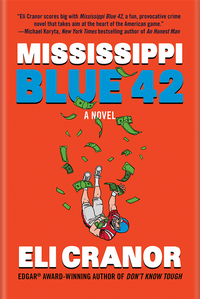

Cover of Mississippi Blue 42 by Eli CranorMississippi Blue 42

by Eli Cranor

DETAILS:
Series: Rae Johnson, #1
Publisher: Soho Crime
Publication Date: August 5, 2025
Format: Hardcover
Length: 370 pg.
Read Date: August 7-11, 2025

Buy from Bookshop.org Support Indie Bookstores

So much depended on a ball stitched together from thirty-two panels of waterproofed leather. The fans came to see what the players did with that ball: the blazing touchdown runs, the high-flying, bone-crunching hits. And the players played for peanuts. That was the only way any enterprise could achieve the sort of profit margins enjoyed by universities with nationally ranked teams. The trick, though, was convincing the rest of the country that college football was not a business, but instead a game, a contest played on the field of higher education, which also served the Chiefs well when it came time to file their taxes.

Because the University of Central Mississippi was an educational organization, it enjoyed a 501(c)(3) status, which meant nearly every dollar the institution made was exempt from federal income tax. It was the same exception granted to churches…

Yes, Mississippi was in the Bible Belt, but the real holy day, the day when every true Southerner bowed at the altar, was game day. And in just a few more hours, the congregation would gather inside their recently renovated, five-hundred-million-dollar cathedral.

What’s Mississippi Blue 42 About?

Rae Johnson is the only daughter of a legendary college football coach and spent most of her life working to be one, too. But at a certain point, she hit the wall of misogyny (with her own father as a spokesman for the wall) and had to find a new career path. Naturally (?), she chose the FBI. We all see the overlap, right?

Anyway, she’s fresh out of the Academy and is assigned to her first case. She’s been sent to help investigate some financial crime surrounding the University of Central Mississippi’s football program. She knows she got the assignment due to her father, which grates her pride. But, she’s not going to back down from the challenge. Her partner in the investigation has been there for months and hasn’t gotten very far, but he’s determined to uncover the problems that he knows are there.

The veteran agent is just getting her acclimated to the investigation when the team’s quarterback

The Fight for the Soul of Moses McCloud

Moses stared at him, still not sure what to make of Cerge’s story, but thinking it felt right somehow, the wildness of his tale in tune with the flashy locker room: the nude white boys, the ping-pong table, the barber chairs. This wasn’t real life. It was all a dream, a four-year fantasy the players paid for with their lives. Even if they did make it to the League, even if they got paid, they still paid for it. And it wasn’t just their knees or shoulders, not even their brains. It went deeper than that. Once their playing days were over, they would be booted out of Eden, resigned to the stands to watch as the next crop of finely tuned athletes took their place. As extravagant as a Saturday spent tailgating in the Glades was, it did not compare to the roar of the crowd. Only gladiators know true glory.

This book, in many ways, seems to be a fight over the soul of the backup quarterback thrust into a leadership position—will he succumb to the culture of bagmen and fame, or will he risk his potential windfall and give Rae the information she needs?

I really like Moses from the beginning—sure, he’s got all the maturity of a college freshman (read: not as smart as he thinks he is, too easily distracted/led along by good-looking women), but there’s something about him you can’t help but like. I really think the battle for his soul angle isn’t that filled with suspense—it’s just the adults around him that fail to understand what he’s saying and what kind of guy he is all along.

But that actually makes the whole thing more entertaining for everyone who isn’t Moses.

What do I think about this as a series debut?

According to the press kit for this book:

Mississippi Blue 42 is the first in what is planned to be an ongoing series starring FBI Agent Rae Johnson as she and a cast of recurring characters explore crime in the world of sports.

Which sounds promising—especially the “world of sports” part. Not because I’m a big sports guy, but I had a hard time imagining Rae looking into some other kinds of crime because Cranor baked the sports-mindset so deeply into her. You put her in an art crime, or a counterfeit money situation? I just don’t see it working as well (but I was ready to try). Rae hunting down a crew of bank robbers would be interesting to see, I just don’t know if she gets into their heads. But even if you move her to professional sports—even something other than football, she’s got the right mindset, the right background to really give a series legs.

Rae reminds me of Ellie Hatcher, Renée Ballard, and Eve Ronin. She’s got ambition, she’s willing to cut corners (maybe too many), she’s determined to make it in a man’s world—and she lets all of that lead her into some blunders as she learns her way. The question is: will she learn from them? The other women did—I trust she will, too. But making those mistakes is fodder for good fiction along the way.

I do wonder what characters from this book will recur. One strong candidate is Rae’s friend who failed a drug test and got booted from the FBI Academy. She had a strong presence early on in the book, but she just vanished later on. Which makes sense for reasons of this book’s plot, but not if you’re establishing a series character. Beyond her, I’m pretty curious.

So, what did I think about Mississippi Blue 42?

This was about the players and the game they’d been forced to play. The contest that took place on the field was nothing compared to the battle that went down in Waffle Houses, seedy motel rooms, used car lots, and a laundry list of other skeevy locales. That’s where boys like Moses McCloud had been fighting for so long nobody even saw them as boys anymore. These were young men whose talents had been exploited to pay their coaches’ multimillion-dollar contracts, secure billion-dollar TV deals, and provide highly visible recruiting for their respective universities. College football wasn’t a game at all; it was a business, a completely self-sufficient economy powered by young, mostly Black athletes.

There are more “bad guys” in this book than in most its size—and I’m really unable to come up with a drop of sympathy or empathy for any of them. I wasn’t prepared for that. I’m used to Cranor helping me see the humanity of his characters. Not that I don’t see humanity here—all I see is the worst of it. Yes, there are some who are less-worse than others, and there are a few that you can easily call The Worst. Right up to the last revelation (which Rae really should’ve seen coming), the worst of America is on display. If you pull up a classic D&D Alignment Chart, you have a couple of Lawful Evil characters, many Neutral Evil characters, and a couple on the extreme end of Chaotic Evil, too. Worse, you have a Lawful Evil who pretends to be Lawful Good—and someone who is convinced he’s Lawful Good, but is really a deluded and easily manipulated True Neutral.

Sorry, that’s not helpful at all, but once I started thinking along those lines, I couldn’t stop. Hopefully, someone out there appreciates it.

The hypocrite bothers me more than they should (because it’s so obvious). The easily manipulated head coach really makes me miss the misguided integrity of the coach from Cranor’s Don’t Know Tough.

And honestly, not much better can be said of most of Rae’s allies through this. But they’re trying. I’m pretty sure they are, anyway. I found them entertaining anyway, and didn’t spend a moment hoping they’d find their comeuppance.

This established a strong world and at least one character that we can follow—I’m very curious to see how this experience shapes Rae’s career (at least the early days of it, obviously) and how she sees herself. But more importantly, this was an entertaining, gripping, roller-coaster of a ride. The series stuff can work itself out—right now, all I want to focus on is Mississippi Blue 42, and it’s a great ride.

You gotta check it out if you’re a Cranor reader (and probably already have). If the Venn Diagram of your interests includes college sports and Crime Fiction, you’ll enjoy this item from the overlap set. Actually, you’ll probably enjoy it if you don’t care about college sports at all, just Crime Fiction. Personally, most of what I know about college sports comes from I Am Charlotte Simmons—and Cranor tells the same story (essentially) about the industry it does, but in a more concise and focused way.

Okay, I’m rambling. Go get this thing, you’ll be glad.


4 Stars

This post contains an affiliate link. If you purchase from it, I will get a small commission at no additional cost to you. As always, the opinions expressed are my own.

20 Books of Summer 2025 logo

Ozark Dogs by Eli Cranor: The Sins of the Fathers…

I’ve been trying to write about this book since April. I know I’m not going to do this justice, and so I keep procrastinating. But with 2 posting days left this year…I can push it off no longer.


Ozark DogsOzark Dogs

by Eli Cranor

DETAILS:
Publisher: Soho Crime
Publication Date: April 4, 2023
Format: Hardcover
Length: 290 pgs.
Read Date: April 12-13, 2023
Buy from Bookshop.org Support Indie Bookstores

What’s Ozark Dogs About?

One of the bigger hurdles for me in completing this post was figuring out what to put here, I toyed with:

It’s by Eli Cranor, which means it’s going to have a Southern Noir sensibility, is probably going to have something to do with family, and is going to be excellent. That’s all you really need to know.

I still stand by that, but figure you need more, I just wasn’t sure what to say. I’ve finally given up and am just going to paste what Soho Crime has on their website (which, frankly, gives away more than I would’ve).

After his son is convicted of capital murder, Vietnam War veteran Jeremiah Fitzjurls takes over the care of his granddaughter, Joanna, raising her with as much warmth as can be found in an Ozark junkyard outfitted to be an armory. He teaches her how to shoot and fight, but there is not enough training in the world to protect her when the dreaded Ledfords, notorious meth dealers and fanatical white supremacists, come to collect on Joanna as payment for a long-overdue blood debt.

Headed by rancorous patriarch Bunn and smooth-talking, erudite Evail, the Ledfords have never forgotten what the Fitzjurls family did to them, and they will not be satisfied until they have taken an eye for an eye. As they seek revenge, and as Jeremiah desperately searches for his granddaughter, their narratives collide in this immersive story about family and how far some will go to honor, defend—or in some cases, destroy it.

Consequences

Don’t get me wrong—there’s plenty of crime, tension, drama, and all the rest in the novel’s “today.” But in a very real sense the novel isn’t about any of that. It’s about what happened almost two decades before this that set the families on their courses and what the outcomes of those courses are.

This is a book about ramifications, consequences, pigeons coming home to roost—however you want to put it. When you read about those earlier events a part of you is going to ask, “Why didn’t Cranor write about that?” Most—or at least many—authors would’ve, and then some would’ve added something like this as a sequel. Or maybe as Part II in a longer novel.

Cranor’s not about that, though. His focus is on what those events do to the present. How they’ve shaped the lives of those in the present (primarily without their knowledge or understanding), and how the sins of the fathers can be visited on their sons and daughters.

The Author’s Note

Frequent/Regular readers will know that I almost never mention this kind of thing when I talk about a novel. Do read this one after you finish reading about the Fitzjurls, the Ledfords, and the rest.

Unless I miss my guess, you’ll agree with every syllable.

So, what did I think about Ozark Dogs?

This, like Cranor’s first novel, would be really easy to over-hype, so I’m going to try to be restrained here.

The prose is so sharp, so…on point. You can tell every syllable was considered, if you read portions of this aloud (or, I’m sure, listen to the audiobook) you will feel the work that went into it—although it’s so smooth and flowing that it comes across as effortless. You see exactly what Cranor intends you to see, probably feel what he intended, and understand the motivations (even the ones that disgust you) of these people in precisely the way he planned.

The dialogue is so well done that you might find yourself sounding a bit like someone from Arkansas for a day or two after you finish.

These characters—it’s hard to think of them as characters, really, they’re people. People you can imagine seeing on the news or in a documentary about all this. It won’t be the most flattering documentary about anyone, I should add. I think every single one of them crosses a line—more likely many lines—that they’ve known their whole life they wouldn’t cross, at least have resolved they wouldn’t cross again years ago. But they do, sometimes with regrets, sometimes with eagerness. And your heart breaks for them, even for some of them that you hope horrible things happen to by the end of the book. Fully developed, fully realized, very human (read: fallible and flawed) characters on every page.

Earlier I said this book is about consequences, and that’s stuck with me for months. But it’s also about devotion—sometimes devotion that borders on obsession. Devotion to a cause, devotion to an idea, devotion to yourself, or (the most dangerous?) devotion to a person (or group of people). There’s a straight line between every character and what they’re devoted to and those consequences.

But if you don’t want to think about books like that—and you’re just looking for a great read? Ozark Dogs fulfills that, too. It’s a full-throttle, action-packed, revenge-driven, thrill ride with great fight scenes, enough blood and guts to satisfy the reader looking for that, and some twists and reveals that’ll stun you.

Cranor gives us another thriller that you can give to an anti-genre snob, who’ll appreciate it as much as people who only read Crime Fiction/Thrillers will. If you haven’t read him yet, do yourself a favor and get this (and Don’t Know Tough) now and start waiting for his July release while you’re at it.


5 Stars

This post contains an affiliate link. If you purchase from it, I will get a small commission at no additional cost to you. As always, the opinions expressed are my own.

Irresponsible Reader Pilcrow Icon

The Friday 56 for 4/13/23: Ozark Dogs by Eli Cranor

The Friday 56This is a weekly bloghop hosted by Freda’s Voice.

RULES:
The Friday 56 Grab a book, any book.
The Friday 56 Turn to Page 56 or 56% on your ereader. If you have to improvise, that is okay.
The Friday 56 Find a snippet, short and sweet.
The Friday 56 Post it.

from Page 56 (and 57) of:
Ozark Dogs

Ozark Dogs by Eli Cranor

Evail loved his big brother, a bond that went even deeper than blood. In a way, Rudnick was the start of everything all those nights in the field, the kits’ calls playing out scared and lonely. It was just like the hunting. Rudnick had simply asked if Evail would do it, and then he did. Again and again. For a while, the brothers went hunting almost every night. It was the summer before Rudnick’s senior year in high school. Evail on the cusp of sixteen.

And then Rudnick was gone, Evail went to prison, and everything changed. The darkness shifted and the calls howled from the inside out. When Evail returned, he took to the field alone, no longer using the recordings, opting instead for the darkness, working along the tree lines and stalking his prey. He wore the hides of the creatures he’d taken. A mass of fur and bone death-still in the shadows, Evail crouching, waiting, the gun barrel blue in the night. Coyotes were loyal and thick as thieves. When one went down, the others came running. It wasn’t until there was a pile of blood-warm bodies that the big boy would finally come sauntering up from the shadows. The alpha. Rudnick had always been the alpha. He wasn’t anything anymore.

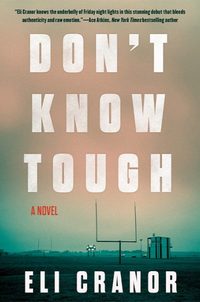
Don’t Know Tough by Eli Cranor: Glory Days, Well, They’ll Pass You By…

Don't Know ToughDon’t Know Tough

by Eli Cranor

DETAILS:
Publisher: Soho Crime
Publication Date: March 22, 2022
Format: Hardcover
Length: 322 pg.
Read Date: May 19-23, 2022 
Support Independent Bookstores - Visit IndieBound.org


I feel like I said too much here—I didn’t give away any plot points (I don’t think), but I still think I maybe said too much. I don’t know how else to talk about this novel. Also, I don’t think it matters what I say, just read the first two pages of Don’t Know Tough and it won’t matter what I put here—you’re going to have to read the rest or will just walk away.

Either way, you’re probably wasting time if you read this post when you could just read the @#$&! book.

What’s Don’t Know Tough About?

Billy Lowe is a running back for a small-town Arkansas High School Football team. He’s practically half the team by himself. They wouldn’t be in the State Championship playoffs without him—and they won’t win anything without him, either.

So when he gets himself in trouble—with the school and potentially the legal system—for repeatedly giving a beating to the son of one of the area’s richest men, their first-year coach’s dreams of glory are in jeopardy.

Then, the boyfriend of Billy’s mother is found dead—likely murdered. Things go from dismal to worse.

Billy

Billy has been valued for one thing in his life—he’s a great football player. He’s the son of a high school football legend. The younger brother of a phenomenal high school player. After High School, he will likely produce a few kids who will go on to be high school football players.

He’s also the target of his mother’s drunken and abusive boyfriend. Everyone living in their trailer is. Her boyfriend (Billy refuses to use his name) replaced the drunken abusive father and husband who abandoned them years ago.

His life is defined by football and abuse. Everything else is just filler.

It’s no wonder then that Billy is full of rage and need for some kind of affection beyond his mother’s imperfect attempts to express her love.

He doesn’t know how to live. He doesn’t know how to be an adult. He knows how to be hurt and how to hurt. We see that immediately in the first two pages—the next 320 are just the repercussions of that.

Coach Trent Powers

Coach Trent sees himself in Billy. His teenaged years featured several different Foster Homes until his high school coach brought him into his home and family and changed his life. He found stability, family, and Christianity. He went on to marry his coach’s daughter.

Trent wants to copy and paste his experience onto Billy (except that whole marrying the coach’s daughter thing—there’s no way that Mrs. Powers would accept that). He has far less time to replicate that scenario than his coach had, but he still thinks he can make it work.

He fails to see the things that separate Billy and his teenaged-self. More importantly, he fails to see the differences between himself and his coach. He is earnest, idealistic, and desperate—he thinks he can impose success on the situation if he wants it enough, if he believes it enough.

At one point, Trent tries to evangelize Billy. It epitomizes this whole endeavor and is one of the more painful scenes in a novel that has an overabundance of painful scenes. I wanted to call a time-out, stop the scene and talk to Trent for a minute. This is not how you present the Gospel, sir, as if simply saying “Jesus” will solve every problem. Go read 1 Corinthians 15:1-11 and try again, stop rushing it. I think he’s genuine, I think this is a heartfelt attempt on his part to help Billy, I am convinced that Trent thinks he’s doing the right thing—but he’s approaching the whole thing incorrectly.

Trent sees himself as the Evangelical Louanne Johnson/Jaime Escalante/Principal Joe Clark/Sister Mary Clarence mixed with Coach Eric Taylor, who will rescue this kid. Sadly, he’s really just a combination of Ned Flanders and Michael Scott. I liked him, wanted him to succeed, and never thought for a moment he would/could, or should.

Race

You hear football, the South, and Crime Fiction and you think this book is going to be about race/racism—at least in part. And you’d be wrong—as hard as that is to believe.

But you’d also be almost right. One of the more impressive things about Don’t Know Tough is the subtle way it is and it isn’t about race in the South.

So, what did I think about Don’t Know Tough?

I was blown away by this. I should stop there before I go overboard with praise. But, I’m not going to. Feel free to stop reading now, though, I’m not going to improve on those six words.

I should probably start off by saying, as un-American as it is, I don’t like football. I don’t see why it’s popular, I wish so many young people in this country wouldn’t sign themselves up for the lasting physical and mental damage that it brings. I do not understand the religious fervor that grips fans of the sport—particularly in Texas and the South when it comes to high school and college teams. And frankly, I don’t know that I want to.

But hey, Dani Rojas speaks for millions when he says, “Football is life.” (even if he’s talking about the other football). So bring on the books about it—especially if you’re going to write them the way that Eli Cranor does. If you’re going to give me something this good, I don’t care what subculture, sport, or location it is—I’m going to lap it up.

As I stumbled through saying above, Don’t Know Tough is about race, it’s definitely about class and family. But it’s primarily about being an adult, about being a man, and how one gets to that stage in life—about mentorship and being mentored. Both Trent and Billy find themselves in situations where they have a greater degree of responsibility than they’re accustomed to or prepared for. Billy is thrust into it by his actions and other people’s actions. Trent decides to take it upon himself. At the same time, everyone around them recognizes them as still being (essentially) children and treats them accordingly.

This is a novel about heartbreak, despair, about clinging to a dream as it crumbles around you (whether or not you realize that’s what’s going on). There is a sense of inevitability about everything that happens to Billy, Trent, and their families—even if any of them realized what was happening and tried to change things, it just wouldn’t matter.

And all of it is told in prose that is beautiful, visceral, empathetic, and honest—I cannot convey to you the greatness of Cranor’s writing properly. I’ll either not be effusive enough in my praise, or I’ll come across as over-hyping it. He invites the reader to think about Hemingway* as you read this—in terms of themes, story, and character—but I’d like to think I’d have gotten there on my own.

* The Old Man and the Sea in particular, but I think it’s safe to bring other works into the conversation.

This is a brutal novel. As I read, I wanted it to end sooner than it did to just stop the suffering of these poor characters. But I wanted to read another couple hundred pages of Cranor’s writing.

Reading Don’t Know Tough is like watching a series of defensive highlights on the NFL Network—hit after hit after hit after bone-crushing hit. It will leave you psychically battered and bruised—and oddly wanting more.


5 Stars

This post contains an affiliate link. If you purchase from it, I will get a small commission at no additional cost to you. As always, opinions expressed are my own.

Powered by WordPress & Theme by Anders Norén