Category: F-J Page 14 of 27

Killer Thriller by Lee Goldberg: The Best-Selling Author/Hapless Hero Ian Ludlow Returns to Save the Day Again

I wrote about half of a post about this book to go up yesterday. But I realized I’d spent a lot of time talking about things I really didn’t care about, and hadn’t spent any time talking about the bits I did care about. But I couldn’t turn the ship around (much to my annoyance). So, I let one more day go without a post — a truly annoying trend for the week/month. This isn’t quite what I wanted it to be. But it’s done. So that’s a start.

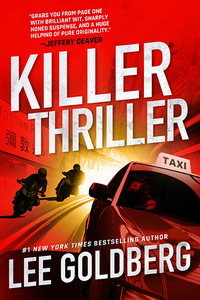
Killer ThrillerKiller Thriller

by Lee Goldberg
Series: Ian Ludlow Thrillers, #2

Kindle Edition, 277 pg.
Thomas & Mercer, 2019

Read: May 21 – 22, 2019

           “…I want Ludlow under constant and total visual, audio, digital, and personal surveillance,” Yat added. If anybody in Beijing asked about it, he’d explain that it was part of his ongoing investigation into Wang Kang’s activities, which wasn’t far from the truth. Those were always the most effective lies. “Mobilize every resource that we have.”

“Including the assassins?”

“Especially the assassins,” Yat said.

In True Fiction, Lee Goldberg introduced us to Ian Ludlow — former TV writer, now thriller writer extraordinaire — who discovered (the hard way) that terrorists were using his fiction as a playbook. Then he had to go on the run for his life from these people who didn’t appreciate the fact that he’d be able to identify what they were doing. Running alongside him (frequently behind, more frequently ahead of him) was the poor girl who was supposed to schlep him from bookstore event to bookstore event in Seattle. Margo didn’t like Ludlow, but finding their fates bound together, she threw herself into surviving — and is very likely the reason he did survive.

Not only did they survive, they uncovered and defeated a group within US Intelligence that were actively plotting against the US. It’s a highly improbable story that didn’t feel that improbable — yet was told in a way that played up the tension, the suspense and the fun. It was one of the funniest and most enjoyable books I read last year.

Now it’s time for the inevitable sequel — Killer Thriller — and Lee Goldberg has somehow done what almost every good sequel strives to do (and few succeed) — he tells pretty much the same story with just a couple of differences, yet does so in a way that feels completely fresh and original — in most ways, superior to the original. I don’t think it’d be hard to take a semi-thorough outline of both novels to compare against each other and find that they’re freakishly similar. But I only thought about that when I sat back to think about the book and its predecessor. While reading, I didn’t care about True Fiction or any similarities the current book had to it. I just had too much fun while reading the sequel I couldn’t be bothered to compare it.

Which is a pretty neat trick, really. It’s like when Chandler Bing said, ” Oh–I think this is the episode of “Three’s Company” where there’s some kind of misunderstanding.” Just because every episode of Three’s Company featured a few misunderstandings — it didn’t keep things (usually) from not being funny. The same kind of thing here — just because Ludlow and Margo are once again thrown in to the middle of things they’re not ready for, it doesn’t keep the action scenes from being riveting and the funny bits from being funny.

So, if you haven’t read the first book, let me tell you a little bit about Ian Ludlow. He’s overweight, doesn’t take care of himself in anyway, shape or form. He doesn’t seem to be attractive (and bounces between knowing it and forgetting it). His ego is pretty big, but he’s also realistic about himself. He’s lazy about everything but his writing — and he could likely be more disciplined about it. Okay, based on what we’re told about his greatest creation, Clint Straker — imagine the combination of Bond and Reacher — he’s pretty lazy. Still, he comes up with incredible plots (don’t take my word for it, take the word of people who based terror campaigns on his work). Deep down (Margo would argue very, very deep) he’s a decent guy. Especially for the 15-25 minutes a day he’s not hitting on some unwilling woman, or thinking about hitting on her.

Margo, meanwhile, is a would-be singer/songwriter, a former dog walker, and is really vocationally lost. She’s smart, she’s tough, and adaptable — even if she’s still trying to figure out how to adapt after the events of True Fiction. She’s picked up some self-defense skills along the way, which will prove to be handy.

Ludlow brings Margo with him to Hong Kong to act as his research assistant and hopefully relax a little from the stress that’s eating at her from her recent harrowing experiences (almost being killed counts as harrowing, right?). He’s going to Hong Kong to do a little promotion for the studio that’s turning his first Straker book into a movie. While there, he wants Margo to scope out some places and things he can use in his upcoming novel. In this novel, the Chinese government is waging a secret campaign to take over the US through political manipulation and selling us cheap products they can use to spy on us. Straker’s going to fight against them in Hong Kong, so he needs some local color.

Once in the hotel (and on the hotel’s wi-fi), a group of Chinese espionage agents tap into Ludlow’s laptop and make an unsettling discovery. The plot laid out in Ludlows “novel” is ridiculously close to the plan this same group has spent years devising and implementing to take over the US government through manipulation, cash, and fear. Clearly this man’s novels are just a cover story, he has to be the most wily of secret agents — using this preposterous writer character as a cover for his actual abilities and mission to stop this Chinese plot.

So the Chinese begin their dangerous game of cat and mouse with the “spy” Ian Ludlow. It’s more of a cat-and-clueless-yet-incredibly-lucky-mouse game. But you get the point. But hey, it works. Think Inspector Gadget and Penny — without the robotic arms and sentient dog.

Like Ludlow, Goldberg spent a lot of time as a writer/producer of television. And in both books he does a great job of lampooning the men and women writing, directing and starring in TV and movies. You can’t help but feel Goldberg exorcising some personal demons as he does so — particularly in the table read scene and everything that Damon Matthews (the actor playing Straker) says and does. Incidentally, I’m sure any parallels people might draw between Matthews/Straker and Cruise/Reacher are completely unintentional on Goldberg’s part. For my money, if doing this sort of thing helps Goldberg deal with the frustrations that seem to plague most TV writers/screenwriters, I hope he keeps pouring out his frustrations on the page — I love ’em.

Goldberg seems to have learned a lot from the Fox and O’Hare books he co-wrote with Janet Evanovich — there are huge chunks of this book that feel like they were originally planned for one of them. Whether Goldberg repurposed the scenes or was just influenced by his time with that series really doesn’t matter — the sensibility that made that series work so well is making this one work very well, too.

From the big things — like fight scenes or car chases — to the way he describes a Washington D. C. restaurant, to little touches like the way that someone smuggles information out of China, Goldberg is at the top of his game — which is an accomplishment. I think I’ve read almost 30 of his books and there are maybe one or two that are more satisfying than Killer Thriller. Thrills and laughs together — and maybe maybe a little surprising character depth and development (just a bit, we don’t want Ludlow to stop being a cad and a loser), this is a whole lotta fun. You can come into this one fresh, you won’t appreciate the changes in character (particularly Margo), but you’ll have just about as much fun as the rest of us.

—–

4 Stars

2019 Cloak & Dagger Challenge Humor Reading Challenge 2019

Reposting Just ‘Cuz — True Fiction by Lee Goldberg: A Writer on the Run

Here’s the second of my Lee Goldberg reposts for the day — by the time you read this, I’ve probably finihsed the sequel to this one, which might be even more fun than this. Do yourself a favor and check out these books — but first, let me try to lay out the argument that you should.

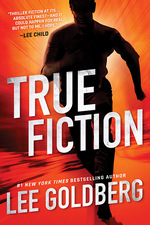
True FictionTrue Fiction

by Lee Goldberg
Series: Ian Ludlow Thrillers, #1

Kindle Edition, 248 pg.
Thomas & Mercer, 2018
Read: July 20 – 21, 2018

“Sorry I’m late,” Ian said. “I’ve been on the run all morning.”

It was a line worthy of Clint Straker and Ian knew it. He couldn’t stop being a writer, always thinking of the next line in one of his thrillers. But he was living a thriller now and it was no thrill at all.

This is one of those books that’s super easy to write about — if you like the premise of the book, you’ll like the book. It’s just that simple. The tricky part is finding someone who wouldn’t like this premise.

Ian Ludlow, television writer turned thriller novelist, can’t believe his eyes — a terrorist attack in Hawaii went exactly the way that he designed and he’s pretty sure that someone is trying to kill him. Ludlow was part of a group of writers (movie, TV, novelists) that came up with some scenarios for the CIA that terrorists might use, so the CIA could design counter-measures. This is a thing that actually happened (maybe still does) following 9/11, because writers have much better imaginations than government employees do. One of those scenarios is playing out in real life and Ludlow doesn’t know what to do. Clearly someone out there doesn’t want Ludlow spreading the word that he’s the source for this attack.

Before he realizes what’s happening, Ludlow is running for his life and has dragged Margo along with him. Margo’s a dog-sitter, house-sitter, aspiring musician, and occasionally drives authors visiting Seattle to their signings. That’s how this poor girl gets sucked into Ludlow’s mess — she saves his life (and then he returns the favor), dooming her to having to run with him.

Add in some over-the-top villains (I hope, see below), and Goldberg’s signature wit and solid writing, and you’ve got yourself a winner.

This is a fast fun ride featuring about the most unlikely of all thriller protagonists. Ian Ludlow isn’t really in any kind of shape; he has no skills with hand-to-hand combat, cars, or weapons — his people skills are suspect, really; all he has going for him is a pretty agile mind. Margo’s a little better off, but not much. They quickly run to the home of one of Ian’s friends who lives off of the grid and is paranoid enough he’ll believe their story. Which may not really be the strongest of qualifications, but they can’t afford to be choosy. The three of them will have to figure out a way to survive — and possibly stop whoever it was behind the attack.

Does anyone else remember Condorman? The Disney film about a comic book writer/artist who accidentally (very accidentally) becomes a super-spy? I was 7 or 8 when it came out and loved it. Anyway, I had a flash-back to that when Ludlow stumbles his way into taking out one of the many assassins that come after him — one of the many times I had an honest audible response to this book (not a book I recommend reading in an ICU ward, for what it’s worth, people tend not to like noises there).

Now, I called the villains over-the-top. I’m not really sure they are — they seem over the top, but there’s a little part of me wonders how hard it really would be for someone to pull off something like this. John Rogers, of Leverage, frequently talked about how some of their over-the-top bad guys were watered down versions of the real thing (because no one would believe the real thing). Take my word for it, I don’t have time to track him down saying it. Let’s put it this way — they’re perfect for this book, and like just about every thriller villain ever, it’s best that they stay inside the book.

While he’s telling a very fun story, Goldberg takes a little bit of time to satirize thrillers, thriller writings, and thriller heroes — I loved every bit of that. It helps that Goldberg writes and reads the same books he’s satirizing, so you know he does it with love and honesty. Some of the excerpts from Ludlow’s books are just awful, it must’ve been hard to write (but so much fun). Ditto for the TV shows that Ian’s friend Ronnie starred in, I really hope that those are things that Goldberg made up for this book (and fear they aren’t).

This feels like Goldberg and Evanovich’s Fox & O’Hare books, or maybe The Man with the Iron-On Badge (which features a protagonist only slightly more likely than Ian) — not his more serious work like King City. The story moves quickly, deftly and will leave you smiling — I can’t imagine Goldberg writing a disappointing book at this point, I just don’t think he can. Pick this up, you will be entertained.

—–

4 Stars

Reposting Just ‘Cuz: — King City by Lee Goldberg

So, I couldn’t get anything written tonight — and Lee Goldberg’s on my mind, so I thought I’d repost a couple of the many posts I’ve done about his books (which is probably less than 50% of what I’ve read). Here’s one from Goodreads before I started this here blog.

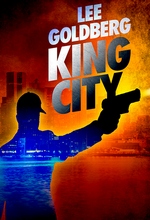
King CityKing City

by Lee Goldberg

Paperback, 246 pg.
Thomas and Mercer, 2012
Read: July 4-5, 2012

One part Jack Reacher, one part Jesse Stone, this first installment in Lee Goldberg’s new series reads like a Western set in the 21st century.

Tom Wade, a rigorously scrupulous cop is assigned to a part of King City so crime and poverty-ridden that city officials pretend it doesn’t exist. He’s sent there because the police force is overly-politicized where it isn’t overtly corrupted, and they can’t fire such an upstanding cop–but maybe his new post will lead to him being killed.

Wade is fully aware of this, but accepts his new post with gusto–he has a chance to make a difference and sets out to do so in as splashy a way as possible.

This isn’t a subtle book with complex characters–and doesn’t try to be. The characters are pretty much the dictionary definition of “stock,” the good guys are good, the bad guys are really bad–and that’s that. A fun, straightforward testosterone-y action book. Hopefully the first of many.

—–

3 Stars

Opening Lines: Killer Thriller by Lee Goldberg

We all know we’re not supposed to judge a book by its cover (yet, publishing companies spend big bucks on cover design/art) (also, this has a great cover). But, the opening sentence(s)/paragraph(s) are fair game. So, when I stumble on a good opening (or remember one and pull it off the shelves), I’ll throw it up here. Dare you not to read the rest of the book.

from Killer Thriller by Lee Goldberg:

           Ian Ludlow’s UCLA creative writing professor insisted that the key to being a successful novelist was writing from personal experience. That’s why the professor was the author of five unpublished novels about sexually frustrated novelists who toiled in obscurity while teaching talentless and ungrateful students how to write.

So Ian ignored his professor’s edict and wrote escapist adventure stories that had nothing to do with his own mundane life. That’s how he flunked the class but eventually became a writer for TV shows like Hollywood & the Vine (half-man, half-plant, all cop!) and the author of the internationally bestselling series of action thrillers about Clint Straker, freelance spy for hire.

“And that’s how I ended up here,” Ian said, standing in front of a hundred people at Seattle’s Union Bay Books on a warm Saturday night.

It took precisely two sentences to make me chuckle, and two paragraphs to make me remember just how fun Ian Ludlow is as a character. It doesn’t get much more efficient than that.

Pub Day Repost: No Country for Old Gnomes by Delilah S. Dawson and Kevin Hearne is a very foine booke that surpässes the original while showing full respect to the umlaut

I’ve tweaked and retweaked this to the point that I can’t read it any more. Hope it’s mostly coherent.

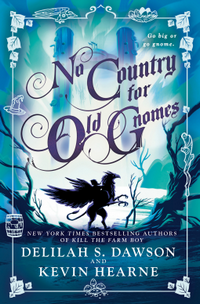
No Country for Old GnomesNo Country for Old Gnomes

by Delilah S. Dawson and Kevin Hearne
Series: The Tales of Pell, Book #2

eARC, 352 pg.
Del Rey, 2019
Read: March 9 – 12, 2019

As much as I loved 2018’s Kill the Farm Boy — and talked about it everywhere and repeatedly — I wasn’t sure how much I really wanted to pick up the sequel. There’s no way it would be as good, the humor would be a little stale, and the whole approach wouldn’t seem as novel. Still, I knew curiosity would get the better of me — and it’d still have its moments. Also, I’m not at the point where I can live in a world with a Kevin Hearne book in print that I haven’t read.

I was so, so wrong. Having established their off-kilter world, strong voice, and approach to the stories of Pell, Dawson and Hearne have come back to play in it. The result is superior in every way that I can think of. I lost track of how many times I said to myself while reading something along the lines of, “how did they improve things this much?”

So this book happens in different corner of the kingdom than Farm Boy did. The Skylar is a choice piece of the land that is home to two diminutive races — halflings and gnomes. Gnomes want to live in their nice little homes, tinker with their little projects and inventions, and wear brightly colored cardigans (well, there was one gnome who wanted to wear a black cardigan, but let’s leave that aside for now). The halflings have found their government hijacked by criminals and those particular halflings are waging a war of sorts on the gnomes, driving them from their homes for unknown reasons. Driven by desperation, two of these displaced gnomes are part of our questing party here. A halfling — committed to (some may say obsessed with) the law that is being ignored by his people is another member of the party.

These three join themselves to an ovitaur named Agape — an ovitaur is like a faun, but is humanoid with sheep characteristics (feet, legs, ears, etc). She’s the last of a long family line serving as teh guardians of a rare treasure, and needs guidance. A gryphon, named Gerd, outcast from his people has been accompanying the halfling for some time, but is devoted to protecting Agape now. The last member of the party is a dwarf named Båggi Biins. Båggi is on his Meadschpringå — a time when young dwarves leave their homes to purge the violence from themselves so they can return to their homes to pursue an ascetic life of creativity. He joins the others certain that journeying with them, protecting them along their way will provide all the outlet required to use his violence in a noble cause.

Their quest? To go to the Great Library, where the founding documents of the gnomeric and halfling civilizations are located — which should prove invaluable to re-establish the peace and help the two societies get along. Agape should find resources to direct her in her guardianship, and hopefully provide Gerd with the proof that he broke no laws of the gryphons.

The fact that most people on Pell consider the Great Library to be a myth shouldn’t be taken as an argument against this quest. What better place than a possibly mythical library to provide the answers they seek?

While these characters are on their quest, working for peace — the king and his advisor are trying to solve the problems between the halflings and gnomes in a more direct approach. We also see (briefly in most cases) other characters from Farm Boy. We see just enough to know how things are going for them some months later — and on the whole, it’s just as you’d hoped/expected it to be for them. It is not essential to have read the previous volume to get 95% of this book. It’s safe to hand this one off to family, friends and coworkers who are wondering what you’re cackling about without making them do homework first.

Along the way, these characters meet a cult of cabbage worshipers, who have the ability to read prophecies in the vegetables; some very frightening mermaids (that look nothing like anything anyone expects); a very Tom Bombadil-esque character (and a few other Tolkien-inspired jokes). As in Farm Boy, the authors manage to use these ideas as sources of comedy and to propel the plot along in meaningful ways. Similarly, they use racial and personal characteristics of the characters to play with, play against and mock genre standards. But almost none of the characters are mere jokes, they’re well-developed characters that happen to be able to comedic. This is not an easy balance to achieve — and Hearne and Dawson are almost flawless on this front.

For example, gryphons are convinced that they perceive greater nuance and details in colors, sounds, tastes and the like and adjust their pronunciation of words via capital letters, umlauts and extra syllables. Gerd’s dialogue is littered with these. It starts off as a joke that just won’t stop, and instead of it getting tired or annoying (which I assumed it would), it becomes just part of the way that Gerd talks. His own particular dialect, that occasionally will strike you as amusing — maybe even just funny occasionally. I wouldn’t say it’s because the authors show restraint with it, employing it just when needed to keep it funny. Quite the reverse, they seemingly take the approach of drowning you in the joke, figuring that it’ll be funny often enough to justify it.

If you’re like me, you have a tendency to skip chapter titles. Doing so with The Tales of Pell would be a mistake. The titles are long, fitting, and insanely goofy. The only thing better are the chapter epigraphs I imagine the drafts going back and forth between the authors, each trying to top the other with the next chapter title/epigraph. And generally succeeding.

These books are noted (as I’ve focused on) for their comedy — as is right, because they are funny. But as anyone who’s read other works by Dawson and Hearne know, they’re about a lot more than comedy. The battle scenes are exciting. The emotional themes and reactions are genuine and unforced. And tragedy hits hard. It’s easy to forget in the middle of inspiring moments or humorous aftermaths of battle that these kind of novels involve death and other forms of loss — and when you do forget, you are open to getting your heart punched.

In case I haven’t made it clear here, Dawson and Hearne knocked it out of the park here. I thought Kill the Farm Boy was outstanding, and No Country for Old Gnomes surpassed it on every front. I don’t expect that the third volume of The Tales of Pell will continue this trend — but I’m more than open to being proven wrong next year. But for 2019? I’m just going to revel in the goodness — the laughs, the pathos, the excitement — brought by this adventure and the wonderful cast of characters. Get your hands on this one.

Disclaimer: I received this eARC from Random House Publishing Group – Ballantine via NetGalley in exchange for this post — thanks to both for this, I really appreciate it.

—–

4 1/2 Stars

No Country for Old Gnomes by Delilah S. Dawson and Kevin Hearne is a very foine booke that surpässes the original while showing full respect to the umlaut

I’ve tweaked and retweaked this to the point that I can’t read it any more. Hope it’s mostly coherent.

No Country for Old GnomesNo Country for Old Gnomes

by Delilah S. Dawson and Kevin Hearne
Series: The Tales of Pell, Book #2

eARC, 352 pg.
Del Rey, 2019

Read: March 9 – 12, 2019


As much as I loved 2018’s Kill the Farm Boy — and talked about it everywhere and repeatedly — I wasn’t sure how much I really wanted to pick up the sequel. There’s no way it would be as good, the humor would be a little stale, and the whole approach wouldn’t seem as novel. Still, I knew curiosity would get the better of me — and it’d still have its moments. Also, I’m not at the point where I can live in a world with a Kevin Hearne book in print that I haven’t read.

I was so, so wrong. Having established their off-kilter world, strong voice, and approach to the stories of Pell, Dawson and Hearne have come back to play in it. The result is superior in every way that I can think of. I lost track of how many times I said to myself while reading something along the lines of, “how did they improve things this much?”

So this book happens in different corner of the kingdom than Farm Boy did. The Skylar is a choice piece of the land that is home to two diminutive races — halflings and gnomes. Gnomes want to live in their nice little homes, tinker with their little projects and inventions, and wear brightly colored cardigans (well, there was one gnome who wanted to wear a black cardigan, but let’s leave that aside for now). The halflings have found their government hijacked by criminals and those particular halflings are waging a war of sorts on the gnomes, driving them from their homes for unknown reasons. Driven by desperation, two of these displaced gnomes are part of our questing party here. A halfling — committed to (some may say obsessed with) the law that is being ignored by his people is another member of the party.

These three join themselves to an ovitaur named Agape — an ovitaur is like a faun, but is humanoid with sheep characteristics (feet, legs, ears, etc). She’s the last of a long family line serving as teh guardians of a rare treasure, and needs guidance. A gryphon, named Gerd, outcast from his people has been accompanying the halfling for some time, but is devoted to protecting Agape now. The last member of the party is a dwarf named Båggi Biins. Båggi is on his Meadschpringå — a time when young dwarves leave their homes to purge the violence from themselves so they can return to their homes to pursue an ascetic life of creativity. He joins the others certain that journeying with them, protecting them along their way will provide all the outlet required to use his violence in a noble cause.

Their quest? To go to the Great Library, where the founding documents of the gnomeric and halfling civilizations are located — which should prove invaluable to re-establish the peace and help the two societies get along. Agape should find resources to direct her in her guardianship, and hopefully provide Gerd with the proof that he broke no laws of the gryphons.

The fact that most people on Pell consider the Great Library to be a myth shouldn’t be taken as an argument against this quest. What better place than a possibly mythical library to provide the answers they seek?

While these characters are on their quest, working for peace — the king and his advisor are trying to solve the problems between the halflings and gnomes in a more direct approach. We also see (briefly in most cases) other characters from Farm Boy. We see just enough to know how things are going for them some months later — and on the whole, it’s just as you’d hoped/expected it to be for them. It is not essential to have read the previous volume to get 95% of this book. It’s safe to hand this one off to family, friends and coworkers who are wondering what you’re cackling about without making them do homework first.

Along the way, these characters meet a cult of cabbage worshipers, who have the ability to read prophecies in the vegetables; some very frightening mermaids (that look nothing like anything anyone expects); a very Tom Bombadil-esque character (and a few other Tolkien-inspired jokes). As in Farm Boy, the authors manage to use these ideas as sources of comedy and to propel the plot along in meaningful ways. Similarly, they use racial and personal characteristics of the characters to play with, play against and mock genre standards. But almost none of the characters are mere jokes, they’re well-developed characters that happen to be able to comedic. This is not an easy balance to achieve — and Hearne and Dawson are almost flawless on this front.

For example, gryphons are convinced that they perceive greater nuance and details in colors, sounds, tastes and the like and adjust their pronunciation of words via capital letters, umlauts and extra syllables. Gerd’s dialogue is littered with these. It starts off as a joke that just won’t stop, and instead of it getting tired or annoying (which I assumed it would), it becomes just part of the way that Gerd talks. His own particular dialect, that occasionally will strike you as amusing — maybe even just funny occasionally. I wouldn’t say it’s because the authors show restraint with it, employing it just when needed to keep it funny. Quite the reverse, they seemingly take the approach of drowning you in the joke, figuring that it’ll be funny often enough to justify it.

If you’re like me, you have a tendency to skip chapter titles. Doing so with The Tales of Pell would be a mistake. The titles are long, fitting, and insanely goofy. The only thing better are the chapter epigraphs I imagine the drafts going back and forth between the authors, each trying to top the other with the next chapter title/epigraph. And generally succeeding.

These books are noted (as I’ve focused on) for their comedy — as is right, because they are funny. But as anyone who’s read other works by Dawson and Hearne know, they’re about a lot more than comedy. The battle scenes are exciting. The emotional themes and reactions are genuine and unforced. And tragedy hits hard. It’s easy to forget in the middle of inspiring moments or humorous aftermaths of battle that these kind of novels involve death and other forms of loss — and when you do forget, you are open to getting your heart punched.

In case I haven’t made it clear here, Dawson and Hearne knocked it out of the park here. I thought Kill the Farm Boy was outstanding, and No Country for Old Gnomes surpassed it on every front. I don’t expect that the third volume of The Tales of Pell will continue this trend — but I’m more than open to being proven wrong next year. But for 2019? I’m just going to revel in the goodness — the laughs, the pathos, the excitement — brought by this adventure and the wonderful cast of characters. Get your hands on this one.

Disclaimer: I received this eARC from Random House Publishing Group – Ballantine via NetGalley in exchange for this post — thanks to both for this, I really appreciate it.

—–

4 1/2 Stars

Slow Horses by Mick Herron: A solid, if slow-building, entry point to a spy series.

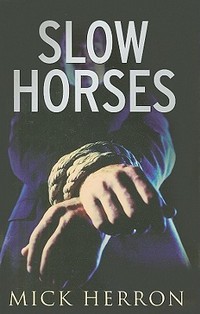
Slow HorsesSlow Horses

by Mick Herron
Series: Slough House, #1
Hardcover, 329 pg.
Soho Constable, 2010
Read: March 1 – 4, 2019

’What you have to bear in mind’–the O.B.’s words–’is that worst sometimes does come to worst.’

The worst had increased exponentially over the last few years.

The O.B.’s words of advice for his grandson turns out to be a bit more. I don’t think Herron placed this on page 2 to be a thesis statement for the book — but it really could be one. River Cartwright was musing about the way things were going for Intelligence officers (and people in related vocations) when it came to predicting what terrorists of various stripes would do. If September 11, July 7, and similar dates have taught Intelligence officers (and people in general), anything it is that sometimes the worst case is actually what happens. (actually, what do I know, maybe it was a thesis for the novel)

Of course, it doesn’t just happen for terrorist attacks — sometimes it happens for someone’s career. Take River Cartwright — after the events on page 2 (and the rest of that first chapter) — and his colleagues. Each of them had worked for the Intelligence service, many of them were rising stars (or stars that had already risen), until they messed up. Sometimes it’s in a large-scale drill, sometimes it was in the course of duty — but they all made an embarrassing mistake, misstep or failure of another stripe, resulting them being assigned to Slough House. In Slough House, all the officers still technically do intelligence work — reviewing transcripts of cell phone conversations for certain words and phrases, for example. But it’s all low priority, low importance work. Far from the important work that the rest of MI-5 (and the rest) do. They’re dubbed the “Slow Horses” and if they aren’t forgotten about by the rest of the service, they’re mocked.

One day, a Slow Horse brushes up against something that approaches “real” work and River takes the results are taken to MI-5’s HQ for them to follow-up on (after making a copy). About the same time that happens, a young Pakistani immigrant is kidnapped by a nationalist group that promises to behead him on the Internet. River decides to try to follow up on this intel, thinking it might lead to the kidnappers. And well, chaos ensues, and let’s leave it there.

Honestly, I had a lot of flashbacks to the show MI-5 (aka Spooks), throughout. The story has a very British spy feel, with more clandestine meetings, history and significant looks than an American spy story (which largely revolve around attractive people shooting things). But these Slow Horses aren’t the type that Nicola Walker, Peter Firth, and Miranda Raison would deal with — at best, they’re the ones those people would pass in the hall. But all of them wanted to get back to the major leagues — they all had the drive, the chip on their shoulder, the need to lose the embarrassment. It makes for an interesting motivation — it’s not just about saving the young man, it’s about them doing it.

The characters are quite a rag-tag bunch, who really don’t like each other much at the beginning — they all know that Slough House is a dead-end and resent being there — and transfer that resentment onto the others stuck there with them. An actual team gets forged through the events of this novel and the characters find things about each other that they can relate to — and maybe even admire.

It’s a solid spy story, and one told with restrained humor — it’s not a comedy by any means, but there are comic sensibilities throughout. Herron could’ve easily turned it into a humorous spy story about rejects trying to save the day. But he plays it pretty straight, there are things to grin about — or at least smile wryly about. But by and large this is a serious story told seriously. And it’s well done — it’s a well-constructed story and by the time the big twist is revealed, you care about the players enough to react appropriately.

But man, it was slow. Once things started happening, it flowed pretty smoothly and quickly. But those early chapters, where Herron was setting up his dominoes, were a slog. It took awhile to figure out why we were spending so much time with X, Y and Z. But when he started knocking the dominoes over? You understood why he’d spent the time and were glad he did. The slow pace of the early chapters were entirely justified, thankfully. Still, I think we could’ve had a better hook early on.

I do think that the later books in the series will be able to build on what’s established here and be less slow, and using the characters we met here get into the action quicker. I’m planning on reading at least a couple more in this series because I did enjoy this one, and think that Herron can build this into a great series. It’s a good entry point into something that promises to be better.

—–

3 Stars

2019 Library Love Challenge 2019 Cloak & Dagger Challenge

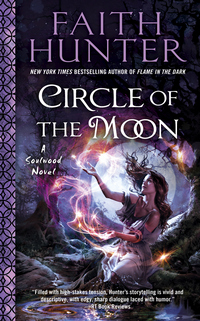
Pub Day Repost: Circle of the Moon by Faith Hunter: PsyLED Fights its Biggest and Most Dangerous Foe and Troubles from Within

Time to wrap up our Tour Stop for this book — I hope you’ve enjoyed it half as much as I have. I get a little long-winded below, sorry — but when I like a book as much as I did this one, it happens.

Circle of the MoonCircle of the Moon

by Faith Hunter
Series: Soulwood, #4

eARC, 400 pg.
ACE, 2019
Read: February 6 – 8, 2019

I’m going to have to talk about the events at the end of the previous book, Flame in the Dark, a little bit. If you haven’t read that — sorry. You may want to use the time you were about to spend on this post to purchase that/get it from your library instead.

So, with any of these Soulwood books there are three main threads to follow: 1. The PsyLED case(s) and storylines associated with the team; 2. The developments with God’s Cloud of Glory Church and Nell’s family; 3. Nell’s personal evolution as in independent woman and her supernatural development. These will all intertwine and effect each other — particularly the private lives of the PsyLED team and Nell’s own development. I want to touch on all these briefly to give you a good idea what to expect with this book.

Let’s start with God’s Cloud of Glory, which gets a lot less ink than we’re used to. But when they show up, it counts. It’s unclear how much of the church is really in favor of the changes occurring within it — it’s probably not as uniform as I’d been thinking. Which makes sense, any reformation is slow and complicated — and won’t be a straight line of progress, humans are messier than that. Whether this group will actually stumble into orthodoxy is hard to say, and it’ll definitely take years. We get to see a little of the pushback to the reforms here, but it’s nothing severe. I expect in a book or two, something will happen because of what we see in this book. The Vampire Tree on the Church’s land takes a different role in this book than we’ve grown accustomed to — and it’s probably the most important and intriguing development having to do with the Church in Circle of the Moon (possibly the most important in the book as a whole, too — time will tell).

We do learn some interesting things about Nell’s family and how they acted before Jane Yellowrock and the feds upended everything, too. I shouldn’t forget that…

As far as Nell goes, it’s been just a few weeks since she stopped being a tree and started being a human-ish person again. As you can see from the excerpt I posted earlier, things are going well for Nell and Occam, and things are moving quickly on the Mud coming to live with Nell front. But both are bringing their share of challenges for Nell. Her life is definitely not looking anything like what she’d envisioned and the changes aren’t easy for her — she mentions at one point her mixed feelings about coming into the twenty-first century. As much as she relishes some of these changes, none of them are easy.

Nell is forced to confront and re-evaluate her ideas about love, commitment, what it means to be in a romantic relationship. So much of her thinking is still that of a “churchwoman” as she’d put it. She knows other women, other men, don’t think of things in those terms and while she’s rejected her upbringing, she hasn’t yet replaced everything she wants to (she probably hasn’t even figured out everything she wants to change).Occam is the best person for her to be involved with right now (the cynic in me wants to say that he’s too perfect, but I like him too much to listen to my inner cynic) — his patience, kindness and understanding are what’s going to help her the most now.

I’m not gong to say anything else about Mud — but I’m a fan. I don’t think Hunter hit a false note with her character or any scene she was in. Mud’s a great character and knows exactly what she wants in this life (at least for now) and what she needs to do to get it. Primarily that involves manipulating and/or convincing her sister to do a few things — and Mud’s an expert at both of those.

As far a Nell and her powers go? Just wow. If you think the tree thing in the last book was revolutionary, just wait. There’s nothing as cataclysmic this time (thankfully — I’m not sure we readers could take it), but the implications of some of what Nell does in this book that aren’t yet known or seen, and the reverberations from them will be felt for a while.

So that brings us to PsyLED. Rick LaFleur wakes up in the middle of a very strange witch circle with no idea how he got there. He’d been called there somehow — as his cat. There’s a dead cat near and Nell picks up traces of vampires in the circle, too. Clearly, black magic is involved — but how and why, no one knows. It doesn’t take long before there are other circles being discovered — new and made in recent weeks. Rick and some of Ming’s vampires alike being called to them. Either of those happenings would be concerning — but the combination of them is mysterious and troubling. Also, why is Rick being called and nothing happening to the team’s other werecat? The questions and mysteries pile up quickly.

Some trouble in Knoxville law enforcement doesn’t help, either. Supernatural crimes/events — things like strange witch circles — aren’t being reported to PsyLED as they ought to be. The FBI and one particular agent (the witch that Nell met last time) are hovering on the fringes of the investigation in a way that speaks of more than mild curiosity. Changes and upheaval in the local vampire government — Ming of Glass is now a MOC, for example — feeds into some of the confusion.

It’s one of those situations where the more Nell and the team learn, the less they know. Everything points to big trouble, they just can’t figure out what kind of trouble — or even its source. Rick is going to have to explain a lot about things he’s previously been reluctant to discuss, for starters. And still, they may not figure out what kind of black magic is involved — and why — before it’s too late to save innocent/not-so-innocent lives.

This is the best PsyLED story this series has yet given us. Nell running off on her own isn’t going to crack this, solid procedure, a real team effort and some quick thinking (and a few lucky breaks) are the key to things working out. It’s probably the most exciting story, too. There’s a lot of action, there are more guns fired in this book by law enforcement than possibly in the first three books combined. Lainey and her magic, JoJo’s computer wizardry (legitimate and less than), Occam’s cat and trigger finger, Tandy’s abilities, plus Nell’s abilities (including offensive capabilities we haven’t previously seen) are going to have to work more in general and in combination with each other than they have in the series so far just to keep the team in the game — but for them to actually close this case and get some answers, they’re going to need extra help. I loved this part of the book and want to keep talking about it, but I’m going to hold back. I’ve often wondered if the team wasn’t wasting time in the past — not this time. Everything clicked for me with this story and I couldn’t be happier about the whole thing.

I’m pretty sure that I can’t say anything about the people behind the circles without ruining something. There’s some real evil afoot, I tell you what. There’s also a damaged soul (well, a few of them), some well-intentioned moves in the past that result in trauma and worse in the present, a mixture of aligned entities that don’t necessarily have the same ends in mind. You combine those things and you get a lot of damage, heartbreak, and death being dealt. Not only is this the best PsyLED story, it’s got the most compelling opponent(s) for the team yet.

I know that Rick has his detractors going back to early on in the Yellowrock books up until his involvement in this series. I haven’t checked as much as I should have to see if some of them have come around to him or not. I’ve never been as anti-Rick as others have been, but he’s never been a character I liked. As soon as he and Jane split, I would’ve been content to never think of him again — but Hunter had other ideas. I liked him in this role, but I’ve always preferred everyone else on the team (except Paka), and really hoped he’d be in the background for some time. Yeah, well, that’s absolutely not the case in this book. I won’t say that this book wholly rehabilitates the character for me — and I can’t imagine that the extreme anti-Rick contingent will be satisfied. But, I will say that it’ll be hard for people to not soften their opinion of him after this book. Hunter did a lot of good to his character in this book. For people who liked Rick and/or were positively-inclined toward him? You’re going to love this book.

Tandy does a couple of things in this book that intrigued me. Nell’s not the only paranormal on this team whose powers are developing in ways that may prove troubling. I wonder if it’s a coincidence that these two (and maybe others?) are changing, or if there’s another explanation — they’re changing each other, one is changing the other while they evolve themselves — or is there an outside party up to something? It’s also possible I’m reading too much into things.

This is largely an aside for people who are Yellowrock fans. Throughout this book, we brush up against Jane Yellowrock and what happened in Dark Queen, which seems to have happened while Nell was a tree (I think Dark Queen started about the same time as Flame in the Dark, but DQ ended a lot sooner than FitD), and Nell’s not really up on what’s going on with her friend yet. She knows a couple of the bullet points, but doesn’t really have the full picture. According to FaithHunter.net’s Reading Order, this novel actually happens after the next Jane Yellowrock novel. So, we’re about as confused as Nell is. Now, does this impact any of the interaction Nell, JoJo and the rest have with Jane, Alex or any of the vampires in Tennessee? No. But man, it makes me even more curious about what happens after Dark Queen — I didn’t think I could be more curious about that than I was, but man…this book has really intensified all that for me.

Okay, back to Circle of the Moon. I’ve given the first three books in the series 4 1/2 Stars each. I think this time I have to give in and toss that missing half star to the rating. The PsyLED story was great, we didn’t get bogged down in the Church/cult business too much, Mud just made me smile, and while I’m not comfortable with every choice Nell made in her personal and professional life (and a couple of the choices worry me long-term) — I like the fact that she’s making them. I can’t think of a single problem with this book, it satisfied every fan-impulse/desire I had, was a step up from previous installments in many ways, and told a solid and complete story that still drives the reader to want more. I can’t imagine a Hunter fan not liking this book — and it’s the kind of book that should get her some new readers, too.

Disclaimer: I received this eARC from Berkley Publishing Group via NetGalley in exchange for this post — thanks to both for this. My opinions remain my own and are the honest reactions of this particular reader.

—–

5 Stars


My thanks to Let’s Talk Promotions for the invitation to participate in this tour and the materials (including the book via NetGalley) they provided.

Circle of the Moon by Faith Hunter: PsyLED Fights its Biggest and Most Dangerous Foe and Troubles from Within

Time to wrap up our Tour Stop for this book — I hope you’ve enjoyed it half as much as I have. I get a little long-winded below, sorry — but when I like a book as much as I did this one, it happens.

Circle of the MoonCircle of the Moon

by Faith Hunter
Series: Soulwood, #4

eARC, 400 pg.
ACE, 2019

Read: February 6 – 8, 2019


I’m going to have to talk about the events at the end of the previous book, Flame in the Dark, a little bit. If you haven’t read that — sorry. You may want to use the time you were about to spend on this post to purchase that/get it from your library instead.

So, with any of these Soulwood books there are three main threads to follow: 1. The PsyLED case(s) and storylines associated with the team; 2. The developments with God’s Cloud of Glory Church and Nell’s family; 3. Nell’s personal evolution as in independent woman and her supernatural development. These will all intertwine and effect each other — particularly the private lives of the PsyLED team and Nell’s own development. I want to touch on all these briefly to give you a good idea what to expect with this book.

Let’s start with God’s Cloud of Glory, which gets a lot less ink than we’re used to. But when they show up, it counts. It’s unclear how much of the church is really in favor of the changes occurring within it — it’s probably not as uniform as I’d been thinking. Which makes sense, any reformation is slow and complicated — and won’t be a straight line of progress, humans are messier than that. Whether this group will actually stumble into orthodoxy is hard to say, and it’ll definitely take years. We get to see a little of the pushback to the reforms here, but it’s nothing severe. I expect in a book or two, something will happen because of what we see in this book. The Vampire Tree on the Church’s land takes a different role in this book than we’ve grown accustomed to — and it’s probably the most important and intriguing development having to do with the Church in Circle of the Moon (possibly the most important in the book as a whole, too — time will tell).

We do learn some interesting things about Nell’s family and how they acted before Jane Yellowrock and the feds upended everything, too. I shouldn’t forget that…

As far as Nell goes, it’s been just a few weeks since she stopped being a tree and started being a human-ish person again. As you can see from the excerpt I posted earlier, things are going well for Nell and Occam, and things are moving quickly on the Mud coming to live with Nell front. But both are bringing their share of challenges for Nell. Her life is definitely not looking anything like what she’d envisioned and the changes aren’t easy for her — she mentions at one point her mixed feelings about coming into the twenty-first century. As much as she relishes some of these changes, none of them are easy.

Nell is forced to confront and re-evaluate her ideas about love, commitment, what it means to be in a romantic relationship. So much of her thinking is still that of a “churchwoman” as she’d put it. She knows other women, other men, don’t think of things in those terms and while she’s rejected her upbringing, she hasn’t yet replaced everything she wants to (she probably hasn’t even figured out everything she wants to change).Occam is the best person for her to be involved with right now (the cynic in me wants to say that he’s too perfect, but I like him too much to listen to my inner cynic) — his patience, kindness and understanding are what’s going to help her the most now.

I’m not gong to say anything else about Mud — but I’m a fan. I don’t think Hunter hit a false note with her character or any scene she was in. Mud’s a great character and knows exactly what she wants in this life (at least for now) and what she needs to do to get it. Primarily that involves manipulating and/or convincing her sister to do a few things — and Mud’s an expert at both of those.

As far a Nell and her powers go? Just wow. If you think the tree thing in the last book was revolutionary, just wait. There’s nothing as cataclysmic this time (thankfully — I’m not sure we readers could take it), but the implications of some of what Nell does in this book that aren’t yet known or seen, and the reverberations from them will be felt for a while.

So that brings us to PsyLED. Rick LaFleur wakes up in the middle of a very strange witch circle with no idea how he got there. He’d been called there somehow — as his cat. There’s a dead cat near and Nell picks up traces of vampires in the circle, too. Clearly, black magic is involved — but how and why, no one knows. It doesn’t take long before there are other circles being discovered — new and made in recent weeks. Rick and some of Ming’s vampires alike being called to them. Either of those happenings would be concerning — but the combination of them is mysterious and troubling. Also, why is Rick being called and nothing happening to the team’s other werecat? The questions and mysteries pile up quickly.

Some trouble in Knoxville law enforcement doesn’t help, either. Supernatural crimes/events — things like strange witch circles — aren’t being reported to PsyLED as they ought to be. The FBI and one particular agent (the witch that Nell met last time) are hovering on the fringes of the investigation in a way that speaks of more than mild curiosity. Changes and upheaval in the local vampire government — Ming of Glass is now a MOC, for example — feeds into some of the confusion.

It’s one of those situations where the more Nell and the team learn, the less they know. Everything points to big trouble, they just can’t figure out what kind of trouble — or even its source. Rick is going to have to explain a lot about things he’s previously been reluctant to discuss, for starters. And still, they may not figure out what kind of black magic is involved — and why — before it’s too late to save innocent/not-so-innocent lives.

This is the best PsyLED story this series has yet given us. Nell running off on her own isn’t going to crack this, solid procedure, a real team effort and some quick thinking (and a few lucky breaks) are the key to things working out. It’s probably the most exciting story, too. There’s a lot of action, there are more guns fired in this book by law enforcement than possibly in the first three books combined. Lainey and her magic, JoJo’s computer wizardry (legitimate and less than), Occam’s cat and trigger finger, Tandy’s abilities, plus Nell’s abilities (including offensive capabilities we haven’t previously seen) are going to have to work more in general and in combination with each other than they have in the series so far just to keep the team in the game — but for them to actually close this case and get some answers, they’re going to need extra help. I loved this part of the book and want to keep talking about it, but I’m going to hold back. I’ve often wondered if the team wasn’t wasting time in the past — not this time. Everything clicked for me with this story and I couldn’t be happier about the whole thing.

I’m pretty sure that I can’t say anything about the people behind the circles without ruining something. There’s some real evil afoot, I tell you what. There’s also a damaged soul (well, a few of them), some well-intentioned moves in the past that result in trauma and worse in the present, a mixture of aligned entities that don’t necessarily have the same ends in mind. You combine those things and you get a lot of damage, heartbreak, and death being dealt. Not only is this the best PsyLED story, it’s got the most compelling opponent(s) for the team yet.

I know that Rick has his detractors going back to early on in the Yellowrock books up until his involvement in this series. I haven’t checked as much as I should have to see if some of them have come around to him or not. I’ve never been as anti-Rick as others have been, but he’s never been a character I liked. As soon as he and Jane split, I would’ve been content to never think of him again — but Hunter had other ideas. I liked him in this role, but I’ve always preferred everyone else on the team (except Paka), and really hoped he’d be in the background for some time. Yeah, well, that’s absolutely not the case in this book. I won’t say that this book wholly rehabilitates the character for me — and I can’t imagine that the extreme anti-Rick contingent will be satisfied. But, I will say that it’ll be hard for people to not soften their opinion of him after this book. Hunter did a lot of good to his character in this book. For people who liked Rick and/or were positively-inclined toward him? You’re going to love this book.

Tandy does a couple of things in this book that intrigued me. Nell’s not the only paranormal on this team whose powers are developing in ways that may prove troubling. I wonder if it’s a coincidence that these two (and maybe others?) are changing, or if there’s another explanation — they’re changing each other, one is changing the other while they evolve themselves — or is there an outside party up to something? It’s also possible I’m reading too much into things.

This is largely an aside for people who are Yellowrock fans. Throughout this book, we brush up against Jane Yellowrock and what happened in Dark Queen, which seems to have happened while Nell was a tree (I think Dark Queen started about the same time as Flame in the Dark, but DQ ended a lot sooner than FitD), and Nell’s not really up on what’s going on with her friend yet. She knows a couple of the bullet points, but doesn’t really have the full picture. According to FaithHunter.net’s Reading Order, this novel actually happens after the next Jane Yellowrock novel. So, we’re about as confused as Nell is. Now, does this impact any of the interaction Nell, JoJo and the rest have with Jane, Alex or any of the vampires in Tennessee? No. But man, it makes me even more curious about what happens after Dark Queen — I didn’t think I could be more curious about that than I was, but man…this book has really intensified all that for me.

Okay, back to Circle of the Moon. I’ve given the first three books in the series 4 1/2 Stars each. I think this time I have to give in and toss that missing half star to the rating. The PsyLED story was great, we didn’t get bogged down in the Church/cult business too much, Mud just made me smile, and while I’m not comfortable with every choice Nell made in her personal and professional life (and a couple of the choices worry me long-term) — I like the fact that she’s making them. I can’t think of a single problem with this book, it satisfied every fan-impulse/desire I had, was a step up from previous installments in many ways, and told a solid and complete story that still drives the reader to want more. I can’t imagine a Hunter fan not liking this book — and it’s the kind of book that should get her some new readers, too.

Disclaimer: I received this eARC from Berkley Publishing Group via NetGalley in exchange for this post — thanks to both for this. My opinions remain my own and are the honest reactions of this particular reader.

—–

5 Stars


My thanks to Let’s Talk Promotions for the invitation to participate in this tour and the materials (including the book via NetGalley) they provided.

EXCERPT from Circle of the Moon by Faith Hunter

I’m happy to give you a little tease of an excerpt from Circle of the Moon‘s first chapter. When I read it, it grabbed my attention right away, I can tell you. Thankfully, I had the rest of the eARC to satisfy me — you’ll have to wait until Feb. 26 to see where Nell and Occam go from here. I almost feel bad about leaving you where this does. Almost.

For those who are interested, I can absolutely “hear” Khristine Hvam’s voice as I read the last line, incidentally. Should be a fun audiobook.


The night sky was a wash of cerulean blue over the trees and the roofline, with a trace of scarlet and plum on the western horizon. A silver wedge of moon would rise soon, no longer full, an important consideration when eating a picnic with a were-creature. Other than the stars, our only light came from an oil lantern propped on a flat-topped rock, casting shadows over the blanket and used paper plates and the half-empty bottle of Sister Erasmus’ muscadine wine, and even that would get snuffed as soon as the meteor shower began.

I was safe on Soulwood land, even in the full dark, and had no need to worry about my surroundings. I was primarily concentrating on the danged wereleopard lounging in human form on the picnic blanket beside me, looking amused, and maybe just a bit smug. Dang cat. “Take. Off. Your. Shirt,” I demanded again.

“Why, Nell, sugar, if you were so desirin’ of seeing me in my naked glory, all you had to do was ask.”

I blushed, which didn’t show, not with my new coloration, but I knew Occam could smell my reaction and hear my suddenly galloping heart. But we had been over this conversational ground on two separate evenings. Two official dates. This was our third and I wasn’t taking no for an answer. I inhaled a steadying breath and leaned in until my face was an inch from his, wiping out the horizon. He had no choice but to focus on me. Quietly, almost a whisper, I said, “This ain’t my first rodeo, cat-man. I been fighting recalcitrant males for mosta my life. You died. You’re still scarred and mostly hairless and moving slow. Now. Take off the shirt. Lemme see the scars so I’ll know what to do to help heal them.”


Lousy place to leave, but that’s all I was given to share. Be sure to place your orders now so you can read what comes next.

My thanks to Let’s Talk Promotions for the invitation to participate in this tour and the materials (including the book via NetGalley) they provided.

Page 14 of 27

Subscribe via Email

Enter your email address to subscribe to The Irresponsible Reader and receive notifications of new posts by email.

Powered by WordPress & Theme by Anders Norén