Category: P-U Page 24 of 36

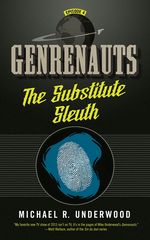
Pub Day Repost: The Substitute Sleuth by Michael R. Underwood

The Substitute SleuthThe Substitute Sleuth

by Michael R. Underwood
Series: Genrenauts, #4eARC, 88 pg.
2016
Read: July 11, 2016

Adventure, excitement, hypothermia. All of this and more await you in the Genrenauts!

Once again, Leah Tang is having a rough time on her first visit to a genre world. It’s Chicago, there’s a snow storm, her primary partner on this particular mission is getting a bit too wrapped up in the story, and she had to see her second dead body (not that such a sight is ever pleasant, but this one is well, is fit for the opening scenes of Castle, Bones, etc.). Thankfully, her sense of humor isn’t only welcome on this mission, it’s required.

It all starts when poor Leah has to wake up early, summoned for a mission to patch a small story breach on Crime World — the Police Procedural region to be precise. King’s going to let her take the lead on it as a training exercise. And then things go wrong. Because, well, that’s just how things are going for this team lately — and the one story breach they came to Crime World to patch is overshadowed by a bigger one. Crime World breaches left unpatched bleed over into our world in the form more, and worse, crimes. Every bleed from a Genre World into ours sounds bad — but this one is worse. Leah is still having qualms about the ethics involved in what her team does, but given the stakes, she’s willing to put them aside.

Probably more than in the previous adventures, Leah and King lean on and exploit the tropes of this world and region. As a fan of the Whacky Investigator/Straight-Laced Law Officer partner stories/shows, I loved watching the two of them use, critique, and play with the story beats, types and clichés. White Hat hacking, convenient recovery periods after being shot, how clues show up at just the right time, and so on. At one point, Leah sees a pair of detectives that work in the precinct with the detective at the center of the breach:

Leah took them to be the friend cops, the other team that would work another part of a case—the cases that would all too often end up being related, thanks to the laws of narrative conservation.

I love that phrase “laws of narrative conservation,” I am stealing that, period. I talk about that phenomenon all the time here, and this phrase is going to save me so much typing.

Between this and the Max novella, we’re learning a good deal about Angstrom King — I think I’m getting a really good sense of him, and I’m liking him more than I expected. Leah is pretty much Leah, just a little more confident in her place and moving onward from where she’s been so far in the series. The rest of the team faded to the background to an extent that I found surprising, and I hope it’s not a sign of things to come. I’m pretty sure it’s not, Underwood wouldn’t have spent so much time establishing the team and characters if he was going to drop them. Everyone was present, but their roles were very diminished. Mallery’s got a bit more to do than the others, but really not much.

The closing pages of this do a great job of setting-up the two-part season finale in the next two novellas. I can’t say more than that — but how any fan of this series can be patient waiting to see what comes next is a greater mystery than the ones the team encounters on Crime World. Best of the bunch.

N.B.: As this was an ARC, there’s a chance that the quotations above might not be in the published version, I’ll try to confirm them as soon as I can.
Disclaimer: I received a copy of novella from the author in exchange for this post–thanks, Mr. Underwood!

—–

4 1/2 Stars

The Substitute Sleuth by Michael R. Underwood

The Substitute SleuthThe Substitute Sleuth

by Michael R. Underwood
Series: Genrenauts, #4

eARC, 88 pg.
2016

Read: July 11, 2016

Adventure, excitement, hypothermia. All of this and more await you in the Genrenauts!

Once again, Leah Tang is having a rough time on her first visit to a genre world. It’s Chicago, there’s a snow storm, her primary partner on this particular mission is getting a bit too wrapped up in the story, and she had to see her second dead body (not that such a sight is ever pleasant, but this one is well, is fit for the opening scenes of Castle, Bones, etc.). Thankfully, her sense of humor isn’t only welcome on this mission, it’s required.

It all starts when poor Leah has to wake up early, summoned for a mission to patch a small story breach on Crime World — the Police Procedural region to be precise. King’s going to let her take the lead on it as a training exercise. And then things go wrong. Because, well, that’s just how things are going for this team lately — and the one story breach they came to Crime World to patch is overshadowed by a bigger one. Crime World breaches left unpatched bleed over into our world in the form more, and worse, crimes. Every bleed from a Genre World into ours sounds bad — but this one is worse. Leah is still having qualms about the ethics involved in what her team does, but given the stakes, she’s willing to put them aside.

Probably more than in the previous adventures, Leah and King lean on and exploit the tropes of this world and region. As a fan of the Whacky Investigator/Straight-Laced Law Officer partner stories/shows, I loved watching the two of them use, critique, and play with the story beats, types and clichés. White Hat hacking, convenient recovery periods after being shot, how clues show up at just the right time, and so on. At one point, Leah sees a pair of detectives that work in the precinct with the detective at the center of the breach:

Leah took them to be the friend cops, the other team that would work another part of a case—the cases that would all too often end up being related, thanks to the laws of narrative conservation.

I love that phrase “laws of narrative conservation,” I am stealing that, period. I talk about that phenomenon all the time here, and this phrase is going to save me so much typing.

Between this and the Max novella, we’re learning a good deal about Angstrom King — I think I’m getting a really good sense of him, and I’m liking him more than I expected. Leah is pretty much Leah, just a little more confident in her place and moving onward from where she’s been so far in the series. The rest of the team faded to the background to an extent that I found surprising, and I hope it’s not a sign of things to come. I’m pretty sure it’s not, Underwood wouldn’t have spent so much time establishing the team and characters if he was going to drop them. Everyone was present, but their roles were very diminished. Mallery’s got a bit more to do than the others, but really not much.

The closing pages of this do a great job of setting-up the two-part season finale in the next two novellas. I can’t say more than that — but how any fan of this series can be patient waiting to see what comes next is a greater mystery than the ones the team encounters on Crime World. Best of the bunch.

N.B.: As this was an ARC, there’s a chance that the quotations above might not be in the published version, I’ll try to confirm them as soon as I can.
Disclaimer: I received a copy of novella from the author in exchange for this post–thanks, Mr. Underwood!

—–

4 1/2 Stars

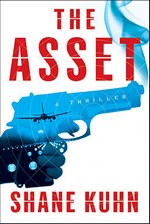
In Medias Res: The Asset by Shane Kuhn

as the title implies, I’m in the middle of this book, so this is not a review, just some thoughts mid-way through.

—–

The Asset
The Asset

by Shane Kuhn

This is not the Shane Kuhn you know. Well, sort of. This is a standalone thriller about Airport/Airplane Security, Terrorism, and the USA’s efforts to keep the friendly skies, well, friendly. It’s not as fun and funny as The Intern’s Handbook or Hostile Takeover (or whatever they’re called in your part of the world). BUT it is just as well-written and suspenseful — and a little easier to believe, actually.

There are hints, suggestions, indicators, and other things pointing to an immanent terrorist attack on the U.S., and not enough people are taking the situation seriously. At least, least that’s the point of view of Kennedy, the security expert and protagonist, who is taking it very seriously. Taking place over 64 days (not a spoiler, that’s literally the 2nd line — although, there could be some action that takes place after that). Will Kennedy be in time to stop it? How will he? this is a pulse-pounder, a nail-biter, a “oh, crud — do I really have to go to work tomorrow? Do I actually need to sleep before then?” kind of book.

I think I’d prefer it to be harder to believe than the other two books, come to think of it.

I’m almost at the mid-way point of the ARC (with thanks to Simon & Schuster and Shane Kuhn) and I’m telling you now, you want to pre-order this, get on your library’s wait-list, or whatever (legal) thing you do to get your hands on a book. It comes out on July 12, you want to be ready for it.

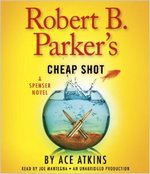
Cheap Shot (Audiobook) by Ace Atkins, Joe Mantegna

Cheap Shot (Audiobook)Robert B. Parker’s Cheap Shot

by Ace Atkins, Joe Mantegna (Narrator)
Series: Spenser, #42

Unabridged Audio, 7 Hours and 30 Minutes

Random House Audio, 2014
Read: June 7 – 9, 2016


This is a very mixed bag of an audiobook. I loved the novel 3 years ago, and enjoyed reliving it. But man, the narration was just not my thing. But I’ll get back to that in a bit.

I stand by pretty much everything that I said 3 years ago (although, I seem to have missed/underrated one plot point last time — I totally bought it this time). Here’s some of what I said before that still applies:

On the one hand, this is not Atkins’ best Spenser. But it’s the one that feels like Parker more than the rest (make of that what you will). The banter, the poking around and stirring things up until you get a break, the fisticuffs, the donuts, the gun fight, the needling of underworld players, and so on — he captures Parker’s voice and pacing better here than he’d managed before (yet doesn’t come across as pastiche). Spenser’s sniffing around the big money and big boys (and a few men) in sports, which serve as a good place for Spenser to reflect how men are to act. Parker did this Mortal Stakes and Playmates (and to lesser extents elsewhere — like Early Autumn), and Atkins is able to do that here (arguably he does so with a subtlety that Parker didn’t achieve).

Kinjo Heywood’s a fun character — slightly more grounded than Mortal Stakes‘ Marty Rabb, far more mature and grounded than Playmates‘ Dwayne Woodcock. One advantage Heywood has is his son, Akira (who’s plenty of fun on his own) — he has someone to provide a good example to, and he strives to. Heywood also seems to have thought ore about life and how one should live it. Marty seemed to think only about Linda (his wife) and baseball, Dwayne was all about his girlfriend (Chantel) and basketball, too — but with less self-examination, it’s just that’s all he had the chance to think about (although Chantel would see that changed, and his horizons broadened if she had anything to say about it). Heywood’s got a kid, he’s been through a divorce, and is fully aware of his place in the limelight (including social media) and his own shortcomings. This alone saves the book from being a reworking of Parker.

I should add that Sixkill has a lot of perspective here (with the assistance of Atkins’ own background in football) — he was close to Heywood’s level, and if he’d made one or two better choices, he would’ve been at this level. He has a better idea what’s going on in Heywood’s mind than Spenser and his brief stint in the boxing world would.

The book begins with Spenser doing bodyguard duty — and as always (Stardust, Looking For Rachel Wallace, A Savage Place, Rough Weather) things don’t go well. You’d think people’d stop hiring him for this kind of work. Spenser turns to investigating — and unearthing lie after lie from his client — while getting Hawk and Sixkill to pitch in on the bodyguard front.

In addition to the main characters, Hawk, Susan, Sixkill, Tony Marcus, and so on; Atkins continues to show a command and familiarity with the impressive gallery of supporting characters in the Spenser-verse. And the new characters fit into the ‘verse just fine, nothing that Parker wouldn’t have created.

Not only did Atkins give us a good story this time, he appeared to be planting and/or watering seeds for future books at the same time — something Parker never bothered with, but I’m glad to see.

About the only thing I’d like to add on this front is that I think I liked the story more this time around.

So much for the lovefest. I just didn’t like Mantegna’s work. I know, I know — he’s done many, many of the Spenser Audiobooks; Parker loved his work with Spenser (even getting him cast in those semi-regrettable movies); and he’s Joe bleepin’ Mantegna. Still, it didn’t work for me. When he was reading the narrative parts — Spenser describing what he was doing, what he was seeing, etc., even making smart aleck asides — I dug it. He did a perfectly entertaining job — maybe even more.

But the strength of Parker’s work was his dialogue, and Mantegna fell flat (at best) on this front. Spenser sounds like Fat Tony, which just should not be. Ever. Kinjo sounds like a stereotypical old blues man, not a young NFL linebacker. Hawk sounds like a slightly younger blues man. And don’t get me started on Zee. That was just embarrassing. Most of the other characters were pretty poorly done, as well. And when the book is so reliant on dialogue, so reliant on the charm of the characters, that missing with just about all of them hurts.

So, like I said, great writing, mediocre (when not disappointing) narration. Please note this rating is for the Audiobook — the whole experience, the narration as well as the writing — still love the book, and would recommend the novel in a heartbeat. This? Eh. It was entertaining enough, but that’s it. Still, any time with Spenser is time well spent.

—–

3 Stars

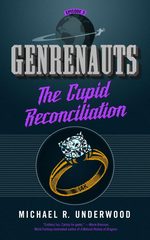
The Cupid Reconciliation by Michael R. Underwood

What? Another Genrenauts/Michael R. Underwood post? Yup. Don’t worry, I’m going to slow down a bit (well, after this and then next week’s post, “What’s in Underwood’s Sock Drawer?”) — but trying to get the word out about the Kickstarter and the series takes some repetition.

I’m pretty sure that there’s a paragraph missing from this — I just don’t know what it was supposed to be about. I may end up revising this tomorrow.

The Cupid ReconciliationThe Cupid Reconciliation

by Michael R. Underwood
Series: Genrenauts, #3

eARC
2016
Read: May 17, 2016

This is my life, Leah thought . . . My amazing, confusing, totally screwed-up life.

Just as Leah is getting to the point that she’s starting to feel comfortable, maybe even a little confident, in her new job — her new life — things get shook up a little. Mallery, the member of the team whose injury led to Leah’s recruitment, is back from her convalescence. That alone will change the team dynamic in the field, and maybe even effect Leah’s standing in the team. The fact that they’re headed to Romantic-Comedy world, Mallery’s specialty, doesn’t help Leah’s spirits (particularly because she’d like that to be her specialty, too).

Speaking of the various worlds, I don’t know if we’d ever been given insight into how life in a Genre World would start to change a person after awhile. Or if we were, it wasn’t explained the way it was here. That was just a cool touch.

While Leah continues to be our point-of-view character, our entry into this world, this is really Mallery’s book. The rest of the team are there, and contribute but the major non-Leah narrative weight is all carried by Mallery. Which I’m fine with, she seems to be a fun character (maybe a little hard to take in real life, but that could just be her nerves about getting into the field/dealing with a probie) and we need to get to know her, but she’s a force of nature.

Mallery beamed, which Leah was realizing was pretty close to the woman’s resting face. Some women had resting bitch face, but Mallery glowed. It was impressive. A little annoying, but impressive.

There was something in the “Coming Next” page in the last episode that made me worry about the relationship between these two not getting off on the right foot — thankfully, it seemed to get off on a decent (if not the right) foot — but nothing’s perfect. The two characters are going to have to fumble a bit to get a strong working relationship.

Don’t get me wrong — King, Roman, and Shirin all had their moments and made their presence felt — but they were bit players in this one. I did appreciate getting to see Roman’s softer side on display, he’s a deeper thinker than you might take him for and his efforts to help the “male lead,” were borderline sweet.

Straightaway when they get to the world, they come up with a strong candidate for the couple causing the breach — and the team is wrong, they have to work harder than the last two times to find where the problem is. I appreciated that move — and didn’t realize until then how smooth that step had gone in the previous adventures.

Maybe it’s because this particular world so closely resembles our own, but Leah got a bit of insight into how the Genrenauts’ activities might seem to one of the people from that world — and it’s not that pretty. The Genrenauts violate the Prime Directive more than Kirk ever did (to put it in genre-terms). And Leah’s not so sure that their particular brand of meddling is all that ethical. And I have to admit, she may have a point. Mallery shuts down that kind of thinking/talk — at least until they’re safely back home. I trust that Leah’s doubts and questions will be all dealt with in a way that’s honest in the near future. Regardless, Leah’s ethical qualms add a good dimension to things.

I enjoyed seeing this world through Genrenaut eyes — the availability of fantastic (and cheap) apartments with amazing views, how easy it is to get a cab, the fact that there’s a romantic scene seemingly everywhere in the background — happy couples everywhere.

. . . Leah walked up to a double-wide window facing the park. The leaves were changing, making for a sea of rich oranges and yellows beside a crystal-clear lake. The view was postcard-perfect. And as a cherry on top, there was a couple rowing a boat in the lake, one carrying a parasol. And Leah could even make out a picnic basket. The energy of the place was contagious. Western world was cheesy and scary. Science Fiction was cheesy and a bit confusing. Rom-Com world was cheesy and delightful.

There’s sort of a happy ending montage at the end (or the narrative equivalent of one, anyway) that was just perfect. Once I realized what exactly Underwood was up to there, I couldn’t help grinning. I know it’s part of the series premise for him to play with, celebrate, comment on genre tropes, clichés, conventions and so on — but sometimes what he does seems to capture the essence of the particular genre in a way that just feels like he did it better than usual. This is one of those times.

If you’ve been reading this series already, you’re going to really enjoy this. If you haven’t started — go back to Episode 1 and start fresh, you won’t be sorry. Underwood has a good thing going here, and it’s just getting better. Fun, yet thoughtful; action-packed, but pretty restrained in use of force. A great balancing act that should inspire more to do this.

Disclaimer: I received this book from the author as part of his promotion of the Season One Kickstarter.

—–

4 1/2 Stars

A Few Quick Questions With…Michael R. Underwood

The first time I’d heard of Michael R. Underwood was on an episode of The Once and Future Podcast back in August of ’14, when he was promoting his first novel, Geekomancy, and I had to get my hands on it as quickly as I could. Reading it confirmed what I’d thought listening to the interview — this is my kind of writer: the interests, the sense of humor, the kind of story he was telling — if we weren’t members of the same Geek Taxonomic Rank, we were close enough. Every book/story since then has just increased that impression (even the ones that didn’t bowl me over). Naturally, I jumped at the chance to help promote his Kickstarter for Season 1 of Genrenauts with this little Q&A.

Man, I so wanted to go full fan-boy on him asking all sorts of detailed questions about his various books — especially this series — enough to make him shout, “Alpha 3-9!” while running away. Instead, I stuck with keeping it short and sweet, so he can focus on the Kickstarter, his job, his books, etc. (and because I like not having Restraining Orders taken out on me).

Michael R. UnderwoodMichael R. Underwood is the author of seven books: Geekomancy, Celebromancy, Attack the Geek, Shield and Crocus, The Younger Gods, and Genrenauts, a series in novellas (The Shootout Solution and The Absconded Ambassador). By day, he’s the North American Sales & Marketing Manager for Angry Robot Books.

Mike lives in Baltimore with his wife and their ever-growing library. In his rapidly-vanishing free time, he geeks out on comics and games and makes pizzas from scratch. He is also a co-host on the Hugo Award-Finalist The Skiffy and Fanty Show and Speculate! The Podcast for Writers, Readers, and Fans.

Between your job, family, social life, social media, writing, media-ingestion (which based on your twitter feed and books is pretty impressive) how do you do it? Have you figured out how to survive without sleep?
I am actually a huge fan of sleep – I need at least 6 to 7 ½ hours a night to stay in peak form. I fit everything in because so many of the things I do fold into two or more others. Watching TV informs my fiction, it gives me stuff to blog about, or to discuss on the podcasts I do. Same with reading and video games. My wife is also a geek, so watching TV/movies, talking about media, and sitting around reading all still counts as time spent together.

My day job and my writing career support one another, since they’re both in the same field. I’m very lucky that my boss at Angry Robot, Marc Gascoigne, doesn’t expect me to put in long hours the way that some publishing professionals have to (I work 40 hours a week on the job, not 50-70 that I know some folks do). If I were an editor, I think it’d be much harder to keep everything balanced.

Even with all of that double-counting, I have still really streamlined my life. I used to have several more hobbies, but I haven’t been making time for tango or historical martial arts in the last few years. I’d like to get back into the martial arts, especially since I have a series in development which draws on that world.

What’s the one (or two) book/movie/show in the last 5 years that made you say, “I wish I’d written that.”?
The movie I most wish I’d written and/or been involved in the creation of is Mad Max: Fury Road. Watching Fury Road for the first time was something akin to a conversion experience for me. The way that action drove (heh) the narrative, how action foregrounded and revealed character, and the way that the film told a very specific story about combating toxic masculinity and rape culture through the lens of an extended chase scene – all of those elements totally blew me away, and have served as a call to action, a challenge to do better in my own writing. It’s a phenomenal example that a story can be exciting, commercial, and have something to say in addition to “whee!”
In between installments of the Ree Reyes series, you had a couple of other works published. Are you exclusively a Genrenauts author for the rest of this season/through season 5, or do you have another iron or two in the fire?
Since the Genrenauts Kickstarter is going very well so far, things are looking good for that series, with the Season One omnibus scheduled for this fall. I’d then start working on Season Two at the start of 2017, looking to pick the series back up in the Spring/Summer.

But I definitely have some other projects in development. There’s the fencing-oriented series I alluded to above, and I’m also eager to get back to the first draft of a space opera that I’ve been working on (it’s so much fun, folks. Some of the most fun I’ve had writing fiction).

My goal is to keep Genrenauts going for all five planned seasons, and to fit other projects in between those seasons, including at least one novel a year if possible. I’d also love to do some writing in the comics medium, but right now my wish-list of projects far outstrips the time I have available to write them, so I have to prioritize based on what projects have the best prospects in terms of finding a good home or method of getting to readers.

Up to this point you’ve been writing Urban Fantasy and SF, is that home for you, or have you thought about trying something else — or are the various worlds in Genrenauts scratching your itch to dabble in something else? Is there a genre that you particularly enjoy, but could never write?
My tastes range across the genres of speculative fiction, so I’m definitely planning on continuing to stretch my skills and write in a variety of modes and sub-genres. Genrenauts really helps with some of that, though there are some places where I have a more specific idea in a sub-genre for something that wouldn’t be a good fit for Genrenauts. Those ideas get their own chair in the Green Room of my writing brain. It’s very crowded in there. Don’t let the Story Idea Fire Marshal know.

I’d really like to write some romantic SF/F, where the romance plot is as developed as the SF/F story. The Ree Reyes series has some romantic elements, but I’ve been reading more Romance novels/novellas and am continually impressed at how Romance writers draw out such intensity of emotion and characterization. I’m trying to learn from those writers and see where I can use those skills to strengthen the relationship plots in my own stories.

I’m not likely to ever write a Literary Fiction work – one without SF/F elements and focusing on the super-deep language, slow-burn, internal exploration that is expected in that mode. It’s just not how I approach storytelling.

The whole point of this was to help promote the Kickstarter campaign, so we’d better talk about it a little — How’s the Kickstarter going (especially compared to what you’d expected/hoped)? What do you want people to know about the campaign that you haven’t already said?
The campaign is going really well! We hit 70% a week from the initial launch (almost to the hour), and it’s looking very likely that we will not only fund, but we might hit several of the stretch goals to have Mary Robinette Kowal return to perform audiobook editions of further episodes in the series. I’m really excited by the outpouring of support I’ve seen for the series, from Kickstarter backers to people offering to help me spread the word to people eager to review the new episodes, and so on.

When I was first developing the idea for Genrenauts, I started to hope that this might become a Big Thing for me, a series that could become a major portion of my creative output over several years, something that would help me develop a community of readers and storytellers, and to contribute to the discussions about why we tell stories and what they can do socially and personally. Every new backer for the Kickstarter, makes that dream ever more a reality, and I am deeply grateful to everyone who is helping make it happen.

Thanks so much for your time. I hope the Kickstarter campaign succeeds, and look forward to reading the rest of the Season.

And, folks, even if you’re not that interested in helping Underwood out, go help out so we can get more of these audiobooks for my sake, okay?

A Genrenauts Reminder

Today was . . . well, let’s call it a day (yesterday by the time this posts, technically). No time for a real post, and I’m too fried to format one of the guest posts I have for times like this.

So instead — let me remind you that Michael R. Underwood is kickstarting the rest of “Season One” of his Genrenauts series, a real favorite around these parts. Here’s a couple of good interviews he’s done to help promote it:

Check ’em out!

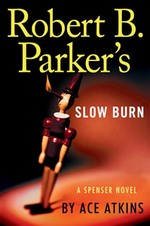
Slow Burn by Ace Atkins

Slow BurnRobert B. Parker’s Slow Burn

by Ace Atkins
Series: Spenser, #44

Hardcover, 304 pg.
G.P. Putnam’s Sons, 2016

Read: May 5, 2016

On the Greenway, a carousel turned to calliope music. The two men approached me. They tried to act like they were shopping, but they were as unobtrusive as a couple of linebackers at a Céline Dion concert.

Say what you will about the relative merits of Atkins’ two current series, but you won’t get lines like that from Quinn Colson (maybe from Lille Virgil). (That’s not really the best line of the book — it’s just the one that requires the least setup)

We’re introduced to a new world here — the Boston Fire Department, and the Arson investigators in particular (but not exclusively). It’s a little harder for Spenser to work his magic here, at least at first, being very much a duck out of water. But, he keeps at it, and eventually things start falling into place — even if he makes one serious (and perhaps life-threatening) mistake early on. There’s a series of suspected arsons, but the proof is minimal, and it doesn’t push the investigators in the right direction — or any direction, really. The usual motives (fascination with fire, insurance money) don’t seem to be involved here.

I should add that the motive for the crimes is interesting, if misguided. I’d almost like to see a bit more of it explored by the good guys, but that’s not what this book is about.

Spenser and his allies do their thing, the way they always do (but fueled by a different donut source). The same ol’ charm, wise cracks, and fists eventually do their job. I think this one is a notch above Atkins’ last — a couple of notches below Atkins or Parker at their best, but better than Parker’s average. The fact that I have to work this hard to decide where exactly in the 40+ this one lies says something — it’s on the good end, I should stress — but it’s hard to distinguish this from the master himself, Robert B. Parker.

There’s some good fodder for long-time fans here — Marty Quirk has a new job, Frank Belson has a new boss (one not particularly taken with Spenser). Not only do we get a callback to Mattie Sullivan, but we get a couple from the more distant parts of Spenser’s past — A Catskill Eagle and Promised Land, one of my least favorites and one of Parker’s best. Atkins’ ability to use for the current narrative, comment on, and tap into fanboy nostalgia all at the same time is really something to watch.

Atkins is again feeling confident enough in his role here to make significant moves in Spenser’s life — not to mention Pearl’s and Sixkill’s. I’m not sure I’m crazy about the latter two, but I’m trusting Atkins. I’m pretty sure he has a plan regarding our favorite disgraced athlete that’ll pay off. Can’t help but wonder what Parker had in store for him, though.

Speaking of plans and things in store — it’s pretty clear that Atkins has a plan for Jackie DeMarco, too. I hope it takes a few books to pull it off, but I fear it won’t.

I’m very glad to hear that we’ve got at least two more of these coming, Atkins is really helping me stay in touch with an old, old friend. I smiled, I chuckled, I even laughed a couple of times, and I reminisced a little, while wondering just how Spenser was going to save the day. All in all, a good way to spend a couple of hours. Now I’ve just got to count down the months until #45.

—–

4 Stars

GENRENAUTS Kickstarter

Genrenauts: The Complete Season One Collection/widget/video.html

If you read this blog regularly, you know I’m a huge fan of Michael R. Underwood’s Genrenauts series. If you don’t, take my word for it (or go read my posts on both novellas, the short story, and the audiobooks). Now, there’s the opportunity to back the production of the rest of “Season 1” of the series.

I encourage you to back it, buy the books, read the books, and then maybe back it at a higher level 🙂

I’ll try not to be annoying, but I will remind you about this a time or two in the next 29 days.

Dead is Best by Jo Perry

Dead is BestDead is Best

by Jo Perry
Series: Charlie & Rose Investigate, #2

Kindle Edition, 296 pg.
Fahrenheit Press, 2016

Read: May 2, 2016

You’d think that having given up the ghost I’d be beyond the grasp of my ex-stepdaughter, the parasite.

Sure, Charlie’s less-than-charitable assessment, doesn’t make it sound like death has mellowed him at all — or that we really want to spend a novel looking into the trials and tribulations of his ex-stepdaughter, Cali. (a quick aside: I loved Charlie’s rant about the pretentious names given to Cali and her peers, “Truth, Canyon, Druid, Turquoise, Vanilla and Road. Don’t tell me those are names–– they’re brands. “) But last time we learned that 1. Charlie has actually mellowed a bit, we just need more time to see it; 2. He’s generally right about his family; and it won’t take long before the reader will actually care about Cali. As difficult as she’ll make it.

Textbooks will tell you that Cali is a “troubled teen.” Which is a pretty vague, and a likely outdated, term. She’s a drinker, a drug user, defiant daughter (although once you meet her mother and current stepfather, you kind of get that) in trouble with the law. But it doesn’t take long once Charlie and Rose start to follow her for her to end up in more trouble than she — or anyone — deserves.

Once again, there’s very little that Charlie and Rose can do other than watch what’s happening and put two and two together in the almost vain hope that Charlie can do something about it. Rest assured, they do, and it doesn’t involve another near death experience (I was a little afraid they’d just be hanging around Surgical Centers waiting for the next opportunity to talk to another ghost). It’s hard to believe that a mystery series where no one knows that the main characters did anything works. But this does.

What can I say about Rose? She’s at once one of the most realistic dog characters I can remember reading lately (she doesn’t talk, narrate, have a point of view chapter, or communicate telepathically), and yet, as a ghost, is the hardest to believe. She’s such a good influence on Charlie, I’m glad whatever or Whoever brought them together after their deaths.

Charlie said something in the last book about death not being about learning anything or insight or growth, that he stays the same. I don’t believe it, he’s not the same guy. But it’s probably a good sign that he doesn’t realize it.

Something I should’ve mentioned when I talked about the previous novel, these chapter epigraphs are great. They represent a truly impressive collection of quotations about death, some funny, some thoughtful, just about all of them keepers. The book is worth the effort just to read these (but you should really focus on the rest of the book).

Perry’s freakishly short chapters make you think Robert Parker was prone to be long-winded and rambling, but they work. You could probably make the case that they’re a commentary on the transient nature of human life or something (if you wanted to, and I don’t). They keep things moving, really keep anything from dragging, and help you get how Charlie and Rose can jump from place to place with ease.

Funny, poignant, all-around good story-telling. Plus there’s a dog. You really can’t ask for more than that. It’s easy to see why people as diverse as Cat Warren and Eric Idle commend these books. I strongly recommend this one (and the predecessor).

—–

4 Stars

Page 24 of 36

Powered by WordPress & Theme by Anders Norén