Category: Robert B. Parker Page 4 of 6

Blood Feud by Mike Lupica: Sunny Randall’s Back in this Promising Reintroduction

Blood FuedRobert B. Parker’s Blood Feud

by Mike Lupica
Series: Sunny Randall, #7
eARC, 352 pg.
G. P. Putnam’s Sons, 2018
Read: October 5 – 9, 2018

I have a complicated relationship with Sunny Randall. Readers of this site have been frequently exposed to my love for Robert B. Parker’s Spenser and Jesse Stone novels, both by Parker and the continuations by Ace Atkins and Reed Farrel Coleman (let’s overlook Michael Brandman’s contributions for the moment). I enjoyed his stand-alone works, and I thought the first couple of Virgil Cole & Everett Hitch books were fun (I haven’t tried the Robert Knott continuations). Which leaves us with Sunny.

Sunny Randall, the story goes, was written to be adapted into a film series for Parker’s chum, Helen Hunt (incidentally, I’ve never been able to envision Helen Hunt in a single Sunny scene, but that’s just me). She’s a private investigator; a former cop; part-time painter (art, not house); emotionally entangled with her ex-husband, but can’t live with him; lives in Boston; and enjoys good food. But she’s totally not a female Spenser — she doesn’t like baseball, see? I’ve read all the books — some multiple times — and while I enjoyed them, I’ve never clicked with Sunny the way I have with others. Including every other Parker protagonist. Most of her novels are mashups and remixes of various Spenser novels, entertaining to see things in a different light — but that’s about it. Frankly, the most I ever liked Sunny was in the three Jesse Stone novels late in Parker’s run (but both characters are better off without each other).

So when it was announced that Mike Lupica would be taking up the reins of this series I was intrigued but not incredibly enthused. I only know Lupica from having bought a few of his books for my sons when they were younger. I didn’t get around to reading any of them, so he’s really a new author for me. And sure, I was a little worried about a YA/MG author taking the reins of a “grown-up” series. But not much — if you can write a novel, you can write a novel, it’s just adjusting your voice and language to be appropriate for the audience.

Enough blather — let’s talk about Blood Feud. Since we saw her last, Sunny has had to move, Richie (her ex-) has gotten another divorce (giving them the chance to date or whatever you want to call it) and has replaced her late dog, Rosie, with another Rosie. Other than that, things are basically where they were after the end of Spare Change 11 years ago (for us, anyway, I’m not sure how long for her, but less time has passed you can bet).

By the way — does anyone other than Robert B. Parker, Spenser and Sunny really do this? Your dog dies, so you go and get another one of the same breed and call him/her the same name? Is this really a thing?

Then one night — Richie is shot. It’s not fatal, but was done in such a way that no one doubts for a moment that it could have been had the assailant wanted it to be. For those who don’t know (or don’t remember), Richie is the son of an Irish mob boss, although he has nothing to do with the family business. He’s given a message for his father — his shooter is coming for him, but wants him to suffer first. This kicks off a race for the shooter — Sunny, the Burke family and the police (led by Sgt. Frank Belson) are vying to be the one to find the shooter.

Before long, the violence spreads to other people the Burkes employ — both property and persons are targeted by this stranger. It’s clear that whoever is doing this has a grudge going back years. So Sunny dives into the Burke family history as much as she can, so she can get an answer before her ex-father-in-law is killed. Not just the family history — but the family’s present, too. As much as the roots of the violence are in the past, Sunny’s convinced what the Burkes are up to now is just as important to the shooter.

Richie’s father, Desmond, isn’t happy about Sunny sticking her nose into things. Not just because of the crimes she might uncover — but he really wants to leave the past in the past. But as long as someone might come take another shot at Richie, Sunny won’t stop. This brings her into contact with several criminal figures in Boston (like Parker-verse constants Tony Marcus and Vinnie Morris) as well as some we’ve only met in Sunny books.

There are a couple of new characters in these pages, but most of them we’ve met before — Lupica is re-establishing this universe and doesn’t have time to bring in many outsiders, but really just reminds us who the players are. Other than the new Rosie, I can’t point at a character and say “that’s different.” He’s done a pretty good job of stepping into Parker’s shoes. Not the pre-Catskill Eagle Parker like Atkins, but the Parker of Sunny Randall books, which is what it should feel like (I wouldn’t have objected to a Coleman-esque true to the character, just told in a different way). I think some of the jokes were overused (her Sox-apathy, for one), but it wasn’t too bad. Lupica did make some interesting choices, particularly toward the end, which should set up some interesting situations for future installments.

The mystery was decent enough, and fit both the situations and the characters — I spent a lot of the novel far ahead of Sunny (but it’s easier on this side of the page). I enjoyed the book — it’s not the best thing I’ve read this year, but it’s a good entry novel for Lupica in this series, a good reintroduction for the characters/world, and an entertaining read in general. If you’re new to this series, this would be as good a place to hop on as it was for Lupica.

I want better for Parker’s creation (but I think I’d have said that for most of Parker’s run with the series), and Lupica’s set things up in a way that we could get that in the near-future. He’s demonstrated that he has a good handle on the character he inherited, the question is, what can he do with her from here? I was ambivalent about this series coming back, but I can honestly say that I’m eager to see what happens to it next.

Disclaimer: I received this eARC from Putnam Books via NetGalley in exchange for this post — thanks to both for this.

—–

3.5 Stars

No . . . just . . . No (or Initial Thoughts on Netflix’s announced adaptation of Atkin’s Wonderland)

According to Variety and Deadline stories today, another actor has been tapped to take on the role of Robert B. Parker’s Spenser: Mark Whalberg. He’ll be starring in Peter Berg’s movie for Netflix, an adaptation of Wonderland — the second novel Ace Atkins wrote about the Boston sleuth — as the potential first in a series.

I’m not Whalberg’s biggest fan, but given the right material, he’s good and he can pull of the physicality needed (and then some, but, whatever). And I have more trust in Peter Berg than most directors (Battleship notwithstanding). And the source material is great.

BUT. . .

From Deadline‘s story:

The movie will differ from the novel, in that it begins with Spenser emerging from a prison stretch, stripped of his private investigator license. Here, he gets pulled back into the underbelly of the Boston crime world when he uncovers the truth about a sensational murder and the twisted conspiracy behind it.

Stripped of his PI license after a prison stretch???? I know that adaptations have to make changes to the character, that’s the whole point of adapting. But this is striking at the core of the character. Spenser a felon? That’s a deal breaker. That makes almost all the changes in The Dresden Files series seem acceptable. It’s like making Edward a werewolf and Jacob a vampire. Or using an animated tiger in Life of Pi à la Bedknobs and Broomsticks. I’m having trouble here, okay? You can get the gist of what I’m saying.

So, I’m happy for the Parker Estate, Ace Atkins and anyone else who made some money off this. I’m happier yet for anyone who discovers Parker/Atkins/Spenser because of this.

But…nope. Just flat-out no. Count me out.*

*(which everyone knows is a giant lie, I’m totally going to watch this because I’m weak, I’m a sucker, and a Spenser-addict)

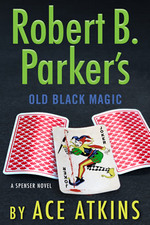
Robert B. Parker’s Old Black Magic by Ace Atkins: Atkins delivers a solid dose of Old Boston Magic

Old Black MagicRobert B. Parker’s Old Black Magic

by Ace Atkins
Series: Spenser, #46

Hardcover, 319 pg.
G.P. Putnam’s Sons, 2018
Read: May 2 – 3, 2018

Wow. The Forty-Sixth Spenser novel. Atkins’ seventh, too — it’s hard to believe. I can still remember some of these as clearly as if I read them yesterday — I’m a little vague on some of them, I have to admit (sorry Bad Business and Painted Ladies), but by and large, this is one of those series that’s defined me as a reader. This is one of those that in years to come that I’m going to remember pretty clearly, too, I’m glad to report.

Also, I’m pretty sure that 46 books in, nothing I say here is going to get the series a new reader. Still, I want to talk about it some.

So here’s the pitch: Locke, an older P.I. and friend/associate of Spenser, comes to him for help — he’d like Spenser to take over one of his cases, as she’s fighting a losing battle with a medical problem. Twenty years ago, a Boston museum was robbed — two paintings and one Picasso sketch were stolen. The Boston Police, the FBI and he have turned over every rock they can think of, he’s traveled the word just to find them. But he’s gotten no where — but there’s some new information coming to light — and with the statute of limitations about to kick in, there’s probably no better time to find the painting then now. Spenser agree and plunges right into the hunt.

Whether you’re Spenser or Nero Wolfe, the worst type of client has to be a committee or board* — a committee that’s not entirely sure they want you to work for them is even worse. The museum committee is led by a classic stuffed shirt, Spenser’s always fun to read when he’s antagonizing the pompous. We’ve also got another Spenser trope — a tough, no-nonsense, hard-to-impress client that Spenser slowly wins over — in the museum director. Putting the two of those together is a good combination. The committee has their own replacement for Locke — an anti-Spenser. British, polished, cultured (he’s probably forgotten more about art than Spenser has ever known), not obviously prone to violence, with an approach to this case that’s very different from Spenser’s. As much as I disliked him, I wish we’d gotten a little more time with him.

This is a novel largely dependent on the non-regular characters — clients, witnesses, sources, suspects. There’s no Hawk, no Sixkill, limited Susan, not enough Pearl — so who does Spenser talk to? Henry (a little more than usual), Frank, Quirk, and Rita — and a couple of chats with Vinnie Morris. Things are still not good with Vinnie, but there might be room in that direction — and common enemies can help a lot. Given the Gino Fish connection, of course we have to have a lot of Vinnie.

Spenser’s approach to this case is classic — he goes around talking to every witness, suspect that he can — annoying some, charming some, learning a very little. Then he moves on to the next and the next, and then circles back to the first. Prying a little more, and a little more. This is a very talk-y book. There’s the threat of violence — and even some actual violence — but most of the actual violence was associated with the original burglars, so we hear about it, but don’t see it. Atkin’s solid take on Parker-dialgoue means that this is a fast, fun read. And that’s fine with me.

Back when Robert B. Parker was writing multiple series, one of the fun aspects was watching characters from one series (typically the longer-running, Spenser books) show up in one of the others. Watching Capt. Healy’s interactions with Jesse Stone, for example, provided an interesting counter-point to the way Healy and Spenser got along. Now that there are three authors actively writing the Spenser-verse series, there’s an added twist to that. Recently (long enough ago that I don’t feel too bad saying it), Reed Farrel Coleman killed off Gino Fish. There are huge chunks of this book that are little else than seeing the effects of that death in Boston’s criminal society (for lack of a better term).

How do we get to Gino Fish? When it comes to Art Crimes — especially higher-end stuff — and the resulting fencing, at that time in Boston everything came through Gino’s fingers. Between the references to the late Gino and the fact that the crime in question took place two decades ago, there’s a lot of history covered here as Spenser talks to various criminals/criminal associates while hunting for these paintings. I do mean a lot of history — going back to events in Mortal Stakes (my first encounter with the series) and characters from The Godwulf Manuscript (the first in the series). Yes, there’s a certain element of this being fan-service-y nostalgia on Atkins part. As a serviced-fan, I’m not complaining. But I think it’s more, it’s the kind of series that Parker and Atkins have given us — one that is very aware of its past and draws on it always. (there’s an interesting contrast to be made with the Jesse Stone series on this front).

If you’re looking at this as a mystery novel, or focusing on the plot — I’m not sure how successful it is (better than many, but I’m not sure it’s up to Atkins’ typical standards). But, if you look at it as some time with old friends — Spenser primarily, but even Quirk, Belson, Henry, etc. — it gets better, especially if you’ve got as much history with these characters as many readers do. Throw in the atmosphere, the perfect voice, the longer-term character moves, and you’ve got yourself a heckuva read. Spenser #46 is as entertaining as you could ask for and I’m already looking forward to #47.


* Yes, it bothers me that I can only come up with two names for this truncated list. I can’t imagine that other P. I.’s are immune to this kind of client, but I can’t think of another example. I’ll probably lose sleep over this memory failure.

—–

4 Stars

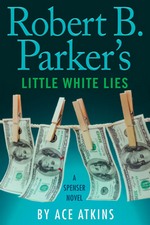
Pub Day Repost: Robert B. Parker’s Little White Lies by Ace Atkins

Really, all I want to say about this book is: “Yes! Atkins did it again — it’s just so good, folks. Long-time fans’ll love it, new readers will likely see the appeal of the series. A lot of fun with a great ending!” But that seems a little surface-y and is just bad writing. But really, that’s everything I’ve got to say.

Little White LiesRobert B. Parker’s Little White Lies

by Ace Atkins
Series: Spenser, #45eARC, 320 pg.
G.P. Putnam’s Sons, 2017
Read: March 16 – 17, 2017

Pearl and I were off to Central Square . Her long brown ears blew in the wind as we drove along Memorial Drive against the Charles. Rowers rowed, joggers jogged, and bench sitters sat. It was midSeptember and air had turned crisp. The leaves had already started to turn red and gold, shining in Technicolor upon the still water.

I debated about what quotation I’d open with — I went with this Parker-esque (and Atkins-esque) description. Little White Lies is one of the better of Atkins run on this series, because (like here) he did something that feels like something Parker would’ve written, but not quite what he’d have said (the more I think about it, the less I think that Parker’d have said “bench sitters sat”).

Actually, that’s true of the other quotation I almost used, too:

I nodded , adding water to the new coffeemaker sitting atop my file cabinet. I’d recently upgraded from Mr. Coffee to one of those machines that used pre-measured plastic cups. I placed my mug under the filter, clamped down the lid, and returned to my desk. Demonic hissing sounds echoed in my office. Where have you gone, Joe DiMaggio?

This is Atkins sixth Spenser novel, and you’d think he’s got enough of a track record that I could stop comparing him to Parker. Well, you’d be wrong — I can’t stop. This, like most of Atkins’ work on this series, is so reminiscent of early Parker novels that it makes some of the latter Parkers look more like they were written by a hired gun. Still, I’m going to try to keep it to a minimum because it doesn’t seem fair to keep doing.

Susan has sent one of her clients to Spenser for some help that she can’t provide. Connie Kelly had been dating someone she met online, invested in one of his real estate deals — and he vanished, taking the money with him. Could Spenser track him down and get her cash back? Sure, he says. It doesn’t take long for the investigation to show that he owes plenty of people money — a couple of months rent here, hundreds of thousands of dollar there.

Here’s the fun part: M. Brooks Welles, the deadbeat in question, is a silver-haired, silver-tongued mainstay on cable news. He’s former CIA, and an expert on military and national security issues — one of those that producers call on regularly when they need a talking head. Why’s a guy like that flaking out on real estate deals? Spenser knows something fishier than expected is going on — which takes him into a world of mercenaries, gun deals, and the ATF.

Then someone tries to kill him. A couple of times. And the book stops feeling like a semi-light adventure, poking fun at the blowhards on cable TV and the state of American Journalism, and how we shouldn’t trust as many people who have cameras pointed at them as we do. Things take on a different tone, bodies start piling up, and a darkness slips in to the book. This also brings in Belson and his new boss — who’s still not a fan of Spenser. About the same time, Connie starts to waver in her conviction that she wants her money back and Welles punished. Spenser, naturally, doesn’t care and plows ahead. Hawk is able to connect Spenser with some mercenaries that travel in the same circles as Welles and the chase is on. Eventually, the action moves from Boston and its environs to Georgia. Which means that Teddy Sapp is going to make an appearance.

All the characters were great — I would’ve liked some more time with some of Welles’ co-conspirators in Boston, I think it’d have helped round out our picture of his crimes. But it’s a minor complaint. We also got plenty of interaction with his Georgia-based colleagues. Even the characters that show up for a page or two as witnesses to the crimes were interesting — it’s the little things like those that add so much. It was nice to see Teddy Sapp again, too. He was the best part of Hugger Mugger (faint praise, I realize). The Hawk material was very good — maybe Atkins’ best use of the character yet.

I fully expect that people are going to spend a lot of time talking about the ending — it didn’t feel like a Parker ending. That said, it felt like an ending that pre-A Catskill Eagle Parker might have tried. It was satisfying, don’t misunderstand, it’s just not the kind of ending that Parker employed. Honestly, there were two other perfectly acceptable places to end the book — and if not for the progress bar at the bottom of my screen, I might have believed that thee ending was earlier and equally strong.

Now, because Atkins and the Parker estate aren’t stupid, there are certain characters that you just know are safe, no matter what shenanigans that they’ve let Atkins and Coleman get away with when it comes to killing off long-term supporting characters. But there was a definite feeling of peril when it comes to [name redacted] and [name redacted]. Sure I knew they’d live to be read about another day, but I wondered how healthy they’d be in the meantime.

This is sharply written, as usual. Atkins knows what he’s doing (in this series or anything else) — a great mix of character moments and plot. Spenser’s voice is strong — as are the voices of the other regulars. It was just a pleasure to read through and through. Let me leave you with one more snippet that is could’ve come from an early-80’s Spenser just as easily today’s, a voice like this is enough reason to read the book — the rest is just gravy (and there’s plenty of gravy):

I returned with sore legs back to my seat on the steps. I spent the next fifteen minutes watching women of all ages, sizes, and colors walk past me. I liked the way most women walked. I liked the way they dressed. And talked and smelled. I was pretty damn sure I was a fan of women in general. Did this make me a sexist or a feminist? Or somewhere in between.

Disclaimer: I received this eARC from Putnam Books via NetGalley in exchange for this post — thanks to both for this.
N.B.: As this was an ARC, any quotations above may be changed in the published work — I will endeavor to verify them as soon as possible.

—–

4 1/2 Stars

Robert B. Parker’s Little White Lies by Ace Atkins

Really, all I want to say about this book is: “Yes! Atkins did it again — it’s just so good, folks. Long-time fans’ll love it, new readers will likely see the appeal of the series. A lot of fun with a great ending!” But that seems a little surface-y and is just bad writing. But really, that’s everything I’ve got to say.

Little White LiesRobert B. Parker’s Little White Lies

by Ace Atkins
Series: Spenser, #45

eARC, 320 pg.
G.P. Putnam’s Sons, 2017

Read: March 16 – 17, 2017

Pearl and I were off to Central Square . Her long brown ears blew in the wind as we drove along Memorial Drive against the Charles. Rowers rowed, joggers jogged, and bench sitters sat. It was midSeptember and air had turned crisp. The leaves had already started to turn red and gold, shining in Technicolor upon the still water.

I debated about what quotation I’d open with — I went with this Parker-esque (and Atkins-esque) description. Little White Lies is one of the better of Atkins run on this series, because (like here) he did something that feels like something Parker would’ve written, but not quite what he’d have said (the more I think about it, the less I think that Parker’d have said “bench sitters sat”).

Actually, that’s true of the other quotation I almost used, too:

I nodded , adding water to the new coffeemaker sitting atop my file cabinet. I’d recently upgraded from Mr. Coffee to one of those machines that used pre-measured plastic cups. I placed my mug under the filter, clamped down the lid, and returned to my desk. Demonic hissing sounds echoed in my office. Where have you gone, Joe DiMaggio?

This is Atkins sixth Spenser novel, and you’d think he’s got enough of a track record that I could stop comparing him to Parker. Well, you’d be wrong — I can’t stop. This, like most of Atkins’ work on this series, is so reminiscent of early Parker novels that it makes some of the latter Parkers look more like they were written by a hired gun. Still, I’m going to try to keep it to a minimum because it doesn’t seem fair to keep doing.

Susan has sent one of her clients to Spenser for some help that she can’t provide. Connie Kelly had been dating someone she met online, invested in one of his real estate deals — and he vanished, taking the money with him. Could Spenser track him down and get her cash back? Sure, he says. It doesn’t take long for the investigation to show that he owes plenty of people money — a couple of months rent here, hundreds of thousands of dollar there.

Here’s the fun part: M. Brooks Welles, the deadbeat in question, is a silver-haired, silver-tongued mainstay on cable news. He’s former CIA, and an expert on military and national security issues — one of those that producers call on regularly when they need a talking head. Why’s a guy like that flaking out on real estate deals? Spenser knows something fishier than expected is going on — which takes him into a world of mercenaries, gun deals, and the ATF.

Then someone tries to kill him. A couple of times. And the book stops feeling like a semi-light adventure, poking fun at the blowhards on cable TV and the state of American Journalism, and how we shouldn’t trust as many people who have cameras pointed at them as we do. Things take on a different tone, bodies start piling up, and a darkness slips in to the book. This also brings in Belson and his new boss — who’s still not a fan of Spenser. About the same time, Connie starts to waver in her conviction that she wants her money back and Welles punished. Spenser, naturally, doesn’t care and plows ahead. Hawk is able to connect Spenser with some mercenaries that travel in the same circles as Welles and the chase is on. Eventually, the action moves from Boston and its environs to Georgia. Which means that Teddy Sapp is going to make an appearance.

All the characters were great — I would’ve liked some more time with some of Welles’ co-conspirators in Boston, I think it’d have helped round out our picture of his crimes. But it’s a minor complaint. We also got plenty of interaction with his Georgia-based colleagues. Even the characters that show up for a page or two as witnesses to the crimes were interesting — it’s the little things like those that add so much. It was nice to see Teddy Sapp again, too. He was the best part of Hugger Mugger (faint praise, I realize). The Hawk material was very good — maybe Atkins’ best use of the character yet.

I fully expect that people are going to spend a lot of time talking about the ending — it didn’t feel like a Parker ending. That said, it felt like an ending that pre-A Catskill Eagle Parker might have tried. It was satisfying, don’t misunderstand, it’s just not the kind of ending that Parker employed. Honestly, there were two other perfectly acceptable places to end the book — and if not for the progress bar at the bottom of my screen, I might have believed that thee ending was earlier and equally strong.

Now, because Atkins and the Parker estate aren’t stupid, there are certain characters that you just know are safe, no matter what shenanigans that they’ve let Atkins and Coleman get away with when it comes to killing off long-term supporting characters. But there was a definite feeling of peril when it comes to [name redacted] and [name redacted]. Sure I knew they’d live to be read about another day, but I wondered how healthy they’d be in the meantime.

This is sharply written, as usual. Atkins knows what he’s doing (in this series or anything else) — a great mix of character moments and plot. Spenser’s voice is strong — as are the voices of the other regulars. It was just a pleasure to read through and through. Let me leave you with one more snippet that is could’ve come from an early-80’s Spenser just as easily today’s, a voice like this is enough reason to read the book — the rest is just gravy (and there’s plenty of gravy):

I returned with sore legs back to my seat on the steps. I spent the next fifteen minutes watching women of all ages, sizes, and colors walk past me. I liked the way most women walked. I liked the way they dressed. And talked and smelled. I was pretty damn sure I was a fan of women in general. Did this make me a sexist or a feminist? Or somewhere in between.

Disclaimer: I received this eARC from Putnam Books via NetGalley in exchange for this post — thanks to both for this.
N.B.: As this was an ARC, any quotations above may be changed in the published work — I will endeavor to verify them as soon as possible.

—–

4 1/2 Stars

Debt to Pay by Reed Farrel Coleman

Debt to PayRobert B. Parker’s Debt to Pay

by Reed Farrel Coleman
Series: Jesse Stone, #15

eARC, 352 pg.
G.P. Putnam’s Sons, 2016

Read: August 20 – 22, 2016

Since the closing pages of Blind Spot, I’ve been waiting for the other shoe to fall victim to gravity. Jesse Stone has been, too. Well, after a more typical Stone novel, the wait is over — Mr. Peepers, the sadistic hitman that almost killed Suitcase Simpson and evaded Jesse, is back.

Just in time for just in time for Jesse’s ex, Jen’s wedding.

Before I forget, isn’t that a great move? Build suspense by ignoring the cliffhanger-esque ending for a whole book? In the wrong hands, that’d be annoying, but done right? Very effective.

Jesse and his lady-love, Diana (the FBI agent turned private security consultant) are off to Texas to meet Jen’s fiance, maybe get a little closure, and covertly protect Jen from the special mix of psychological and physical torture that Peepers subjects his victims to before killing them. While Jesse seems to be several steps behind, Peepers seems to be calling all the shots — he’s got all the power and is making Jesse jump through whatever hoops he wants him to.

Meanwhile, changes are afoot with the Paradise Police Department, State Homicide and Suit’s life (and a few other places) — just so we don’t all get too wrapped up in Pepper’s quest for vengeance.

As he has in the previous two novels in this series, Coleman keeps things moving at a great pace, the suspense keeps getting ratcheted up — interspersed by heartwarming, amusing, and troubling moments, so it’s not suspense overkill. There are some great character moments — especially with Diana and Jesse, Suit and a few people, Jesse and a bottle. There’s no mystery here — we all know who the villain of the piece is, the only question is how Peppers will attack and who will remain standing at the end of the book.

In his other major series, Parker introduced a paid assassin, The Gray Man, who almost killed Spenser and plagued him for a while afterwards. Mr. Peepers is far creepier, deadlier, and interesting than the Gray Man ever was. I really didn’t like being in that dude’s head as much as we were — which means that Coleman succeeded in making him a terrible person — I felt like washing my brain out with soap to get over some of the Peepers chapters.

Ace Atkins has returned Spenser to his roots (moved things forward, don’t get me wrong, it’s not just a nostalgia trip), but Coleman has taken Jesse and the rest and shaken things up — he’s stayed true to the characters, the series, the feel — but he’s pushed things ahead and has probably made more real changes to the series than Parker did since book 2 (but making things feel risky and inventive feels like the roots of this series). Actually, he’s not just changed this series — he’s done things that affect the whole of the Parker-verse. Just look at Suit — everything we need to know about what Coleman’s doing to the series is embodied there. I know Coleman’s take is not that popular with some long-time fans, but I couldn’t be happier — either with the series as it is right now, or with this book.

This was riveting, literally never a dull moment — not relentless, you can relax occasionally, even grin. But I had to force myself to put it down to do the responsible adult thing a couple of times. I expect most fans of Jesse and the PPD folks will have similar experiences with Debt to Pay.

Disclaimer: I received this eARC from G.P. Putnam’s Sons via NetGalley in exchange for this post — thanks to both for this.

—–
4 1/2 Stars

Cheap Shot (Audiobook) by Ace Atkins, Joe Mantegna

Cheap Shot (Audiobook)Robert B. Parker’s Cheap Shot

by Ace Atkins, Joe Mantegna (Narrator)
Series: Spenser, #42

Unabridged Audio, 7 Hours and 30 Minutes

Random House Audio, 2014
Read: June 7 – 9, 2016


This is a very mixed bag of an audiobook. I loved the novel 3 years ago, and enjoyed reliving it. But man, the narration was just not my thing. But I’ll get back to that in a bit.

I stand by pretty much everything that I said 3 years ago (although, I seem to have missed/underrated one plot point last time — I totally bought it this time). Here’s some of what I said before that still applies:

On the one hand, this is not Atkins’ best Spenser. But it’s the one that feels like Parker more than the rest (make of that what you will). The banter, the poking around and stirring things up until you get a break, the fisticuffs, the donuts, the gun fight, the needling of underworld players, and so on — he captures Parker’s voice and pacing better here than he’d managed before (yet doesn’t come across as pastiche). Spenser’s sniffing around the big money and big boys (and a few men) in sports, which serve as a good place for Spenser to reflect how men are to act. Parker did this Mortal Stakes and Playmates (and to lesser extents elsewhere — like Early Autumn), and Atkins is able to do that here (arguably he does so with a subtlety that Parker didn’t achieve).

Kinjo Heywood’s a fun character — slightly more grounded than Mortal Stakes‘ Marty Rabb, far more mature and grounded than Playmates‘ Dwayne Woodcock. One advantage Heywood has is his son, Akira (who’s plenty of fun on his own) — he has someone to provide a good example to, and he strives to. Heywood also seems to have thought ore about life and how one should live it. Marty seemed to think only about Linda (his wife) and baseball, Dwayne was all about his girlfriend (Chantel) and basketball, too — but with less self-examination, it’s just that’s all he had the chance to think about (although Chantel would see that changed, and his horizons broadened if she had anything to say about it). Heywood’s got a kid, he’s been through a divorce, and is fully aware of his place in the limelight (including social media) and his own shortcomings. This alone saves the book from being a reworking of Parker.

I should add that Sixkill has a lot of perspective here (with the assistance of Atkins’ own background in football) — he was close to Heywood’s level, and if he’d made one or two better choices, he would’ve been at this level. He has a better idea what’s going on in Heywood’s mind than Spenser and his brief stint in the boxing world would.

The book begins with Spenser doing bodyguard duty — and as always (Stardust, Looking For Rachel Wallace, A Savage Place, Rough Weather) things don’t go well. You’d think people’d stop hiring him for this kind of work. Spenser turns to investigating — and unearthing lie after lie from his client — while getting Hawk and Sixkill to pitch in on the bodyguard front.

In addition to the main characters, Hawk, Susan, Sixkill, Tony Marcus, and so on; Atkins continues to show a command and familiarity with the impressive gallery of supporting characters in the Spenser-verse. And the new characters fit into the ‘verse just fine, nothing that Parker wouldn’t have created.

Not only did Atkins give us a good story this time, he appeared to be planting and/or watering seeds for future books at the same time — something Parker never bothered with, but I’m glad to see.

About the only thing I’d like to add on this front is that I think I liked the story more this time around.

So much for the lovefest. I just didn’t like Mantegna’s work. I know, I know — he’s done many, many of the Spenser Audiobooks; Parker loved his work with Spenser (even getting him cast in those semi-regrettable movies); and he’s Joe bleepin’ Mantegna. Still, it didn’t work for me. When he was reading the narrative parts — Spenser describing what he was doing, what he was seeing, etc., even making smart aleck asides — I dug it. He did a perfectly entertaining job — maybe even more.

But the strength of Parker’s work was his dialogue, and Mantegna fell flat (at best) on this front. Spenser sounds like Fat Tony, which just should not be. Ever. Kinjo sounds like a stereotypical old blues man, not a young NFL linebacker. Hawk sounds like a slightly younger blues man. And don’t get me started on Zee. That was just embarrassing. Most of the other characters were pretty poorly done, as well. And when the book is so reliant on dialogue, so reliant on the charm of the characters, that missing with just about all of them hurts.

So, like I said, great writing, mediocre (when not disappointing) narration. Please note this rating is for the Audiobook — the whole experience, the narration as well as the writing — still love the book, and would recommend the novel in a heartbeat. This? Eh. It was entertaining enough, but that’s it. Still, any time with Spenser is time well spent.

—–

3 Stars

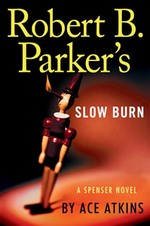
Slow Burn by Ace Atkins

Slow BurnRobert B. Parker’s Slow Burn

by Ace Atkins
Series: Spenser, #44

Hardcover, 304 pg.
G.P. Putnam’s Sons, 2016

Read: May 5, 2016

On the Greenway, a carousel turned to calliope music. The two men approached me. They tried to act like they were shopping, but they were as unobtrusive as a couple of linebackers at a Céline Dion concert.

Say what you will about the relative merits of Atkins’ two current series, but you won’t get lines like that from Quinn Colson (maybe from Lille Virgil). (That’s not really the best line of the book — it’s just the one that requires the least setup)

We’re introduced to a new world here — the Boston Fire Department, and the Arson investigators in particular (but not exclusively). It’s a little harder for Spenser to work his magic here, at least at first, being very much a duck out of water. But, he keeps at it, and eventually things start falling into place — even if he makes one serious (and perhaps life-threatening) mistake early on. There’s a series of suspected arsons, but the proof is minimal, and it doesn’t push the investigators in the right direction — or any direction, really. The usual motives (fascination with fire, insurance money) don’t seem to be involved here.

I should add that the motive for the crimes is interesting, if misguided. I’d almost like to see a bit more of it explored by the good guys, but that’s not what this book is about.

Spenser and his allies do their thing, the way they always do (but fueled by a different donut source). The same ol’ charm, wise cracks, and fists eventually do their job. I think this one is a notch above Atkins’ last — a couple of notches below Atkins or Parker at their best, but better than Parker’s average. The fact that I have to work this hard to decide where exactly in the 40+ this one lies says something — it’s on the good end, I should stress — but it’s hard to distinguish this from the master himself, Robert B. Parker.

There’s some good fodder for long-time fans here — Marty Quirk has a new job, Frank Belson has a new boss (one not particularly taken with Spenser). Not only do we get a callback to Mattie Sullivan, but we get a couple from the more distant parts of Spenser’s past — A Catskill Eagle and Promised Land, one of my least favorites and one of Parker’s best. Atkins’ ability to use for the current narrative, comment on, and tap into fanboy nostalgia all at the same time is really something to watch.

Atkins is again feeling confident enough in his role here to make significant moves in Spenser’s life — not to mention Pearl’s and Sixkill’s. I’m not sure I’m crazy about the latter two, but I’m trusting Atkins. I’m pretty sure he has a plan regarding our favorite disgraced athlete that’ll pay off. Can’t help but wonder what Parker had in store for him, though.

Speaking of plans and things in store — it’s pretty clear that Atkins has a plan for Jackie DeMarco, too. I hope it takes a few books to pull it off, but I fear it won’t.

I’m very glad to hear that we’ve got at least two more of these coming, Atkins is really helping me stay in touch with an old, old friend. I smiled, I chuckled, I even laughed a couple of times, and I reminisced a little, while wondering just how Spenser was going to save the day. All in all, a good way to spend a couple of hours. Now I’ve just got to count down the months until #45.

—–

4 Stars

The Devil Wins by Reed Farrel Coleman

The Devil WinsRobert B. Parker’s The Devil Wins

by Reed Farrel Coleman
Series: Jesse Stone, #14
Hardcover, 342 pg.

G.P. Putnam’s Sons, 2015

Read: September 11, 2015


There’s no good reason for me to have difficulty writing about Coleman’s Jesse Stone, but I twice in a row now, I have. It looks like it’ll take me less than a month to get this up, so that’s something I guess (but it should’ve taken me less than a day!) But man, I love these books!

In this one, on page 3 there was a line I wanted to read to my wife, on page 4 I was grinning. It was so good to be back in Paradise, MA. Chapter 2 served as a a reminder this wasn’t Parker’s Stone, this was Coleman’s. Which is not necessarily better or worse, just different — it’s still the same world, populated with the same people, it’s just told differently. The Devil Wins started strong and stayed that way.

One of the things that distinguished this series from the Spenser series (and later, Randall — which felt like Spenser) was the atmosphere — this was a gray world (so well captured in the movies). Not just morally (and that could be argued, I think), but weather, mood, outlook on life of the characters — economy of the community, even. Later, Parker seemed to pull back on that — either deliberately, or for the same reason that Spenser’s backstory changed. Coleman has returned to the gray, and amped it up a bit, his style brings that into focus. His dialogue might not be as snappy (and it’s not), but it’s thoughtful, as is the narrative and his descriptions. You can almost feel this world as much as see it.

Every town has its dark secrets, the events people don’t like to remember, or discuss, or admit they happened. Paradise has a few of those, I’d wager — one of them was that about twenty-five years ago, two high school girls disappeared without a trace. While most presumed (maybe hoped) that they’d been killed, there were no suspects, no motive, no evidence. Eventually, time moved on and the town collectively repressed the events. A fresh homicide investigation leads to the discovery of two much older bodies — everyone assumes (and it’s quickly confirmed) that it’s these two girls. Now Jesse has to deal with two investigations — one fairly low-priority, and one that is bringing back ghosts for everyone in Paradise (and is attracting plenty of attention from the rest of the world).

After putting his own mark on Jesse in Blind Spot, Coleman moves on to Suitcase Simpson and Molly. Don’t get me wrong, this is still Jesse’s book, and his presence dominates the narrative. But it’s in these pages that Coleman plants his flag on Suit and Molly. Suit is possibly at his most self-aware here, almost dying can do that to a person (making Coleman’s tweak totally justified), we don’t get as much time with him as we do with Molly, but what we do is golden. More importantly, Jesse has to be honest with himself about Suit — and that clarity will drive their relationship going forward. If Coleman hadn’t delivered with the rest of the book, but had with this? It’d have been worth it.

Parker, Coleman (and Brandman) hadn’t given us too many details about Molly outside of her outstanding work as Jesse’s conscience, aide, and friend. We got the little fling with Crow, and some references to her family, and that’s it. Which is exactly the way that Officer Crane wants it. But sometimes, you can’t keep that wall between your personal and professional as high as you want to — sometimes the past comes back to haunt you — and it does in spades for poor Molly. In the end, we don’t learn that much about her that we didn’t know, but it’s easy to see how what Coleman shows us helped shape her into the woman she is. (Minor spoiler ahead, skip to the next paragraph if you want) One of the two girls was Molly’s best friend, and by all rights, she should’ve been with her the night they disappeared. The discovery of the bodies, what they learn during the investigation, shake the seemingly unflappable Officer Crane to her core.

One more reason for her boss to take care of business. Not that he really needs it. Especially when more bodies start to show up.

Best part of this book for me? There’s no Gino Fish. There’s no deus ex mafia providing the solution for Jesse. It’s procedure, dogged determination and criminal stupidity — plus a little dumb luck that helps Jesse conclude what happened twenty-five years ago and today.

In addition to the great character work with our old friends, we get to focus on three new friends of Jesse’s in this book — two of whom are long-time residents of Paradise that we haven’t encountered yet, one is new to town. Jesse enlists the assistance of the editor of Paradise’s newspaper with the historical elements of his case (the police files were not up to snuff) in exchange for exclusives on a story starting to get some national attention. An insurance agent/city councilman who has been Jesse’s biggest supporter in Paradise’s government encourages him to keep on track and solve the crimes in a hurry (and when that fails, turns to threats). There’s a new Medical Examiner in the area (whose departure from NYC is similar to a certain LAPD detective’s) who befriends Jesse — she’s smart, attractive, and interested in more — but for now they decide on friendship.

I guess I should quickly mention the other women in Jesse’s life, having talked about Tamara Elkins. She’s talked about a couple of times, but we don’t get to see the new character from the Blind Spot, Diana Evans, which is a shame. I hope that changes soon, Coleman certainly leaves the door open for it, although Coleman’s going to have to start using surnames that don’t sound so similar. I thought Jen was around juuuuuust enough for my taste (I also appreciated the talk about Sunny Randall).

I find it amusing how many people I’ve seen complain about Jesse’s drinking being talked about so much. His battle with the bottle was a focus from Day 1 — sometimes more successful, sometimes less so — but always, always a presence, often discussed no matter if he was drinking or not. It’s there, it’s looming, Stone battles it as he does the rest of his demons (the “it could have been” of baseball, and Jen) — while doing what he can for these girls and the community.

Once again, Coleman strikes the right atmosphere and mood, captures the essence of the characters — while not keeping them frozen in amber, tells a very Parker-esque story in his own manner, and makes me seriously consider moving to a fictional Massachusetts town, despite the troubling homicide rate. It wasn’t as good as his first foray into this world, but I’m not sure it could’ve been, and it was close enough to justify reading it a few times anyway. Please, sir, I want some more.

—–

4 1/2 Stars

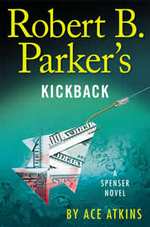
Kickback by Ace Atkins

KickbackKickback

by Ace Atkins
Series: Spenser, #43

Hardcover, 292 pg.
G.P. Putnam’s Sons , 2015
Read: May 20, 2015

As you may have noticed yesterday, I read Ace Atkin’s latest novel featuring Robert B. Parker’s Spenser. Now, with Ace Atkins/Reed Farrel Coleman taking over Robert B. Parker’s characters it’s really hard for me to be dispassionate/critical — unless they annoy me — or worse (see Michael Brandman, or — <a href="https://irresponsiblereader.com/2014/01/28/murder-in-the-ball-park-by-robert-goldsborough” target=”_blank”>Robert Goldsborough doing that for Rex Stout). I am capable of actual critical thought, I think. I’m pretty sure. But it takes time, and I just want to get this up. Soooo, I’m going to try to throw up some quick thoughts/impressions on Kickback

It started off strong — a couple pages of intro material from a third-person point of view that established a hopeless, inevitable tone. And then we turn the page and get something that might as well be vintage Parker. I smiled like a goofball throughout the note-perfect first chapter. It was like visiting an old, dear friend. Speaking of old friends, loved the callback to The Godwulf Manuscript (which, because I’m that kind of nerd, I feel compelled to point out I recognized before Atkins spelled it out). Atkins has been, and continues to be, skilled at dropping in these bits of Spenser’s background — enough to demonstrate that he knows the world and to satisfy fans like me — but not so much to clutter up things. Still, it’s time for Paul to show up.

As this is the 43rd installment of this series, it’s going to be reminiscent of a few others — there’s a little bit of Small Vices in this, and a couple of others, but this is primarily a new Ceremony, but without the moral ambiguity. In this case, we have judicial (and police) corruption tied to a private prison (in all but name) for adolescents in a small town. Some people have tried to fight this, but it only serves to make things worse — fatally so in some cases. This isn’t anything new to Spenser or crime fiction, in fact, it’s borderline cliché. But Atkins treats it with respect, and uses the tried and true story to reflect on current problems with the prison industry.

Hearkening back to Crimson Joy (maybe others that I’m not remembering), we have some third-person intercalary chapters — more successful than the serial killer’s POV in the earlier work. These trace the arrest, court appearance and detention of one of the town’s youth. Not Spenser’s client — but someone he befriends. The knot in my stomach got tighter and tighter each time. Really well done.

I continue to like Susan à la Atkins, she’d gotten boring during Parker’s later years, but she’s back and fun. Hawk is still Hawk, but Atkins has turned back the clock a bit on him, too. I’m going to stop here before I mention how Belson, Quirk, and so on have received similar treatment. This has reinvigorated the series, renewed my interest (and, from what I’ve seen) and the interest of others — this is just what Spenser needed. Yes, I’d rather Parker had done this — but I’m glad Atkins has in his place.

I do think the last fifty pages or so were rushed — things outside the detention center seemed rushed — another chapter or two spent gathering evidence might have helped me accept things. Still, so many other things in this one worked so well, I was able to overlook it (I might have harsher things to say later on, or with future re-reads).

I’m giving this 5 Stars. I’m not utterly convinced it earned it — if it was another author with another P.I., I might not. At the same time, from page 1 on, I was hooked and only put this down for a few seconds at a time when work required it until I was done. I laughed, I worried about a couple of clients, I had fun — I was thoroughly engaged the whole time. Which pretty much equals 5 Stars no matter who wrote it and who starred in it. I really, really liked it — but I could’ve told you that was probably going to be the case months ago when I ordered it.

—–

5 Stars

Page 4 of 6

Powered by WordPress & Theme by Anders Norén