Category: Authors Page 119 of 123

Dusted Off: Happy Birthday, Archie

On Oct 23 in Chillicothe, Ohio, Archie Goodwin entered this world–no doubt with a smile for the pretty nurses–and American detective literature was never the same.

I’m toasting him in one of the ways I think he’d appreciate most–by raising a glass of milk in his honor.

Who was Archie? Archie summed up his life thusly:

Born in Ohio. Public high school, pretty good at geometry and football, graduated with honor but no honors. Went to college two weeks, decided it was childish, came to New York and got a job guarding a pier, shot and killed two men and was fired, was recommended to Nero Wolfe for a chore he wanted done, did it, was offered a full-time job by Mr. Wolfe, took it, still have it.” (Fourth of July Picnic)

Long may he keep it. Just what was he employed by Wolfe to do? In The Black Mountain he answers the statement, “I thought you was a private eye” with:

I don’t like the way you say it, but I am. Also I am an accountant, an amanuensis, and a cocklebur. Eight to five you never heard the word amanuensis and you never saw a cocklebur.

In The Red Box, he says

I know pretty well what my field is. Aside from my primary function as the thorn in the seat of Wolfe’s chair to keep him from going to sleep and waking up only for meals, I’m chiefly cut out for two things: to jump and grab something before the other guy can get his paws on it, and to collect pieces of the puzzle for Wolfe to work on.

In Black Orchids, he reacts to an insult:

…her cheap crack about me being a ten-cent Clark Gable, which was ridiculous. He simpers, to begin with, and to end with no once can say I resemble a movie actor, and if they did it would be more apt to be Gary Cooper than Clark Gable.

In case you’re wondering if this post was simply an excuse to go through some collections of Archie Goodwin quotations, you wouldn’t be totally wrong…he’s one of the fictional characters I like spending time with most in this world–he’s the literary equivalent of comfort food. So just a couple more great lines I’ve quoted here before:

I would appreciate it if they would call a halt on all their devoted efforts to find a way to abolish war or eliminate disease or run trains with atoms or extend the span of human life to a couple of centuries, and everybody concentrate for a while on how to wake me up in the morning without my resenting it. It may be that a bevy of beautiful maidens in pure silk yellow very sheer gowns, barefooted, singing “Oh, What a Beautiful Morning” and scattering rose petals over me would do the trick, but I’d have to try it.

I looked at the wall clock. It said two minutes to four. I looked at my wrist watch. It said one minute to four. In spite of the discrepancy it seemed safe to conclude that it would soon be four o’clock.

“Indeed,” I said. That was Nero Wolfe’s word, and I never used it except in moments of stress, and it severely annoyed me when I caught myself using it, because when I look in a mirror I prefer to see me as is, with no skin grafted from anybody else’s hide, even Nero Wolfe’s.

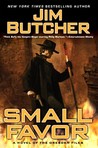
Dusted Off: An Open Letter to Jim Butcher

Dear Mr. Butcher,

I just finished reading your latest Dresden Files novel, Changes and would like to thank you for one of the best reads I’ve had in months. And by thanks I mean to say that I hope you die a slow, agonizing death. Not anytime soon, mind you, it needs to be after you’ve completed the next novel (if not the whole series). Still, I hope it happens, and I hope you dread its coming.

I actually am just kidding, sir. If nothing else, the intensity of my initial reaction speaks to the connection that exists between the great characters you’ve created and your readers. Honestly, you seem like a pretty cool guy, I’d love to buy you a Whopper some time and just chat–‘course what I’d really love is to take that Whopper and shove it so far down your throat that…

maybe I should finish this some other time.

Sincerely,

Dusted Off: Too Many Women by Rex Stout

Alright, once again, picking up after a pointless break in a surely vain attempt to catch up with my little project, this time looking at the classic, Too Many Women. Like The Silent Speaker, this one gets re-read more than others in my collection, and is still fun to read every time.

The president of the large engineering supply corporation, Naylor-Kerr, comes to Wolfe with an interesting problem. During a recent survey of departments about employee turn-over, an employee of the company is listed as “murdered.” Which is a pretty good reason to no longer come to work, but the idea that one of their employees has been murdered (particularly when the police think he was just a victim of a hit-and-run) is a bit too scandalous for such a fine and upstanding company, and could Mr. Wolfe please rid them of such rumors? Wolfe takes the case, mostly to get Archie out of the office for awhile–they’re getting on each other’s nerves and could use some space. So Archie poses as a personnel consultant and goes undercover.

The first thing Archie notices on his arrival at the offices is that there are a whole lotta women (clerical staff, on the whole) working at this company (see quotation below), enough to ensure that he’s got plenty of incentive to stick around and do a thorough investigation. He’s not there too long before he begins to find evidence that the murder accusation might be well founded after all–and before you know it, there’s another body (shock!). The first victim was some sort of lothario, who didn’t like to go far for his pray, so the suspect list is pretty large. Archie bounces around from attractive female suspect to attractive female suspect, questioning, wining and dining, and all other sorts of verbs, until his boss puts all the pieces together.

This is a breezy novel with plenty to recommend it in matters of style, humor, fun characters and plot quirks. Whether it be the petty bickering between the two stars, the patter between Archie and the women, or Archie having to put up with one individual’s health food nuttiness; the interplay between various characters is definitely more than enough to draw the reader in.

I can’t help but note, each time I read this, how much books like this disprove many of the assumptions we have about this time period–particularly those propogated by groups wanting to imagine the mid-20th century as some sort of moral oasis

I could reproduce pages and pages of Archie’s descriptions of the staff of Kerr-Naylor to give Stout a chance to strut his stuff, but will leave them to their proper context, just listing two here for a sample:

     …as far as space went, it was a room about the size of the Yankee Stadium, with hundreds of desks and girls at them. Along each side of that area, the entire length, was a series of partitioned offices, with some of the doors closed and some open. No stock of anything was in sight anywhere.
     One good glance and I liked the job. The girls. All right there, all being paid to stay right there, and me being paid to move freely about and converse with anyone whomever, which was down in black and white. Probably after I had been there a couple of years I would find that close-ups revealed inferior individual specimens, Grade B or lower in age, contours, skin quality, voice, or level of intellect, but from where I stood at nine-fifty-two Wednesday morning it was enough to take your breath away. At least half a thousand of them, and the general and overwhelming impression was of–clean, young, healthy, friendly, spirited, beautiful and ready. I stood and filled my eyes, trying to look detached. It was an ocean of opportunity.

She was not at all spectacular…but there were two things about her that hit you at a glance. You got the instant impression that there was something beautiful about her that no one but you would understand and no one but you could help her out of. If that sounds too complicated for a two-second-take, okay, I was there and I remember it distinctly.

Dusted Off: The Silent Speaker by Rex Stout

With The Silent Speaker, we’ve returned to novels in our tour through the Corpus, the War is over and our heroes, like the rest of the country, are adjusting to that fact. In the U.S., part of that has to do with price regulation and battles between governmental agencies and private businesses. In this case we have the Bureau of Price Regulation (BPR) and the National Industrial Association (NIA).

Now, I’ll be honest (and I realize this makes me a horrid person), this part of U.S. History makes my eyes glaze over, so I can’t say for certain how much the relationships depicted between the two entities are accurate. But this feels real (names of agencies/groups/companies being changed, naturally), and a little bit of reading that I’ve done about The Silent Speaker seems to support that. In years to come, Stout will not tweak details like that (The Doorbell Rang), but it’s more than understandable when he and other authors take that tack.

The head of the BPR (Cheney Boone) was scheduled to speak before a gathering of the NIA–a hostile audience, to be sure. And it does not appear that his address was going in anyway to endear him or the rest of his McCoys to the NIA Hatfields. But a funny thing happened on the way to the podium–well, not funny at all really, but that’s the phrase. Someone took a monkey wrench to his cranium while he was backstage rehearsing. The BPR people and the Boones begin accusing someone–anyone–with ties to the NIA, the NIA are certain that it’s all a front designed to bring public sentiment against him.

The police are soon stymied and have to deal with enough political pressure to prevent them from doing any real work. Wolfe’s patience is tried (and then some) by the bickering between and within the various camps. In addition to the vitriol flying all over, there are enough red herrings to keep things too confusing for the case to progress much.

In this book, at last, our cast of regulars is completed with the introduction of newspaperman extraordinaire, Lon Cohen. He doesn’t get a lot of space in this appearance, but that’s remedied in the next couple of books (and many future ones).

This is really one of the gems in the series, and one I return to more often than many others. I can’t put my finger on exactly why, but all cylinders are firing this time out, and not a false or ill-advised step is made (by the author anyway). This is a great novel to serve as an entry (or re-entry) point to the series for someone not sure where to start.

And now, for our regularly scheduled collection of witticisms and other notable quotes:

As usual, he didn’t life an eye when I entered. Also as usual, I paid no attention to whether he was paying attention.

     “Satisfactory, Archie,” [Wolfe] muttered.
     Frankly, I wish I could make my heart quit doing an extra thump when Wolfe says satisfactory, Archie. It’s childish.

[Wolfe] pushed the button, savagely, for beer. He was as close to being in a panic as I remembered seeing him.

I looked at the wall clock. It said two minutes to four. I looked at my wrist watch. It said one minute to four. In spite of the discrepancy it seemed safe to conclude that it would soon be four o’clock.

     I had made a close and prolonged study of Wolfe’s attitude toward women. The basic fact about a woman that seemed to irritate him was that she was a woman; the long record showed not a single exception; but form there on the documentation was cockeyed. If woman as woman grated on him you would suppose that the most womany details would be the worst for him, but time and again I have known him to have a chair placed for a female so that his desk would not obstruct his view of her legs, and the answer can’t be that his interest is professional and he reads character from legs, because the older and dumpier she is the less he cares where she sits. It is a very complex question and some day I’m going to take a whole chapter for it. Another little detail: he is much more sensitive to women’s noses than he is to men’s. I have never been able to detect that extremes or unorthodoxies in men’s noses have any effect on him, but in women’s they do. Above all he doesn’t like a pug, or in fact a pronounced incurve anywhere along the bridge.
     Mrs. Boone had a bug, and it was much too small for the surroundings. I saw him looking at it as he leaned back in his chair. So he told her in a gruff and inhospitable tone, barely not boorish…

Dusted Off: Not Quite Dead Enough by Rex Stout

The ninth installment in the series always leaves me feeling…eh. It’s not like I don’t enjoy parts of it, but it’s not Stout at his best. A lot of it feels forced actually, as if Stout felt compelled to write something in support World War II and just couldn’t find a way to work it into the series naturally.

Let me say upfront, I don’t blame Stout for falling a little flat here–while he wrote this he was working a lot to support FDR and the war effort through various means. If you haven’t read McAleer’s biography of Stout, I’d highly recommend it, particularly over this period. It makes sense that he wasn’t at his best here.

Like Black Orchid, Not Quite Dead Enough is made up of two novellas. In the first, we are introduced to Major Archie Goodwin, of Army intelligence. He’s sent to NYC to recruit his once and future boss to the effort. Wolfe’s far more interested in joining the infantry (see the quote below), and has given up the detective business and his assorted comforts and indulgences in order to train. The description of his training and his appearance at this time are worth the effort alone.

Archie uses a case that his long-time friend, Lily Rowan, was trying to get him involved with to rekindle Wolfe’s dormant detective skills as a way to move him from his focus on the infantry to intelligence. The case isn’t that interesting, really, but there are some fun characters.

The second novella, Booby Trap shows us the Major acting as Wolfe’s handler while he acts as a civilian consultant to the intelligence service. In this particular instance, Wolfe gets to play to his strength, dealing with a couple of murders of Intelligence officers investigating some fraudulent arms sales. I find it disappointing, really, but I do read it occasionally.

My lukewarm feeling toward these stories carries over to the quotes I jotted down:

Not Quite Dead Enough
[Wolfe speaking] “I am going to kill some Germans. I didn’t kill enough in 1918.”

Wolfe pronounced a word. It was the first time I had ever heard him pronounce an unprintable word, and it stopped me short.

Booby Trap
“Indeed,” I said. That was Nero Wolfe’s word, and I never used it except in moments of stress, and it severely annoyed me when I caught myself using it, because when I look in a mirror I prefer to see me as is, with no skin grafted from anybody else’s hide, even Nero Wolfe’s.

[Wolfe speaking] “Archie. I submit to circumstances. So should you.”

Dusted Off: Black Orchids by Rex Stout

Black Orchids is the ninth installment in the Wolfe/Goodwin series, and the first to not be a novel. Instead, it’s a collection of two novellas, one that shares it’s name with the book and Cordially Invited to Meet Death. For whatever reason, I kept putting this one off for years–until 2 years ago, I think. What a stupid, stupid move. These are not Stout’s best work–in character, complexity, theme or whatever–but they are just about the most entertaining entries in the corpus. I literally LOL’ed more than once the first time I read them, and a couple of times on this second read as well.

It’s no mistake that the book shares the title with the first novella–it’s the superior entry, a funny, light romp until it stops and becomes one of the grimmer entries in the corpus. Wolfe throughout is childish, peevish, calculating and, eventually, ruthless. Archie is, well, Archie.

Lewis Hewitt, a fellow orchid fanatic and sometimes ally of Wolfe’s has produced a new hybrid that Wolfe is very jealous of–some black orchids (not the most subtle of titles), and is showing them at New York’s annual flower show. Naturally disinclined to attend himself, Wolfe sends Archie down to view them, take notes on them, etc. Archie indulges him in this, fully expecting Wolfe to try something to get them.

Another exhibit at the show features a couple acting out a summer picnic, the man is okay, and the woman is so striking that Archie immediately starts calling her his fiance. Judging by the crowd that assembles at the time each day where the man naps and she washes her feet, Archie’s not the only one smitten.

Now is the time where I mention that as this is a Wolfe story, someone gets killed. Hewitt is tangentially associated with killing, enough to scare him into being open to some pressure from Wolfe regarding the hybrids.

Things remain lighter for a little while, but then as I said they get dark and morally murky. Even so, a rollicking good read that ends too soon.

The second story, has it’s moments, too. Bess Huddleston, a party planner for the obscenely rich, is being blackmailed and comes to Wolfe for help. Years before, Huddleston had insulted Wolfe’s dignity by trying to hire him to play detective at a party (she ended up settling for Inspector Cramer), nevertheless, Wolfe takes the case and sends Archie to her home to investigate.

Huddleston’s home and the inhabitants thereof are some of the strangest a reader will encounter anywhere–as is the method of murder and attempted murder that Archie stumbles into.

Unlike Black Orchids, this one was just short enough to remain entertaining. Oh, I should mention that both Fritz and Wolfe end up taking guidance in the kitchen from a (female!!) suspect–that alone makes this worth the time.

Lines that struck me as insightful/funny/revealing/whatever

from Black Orchids
I do not deny that flowers are pretty, but a million flowers are not a million times prettier than one flower. Oysters are good to eat, but who wants to eat a carload?

[Archie speaking to Wolfe] Will you kindly tell me,” I requested, “why the females you see at a flower show are the kind of females who go to a flower show? Ninety per cent of them? Especially their legs? Does it have to be like that? Is it because, never having any flowers sent to them, they have to go there in order to see any?”

[Rose Lasher speaking of Archie] “That ten-cent Clark Gable there that thinks he’s so slick he can slide uphill”

And Archie’s reaction: …her cheap crack about me being a ten-cent Clark Gable, which was ridiculous. He simpers, to begin with, and to end with no once can say I resemble a movie actor, and fi they did it would be more apt to be Gary Cooper than Clark Gable.

from Cordially Invited to Meet Death
[Wolfe speaking] There is nothing in the world, as indestructible as human dignity.”

For a cop to move persons from the house, any person whatever, with or without a charge or a warrant, except at Wolfe’s instigation, was an intolerable insult to his pride, his vanity and his sense of the fitness of things. So as was to be expected, he acted with a burst of energy amounting to violence. he sat up straight in his chair. [I cannot read that last sentence w/o chuckling]

Dusted Off: Where There’s a Will by Rex Stout – Updated

Wow, it’s been exactly one month since I started this post. When I get behind (on these write-ups, not the reading) I get beeeehind.

So I can’t be certain, since it was twenty some years ago, but I think this was the first I ever read–and while I don’t remember being hooked right away, I did beat it to the library to grab another one. As I recall, the copy of the book my aunt loaned me had a balloon-y cartoonish drawing of Wolfe shoving his face into an orchid under some 70’s era kitchen green and orange stripes. Never judge a book by its cover indeed.

We are introduced right away to the remarkable Hawthorne sisters–April, May and June; a writer (married to the Secretary of State), a college president and one of Broadway’s brightest stars. Their wealthy brother has just died in a hunting accident and left behind a most curious will. His sister’s didn’t get the inheritance they’d been promised, instead they’d each been left a piece of fruit. That didn’t bother them too much–except for appearance’s sake (although May, the college prez, is distraught that her school didn’t get what it’d been promised); what bother’s the sisters is the way his wife wasn’t taken care of, and that his mistress (a poorly kept secret at best) received the overwhelming bulk of the estate. The sisters want Wolfe to prevail upon the mistress to return much of her inheritance to the more “rightful” heirs. Wolfe, for reasons I can’t understand, takes the case. Naturally, it’s not too long into the case before someone’s killed, and that’s when things really start to get interesting.

On the whole, the male characters (other than the regulars) in this novel are pretty dull, but most of the female characters rate a novel all their own. The three Hawthorne sisters have all striking personalities and a realistic dynamic between the three. There’s an interesting detail or two about the widow that I’ll save for those who want to read it. The daughter of the writer and the Secretary of State, Sara Hawthorne, grabs my attention each time I read it. Even if I can rarely remember how much peril she will be in by the end of the book–I always care a bit more about her welfare than I do similar Stout characters. As the sole female descendant of the legendary sisters, she feels the weight of expectation to do something as remarkable to the world at large, while being convinced that she’s not of the same caliber as her mother and aunts. To make up for that, she tries harder to be unique, to make her mark, to distinguish herself than the others probably had to–and in doing so endears herself to readers as well as to Wolfe and Archie.

A staple of P.I. fiction involves interactions between police and the private dicks–usually (after the first novel or three), there’s some sort of grudging mutual respect and assistance. Yet typically, there’s a mixture of trust and distrust–the P.I.’s withhold information and or straight-out lie to the cops and vice versa–teeter-tottering between the two extremes. Sometimes this feels forced, or even obligatory–even from skilled authors. Stout almost always pulls it off successfully (I can’t think of an exception), and generally entertainingly (thanks to Archie’s narration if nothing else). Wolfe has laid all his cards on the table and Inspector Cramer is convinced Wolfe’s up to something and makes more than one biting comment in that regard, leading Archie to observe: “It’s a funny and sad thing, the purer our motives are, the worse insults we get.” A sign of Stout’s ability is that he can keep something this tried and true fresh.

You’ve got a very wide and colorful cast of characters, a dash of political intrigue, and Wolfe out of the office on a case. What’s not to like?

A line or two that made me grin, both revealing a good deal about all involved.

Wolfe frowned at her. He hated fights about wills, having once gone so far as to tell a prospective client that he refused to engage in a tug of war with a dead man’s guts for a rope.

[After Archie is informed by Fritz that Wolfe has left on business] I hung up and went back out to the car and told Fred:
“A new era has begun. The earth has turned around and started the other way. Mr. Wolfe has left home in a taxicab to work on a case.”
“Huh? Nuts.”
“Nope. As Fritz says, honest for God. He really has. So if you’ll–“
“But [expletive], Archie. He’ll get killed or something.”
“Don’t I know it?”

Update: Found the cover image I remembered. I was off on the colors (tho’ there could be another version, I guess), but there’s that nasty cartoon….

Dusted Off: Split Image by Robert B. Parker

I have just spent 2 hours in the presence of some good friends, and am covered in the glow of a good time (even if TLomL will bemoan the fact that I knocked off a hardcover in a single 2-hr setting, sorry dear).

I was apprehensive and ambivalent about picking up one of the last books that Parker finished before his death, but that vanished by the end of a chapter or two–and given the wafer-thin nature of his chapters, that means it didn’t take long at all. And other than the occasional transient thought, it really didn’t come up as I read. But now I’m done, and all I can think about his how this was the end of the road. And that’s really too bad.

Many people will say they can tell in Rex Stout’s final novel that Stout pretty much wrote a conclusion to his series–not an airtight conclusion, he could’ve easily continued, but it served well as a conclusion to his long-running series. The same could be said for Split Image, although Night and Day could’ve functioned that way as well (but not as neatly, and the book wasn’t nearly as good, so I’m glad it didn’t have to). There is a real sense of Parker saying goodbye to the characters — although a lot of that is likely projection and isogesis on my part.

For awhile there, as the quality of Parker’s other series/works vacillated, the Jesse Stone novels could be counted on for a certain level of quality–but lately, they’ve been just up and down as the rest. Thankfully, thankfully, Split Image comes out on the up side. Sure, there’s the now typical wandering around in the middle portion, but there’s enough various plot elements at play that it doesn’t detract as much.

A typical Parker novel will have 2 plotlines, one having to do with a case and another having to do with some personal conflict with the protagonist–and with Jesse Stone novels, that’s typically Jesse dealing with his ex-wife and excessive drinking. But a few years back, Parker merged his female PI series into the Stone books, and this is the pinnacle of that merge giving us 4 basic plots–the crime Jesse’s dealing with, the case Sunny’s working, Jesse dealing with Jen and alcohol, and Sunny dealing with her relationship with her ex. That’s enough balls in the air at one time that even if the novel’s basically at a standstill, you don’t notice.

And thankfully, each plotline actually works pretty well. Jesse’s investigating a double murder involving some gangsters, Sunny’s dealing with a girl who may have been kidnapped/brainwashed by a possible cult (shades of an old Spenser case as is typical of a Sunny story), Jesse’s gaining insight (with the help of Sunny/his therapist) into what he expects from a relationship with a woman and how Jen just wouldn’t fit that, and Sunny’s gaining insight (with the help of Jesse/her shrink) into her relationship needs with men.

Throw in appearances from Spenser regulars, enough name-dropping to tie Jesse’s gangsters into the larger Parker-verse, the lines any Parker novel has to have (‘We’d be fools not to,’ ‘Enough with the love talk,’ etc.), the glorification of having pet dogs (yet another Parker philosophy that’s dead-on), and an actual satisfying conclusion to the investigations and you have yourself a great Parker novel.

Not the book to start reading Stone with (that’s Night Passage), but for people who know the characters it’s a darn satisfying read.

I should admit I was pretty embarrassed at how long it took me to get the title. In my defense, tho’ I really didn’t think about it until I saw it out of the corner of my eye printed on top of p. 195 and had an “Well Duhhhh” moment.

Dusted Off: Over My Dead Body by Rex Stout

And here we are at the seventh Archie Goodwin novel (feat. Nero Wolfe), Over My Dead Body. All things considered, this is not my favorite in the series, though I admit to reading it at least bi-annually. It should be noted that “not my favorite” roughly equals a grade of B-.

This is the first time we get a feel for Wolfe’s politics (and can guess at Stout’s), although it’s difficult to discern everything Stout’s trying to say because of my lack of knowledge about politics in the area around Montenegro pre-World War II. One day I keep telling myself that I’m going to look into that and see just how much Stout reflected reality, but today is not that day.*

A woman who claims to be Wolfe’s long-abandoned daughter shows up looking for help in a case involving some missing diamonds. Until he can determine whether she is who she claims, Wolfe has to step in to assist. Just as things look like they’re settled on that account, someone is killed in a less than normal fashion. Of course. This sets off a case of multiple homicide and international intrigue, involving more than one European power, the NYPD and the FBI. Not to mention, we learn a little about Wolfe’s past, which is definitely more than a little interesting.

There are some truly funny moments in this one, and some very clever work by Stout, Wolfe and Archie. But…I dunno, it doesn’t totally work for me, dawg. Still, a Wolfe novel is like pizza and that other thing…even when it’s not great, it’s still good.

A couple of lines worth repeating…

[after escorting an FBI agent from the house] “You see what happens,” I told him bitterly. “Just because you rake in two fat fee and the back account is momentarily bloated, in the space of three weeks you refuse nine cases. Not counting the poor little immigrant girl with a friend who likes diamonds. You refuse to investigate anything for anybody. Then what happens? America gets suspicious because it’s un-American not to make all the money you can, and sicks a Senior G-man on you..”

[Fritz] was stiffly formal, as was his invariable custom when there were ladies present, not form any sense of propriety but from fear. Whenever any female, no matter what her age or appearance, got inside the house, he was apprehensive and ill at ease until she got out again.

“I carry this fat to insulate my feelings. They got too strong for me once or twice and I had that idea. If I had stayed lean and kept moving around I would have been dead long ago.”

* Assuming I keep at this, fifteen entries from now, we’ll get another crack at this region, and I feel much more confident about what’s going on there.

Dusted Off: Some Buried Caesar by Rex Stout

While I’m enjoying this little Wolfian project of mine, I noticed when I picked up Some Buried Caesar that I was rather eager to dig into it. This is easily one of my favorite books–not just in this series, either. This is one of the funniest, most entertaining books Stout wrote, a real winner.

Like the last book, we again find Wolfe and Archie away from their cozy New York City abode. Last time, Wolfe was driven by his love of haute cuisine to subject himself to the whims of machinery. He has baser motives for this trip–a fellow orchid grower has slighted Wolfe, so Wolfe’s journeyed to upstate New York to humiliate him at a county fair’s competition.

As they near their destination, they have a minor accident in their car and find themselves taking refuge at the home of Thomas Pratt, the millionaire owner of a chain of diners called Pratteterias (don’t that just sound appetizing?). Pratt is preparing for a publicity stunt, where he will be barbecuing a champion bull, still in the prime of life. This is causing quite the stir among local (and, apparently some non-local) cattlemen, and Pratt is worried (with good reason) that at least one of them will attempt some sort of tomfoolery to prevent the bull feed. The son of one cattleman bets Pratt $10,000 that it won’t happen, which drives Pratt to engage Wolfe’s services to ensure it’ll take place.

From there, Fletcher’s Law kicks in and Wolfe has something more up his alley to work on. The trip to the country for a flower show becomes a maze of intrigue, crime, old family feuds, prison reform, and dumplings that are out of this world.

It is in this book that Archie meets Lily Rowan. There will be many competitors for Archie’s affections, and a few women will come close, but none are the match for him that Lily is. There aren’t many recurring characters that haven’t been introduced by this book, but Lily quickly takes her place amongst them.

For the sake of remaining spoiler-free, I trimmed my original selection of quotable portions somewhat, and still have what’s likely to be the largest selection I’ll offer up in this series.

[Archie speaking] Let’s say she goes ahead and ruins him. In my opinion, if he’s worth the powder to blow him to hell, he’ll soon get unruined. No man was ever taken to hell by a woman unless he already had a ticket in his pocket, or at least had been fooling around with timetables.

I had been accosted by a tall skinny guy in a pin-check suit, as young as me or younger, wearing a smile that I would recognize if I saw it in Siam–the smile of an elected person who expects to run again, or a novice in training to join the elected person class at the first opportunity. He looked around to make sure no spies were sneaking up on us at the moment, introduced himself as Mr. Whosis, Assistant District Attorney of Crowfield County, and told me at the bottom of his voice, shifting from the smile to Expression 9B, which is used when speaking of the death of a voter, that he would like to have my version of the unfortunate occurrence…[Archie makes a wise crack] That confused him, because he had to show that he appreciated my wit without sacrificing Expression 9B

Dressed in a light tan jersey thing, with a blue scarf and a little blue hat, among those hearty country folk [Lily Rowan] looked like an antelope in a herd of Guernseys. I sat down across the table from her and told her so. She yawned and said that what she had seen of antelopes’ legs made it seem necessary to return the compliment for repairs

I was wondering which would be more satisfactory, to slap her and then kiss her, or to kiss her and then slap her.

It was Nancy Osgood, and the glance she cast behind her as she entered one of the sheds was either furtive or I was getting fanciful. Even if she was furtive it was none of my business, but a detective who minds his own business would be a contradiction in terms

“One test of intelligence, [Wolfe] said patiently, “is the ability to welcome a singularity when the need arises, without excessive strain. Strict rules are universal. We all have a rule not to go on the street before clothing ourselves, but if the house is on fire we violate it…”

[Wolfe speaking] “Proscriptions carried too far lead to nullity.”
[Archie replies] “After I analyze that I’ll get in touch with you. My first impulse is to return it unopened.”

Page 119 of 123

Powered by WordPress & Theme by Anders Norén