Category: Authors Page 36 of 124

Not Awkward by Matthew Hanover: Moving On by Looking Back

This is a little (pun unintended but embraced) awkward to write—I served as a beta reader for this and had intended to wait until the final version was published to say anything. But Hanover asked, so here we go. Many things may (and have) changed from the draft that I read and what will be published in a couple of months, so I’m not going to get into some of the particulars that I want to until then, and I know what the final version will be like. Hopefully, this isn’t too vague as a result:


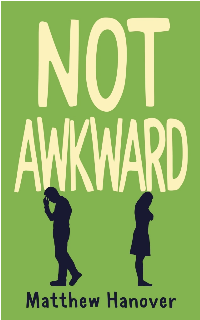
Not Awkward

Not Awkward

by Matthew Hanover
Series: Wallflowers, #3

Beta Version
2021

Read: May 9-18, 2021

What’s Not Awkward About?

I’m assuming I’m not the only one who finds themselves in a situation like this—I halfway expected to find a Jeff Murdock monologue about this, but alas… You go to an event of some kind because of family obligation, an acquaintance, your Significant Other’s employer—not because you really want to, but you feel you should. Once there, you stay an adequate amount of time and try to make your excuses and leave. But the host or someone talks you into staying for a little longer, and a little longer after that. While you may not be actively hating the experience, you’re certainly not enjoying yourself much and are looking for an opportunity to make a tactful exit.

This is pretty much the situation that Scott finds himself in. But rather than a birthday party for your second cousin you haven’t seen in a decade, Scott finds himself as a guest at his ex-girlfriend’s house while they sit shiva for her father. Recently fired and about to get married, Scott felt like he should go to the funeral for the man who always treated him so well. One thing led to another and Leila’s mother compelled him to stay for a night, which turns into another, and another…

Scott’s fiance, Charlotte, is off for a bachelorette’s week with his sister and Charlotte’s closest friend, Quinn. So there’s nothing for him to go home to, and he can search for jobs from Leila’s as well as anywhere. So he sticks around as emotional support (and/or emotional punching bag, depending on Leila’s understandably shifting moods require), and finds himself with an opportunity to get the closure he didn’t realize he needed and maybe even an explanation for why she dumped him out of the blue six years ago. Or maybe, something else will end up happening between the two.

Speedcubing

A few months ago, one of the local newscasts had a feature about an area resident who used to take part in Rubik’s Cube competitions on a pretty high level, it looked back on his competitions and “does he still have it?” No, he doesn’t. But he’s still faster than at least 96% of anyone who’s ever solved one.

So when we learn that Charlotte is a speedcuber, going to competitions, posting videos to social media, my mind immediately went back to that and I was in. Most readers aren’t going to have that particular background, but Charlotte’s hobby (for lack of a better word, but it’s not quite right) is going to make her stand out in readers’ minds—how often have you come across a character who does that? What I appreciated most about the Rubik’s cube thing is that was it starts out as a character quirk, but by the end, Hanover finds some thoughtful things to do with it—revealing something about the character (and a little more).

The Sister Factor

A mistake that readers like me can make is to think they’ve figured out all a writer’s moves, I really thought I had a handle on the role of “protagonist’s sister” in Hanover’s books. So when Quinn shows up pretty early, I sat up and paid attention to her. Which is when I noticed that Quinn is going to serve another role in this novel. She’s not an antagonist, but she’s certainly an obstacle for both Charlotte and Scott to overcome.

She’s been best friends with Charlotte since childhood—and try as she might, she’s still having trouble shifting from being Charlotte’s best friend to her best friend and brother’s significant other/future sister-in-law. I wasn’t entirely sold on this particular arc, but it helped us get a different look at Scott and his love life, and in the final third or so of the novel, it really paid off.

Along the same lines, Hanover hasn’t given us a protagonist’s brother before. I really didn’t care for this one—but I wasn’t supposed to*, he was written in such a way that it’d be hard to like him at all. But Scott and Quinn having an older brother is a new dynamic for Hanover and it works pretty well.

* And I won’t even get started about his wife.

The Interconnectedness of It All

In Not Dressed, Hanover alludes to a couple of characters and events from Not Famous, but here in Not Awkward he goes a lot further—the characters and events actually show up in the text. Sure, it’s done in such a way that people who haven’t read the other books won’t be short-changed when it comes to understanding this novel. But if you have read them, you’ll appreciate the way that Hanover has woven them into these pages.

It’s a great way to make a reader smile when they recognize something. But better, it’s a fantastic way to touch base with characters from one of those books. “Oh, look X got engaged.” Or “hey, Y and Z will be working together.” We also get to see characters like that in a different setting and from a different perspective. Rather than having to go through the bother with writing a whole new novel about one of Not Dressed‘s characters, with a few scenes in this (that move the plot along and help us understand Scott better), we see that character in a whole new light and it may change what you think of some parts of that other book.

Again, I stress—if you haven’t read his other novels, or if you don’t remember the details, it won’t matter at all.

Eep! A Conservative!

There is a character in this book who is a political conservative who works in politics (in more of the pre-2015 mold, I should stress), but this is a non-political book. The fact that they are conservative is mentioned a few times, and two (I think—no more than three) positions are mentioned. There are no debates, explanations, or arguments for the positions.

I mention this only because in our current climate, a lot of readers (from all over the political spectrum) run for the hills when politics come up. There is no need for that here—it’s brought up occasionally, but not in any kind of detail. No political position is ever endorsed or supported, or discussed in any kind of depth.

So, what did I think about Not Awkward?

While this is a lighter read, as is the norm for a “lad lit” novel—it’s not as funny as Hanover’s earlier works. That said, there are a couple of moments that are comedic gold. Slap-stick humor is difficult to pull off in print, but Hanover makes it look fairly effortless.

At at least three points in this novel, I assumed I knew how the rest would play out, “Oh, it’s going to be ____ kind of a story.” And I was wrong each time—thankfully. Instead, Hanover has given us a different kind of story than he has in the past, a subtler one, a more mature one.* One still infused with his trademark warmth, heart, and appeal. But there’s more going on, there’s a little ambiguity about some things. Experience is making a better author out of Hanover.

* Although I would have been satisfactorily charmed and entertained by the kind of story he’s given us before.

There were aspects of the story or characters that I wasn’t crazy about—but I’m not going to get into that at this point, because I don’t know what will happen to those things between the beta stage and the final version (although I was told about some directions he was going and that made me feel better). Maybe I’ll update this when the final version is out—maybe I won’t, we’ll see how much I care once it hits. But whatever quibbles I might have had, that’s all they were, quibbles. And they paled in comparison to the novel as a whole.

Because I wanted to think carefully about this novel, I wouldn’t let myself read more than 10-15 percent of it a night. That was hard. I wanted to read the whole thing in one sitting—and easily could have. I literally had to force myself to stop reading each time I picked it up so I could send my feedback and do other things. But I wanted to keep going, I had such a great time with these characters, this story, and Hanover’s writing.

Somewhere in there is Hanover’s secret—no matter what dumb, reckless, obnoxious, or (have to say it) awkward thing his characters do, you like them. You can’t help but do so. Scott said a couple of things in the first chapter that really made me wonder if I wanted to go through an entire book with him. By the third, I was pulling for the guy. This goes for Leila, too—not only did she break Scott’s heart six years ago, but she didn’t even tell him why. But in no time flat, you’re hoping she’s doing okay after her father’s death and you feel bad for the situation she finds herself in. If it’s bad enough that she talks Scott into sticking around…

And I’ve gone on far too long here. I need to wrap things up.

Not Awkward is a warm and heart-filled story about revisiting the past, finding healing (whether or not you thought you needed it), and embracing a future that doesn’t look like you expected it would (and is probably better). It’s the kind of book that’ll make you feel a little better about life for a while—and who doesn’t want to read something like that?



4 1/2 Stars

20 Books of Summer 2021

20 Books of Summer
One summer.

Three months.

93 Days.

20 books.

Are you in?


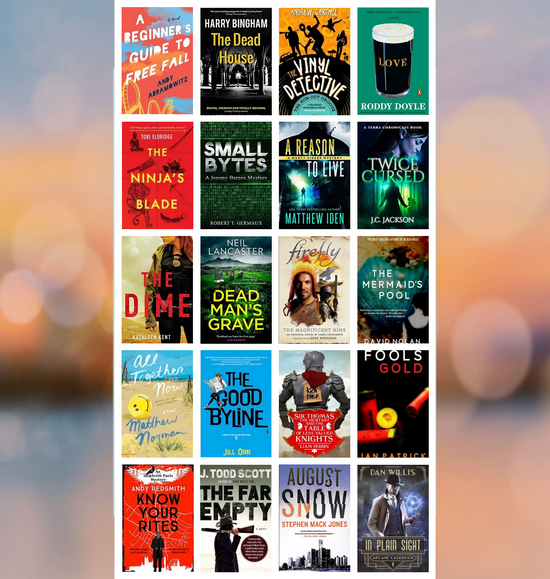
Here’s the kickoff post on 746 Books in case you want more details. I had a lot of fun with this last year (the time pressure helped a lot), so let’s give it another shot. Last year, my list was a mix of summer releases, NetGalley things I’d been procrastinating on, and some things I’d meant to read for a while. But here’s the thing–I don’t need something prompting me to read the next Ace Atkins or Kevin Hearne, ditto for my NetGalley stack–that’s going to get read. So in keeping with my push to trim my TBR List (both aspirational and stuff I already own) this year, 19 of these 20 books are those (I did put one upcoming release on the list, it was a moment of weakness). It’s going to be an actual challenge to get all of these read, but I think I’m up for it.

Anyway, here’s my list (subject to change, but I’m going to resist the impulse to tweak as much as I can).

1. A Beginner’s Guide to Free Fall by Andy Abramowitz
2. The Dead House by Harry Bingham
3. The Run-Out Groove by Andrew Cartmel
4. Love by Roddy Doyle
5. The Ninja’s Blade by Tori Eldridge
6. Small Bytes by Robert Germaux
7. A Reason to Live by Matthew Iden
8. Twiced Cursed by J. C. Jackson
9. The Dime by Kathleen Kent
10. Dead Man’s Grave by Neil Lancaster
11. The Magnificent Nine by James Lovegrove
12. The Mermaid’s Pool by David Nolan
13. All Together Now by Matthew Norman
14. The Good Byline by Jill Orr
15. Sir Thomas the Hesitant and the Table of Less Valued Knights by Liam Perrin
16. Fools Gold by Ian Patrick
17. Know Your Rites by Andy Redsmith
18. The Far Empty by J. Todd Scott
19. August Snow by Stephen Mack Jones
20. In Plain Sight by Dan Willis

20 Books of Summer '21 Chart

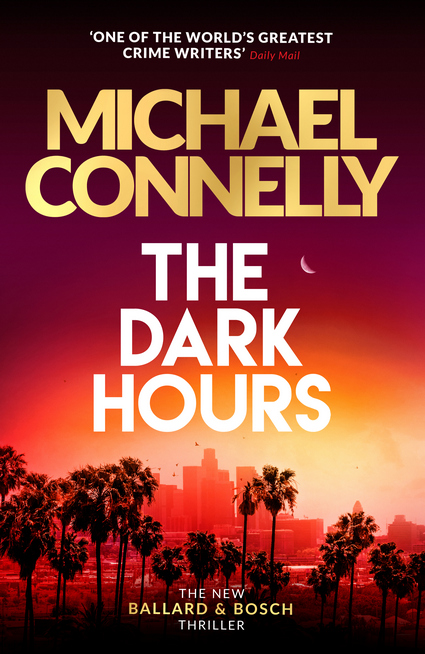
Cover Reveal: The Dark Hours by Michael Connelly

I’m excited to take part in the UK Cover Reveal for the new Harry Bosch/Rene Ballard thriller, The Dark Hours by Michael Connelly this morning. Before we get to the cover, let’s talk a bit about the book, okay?

Book Blurb

Has a killer lain dormant for years only to strike again on New Year’s Eve? LAPD Detective Renée Ballard and Harry Bosch team up to find justice for an innocent victim in the new thriller from #1 New York Times bestselling author Michael Connelly.

There’s chaos in Hollywood on New Year’s Eve. Working her graveyard shift, LAPD Detective Renée Ballard seeks shelter at the end of the countdown to wait out the traditional rain of lead as hundreds of revelers shoot their guns into the air. As reports start to roll in of shattered windshields and other damage, Ballard is called to a scene where a hardworking auto shop owner has been fatally hit by a bullet in the middle of a crowded street party.

It doesn’t take long for Ballard to determine that the deadly bullet could not have fallen from the sky. Ballard’s investigation leads her to look into another unsolved murder-a case at one time worked by Detective Harry Bosch.

Ballard and Bosch team up once again to find out where the old and new cases intersect. All the while they must look over their shoulders. The killer who has stayed undetected for so long knows they are coming after him.

Book Details:

Book Title: The Dark Hours by Michael Connelly
Publisher: Orion (UK)/Little, Brown and Company (US)
Release date: November 9, 2021
Format: Hardcover/Ebook/Audiobook
Length: 416 pages


And now…

The Cover

The Dark Hours UK
If that doesn’t grab your eyes, call your optometrist/ophthalmologist, there’s something wrong with them.


My thanks to The Orion Publishing Group for the invitation to participate in this reveal.

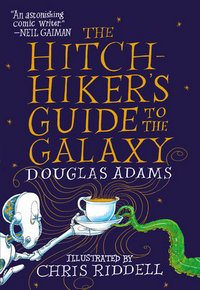
A Quick Look at the Wonderful The Hitchhiker’s Guide to the Galaxy: The Illustrated Edition by Douglas Adams, Chris Riddell (Illustrator)

The Hitchhiker's Guide to the Galaxy

The Hitchhiker’s Guide to the Galaxy:
The Illustrated Edition

by Douglas Adams, Chris Riddell (Illustrator)

Hardcover, 291 pg.
Del Rey, 2021

Grab a copy from your local indie bookstore!

As soon as I picked up this book this weekend, I just knew that I had to talk about it today on Towel Day. And then I sat down to write about this—and I’m not really sure what to say. Anyone who’s read this site much knows how bad I am at describing art. But, what else am I going to talk about today?

For the 42nd Anniversary of the publication of the novel The Hitchhiker’s Guide to the Galaxy, the publishers commissioned noted illustrator and political cartoonist Chris Riddell to tackle this classic. And wow, what a great choice.

Contents

The book starts off with “A Guide to the Guide” a short piece Adams wrote about the series in its various forms shortly after the release of So Long, and Thanks for All the Fish. Then we get the text of the novel—attractively laid out, with illustrations scattered throughout.

One of the best things included in this edition is a large, full-color illustration on the inside cover—it’s a collection of some of the more obscure characters mentioned (largely in passing) throughout the novel—and the book ends with a key to that illustration. Which is just great, I’ll be the first to admit that I didn’t give almost any of these any thought. And now I don’t have to, Chris Riddell did it for me.

Some of the Characters and Scenes Depicted

By and large, the illustrations don’t really match what I had in my head (although the Ravenous Bugblatter Beast of Traal was pretty close), but almost every time I look at one, my reaction is “yeah, he’s nailed it, that’s what _____ should look like.”

I’m not going to go over all of them, but I’ve had a blast flipping back and forth through the book looking at the pictures. The small furry creature from Alpha Centauri (a real one) was adorable, Slartibartfast was…perfect, Marvin looks nothing like the TV show or movie—thankfully. Eddie the Shipboard Computer is odd, but I can buy it. Eccentrica Gallumbits looks, well, you know. Trillian’s mice and (particularly in their native universe) and The Heart of Gold was just great. Deep Thought was another surprise but absolutely worked. Gag Halfrunt looks just like a private brain-case specialist should look. Last, but not least, the falling sperm whale and the poor bowl of petunias got a two-page spread, and I’d absolutely love to have a print on my wall of it.

Trillian

My biggest beef about the book is the small number of illustrations of the core characters—I liked what I saw, but we really only got more than one illustration of Trillian (although Zaphod, or should I say…Phil? is in the background).

I’m sure most of us can figure out why they’d include another picture of the attractive mathematician and astrophysicist, rather than the bumbling human, the two-headed egomaniac, the oddball researcher, or the morose android.

Some examples

So, I wasn’t really sure what I could get away with as far as showing samples from the book, so I didn’t want to just take some pictures of a few of the illustrations (besides, it’s clear that my photographic ability isn’t that great). But I was able to find this drawing for some original art to celebrate the publication. The art shown isn’t exactly what you find in the book (the book version of Prostetnic Vogon Jeltz, for example, is far more disgusting), but these sketches give you an idea of what you’ll find here. That’s about the best I can do.

It’d take a lot for me not to like an edition of this novel, I realize, but I absolutely love Riddell’s work on this. Which is great for me—if I’m going to bring another edition into my house, it’d better be great. It is, the illustrations capture the feel and flavor of the novel, and make it feel fresher. I strongly recommend it for fans new, old as well as those who are still on the verge of being fans.

This post contains an affiliate link. If you purchase from it, I will get a small commission at no additional cost to you. As always, opinions are my own.

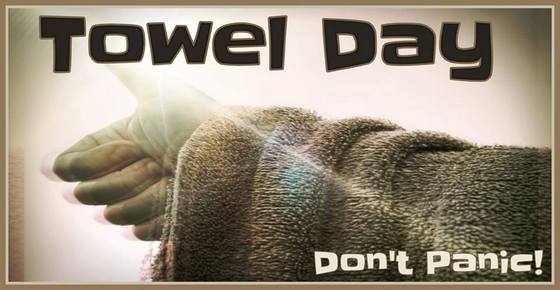
Towel Day ’21: Do You Know Where Your Towel Is?

(actually updated and slightly revised this 5/25/20!)

The Hitchhiker’s Guide to the Galaxy has a few things to say on the subject of towels.

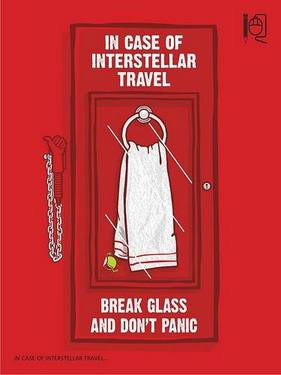
A towel, it says, is about the most massively useful thing an interstellar hitchhiker can have. Partly it has great practical value. You can wrap it around you for warmth as you bound across the cold moons of Jaglan Beta; you can lie on it on the brilliant marble-sanded beaches of Santraginus V, inhaling the heady sea vapors; you can sleep under it beneath the stars which shine so redly on the desert world of Kakrafoon; use it to sail a miniraft down the slow heavy River Moth; wet it for use in hand-to-hand-combat; wrap it round your head to ward off noxious fumes or avoid the gaze of the Ravenous Bugblatter Beast of Traal (such a mind-bogglingly stupid animal, it assumes that if you can’t see it, it can’t see you); you can wave your towel in emergencies as a distress signal, and of course dry yourself off with it if it still seems to be clean enough.

More importantly, a towel has immense psychological value. For some reason, if a strag (strag: non-hitch hiker) discovers that a hitch hiker has his towel with him, he will automatically assume that he is also in possession of a toothbrush, face flannel, soap, tin of biscuits, flask, compass, map, ball of string, gnat spray, wet weather gear, space suit etc., etc. Furthermore, the strag will then happily lend the hitch hiker any of these or a dozen other items that the hitch hiker might accidentally have “lost”. What the strag will think is that any man who can hitch the length and breadth of the galaxy, rough it, slum it, struggle against terrible odds, win through, and still knows where his towel is is clearly a man to be reckoned with.

Hence a phrase that has passed into hitchhiking slang, as in “Hey, you sass that hoopy Ford Prefect? There’s a frood who really knows where his towel is.” (Sass: know, be aware of, meet, have sex with; hoopy: really together guy; frood: really amazingly together guy.)

Towel Day, for the few of who don’t know, is the annual celebration of Douglas Adams’ life and work. It was first held two weeks after his death, fans were to carry a towel with them for the day to use as a talking point to encourage those who have never read HHGTTG to do so, or to just converse with someone about Adams. Adams is one of that handful of authors that I can’t imagine I’d be the same without having encountered/read/re-read/re-re-re-re-read, and so I do my best to pay a little tribute to him each year, even if it’s just carrying around a towel.

Some time in 7th or 8th grade (I believe), I was at a friend’s house—his brother let us try his copy of the text-based Hitchhiker’s Guide game, and we were no good at it at all. His brother had a copy of the novel, however, and we all figured that the novel held the keys we needed for success with the game (it did not). It was decided that I’d be the one to read the book and come back in a few days as an expert. Adams’ irreverent style rocked my world—could people actually get away with saying some of these things? His skewed take on the world, his style, his humor…and a depressed robot, too! It was love at first read. One of those experiences that, looking back, I can say shaped my reading and thinking for the rest of my life (make of that what you will). If carrying around a (massively useful) piece of cloth for a day honors his memory? Sure, I’m in.

One of my long-delayed goals is to write up a good all-purpose Tribute to Douglas Adams post, and another Towel Day has come without me doing so. Belgium.

Next year . . . or later. (he says for at least the 7th straight year, a work ethic I like to believe Adams would recognize).

In the meantime, here’s some of what I’ve written about Adams. A couple of years back, I did a re-read of all of Adams’ (completed) fiction. For reasons beyond my ken (or recollection), I didn’t get around to blogging about the Dirk Gently books, but I did do the Hitchhiker’s Trilogy:
bullet The Hitchhiker’s Guide to the Galaxy
bullet The Restaurant at the End of the Universe
bullet Life, The Universe and Everything
bullet So Long, and Thanks For All The Fish
bullet Mostly Harmless
bullet I had a thing or two to say about the 40th Anniversary of The Hitchhiker’s Guide to the Galaxy
bullet (this link will go live later in the morning of 5/25/21) I took a look at the 42nd Anniversary Illustrated Edition of The Hitchhiker’s Guide to the Galaxy
Also, I should mention the one book Adams/Hitchhiker’s aficionado needs to read is Don’t Panic by Neil Gaiman, David K. Dickson and MJ Simpson. If you’re more in the mood for a podcast, I’d suggest The Waterstones Podcast How We Made: The Hitchhiker’s Guide to the Galaxy—I’ve listened to several podcast episodes about this book, and generally roll my eyes at them. But this is just fantastic. Were it available, I’d listen to a Peter Jackson-length version of the episode.

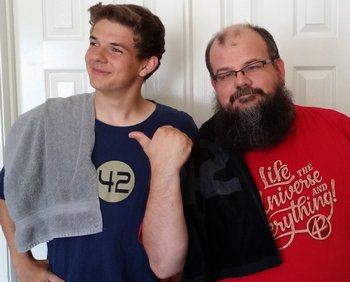
I’ve only been able to get one of my sons into Adams, he’s the taller, thinner one in the picture from a few years ago.

TowelDay.org is the best collection of resources on the day, recently posted this pretty cool video, shot on the ISS by astronaut Samantha Cristoforetti.

Even better—here’s an appearance by Douglas Adams himself from the old Letterman show—so glad someone preserved this:

Love the anecdote (Also, I want this tie.)

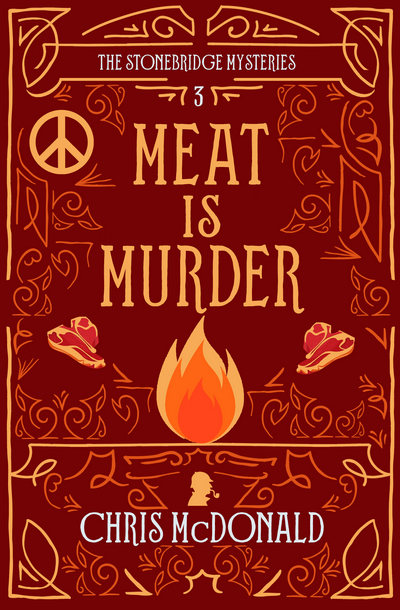
COVER REVEAL: Meat is Murder (Stonebridge #3) by Chris McDonald

Welcome to The Irresponsible Reader’s part in the Cover Reveal for Chris McDonald’s Meat is Murder! (which means we’re about a month away from me having a pleasant day with the book and probably saying some complimentary things about it). Like the first two books in the Stonebridge Mysteries, it looks pretty sharp. But before we get to the cover down below, but before the picture, I’ve got a few words to share about the book.

Book Blurb

McNulty’s Meats, one of Stonebridge’s oldest businesses, is about to be taken over in a lucrative deal that would make brothers Ron and Kevin very rich men indeed. Unfortunately for them, local activist Tyler Love has other ideas. Convinced that the deal would be bad for the town, he burns the place to the ground and inadvertently kills himself in the process.

At least, that’s what the police think.

Tyler’s mum disagrees and pleads with amateur sleuths Adam and Colin to investigate. Although, going up against the psychopathic McNulty brothers, a rival businessman, a group of hippies, and a girlfriend with secrets of her own might not be such a good idea… Someone has something to hide, and will go to great lengths to keep that secret buried.

Meat is Murder
is the third book in The Stonebridge Mysteries series of Cosy Crime novellas.

Publication date: June 8, 2021

About the series

Stonebridge is a small town on the north coast of Northern Ireland. Most of its inhabitants are friendly, happy people. Most of them… Because bad things happen even in the happiest of places. It’s a good thing, then, that Adam Whyte and Colin McLaughlin call Stonebridge home.

Armed with an encyclopedic knowledge of detective shows, a misplaced sense of confidence and a keen desire to see justice done, these two are the closest thing the town has to saviours. Which isn’t that reassuring…

About the Author

Chris McDonaldOriginally hailing from the north coast of Northern Ireland and now residing in South Manchester, Chris McDonald has always been a reader. At primary school, The Hardy Boys inspired his love of adventure before his reading world was opened up by Chuck Palahniuk and the gritty world of crime. A Wash of Black is his first attempt at writing a book. He came up with the initial idea whilst feeding his baby in the middle of the night, which may not be the best thing to admit, considering the content. He is a fan of 5-a-side football, heavy metal and dogs. Whispers in the Dark is the second installment in the DI Erika Piper series, and Chris is currently working on his latest series, The Stonebridge Mysteries, published by Red Dog Press in 2021.


And now…

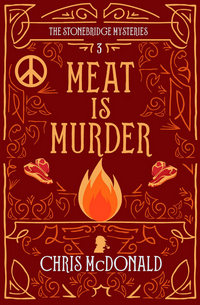
The Cover

Meat is Murder
The cover designers at Red Dog have done it again.

Again, this book comes out on June 8th, but you can pre-order this now at: Red Dog Press, Amazon, Kobo, or Google (but you should absolutely order from Red Dog directly, the Bezos retirement fund is big enough, help out the publisher).


My thanks to Red Dog Press for the invitation to participate in this reveal and the materials they provided.

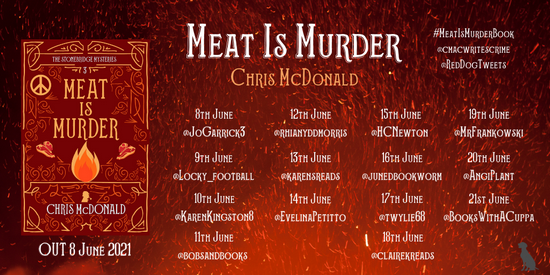
Meat is Murder Cover Reveal Banner

The Friday 56 for 5/7/21: A Wanted Man by Rob Parker

The Friday 56This is a weekly bloghop hosted by Freda’s Voice

RULES:
The Friday 56 Grab a book, any book.
The Friday 56 Turn to Page 56 or 56% on your ereader. If you have to improvise, that is okay.
The Friday 56 Find a snippet, short and sweet.
The Friday 56 Post it

from 56% of:
A Wanted Man

A Wanted Man by Rob Parker

We go through all the names quickly, and Jack identifies each one as one of his father’s friends or family members. He can’t identify a couple of them, but the picture is already clear. The first phone is for personal use only – a useful tool for organising the dualities of the life he had chosen.

That poses the inevitable question of the twenty-six names on phone two. Call signs or numeric pseudonyms for twenty-six people who clearly got the special treatment. How best to find out who they are, though? And of course, what was that third phone used for, if not for business or personal? That makes me question if there’s a fourth, that perhaps he had one with him when he was taken. I could ask Jack, but all three phones are identical. ‘IPhone 4S’ in black, ‘32GB’ it says on the back of each. There’s no telling them apart. Even the home screen wallpapers are the same.

PUB DAY REPOST: Robert B. Parker’s Payback by Mike Lupica: Sunny Does Some Dangerous Favors for Some Dear Friends

Payback

Robert P. Parker’s Payback

by Mike Lupica
Series: Sunny Randall, #9

eARC, 352 pg.
G.P. Putnam’s Sons, 2021

Read: April 14-15, 2021
Grab a copy from your local indie bookstore!

What’s Payback About?

Sunny’s closest friend, Spike, has got himself in trouble—he needed some financial assistance to keep the doors of his restaurant open (like just about every restaurant in 2020) and let a long-time customer and friend, a hedge fund manager, loan him the money. But when Spike tried to pay off the loan, he learned the hard way that Alex Drysdale wasn’t so much a friend as he was an opportunistic toad, and thanks to clever work on the contract, Spike had defaulted on the loan almost immediately.

Spike has already let his fists do the talking (and broken Drysdale’s nose), but oddly enough, that didn’t help. So, Sunny decides she’s going to figure out a way to get Drysdale to release him. Financial crimes aren’t really Sunny’s forte—much less shady, but not criminal, financial deals—but Spike is family and she figures she can learn as she goes.

She’s barely begun digging into Drysdale and his practices when she gets a call from Lee Farrell who needs a favor. His niece, a student at Taft*, was assaulted and she refuses to talk to the police or Lee. Can Sunny help? Sunny tries to talk to her, but Emily keeps saying it was just a misunderstanding and refuses to explain anything. Lee’s worried about her, Sunny’s concerned and nosy. So while Lee deals with a major homicide investigation, Sunny starts digging into Emily’s life.

* Yup, Taft, the Parker-verse’s all-purpose university for people who don’t go to Harvard.

Before Sunny can really get anywhere with the Drysdale investigation, she’s warned off. THat warning quickly becomes direct threats against her, Spike, Richie’s son, and her father. You have to admit, that’s really not the most clever approach. Sunny warns them all to be careful and works harder to find something. One of the biggest things she finds is a link between the two cases.

Ahh, a Little COVID-19 Fiction

Early on, we’re told that this starts shortly after the pandemic is over and life has gone back to something akin to normal. But vaguely so, especially when this was written, no one had an idea when exactly this would be, so Lupica left things vague.

Also, Spike’s is in trouble because of the impact that COVID has had on restaurants.

I lost count of how many times that Sunny talked about the world falling apart and getting worse. Clearly, this is a product of 2020 (and 2021). I remember hearing and reading authors last year talking about not being sure how to address COVID in their works—if they were even going to. This is probably the best way to do it—acknowledge it happened, look at the changes/difficulties it brought about—and don’t get into the details.

Poor Lee Farrell

This is my biggest beef with the novel—and the more that I think about it, the more it bothers me.

So, Lee’s got a big case that he’s dealing with and a family member in trouble—and he’s still not in the book that much. Belson plays a bigger role than Lee does in the book, which is fine because it’s not like Belson gets a lot of use in the Atkins novels, and he shouldn’t be put out to pasture. But this was a chance for Lee to get to shine and Lupica let it pass by.

I like Lee, and have since Paper Doll (he was one of the few good things in that novel), but Parker never used him all that much—and Lupica does the same. It’s time for Lee Farrell to really get a moment.

Sunny and The Men in Her Life

There are two other things that Lupica inherited from Parker that he’s maintained—but I’d like him to move on. From Family Honor on, there’s been this tension between Sunny’s independence, being able to make it as a female in a male-dominated world/industry and her being dependent on men like Richie and Spike (and a couple of others) to help out when things get dangerous. I can see revisiting the issue from time to time, but the authors have spent so much time on it, the reader has to wonder—why doesn’t Sunny do something about it? Either step up her fitness and martial arts training, or partner up with a female who can handle the shooting and hand-to-hand stuff. They exist.

Similarly is her seemingly everlasting tie to Richie, being unable to let him go—even as it’s clear she needs to, for at least his son’s sake. Her level of commitment to Jesse Stone could use some definition as well, but that’s not going to happen as long as Richie’s around (and, I’m not sure Jesse’s capable of it). Coleman was able to get Jesse to the point where he was able to let go of Jen (a move that was more overdue than Sunny and Jesse). I’d like to see Sunny do something similar, all that therapy she’s received should be enabling her to make some tough choices.

All that said, again, these are inherited themes, ideas, and characteristics. I’m not holding them against Lupica for maintaining it (he can only do so much without getting the fans to rebel). I just think it’d be nice to see.

So, what did I think about Payback?

Lupica is locked-in on this series, he’s got a handle on the characters and the stories he wants to tell and gets it done confidently, smoothly, and with just enough flair to keep the reader hooked and turning pages. This was his best yet. I’d describe his first two novels in this series as “good, for a Sunny Randall novel.” Payback. is doesn’t get the modifier. It’s good, period.

* I’ve got both hardcovers on the shelf next to me, after getting the eARCs from NetGalley. So if that sounds a little more back-handed than I mean that to be, maybe the fact that I shelled out for them takes a bit of the sting out of it.

The prose is crisp. It’s engaging and filled with a Parker-esque clarity and wit. The story is compelling and an interesting reaction to things in the zeitgeist, and the characters are as solidly drawn and executed as they were over two decades ago when Sunny debuted. New readers or established Sunny fans alike will find enough to entertain them and will likely come back for more—just like me. I recommend Payback to you.

Disclaimer: I received this eARC from PENGUIN GROUP Putnam via NetGalley in exchange for this post—thanks to both for this.


3.5 Stars

This post contains an affiliate link. If you purchase from it, I will get a small commission at no additional cost to you. As always, opinions are my own.

Below Zero (Audiobook) by C. J. Box, David Chandler: Joe Pickett’s 9th Adventure is Almost Impossible to Believe

Before you read on—if you haven’t read the third book in the Joe Pickett series, Winterkill, you probably shouldn’t read anything else in this post. Really, it’s impossible for me to not ruin Winterkill and talk about this book.


Below Zero

Below Zero

by C. J. Box, David Chandler (Narrator)
Series: Joe Pickett, #9

Unabridged Audiobook, 10 hrs., 22 min.
Recorded Books, 2009

Read: March 24-25, 2021
Grab a copy from your local indie bookstore!


Don’t say I didn’t warn you if you haven’t read Winterkill…

What’s Below Zero About?

Joe Pickett’s daughter starts getting text messages from a very unlikely source: April, her foster sister. The sister that Joe watched die in a fire during a horrific FBI raid on a group of survivalists. Joe and Marybeth are skeptical at first—Sheridan is a little skeptical, but she wants to believe. Eventually, they provisionally accept that it is April texting them and Joe heads off to rendezvous with her.

The difficulty comes with April’s traveling companions—she’s fuzzy on the details, but the men she’s with are hurting people. Joe’s able to construct a path of where they’ve been (where they’re headed is pretty murky, though) and pieces together some sort of motive. The victims have been significant polluters in their own way—and he’s pretty sure that one of the killers is an environmental activist and the child of a notorious mobster, who might have been learning a lesson from his father.

Joe now has two goals—track down the person claiming to be April and see if she really is who she claims to be—and learn how she survived, and stop the killings.

The Balancing Act

Behind the murders stands a discussion about environmental concerns vs. real-world solutions vs. way of life in West. This is a theme of the last few books in the series (probably all of the books, it just feels more pronounced). Generally, when I’ve encountered this kind of thing it’s not dealt with very well—the novel preaches at readers about the environment, an unrealistic solution is approved/implemented, or the whole concern is shrugged off (either because it’s too late to do any good* or because the characters don’t accept the legitimacy of the concerns. I love the way Box does this and I wish more authors would learn from him.

* Yes, I realize that it might be too late, but we’re not going to focus on that right now.

Poor Old Lu

I don’t want to say that I’ve disliked Lucy, Joe’s younger daughter. But I’ve never been taken with her as I have been with the rest of the family. She’s too much like her grandmother I guess. She’s about clothes and nice things, not about wildlife or her family or whatever it is that makes Sheridan an interesting character.

But her reaction to the possibility of April being alive? What’s more, her reaction to Sheridan being the sole point of contact between Joe and April? It just broke my heart. I actually wanted her to get to tag along with her dad and sister for a change. I hope this is a sign of things to come and that I finally get the chance to get invested in the character.

David Chandler

I’ve got nothing to say here that I haven’t said before. Chandler is Pickett in my mind. When the TV series starts, I’m going to be comparing Michael Dorman to him (and I think Dorman’s not going to fare too well).

So, what did I think about Below Zero?

I hated, hated, hated the way that Box brought April back. This isn’t General Hospital or Days of Our Lives, after all. Also, it ruined some of the gut-punch of an ending of Winterkill. But by the end, Box had won me over and convinced me that it wasn’t the worst idea he’d ever had.

I do wonder how the traveling murderer story would have worked without the April aspect—part of me would have liked a closer focus on that. But I don’t know how much I’d have cared about them without April as a point-of-entry into that story.

I’m curious about where Joe and the family go from here. It’s possible I’ll totally get over my antagonism toward the April story within a book or two, it all depends on what Box does from here.


3.5 Stars

2021 Library Love Challenge 2021 Audiobook Challenge

This post contains an affiliate link. If you purchase from it, I will get a small commission at no additional cost to you. As always, opinions are my own.

Dead Secret by Noelle Holten: Maggie Has to Juggle Several Balls at Once—Can She Keep it Up AND Catch a Killer?

Dead Secret

Dead Secret

by Noelle Holten
Series: DC Maggie Jamieson, #4

Kindle Edition, 448 pg.
HarperCollins Publishers, 2021

Read: April 23-26, 2021


Before I dive in, I’d fully intended on having this posted five days ago, but I had to keep trashing paragraphs because I’d wander into a spoiler or three, and by the time I’d sanitized them enough to post, they were worthless. This has resulted in a shorter post than I expected, and one that may not feel up to my typical thoroughness for this series. There’s a lot to chew on in this novel—more than anything since Dead Inside—but this isn’t the place to talk about it.

The team were deflated – long nights, no solid leads – morale down – they needed to catch a break.

While they waited for more information, Maggie spent the majority of her day chasing up the curfew company, cross-referencing the prison tattoos – which was proving to be a very tedious job – and chasing up Social Care.

While waiting on hold, she recalled a conversation she’d had with her brother about how funny she found it that a large majority of the public believed that everything in a murder investigation was so exciting and moved quickly because of the way that it was portrayed in movies and TV – however a big part of her job focused on calls, computer work, research, and reports. She wished it was the opposite!

What’s Dead Secret About?

The book opens in the final fleeting moments of a young man’s life, he’s scared, beaten, bloody, and desperate for help. And then he’s no longer scared or desperate again. Found in a woody area near an industrial estate, his face has some dots drawn on it, but aside from that, there are no other clues—assuming they are one.

Maggie and the rest of her team have barely begun to get into this investigation when their DI drops a bomb on them—their DCI has gone missing. It’d been a couple of days since anyone had heard from him, so some officers went to check him—they found no one at the home but did find evidence that a violent crime had been committed there. Given their staffing levels, they couldn’t have some detectives work the missing persons cases and others focus on the homicide, so each detective on the team would be involved in each. Watching the detectives try to balance these cases—which primarily means not dropping everything to focus on DCI Hastings and his family—is good to see, and a needed reminder that actual detectives frequently have to juggle multiple cases at once—unlike their fictional counterparts.

Meanwhile, the domestic abuse shelter that Lucy Sherwood has been trying to start is on the verge of opening. But days before, a “battered and semi-conscious woman in her doorway” led her to get an early start. The young woman doesn’t speak at the beginning and appears to be reading lips when dealing with the paramedics. She won’t interact with the police, however. It is impossible not to feel all kinds of sympathy toward this woman—and Lucy definitely feels that way. This storyline is a fantastic way to follow up on Dead Inside, the first book in the series, and show how far Lucy’s comes since then and why her center is needed.

Realism

One thing that seems to jump out at the reader of this series is how authentic the procedural elements feel. Sure, events and characters are heightened, clearly played for greater narrative tension, and the like. But you can’t avoid how real this world, characters, and situations seem. Like the general public in that quotation above, novel readers are frequently given just “the exciting” portions of the procedural, but here, we see the drudgery, the combing through reports, and endless research before substantial advances in the investigation are made. While showing the reader that research and paperwork characterizes modern policing, Holten still allows her characters to have small maverick streaks that propel the action forward a little faster than the actual procedure can.

Along the same lines, all I know about the British probation system comes from this series and Helen Fitzgerald’s Worst Case Scenario. I think if I did, I’d have a better appreciation for scenes in each of these novels. Lacking that (and the drive to do research), I just have to assume that Holten was paying attention during the almost two decades she worked as a probation officer and is giving us something fairly reality-based.

One Random Thought

There are six times in the novel that “youths” is used, like: “youths in the area”, “gang of youths”, and so on. Maybe it’s a cultural thing, but I couldn’t help but laugh. It was like Maggie had been replaced by Schimdt. It’s not worth mentioning, really. But in a book as grim as this, you take the smiles where you can get them.*

* See also two surprising, but effective, TV references. I don’t remember this series doing that.

Give Her a Break

Several times throughout the novel, Maggie thinks about how tired she is—and how little downtime she’s had between major cases. She didn’t get a lot of time between these cases and the previous books (although she had even less between Books 2 and 3). Maggie needs to catch her breath if she’s going to be any good to anybody. Her personal life is a mess, and I’m worried that her professional life is close it one, too. Her physical and mental reserves have to be beyond spent—and you can’t help but wonder as you read this book (and the previous one) if she wouldn’t have picked up on something sooner if she’d been coming at things with a fresh mind.

It’s not much of a spoiler to say that Maggie isn’t going to get a whole lot of downtime before Book 5’s case takes over her life. But what comes after that? As far as I can tell*, this is intended to be a five-book series—so hopefully Maggie gets to take that holiday she’s been thinking about. Even more hopefully, we get to have at least a few more books with her.

* I’m prepared to be shown that I’m wrong—and hope I am.

So, what did I think about Dead Secret?

I’m a fan of this series—so obviously, I went into this book expecting to like it. But any reader knows that sometimes those expectations aren’t met. Thankfully, it wasn’t long at all before I knew Holten had, once again, provided her readers with a great read.

You’ve got a pretty grizzly beating death to start off with and then you the police’s natural inclination to focus all resources on the missing DCI—and them not necessarily wanting to follow all the evidence that points to the DCI not being the kind of man they all thought. Just those two storylines would be enough. But then Holten throws in that third storyline—here’s a person in desperate need of help, a survivor of (as far as anyone can tell) of domestic violence—a reminder that policing isn’t about arrests, it isn’t about only maintaining social order—it’s about people like this woman who showed at Lucy’s front door, it’s protecting and serving the public. This is the kind of thing that both (fictional and real) civilians and the (fictional and real) police need to be reminded of, and here it elevates the rest of the novel by its presence.

I’d largely figured out who the killer was and how it was happening pretty early on. I wasn’t prepared for the motive behind the killing until it was clear. Holten also did a good job of revealing enough for readers who wanted to identify the killer early while at the same time writing things clearly enough that even people who didn’t want that revelation would be able to enjoy the novel.

This is Holten at her best—I also see this having better commercial appeal than the previous novels in the series and I hope I’m right. Can you read this without having read the previous three novels? Yes. I think you’d be better off starting with the first book, but the important thing is that you start somewhere with this series.


4 1/2 Stars

Page 36 of 124

Powered by WordPress & Theme by Anders Norén