Category: Authors Page 47 of 123

Robert B. Parker’s Grudge Match by Mike Lupica: Sunny Randall’s Forced to Work for an Enemy as Lupica Settles into the Series

Grudge Match

Robert B. Parker’s Grudge Match

by Mike Lupica
Series: Sunny Randall, #8

eARC, 210 pg.
G.P. Putnam’s Sons, 2020

Read: April 21-22, 2020
Grab a copy from your local indie bookstore!


As I said last year when Lupica debuted his continuation of the Sunny Randall books with Blood Feud, I’ve had a complicated relationship with Sunny and was ambivalent with the series re-starting. However, I enjoyed Blood Feud (although comments on my post said I came across as lukewarm, I didn’t mean to) and really thought that Lupica had a good take on the character.

Thankfully, we don’t have a sophomore slump here, I think Lupica’s feeling more comfortable in these shoes and delivered something a little more ambitious. Tony Marcus begins this book by describing the best way to hold a grudge—and then goes on to point out all the reasons Sunny has recently given him to hold one against her. If nothing else is clear from this, you do not want Marcus harboring anything for you. He does this just to impress upon Sunny that his offer of employment is something she should strongly consider.

Tony’s lover, confidante, right hand, and former employee has left him. Without warning, without notice—and Tony wants her back. He’s not that concerned for her safety, he’s a little concerned that she defected to some new competition for his turf, but mostly he just wants to know what happened and how he can win her back. Sunny (and this reader) is fairly convinced by Marcus—she doesn’t think Marcus wants to hurt her, he just wants her back. Sunny hems and haws, but agrees to take on the case—for her own safety and because she’s able to convince herself that she’s actually working for Lisa Morneau, not Marcus.

This puts her on a path to explore the world of prostitution in Boston—this isn’t the first time Sunny’s done something like this, but this time she’s working for Marcus, which opens a few more doors. She meets with Lisa’s closest friend, someone she helped get out of the life, as well as former colleagues. Sunny also has several run-ins with Marcus’s new competitor, who seems like he’s wanting to start a war with him.

At some point, the trail leads to Paradise—leading to Sunny meeting up with Jesse Stone. The two banter and flirt a bit, and Jesse offers some help on the Paradise front. It was nice to see them together again (I’ve often thought the best use of the Sunny character was as Stone’s associate).

Now, it’s not long before the search for Lisa results in murder—and Lisa herself is frightened, sure that she’s next. Which drives Sunny to start to look into why would someone want to threaten her. What does Lisa know that makes her dangerous? And can Sunny use this knowledge to save Lisa and prevent the gang war on the verge of erupting?

While that’s going on Richie’s (other) ex-wife moves back to Boston with their son, Richard, and now wants Richie to play the role in Richard’s life that she’d previously blocked him from. Richie responds as any father worthy of the title would—he’s overjoyed and turns his life upside down to accommodate that without a second thought. Sunny recognizes that this is the way he should react, but can’t quite get on board with it herself in the same way—for a combination of reasons, some petty, some understandable (maybe some fit under both columns). It’s a dicey story for all characters involved and Lupica deals with it well.

Lupica goes out of his way to make sure it’s obvious that this takes place in the Parker-verse outside of Paradise. Of course, Sunny sees her therapist, Susan Silverman; Sunny consults Lee Farrell a few times (nice to see him again) and they talk about Frank Belson once or twice (the new captain, too); Vinne Morris pops in briefly; there’s a mention of Patricia Utley, and something Tony Marcus says places this at the same time as Angel Eyes. That’s nice and pretty fun, but he’s almost name-dropping enough to make him seem desperate to prove his legitimacy as a Parker fan. “No, really, I’m qualified to write these books, let me show you how familiar I am with all the series.” I think Atkins came close to this in his first two Spenser books, Coleman in his first Jesse Stone, so it’s not unique to Lupica. Also, he doesn’t get to the point of desperation, but he’s close—if he can just dial that back a bit now, he’s proved himself.

Feel free to skip this paragraph, I dance right down the border of The Spoiler Zone (and might put a couple of toes into it). My gut reaction to the way things were left with the Richie/Richard storyline is pretty negative. It’s hard to get into without spoiling things, but…Richie reacted irrationally to things given his family and who he knows Sunny is, and Sunny took the easy way out with things (Susan Silverman would not approve—if she let herself approve/disapprove of Sunny’s actions). Now, this doesn’t mean that Lupica fell down in the writing—he’s actually writing the characters the way they were created, flaws and all. I’d like to see some growth in the characters and we didn’t get that yet—but that could be because he’s setting things up for future books. Or, he could be letting these two stagnate where they are (see Parker’s treatment of Stone in the later books).

Sunny has a good deal of internal discussion about how she’s finding herself in the situations she’s facing because of decisions men have reached, and not herself—she’s reacting too much to men’s choices. She resolves not to be the threatened, but to be the one threatening. I think there’s a lot of merit to these lines of thinking—but she seems to go through this (or something pretty close to it) in every book (by Lupica or Parker). At some point, it’d be nice to see her move past this—or add some nuance or wisdom to this consideration.

Lupica keeps things moving throughout—even when Sunny’s investigation starts going in circles, the plot keeps going. He writes confidently and with just enough flair to make this fit in the Parker-verse. There’s a joke or two that he returns to too often, but it feels in-character for Sunny’s narration to do that, so I’m not complaining.

The last line…I’m not going to say anything about it, but I could fill an entire post with what I like about it, what it makes me fear, and how I should’ve seen it as inevitable. But… I’m not going to say anything about it because I don’t play that way. Feel free to talk about it in the comments after the book comes out, though.

So, I have a lot to say about this, it turns out—but it boils down to this: Grudge Match was a fast, easy read—the plot and the prose were as smooth as you could want. Lupica has captured the voice of the Sunny Randall books and has made it his own. While I was bothered by a couple of the character beats toward the end—they didn’t take away from my enjoyment of the book. If you’re a Sunny fan, you’ll be entertained. This actually would work as a pretty decent entry point to the series, too—it’s pretty accessible (including the ongoing arcs, Lupica makes sure that people who are new to the series or haven’t read them since the last Parker in ’07 have enough information to tap into them).

Disclaimer: I received this eARC from Putnam Books via NetGalley in exchange for this post—thanks to both for this.


3.5 Stars

This post contains an affiliate link. If you purchase from it, I will get a small commission at no additional cost to you. As always, opinions are my own.

A Few Quick Questions With…Like the Wolfe Podcast (and a little bit of an intro to it)

Most of what I’ve written about Nero Wolfe/Archie Goodwin and their author Rex Stout predates this blog, but I’ve not hid the fact that I’m a near-rabid fan, and will take any excuse to mention them. So imagine my excitement when a few weeks ago, someone joined one of the fan groups on Facebook and mentioned he had a podcast working through the Corpus.

Like the WolfeLike the Wolfe is working their way, book by book, through series starting with the first, Fer-de-Lance (something I wrote about it, their podcast episode). Typically, there’s a little bit of material that’s safe for someone who hasn’t read the book under discussion, but most of the episode is full of spoilers and assumes a familiarity with the material.

Which honestly, is fine—few Wolfe and Archie fans read (or re-read, re-re-read, re-re-re-re-read, etc.) the books for the whodunit.

In the first few episodes, the audio quality isn’t that great and the hosts are clearly learning how to do a podcast. But those shortcomings actually come across as charming, and their enthusiasm is infectious. By Episode 8-The Silent Speaker, the audio quality has really improved and the hosts have obviously become comfortable with the format.

I binged the first 9 episodes in under a week, and had a blast. Sure, I’d quibble with some of the observations and would demur with some of their evaluations/criticisms—but that’s part of the fun, right?

Anyway, I’ve blathered on long enough—the hosts, Reyna Griffin and Jeff Quest, were gracious enough to answer a few questions for me. Check these out, and then go listen to their podcast. If you’re new to Wolfe, it’s a great introduction (Quest himself is a newbie), if you’re a die-hard fan, you’ll love revisiting the books (if you’re in between—give it time, you’ll become a die-hard). If you have no idea what I’m talking about? Give the books a shot, and use this podcast to help (I also blathered on a bit about the idea here).

Why don’t you both start off by giving me a little bit of background info about you as readers/in general? Introduce yourselves to us—and how did you get to know one another? I’m guessing it wasn’t via a Craigslist advertisement, “Looking for a Co-Host for a Nero Wolfe Podcast.” (do note, out of respect for the character that brings us together, I didn’t abbreviate advertisement—I just can’t bring myself to do it anymore)
Reyna Griffin (RG): Hello! I always wonder what would be great to say about myself, but here it goes! My name LaReyna Griffin and I LOVE Nero Wolfe novels. I am a huge fan of mystery/detective novels – I really like to get away from the real world. For me reading is something I do to just decompress and I do like to read other than detective novels (even tho I will never say no to a Poirot story) these are my favorites. I am in 2 book clubs, they typically are not my usual books so I do get out of my comfort zone a few times a month. Some of my favorite authors are Christie, Beaton, and of course Stout. How I met JQ? Jeff was my boss at my previous job – he actually has been my boss since I was 18, in one way or another, and it was through this that I found that we both were book folks. The idea for the podcast was *maybe* a collab brainchild but probs more Jeff.

Jeff Quest (JQ): Jeff Quest here and I seem to remember this being prompted more by Reyna than myself. I’m the newbie to the series and take care of most of the tech side of the podcast.

I’ve always been a fan of mysteries and was more than happy to try an author I hadn’t read before. I have a far greater knowledge of spies, I write and podcast about them at my site SpyWrite.com and that’s probably what prompted the idea of a podcast looking at Wolfe. Wolfe is a surprising blind spot in my mystery reading so when Reyna suggested reading through the series and talking about each book I was up for it. However I leave the encyclopedic knowledge of the Nero Wolfe series to Reyna.

What brought each of you to the Nero Wolfe series? Was it a recommendation from someone? Just stumbling across one in a bookstore? Did you mean to buy a book about Orchid Growing and get a very poor substitute? For me, it was an aunt who insisted I’d like them—she eventually got tired of me ignoring them and just handed me a couple of them (I believe it was Where There’s a Will and something else), and that was it. Three decades later and I’m still re-reading them.
RG: My mother brought me to Nero but what kept me here was watching the A&E series (brought to life by Timothy [Hutton] and Maury [Chaykin]). I loved the books but the characters became so real for me once that show was aired. I actually rewatch the show on a weekly basis, it is just that timeless and good. It says something about a show that is on par with the books (maybe better??).

JQ: Reyna was the one that has me hooked on the series, although it really only took reading the first book to see why so many have fallen in love with the series. From the first moments Archie’s voice is so vibrant and fun, you can’t help but want to keep reading.

Why a podcast? Whose idea was it and how did it come about?
RG: Hmm I think the podcast because we wanted to share our love for the topic and this was the best format. I wasn’t much for a blog because I am not a writer and also I wanted to maintain some contact/interaction with JQ.

JQ: Yeah, since I had done a few other podcasts on spy related topics for my own site and the Spybrary podcast (Spybrary.com), this seemed like a fun way to keep in touch with Reyna while also having some interesting structured discussions.

What kind of response are you getting to these episodes?
RG: We were on break for a bit, due to life issues, but now we see that folks are interacting with the podcast – from comments to tweets about our choices.

JQ: So far so good. We didn’t really promote it much yet, we wanted to have a few episodes under our belt before doing that, but folks seem to be enjoying it, aside from my apparently foolish references to Wolfe as “Nero.” which gets folks riled up.* I had a chance to talk to Josh Pachter about the book he edited, The Misadventures of Nero Wolfe, which was quite fun. I’m hopeful that I can do some more of that. It would be great to give the fan community a place to hear the voices of others who enjoy his work, especially for those who don’t have a local Wolfe club to gather with.

* I’d note that I’m one of those riled up by that, Archie has noted that only three men refer to him by his first name. That’s a personal bugbear, and I don’t hold it against them (however must I grimace when I hear it).

One more question about the podcast itself—are we going to ever get to hear your “Lost Episodes” (Some Buried Ceasar, Over My Dead Body, Where There’s a Will, Black Orchids, Not Quite Dead Enough, Booby Trap—I assume Black Orchids is around the corner, given that you did Cordially Invited to Meet Death)?

JQ: I’ll take the blame for this. The dreaded “tech issues” reared their head. We lost a couple due to a garbled recording and I have a couple that I need to go back to the original recordings to reedit for release after the first edit was lost in a hard drive crash.

Luckily, I’ve spent the time we were on hiatus learning a bit more on how to put out a better podcast. So the quality for future episodes should be stronger than those early episodes.

Let’s shift to the books themselves: Jeff, you’re the neophyte (by the way, I’d love to be in your shoes and have all these great reads in my future—they’re great re-reads, but for them to be new again?), so what’s your favorite Wolfean moment so far? Reyna, I don’t know if you can limit yourself to just one at this point (especially without ruining anything for Jeff), so maybe give me one from the books you’ve discussed on the podcast.
RG: My favorite moment we have not hit yet! My favorite moment comes in The Doorbell Rang, a very cool scene in Wolfe’s office with the client where he puts her in her place while still being a gentleman.

JQ: Is it the very first book where Archie is lamenting losing the wallet that Wolfe gave him?* Although Archie gives Wolfe a hard time, it shows how much he really cares and what they’ve been through together. I really liked that moment.

* Great moment indeed, but it’s from The League of Frightened Men, the second novel (which Quest has mentioned enough on the podcast that I was surprised he slipped here).

You’ve both talked about enjoying Wolfe’s vocabulary. I know that my vocabulary (in writing and in conversation) improves generally when I’m in the middle of a Wolfe novel have you found that? Reyna, this is more likely for you (but Jeff can weigh-in if he wants): do you have a favorite Wolfean word/phrase? How many of them have entered your day-to-day vocabulary? Personally, off the top-of-my-head, I use “flummery” quite often; I can’t type it any other way than, “Pfui,” (and typically pronounce it like that); and will go out of my way to not use “contact” as a verb (and have been told I scowl when people do so at work). ?

RG: While I find “Flummery” as my go-to word for something outlandish, I prefer to use some of his phrasings – they randomly will pop into my head, usually when at work and dealing with a difficult client. One I used recently in a meeting with my boss was “Cheek meets cheek” – referenced in Eeny Meeny Murder Moe.

JQ: I probably haven’t read enough of the books for his vocabulary to really sink in yet but I can’t resist a good “satisfactory.”

You talked a little about casting Arche in your Introduction to him, and you’ve suggested actors for other prominent characters. But aside from a little tongue-in-cheek (I presume) casting that I couldn’t hear in your The League of Frightened Men episode, I don’t think I’ve heard you suggest anyone for Wolfe. My current picks for him are Vincent D’Onofrio or Steve Schirripa (assuming he can lose the Brooklyn accent), what about you?
RG: I love Vincent D’Onofrio, and his recent twitter soliloquies really reinforce this. He would be great! He has that slightly off-putting method that makes him a great Wolfe. Besides him, I actually can’t think of an actor that would be fitting for the shoes left by Maury Chaykin. I also need to see it, because before I saw Kenneth Branagh as Poirot I would never have thought we could recast from David Suchet.

JQ: I always find dream casting tough. Mainly because film and tv is so different from print. Personally, I’d go with some unknowns that could really make the role their own. The trouble with well-known actors is that it becomes hard to see past the actor and let them become a character that we all know and love.

If you forced me to pick, I’d go crazily out of the box and say someone like Andre Brauer for Wolfe and Daniel Radcliffe for Archie. Brauer has that great broodiness that’s needed and can just look smart. Radcliffe is too short but has a fun energy that he could bring to the role. But I might not mention those on the podcast, the Wolfe Pack (or Reyna) would probably string me up!

Bauer is an inspired choice—Radcliffe’s not bad, either, I can see that working.

Thanks for your time—and thanks for the podcast, I’m thoroughly enjoying it.

RG and JQ: Thanks for having us here and for listening!

Quick Takes on Some Quick Reads: The Time Traveler’s Guide to Dating; Ice by Neil Lancaster; Shall We Gather by Alex Bledsoe

The point of these quick takes posts is to catch up on my “To Write About” stack—emphasizing pithiness, not thoroughness. These three were all short reads, making it very difficult to write much more than this, anyway.

The Time Traveler's Guide to Dating

The Time Traveler’s Guide to Dating, Issue 1

by Todd Gilbert, Brandon McKinney, Zachary Brunner, Daniel Bruckner
Series: The Time Traveler’s Guide to Dating, #1
PDF, 22 pg.
Read: April 4, 2020

I saw an advertisement for this on Instagram last weekendsomething about a Time Travel Rom-Com in six free issues. I decided it was worth a shot.

This is the story of an assistant manager at a “big box” store, angry and resentful over being denied a promotion (a series of them, I think). He sets out to exact his revenge by (the reader can see) future versions of himself.

So far, I’ve read the first issueit’s a clever story, I like the art. I really don’t like the protagonist, but have hope he can be redeemed (or another major character emerges to get behind). But for the moment he’s an impetuous, selfish fool, and I’m sort of rooting against him.

I’m not going to check back in on this until I finish the series, but I’m looking forward to the rest of it.

Ice

Ice

by Neil Lancaster
Series: Tom Novak Thriller
Kindle Edition
Read: April 4,2020

So, it seems that a Mexican drug cartel is trying to bring a new, extra addictive variety of Meth into London. We see both a user recruited by the cartel’s representative and a less-than-ethical tax specialist who finds himself laundering money for them. Novak comes into both of their lives in his efforts to stop this incursion.

So, here’s the cool thingminor spoilerNovak takes on a criminal enterprise and doesn’t hurt/shoot/kill anyone. That’s a nice thing to see.

But, this just wasn’t a good story. It feels like an outline, there’s no real drama or suspense. There’s a lot of talking, a lot of exposition.

I don’t like not saying good things about Novak or Lancaster, but aside from the novelty of Novak not leaving a trail of death and destruction, there’s not a lot of positive things to say. I like the idea of this, I just didn’t dig the execution.

Shall We Gather

Shall We Gather

by Alex Bledsoe
Series: Tufa
Kindle Edition, 18 pg.
Tor Books, 2013
Read: March 24, 2020

There’s not much of a plot here, eitherbut there is one. This is primarily a way to look at two charactersthe outsider desperately trying to make a home in Cloud County, Rev. Craig Chess, and Mandalay Harris. Someone (no one we’ve met before) is dying and he asked for Chess to come. Outside, Chess meets Mandalay for the first time and the two have a couple of interesting conversations. There’s a bit more to it than that, but that’s enough for this.

I really liked watching these two interact, sizing each other up. Mandalay is at her creepifying best and Chess is his earnest, loving self. As much as he and I would debate essentials of the Faith, Chess has always been one of those fictional characters that’s easy to respect as well as like. I always appreciate the way that Bledsoe writes him.

Short (very short), but absolutely worth the time. It’s the one thing that I’ve taken off the TBR list since I started those Down the TBR Hole posts because I’ve read it. Will hopefully not be the last.

Top 5 Saturday: Sibling Relationships

Top 5 Saturday Sibling Relationships

The Top 5 Saturday weekly meme was created by Amanda at Devouring Books.

Rules!

  • Share your top 5 books of the current topic—these can be books that you want to read, have read and loved, have read and hated, you can do it any way you want.
  • Tag the original post (This one!)
  • Tag 5 people (I probably won’t do this bit, play along if you want)

This week’s topic is: Sibling Relationships. If the Weasley family doesn’t immediately spring to mind once you think about siblings, there might be something broken in your mind—ditto for the Pevensies. But I wouldn’t let myself use them. The more I wrote in this list, the more relationships came to mind that I don’t have space for–that’s very annoying (a lot of fun, too), I hate to leave some of these off. I don’t know why I didn’t grab sibling relationships that are more than a pair (the aforementioned groups, the Spellmans or Tropper’s Altmans would’ve worked)—I’m assuming it’s because I had one sibling myself, so I tend to think of pairs rather than 3+?

Sibling relationships are tricky to depict—they’re all a little different, but there are some typical aspects. There’s a shared history (even if individuals react pretty differently to them, and remember them differently); jealousy/rivalry—usually tempered by some sort of affection and loyalty; usually a bit of reflexive self-sacrifice (frequently malgré lui); and a kind of honesty you don’t get from anyone else.


Raistlin and Caramon Majere

from: Dragonlance Chronicles, Dragonlance Legends
by
Margaret Weis, Tracy Hickman

This is the first sibling relationship that really sticks out at me (post-juvenile fiction, anyway). They need each other (in healthy and unhealthy ways), but really don’t like each other. There’s a love and a bond that’s nigh-unbreakable, don’t get me wrong, but man…Raistlin treats his brother like trash. I remember regularly being so upset with him for that (and a little bit now just thinking about it), but Caramon keeps coming back for it. He never gives up on his twin. Even when—especially when—he absolutely should. It’s a nuanced and complex relationship and is likely one that I judge many other fictional representations by.

Side note: I really need to re-read the first couple of Dragonlance trilogies.


Jack and Jill Wolcott

from: Wayward Children
by
Seanan McGuire

(art by Rovina Cai)
While I do wonder if McGuire had come back to this well one time too many in this series, there’s clearly something about this fractured relationship (huh, another set of twins, with one more to come…didn’t mean to do that) that clearly resonates with readers and the author. If there’s anything healthy in their relationship when we first meet them, it’s gone by the most recent volume—but they’re the textbook definition of inextricably linked. To their detriment, yes, but that’s beside the point. Fascinating pair.


Scout and Jem Finch

from: To Kill a Mockingbird
by
Harper Lee

Scout worships her brother (doesn’t stop her from being frustrated with him frequently) and Jem’s clearly devoted and protective of her. I’ve loved reading about these two since I first met them in Mme. Dobbs’ English class* in high school and I’ll probably love it for the rest of my life. They’re not ideal, but they’re pretty close.

* she also taught my French class, so I reflexively think of her with that title)


Doug and Clair Parker

from: How to Talk to a Widower
by
Jonathan Tropper

Alas, I don’t have a picture of them—Tropper doesn’t inspire a lot of fan art. Yeah, Doug and Clair’s relationship echoes any number of the sibling relationships in Topper’s work. This is honestly the first pair that jumped to mind when I compiled this list. The honesty, the humor, the prodding/pushing, and care between the two is one of the best parts of this novel (probably my favorite of his). Great interplay between the two. Neither Doug or Clair remind me of my sister or myself individually, but for some reason, their relationship made me think about our relationship.


Harry Dresden and Thomas Wraith

from: Dresden Files
by
Jim Butcher

(art by Mika-Blackfield)
Sure, these two weren’t aware of each other for most of their lives, so their shared history has only to do with their mother. Still, the bond, the love, the loyalty that everyone thinks of when it comes to brothers is perfectly depicted with these two. They’re probably my favorite sibling pair that’re still being written about—I just hope they both survive ’til the end.

The Wanderlust Book Tag

The Wanderlust Book Tag
My general attitude toward traveling is, “Why?” Followed closely by, “Well, okay, but can I bring books?” Which is not to say that I have anything against the idea of other places, but they’re things best experienced by other people. Or vicariously.

Which brings us to this Book Tag, seen recently on Bookstooge’s Reviews on the Road (but I’ve also appreciated Ola and Pio’s entry on Re-enchantment Of The World and The Orangutan Librarian‘s). Nothing better than exploring different environments than through novels.

The Rules

bullet Mention the creator of the tag and link back to original post [Alexandra @ Reading by Starlight]
bullet Thank the blogger who tagged you (see earlier mention of Bookstooge)
bullet Answer the 10 questions below using any genre
bullet Tag 5+ friends (the first five people who read this should consider themselves tagged. Not sure if you’re #3 or #17? Assume you’re #3)

The Settings

1. Secrets and lies: a book set in a sleepy small town

Paradox BoundParadox Bound

by Peter Clines
My post about the book.
A (seemingly?) typical small New England town is our entry point into a cross-country time travel adventure.


2. Salt and sand: a book with a beach-side community

The Dawn PatrolThe Dawn Patrol

by Don Winslow
I can’t believe that I’ve never written anything about this. Sigh. I read “beach” and it’s the first novel that pops to mind (also third, sixth, ninth-twelfth, and so on). A stylish, deceptively breezy PI novel centering on a group of surfers in San Diegeo is what made me a Don Winslow fan for life.


3. Here there be dragons: a book with a voyage on the high seas

Wake of the Bloody Angel (Eddie LaCrosse, #4)Wake of the Bloody Angel

by Alex Bledsoe
My post about the book.
This entry in the Eddie LaCrosse “PI in a fantasy world” series takes our redoubtable hero to the high seas in search of a missing person. There’s adventure, piracy, sword-play, banter, friendship, and a bit of betrayal.


4. Tread lightly: a book set down a murky river or a jungle

The InformationistThe Informationist

by Taylor Stevens, Hillary Huber (Narrator)
My post about the book.
I think there’s a nasty river, there’s jungle, and a good deal of urban settings. This first Vanessa Michael Monroe adventure introduces readers to a world not seen enough, as well as a heckuva character.


5. Frozen wastes: a book with a frost bitten atmosphere

Hell is EmptyHell is Empty

by Craig Johnson
My post about the book.
As Johnson tries to cycle through the seasons in these books, Walt’s actually had a few Wyoming-as-frozen-wasteland adventures. This one is just my favorite of them. Walt’s on the hunt for escaped federal prisoners in the middle of a blizzard. A gripping tale of man against nature, man against man, man against himself, told with Johnson’s signature style and wit, with one foot in Dante and the other in Indian folklore.
Runner up: Winterkill (Audiobook) by C. J. Box, David Chandler


6. The boonies: a book with rough or isolated terrain

A Star-Reckoner's LotA Star-Reckoner’s Lot

by Darrell Drake
My post about the book.
Set in Persia, full of rough and isolated terrain. Full of social mores that are just as foreign to Western readers as anything that the most imaginative novelist could invent, along with a magic system, a belief system, and a host of supernatural beings that are equally novel. Years later, I’m still in awe of what Drake did with this.


7. Hinterlands and cowboys: a book with a western-esque setting

The Shootout SolutionThe Shootout Solution

by Michael R. Underwood
My post about the book.
The beginning of the Genrenauts series, which I can’t summarize (I’ve tried). So, here’s a bit from the blurb from Underwood’s site:…our world is just one of many, and every other world is the home of a story genre — Science Fiction or Romance, Fantasy or Western — populated by archetypal characters and constantly playing out familiar stories.

The Genrenauts’ mission: find and fix broken stories. If they fail, the ripples from the story worlds will cause havoc and devastation on their home world.

This particular mission takes place on Western world, which is pretty much the definition of Western-esque.


8. Look lively: a book set across sweeping desert sands

Hunger Makes the WolfHunger Makes the Wolf

by Alex Wells
My post about the book.
A SF with a touch of fantasy set on a planet that’s basically defined by sweeping desert sands. Tanegawa’s World is a little forgotten backwater of a planet—think Tatooine—so forgotten that none of the colonists there really have a clue that there’s an interplanetary government, or what’s going on with any other planet. The company that runs the mines (and by extension, the farming communities that support the mines) runs the whole show. There are organizations of workers in individual towns, and there’s a loose network connecting them, for mutual assistance and support. And then there are the Ghost Wolves—a band of mercenary bikers. They are a law unto themselves, but have strong ties to the miner groups. They may be supported by/sympathized with by most people in the towns, but officially they’re outlaws.


9. Wild and untamed: a book set the the heart of the woods

Back of BeyondBack of Beyond

by C. J. Box, Holter Graham (Narrator)
My post about the book.
For those of us in the US (at least the lower 48), there’s nothing like Yellowstone National Park for wild woods. This adventure into the untamed wilds on the hunt for a murderer pits a bunch of people who have no business being in the woods (helped by a couple of pros) against the elements, their own incompetency, and a little bit of urban evil.


10. Wildest dreams: a whimsical book shrouded in magic

No Country for Old GnomesNo Country for Old Gnomes

by Delilah S. Dawson and Kevin Hearne
My post about the book.
Yeah, I can think of a few other contenders for this. But “whimsy” is the best word to describe this book. And there’s loads of magic afoot (or is that a-beard?). Such a freakishly fun read, I have to throw in a reference to it whenever I can.

Smoke Bitten by Patricia Briggs: Mercy Deals with Unexpected Threats from Every Direction

Smoke Bitten

Smoke Bitten

by Patricia Briggs
Series: Mercy Thompson, #12

Hardcover, 342 pg.
ACE, 2020

Read: March 24-28, 2020
Grab a copy from your local indie bookstore!


There’s just so much going on in this novel, it’s hard to know where to start—this may be the busiest Mercy Thompson novel yet. Well, okay, we’ll start with the titular bit. Something/Someone has escaped from Underhill. This seems fairly impossible, but I guess even nigh-omnipotent sentient spaces make mistakes every now and then. Doubtlessly the Columbia Basin pack would’ve gotten involved at some point, but since Mercy recognized the threat before the Fae—or anyone else—did, they were on the front line for this. Whoever it bites, it controls. It can shape-shift to look like anyone, too. It’s deadly and doesn’t seem to have much of a plan beyond creating as much chaos and gathering as much power as it can.

While dealing with that, another threat to the pack presents itself. There are some new werewolves in the area, and their goal is simple: become the new pack in town. As Adam’s pack is now independent of The Marrok, these wolves have decided they’re ripe for a takeover. None of these are wolves to be taken lightly—some have recently left a pack run by very dominant Alpha, which took some strength. All of them have strong reputations amongst the wolves (generally positive), although one is known as the wolf who’d do things that Charles Cornick wouldn’t do for his father. These are not going to be easy to face off against.

The thing that’s the most distressing (and given what I’ve just talked about, that’s saying something) for Mercy is that there’s a problem between her and Adam. The roots of the issue go back to before we met Adam, but something happened in Storm Cursed to tip Adam over the brink. The latest meddling by Adam’s ex, Chrissy, made it all boil over and threatened the peace and stability of the pack—as well as their marriage. We see Mercy at her most vulnerable since…well, probably since the attack at the garage (or what The Monster tried to do in Bone Crossed), which stresses for the reader how bad the situation is. The two take some positive steps, but things aren’t resolved wholly here—and I hope Briggs doesn’t patch things up quickly between the two between novels. I think we need to see the pair continuing to work through things.

There’s a few more things going on, too, including some fun with Sherwood (who is quickly becoming a favorite character), some interesting developments with Jesse’s life, and some interesting character development in general with pretty much each of the pack members we usually get time with. Oh, and lest I forget, an old friend comes back.

One final thing to mention: last year, while talking about Storm Cursed, I said:

There’s something that happens in the climactic battle scene that I want to talk about more than I want to talk about anything else in this book—because in the long run it’s going to be bigger and more important than anything else that happens or I’ll eat my hat. It’s so small, so quick that it’d be easy to miss—2 sentences on one page, then twelve pages later 2 more sentences. And Briggs has at least one novel’s worth of plot seeded right there. I love when I see an author do something like that and make it look effortless. And I think I’m underselling it. But I’ll have to leave it there—maybe in book 12 (or 15) when it happens, I’ll remember to say, “Remember that thing I didn’t talk about in Storm Cursed? This is it.”

Well, Briggs gave that seed plenty of water and a little fertilizer in these pages. I still don’t feel comfortable talking about it in detail for reasons I can’t explain. But whoo-boy, I can’t wait to see what Briggs has in mind.

So, yeah, like I said—a lot of balls in the air. Or plates spinning. Pick a metaphor you like best. And I think Briggs did alright by them all—yeah, I’d have liked a bit more time with the new wolves, but we didn’t need it—and I’m not sure we’re done with them (maybe in the next Alpha and Omega book if not in an upcoming Mercy novel?). To deal well with all these elements and keep the novel moving quickly and resolving in a satisfactory manner (with a few more strings than usual left for the next installment) speaks highly of Briggs’ skill. Fans of Mercy Thompson shouldn’t wait to grab this, people who are curious about the series should be able to come on board now, too (although, you really ought to read them all). Briggs is at the top of her game now, and it’s just fun to watch.


4 Stars

This post contains an affiliate link. If you purchase from it, I will get a small commission at no additional cost to you. As always, opinions are my own.

The Immortal Conquistador by Carrie Vaughn: Just who is the Vampire Rick, Anyway?

I’ve been trying to get this out for over a week now (it was published last week), but I couldn’t seem to be able to—I’m a little surprised I’ve had the energy to post anything since I started telecommuting (odd that not going anywhere tires me out more than going to work does). Finally, with apologies to the publisher for getting this post up late.

The Immortal Conquistador

The Immortal Conquistador

by Carrie Vaughn
Series: Kitty Norville

eARC, 192 pg.
Tachyon Publications, 2020

Read: March 20-23, 2020


I’ve been a fan of the Kitty Norville series since the debut in 2005, and one of the supporting characters that fans seem most enamored of—and are given the least information about—is Kitty’s vampire ally, Rick (the Master of Denver).

For those (like me) who need a little brushing up on some of what went on toward the end of the series, Rick leaves Denver for a while in order to explore a different way to take on Dux Bellorum (the series’ Big Bad).

This book gives the reader some insight into what Rick was up to during this time. The book stitches together four short stories about Rick’s origin (some previously published, some not) while Rick introduces himself to the Order of Saint Lazarus.

I’d already read the first story, “Conquistador de la Noche,” in the collection Kitty’s Greatest Hits—but it worked really well in this setting, too—this sets the stage for the rest of Rick’s history and tells about him becoming a vampire. The next two stories show what happens when he first encounters the Vampire sub-culture and is first exposed to the rules (most) Vampires live by and how Rick skirts the edges of those rules and starts to make both a name for himself and build his different kind of power base.

The fourth story is my favorite detailing what happens when Rick meets a legendary Old West character. It was just a great story with an element of fun. It’s also something the reader is told that Rick’s never told anyone about before. It’s precisely the kind of thing that Kitty would kill to hear, she’s constantly asking vampires and other supernatural types for stories like this. That Rick would go out of his way to deprive her of this story (but we get to read it) was a little extra dash of fun.

I don’t know that this gave me a much better picture of Rick—the novels had pretty much done that. We know his character, we may not understand his past and what he was—but we know who he is. But this book rounds out our understanding of the man and gives the reader a little hope for his future.

Once I cottoned on to what Vaughn was doing—stitching together short stories—I was a little skeptical of the format. But I came around pretty quickly and decided it worked really well. It’s better than a simple short story collection, essentially giving us a bonus story. The stories (including the framing device) feel different from the Kitty series, but not so much that it doesn’t feel like the same world.

A cool bonus of this—you can read it totally independent of the Kitty Norville series. It’s not dependent at all on the events or people of the series (there are references to certain antagonists, but not in any way that makes familiarity with the series necessary for understanding).

I do have to wonder about the timing of this—the series ended almost five years ago, so I’m not sure I get why we’re getting this material in this format now. But that’s just me being curious, not complaining. Did I (or the series) need The Immortal Conquistador? No. But I’m very glad I got it.

Disclaimer: I received this eARC from Tachyon Publications via NetGalley in exchange for this post —thanks to both for the opportunity.


3.5 Stars

Dryad Teas Inspired by the Dresden Files

And Now for Something Completely Different

This is not what I typically post about, but it sort of fits.

I’m not a big tea drinker—but I dabble from time to time, and we’re in the middle of another attempt to drink more (health benefits, no sugar, etc., etc.—oh, and it tastes good, too). While I’m playing around with this blend and that, someone posts on one of the Dresden Files Fan Facebook pages a link to Dryad Teas’ Dresden Files inspired teas (and then someone posts about another company’s varieties, too!). I have to be honest, my mind is boggled, how do you come up with tea blends based on fictional characters? Sure, I can see a Picard-branded Earl Gray variety or something that Lady Mary or Count Grantham might drink; but thinking about a character and coming up with a tea blend based on them? I wouldn’t know where to start—and I’m freakishly impressed (and incredibly curious about it).

Anyway, I ordered some samples from Dryad’s Dresden teas, and thought I’d share a thought or two about them.

KarrinKarrin

Inspired by the amazing ‘Dresden Files’ book series by Jim Butcher, this blend is a thought provoking mix of peach and apricot with deep undertones of black tea.

I’m not sure that this says, Karrin Murphy to me. It does make me think of her house—left to her by her grandmother, and I don’t think she re-decorated it much (I’m ready to be corrected on that front). In the end, it was too fruity for me. It smells great, though, and tastes very pleasant.

Bob the SkullBob the Skull

…this blend is a delicious mix of genmaicha and citrus. Notes of raspberry and lime pair with the depth of the genmaicha to create a light blend with promise, fitting for Bob the Skull.

Another one that I’m not sure about—it’s too floral, and too mild for me to drink regularly. I’m also not a big green tea guy. But there’s something about this blend of flavor that is very, very pleasant. I would absolutely drink it again (I’m not sure I’d buy it though). I think they drew too much from Bob’s love of Romance novels when they came up with the blend. (just a wild guess)

DresdenDresden

…this blend is inspired by Dresden. Smoky and spicy, the text of “The building was on fire, and it wasn’t my fault.” explains the character perfectly. This tea is no different.

Now this? This was my cup of tea.* Going from that quoted line, it’s smokey, dark, deliciousness. I tried to explain the flavor to my wife by saying it’s like “a tea made from pipe tobacco, but it tastes good.” She told me I shouldn’t ever tell anyone that. I tried explaining it to a friend, who is also a Dresden fan, by saying “Imagine the ashes of the building that was on fire (but wasn’t his fault), made into a tea, that somehow tastes good.” She didn’t tell me that I shouldn’t repeat that description, but her expression pretty much did.

Basically, I don’t know how to describe how things taste–this was strong, smokey, bold, full of flavor. I’d drink this by the gallon.

* Had to be done.

Anyway, check out Dryad Teas. Even if these don’t appeal, they have a lot of geeky teas/accessories.

Classic Spenser: God Save the Child by Robert B. Parker

Classic Spenser

God Save the Child

God Save the Child

by Robert B. Parker
Series: Spenser, #2

Mass Market Paperback, 202 pg.
Dell Publishing Co., 1974

Read: February 25, 2020
Grab a copy from your local indie bookstore!

He hunched the chair forward and wrote a check on the edge of my desk with a translucent ballpoint pen. Bartlett Construction was imprinted in the upper left corner of the check—I was going to be a business expense. Deductible. One keg of 8d nails, 500 feet of 2×4 utility grade, one gumshoe, 100 gallons of creosote stain. I took the check without looking at it and slipped it folded into my shirt pocket, casual, like I got them all the time and it was just something to pass along to my broker. Or maybe I’d buy some orchids with it.

A nice bit of description, a bit of wit and a Nero Wolfe reference. Not a bad start.

I’m not certain, but I think this was the first Spenser novel that I purchased, and I’d read a handful before then (my then local library started with book 3). It was a new copy (an extravagance for me then), and justing by the state it’s in, I may have to buy myself a replacement copy after one or two more reads. Actually, it may not survive another whole read (that back cover is holding on by strength of will).

Which is just a long-winded way to say that it’s not like I read this with fresh eyes.

Roger (call him “Rog”) and Marge Bartlett have come to Spenser for help finding their fourteen-year-old son, Kevin, who has seemingly run away from home with the clothes on his back and his pet guinea pig. He’s been gone a week, and the local police haven’t been able to do much. Spenser assures them that unlike the police, the only thing he has to focus on his hunting for Kevin—not breaking up fights, ticketing speeders, arresting drunks, etc.—”Also, maybe I’m smarter than they are.”

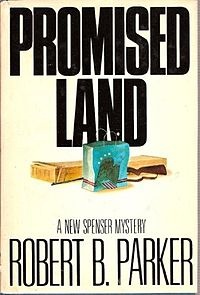
During their initial consultation, we see that the couple is also a bit more focused on other things than Kevin. Marge is sure to work in references to her acting and cooking classes, she’s a self-described creative person who has to express it. Rog seems a bit more focused on the bottom line (which he might need to be, since Marge seems to spend money like it’s going out of style). By the end of the book, my impression is that Rog is trying to do the right thing for his family, has some real concern over Kevin, but maybe doesn’t know how to show it. Marge is too self-involved for my taste and doesn’t come across very well (and has some other problems I won’t get into). But when the chips are down, both will selflessly and reflexively react to help their son. Their daughter, Kevin’s younger sister, is practically ignored throughout and I always feel bad for her. We’ll see an echo of this couple (with significant variations) in Promised Land in a couple of months.

The Bartletts live in Smithfield, which a fictionalized version of Lynnfield, MA. There are some pretty good reasons that Parker probably had to change the name in this novel, but as Spenser spends time in almost every novel since in Smithfield, I wonder if he ever regretted it.

Police Chief Trask is this close to being a tough-guy cartoon of a cop. He’s far more concerned with making sure that Spenser knows that he’s running the show than he is in anything Spenser has to say on their initial meeting (and he doesn’t improve much after this). He’s done some checking on Spenser and the two banter a bit about Spenser’s record. Well, Spenser banters and Trask tries to push him around, anyway.

Before Spenser can do too much on his own to find Kevin, a very strange looking ransom note shows up. Which brings the Massachusetts State Police, in the person of Lt. Healy, into things.

Healy I knew of. He was chief investigator for the Essex County DA”s office. There were at least two first-run racketeers I knew who stayed out of Essex County because they didn’t want any truck with him.

Healy said, ‘Didn’t you used to work for the Suffolk County DA once?”

I said, “Yes.”

“Didn’t they fire you for hotdogging?”

“I like to call it inner-directed behavior,” I said.

“I’ll bet you do.” Healy said.

Healy is tough, smart and ethical—and has little respect for Trask. He and Spenser work together pretty well, and Healy will appear or be mentioned in another dozen Spenser novels before making regular appearances in the Jesse Stone books.

From this point, things get strange—the ransom note is just the beginning, and a strange kidnapping will evolve into a murder case, a drugs and prostitution ring, and . . . well, more things. As with The Godwulf Manuscript the climactic fight involves two people who have no business engaging in hand-to-hand combat. Unlike last time, Spenser’s not sidelined for this fight and gets involved as well—it’s one of my favorite fight scenes in the series. Parker shows off his knowledge of and affinity for boxing here. Spenser’s motive for engaging in the fight isn’t necessarily pure, and I kind of like how honest Parker and Spenser both are about that.

As nice as that scene is, that’s not the end of the story—and whatever victory Spenser enjoys, it’s empty. Which is a nod to Spenser’s noir lineage and something that will show up again and again in the series.

While we’re introduced to Spenser in the previous novel, it doesn’t feel quite like a Spenser novel. But God Save the Child does. The same flavor, pacing, and approach to the story that are here are in almost every thing that Parker does with the character from this point forward. The character will evolve from novel to novel, but the series really starts here.

Possibly the biggest reason for that is that it’s in these pages we meet Susan Silverman. She’s the guidance counselor at Smithfield High School and after the Assistant Principal demonstrates that he’s useless for giving Spenser any insight into Kevin, she’s who Spenser turns to. Spenser’s described quite a few women prior to this, but from the first paragraph, Susan’s different.

Susan Silverman wasn’t beautiful. but there was an intangibility about her a physical reality, that made the secretary with the lime-green bosom seem insubstantial. She had should-length black hair and a thin dark Jewish face with prominent cheekbones. Tall, maybe five seven, with black eyes. It was hard to tell her age, but there was a sense about her of intelligent maturity which put her on my side of thirty…When she shook hands with me, I felt something click down the back of my solar plexus.

I said hello without stammering and sat down.

Parker’s not quite as blatant about it as Henry Fielding is about Sophie (for those who’ve been reading my Fridays with the Foundling series), but he’s fairly obvious in the way he portrays Susan in this scene (not to mention the several that follow) that she’s different. Exceptional. She ends up being the love of Spenser’s life and shows up in every book hereafter. But for now, they’re just meeting, but there’s a spark between the two of them and Spenser soon asks her to dinner.

I had just finished washing my hands and face when the doorbell rang. Everything was ready. Ah, Spenser, what a touch. Everything was just right except that I couldn’t seem to find a missing child. Well, nobody’s perfect. I pushed the release button and opened my apartment door. I was wrong. Susan Silverman was perfect.

It took nearly forty years of savior faire to keep from saying “Golly.”…

“Come in,” I said. Very smooth. I didn’t scuff my foot; I didn’t mumble. I stood right up straight when I said it. I don’t think I blushed.

During their date, Susan makes the following observation about Spenser,

So, sticking your nose into things and getting it broken allows you to live life on your own terms, perhaps.

Spenser is impressed with this insight—and it’s a recurring theme for the two of them to talk about for the next few decades—with each other or when Susan tries to explain Spenser to others. The choices he’s made in his life—relational, vocational, lifestyle, what have you—are all about living life on his own terms. There’s a lot to be commended in this approach, and some problems (in two books we meet a more extreme version of someone living this way…but that’s for another day). Another frequent thing that comes up in their conversations appeared for the first time when they met.

“Why do you want to know?” [Susan asks]

“Because it’s there. Because it’s better to know than not to know in my line of work.”

If I had a quarter for every time the two of them said this (sometimes he does the set up), I’d be able to buy my replacement copy of this book.

It’s not just because they say the same things in almost every book (wow, it sounds dull when I put it that way—it’s not, at least not for several years), it’s the effect that Susan has on Spenser that changes the series. It made Spenser stand out from the rest of the genre’s tough guys. I could go on and on about Susan or Susan-and-Spenser, but I’ll hold off on it for now.

As chapter two begins, we’re treated to four long paragraphs (about two pages in my edition) describing the route between Boston and Smithfield, with commentary from Spenser on the scenery, traffic, businesses, etc. that he comes across. This is something that Parker excels at—and doesn’t do nearly often enough (but at least once a book). I’ve never been in that part of the world, I defiantly can’t go to the version of that area that existed in 1974—but I walk away from this description feeling like I know the area.

As far as recurring characters go (other than Healy and Susan), Frank Belson makes a quick appearance, and we meet Henry Cimoli—who runs the Harbor Health Club, Spenser’s gym. Henry’s importance will ebb and flow (as will the frequency of appearances) over the rest of the series, but he’s a constant enough presence that it’s good to meet him for the first time here.

There’s a lot more that could be mined from these pages, but this has gotten too long. I may pick up a strand or two in the future, but we’ll see. God Save the Child seems to be a story about a runaway (or a kidnapping?), but really it’s about a young man struggling to understand his place in the world, parents who aren’t sure how to parent, and a detective starting to change his place in the world. There’s a lot of wit, some good social commentary, some decent detecting, and a great fight scene—all expertly and (seemingly) effortlessly written. That’s a reductionistic way to look at it, but that’s a Spenser novel in a nutshell. I loved revisiting it, and can’t wait to get to the next book.

This post contains an affiliate link. If you purchase from it, I will get a small commission at no additional cost to you. As always, opinions are my own.

Pub Day Repost: The K Team by David Rosenfelt: A New PI Trio Takes a Bite Out of Crime

The K Team

The K Team

by David Rosenfelt
Series: The K Team, #1

eARC, 304 pg.
St. Martin’s Press, 2020

Read: March 13-16, 2020
Grab a copy from your local indie bookstore!


After 20+ books (and counting!) in a series, what’s an author to do? Well, if you have the dog food bills that David Rosenfelt must have (seriously, check out the photos on his website or Facebook page of the dogs he and his wife shelter), you create a spin-off. I found myself comparing the books a lot in the paragraphs that follow—I won’t make a habit out of it as the series progresses, but I kept comparing them as I read, so that’s how I think of the book. I hope it doesn’t get too tiring.

In 2019’s Dachshund Through the Snow, we met Former Paterson NJ police officer Corey Douglas and his German Shepherd partner, Simon Garfunkel. At the end of that novel, Corey had decided to join forces with Laurie and Marcus to form a detective agency. This is their first case—and what a way to start!

Longtime Andy Carpenter antagonist, the harsh, yet fair, Judge Henry Henderson (aka Hatchet) hires the team to look into a blackmailer trying to pressure the judge into something. He doesn’t know what the blackmailer wants yet, but he knows there’s enough to damage (probably fatally!) his career. The arrangement they enter into means that Andy won’t be able to try a case before Hatchet again—which bummed me out, he wasn’t a constant presence in those novels, but a frequent one—probably the only judge’s name I recognized. I enjoyed watching Andy squirm around the judge.

But now, it’s Hatchet’s turn to squirm. The blackmailers (well, potential blackmailers—he’s quick to note they haven’t actually broken the law yet), have some manufactured evidence to make it look like he’s crooked. He’s not, and has enough of a reputation and goodwill to weather the storm. Probably. But the hint of scandal would taint his record and probably force him off the bench.

So, Corey, Laurie, and Marcus get to work—looking into cases the judge presided over and could be alleged to have influenced. Before long, the threats get more real and bodies start appearing (or, disappearing, in some cases). And well, that’s really all I can safely say. But fans of the Andy Carpenter books will be familiar with the way things play out—and new readers will be entertained by it, too.

Marcus doesn’t do much more (especially on the dialogue front) in The K Team than he does in a typical Andy Carpenter book, he’s basically an unintelligible superhuman (yeah, the jokes about the protagonist’s inability to understand him are of the same genus as the ones in the Carpenter novels, but they’re a different species coming from Corey—I was surprised at how refreshing that was). I think he probably gets a little more space devoted to him than he typically gets, but he does basically what we’re used to seeing. There are a couple of exceptions, including what I believe is the longest hand-to-hand fight scene we’ve seen from him.

Even Laurie isn’t featured as much as I expected. Actually, that’s an understatement. I assumed that this would be Laurie’s series with a couple of sidekicks—or maybe an equally Laurie and Corey series with Marcus showing up to do his thing every now and then. Maybe a third person kind of thing alternating between focusing on each character. But no, this is first person from Corey’s POV—so we get a lot of Laurie, but most of what she did was off-screen, only teaming up with Corey for bigger moments or to discuss what they’d done together. It’s not what I expected, but I can live with it (I just wish she’d get to shine a bit more).

So, Corey…we get to know him a bit better here than we did in his first appearance, obviously. He’s single—deliberately—and very devoted to Simon (but not the same way that Andy is to Tara), they worked together and are now shifting to a new career together. Corey’s a bit more willing to leave Simon out of some of the action than say, Bernie Little is (eager, occasionally, for Simon’s safety). He’s a movie buff—a little bit of a nerd about them, it seems—and I look forward to seeing this more. He’s good at his job, still a straight arrow (the kind of cop he was), but is discovering that he’s more willing to color outside the lines than he thought. I’m looking forward to getting to know him better.

The humor is a similar style to the one employed in the Andy Carpenter books, but it’s not Andy’s voice in a different body. Corey is distinctive, but fans of the one will tend to enjoy the other. That’s half the point (maybe 70% of the point) of a spin-off, right? Similar, but not equal—that applies for the voice, the humor, and the story.

If you’ve never read an Andy Carpenter book, don’t worry. Just think of this as the good idea it is—a team of PI’s working together instead of a lone operator with an occasional side-kick. A trio is so rare in the PI fiction biz that I can’t wait to see it at work more in future installments. I enjoyed this enough that I’m ready to read the next two at least. There was so much set-up to The K Team that Rosenfelt almost had to shoe-horn the plot around it. This was a good intro to the series, but I’m looking forward to seeing what Rosenfelt has in store for the team now that he’s been able to establish things.

Disclaimer: I received this eARC from St. Martin’s Press via NetGalley in exchange for this post—thanks to both for this.


3.5 Stars

This post contains an affiliate link. If you purchase from it, I will get a small commission at no additional cost to you. As always, opinions are my own.

Page 47 of 123

Powered by WordPress & Theme by Anders Norén