Category: Authors Page 46 of 123

Top 5 Tuesday – Top 5 Opening Lines


I love a good opening line. A solid opening paragraph or page is great, but an opening line that sells you on the next 200-500 pages? Magic. When I saw this list topic listed, these 5 jumped to mind—they may not be the best I’ve ever read, but they’re the most memorable.

(I tried, tried, tried to limit myself to the opening line, but I failed on a couple of them, couldn’t help myself.)

5 A Portrait of the Artist as a Young Man
A Portrait of the Artist as a Young Man by James Joyce

I remember in our English class in High School when we were assigned this book, pretty much no one was interested. When Mr. Russo passed out the paperbacks, a few of us flipped it opened and read these first words—and suddenly we were open to the idea (didn’t last long for all of us, but that’s beside the point, we’re focused on the opening lines here). It’s stuck with me for almost 30 years, that’s gotta say something.

Once upon a time and a very good time it was there was a moocow coming down along the road and this moocow that was coming down along the road met a nicens little boy named baby tuckoo….

4
Neuromancer by William Gibson

This sentence was love at first glance for me. Still love it. Naturally, no one knows what color this is referring to anymore.

The sky above the port was the color of television, tuned to a dead channel.

3
The Big Sleep by Raymond Chandler

Oft-parodied. Oft-imitated. Often-celebrated. Does it get better than this?

It was about eleven o’clock in the morning, mid October, with the sun not shining and a look of hard wet rain in the clearness of the foothills. I was wearing my powder-blue suit, with dark blue shirt, tie and display handkerchief, black brogues, black wool socks with dark blue clocks on them. I was neat, clean, shaved and sober, and I didn’t care who knew it. I was everything the well-dressed private detective ought to be. I was calling on four million dollars.

2
Harry Potter and the Sorceror’s Stone by J. K. Rowling

Why bother saying anything here?

Mr. and Mrs. Dursley, of number four Privet Drive, were proud to say that they were perfectly normal, thank you very much. They were the last people you’d expect to be involved in anything strange or mysterious, because they just didn’t hold with such nonsense.

1
The Hitchhiker’s Guide to the Galaxy by Douglas Adams

I’ll go on and on about this book next week, so I’ll just keep my trap shut here. But man…there was something about these lines that got into my blood.

Far out in the uncharted backwaters of the unfashionable end of the Western Spiral arm of the Galaxy lies a small unregarded yellow sun.

Orbiting this at a distance of roughly ninety-eight million miles is an utterly insignificant little blue-green planet whose ape-descended life forms are so amazingly primitive that they still think digital watches are a pretty neat idea.

Trophy Hunt by C. J. Box: Pickett takes on an X-Files-y case

Trophy Hunt

Trophy Hunt

by C. J. Box
Series: Joe Pickett, #4

Paperback, 375 pg.
G. P. Putnam’s Sons, 2004

Read: May 15-16, 2020
Grab a copy from your local indie bookstore!


I’m short on time, so I’m going to cut a corner and use the official blurb:

It’s an idyllic late-summer day in Saddlestring, Wyoming, and game warden Joe Pickett is fly-fishing with his two daughters when he stumbles upon the mutilated body of a moose. Whatever – or whoever – attacked the animal was ruthless: half the animal’s face has been sliced away, the skin peeled back from the flesh. Shaken by the sight, Joe starts to investigate what he hopes in an isolated incident.

Days later, after the discovery of a small herd of mutilated cattle, Joe realizes this something much more terrifying than he could have imagined. Local authorities are quick to label the attacks the work of a grizzly bear, but Joe knows otherwise. The cuts on the moose and the cattle were too clean, too precise, to have been made by jagged teeth. Are the animals only practice for a killer about to move on to another, more challenging prey? Soon afterward, Joe’s worst fears are confirmed. The bodies of two men are found within hours of each other, in separate locations, their wounds eerily similar to those found on the moose and cattle.

There’s a vicious killer, a modern-day Jack the Ripper, on the loose in Saddlestring – and it appears his rampage is just beginning.

Pro tip: don’t read C. J. Box describing a moose corpse while eating lunch.

That aside, I had a lot of fun reading this. Joe ends up being the Game and Fish representative on the task force the governor calls for to investigate these mutilations. Sheriff Barnum is also on the task force, giving us more opportunities to be annoyed by him (I’m really looking forward to the upcoming election which should remove him from office).

I have a note to compare Nate Romanowski and his approach to spirituality and nature and Henry Standing Bear’s—and I think that could be a fruitful discussion, but I think I need to see Nate wax spiritual a little more in future books. But at least at this point, Nate seems like some white dude getting a little strange, whereas Henry seems genuine (which isn’t to say Nate’s fake, he’s just…new at it?). Regardless, it was good to see Nate again, and I like the way that he’s settling into the series (if only so there’s someone around who can shoot and is generally on Joe’s side).

On the one hand, the constant discussion about the precarious financial situation the Picketts face is a refreshing and bracing bit of realism—but if Box would ease off on it a little bit, that’d be nice, just a bit. I like seeing Marybeth struggling to find her place in the world in a way that helps her family—if nothing else, her bouncing around from employer to employer (as her small business allows) she can be put in all sorts of interesting places to tie into Joe’s cases (see these last two books).

Lucy took a bigger role than she usually gets, which sadly took a little bit of space from Sheridan. But she still gets a chance to shine, which makes me happy.

But what brings readers back is Joe Pickett. He’s not the smartest, the quickest, the most insightful mystery protagonist around. But he’s dogged. He’s persistent. He’s one of those rare good guys. He gets the job done, eventually, because that’s what he needs to do. Easy to like a character like that, he’s not really Everyman. He’s the kind of guy an Everyman would like to be.

(which does mean that the reader figures things out a lot faster than he does, but oh, well)

This was the first Joe Pickett novel that I read instead of listening to (my library doesn’t have the audiobook)—this is the first time I’ve gone from audio to print. It was interesting, but I think I prefer Chandler’s narration to my own (but I liked getting the spelling of a couple of names).

It’s a solid mystery, a good time with some characters that I liked. It’s a little heavy on the “woo-woo” stuff (Joe’s term), but I can live with that. I don’t know that this is the best one to come to the series with, but it’s a good installment for those that are familiar with the characters.


3.5 Stars

2020 Library Love Challenge

This post contains an affiliate link. If you purchase from it, I will get a small commission at no additional cost to you. As always, opinions are my own.

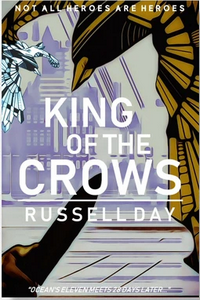
The King of the Crows by Russell Day: Prescient. Gripping. Haunting. Unpredictable. What stories should be.

King of the Crows

King of the Crows

by Russell Day

Kindle Edition, 456 pg.
Fahrenheit Press, 2020

Read: April 28-May 9, 2020

… for me at least, the first week of the Lockdown was the worst.

Knowing it had happened to me. I hadn’t escaped, I wasn’t one of the lucky ones. Lucky to be safe or lucky to be dead. Take your pick. I was neither.

That right there gives you a pretty good idea what kind of light and fluffy read this is going to be.

There are two timelines in this story—the primary focuses on a post-pandemic London, while the other shows what happened to a couple of the characters mid-pandemic (with plenty of material describing what the pandemic was like for others). In the primary timeline, Europe is a disaster—a “wasteland”—and eight years after the Outbreak, it’s beginning to put itself back together. But it’s going to take a long, long time to recover from this. Don’t let the fact that “eight years after” this fictional outbreak is 2028 bother you at all.*

* Good luck with that. I’ll get back to this in a bit.

I’m not going to try to list all the various ways that Day uses to tell this story: I’m certainly going to forget several. So here’s a partial list: here’s a third-person 2028 narrator describing a police investigation, a first-person perspective on the same investigation; a first-person account of that same detective’s life during the Outbreak; selections from a screenplay made about a group of Londoners during the Outbreak; selections from the Outbreak-memoir of one of those Londoners; and third-person narration of the same (N.B.: these three will vary in telling ways); redacted 2028 prison correspondence about the Outbreak; excerpts from scholarly works on aspects of the Outbreak (including a very illuminating work on the slang of the time); graffiti from 2021; internet message boards. Day weaves these together to tell his story, build the world, and help you to understand it. Frequently, I read something from the 2028 timeline, and understood it—only to find a new depth to it several pages later after getting another piece of the puzzle from 2020/2021. It’s hard to juggle that many narrative forms/voices/perspectives/calendars as a reader or a writer—Day pulled it off better than I did (any problems I had following things I attribute to myself, and it was pretty easy to clear out my misunderstanding with a minimum of backtracking*). It definitely helps paint the picture of the scope and variety of effects the sickness had on the world more efficiently than a consistent first- or third-person narrative would be able to.

* This would be easier in hardcopy than on an e-reader in my opinion. But that’s just a guess.

There are times (several of them) when I felt that the characters were getting lost amongst the plot and worldbuilding and sickness. But when I stopped and thought about it—and eventually got to the point where I didn’t have to—I realized I had a pretty solid idea about who these people were and was more invested in them than I expected. I thought there was so much going on that the people were getting hidden, but really, Day’s work was subtle—working in the characters into my subconscious like you give a dog its medicine. Normally, this isn’t something I require (or would like)—and it’s not Day’s usual M. O. (quite the opposite), but I think this approach really fit the novel and the story/world.

“They weren’t zombies,” he says, softly. “Don’t call them zombies.”

No one who was involved in the Outbreak for real uses the zee word.

So exactly what was the sickness?

I remember reading a couple of years ago about these ants that would succumb to a fungus which would short-circuit their brain and make them do certain things before killing them—or something like that, vague memories here. Then there were stories about parasites controlling the host’s actions—both of these stories had their 15 seconds of fame on social media around the same time (I may be messing the details up a little bit, but I’m not writing history here).

In Day’s world, one of these kinds of parasites will reside—asymptomatically, I should stress—in cats, who would pass it on to humans. Skipping the details, the humans would get very sick and then, survivors would maybe succumb to a psychosis that would make them violent. This sickness, HV-Tg (Human Variant-Toxo gondii), in a little more than a year would kill more than 20 million in Europe (at least 33% of France’s population) Et voilà!—an easy to believe pandemic that results in Zombie-like people wandering around.

Now, if one of those who’d “switched” and become violent infected you during an assault, well, you were likely to succumb. There were enough of these (“psychos” or “Gonzos”), and the sickness was so widespread, that the police and military couldn’t keep up, that civilians were forced to take action and defend themselves, their family and neighbors. People quickly forming into gang-like associations for mutual protection. It was a literal kill-or-be-infected (and likely killed) situation.

One such association became known as The Crows or The Kings of the Crows. They developed a legendary status mid-and post-Outbreak—and are the subjects of the memoir and film mentioned above. One of their number who happened to survive (and gain notoriety enough to get a publishing deal for a memoir) is the subject of the 2028 investigation. They survived the worst of the worst in one of the hardest-hit cities. They did so via means and methods that many (including their own) would find deplorable, but under circumstances that not only permitted, but required, those actions.

We also see what happens to an American in Paris for work when the Outbreak reaches the point that International travel is canceled (particularly to the U.S.). Her allies will never be considered the Kings of anything, and the contrast between how she survives to what the Crows do is pretty striking.

In 2028…eh…you know what? You should read that for yourself. I’m going to say something I’ll regret.

The biggest killer in those days wasn’t the disease or the psychos, it was stupidity.

However, it has been pointed out by many historians, logic was one of the first casualties of the Outbreak.

Some of the best moments of this book have nothing to do with advancing the plot, they’re little bits showing what the world of the Gondii-pandemic looks like. The man telling the story about taking his girlfriend to the ER because of a burn—how they were treated, and how she became infected. The soldiers coming back from a Middle East deployment being completely unprepared for what had happened to their home country. The mother and son who traveled with the Crows for awhile.

Ultimately, it’s not the story you think you’re getting…or is it? The marketing tag line is, “Ocean’s Eleven meets 28 Days Later.” It is, all things considered, a good, catchy line. I’m not sure it’s all that accurate a description of the novel (but it’s not inaccurate). What it is, really slides up on you—and when you see it it feels like it was obvious all along (even if you wouldn’t have said that 20 pages earlier). There’s a straightforward crime story at the heart of this novel—it’s just surrounded by so many layers, that you can miss it—there’s the sickness, there’s the horrible social and political context (both mid- and post-Outbreak), there’s what the characters are going through otherwise—and the whole thing is drenched in social commentary about 2020 society, e.g., sexism, economics, medical care.

And that’s not even touching the context we’re reading it in now. I truly wonder what I’d think of this book if I’d read it last Fall. I’d still like it, I’d still be impressed by it—but I don’t know if it would resonate with me the same way. There’s almost nothing about Gondii that’s comparable to COVID-19. But the way that people and governments respond—well, that’s pretty different, too. but if you can’t see what’s going on around us reflected in this novel? You’re not paying attention. That Day appears so prescient says something about his skill and observation (and a lot about Western culture, too).

I can see why people cling to the idea that the Gonzos were trying to tell us something. Something’s out there trying to get a message through: there’s a plan. Compared to the idea that it was all just chance, it’s a comfort of a type. Chance doesn’t care and can’t be appeased and can’t be reasoned with. Chance means it could all happen again.


5 Stars

The Sword-Edged Blonde (Audiobook) by Alex Bledsoe, Stefan Rudnicki: This Hard-Boiled Fantasy Mixes the Best of Both Genres

The Sword-Edged Blonde

The Sword-Edged Blonde

by Alex Bledsoe, Stefan Rudnicki (Narrator)
Series: Eddie LaCrosse, #1

Unabridged Audiobook, 8 hrs., 28 min.
Blackstone Audio, 2012

Read: April 22-24, 2020
Grab a copy from your local indie bookstore!


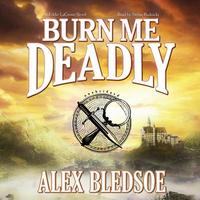
I’ve read this novel at least twice (13 and 11 years ago), and apparently have forgotten almost all of it. In fact, what I did remember as the climactic scene must belong to the second novel in the series, Burn Me Deadly. I can do better with the rest of the series (and not just because I actually wrote something about them—but I’m looking forward to taking another look at them in the coming months.

But I’m getting ahead of myself, I should introduce you to Eddie LaCrosse and his world. It’s your basic Fantasy world—swords, rumors of sorcery, small kingdoms, and so on. Eddie’s an ex-soldier, ex-mercenary, now “sword jockey” (basically a private cop). He’s got a little more on his résumé, but you’ll learn more about that as you dive in yourself. He’s been hired by an old friend, the King of a neighboring country to clear his wife of the horrific murder of her son. She doesn’t remember him, but when he meets her, Eddie realizes that he knew the Queen long before the King did.

Eddie’s investigation takes him through multiple kingdoms, into the remains of a cult, and into a criminal network that rivals anything that Varys put together for efficacy or ruthlessness. At the same time he does this, Eddie takes a trip through his personal history, reliving the time he knew the Queen (and events leading up to that). The two storylines are interwoven to help Eddie solve what seems like a perfect crime.

Both in the narration, LaCrosse’s character and the kinds of people we meet along the way, Bledsoe channels Chandler. LaCrosse is casually violent in a way that Marlowe indulged in a bit too often for me, and the (for lack of a better word) grotesque (in physical appearance and morality) criminals Eddie deals with in the latter parts of the book felt particularly Chandler-esque to me.

There’s some things that happen at the end that point to Eddie coming to terms with parts of his past that he’s been unable/unwilling to acknowledge existed. The character won’t change as a result of this (at least not much), but I think it opens the door for some of his rougher edges to be rounded out. How well that actually happens, I’ll have to see (I don’t trust my memory enough right now)—but at the very least, Bledsoe made it possible for the character to grow and evolve here.

Rudnicki’s narration didn’t really work for me initially—there was a quality to his voice that just didn’t click with me. But, I kept going because I liked the novel. Before the halfway mark, however, he’d won me over. I can’t put my finger on it (either good or bad), but he sold the emotional moments, the humor, and Eddie’s general attitude. Which is good enough for me.

It’s hard for me to rate this one on its own terms—I remember liking it. I remember what Bledsoe does with the characters. And those things color my rating, leading me to probably giving this another half-to-whole star more than I would otherwise. But also, for the world. The merging of Fantasy and Hard-boiled genres in a way that’s seamless and well-executed. I recommend this one and will be back for more soon.

Bookstooge posted about this book yesterday. It’s probably worth a read (I’ll read it later today, I didn’t want his voice in my head as I wrote this).


4 Stars

This post contains an affiliate link. If you purchase from it, I will get a small commission at no additional cost to you. As always, opinions are my own.

Apex Predator by M.R. Miller: Nothing goes According to These Plans

Apex Predator

Apex Predator

by M. T. Miller
Series: The Culling, Book 2

Kindle Edition, 238 pg.
2020

Read: April 17-20, 2020
Grab a copy from your local indie bookstore!

“Nothing ever goes according to plan,” Shast said. That was why contingencies existed. Layers upon layers of them.

That’s from Chapter 4. By the time the book ends 11 chapters later, Shast is going to a whole new understanding of that.

But I’m getting ahead of myself there’s some sort of monster infestation in a city—forces have been sent to take care of it–two different waves, actually. But they didn’t work. So now, The Culling–the organization that handles these kinds of things, has sent a full Hand to clear it out. A Hand is a team of five hunters, each with a different specialty. With those combined talents, they should be able to handle anything.

Only Shast and the most senior member of the Hand have worked together before, the other three are experienced, but not that much. It’s a diverse group of people who usually work along and there’s a good deal of bickering and being at loggerheads on the way to the city. Once there, once the hunt gets underway, that gets compartmentalized and the Hand gets to work.

For a completely foreign world—that we still don’t really know that much about (but we’re learning)—it’s a testimony to Miller’s story-telling that the reader is able to plug into their activities, get an idea what’s at stake and why they’re doing what they’re doing.

It doesn’t take long for every theory they have to be proven wrong, everything they try to not have any success. And before long, it’s clear that what they’re facing is something most of them had never heard of—or if they had, they thought was a myth. It’s not a myth, and soon the hunters are the hunted.

Interspersed with that story are flashbacks to a hunt from early in Shast’s career, and enduring that was pivotal in his development into the hunter that he is. He gained the perspective, the cold-heartedness that he requires to survive the hunt that’s the focus of this novel. I don’t remember Miller doing anything like this before, he pulls it off pretty well. There are times when you get a story like this that you really wonder what the flashback storyline has to do with anything, but I gave Miller the benefit of the doubt and was rewarded for it.

Last time out, I praised Miller’s design of monsters. This time, I need to do the same. I don’t remember reading monsters like this before—while they were completely original, I had no trouble getting a clear idea how these things looked or acted. They were disturbing, powerful and you have little trouble understanding why the Hand wants to destroy them.

Even better is his character design—each member of the Hand is a fully realized character–and we learn their backstory, culture, specialties, and the rest without ever feeling like we endured an info drop. Through them, we get a better idea how this world works and how the Culling developed. I’m still trying to get a handle on this world, not that it bothers me much, I know what I need to know—but I’m intrigued, I’m curious. I appreciate getting a little more information about this place.

Now in the first book of the series, Shast and his companions face off with a large and unprecedented force of monsters, but it’s something they can get a handle on, something they can understand and adapt to. This time, the Hand is completely blindsided and maybe outclassed. How he moves on from this point to book 3, I have no idea—I assume Miller has a few tricks up his sleeve and I’m looking forward to seeing what they are. In the meantime, I’d encourage you all to go pick this one up.


4 Stars

Note: I received a copy of this book from the author in exchange for this post and my honest opinion. I thank him for that.

This post contains an affiliate link. If you purchase from it, I will get a small commission at no additional cost to you. As always, opinions are my own.

Pub Day Repost: Robert B. Parker’s Grudge Match by Mike Lupica: Sunny Randall’s Forced to Work for an Enemy as Lupica Settles into the Series

Grudge Match

Robert B. Parker’s Grudge Match

by Mike Lupica
Series: Sunny Randall, #8

eARC, 210 pg.
G.P. Putnam’s Sons, 2020

Read: April 21-22, 2020
Grab a copy from your local indie bookstore!


As I said last year when Lupica debuted his continuation of the Sunny Randall books with Blood Feud, I’ve had a complicated relationship with Sunny and was ambivalent with the series re-starting. However, I enjoyed Blood Feud (although comments on my post said I came across as lukewarm, I didn’t mean to) and really thought that Lupica had a good take on the character.

Thankfully, we don’t have a sophomore slump here, I think Lupica’s feeling more comfortable in these shoes and delivered something a little more ambitious. Tony Marcus begins this book by describing the best way to hold a grudge—and then goes on to point out all the reasons Sunny has recently given him to hold one against her. If nothing else is clear from this, you do not want Marcus harboring anything for you. He does this just to impress upon Sunny that his offer of employment is something she should strongly consider.

Tony’s lover, confidante, right hand, and former employee has left him. Without warning, without notice—and Tony wants her back. He’s not that concerned for her safety, he’s a little concerned that she defected to some new competition for his turf, but mostly he just wants to know what happened and how he can win her back. Sunny (and this reader) is fairly convinced by Marcus—she doesn’t think Marcus wants to hurt her, he just wants her back. Sunny hems and haws, but agrees to take on the case—for her own safety and because she’s able to convince herself that she’s actually working for Lisa Morneau, not Marcus.

This puts her on a path to explore the world of prostitution in Boston—this isn’t the first time Sunny’s done something like this, but this time she’s working for Marcus, which opens a few more doors. She meets with Lisa’s closest friend, someone she helped get out of the life, as well as former colleagues. Sunny also has several run-ins with Marcus’s new competitor, who seems like he’s wanting to start a war with him.

At some point, the trail leads to Paradise—leading to Sunny meeting up with Jesse Stone. The two banter and flirt a bit, and Jesse offers some help on the Paradise front. It was nice to see them together again (I’ve often thought the best use of the Sunny character was as Stone’s associate).

Now, it’s not long before the search for Lisa results in murder—and Lisa herself is frightened, sure that she’s next. Which drives Sunny to start to look into why would someone want to threaten her. What does Lisa know that makes her dangerous? And can Sunny use this knowledge to save Lisa and prevent the gang war on the verge of erupting?

While that’s going on Richie’s (other) ex-wife moves back to Boston with their son, Richard, and now wants Richie to play the role in Richard’s life that she’d previously blocked him from. Richie responds as any father worthy of the title would—he’s overjoyed and turns his life upside down to accommodate that without a second thought. Sunny recognizes that this is the way he should react, but can’t quite get on board with it herself in the same way—for a combination of reasons, some petty, some understandable (maybe some fit under both columns). It’s a dicey story for all characters involved and Lupica deals with it well.

Lupica goes out of his way to make sure it’s obvious that this takes place in the Parker-verse outside of Paradise. Of course, Sunny sees her therapist, Susan Silverman; Sunny consults Lee Farrell a few times (nice to see him again) and they talk about Frank Belson once or twice (the new captain, too); Vinne Morris pops in briefly; there’s a mention of Patricia Utley, and something Tony Marcus says places this at the same time as Angel Eyes. That’s nice and pretty fun, but he’s almost name-dropping enough to make him seem desperate to prove his legitimacy as a Parker fan. “No, really, I’m qualified to write these books, let me show you how familiar I am with all the series.” I think Atkins came close to this in his first two Spenser books, Coleman in his first Jesse Stone, so it’s not unique to Lupica. Also, he doesn’t get to the point of desperation, but he’s close—if he can just dial that back a bit now, he’s proved himself.

Feel free to skip this paragraph, I dance right down the border of The Spoiler Zone (and might put a couple of toes into it). My gut reaction to the way things were left with the Richie/Richard storyline is pretty negative. It’s hard to get into without spoiling things, but…Richie reacted irrationally to things given his family and who he knows Sunny is, and Sunny took the easy way out with things (Susan Silverman would not approve—if she let herself approve/disapprove of Sunny’s actions). Now, this doesn’t mean that Lupica fell down in the writing—he’s actually writing the characters the way they were created, flaws and all. I’d like to see some growth in the characters and we didn’t get that yet—but that could be because he’s setting things up for future books. Or, he could be letting these two stagnate where they are (see Parker’s treatment of Stone in the later books).

Sunny has a good deal of internal discussion about how she’s finding herself in the situations she’s facing because of decisions men have reached, and not herself—she’s reacting too much to men’s choices. She resolves not to be the threatened, but to be the one threatening. I think there’s a lot of merit to these lines of thinking—but she seems to go through this (or something pretty close to it) in every book (by Lupica or Parker). At some point, it’d be nice to see her move past this—or add some nuance or wisdom to this consideration.

Lupica keeps things moving throughout—even when Sunny’s investigation starts going in circles, the plot keeps going. He writes confidently and with just enough flair to make this fit in the Parker-verse. There’s a joke or two that he returns to too often, but it feels in-character for Sunny’s narration to do that, so I’m not complaining.

The last line…I’m not going to say anything about it, but I could fill an entire post with what I like about it, what it makes me fear, and how I should’ve seen it as inevitable. But… I’m not going to say anything about it because I don’t play that way. Feel free to talk about it in the comments after the book comes out, though.

So, I have a lot to say about this, it turns out—but it boils down to this: Grudge Match was a fast, easy read—the plot and the prose were as smooth as you could want. Lupica has captured the voice of the Sunny Randall books and has made it his own. While I was bothered by a couple of the character beats toward the end—they didn’t take away from my enjoyment of the book. If you’re a Sunny fan, you’ll be entertained. This actually would work as a pretty decent entry point to the series, too—it’s pretty accessible (including the ongoing arcs, Lupica makes sure that people who are new to the series or haven’t read them since the last Parker in ’07 have enough information to tap into them).

Disclaimer: I received this eARC from Putnam Books via NetGalley in exchange for this post—thanks to both for this.


3.5 Stars

This post contains an affiliate link. If you purchase from it, I will get a small commission at no additional cost to you. As always, opinions are my own.

Audiobook Catch-Up Quick Takes on Caliban’s War by James S.A. Corey, Jefferson Mays (Narrator); Heartless by Gail Carriger, Emily Gray (Narrator); Demon Born Magic by Jayne Faith, Amy Landon (Narrator); Stardust by Neil Gaiman; Dumplin’ by Julie Murphy, Eileen Stevens (Narrator); Funny, You Don’t Look Autistic by Michael McCreary; Paradise Valley by C.J. Box, Christina Delaine (Narrator)

The point of these quick takes post to catch up on my “To Write About” stack—emphasizing pithiness, not thoroughness. This is a little longer than most of these that I do, I just wanted to get caught up on my Library Book Audiobooks (I’m so thankful that I can get audio downloads from my library right now—I’d be lost without them!)

Caliban's War

Caliban’s War

by James S.A. Corey, Jefferson Mays (Narrator)
Series: The Expanse, #2
Unabridged Audiobook, 21 hrs.
Hachette Audio, 2017
Read: April 6-14, 2020
Grab a copy from your local indie bookstore!

(the official blurb)
90% of the reason I’m doing this in a Quick Take post is because if I don’t cover it in a paragraph or two, I’ll take 15 pages (or the equivalent). I’m kicking myself so hard for not jumping on each installment of this series as soon as it was published (although, if I did, I would be missing out on the audiobooks). I read the first book shortly after publication, but missed the release of this bookso before I realized it I was two novels and over a thousand pages behind, and I just couldn’t find the time to catch up.

Anyway, this might not have been the right time to listen to a novel about an unexpected, largely unknown, biological enemy of all humanity and the inexplicable reactions of several governments to itthrough the eyes of people living in fairly enclosed spaces. Still, it’s gripping, imaginative, wonderfully told and very compelling. I can’t wait to see what’s next (although, I’m pretty apprehensive of it, too). I loved the new characters and hope they stick around.
4 Stars

Heartless

Heartless

by Gail Carriger, Emily Gray (Narrator)
Series: The Parasol Protectorate, #4
Unabridged Audiobook, 11 hrs., 19 mins
Hachette Audio, 2011
Read: April 1-3, 2020
Grab a copy from your local indie bookstore!

(the official blurb)
I think I’m about over this series, but maybe it was just this novel. Alexia seemed to run around oblivious to what was going on for almost the entire booksure, it’s kind of explained by the effect “the infant inconvenience” is having on her mind, but I don’t totally buy that. (maybe that’s my maleness talking). The first couple of chapters and the little bit at the end with the newborn were the highlights for methe climactic battle sequence was fun, I just didn’t like how we got there. Still, it was a fun listen and I enjoy the characters. I hope the series finale is better.

That said, Emily Gray is a delight. I seriously cannot listen to her enough.
3 Stars

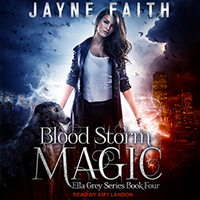
Demon Born Magics

Demon Born Magic

by Jayne Faith, Amy Landon (Narrator)
Series: Ella Grey, #4
Unabridged Audiobook, 8 hrs., and 52 mins.
Tantor Audio, 2017
Read: April 24-27, 2020
Grab a copy from your local indie bookstore!

(the official blurb)
Ella now knows where her brother is, but she’s been cut off from her power, so she can’t move on it. Due to her lack of power (and some other stuffincluding a total and inexplicable lack of due process), she loses her job. She and Damien start a private consulting business, make a Faustian deal and will deal with the consequences over most of this book and the next. Along the way, Ella learns why her brother is off the grid.

The luster has really worn off this series for me. I think it’s possible that Faith will stick the landing and I’ll be happy with the set as a whole, but I think she’s squandered a good start. If there was more than one book left, I’m not sure I’d bother.
3 Stars

Stardust

Stardust

by Neil Gaiman
Unabridged Audiobook, 6 hrs., 23 mins
HarperAudio, 2006
Read: April 28-29, 2020
Grab a copy from your local indie bookstore!

(the official blurb)
I remember being disappointed when I read the book a few years ago, because the movie version (that I love) was such a lousy adaptation. The text eventually won me over, but it took a long time. This is backward, I realize, but what are you going to do?

Anyway, I came into this audiobook with low expectations, but I wasn’t in the mood to spend money on an audiobook and everything I wanted from the library was checked out. Listening to Gaiman’s always fun, so I gave this a whirl. Between Gaiman, low expectations, knowing it’s not the movie, and a story that’s really good when you give it a chance, I had a great time.

It’s a fairy tale that isn’t. Gaiman draws on every convention, every trope and uses them the way a child uses a play-doh set.
4 Stars

Dumplin’

by Julie Murphy, Eileen Stevens (Narrator)
Series: Dumplin’, #1
Unabridged Audiobook, 9 hrs., 45 mins.
HarperAudio, 2015
Read: April 29-30, 2020
Grab a copy from your local indie bookstore!

(the official blurb)
This was just cute. Another “don’t make me spend money on audiobooks while I wait for holds to become available” listen. A YA story about a fat girl (her words, not mine) who joins her small-town beauty pagent, and the scandal that ensues. It’s almost entirely predictable, but Murphy’s style makes it feel fresh, and you just don’t care about the predictability. Steven’s narration is spot-on, too. I had a lot of fun with this.
3 Stars

Funny, You Don't Look Autistic

Funny, You Don’t Look Autistic: A Comedian’s Guide to Life on the Spectrum

by Michael McCreary
Unabridged Audiobook, 3 hrs., 37 mins
Annick Press, 2019
Read: March 31, 2020
Grab a copy from your local indie bookstore!

(the official blurb)
McCreary was five when he was diagnosed with Autism Spectrum Disorder, but it had challenged him and his parents far before then. In this short memoir, he talks about growing up with ASD and finding his place in performing and comedy. This wasn’t as funny as you might hope from a comedian’s memoir, but given that the focus of it was on the way he got through life and learning his craft while learning how to live in a neurotypical world, it’d be hard to be funny. Still, there was a light-heartedness to the entire book that made it pretty appealing.

I had plenty of fun listening to this, and gained some insight (much needed, I expect) into ASD. I think the hard copy might be a bit better because there are charts, graphs, etc. he mentions throughout (yes, there are pdf versions available on the publisher’s site, but who listens to an audiobook when they can stop and look at a pdf?).
3.5 Stars

Paradise Valley

Paradise Valley

by C. J. Box, Christina Delaine (Narrator)
Series: The Highway Quartet, #4
Unabridged Audiobook, 10 hrs., 6 mins
Recorded Books, 2017
Read: March 26-30, 2020
Grab a copy from your local indie bookstore!

(the official blurb)
Here we go. Cassie Dewell vs. The Lizard King: The Final Battle. Kyle Westergaard comes along for the ride, toobecause we can’t have a Highway novel without a young person’s perspective. A lot of other characters from the entire series make appearances (important ones), too.

This was a solidhorrifying, but solidconclusion to this arc. And it does set up a way for things to continue beyond this point.

I’m really glad that I started this series (it, too, started with a “don’t make me spend money on audiobooks while I wait for holds to become available” listen)
3.5 Stars

2020 Library Love Challenge
This post contains affiliate links. If you purchase from any of them, I will get a small commission at no additional cost to you. As always, opinions are my own.

Top 5 Saturday: Retellings That Have Stuck With Me

Top 5 Saturday Retellings

The Top 5 Saturday weekly meme was created by Amanda at Devouring Books.

Rules!

  • Share your top 5 books of the current topic—these can be books that you want to read, have read and loved, have read and hated, you can do it any way you want.
  • Tag the original post (This one!)
  • Tag 5 people (I probably won’t do this bit, play along if you want)

The Upcoming Schedule Is:

5/9/20 — Books with a Number in the Title
5/16/20 — Books by Debut Authors
5/23/20 — Books about Plants/Flowers (Can be on cover, in title or plot)
5/30/20 — Books from a Male POV


The Story of Edgar Sawtelle by David Wroblewski

A Retelling of: Hamlet by some obscure playwright

The reason I didn’t call this list “My Favorite Retellings” or something like that is this novel. I didn’t really enjoy much of this one. But man, it was gorgeously written. Before I started this blogged, I wrote a little about it on Goodreads: “Meticulously crafted, wonderfully and intricately written, fantastic characters, a world you’d love to live in, imaginative, creative, a concept so great, so well executed…aaaaaand I had to force myself to read it. I took 3 breaks from this novel, and had to drag myself back to it each time. I feel like I owe this book 5 stars because it deserves them, but I really want to give it 1.75 or so. There is no reason at all that I shouldn’t like it—people should love this work, actually. But I just didn’t.” Still, nine years later, this is the first novel that lept to mind when I started this list and I have vivid memories of a lot of the book. Can’t beat that.


Fuzzy Nation by John Scalzi

A Retelling of: Little Fuzzy by H. Beam Piper

An Avatar-esque story, that’s nowhere near as self-important and a whole lot more entertaining than the Cameron movie. Jack Holloway is a prospector on the planet Zarathustra who discovers a potentially sentient and language using species (that coincendentally are about the cutest things ever). Holloway has to figure out a way to keep the species from being wiped out by an uncaring corporation. This might actually be my favorite Scalzi novel.


Cinder by Marissa Meyer

A Retelling of: Cinderella

A YA SF re-imagining of the Cinderella story featuring a young woman with a cybernetic leg who attracts the attention of a Prince trying to help his people survive a plauge. It launches an epic series (also featuing re-tellings I could have filled this list with). I don’t know that the entire Lunar Chronicles series really delivered on the promise of this book, but I had a lot of fun with it. If you’re going to do a re-imagining, this is the way to do it.

* Jim C. Hines’ Princesses series also comes to mind at this point…maybe I should have included one of them…


Re Jane by Patricia Park

A Retelling of: Jayne Eyre by Charlotte Brontë

Brontë’s novel is one of my All-Time Desert Island Top 5 novels, and I’m a sucker for a retelling of it. This one is set in NYC in the late 1990’s. Jane Re, is a half-Korean, half-American orphan who is hired to be the au pair for a Chinese adoptee. It’s Jane Eyre and more. As I said when I posted about it, it’s a clever re-imagining, and/or a satisfying read.


The Graveyard Book

A Retelling of: The Jungle Book by Rudyard Kipling

I remember reading this to my kids years ago, and being very affected by it myself. It’s haunting, playful, creepy and heartwarming. A brilliant way to retell the story of an lone man-child in a very foreign atmosphere by beings not fit to raise one—and their efforts to help him fit in his native society.

The Misadventures of Nero Wolfe: Parodies and Pastiches Featuring the Great Detective of West 35th Street by Josh Pachter, ed.: A Collection of Short Pieces Celebrating Nero Wolfe

The Misadventures of Nero Wolfe

The Misadventures of Nero Wolfe: Parodies and Pastiches Featuring the Great Detective of West 35th Street

by Josh Pachter, ed.

Kindle Edition, 364 pg.
Mysterious Press, 2020

Read: April 15-27, 2020
Grab a copy from your local indie bookstore!


Wow—2 chances to talk about Nero Wolfe in less than a month? Say what you will about 2020, there are some really nice things going on, too.

In the same vein as the 2018 compilation that he co-edited, The Misadventures of Ellery Queen, Pachter (with the blessing of Stout’s daughter), Pachter presents just what the title promises: a collection of short pieces featuring takes on Nero Wolfe (and, generally, Archie Goodwin).

There are three introductory essays—one by Otto Penzler; one by Stout’s daughter, Rebecca Stout Bradbury; and then one from Pachter (which served as a typical introduction). All three of these pieces were a pleasure to read, but obviously, Bradbury’s is the standout for sentimental reasons.

Then we move into pastiches, although some felt more like parodies to me—but why quibble? The first entry just didn’t work for me, and almost put me off the project as a whole. But, it’s Wolfe, so as much as I say “almost”—there’s no chance that’d stick. Thankfully, the second entry more than made up for it, as did the rest. A personal highlight came from Pachter reprinting the first chapter of Murder in E Minor, Robert Goldsborough’s first Wolfe novel—I appreciated the reminder that I did really like his work at one point. (I wish something from William L. DeAndrea’s Lobo Blacke/Quinn Booker books had made it in here)

The next section featured a handful of parodies. By and large, I enjoyed this part, but I would’ve appreciated a bit more subtlety with many of the works. The story “Julius Katz and the Case of Exploding Wine” was simply fantastic—I will be tracking down more of these stories by Dave Zeltserman as soon as I can (I have a browser tab open at the moment for an e-store with the collections).

The final section, “Potpourri,” was my favorite. It included things like a story about a circus’ Fat Woman doing a fine Nero Wolfe impression (and was a pretty clever story even without that); Pachter’s short story about a young man named for Wolfe, “Sam Buried Caesar,” which was utterly charming; and a scene from Joseph Goodrich’s stage adaptation of Might as Well Be Dead. The highlight of this section (and possibly the entire book) was a little story called “The Damned Doorbell Rang,” about a couple who used to live next to Wolfe’s Brownstone on West 35th (obviously on the opposite side from Doc Vollmer), who didn’t realize who they lived next to, nor appreciate the goings-on in the brownstone. An inspired idea that was executed wonderfully.

As with almost every compilation ever assembled, there were a lot of high highs and very low lows in this one—and most readers will likely disagree with what I’d put in either category. But I can’t imagine any Wolfe reader not finding more than enough in this book to consider any time spent with it a win. The writers all clearly had fun with the subject matter, and it’s infectious. Pachter has speculated about doing another collection of Wolfean tidbits. If he does, I know I’ll be more than ready to grab it.

For a lot more about the book—the background, more information about some of the entries/authors/whatnot—check out Episode 10 of Like the Wolfe podcast. It’s a fun episode.


3.5 Stars

This post contains an affiliate link. If you purchase from it, I will get a small commission at no additional cost to you. As always, opinions are my own.

Fake Truth by Lee Goldberg: Ian Ludlow, Fake News, and the Return of the Soviet Union?

Fake Truth

Fake Truth

by Lee Goldberg
Series: Ian Ludlow Thrillers, #3

Kindle Edition, 294 pg.
Thomas & Mercer, 2020

Read: April 15-16, 2020
Grab a copy from your local indie bookstore!

“If any of us get caught or killed,” Ian said, “the secretary will disavow any knowledge of our actions.”

“Who is the secretary?” [CIA Director] Healy asked.

“I don’t know,” Ian said. “It’s what the boss on the recording says to Peter Graves on every episode of Mission: Impossible, right before he wishes him luck and the tape explodes.”

“This isn’t a TV show,” Healy said. “This is reality.”

“You say that like there’s still a difference.”

Too often lately, life has been like one of Ian Ludlow’s novels come to life. Which is a lot of pressure to work under, so much so that he’s in danger of missing a deadline to submit his next book, without even getting it started.

Meanwhile, Wang Mei, the Chinese actress Ludlow recently helped defect, needs a job. And she’s decided that seducing him is the way to achieve that. Ludlow’s got connections, and he happens to be the only American she knows who trusts her. Ludlow is actually pretty easy to seduce, not only does he help her get a job on a TV show, he helps her with some PR to rehabilitate her image (with CIA guidance).

But back to the main story, Margo gets Ludlow brainstorming like he used to—not only to get a novel working, but she’s pretty sure that he’ll end up stumbling over an assignment so she can exercise her new-found skills. The official blurb sums up what they stumble upon in 1/3 of the words I’d take, so let’s use it:

…the connection between a barbaric drug lord in Mexico, a homicidal rapist in California, a rogue citizens army in Texas, a raging TV pundit in New York, and two dead tourists in Portugal…before the President of the United States makes a catastrophic mistake that could resurrect the Soviet Union.

That sounds utterly ludicrous, but as things unfold it seems utterly plausible—and like something only a guy like Ludlow could uncover. And when it comes time for Ludlow and Margo (with help from Wang Mei and Ronnie Mancuso)* to stop this plot—the brakes come off and things get really ridiculous. I had a blast with it.

* I was really glad to see him again, by the way, he’s a fun character

Mark Twain wrote, ” Truth is stranger than fiction, but it is because Fiction is obliged to stick to possibilities; Truth isn’t.” (and others have said similar things, but my rule is quote Twain as often as possible) Fake Truth is another bit of evidence of that. As outlandish as a lot of the plot points and technology in the book seems, Goldberg has talked in interviews about how all of the tech exists, and that he had to keep changing parts of the novel when the parallels between truth and his fiction got a bit too close. This reminds me of the Leverage creators talking about how they had to take real crimes and scale them back to use them in the show because they seemed unbelievable otherwise. Thinking about the events of the book—either mid-read or after—and knowing that there’s a very strong possibility that things like this have and are happening? It’s truly disturbing. It makes you want to jump into novels.

Anyway, back to this novel—Goldberg once again pulls off this great magic trick by taking a ridiculous plot and goofy humor and somehow creating a solid thriller. I’ve seen others try this and it doesn’t work out quite as well. If he can keep this up, I’ll come back as long as he’s able to publish these. Laughs and action, characters you can enjoy (even if you don’t think you’d want to be anywhere near them in real life)—Fake Truth is a great way to spend some time.


4 Stars

This post contains an affiliate link. If you purchase from it, I will get a small commission at no additional cost to you. As always, opinions are my own.

Page 46 of 123

Powered by WordPress & Theme by Anders Norén