Category: Authors Page 55 of 123

The Shameless by Ace Atkins: Tibbehah County’s Dark Past, Present and Future Combine for Atkins’ Strongest Novel Yet

The ShamelessThe Shameless

by Ace Atkins
Series: Quinn Colson, #9
Hardcover, 446 pg.
G.P. Putnam’s Sons, 2019

Read: July 23 – 24, 2019

This just feels like too much of a novel to do an adequate job with. It’s been a week and a half (at the time of writing), and I’m still thinking about this book and everything Atkins did in it. I’m honestly not up to the task of doing it right. But I’ll give it a shot, with the up-front caveat that I’m missing a lot. You just need to read this.

Twenty years ago, when Quinn was in High School, a student a couple of years older than him went missing in the woods while hunting—and everyone came out in droves to look for him. For weeks the town, the media, and the Sheriff’s Department (under Quinn’s uncle) devoted every waking hour to finding him. They eventually found his body near his rifle and ruled it a suicide. But no one was satisfied with that finding. Now, two New York journalists have arrived to re-open the case, look at things from a new perspective, and hopefully come up with enough material (and, better, a satisfying conclusion) for the next season of their podcast about missing people.

Quinn’s new wife, Maggie, had been the boy’s girlfriend and initially helps the podcasters out a lot. The boy’s family isn’t united about this new search for answers, but most people are willing to help (while being suspicious of the two). A lot of old secrets, old prejudices, and unanswered questions and qualms are brought forth from the recesses of the collective memory of the community. A tragedy that had shaken the county decades previously is doing the same thing again.

These two are in town for months, stirring up trouble, stirring up gossip, stirring up emotions (sometimes intentionally, sometimes not), and generally being a distraction for Quinn. He’d frankly love to devote energy, time and attention to solving a cold case, but there’s a bigger, more dangerous, and frankly, very contemporary threat—Senator Jimmy Vardaman. Vardaman’s been on the fringes (and frequently closer) to the problems around Tibbehah County for quite some time, but now he’s running in the gubernatorial primary and is doing much better than expected. If he wins this, he’s a shoo-in for the actual election. Tapping into a false sense of nostalgia for the Mississippi that never was, a healthy dose of racism, and empty platitudes—and a healthy dose of Syndicate cash—Vardaman’s doing better than anyone expected.

There are a number of crimes that Quinn strongly believes are tied to Vardaman, but he can’t find enough proof. Every time he comes close, something prevents it from happening—he has a few opportunities here to bring Vardaman down before primary and devotes all his energy toward them. One of the strongest themes running through this novel is the intersection of crime and politics, and how that affects both enterprises. Too often (in fiction and reality), politics boils down to the influence of and lust for money and power—which is pretty much what crime (particularly the more organized forms of it) is. Vardaman’s not the only example this series or this novel has of it, but he’s the current exemplar in Atkins’ world.

Meanwhile, Fannie Hathcock is still running the show when it comes to illicit materials and licit (but not fully-clothed) women in Tibbehah County. Recent events have left things shaky for her, and Vardaman’s ascent (and those he owes favors to) will make things shakier. We don’t see much of what that means in this book, but I think we will soon. I don’t think Fannie is a woman to be taken lightly—the power structures on both sides of the law may be less-than-welcoming to a woman—and I don’t expect her to go quietly (if she goes at all).

My biggest complaint is about Boom Kimbrough. Yes, Quinn’s best friend and staunchest ally (no offense to Maggie or Lillie), is a presence throughout—but is absent from the major story, and his subplot doesn’t get that much space. Boom’s primarily recovering from—to some extent—the events of The Sinners, and that’s about all we see from him. He and Caddy spend a lot of time together, but if he has more than one conversation with Quinn, I’d be surprised. I should’ve taken notes on that front (but who’d have thought I’d have to?). I assume we’ll see more of him in future books—I just don’t want to wait.

Using the podcast—and the stir it creates—to revisit many of the characters’ storylines, see how they got to where they are now (possibly to look at them in a different light)—is a brilliant move and Atkins uses it very effectively. There are moments recalled because of this podcast that I’d forgotten about or hadn’t seen in relation to the greater story arcs. Also, it’s a great way to help the reader see that other parts of the county may not see Quinn’s actions the same way the reader has. By using the podcast, Atkins is able to create drama with this as well as avoiding several dull information dumps.

Something that I don’t particularly enjoy—but respect and appreciate—is the way things ended. I’ve seen several people call it a cliff-hanger of an ending. I don’t really see it that way, but I can see where they’re coming from. Now, I’m not going to get into the details for obvious reasons (for one, I’m not a monster), but I can say that it was a very noir ending. Which fits, this is a dark series—fun, sometimes funny—but a real Southern noir. This is Colson at the noirest, particularly the last chapter. It was a perfect ending to a great book—so don’t take my not particularly enjoying as a complaint. I’d prefer an ending where justice triumphs, evil is vanquished, and Quinn rides off into the sunset. That ain’t the world we live in, that’s not the world of Tibbehah County, and this novel is better at showing us than the others have been (not that things like a tornado wiping out huge parts of the county are exactly rainbows and unicorns, either).

Can this be read as a jumping-on point? I actually think it can—it easily serves as a “Where We Are Now/Where We Have Been” novel. But just know that you’re going to want to go back and read the others to understand everything talked about (much of which is alluded to, rather than explained—the way you’d talk to an old friend about something that happened four years ago). Obviously, the best thing to do is get The Ranger and work your way up to this point, but this would be the best jumping-on point since The Ranger.

The Shameless is the longest novel in the series, easily the most ambitious, and very possibly the best (I can’t think of a better one, but I’d have to re-read them. Which isn’t a bad idea, actually.). It feels like a change in the series—which is hard to describe without spoiling, but if Chapter One was Quinn’s struggles against Stagg, Chapter Two would be everything up to this book until Stagg went to prison, and then Chapter Three is whatever comes after The Shameless. Something tells me this small-town sheriff is missing the days when his biggest problem was Stagg.

I really can’t recommend this enough—Quinn Colson and Ace Atkins are some of the best in the genre today and The Shameless is the best proof of that.

—–

5 Stars

2019 Library Love Challenge2019 Cloak & Dagger Challenge

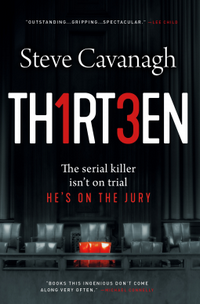
Thirteen by Steve Cavanagh: Eddie Flynn, a Serial Killer and a “Trial of the Century”

ThirteenThirteen

by Steve Cavanagh
Series: Eddie Flynn, #4
eARC, 336 pg.
Flatiron Books, 2019
Read: July 26 – 29, 2019

I wanted this posted a day ago, but just a couple hours after finishing it, I wasn’t capable of discussing it in a meaningful way—unless you consider gibberish with intermittent “squee”s and a lot of exclamation points meaningful (and, I suppose it is, in a fashion). I think I’m a bit better now, but I’m still having a hard time organizing my thoughts. I’ve discussed each of the prior Eddie Flynn books in the last couple of years here—and each one has been a little better than its predecessor. This is no exception—but I’m not sure if Eddie Flynn #5 will be able to top this one (equalling it will prove difficult enough).

But I’m getting ahead of myself.

Before he’s had time to fully absorb—much less react to—some devastating personal news, Eddie Flynn is approached by one of the biggest, flashiest, best-known defense attorneys in New York to be his second chair in an upcoming murder trial. He’s not interested, at all—even after the money on the table is mentioned. But he eventually agrees to meet with the accused to decide if he believes in the client’s claims of innocence.

Robert (Bobby) Solomon is an actor on the verge of super-stardom. He’s one-half of a Hollywood power-couple with a reality show and a couple of movies together that are responsible for this status. He also stands accused of killing his wife and their security chief after finding them in bed. Eddie believes him and signs on. The media (social and otherwise) is abuzz with the killings and is circulating plenty of rumors, innuendoes and speculation about Bobby and his wife at this time, as they cover “The Trial of the Century.”

The prosecution’s case is almost overwhelmingly strong, but with some creative thinking, Eddie and his investigator dive into the case, coming up with a strategy for his defense—including ways to attack the prosecution’s case. His investigator is the FBI Agent Harper from The Liar, who has since quit the Bureau and is doing PI and security work with her former partner (this was a great move by Cavanagh, she’s the best character from that book not named Flynn).

Still, that’s a daunting target and an almost impossible feat. But what makes it worse? The actual killer—a serial killer, mind you—is on the jury and is committed to getting a guilty verdict. What a great hook, right?

It is hard, almost impossible, to give readers a serial killer as unique as this one. He’s not as charming or intelligent as Dr. Lecter (but close on the latter), he’s not as obviously sick and twisted as most fictional serial killers. There’s not a trace of sexual sadism or anything like that to his modus operandi (which is not to say there’s none in his past). He’s smart, he’s careful, he’s strategic and committed to his vision. He’s got some natural gifts that help him—and an ally that assists him (a non-lone wolf serial killer, I don’t know if I’ve seen that before).

What separates this killer from the rest is the motivation behind his killings and victim selection (and how he makes them a victim). Yes, he’s clearly mentally ill—psychopathic/sociopathic tendencies (if he’s not diagnosable with either), and he enjoys his work. But there’s an ethos, an ideology behind his work. He’s got a message for the world, a lesson he’s trying to teach people. Everything he does is toward this goal, toward living out this ethos. I absolutely loved this, and the more Cavanagh showed this was behind the killing (and eventually, killings), the more we saw of the motivation, the more I liked it (and the more impressed I was with the creation of this killer).

I want to go on a few more paragraphs about him, but I can’t without spoiling everything—so let me stress this is a great, and unique, serial killer.

While dealing with this case, Eddie also has some family problems he’s trying to address, and there are some NYPD cops out for him after embarrassing a detective on the witness stand. Eddie spends more time in danger from members of the NYPD than he does from the killer.

Harry, of course, is back—which is great. He’s more involved in this case than he has been since the first book, The Defense. He’s a judge, Eddie’s former mentor and current self-appointed guardian of Eddie’s alcohol intake. He’s a great friend and ally for Eddie. We also see the return of Arnold Novoselic, the jury consultant that caused so much trouble for Eddie in The Defense, this time, however, he’s on Eddie’s side. From a one-dimensional bad guy in book 1, he’s transformed into someone Eddie has to—and then can—rely on. There’s a new prosecuting attorney, and he’s a great character and a worthy competitor for Eddie.

No matter who’s writing the legal thriller, one of my favorite parts of the book is the narrator/protagonist giving the reader insight into how the judicial system functions—the nitty-gritty stuff about scheduling trials, deciding who to put on your witness list, the order you call the witnesses in, and so on. The reader gets plenty of that here—along with two (complementary) explanations why attorneys on either side of the case just don’t want anything to drive a judge to sequester a jury. I’d never thought of that before, but it rings so true. Eddie also gives a very detailed explanation about how the skills that made him a successful con artist make him a successful trial lawyer. Because I enjoy it so much, I could’ve read a whole lot more of this “behind the scenes” material if it’d been possible for Cavanagh to work it in. Still, I think we get more of that here than we have before.

The pacing on this book is intense—Eddie being hired, investigating, the trial and the outcome all take place in a week. A business week, Monday – Friday, to be specific. That’s just insane—and improbable. But you don’t stop to doubt it while reading. Even after finishing the book, I can’t be bothered to spend too much time wondering about that, because Cavanagh sold the timeline so well. It doesn’t feel rushed at all, however, it just feels like an intense thriller.

While driving the pace that hard, no corners are cut in the intricacy of the story. There are surprises, twists and turns enough to satisfy every reader, and enough courtroom shenanigans to compete with Mason or Haller. The penultimate reveal got me calling Cavanagh some pretty terrible names—not because I didn’t like the reveal, not because Cavanagh cheated in the way he told the story, but because he fooled me. It was all there, ready to be seen, but like a good magician, Cavanagh kept my eyes on what he was doing with one hand and ignoring the —he totally hoodwinked me. I admire that in an author but despise myself for falling victim.

Is Thirteen a decent jumping-on point to the series? Oh yeah, a great one—but you might find yourself a bit underwhelmed if you then go on to read the previous books (just a bit, that that’s only in comparison to this). For those of us who’ve been with Eddie for a while? This is a noticeable progression in quality. Cavanagh’s no longer a promising new author, he’s a reliable established veteran. Cavanagh’s been accumulating plenty of awards lately, and Thirteen demonstrates why and absolutely deserves the critical and award attention it’s been receiving. But better than all of that? It’s a riveting and rewarding read—entertaining, tense, and satisfying. Go get yourself a copy now and you can thank me later.

Disclaimer: I received this eARC from Flatiron Books via NetGalley in exchange for this post — thanks to both for this.

—–

5 Stars

2019 Cloak & Dagger Challenge

Heart of Barkness by Spencer Quinn: Chet & Bernie are Back in Action as they Work to Clear a Country Music Legend

Heart of BarknessHeart of Barkness

by Spencer Quinn
Series: Chet and Bernie, #9
Hardcover, 299 pg.
Forge Books, 2019

Read: July 9 – 10, 2019

It’s been 4 years—4 long years (28 dog years!) since the publication of Scents and Sensibility, so it’s understandable (but personally troubling) that I’d forgotten it ended on something of a cliffhanger. It came back to me rather quickly as Quinn resolved it in the opening pages, but I’d still encourage those whose memory might be equally sketchy to re-read at least the last chapter of Scents before starting this.

For those who aren’t familiar with the series, Chet’s a very large mixed-breed dog, who flunked out of Police Dog Training at the very end of the course. Since then, he was adopted by Bernie Little, a Private Investigator. The two make a fantastic team, and Chet narrates the novels recounting some of their adventures. Chet’s a fantastic character and a very good dog. He’s got a short attention span and will frequently lose track of what he was talking about, he is utterly devoted to Bernie and is convinced that everything his partner does is the greatest. Bernie seems to be a pretty good PI, thankfully (but you have to read between the hagiographic lines from Chet).

The core of this novel revolves around an elderly legendary country singer, Lotty Pilgrim (I see her as latter-day Loretta Lynn-type). She’s fallen on hard times (a tried and true mix of being too trusting and bad business management) and is playing in a dive bar in Phoenix when she meets Bernie and Chet. Bernie foils an attempt to steal her tip jar, and then when he attempts to follow up on that attempt, he learns somethings that disturb him. Soon after this, Lotty’s current business manager is killed and Lotty is the chief/only suspect — and is even on the verge of confessing to it.

Bernie doesn’t believe it for a second—neither does Chet, I should add—and can’t stomach the idea of her confessing like that. So he launches an investigation of his own—despite very insistent suggestions from local Law Enforcement to mind his own business. Bernie’s investigation involves a lot of digging into the past as well as the expected digging into the present. The more he digs, the more questions it seems to raise Chet would interject here to say that’s Bernie’s plan.

Throughout the series, Chet will compare what they’re doing with to something they did in a past case—usually not one that’s recorded in a novel. We learn a lot about Bernie through these quick flashbacks. Chet seems to reveal a lot more this time then he has in the past, and I’m glad we don’t get the full story about at least one of those cases—it sounds pretty grim.

The one thing I want to mention that separates this from the rest of the series is pretty tricky without giving anything away. But there’s something that happens in every book—a well that Quinn returns to too often for my taste. And it’s absent in this book. I loved that. Variety is good for the fans.

I don’t want to take the time to talk about all the new characters—but as the plot centers around Lotty Pilgrim, I want to talk about her for a moment. She’s not technically Bernie’s client, but his efforts are focused on keeping her out of trouble—especially if she doesn’t deserve it. She’s an intriguing character—an object of admiration and pity at the same time; she’s still actively writing and performing, while relegated to a trivia quiz answer in the culture; she’s fiercely independent and feisty, but she’s also clearly the victim of her past, several people in the music industry, and (as I said before) a trusting nature. She’s ridden with guilt, and a lot of her problems may be self-inflicted in a twisted form of penance. All said, I liked her as a person. I wouldn’t think that there’s more for Quinn to do or explore with her, I’d be happy to be proven wrong

Of course, the book’s not all business for the Little Detective Agency. Bernie’s been divorced for a while and sees his son (Chet’s second-favorite human) regularly, and started seeing Suzie in the first novel. There are big developments on the Suzie front here—but that seems kind of par for the course over the last two or three novels, and while I’m not crazy about them, I don’t know that I’m opposed to it. I think the next book (thankfully, I’ve seen Quinn state it’s finished) will tell me a lot about that

Is this a decent jumping-on point? Yeah, it’d work—almost the entire series works as one (I’m not sure Paw and Order or The Sound and the Furry would be). But obviously, you’d pick up on nuances, background, and so on if you start at the beginning. It was so good to spend time with these two again, and the book itself is one of the best in the series—both in terms of plot and character moments for the protagonists. It’s funny, heartfelt, clever, suspenseful, and satisfying. And it features a dog. Really can’t ask for more.

At one point, Lotty writes a song about Chet, cleverly entitled “Song for Chet.” It was recorded and a video made with clips provided by Quinn’s fans. I just can’t leave this post without sharing it:

—–

4 Stars

2019 Cloak & Dagger Challenge

✔ A book with your favorite animal on the cover or in the title

Ink to Ashes by Russell Day: The Least Likely Miss Marple Successor Dives into the Murky World of Motorcycle Gangs

I’d fully intended to post about this book last week, until I remembered that this was #IndieCrimeCrawl week. Who better to write about this week than Russell Day and Doc Slidesmith? I don’t think I can think of better representatives of Indie Crime Fiction than them. Last year Day made me into a near-raving fanboy, and this year’s work has only made me appreciate him all the more. There’s a realism as well as poetry to his prose that needs to be experienced to understand. I can’t encourage you enough to buy and read his work. This is one of the grittier works I referred to yesterday (when this was supposed to post, but life happened and I forgot to edit the intro), and so it might not appeal to as many people as other authors do — but for those whose taste run to the darker side of Crime Fiction, Russell Day is your man.

Ink to AshesInk to Ashes

by Russell Day
Series: Doc Slidesmith, #2

Kindle Edition, 306 pg.
Fahrenheit Press, 2019

Read: July 12 – 13, 2019

           For me, the why of it is always the point.

As much as we all like a good whodunit, generally, I’m with Doc Slidesmith — the whydunit is really what’s more interesting. You might have an incredibly clever criminal — and an equally clever sleuth (professional or amateur) — a twisty, turny plot with perfect reveals, and the rest — but if the motive behind the crime is non-existent or non-interesting, the novel just isn’t going to be that satisfying. Russell Day’s Doc Slidesmith novels are all about the why — he’ll pull the why out at the end and it’ll be something you don’t expect (but maybe should have), and it will be compelling as you could want.

One of Doc Slidesmiths’ oldest friends has died in a motorcycle accident and his widow has very unusual request, which I’ll leave for you to read about on your own. But it leads to one of the . . . strangest and most striking first chapters that I can remember.

For those that haven’t met Doc before — he’s your standard-issue doctor of psychology, who has embraced voodoo and tarot reading, rides a motor cycle and owns a tattoo shop, while solving mysteries that he stumbles into à la Miss Marple. You know the type. Yakky is his taciturn friend/colleague who works in Doc’s shop, and is a backup/wingman when Doc needs one (whether he wants one or not).

The widow has another request — her husband was one of the founders of a motorcycle club, and one of the newest members has disappeared. Can Doc track him down as a favor to the dearly departed? She can’t ask any members of the club so she’s counting on Doc to come through for her.

At the moment, things are really tense intra-club membership. There’s a move for the club to stop being a tighter association of motorcycle enthusiasts and become a full-fledged outlaw biker gang. This is causing problems in the ranks — there are many who don’t want anything to do with that, preferring to preserve the club as is — but there are many, typically younger voices who want to go all the way with this. Tied into this move are income streams and dissension about some of them, plus pressure to add in something more illegal than they currently have to worry about.

Doc’s not far into his search when he can tell there’s a lot of lies around the disappearance of the member, and before Doc can figure out who’s lying and why — the search becomes deadly. It isn’t long after that when Doc starts to question the official finding about the motorcycle accident. Leading to more questions and deceit. Yakky and Doc now have to walk through this minefield to find out what happened to the member (and why), what happened to Doc’s friend (and why) — oh, and maybe stop an all-out war between this nascent outlaw gang and an already established one. Just another day in the office for Slidesmith.

I was able to guess the who behind one of the lines of investigation pretty easily, but the why was something I just didn’t see. The other line was a mystery for me right up until the reveal, making that particular reveal quite satisfying. Coupled with Day’s ear for dialogue and evocative prose, the mysteries — and the darkness of the human psyche they explore makes this a compelling read — almost a must-read.

The various club members and those who come into regular contact with them are really well depicted — and several of them are the kind of character that you hope show up again in a future book in the series. But the core of the book is Doc and Yakky. Now, Needle Song was written from Yakky’s perspective, where this is written from Doc’s — and that makes so much difference. A lot of master detective types (amateur or not) need to be written about “by” a friend, associate or assistant. John Watson, Archie Goodwin, Chet, Danny Boyle do more than narrate the stories and relate the exploits of their partners/employers, they also help convey the proper sense of awe and wonder we’re supposed to have for the Great Detective. In Needle Song, we got that from Yakky — both the narration and we were given a proper sense of admiration in response to Doc. Here, we only get Doc’s narration — and he isn’t nearly as impressed with himself as Yakky was/is. Which makes it harder for the reader to be.

On the other hand, Needle Song was in many ways, Yakky’s story. This is absolutely Doc’s story, so who else could tell it to us? And Day is able to get across the kind of guy that Doc is — like in this testimony from his departed friend:

           “Do you know what Dago used to say about you? He said, if you followed someone into a revolving door, you’d walk out in front of them. He thought a lot of you.”

Don’t let the fact that I’m not raving give you the impression there’s something wrong with this book. Rather, it just reminds me how impressed I was with Needle Song. I wondered if Day could live up to expectations, and I don’t think he did. Many will disagree with me (which is a good thing), but while this was a solid, compelling read featuring characters that I can’t get enough of — it didn’t knock my socks off. Russell Day remains one of the strongest new voices I’ve come across in the last couple of years. I know his next novel will be completely different from this, but I hope he comes back to this world soon. In the meantime, go, go get this.

—–

4 Stars

Pub Day Repost: Bark of Night by David Rosenfelt: Another winner of a case for the lawyer who’s gone to the dogs

Bark of NightBark of Night

by David Rosenfelt
Series: Andy Carpenter, #19

eARC, 304 pg.
Minotaur Books, 2019
Read: July 3 – 4, 2019

I know it’s practically de rigueur for me to start off talking about how difficult it is to talk about yet another Andy Carpenter book, but I’m going to try to resist this time (no promises that I won’t resort to it next time).

Instead, I want to focus on people who read this blog and haven’t picked up a book in this series — let’s see if I can help you come to the light. Andy Carpenter is a defense attorney — thanks to some high profile cases, some lucrative lawsuits, (and some other things), he’s an independently wealthy defense attorney (see the first couple of books for details). He’s also lazy. These two traits generate a lawyer/protagonist who doesn’t want to take on clients who doesn’t want to go to work (he’s the anti-Lincoln Lawyer). He’d rather watch sports, hang out with his wife, kid, friends and dog (especially the latter) and maybe check-in on the dog rescue he runs with a former client. He only takes on a case when he likes the potential client, he feels an injustice is being done, his wife talks him into it — or the life of a dog lies in the balance (there’s a strong link between the first reason I listed and the last). This time out, it’s pretty much a combination of those motivations. Nevertheless, when he takes on a client, he pulls out all the stops for him or her. Much like with Perry Mason, you have to wonder why prosecutor’s don’t just drop charges when Andy shows up in court — you can bet his client will be exonerated.

Andy’s vet calls him to his office to talk about something — namely, this dog that had been brought in to be euthanized. Before he did that, someone in his office scanned the microchip in the dog. The man who paid for the euthanization, wasn’t the owner f the dog — because he’d been murdered shortly before the dog appeared. After some digging, Andy discovers that the man who brought the dog in is very likely connected to the murder (especially when they look at his rap sheet). No one’s sure why he wanted a vet to take care of destroying the dog rather than doing it himself. But someone completely different has been charged with the crime, and Andy knows that this man is innocent — he has to be, there’s no other explanation how the would-be dog killer got involved.

From there, Andy and his team (his PI wife, her PI friend/Andy’s bodyguard, Andy’s CPA/hacker, his associate attorney) set out to defend their client, figure out why anyone would want to kill the victim (a documentary filmmaker, and not a particularly successful — or good — one), and maybe answer a few questions about the victim’s dog. Like most Carpenter novels, the mystery is just twisty enough to keep you guessing to the end. Andy’s courtroom antics are pretty subdued this time, but watching him in action is fun — particularly as he battles the Assistant D.A.

Andy’s team — and his friends who aren’t on the team — are as enjoyable to spend time with as ever. With some long-running series you stick with it because the characters are so near and dear to you. With some, you put up with characters because the author puts out great mysteries/adventures/whatever. It’s with the best series that you get both — a good mystery (in this case) and a cast of characters you look forward to seeing again. That’s definitely what we have in the Andy Carpenter books, and Bark of Night is a prime example of it.

As a capper, if the last few paragraphs don’t provoke a warm fuzzy or three in you, there’s something wrong with you and you should probably seek professional help. Rosenfelt is good at the heart-warming stuff, and he’s at the top of his game here.

Newcomers will get enough information along the way to hop on board here — there’s no need to feel like you need to go back to Book One (Open and Shut) and read them in order to catch all the nuance. Start here, and you’ll easily see why this book has charmed and entertained audiences enough to last for 19 books (and counting!). It’s a clever mystery, featuring characters that are reliably comfortable and funny — with just enough moments of seriousness and displays of skill that you can believe they’ll be defending someone and bringing a killer to justice at the same time. This is one of the better installments in the last few years (both for being enjoyable and for the mystery) and should move right to the top of your TBR (note that a “lesser” Andy Carpenter book is still fun, engaging and entertaining).

Disclaimer: I received this eARC from St. Martin’s Press via NetGalley in exchange for this post — thanks to both for this opportunity.

—–

4 Stars

Finest Sh*t!: Deviant Stories by Nick Kolakowski: This collection of short fiction is a great display of Kolakowski’s strengths IndieCrimeCrawl

I’m going to be kicking off my involvement in #IndieCrimeCrawl with the latest from Nick Kolakowski. About a year ago, he emailed me to take a peek at his novel Boise Longpig Hunting Club, a fast, energetic, visceral read. Then came his Love & Bullets Hookup Trilogy — which was as entertaining as you could want. Now it’s time for his new short fiction collection, which I pre-ordered the instant I heard about it. One of the best things about Indie Crime Fiction is the depth of strong voices with perspectives you don’t find every day. Nick Kolakowski is a prime example of this. Check out all of his work, you’ll be in for a treat.

 Finest Sh*t!Finest Sh*t!: Deviant Stories

by Nick Kolakowski
Series: Loose Rounds, Book 2

Kindle Edition, 202 pg.
Final Round Press, 2019

Read: June 14 – July 3, 2019

           With a feral yelp, Raoul worked the dial until he landed on a station thundering drums and guitar, a solid backbeat for Luis and Jesus slicing and shoveling mounds of peppers and onions and pig. The music blasted the asphalt amphitheater of the parking lot, signaling that the truck was officially open for business.

The first customers drifted toward them. Give me your hungry, your nearly broke, your masses yearning for lunchtime deliciousness, Jesus thought as he wiped his hands on his apron and prepared to meet the first of the lunch rush. And I’ll give you two tacos for three dollars.

That’s from “Taco Truck,” one of the ten short stories that appear with a novella in Nick Kolakowski’s latest collection, Finest Sh*t!: Deviant Stories. There are tales of revenge, heroism, thwarted revenge, and people driven to extremes no one should be driven to — even some SF. Essentially, like with the best of Crime Fiction (no matter when it’s set) we have people in desperate situations (sometimes of their own making, sometimes out of their control) doing what they needed to.

As with every short story collection, there are some of these short stories that really, really worked for me, and others that didn’t do much for me at all — that’s just how it goes. But even the stories that I didn’t appreciate had that Kolakowski quality that I’ve really come to enjoy.

The novella, The Farm takes up about half of the book. It begins in 1931 and ends in 2008, following one farming family through the generations. This family goes through wars, violent crime, financial hardship, betrayal — and more than a few of the more positive parts of life, too. There’s some poetry, too. I guess that qualifies as one of the more positive aspects, but I’m not always sure. In the end, I really liked this novella — but it took some effort to get into it. That’s probably on me. Kolakowski fits a novel’s worth of a family saga into this roughly 100 pages — which is quite a feat. There’s part of me that would like to see it developed into a 350-400 page novel to flush out some of the details, but I think he’s right to keep it brief. It alone is well worth grabbing the collection.

This collection covers all sorts of tones, topics and perspectives. As I’ve come to expect from Kolakowski, I wouldn’t have predicted anything that I found in these pages. My rating may be on the low side, but that’s just because I couldn’t really sink my teeth into anything — I typically rate short story collections low. But there’s gold in here — a little dross (but what I think is dross will probably appeal to others). If you’re not familiar with Kolakowski, this is a great way to introduce yourself to one of the strongest voices in Crime Fiction today. If you are familiar with him, you don’t need me to tell you how good these stories can be.

—–

3.5 Stars

Pub Day Repost: The Bookish Life of Nina Hill by Abbi Waxman: Believe the hype. All of it. 352 pages of Joy.

The Bookish Life of Nina HillThe Bookish Life of Nina Hill

by Abbi Waxman

eARC, 352 pg.
Berkley Books, 2019
Read: July 1 – 3, 2019

I think it’s entirely fitting to start my post about this book by talking about another book (Nina Hill would approve, maybe even insist on it). I remember a lot of what I read about High Fidelity in the late 90’s (I was a little late to the party), was about guys saying to either hand the book to women to help them understand how we think — or to keep it out of their hands, for the very same reason. That resonated with me. I never thought for a second that I was Rob, Dick or Barry, but we thought the same way, we had a similar weltanschauung — their banter was scripted, where mine frequently fumbled — but overall, they were proof that I wasn’t the only one in the world who thought that way. It took me less than two chapters to feel the same way about Nina Hill — our tastes differ somewhat, she’s more clever than I am, and there’s the ridiculous affection for felines — but on the whole, she’s my kind of person. In fact, many of the people in this book are — she’s just the best example of it.

The authorial voice — Nina’s voice, too — is fantastic. I seriously fell head over heels almost instantly with them. The narrative is specific, funny, observant, compassionate, and brutally honest — mostly funny. It’s just so well-written that I knew (and said publicly) by the end of the first chapter that this was going to be in my personal Top 3 for 2019 — I’ve had some time to think about this, and have reconsidered. I’m confident it’ll be in the Top 5, but I should give the rest of the year a little room to compete. It’s one of those books that’s so well-written you don’t care what or who it’s about, as long as you get to read more of that wonderful prose. By chapter 4 — and several times after that — I had to self-consciously stop myself from highlighting and making glowing notes — because if I didn’t, I’d end up never finishing the book (I still have a lot of notes and passages highlighted).

Let me try to explain via a tortured metaphor (this is where you see why I blog about books, and not write my own). Say you’re taking a road trip, say, to go look at autumn leaves and you know the city you’ll be staying in, but know that there are about 18 different ways for the driver to arrive in that city. You know the whole time where you’ll end up, but you don’t have a clue how you’ll get there, what kind of foliage you’ll see (hint: it’ll be brown, red or orange), what the roads will be like, or what random and surprising things might happen along the way. It’s not about the destination, it’s the journey — as the fortune cookies and high school graduation speeches tell you. This book is the same way — readers are going to know pretty much where this book is going to end up once they’ve read a few chapters. What they don’t know is how they’ll get there, what they’ll see on the way, what kind of surprises will be along the way, and how fast they’ll get there. It’s in these things that Waxman excels — her plotting is pretty obvious, but her execution is dazzling and often unexpected. (I want to stress that this is an observation, not a criticism)

Nina Hill is a reader — books are how she defines herself, the prism through which she sees and interacts with the world. She has a job (bookseller), a cat, a small home with a lot of shelves, a trivia team, book club, a place she exercises, a visualization corner, a fantastic planner and a love of coffee and quality office products. Her life is pretty regimented, but everything is just how she likes it. She also is introverted, prone to anxiety, and averse to change. Nina’s smart with a great memory, a penchant for honesty, and highly-developed sense of who she is.

Her friends are essentially the women she works with and the members of her trivia team — all of whom are intelligent, witty, well-read and fun. The kind of people I’d love to hang out with over coffee or wine for a few hours a week.

Nina’s mother is a noted and award-winning photojournalist and spends most of her time traveling the world being one. Nina was largely raised by a Nanny (although her mother visited frequently). Nina has never known a father.

Until one day her life changes — a lawyer arrives with some news. Her father is dead. Apparently, her mother discovered he was married and refused to have anything further to do with him. He was absolved of any need to support Nina or her mother as long as he never made contact with her. Which he honored — but made provisions for him in his will.

Her father was a successful entertainment lawyer, and a serial monogamist. He was married three times (one divorce, one widowing, and one marriage intact), had several children and more grandchildren (there are contextually appropriate and helpful graphics to help you understand the family structure). Nina went from being alone in the world to being a sister, an aunt and a grand-aunt in one conversation. She slowly meets various members of the family — discovering similar personality traits, interests and physical characteristics. The family she meets is wonderful — I could easily spend more time with them all. One brother and a nephew (who is older than her) in particular stand out — she gets to know them sooner and deeper than the rest. But many others are on their heels, and even the least-likable among them turn out to be great (with one exception, but that’s by design).

While reeling from the changes of learning she has an extended family, starting to meet them, and learning about her father — another thing happens in her life. There’s a member of a rival trivia team that she finds attractive, and who just may find her attractive. They have similar tastes and many shared interests, but he seems to know a lot about sports (including what “a Don Shula” is) and isn’t much of a reader. But there’s something about him . . .

There are three significant child characters in the novel — they’re not around much, but when they are, they have a large impact on the plot. They are all pretty unrealistic, talking and (apparently) thinking in ways that are immature, but not how kids talk and/or think. But they’re so adorable that you forgive Waxman immediately for these overly-precocious children. It’s not a major thing, I just wanted to say something less-than-positive about the book, and this is all I could come up with.

Throughout the novel, Nina learns how little she’s really alone in the world and how she might be able to find time for more people in her life — without losing who she is and too much reading time. This is the core of the novel and everything else is in service to this goal. While this is going on, there are plenty of laughs, chuckles and wit to carry the reader from plot point to plot point.

It’s a good thing that I stopped quoting from ARCs (I almost never got around to verifying the lines in the published version), because this post would either never be completed or would be so long that I’d be the only one who’d read the whole thing. I had to stop myself — repeatedly, actually — from highlighting great lines. Particularly comments Nina made to others (or the Narrator made on her behalf) about books and/or reading. Book memes are going to be mining this novel for years — you’ve seen 357 variations on the Tyrion lines about reading, or the 200+ takes on “Books were safer than people anyway” from The Ocean at the End of the Lane. Folks, Nina Hill is going to bury both of them.

According to Goodreads, I’ve read 122 books so far in 2019. If pressed, I’d easily say this is better than 120 of them, and might tie the other (it’s a lot more fun, I can say without a doubt). Your mileage may vary, obviously, but I can’t imagine a world where anyone who reads my blog not enjoying this novel and protagonist. It’s charming, witty, funny, touching, heart-string-tugging, and generally entertaining. I don’t know what else to say other than: Go, go read this, go buy it, expect it as a gift from me (if you’re the type to receive gifts from me, I’m not buying one for all of you on my wages, as much as I might want to).

Disclaimer: I received this eARC from Berkley Publishing Group via NetGalley in exchange for this post — thanks to both for this great opportunity!!

—–

5 Stars

Bark of Night by David Rosenfelt: Another winner of a case for the lawyer who’s gone to the dogs

Bark of NightBark of Night

by David Rosenfelt
Series: Andy Carpenter, #19

eARC, 304 pg.
Minotaur Books, 2019
Read: July 3 – 4, 2019

I know it’s practically de rigueur for me to start off talking about how difficult it is to talk about yet another Andy Carpenter book, but I’m going to try to resist this time (no promises that I won’t resort to it next time).

Instead, I want to focus on people who read this blog and haven’t picked up a book in this series — let’s see if I can help you come to the light. Andy Carpenter is a defense attorney — thanks to some high profile cases, some lucrative lawsuits, (and some other things), he’s an independently wealthy defense attorney (see the first couple of books for details). He’s also lazy. These two traits generate a lawyer/protagonist who doesn’t want to take on clients who doesn’t want to go to work (he’s the anti-Lincoln Lawyer). He’d rather watch sports, hang out with his wife, kid, friends and dog (especially the latter) and maybe check-in on the dog rescue he runs with a former client. He only takes on a case when he likes the potential client, he feels an injustice is being done, his wife talks him into it — or the life of a dog lies in the balance (there’s a strong link between the first reason I listed and the last). This time out, it’s pretty much a combination of those motivations. Nevertheless, when he takes on a client, he pulls out all the stops for him or her. Much like with Perry Mason, you have to wonder why prosecutor’s don’t just drop charges when Andy shows up in court — you can bet his client will be exonerated.

Andy’s vet calls him to his office to talk about something — namely, this dog that had been brought in to be euthanized. Before he did that, someone in his office scanned the microchip in the dog. The man who paid for the euthanization, wasn’t the owner f the dog — because he’d been murdered shortly before the dog appeared. After some digging, Andy discovers that the man who brought the dog in is very likely connected to the murder (especially when they look at his rap sheet). No one’s sure why he wanted a vet to take care of destroying the dog rather than doing it himself. But someone completely different has been charged with the crime, and Andy knows that this man is innocent — he has to be, there’s no other explanation how the would-be dog killer got involved.

From there, Andy and his team (his PI wife, her PI friend/Andy’s bodyguard, Andy’s CPA/hacker, his associate attorney) set out to defend their client, figure out why anyone would want to kill the victim (a documentary filmmaker, and not a particularly successful — or good — one), and maybe answer a few questions about the victim’s dog. Like most Carpenter novels, the mystery is just twisty enough to keep you guessing to the end. Andy’s courtroom antics are pretty subdued this time, but watching him in action is fun — particularly as he battles the Assistant D.A.

Andy’s team — and his friends who aren’t on the team — are as enjoyable to spend time with as ever. With some long-running series you stick with it because the characters are so near and dear to you. With some, you put up with characters because the author puts out great mysteries/adventures/whatever. It’s with the best series that you get both — a good mystery (in this case) and a cast of characters you look forward to seeing again. That’s definitely what we have in the Andy Carpenter books, and Bark of Night is a prime example of it.

As a capper, if the last few paragraphs don’t provoke a warm fuzzy or three in you, there’s something wrong with you and you should probably seek professional help. Rosenfelt is good at the heart-warming stuff, and he’s at the top of his game here.

Newcomers will get enough information along the way to hop on board here — there’s no need to feel like you need to go back to Book One (Open and Shut) and read them in order to catch all the nuance. Start here, and you’ll easily see why this book has charmed and entertained audiences enough to last for 19 books (and counting!). It’s a clever mystery, featuring characters that are reliably comfortable and funny — with just enough moments of seriousness and displays of skill that you can believe they’ll be defending someone and bringing a killer to justice at the same time. This is one of the better installments in the last few years (both for being enjoyable and for the mystery) and should move right to the top of your TBR (note that a “lesser” Andy Carpenter book is still fun, engaging and entertaining).

Disclaimer: I received this eARC from St. Martin’s Press via NetGalley in exchange for this post — thanks to both for this opportunity.

—–

4 Stars

Bullet Points about Even Dogs in the Wild by Ian Rankin: Another winner from one of the best in the biz

Even Dogs in the WildEven Dogs in the Wild

by Ian Rankin
Series: John Rebus, #20

Hardcover, 347 pg.
Little, Brown and Company, 2016

Read: June 10 – 12, 2019

This post is overdue, and I can’t seem to find time to do it right. So, I won’t. Here’s a quick and dirty way to get it taken care of. I wish I had it in me to do a better job, but I don’t. Here’s the blurb taken from Rankin’s site:

           Retirement doesn’t suit John Rebus. He wasn’t made for hobbies, holidays or home improvements. Being a cop is in his blood.

So when DI Siobhan Clarke asks for his help on a case, Rebus doesn’t need long to consider his options.

Clarke’s been investigating the death of a senior lawyer whose body was found along with a threatening note. On the other side of Edinburgh, Big Ger Cafferty – Rebus’s long-time nemesis – has received an identical note and a bullet through his window.

Now it’s up to Clarke and Rebus to connect the dots and stop a killer.

Meanwhile, DI Malcolm Fox joins forces with a covert team from Glasgow who are tailing a notorious crime family. There’s something they want, and they’ll stop at nothing to get it.

It’s a game of dog eat dog – in the city, as in the wild.

Even Dogs in the Wild brings back Ian Rankin’s greatest characters in a story exploring the darkest corners of our instincts and desires.

If I had the time to do this properly, here are the things I’d be talking about.

  • Rebus as consultant/PI — this is really the perfect role for him, he’s not that great at procedure anyway. Calling his own shots, following his instincts, going about things, he’s a better fit for this kind of thing than a certain retired LAPD Detective.
  • This proves to be the kind of case made for Rebus — the solution lays in the past, but the ramifications are in the present.
  • Cafferty isn’t the suspect here (he’s not innocent, he never is), but he’s the victim — and maybe a concerned citizen?
  • There’s little in Crime Fiction better than Rebus and Cafferty on the same page — that’s as true here as ever.
  • Clarke’s role seemed diminished in favor of Fox and Rebus (particularly the former), but maybe that’s just me — what she does, however, allows Rebus to do what he does best
  • The Clarke/Fox friendship is an interesting one — and different from the Clarke/Rebus friendship. I’ll enjoy watching this develop.
  • I’m already really enjoying the Fox/Rebus friendship/mentorship. That’s not something anyone would’ve seen coming the first time we met Fox, or the first time we saw the two of them cross paths. The fact that they’ve got a strange friendship/mentorship going on is just wonderful.
  • There’s more going on in Fox’s personal life than we’ve really ever seen with Rebus or Clarke on an extended basis.
  • Fox’s share of the story is really strong and displays the character we’ve come to know over the past few novels, but evolving to take on some of Rebus’ better traits, but none of his . . . well, worse.
  • For a period of time, through no fault of his own, Rebus takes guardianship over a small dog. This was just fantastic and one of my favorite things to happen to him in years.

Combine all of the above with Rankin’s consummate skill and you’ve got another winner — the twentieth Rebus book and the character, the writing, and the perspective is a strong and fresh as it ever was. A sure-fire win for old fans that would probably convert a newbie, too.

—–

4 Stars

2019 Library Love Challenge 2019 Cloak & Dagger Challenge

Jane Yellowrock 10th Anniversary Sweepstakes

Celebrate 10 years of Jane Yellowrock!

Enter for your chance to win the entire New York Times bestselling Jane Yellowrock series (so far), plus cool Jane swag!

Wow! Jane Yellowock’s really been around for 10 years?!?! (well, 10 years and 2 days) I came to the series around the time book 3 was published, but even having spent 8 years reading her seems to be hard to believe. Since her debut she’s survived 12 novels (many, many vampires and other supernatural sorts have not), several short stories and has even spawned a spin-off. Slowly but surely through these years, Jane and Faith Hunter alike have become real favorites of mine—finding an Urban Fantasy character/author/series better than theses is nigh impossible.

So I’m more than happy to have been asked to help promote this here 10th Anniversary Sweepstakes.* If you haven’t read this series, what better way to jump in? If you have, well, you know what a Major Award it would be. You’ve gotta go enter this thing—you have until the 14th..

* I just hope by doing so I didn’t disqualify myself.

Skinwalkwer cover“There is nothing as satisfying as the first time reading a Jane Yellowrock novel.” — Fresh Fiction

Jane Yellowrock is the last of her kind—a skinwalker of Cherokee descent who can turn into any creature she desires and fights vampires, demons, and everything in between in the city of New Orleans.

Enter today for your chance to win all of Jane’s adventures:

Winners will also receive a Shattered Bonds bookmark and an exclusive character card featuring Jane and Beast!

“Jane Yellowrock is smart, sexy, and ruthless.”—#1 New York Times bestselling Kim Harrison

Page 55 of 123

Powered by WordPress & Theme by Anders Norén