Category: Authors Page 80 of 124

Silence Fallen by Patricia Briggs

Silence FallenSilence Fallen

by Patricia Briggs
Series: Mercy Thompson, #10

Hardcover, 364 pg.
Ace Books, 2017

Read: March 10 – 13, 2017


It was pretty clear from the pages of Fire Touched that Mercy’s little The Doctor to the Sycorax speech was a big deal. But I don’t think any of us really had a clue just how far-reaching the potential ramifications were until it’s spelled out for us by a few different characters here. Well, okay, that’s probably not true — a lot of people who read these books probably thought about it, but I didn’t — and I think that Mercy and her acquaintances do a better job of spelling things out than I could, so I’ll let them. But many in the supernatural communities aren’t happy that she did it and are looking for ways to insulate themselves from it, as well has looking for ways to take advantage of it for their benefit.

One such person is Bonarata — one of the oldest, and most feared vampires in the world — he has ties to the Tri-Cities vampires, as well. He’s the one who’s responsible for Marisila, Stefan and Wulfe leaving Europe and ending up in the Tri-Cities. He’s also a legend in Werewolf circles — many years ago, he killed an Alpha and turned his mate into a blood-slave. After the death of Chastel, Bonarata is the closest thing the non-Fae have to a Super-Villain (pretty sure any of the Grey Lords that wanted to could wipe the floor with him).

So shortly after Fire Touched, Bonarata arranges for Mercy to be kidnapped. Now, while Briggs’ vampires aren’t the political wheels-within-wheels schemers that Faith Hunter’s are, they’re still crafty and wily — so all his reasons for doing so aren’t immediately discernible (and probably not totally discernible by the end of the book — but we get closer).

Mercy is Mercy, however, and it doesn’t take too long before she escapes from Bonarata and finds herself running throughout Europe to escape from his henchmen. She finds herself in Prague (this detail feels like a spoiler, but it’s on the dust jacket, so . . . ) where her best bet for an ally is one of the few Alphas in the wold with a grudge against Bran Cornick. In addition to this she finds herself in the middle of a couple of vampire nests competing for control of Prague, and there’s a whole bunch of ghosts (and other things that go bump in the night) that are taking advantage of the presence of someone who can see them.

Meanwhile, Adam, Marisila, Stefan, Honey and a couple of others are on the way to Bonarata’s home to negotiate for Mercy’s release. Whoops. These chapters are told in Mercy’s voice from Adam’s point-of-view, as if she’s relating what he told her happened, which is a nice touch. It also suggests that she survives this mess — not-at-all-a-spoiler: the first person narrator lives. It’s here that we learn a lot more about Honey, Marisila and Stefan — we also learn about Adam’s Doctor Who fandom. It’s nice seeing things from Adam’s POV for a change.

Mostly the book consists of Adam and Mercy doing all they can to survive long enough to see each other again — which is sweet. We’ve seen them work together plenty of times in this series — we’ve also seen them apart for brief periods — this is the longest (that I can recall) that they’ve been separated, and the furthest apart they’ve been. They’re both independent by nature (however that nature is shaped into something else for the needs of the Pack), so they can adapt to this, but their primary goal is to get back together. Which I’m sure made many, many fans cheer and melt.

Will someone drawn in by the cover art, or wanting to see what the fuss over this Briggs-person enjoy the book? Yeah, I think so — but not as much as the established fan. This book works as well as it does because of the world, not just the story. We’ve been in Mercy’s world for 10 books now — for most of us you can add the short stories and Charles & Anna novels, too. We know it what it means for Honey to make that trip. We know what it means for people to exploit Mercy (or try to) to get to Bran or Adam. We know the pain that the loss of pack-link or mate-bond creates. This would be a lousy book 4, but with the cumulative weight of this series, Silence Fallen us a strong book 10.

It was a fun book — exciting, amusing, and fascinating to see how packs and nests work outside of the US. Most of all it was a good story, taking several competent and powerful characters out of their usual setting and circumstances, and throwing them into a milieu they’re not familiar with to watch them sink or swim. Excellent read for fans of the series — which isn’t a surprise to any, but just something I think I have to say.

Now begins the wait for #11.

—–

4 Stars

A Few Quick Questions With…Duncan MacMaster

Not only did the good people at Fahrenheit Press provide me with Duncan MacMaster’s Hack (which I just posted about), I got an interview with Mr. MacMaster as well! As usual, this is short and sweet, he’s got better things to do than come up with clever answers for me, y’know? Seriously, loved his answers. Give this a read and then scurry out to buy his book.

Would you like to give the elevator pitch for Hack? (for that matter, if you want to throw one in for A Mint Condition Corpse, that’d be fine, too)
The elevator pitch for Hack would be: A desperate man is hired to ghostwrite the autobiography of a washed up TV star with scandal in his past and murder in his future.

The pitch for A Mint Condition Corpse would be: A semi-retired artist’s trip to his favourite comic book convention is spoiled by murder, and only he can solve it.

Do you have experience as a Ghost Writer? Is Hack your way working out some demons? Or does it have a much more benign genesis?
I never specifically worked as a ghostwriter. I did do things like selling jokes to comedians (no one you ever heard of) so I know a bit about doing something that someone else gets credit for.

There is a certain amount of exorcism in the genesis of Hack. By the time I got to writing it I had spent a very long time getting metaphorically kicked in the head by the writing business. The joke market had dried up, and I spent years enduring rejections that ranged from the incoherent to the callous, and some career setbacks that were downright ridiculous.

As you could guess, those experiences left some demons that needed to be exorcised, and Jake Mooney, the hack writer of the title, did it for me. Jake’s had a life defined by setbacks and it’s made him bitter, cynical, and lonely. He sees being a credited author as a step towards some redemption as a writer, and solving the crimes as an attempt at redeeming himself as a human being.

Of course none of this was conscious while I was writing it. While putting down that first draft all I could think about was the plot, the characters and making sure everything made sense. I didn’t discover what I had done with Jake’s and my own hunger for redemption and validation until working on later drafts.

It was different with my first crime novel A Mint Condition Corpse. That started with a conscious decision to make Kirby Baxter, card-carrying comics geek, the Sherlockian hero instead of the comedy relief sidekick, and to use him as a vehicle to combine mystery with a satire of pop culture and the people who run it. Hack, has a lot more of my id running amok in it.

You’ve done a little in other genres, but your publications seem to be predominately in the Crime/Mystery genre. What is it about the genre that brings you back? Is there a genre you particularly enjoy, but don’t think you could write?
I’ve dabbled in science fiction, fantasy, and even horror, and I do plan to do more in those genres in the future, but mystery/crime does seem to have a grip on me. Probably because it deals with people who are at the extremes of their emotions, and also because it’s a genre that’s is still a wide open field when it comes to narrative possibilities.

I always credit my narrative style to SCTV. It was a sketch comedy show I watched as a child that parodied television and movies, and it taught me that popular culture is loaded with tropes and cliches that create expectations in the audience. If you know them and understand them, then you can use them to manipulate expectations to misdirect, surprise, amuse, and hopefully amaze the audience.

When I started reading crime fiction in my teens I began to see the patterns inherent in the genre, and started seeing how they could be manipulated to create something new and entertaining.

As for a genre I enjoy, but don’t think I could write….well, I’m not sure. I’m sure readers would tell me if I really screwed up. My bet would be on straight up horror without any sort of mystery to solve inside it.

What’s the one (or two) book/movie/show in the last 5 years that made you say, “I wish I’d written that.”?
Don Winslow’s The Power of the Dog, a relatively slim volume that contains an epic inside. It sets a high standard that I hope to come close to some day. For the most part I tend to avoid reading fiction while I’m writing. I have a bad habit of inadvertently imitating whoever I’m reading. I wrote some truly dreadful pastiches while I was on a Lovecraft reading binge in my early twenties. All sorts of gooey overwrought eldritch nonsense.
This one’s not about you directly, but what is it about Fahrenheit Press that seems to generate the devotion and team spirit that it does (or at least appears to)? I don’t know that I’ve seen as many authors from the same publisher talk about/read each other’s books — or talk about the publisher — as much as you guys seem to. Is it simply contractual obligation, or is there more?
There’s no contractual obligation for camaraderie at Fahrenheit Press, or the House of Love, as our fearless leader likes to call it.

I can sum it up this way: Joining Fahrenheit is like joining a punk band in the mid-70s.

We don’t know what the future holds, or what we will achieve in the end. All we do know is that we are a band of misfits who are all doing what we love, we’re breaking rules and conventions that some thought were inviolate, and that we are all in this wild ride together.

Fahrenheit has been the best experience I’ve ever had in publishing, and I’m sure my fellow authors will agree with me on that.

What’s next for Duncan MacMaster?
I just finished the first draft of a sequel to A Mint Condition Corpse, called Video Killed The Radio Star, and the brutal editing/rewrite process awaits me. I’m also developing a more experimental project examining male archetypes in crime fiction and the concept of the unreliable narrator. I am even outlining a potential sequel to Hack called Hacked, where Jake goes Hollywood. I’m hoping to complete all these projects and make them worthy of publication as soon as possible.

What happens after that, is anyone’s guess.

Thank you for having me on your blog.

Thanks for your time — I really appreciate it, and hope that the Hack‘s release is successful (as it deserves).

Hack by Duncan MacMaster

This feels a bit rushed to me — and more than a little vague. I guess it should, it was a little rushed, I liked this book enough that I pounded it out a couple of hours after finishing it, I didn’t want to sit on it for a while. And if the post is vague, it’s because this is the kind of mystery difficult to talk about without cracking open all the secrets, and because a lot of what I really liked about this is in the little details MacMaster gave. You need to experience it yourself to get what I’m saying.

HackHack

by Duncan MacMaster
Series: Jake Mooney, #1

Uncorrected Proof
Fahrenheit Press, 2017

Read: February 28 – March 1, 2016

Little victories, since they’re all I can hope for, they’re what I live for.

Jake Mooney used to be a pretty good reporter — good reputation, good results — but he got out of that game and got into a more lucrative field, even if it was more distasteful. Events transpired,  and that goes away — I’ll let you read it for yourself, but it involves lawyers and an ex-wife. Nowadays, he gets by being a ghost-writer for established authors who don’t have the time or ability to write their own material. Out of the blue, he gets an offer to help a former TV star, Rick Rendell, write his autobiography. He’ll even get credited for it. Credit — and a nice cash bonus. How can he say no?

Before you can say “Jessica Fletcher,” someone tries to kill Jake and then Rick is shot in front of a handful of witnesses, including Jake. Between his affection for (some of) the people in Rick’s life, worry over his own safety, curiosity, and his own sense of justice, Jake dives in and investigates the murder himself.

Jake finds himself knee-deep in a morass involving unscrupulous agents (I’m not sure there’s another kind in fiction), wives (current and ex-), Hollywood politics, an IRS investigation, a Drug Cartel, former co-stars, hedge fund managers, hit men, and a decades-old mysterious death. And a few more fresh deaths. . The notes he’s already taken for the book gives Jake fodder for his investigation — but the combination of notes and his continuing work provides the killer a constant target (and threat). As long as Jake’s working on the mystery/mysteries — and doing better than the police at uncovering crimes and suspects — the killer can’t just escape, Jake has to be stopped.

The voice was great, the mystery had plenty of twists and turns, Jake’s ineptitude with firearms was a great touch and served to keep him from being a super-hero. I really can’t think of anything that didn’t work. There’s not a character in the book that you don’t enjoy reading about. I had three strong theories about what led to Rick’s death and who was responsible — the one I feared the most wasn’t it (thankfully — it was a little too trite). My favorite theory was ultimately right about the who, but was absolutely wrong about everything else. I take that as a win — I felt good about my guess and better about the very clever plotting and writing that outsmarted me.

That’s more about me than I intended it to be, so let me try this again — MacMaster has set up a great classic mystery — a la Rex Stout or Agatha Christie. A dogged investigator with a personal stake in the case, supporting characters that you can’t help but like (or dislike, as appropriate), a number of suspects with reasons to kill the victim (with a decent amount of overlap between those two groups), and a satisfying conclusion that few readers will see coming. Hack is funny, but not in a overly-comedic way, it’s just because Jake and some of the others he’s with have good senses of humor. I chuckled a few times, grinned a few more.

I bought MacMaster’s previous book, A Mint Condition Corpse, when it came out last year — sadly, it’s languishing in a dark corner of my Kindle with a handful of other books from Fahrenheit Press (I’m a great customer, lousy reader, of that Press).  Hack wasn’t just an entertaining read, it was a great motivator to move his other book higher on my TBR list. Get your hands on this one folks, you’ll have a great time.

Disclaimer: I received a copy of this from the publisher, nevertheless, the opinions expressed are my own.

—–

4 Stars

Hide and Seek by Ian Rankin

Hide and SeekHide and Seek

by Ian Rankin
Series: John Rebus, #2

Hardcover, 272 pg.
Minotaur Books, 1991

Read: March 4, 2017


Now, this is more like it. You’ve got a seasoned detective who sees something that just doesn’t jibe — a routine O. D. that just doesn’t look right. At least to him — everyone else (including the detective who’d normally be assigned to the case) is good with the obvious answer. Not at all shockingly, there is more than meets the eye to this death.

Rebus’ ex and daughter have moved away, his brother is in jail, Gill is now seeing a DJ (who seems to be pretty popular), and Rebus has a new boss (and a promotion) — so outside of Rebus himself, there’s not a whole lot to tie the two novels together. It’s not just his coply intuition (to borrow Jesse Stone’s phrase), it’s some occult symbolism, a stolen camera, and the testimony of a near-witness that make Rebus continue to investigate. He spends time with druggies, students, male prostitutes, artists, academics, and the upper crust of local society in an effort to explain the death.

There’s something to Rankin’s prose that elevates it above most of what you find in Police Procedurals — I can’t put my finger on it, but you can feel it. The description of the corpse was fantastic, filled with those little details that will stick with me longer than your typical macabre tableau à la Thomas Harris or Val McDermid. The closing image was just as strong — ambiguous, but striking. I can’t wait to see what he does as he becomes a better writer.

Rebus isn’t good with people — family, friends, co-workers, lovers — he drinks and smokes too much, and cares more about police work than anything else. Even when he makes an effort with people (not part of a case), it just doesn’t go well at all — we’ve seen this character before, but it still works — readers just like this kind of cop.

So much of this feels (when you think back on it — or when you start to realize what he’s doing in a scene/with a character) like something you’ve seen before — maybe several times. Even by 1991 standards. But when you’re reading it, somehow , Rankin makes it feel fresh. I should note, incidentally, that a lot of what you think you’ve seen before, you maybe haven’t, if you give him enough time. He didn’t cheat with the solution, or how it was reached — but it felt like it came out of nowhere (it didn’t). That’s good enough for me.

That’s 2 down, 19 to go. Knots & Crosses felt like a character study, a good crime novel. Hide and Seek, on the other hand, feels like someone is building/introducing a series. It’s a subtle difference, but important. I’m reminded of the difference between Parker’s The Godwulf Manuscript and God Save the Child. It’s only going to get better from here. I really like this character, even if I’m not doing a good job talking about him — I think that’ll change in forthcoming books. Once Rankin stops establishing the character/building the series’ foundation and starts building.Also, I look forward to getting a better understanding of Rankin’s use of the term “Calvinist.” This one was good, solid writing with a satisfying story — not dazzling, but everything you want in a procedural.

2017 Library Love Challenge

—–

3 Stars

Cold Reign by Faith Hunter

Cold ReignCold Reign

by Faith Hunter
Series: Jane Yellowrock, #11

eARC, 384 pg.
Ace, 2017

Read: March 6 – 9, 2017


Lee Child (and others, I’m sure) has said something along the lines of the key to writing a long-running series is that in each book you give the readers exactly the same thing, only different. Here in book 11 of the Jane Yellowrock series, that’s exactly what Faith Hunter has delivered — Jane Yellowrock up to her neck in revenant vampires, schemes within schemes within schemes, and dealing with the Big Cat that shares her body — but in a new way, with different (yet the same) schemers, a different kind of revenant, and new challenges and revelations about her Beast.

The tricky part of this is coming up with something to say . . . I mean really, the fact that I’m still reading the series 11 books in pretty much demonstrates that I’m a fan and that I’m predisposed to like this — both in its sameness and differentness. I like spending time with Jane and the rest (particularly Eli, Alex and Bruiser), seeing her navigate through this wold, and beating people up/taking out vampires. The “same” stuff is as good as always (maybe even a little better), so what about the “different” stuff?

There’s a lot to cover on that front, actually — I can’t cover it all, that’s Hunter’s job (and she’s so much better at it). But I can do a little. This book takes place sometime after Curse on the Land (yay, multi-series continuity!), and long enough after Shadow Rites that Jane’s started to come to terms with her expanded household and all that it entails (please note the use of the word, “started” — I’m not sure she’s quite finished even at the end of this one). But that’s just the beginning. There are a handful of revenants popping up — but they’re not the kind that Jane is used to dealing with. And their presence might be signalling something significant.

The Youngers have evolved somewhat — Alex is maturing, and even getting out of the house a little — but he’s still the same dude. Eli — wow, we see so many sides of him here that we hadn’t before (maybe saw hints of, but not like this), I loved every bit of the Eli material here — and man, did he make me laugh. He also made me get a little bleary eyed at one point — something I couldn’t ever imagine that I’d say.

Beast does something that I don’t think we’ve seen before — she has something going on that she’s keeping from Jane. There’s something she knows, maybe something she did, that she’s blocked Jane’s knowledge of. That’s scary — kinda cool — but mostly scary. The repercussions of Beast doing things without the human part of her knowing, there’s a couple of books right thee.

Naturally, the biggest differences come from growth and changes to Jane herself — at one point, she says

My life was so weird I scarcely recognized it.

The only reason readers can recognize it is that we’ve followed the series — if someone made the strange decision to read Skinwalker and then jump to Cold Reign, I bet they’d barely recognize the protagonist. The changes in her abilities, her shifting (but not totally shifted) feelings towards vampires and their practices, her love life, her friends, her understanding of her past, etc., etc. — she’s come a long way, mostly for the good, I think. There’s even a sentence I identified in my notes as “possibly the sweetest, sappiest thing to come out of Jane’s narration.” I decided not to include it here, but fans will gush over it. I just know it.

None of that means that when it comes time for bringing the pain that Jane’s not up to it — in fact, thanks to recent events, she’s better at it than ever. Her use of the Gray Between (which is bordering on being over-used), is improved here — she’s able to handle it better and uses it to her great advantage. Yeah, she might be not be that recognizable, but she’s a better character for it.

The core of this book — plotwise, anyway — comes back to the looming summit with the European Vampires, while Leo continues preparing for it, some things start happening that make he and his Enforcers begin to think that maybe the EVs are already in New Orleans and doing what they can to undermine him before anything official happens. Hunter, like many authors, has really taken advantage of the long-lived nature of vampires and how they’ll use that for long-range planning. In Cold Reign we see that used very well — as I mentioned before, there’s a new kind of revenant running around New Orleans — and there’s no good explanation for how that’s happening (there’s a pretty diabolical explanation, however). This brings us back to the first time Jane stuck her toe in the water of Leo Pellisier’s plans, and the early defenses against insurgents that Jane mounted on his behalf. Plots and schemes that we thought we were done with (if only because the plotters and schemers were no more), are brought back up and put into a new light in a very convincing manner. If Hunter said that she’d been planning these moves since book 2 or so, I’d believe her — I’d also believe her if she said that she needed something for this book and took advantage of some of material from her early books. Either way, she does a very clever job of it.

There’s a little bit of Soulwood in Cold Reign. We get a mention or two of Nell Ingram. Rick LaFleur is around doing PsyLED stuff — without the rest of his team, sadly. Soul is seen a few times, but doesn’t do much (but what she does is pretty cool).

I’ve long enjoyed Jane’s calorie-rich dietary needs and the abandon with which she dives into her food — and I think I’ve noted with both books, how fun it is to watch Nell Ingram sample junk food. But I think in Cold Reign, Beast trumps them both — she eats her first taco. And I found it delightful, really, literally laughing out loud. I’ve decided that what Hunter’s fans need is a Food Network-style show featuring Jane, Nell and Beast trying various foods — I’d just love it.

The ending came a little quicker than I expected (possibly was confused thanks to the Soulwood preview at the end tweaking the percentage — but even without that, it seemed sudden). Which isn’t a bad thing, and probably says more about me than anything about the book — maybe I just wasn’t ready to say “see ya later” to Clan Yellowrock yet. Without spoiling much, there wasn’t a lot of resolution here — there was enough — but not as much as you might expect. The threat to Leo is still out there, and Jane et al. have their work cut out for them to prevent a European Vampire takeover.

Another winning tale of Vampire Politics, New Orleans weather, Magic, Big Cats and blood — lots and lots of blood. At this point, I’m not sure Hunter can do anything wrong with this series — and I hope she doesn’t prove me wrong anytime soon. Get your orders in now folks so you can dive on it on May 2.

Disclaimer: I received this eARC from Berkley Publishing Group via NetGalley in exchange for this post — thanks to both for this.
N.B.: As this was an ARC, any quotations above may be changed in the published work — I will endeavor to verify them as soon as possible.

—–

4 1/2 Stars

Pub Day Repost: Say Nothing by Brad Parks

Say NothingSay Nothing

by Brad Parks
eARC, 448 pg.
Dutton Books, 2017
Read: January 19 – 21, 2016

Since his debut novel, Faces of the Gone in 2009, I’ve considered myself a Brad Parks fan — but when I heard that he was going to step away from his series for a stand-alone, I got a little nervous. Maybe I wasn’t a Brad Parks fan — maybe I was just a Carter Ross fan. Honestly, the parts of the Carter Ross novels that he doesn’t narrate aren’t my favorite. Also, we all know all too well that for every Suspect or Mystic River, series writers can give us a The Two Minute Rule or Shutter Island — maybe grabbing this book was going to be a mistake.

Thankfully, it wasn’t.

While working on this post, I saw this from Sue Grafton talking about Say Nothing: “Terrific book. Truly terrific. Tension throughout and tears at the end. What could be better than that?” I’m a little annoyed by this, honestly. That’s pretty much how I was going to sum up things for this post. Frankly, I wish Grafton would focus her efforts on finding another 5 letters between X and Z rather than preemptively stealing my lines.

We meet Judge Scott Sampson a few minutes after the biggest crisis of his life has started — and a few minutes before he leans about it. Once you get to learn Sampson a little, you’ll see that the bar for biggest crisis for him is set a little higher than for most. He’s informed that his twin children have been kidnapped and is provided some pretty compelling reasons to believe that he’s under surveillance (and will soon be given even more reason to believe that). Basically, the message he gets is this: if you want to see you children alive and well, you will do what we tell you to with a case. There are a few tests he has to pass to demonstrate his compliance — tests that may do lasting damage to his career. But Sampson is eager to prove that he will do whatever he’s asked for his children, consequences notwithstanding.

This isn’t going to be an overnight escapade — in fact, for Sampson and his wife (how have I failed to mention Allison?), this is an ordeal of indefinite duration. The stress, the worry, the intense reaction to this situation begins taking its toll almost immediately. These pressures test their individual ethics, bring secrets to light, expose and exacerbate problems in their marriage, and generally bring them both to the breaking point. They are also both driven to discover their inner-Liam Neeson in order to get their daughter (and son) back — neither, really possess a particular set of skills fitting this goal, sadly. These attempts just make their personal and interpersonal woes worse — and their lives continue spinning out of their control.

There is a relentlessness to the pace that’s a pleasure — and a drain. Jack Reacher gets a good night’s sleep and enjoys coffee (and the less than occasional romantic interlude), Harry Bosch has jazz to relax him, Elvis Cole has that cat and Tai Chi — as intense as things may get, by and large these guys get a break. But for Scott and Allison — their children don’t stop being kidnapped, and whatever solace they might find in alcohol, sleep or family — it’s a temporary band-aid at best.

This doesn’t mean that it’s not an enjoyable read — Scott is a charming character and you will like him as you learn more about his life and family. You will not approve of every move he makes here (I guess you might, but I hope you don’t), but on the whole you will understand why he makes them and won’t judge him too harshly. Whoops, I was talking about tone here — I had fun with this, even as I was feeling a shadow of the pressure Scott and Allison are under, I even laughed once. There’s a real sense of peril when the narration focuses on the children — but it never feels exploitative.

Like most readers will, I had a couple of pretty compelling theories about who was behind everything (and why), and focused on the correct one pretty early on. Which didn’t stop me from being taken aback when it Parks revealed it — he really handled that well. Another weakness comes in the last couple of pages where Parks ties up a few loose ends, and a couple of them feel too tidy. But it’s instantly forgivable, and you want these characters to have something tidy after all they’ve gone through. On the whole, however, the characters and situations are complex and real (if heightened) — Parks nailed this whole thing. I think this will hold up to at least one repeat reading — the second read might even be more rewarding since you can appreciate what Parks is doing without being distracted by wondering what’ll happen.

The tears that Grafton mentioned? Yeah, she got that part right, too.

This is a thriller filled with real people and situations that you can believe. You’ll run the emotional gamut a time or two while reading this and will wish you could read faster just so you can make sure these kids make it home. I think I like the Carter Ross books more than this, but it’s in Say Nothing that Parks finds his stride as a crime fiction writer. Really well done.

By the way, It turns out that I am a fan of Brad Parks. Phew.

Disclaimer: I received this eARC from Dutton via NetGalley in exchange for this post — thanks to both for this, although my Primary Care Physician probably isn’t crazy about what it did to my blood pressure .

—–

4 1/2 Stars

Mercy Thompson Audiobooks 1-3: Moon Called, Blood Bound, Iron Kissed by Patricia Briggs, Lorelei King

Rather than try to talk about these individually, I thought I’d save time and tackle them in one post. Let’s hope it works…

Moon CalledMoon Called

by Patricia Briggs, Lorelei King (Narrator)
Series: Mercy Thompson, #1
Unabridged Audiobook, 9 hrs., 14 min.
Penguin Audio, 2009
Read: December 23 – 38, 2016

Blood BoundBlood Bound

by Patricia Briggs, Lorelei King (Narrator)
Series: Mercy Thompson, #2
Unabridged Audiobook, 10 hrs., 2 min.
Penguin Audio, 2009
Read: December 28 – 30, 2016

Iron KissedIron Kissed

by Patricia Briggs, Lorelei King (Narrator)
Series: Mercy Thompson, #3
Unabridged Audiobook, 9 hrs., 11 min.
Penguin Audio, 2009
Read: December 30, 2016 – January 4, 2017


I’ve only posted about a couple of the books in this series, since I read most of the series before starting this blog, it feels strange not to have old posts to go back and steal from. How do I do this concisely, now? I mean this should be one of the longest posts I’ve written, if I was going to do it right.

But I’m not going to do it right, I’m going to do it quick. Simply: Mercy Thompson is a skinwalker of sorts, who was raised by a pack of werewolves (a pack led by the Alpha of North America, it should be noted), who has an English degree and works as a VW mechanic. When we meet her in Moon Called, she’s living near the Alpha of the Tri-Cities of Oregon, is friends with a vampire, knows a couple of the Fae who live on the (Fae) reservation nearby. Almost no one knows about her ability to shift into a coyote (other than these supernatural folks), and she has no intention of changing that. However, she finds herself in the middle of a few goings-on in the supernatural community and becomes a prominent player in the area.

In Moon Called Mercy discovers a group experimenting on werewolves — even creating some for the sole purpose of being guinea pigs. In Blood Bound, Mercy is called upon by the local vampires to pay a debt by helping them track and destroy a rogue über-vampire/serial killer. Then in Iron Kissed Mercy begins helping local Fae investigate a series of murders on the reservation, using her special abilities — in the end, she has to dance around Fae politics while trying to prove that a dear friend wasn’t behind the killings. Throughout this, she has a love life, some friends, helps the local pack with some internal issues, and finds herself in mortal danger frequently. All while maintaining her shop, sense of humor, and independence.

I love these characters — all of them, I can’t think of a single one of them I wouldn’t want to spend more time with. Mercy has an attitude, perspective and humor that I enjoy, and good taste in friends/acquaintances, too. Briggs’ approach to werewolves, vampires, etc. is fantastic and I frequently judge other UF writers by how they match up to Briggs’ approach.

There is a richness to Briggs’ writing and to the world she’s created that’s truly impressive. It takes me less than a chapter to feel absolutely at home in the books (this happened when I first tried Moon Called and has happened with every successive volume — not just in my going through them again on audio). What blew me away going through these books is how much of this series (and the spin-off series, Alpha and Omega) is established in Moon Called — she’s what, 14 books or so in and 98% of those books can be traced to this first one. Whether that’s because she’s good at going back and picking up details to flesh out or because she plotted things out so well, it really doesn’t matter — the material was there and she’s using it well. The world she established is so well-formed that she can keep playing in it without having to invent new things, change the rules she established, or anything else. I can’t think of another UF universe that was so well-built from book one.

King gives a really strong performance here — her characters are spot-on, the narrative stays engaging. Really, a bang up job, with one big flaw: she can’t pronounce local geographic names. Granted, most people who don’t live in Washington/Idaho/Montana(ish) aren’t going to notice, but man, it’s hard to listen to. If I have to hear her butcher “Coeur d’Alene” one more time . . . On the other hand, there’s this scene in Iron Kissed between Adam (local Alpha) and Ben (British werewolf who joined the pack because he had to leave England under suspicious circumstances) where Ben has to explain to Adam the psychological trauma Mercy’s suffered and how she’s reacting. When I first read the book, I was in shock a. because of the traumatic scene (really well written) and b. Ben’s more than capable and empathetic understanding/explanation. This time through, King’s performance just stunned me — it was so good. She nailed the whole thing and almost had me in tears in my cubicle.

I loved the books, I think the audiobooks are among the best I’ve heard — the only reason that I haven’t gone further in this series of audiobooks is that the library system here doesn’t have #4 (they do have the rest of the series, oddly enough), and I haven’t justified the expense for myself yet. For old fans of the books, or people looking for something new to listen to — these are well worth your time. Great material presented in a pretty compelling way.

—–

4 Stars

The Shanghai Moon by S. J. Rozan

The Shanghai MoonThe Shanghai Moon

by S. J. Rozan
Series: Lydia Chin & Bill Smith, #9

Hardcover, 373 pg.
Minotaur Books, 2010

Read: February 16 – 18, 2016


Oh, man . . . things got away from me and I haven’t been able to reconnect with Lydia or Bill for too long now (14 months between books I think) — I missed them. Thankfully, it took no time at all to get back in the groove.

Speaking of breaks, following the shattering events of Winter and Night, Bill Smith pretty much took a break from everything — including Lydia. She understood that but didn’t like it one bit. So when he does come back into he life early on in this book, she doesn’t exactly welcome him with open arms, and makes him jump through a few hoops to get back into her good graces (but not nearly as many hoops as she intended).

But before we get to that, a one-time mentor and occasional colleague, Joel Pilarsky asks Lydia to help with an investigation. Some jewels have recently been uncovered in China, stolen and theoretically brought to New York to be sold. The client wants Pilarsky to track them down — he suggests that he’ll cover the Jewish jewelry shops that might buy them, and hires Lydia to do the same with Chinese jewelers. What makes these jewels special is that they belonged to Jewish refugees in the 1930’s who fled to Shanghai, and were probably owned by the same person who owned a legendary piece of jewelry from that time — The Shanghai Moon. Not that the client, a lawyer focused the recovery of Holocaust items, bothers to mention The Shanghai Moon (she has a lame excuse for that oversight when Lydia brings it up later).

Yes, I did say Jewish refugees in Shanghai. I felt bad about not knowing anything about that until Lydia confessed it was news to her, too. She’s intrigued by this notion — and the story of the owner of these jewels, much of which is preserved in letters she wrote to her mother after fleeing from Europe and are now part of a collection of Holocaust documents. We get these letters to, and read them with Lydia and slowly we’re drawn in to the saga of this poor woman and the Chinese man she marries while Lydia and Joel search for her heirlooms.

The investigation soon focuses on The Shanghai Moon — and the murders that appear to be connected to this crime. Bill returns to Lydia’s life in time to help with this investigation. Before you know what’s happening, we’re immersed in a mystery that stretches over decades and involves Nazis, Communists, Japanese military, NYC Chinese gangs and much, much more. The threads that connect all these to the jewels and the family tied to them are so many in number and complex in nature, that I wouldn’t try to explain it even if it wouldn’t spoil the book.

I didn’t get as invested in the historical material as Lydia did — but i came close, and I think most readers will, too. If for no other reason than Bill and Lydia do. There’s a history professor that the pair interview for some more context that I’d love to meet again (I can’t imagine how that’d happen) — he’s a fun character that’s much better developed than most characters filling his role would be in detective novels.

I don’t know if I’ve liked Lydia’s mom as much as I did in this book before (or enjoyed her as much) — it took Lydia far too long to understand what her mother was doing throughout the novel, and the growth/change it represented, but I thought it was great. I’m actually looking forward to reading about her in the next novel (I’ve never disliked the character, just have never been that interested in her).

Best of all, as normal, was the banter and other types of conversation between Lydia and Bill. I’ve said it before, I’ll probably say it again, but I’d read a couple hundred pages of them just talking over tea and snacks. There was a lot unsaid between them about the months between the novels, but Rozan had them not say it in a great way — and what they said was as good as usual.

Throw in a juicy mystery, good characters and a missing treasure? You’ve got yourself a winner. No surprise that I liked the ninth novel in a series I’ve enjoyed the previous eight in — but that doesn’t make it any less good, it just means that Rozan’s consistently on target. I strongly recommended The Shanghai Moon along with its predecessors.

—–

4 Stars

2017 Library Love Challenge

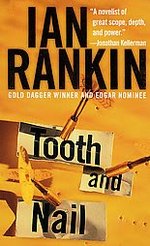
Knots & Crosses by Ian Rankin

Knots & CrossesKnots & Crosses

by Ian Rankin
Series: John Rebus, #1

Hardcover, 256 pg.
Minotaur Books, 1987

Read: February 1 – 4, 2016

Yet there had to be clues. There had to be. Rebus drank his coffee and felt his head spin. He was feeling like a detective in a cheap thriller, and wished that he could turn to the last page and stop all his confusion, all the death and the madness and the spinning in his ears.

After 21 novels and 30 years of being in print, I finally decided to give DS John Rebus and his author Ian Rankin a shot, it looks like they might stick around for a bit. Seriously, I’ve seen the names a lot over the last few years, and despite being unimpressed with his appearance in the Face/Off collection a couple of years ago (I’m sure I’ll change my opinion once I get to know Rebus a bit), when I needed a new mystery series to sink my teeth into, this looked like a good candidate.

In Knots & Crosses we meet DS John Rebus, a former SAS officer, now a Detective Sergeant in Edinburgh. He’s scraping by, he has an ex-wife and daughter; a small, dusty apartment; stacks of books; a pretty successful brother that he really has no relationship with; a large capacity for drinking; a surly attitude; and a not-that-successful program to limit his smoking. On the whole, that sounds a lot like many other fictional detectives (police and otherwise) — but there’s something about him that doesn’t seem that cookie-cutter when you read him. Maybe it’s just Rankin’s writing, maybe there’s something else — I’m not sure yet, I’ll have a better idea in a book or two (which will also give Rankin the time to distinguish Rebus). There is one other thing that separates him, but that’s the crux of this book, so I won’t get into it.

There’s a serial killer at loose in Edinburgh, killing girls and sending little notes to Rebus, taunting him about it. Sadly, Rebus doesn’t realize that for quite some time. Whoops. Not that there’s any reason for him to have seen the link, really — the killer was really more clever than he needed to be on that front. Rebus is part of the army of police working on his case, while dealing with some personal demons of his own — hopefully, the latter doesn’t prevent him from doing his part to help with the former.

The best part of the book for me was Rankin’s writing — the book is full of great sentences. Not so much that it distracts from the characters or story, but enough that you can admire his prose while enjoying the rest. This book wasn’t intended to be the beginning of a series, and doesn’t really feel like one — it’s a character study (probably a couple of characters, really), but one that’s rich enough that Rankin could come back to Rebus and build. There’s no way that future cases will be solved the way that this one was, this isn’t a prototype for Rebus’ methods, but an introduction to the detective and his world.

I liked Rebus — well, not “liked,” really. But as a character, he’s someone I want to spend more time with. Like Harry Bosch, he doesn’t seem to be a likable person, but frequently, those are the kind of guys you like reading about. I also liked that he wasn’t some sort of super cop. At one point, he’s described as not “a very good” cop, merely “a good one” (or something quite like that, I don’t have the book on me to get the exact wording). I imagine that over another 20 novels, he’ll get better — and I look forward to seeing that growth.

I really wish I’d known what “Noughts and Crosses” was before the killer mentioned it late in the book, sending me to google. I’m not sure it would’ve improved the book much for me, but I’d have appreciated aspects more and when I should’ve. Stupid “two countries separated by the same language”-thing….

Anyway, a solid beginning to the series, and more importantly, a good read for those who like police procedurals. I’ve already got the sequel on my shelf and will be getting to it in a week or so.

—–

3 Stars

2017 Library Love Challenge

Say Nothing by Brad Parks

Say NothingSay Nothing

by Brad Parks

eARC, 448 pg.
Dutton Books, 2017

Read: January 19 – 21, 2016


Since his debut novel, Faces of the Gone in 2009, I’ve considered myself a Brad Parks fan — but when I heard that he was going to step away from his series for a stand-alone, I got a little nervous. Maybe I wasn’t a Brad Parks fan — maybe I was just a Carter Ross fan. Honestly, the parts of the Carter Ross novels that he doesn’t narrate aren’t my favorite. Also, we all know all too well that for every Suspect or Mystic River, series writers can give us a The Two Minute Rule or Shutter Island — maybe grabbing this book was going to be a mistake.

Thankfully, it wasn’t.

While working on this post, I saw this from Sue Grafton talking about Say Nothing: “Terrific book. Truly terrific. Tension throughout and tears at the end. What could be better than that?” I’m a little annoyed by this, honestly. That’s pretty much how I was going to sum up things for this post. Frankly, I wish Grafton would focus her efforts on finding another 5 letters between X and Z rather than preemptively stealing my lines.

We meet Judge Scott Sampson a few minutes after the biggest crisis of his life has started — and a few minutes before he leans about it. Once you get to learn Sampson a little, you’ll see that the bar for biggest crisis for him is set a little higher than for most. He’s informed that his twin children have been kidnapped and is provided some pretty compelling reasons to believe that he’s under surveillance (and will soon be given even more reason to believe that). Basically, the message he gets is this: if you want to see you children alive and well, you will do what we tell you to with a case. There are a few tests he has to pass to demonstrate his compliance — tests that may do lasting damage to his career. But Sampson is eager to prove that he will do whatever he’s asked for his children, consequences notwithstanding.

This isn’t going to be an overnight escapade — in fact, for Sampson and his wife (how have I failed to mention Allison?), this is an ordeal of indefinite duration. The stress, the worry, the intense reaction to this situation begins taking its toll almost immediately. These pressures test their individual ethics, bring secrets to light, expose and exacerbate problems in their marriage, and generally bring them both to the breaking point. They are also both driven to discover their inner-Liam Neeson in order to get their daughter (and son) back — neither, really possess a particular set of skills fitting this goal, sadly. These attempts just make their personal and interpersonal woes worse — and their lives continue spinning out of their control.

There is a relentlessness to the pace that’s a pleasure — and a drain. Jack Reacher gets a good night’s sleep and enjoys coffee (and the less than occasional romantic interlude), Harry Bosch has jazz to relax him, Elvis Cole has that cat and Tai Chi — as intense as things may get, by and large these guys get a break. But for Scott and Allison — their children don’t stop being kidnapped, and whatever solace they might find in alcohol, sleep or family — it’s a temporary band-aid at best.

This doesn’t mean that it’s not an enjoyable read — Scott is a charming character and you will like him as you learn more about his life and family. You will not approve of every move he makes here (I guess you might, but I hope you don’t), but on the whole you will understand why he makes them and won’t judge him too harshly. Whoops, I was talking about tone here — I had fun with this, even as I was feeling a shadow of the pressure Scott and Allison are under, I even laughed once. There’s a real sense of peril when the narration focuses on the children — but it never feels exploitative.

Like most readers will, I had a couple of pretty compelling theories about who was behind everything (and why), and focused on the correct one pretty early on. Which didn’t stop me from being taken aback when it Parks revealed it — he really handled that well. Another weakness comes in the last couple of pages where Parks ties up a few loose ends, and a couple of them feel too tidy. But it’s instantly forgivable, and you want these characters to have something tidy after all they’ve gone through. On the whole, however, the characters and situations are complex and real (if heightened) — Parks nailed this whole thing. I think this will hold up to at least one repeat reading — the second read might even be more rewarding since you can appreciate what Parks is doing without being distracted by wondering what’ll happen.

The tears that Grafton mentioned? Yeah, she got that part right, too.

This is a thriller filled with real people and situations that you can believe. You’ll run the emotional gamut a time or two while reading this and will wish you could read faster just so you can make sure these kids make it home. I think I like the Carter Ross books more than this, but it’s in Say Nothing that Parks finds his stride as a crime fiction writer. Really well done.

By the way, It turns out that I am a fan of Brad Parks. Phew.

Disclaimer: I received this eARC from Dutton via NetGalley in exchange for this post — thanks to both for this, although my Primary Care Physician probably isn’t crazy about what it did to my blood pressure.

—–

4 1/2 Stars

Page 80 of 124

Powered by WordPress & Theme by Anders Norén