Category: Authors Page 88 of 124

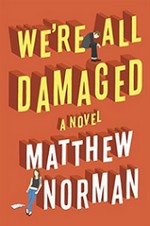
We’re All Damaged by Matthew Norman

We're All DamagedWe’re All Damaged

by Matthew Norman

Paperback, 268 pg.
Little A, 2016

Read: June 8 – 9, 2016

It’s a cruel fact that if your wife cheats on you, the guy will have a name like Tyler. Something cool–something your parents never would have had the guts to name you.

This particular Tyler is involved in Andy Carter’s wife leaving him (he’s not the cause, as Harry Burns’ buddy, Jess, would remind us, “Marriages don’t break up on account of infidelity. It’s just a symptom that something else is wrong.”). Karen uses the symptom as an excuse to dump Andy at an Applebee’s in the funniest and most tragic first chapter since Tropper’s This Is Where I Leave You.

Actually, there are several similarities between this book and This Is Where I Leave You — which is not to say that Norman’s ripping Tropper off or anything (although, it’d be a good book to steal from). It deals with some similar themes in a similar tone with similar heart. A few times Norman made me think of Tropper (I bet next time that the next time I re-read Tropper’s book, I’ll think of Norman’s).

Following the Applebee’s disaster, Andy sort of fell apart, I’ll spare you the details because Norman does a much more entertaining job of relating them than I could. But long story short, he quits his nice job and moves to from Omaha to New York and becomes a bartender, and is sort of adopted by a stray cat named Jeter (as has been well established, I’m not a cat person, but I liked Andy’s relationship — for lack of a better term — with Jeter). While licking his wounds — or whatever — he pretty much cuts off communication with his family and friends. Not out of spite or anything, but it just seems to take too much energy.

For a while now, I’ve had to keep reminding myself that I’m a nice person. Like, nice nice. Midwestern nice. Half the people who signed my high school yearbook told me so–it’s documented. A few of them even mentioned that I should never change, never ever. I once helped a blind lady walk across a grocery store parking lot in the rain. I used to run 5Ks on Saturday mornings to fight cancer and juvenile diabetes and all of that horrible shit.

Time moves on, as it tends to outside of SF novels, anyway. Before he knows it, Andy’s being stood up for a blind date and he gets a call that his grandfather is about to die. A grandfather that Andy’s pretty much ignored for over a year. So Andy goes home, after promising his boss/friend that he won’t have anything to do with Karen.

Want to bet he keeps that promise? Yeah, me neither.

He doesn’t recognize his parents, the kind of house they live in, or the notoriety his mother (a conservative radio talk show host) is enjoying. His grandfather, suffering from dementia (amongst many other things), doesn’t recognize him, either. Andy is recognized by his former best-friend/ex-brother-in-law, his brother, his parents, his ex-father-in-law, a few people he’s never met. Including someone claiming to be his sister. Oh, and Tyler.

She calls herself Daisy, “smeller of books and a marker-upper of books,” and actually has a pretty good reason to calling herself his sister. But she has other plans for him — inspired by the stories his grandfather’s been telling her, Daisy has decided to fix Andy. She sports multiple tattoos, has no discernible source of income, and marks up books. Really, not the kind of person a respectable young man should be associated with — even a formerly respectable young man. But man, I really, really liked Daisy (marking up books notwithstanding), I can almost guarantee you will, too.

You’ll probably like Andy, his grandfather, father, niece and ex-friend, too. Forget about liking Tyler, just not going to happen. I’m not sure where you’ll come down on Mom. I’m not sure where I come down on mom, either.

I’m not sure you’re supposed to have a firm opinion about her, either. My one complaint with the book has to do with Mom. The novel takes place in the weeks leading up to the
Obergefell v. Hodge
decision, and since Mom’s a conservative talk show host on the verge of nationwide fame, the case is mentioned a lot. No one, on either side of the issue, deals with it in a substantive manner — it’s all sound-bites and bumperstickers. Frankly, something so important should’ve been dealt with gravitas, not in sloganeering and cartoonish representatives. Sadly, by and large that’s all that the Internet, TV and radio gave us — so that really Mom (and her vocal opponents) were realistic representations of a lot of our country. Not the best part of it, sadly, just a large part. I can’t fault Norman for focusing on them just because they were realistic just because I wish they weren’t.

So, while maybe coming out of the ruins he’s made of his life and personality, Andy mends some fences, further ruins some more, connects with his father in a way he hadn’t in a long time, and maybe even gets a little closure. He also makes a fool out of himself, gets punched, and has to attend his grandfather’s funeral. Thanks to Daisy’s pushing, he may not be living a good life — but it’s one a lot more interesting than just wallowing in the past.

At a certain point, you pretty much figure out exactly how things are going to go in the book — and you’ll be right (except for the once or twice where you’ll be really wrong). But it doesn’t matter, because things work out the way they should, and Norman works them out in a pleasant, engaging style.

I liked Andy’s ambivalent relationship to technology — the imaginary conversations he has with Siri made me grin. And then there’s his first brush in months with Facebook.

I’ve given it some thought, and, seriously, there’s just no way Facebook can be good for you. I’m sure there have been studies, so this probably isn’t some brilliant revelation, but I’ll say it anyway. On the surface, it’s harmless enough, I guess. How bad can it really be with its endless baby posts, food pictures, and beachy foot selfies? But it’s not that simple. Mixed in with all of its silly bullshit, Facebook is the literal manifestation of all our regrets, looping and looping, for free, on our computers and phones. People who should be gone and safely out of forever are there again, one cryptic little glimpse at a time, reminding us of all the things we should or shouldn’t have done.

Seriously, Norman deserves some sort of literary prize for the “literal manifestation of all our regrets” line, right?

There’s also a cameo in here that was such a nice touch.

This was a very amusing book — frequently funny. This was also a touching book — I might have gotten misty once or twice. More than anything else, this was engaging — I was right there with Andy the whole time, cringing when he was being stupid, grinning when he was being charming or mature. I enjoyed this one so much that I can’t quite figure out how to say it. Norman belongs up there with Nick Hornby, Jonathan Tropper, Rainbow Rowell and Jennifer Weiner — he can make you laugh, make you cry, make you feel, all while telling a pretty good story. I should go back and re-read his other novel, just to be able to prove this. But until I do, just take my word for it and give this a shot.

—–

5 Stars

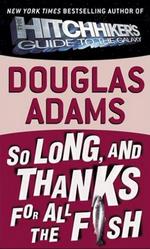
Reread Project: So Long, and Thanks For All The Fish by Douglas Adams

So Long, and Thanks For All The FishSo Long, and Thanks For All The Fish

by Douglas Adams
Series: The Hitchhiker’s Guide to the Galaxy Trilogy, #4

Mass Market Paperback, 214 pg.
Del Rey, 1999
Read: June 14, 2016

Arthur had a swordfish steak and said it made him angry. He grabbed a passing waitress by the arm and berated her.

“Why’s this fish so bloody good?” he demanded, angrily.

“Please excuse my friend,” said Fenchurch to the startled waitress. “I think he’s having a nice day at last.”

I’ve said it before, I’ll say it again: this is my favorite Douglas Adams novel. Sure, The Hitchhiker’s Guide is fantastic and I love it and you can make a strong case that at least one of the Dirk Gently novels is his best (I expect I’ll be doing so in a couple of months) — but this is the one that does it for me.

Unlike the previous three, there is an actual narrative here — it’s not a collection of scenes, jokes, and vignettes loosely tied together. Arthur Dent arrives on Earth (no, really) after traipsing from one end of the galaxy to the next; from the end of the universe, to the beginnings of life on Earth; basically all throughout time and space (sadly, without the blue box). And now he’s trying to re-acclimate to life at home. Which has somehow not been destroyed, neither has his house. In fact, everything’s pretty much like it was before.

Just with everyone convinced that the Vogon Constructor Fleet was a CIA-induced Mass Hallucination. Not everyone believes it, but most do. Two people who don’t believe that are a man named Wonko the Sane and Fenchurch. Both of whom are pretty cool characters.

I’ll skip Wonko, because the name says everything. Fenchurch, on the other hand, is perfect. She’s everything that Trillian never got the chance to be (except in the semi-disastrous final chapters of Life, the Universe, and Everything. She’s funny, smart, sexy — just what Arthur needs. I’d happily read a book just about her.

There’s a mention of Zaphod — briefly — but that’s it. So the zaniness fell into Ford’s capable lap. I’ve always liked Ford better, anyway. And he’s able (as always) to pull off the zaniness, the comedy, the . . . everything without being quite the obnoxious twit that Zaphod is.

Ford’s his usual delusional, clueless, charming, drunken self.

Here was something that Ford felt he could speak about with authority.

“Life,” he said, “is like a grapefruit.”

“Er, how so?”

Well, it’s sort of orangy-yellow and dimpled on the outside, wet and squidgy the middle. It’s got pips inside, too. Oh, and some people have half a one for breakfast.”

“Is there anyone else out there I can talk to?”

Arthur comes out of this one looking pretty good, too. He’s not whining, he’s not just getting pulled around by his dressing gown wherever whim strikes Ford (or Zaphod). He’s mature, capable, witty. He sees a problem or two and solves them (even if one of those problems is just “who was that girl I almost met the other day”?). He’s almost a wholly different guy when he’s home. Which makes him a lot like the rest of us — which is sort of the point of Arthur since we first met him.

One of the highlights of the last book was the section about flying, I’m pretty sure I said that. The section here about flying is better — Arthur teaching Fenchurch, Arthur remembering how to do it in the first place — and then the two of them flying around. It’s just about perfect.

And, of course, there are little bits like:

Of course, one never has the slightest notion what size or shape different species are going to turn out to be, but if you were to take the findings of the latest Mid-Galactic Census report as any kind of accurate guide to statistical averages you would probably guess that the craft would hold about six people, and you would be right.

You’d probably guessed that anyway. The Census report, like most such surveys, had cost an awful lot of money and told nobody anything they didn’t already know — except that every single person in the Galaxy had 2.4 legs and owned a hyena. Since this was clearly not true the whole thing eventually had to be scrapped.

    There’s a few things I’d love to go on and on about, but no one wants to read me gushing and gushing and gushing, so here are the assorted highlights:

  • The zig at the end of the Prologue.
  • Arthur’s biscuit/train station story. Seriously, I just love this.
  • Rob Mckenna
  • Wonko the Sane naming the world The Asylum and his house Outside the Asylum.
  • Wonko the Sane’s name.
  • All the California jokes. Clearly, he’d been vacationing there too much.
  • The whole thing about the lizard government and democracy is both funny and relevant.
  • Chapter 25 is just dandy.

The last chapter or two are a little weak, pretty close to the older books in tone and style. But they work, they are tied into the narrative and star Marvin. So who’s going to complain? Not me.

Really, I’ve got nothing but positive things to say about this. I love it. One of the easiest 5-star ratings I’ve ever given.

—–

5 Stars

In Medias Res: The Asset by Shane Kuhn

as the title implies, I’m in the middle of this book, so this is not a review, just some thoughts mid-way through.

—–

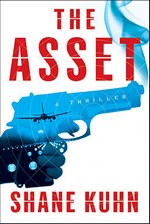
The Asset
The Asset

by Shane Kuhn

This is not the Shane Kuhn you know. Well, sort of. This is a standalone thriller about Airport/Airplane Security, Terrorism, and the USA’s efforts to keep the friendly skies, well, friendly. It’s not as fun and funny as The Intern’s Handbook or Hostile Takeover (or whatever they’re called in your part of the world). BUT it is just as well-written and suspenseful — and a little easier to believe, actually.

There are hints, suggestions, indicators, and other things pointing to an immanent terrorist attack on the U.S., and not enough people are taking the situation seriously. At least, least that’s the point of view of Kennedy, the security expert and protagonist, who is taking it very seriously. Taking place over 64 days (not a spoiler, that’s literally the 2nd line — although, there could be some action that takes place after that). Will Kennedy be in time to stop it? How will he? this is a pulse-pounder, a nail-biter, a “oh, crud — do I really have to go to work tomorrow? Do I actually need to sleep before then?” kind of book.

I think I’d prefer it to be harder to believe than the other two books, come to think of it.

I’m almost at the mid-way point of the ARC (with thanks to Simon & Schuster and Shane Kuhn) and I’m telling you now, you want to pre-order this, get on your library’s wait-list, or whatever (legal) thing you do to get your hands on a book. It comes out on July 12, you want to be ready for it.

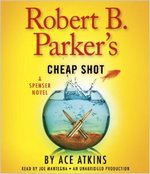
Cheap Shot (Audiobook) by Ace Atkins, Joe Mantegna

Cheap Shot (Audiobook)Robert B. Parker’s Cheap Shot

by Ace Atkins, Joe Mantegna (Narrator)
Series: Spenser, #42

Unabridged Audio, 7 Hours and 30 Minutes

Random House Audio, 2014
Read: June 7 – 9, 2016


This is a very mixed bag of an audiobook. I loved the novel 3 years ago, and enjoyed reliving it. But man, the narration was just not my thing. But I’ll get back to that in a bit.

I stand by pretty much everything that I said 3 years ago (although, I seem to have missed/underrated one plot point last time — I totally bought it this time). Here’s some of what I said before that still applies:

On the one hand, this is not Atkins’ best Spenser. But it’s the one that feels like Parker more than the rest (make of that what you will). The banter, the poking around and stirring things up until you get a break, the fisticuffs, the donuts, the gun fight, the needling of underworld players, and so on — he captures Parker’s voice and pacing better here than he’d managed before (yet doesn’t come across as pastiche). Spenser’s sniffing around the big money and big boys (and a few men) in sports, which serve as a good place for Spenser to reflect how men are to act. Parker did this Mortal Stakes and Playmates (and to lesser extents elsewhere — like Early Autumn), and Atkins is able to do that here (arguably he does so with a subtlety that Parker didn’t achieve).

Kinjo Heywood’s a fun character — slightly more grounded than Mortal Stakes‘ Marty Rabb, far more mature and grounded than Playmates‘ Dwayne Woodcock. One advantage Heywood has is his son, Akira (who’s plenty of fun on his own) — he has someone to provide a good example to, and he strives to. Heywood also seems to have thought ore about life and how one should live it. Marty seemed to think only about Linda (his wife) and baseball, Dwayne was all about his girlfriend (Chantel) and basketball, too — but with less self-examination, it’s just that’s all he had the chance to think about (although Chantel would see that changed, and his horizons broadened if she had anything to say about it). Heywood’s got a kid, he’s been through a divorce, and is fully aware of his place in the limelight (including social media) and his own shortcomings. This alone saves the book from being a reworking of Parker.

I should add that Sixkill has a lot of perspective here (with the assistance of Atkins’ own background in football) — he was close to Heywood’s level, and if he’d made one or two better choices, he would’ve been at this level. He has a better idea what’s going on in Heywood’s mind than Spenser and his brief stint in the boxing world would.

The book begins with Spenser doing bodyguard duty — and as always (Stardust, Looking For Rachel Wallace, A Savage Place, Rough Weather) things don’t go well. You’d think people’d stop hiring him for this kind of work. Spenser turns to investigating — and unearthing lie after lie from his client — while getting Hawk and Sixkill to pitch in on the bodyguard front.

In addition to the main characters, Hawk, Susan, Sixkill, Tony Marcus, and so on; Atkins continues to show a command and familiarity with the impressive gallery of supporting characters in the Spenser-verse. And the new characters fit into the ‘verse just fine, nothing that Parker wouldn’t have created.

Not only did Atkins give us a good story this time, he appeared to be planting and/or watering seeds for future books at the same time — something Parker never bothered with, but I’m glad to see.

About the only thing I’d like to add on this front is that I think I liked the story more this time around.

So much for the lovefest. I just didn’t like Mantegna’s work. I know, I know — he’s done many, many of the Spenser Audiobooks; Parker loved his work with Spenser (even getting him cast in those semi-regrettable movies); and he’s Joe bleepin’ Mantegna. Still, it didn’t work for me. When he was reading the narrative parts — Spenser describing what he was doing, what he was seeing, etc., even making smart aleck asides — I dug it. He did a perfectly entertaining job — maybe even more.

But the strength of Parker’s work was his dialogue, and Mantegna fell flat (at best) on this front. Spenser sounds like Fat Tony, which just should not be. Ever. Kinjo sounds like a stereotypical old blues man, not a young NFL linebacker. Hawk sounds like a slightly younger blues man. And don’t get me started on Zee. That was just embarrassing. Most of the other characters were pretty poorly done, as well. And when the book is so reliant on dialogue, so reliant on the charm of the characters, that missing with just about all of them hurts.

So, like I said, great writing, mediocre (when not disappointing) narration. Please note this rating is for the Audiobook — the whole experience, the narration as well as the writing — still love the book, and would recommend the novel in a heartbeat. This? Eh. It was entertaining enough, but that’s it. Still, any time with Spenser is time well spent.

—–

3 Stars

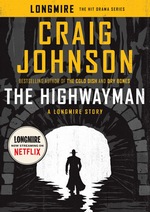
The Highwayman by Craig Johnson

The Highwayman The Highwayman

by Craig Johnson
Series: Walt Longmire, #11.5

Hardcover, 190 pg.
Viking, 2016

Read: June 7 -8, 2016

We’re taught to work independently, but nothing strikes you quite like a 10-78 [Officer Needs Assistance], the urgency to reach a fellow officer in need. It’s instinctual to individuals who are trained to respond and risk their lives for each other and complete strangers.”

Having been in Wyoming Law Enforcement for so long, he knows pretty much every officer in the state. One such person is Rosey Wayman, a Highway patrolman who’s having some problems. She’s taken a new assignment, a jurisdiction once patrolled by a (literally) legendary officer. Since then, well, strange things have been happening. Walt and Henry (as a favor to her and her C.O.) have dropped by to act as sort of independent witnesses — basically to determine if her imagination is getting the best of her, or if there are strange things underfoot.

One of the best parts of this series is the way that Johnson writes about things that can’t be readily and easily explained (generally) without spelling things out for the reader. Yes, a character may be having a psychological problem, a physical problem, or there might be a spiritual dimension to what they experience — maybe all of the above — but what Johnson won’t do is tell you what happened. Henry, Walt, Ruby, Lucian or any number of others just might express their thoughts/opinions/beliefs, but the author won’t.

Which means that when Johnson tells a ghost story? You’re in for a good one. One where you have no idea if the ghost in question is a manifestation of someone’s (or multiple someones’) subconscious.

I will admit I was confused when I saw this was advertised as a novella. The last Longmire novel, Dry Bones was 306 pages long, and this was listed at 200 (190 is my count). How did that qualify as a novella (which is a fairly slippery term, anyway)? And then I picked up a copy. This one measured at 5.3″ x 7.4″ (Dry Bones was 6.2″ x 9.2″). Which explained everything. Reading it made it clear that it wasn’t a novel — one story, no personal drama, no ongoing story/character arcs — just Walt, Henry and Rosey on a ghost hunt.

Lean prose, great characters, a setting that means more than just the place where the action takes place (and is described thusly) — everything you want in a Longmire story.

One other thing that I have to mention — the elderly Arapaho sha-woman that Henry introduces Walt to is a real hoot. Her teasing/harassment of Walt was a needed dash of fun in this book, I can only hope that Johnson finds an excuse to use her again.

If this was a novel, it’d be 3-3 ½ stars, but since it’s supposed to be a novella, I’ll give it a 4. Just what the doctor ordered to tide you over until the next full book.

—–

4 Stars

Hounded (Audiobook) by Kevin Hearne, Luke Daniels

Hounded AudiobookHounded (Audiobook)

by Kevin Hearne, Luke Daniels (Narrator)
Series: The Iron Druid Chronicles, #1

Unabridged Audiobook, 8 hours and 11 minutes
Brilliance Audio, 2011

Read: April 26, 2016


Keeping this brief so I can catch up on other things, I posted a few quick thoughts about the book previously — and that still covers most of my thoughts:

It took no time at all for this book to grab me, and another 15 pages for me to fall in love with this. Right off the bat we get a solid action sequence, get the basics of our hero’s magic system, and meet a goddess. Not a bad start–it helps a lot that Atticus’ personality and charm comes through right away and draws you in.

Then we get a talking dog. Technically a dog (Oberon the Irish Wolfhound) that can communicate telepathically with Atticus, but why get picky? Oberon’s snarky, smart and pop culturally savvy–he runs a close second behind Harry Dresden’s Mouse for coolest pooch in Urban Fantasy. I’d be willing to read a book that’s nothing but Atticus and Oberon hanging out.

Throw in a helpful werewolf pack, a friendly vampire, a troublesome local coven, and a fight with an ancient Celtic deity and you get yourself a dynamic intro to what seems to be one of the best Urban Fantasy series around.

From the point of view of someone who’s read book 8, going back to the beginning like this was a lot of fun. I could see the development in Atticus, Laksha and others (even Oberon — who is now cooler than Mouse), got to see dearly departed friends (like spoiler and other spoiler), and could see a lot of seeds being planted that are still bearing fruit. It was also nice to be reminded why I used to like Granuaile.

So, I guess I should focus on Luke Daniels’ narration. It was great — I’m not crazy about his interpretation of Oberon, but it has an undeniable charm (that goes beyond the incredible amount of charm that Hearne gave him). His characterizations of each everyone are strong — even the accents. In particular, his Widow MacDonagh made me laugh, even after repeated exposure to her (read the book at least two times, and now listened to the audiobook twice).

It’s a fun listen with some great characters — and the beginning of one of my favorite ongoing series. If you’ve still happened to miss The Iron Druid Chronicles, this is a great way to dive in.

—–

4 Stars

The Cupid Reconciliation by Michael R. Underwood

What? Another Genrenauts/Michael R. Underwood post? Yup. Don’t worry, I’m going to slow down a bit (well, after this and then next week’s post, “What’s in Underwood’s Sock Drawer?”) — but trying to get the word out about the Kickstarter and the series takes some repetition.

I’m pretty sure that there’s a paragraph missing from this — I just don’t know what it was supposed to be about. I may end up revising this tomorrow.

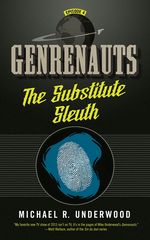
The Cupid ReconciliationThe Cupid Reconciliation

by Michael R. Underwood
Series: Genrenauts, #3

eARC
2016
Read: May 17, 2016

This is my life, Leah thought . . . My amazing, confusing, totally screwed-up life.

Just as Leah is getting to the point that she’s starting to feel comfortable, maybe even a little confident, in her new job — her new life — things get shook up a little. Mallery, the member of the team whose injury led to Leah’s recruitment, is back from her convalescence. That alone will change the team dynamic in the field, and maybe even effect Leah’s standing in the team. The fact that they’re headed to Romantic-Comedy world, Mallery’s specialty, doesn’t help Leah’s spirits (particularly because she’d like that to be her specialty, too).

Speaking of the various worlds, I don’t know if we’d ever been given insight into how life in a Genre World would start to change a person after awhile. Or if we were, it wasn’t explained the way it was here. That was just a cool touch.

While Leah continues to be our point-of-view character, our entry into this world, this is really Mallery’s book. The rest of the team are there, and contribute but the major non-Leah narrative weight is all carried by Mallery. Which I’m fine with, she seems to be a fun character (maybe a little hard to take in real life, but that could just be her nerves about getting into the field/dealing with a probie) and we need to get to know her, but she’s a force of nature.

Mallery beamed, which Leah was realizing was pretty close to the woman’s resting face. Some women had resting bitch face, but Mallery glowed. It was impressive. A little annoying, but impressive.

There was something in the “Coming Next” page in the last episode that made me worry about the relationship between these two not getting off on the right foot — thankfully, it seemed to get off on a decent (if not the right) foot — but nothing’s perfect. The two characters are going to have to fumble a bit to get a strong working relationship.

Don’t get me wrong — King, Roman, and Shirin all had their moments and made their presence felt — but they were bit players in this one. I did appreciate getting to see Roman’s softer side on display, he’s a deeper thinker than you might take him for and his efforts to help the “male lead,” were borderline sweet.

Straightaway when they get to the world, they come up with a strong candidate for the couple causing the breach — and the team is wrong, they have to work harder than the last two times to find where the problem is. I appreciated that move — and didn’t realize until then how smooth that step had gone in the previous adventures.

Maybe it’s because this particular world so closely resembles our own, but Leah got a bit of insight into how the Genrenauts’ activities might seem to one of the people from that world — and it’s not that pretty. The Genrenauts violate the Prime Directive more than Kirk ever did (to put it in genre-terms). And Leah’s not so sure that their particular brand of meddling is all that ethical. And I have to admit, she may have a point. Mallery shuts down that kind of thinking/talk — at least until they’re safely back home. I trust that Leah’s doubts and questions will be all dealt with in a way that’s honest in the near future. Regardless, Leah’s ethical qualms add a good dimension to things.

I enjoyed seeing this world through Genrenaut eyes — the availability of fantastic (and cheap) apartments with amazing views, how easy it is to get a cab, the fact that there’s a romantic scene seemingly everywhere in the background — happy couples everywhere.

. . . Leah walked up to a double-wide window facing the park. The leaves were changing, making for a sea of rich oranges and yellows beside a crystal-clear lake. The view was postcard-perfect. And as a cherry on top, there was a couple rowing a boat in the lake, one carrying a parasol. And Leah could even make out a picnic basket. The energy of the place was contagious. Western world was cheesy and scary. Science Fiction was cheesy and a bit confusing. Rom-Com world was cheesy and delightful.

There’s sort of a happy ending montage at the end (or the narrative equivalent of one, anyway) that was just perfect. Once I realized what exactly Underwood was up to there, I couldn’t help grinning. I know it’s part of the series premise for him to play with, celebrate, comment on genre tropes, clichés, conventions and so on — but sometimes what he does seems to capture the essence of the particular genre in a way that just feels like he did it better than usual. This is one of those times.

If you’ve been reading this series already, you’re going to really enjoy this. If you haven’t started — go back to Episode 1 and start fresh, you won’t be sorry. Underwood has a good thing going here, and it’s just getting better. Fun, yet thoughtful; action-packed, but pretty restrained in use of force. A great balancing act that should inspire more to do this.

Disclaimer: I received this book from the author as part of his promotion of the Season One Kickstarter.

—–

4 1/2 Stars

A Few Quick Questions With…Michael R. Underwood

The first time I’d heard of Michael R. Underwood was on an episode of The Once and Future Podcast back in August of ’14, when he was promoting his first novel, Geekomancy, and I had to get my hands on it as quickly as I could. Reading it confirmed what I’d thought listening to the interview — this is my kind of writer: the interests, the sense of humor, the kind of story he was telling — if we weren’t members of the same Geek Taxonomic Rank, we were close enough. Every book/story since then has just increased that impression (even the ones that didn’t bowl me over). Naturally, I jumped at the chance to help promote his Kickstarter for Season 1 of Genrenauts with this little Q&A.

Man, I so wanted to go full fan-boy on him asking all sorts of detailed questions about his various books — especially this series — enough to make him shout, “Alpha 3-9!” while running away. Instead, I stuck with keeping it short and sweet, so he can focus on the Kickstarter, his job, his books, etc. (and because I like not having Restraining Orders taken out on me).

Michael R. UnderwoodMichael R. Underwood is the author of seven books: Geekomancy, Celebromancy, Attack the Geek, Shield and Crocus, The Younger Gods, and Genrenauts, a series in novellas (The Shootout Solution and The Absconded Ambassador). By day, he’s the North American Sales & Marketing Manager for Angry Robot Books.

Mike lives in Baltimore with his wife and their ever-growing library. In his rapidly-vanishing free time, he geeks out on comics and games and makes pizzas from scratch. He is also a co-host on the Hugo Award-Finalist The Skiffy and Fanty Show and Speculate! The Podcast for Writers, Readers, and Fans.

Between your job, family, social life, social media, writing, media-ingestion (which based on your twitter feed and books is pretty impressive) how do you do it? Have you figured out how to survive without sleep?
I am actually a huge fan of sleep – I need at least 6 to 7 ½ hours a night to stay in peak form. I fit everything in because so many of the things I do fold into two or more others. Watching TV informs my fiction, it gives me stuff to blog about, or to discuss on the podcasts I do. Same with reading and video games. My wife is also a geek, so watching TV/movies, talking about media, and sitting around reading all still counts as time spent together.

My day job and my writing career support one another, since they’re both in the same field. I’m very lucky that my boss at Angry Robot, Marc Gascoigne, doesn’t expect me to put in long hours the way that some publishing professionals have to (I work 40 hours a week on the job, not 50-70 that I know some folks do). If I were an editor, I think it’d be much harder to keep everything balanced.

Even with all of that double-counting, I have still really streamlined my life. I used to have several more hobbies, but I haven’t been making time for tango or historical martial arts in the last few years. I’d like to get back into the martial arts, especially since I have a series in development which draws on that world.

What’s the one (or two) book/movie/show in the last 5 years that made you say, “I wish I’d written that.”?
The movie I most wish I’d written and/or been involved in the creation of is Mad Max: Fury Road. Watching Fury Road for the first time was something akin to a conversion experience for me. The way that action drove (heh) the narrative, how action foregrounded and revealed character, and the way that the film told a very specific story about combating toxic masculinity and rape culture through the lens of an extended chase scene – all of those elements totally blew me away, and have served as a call to action, a challenge to do better in my own writing. It’s a phenomenal example that a story can be exciting, commercial, and have something to say in addition to “whee!”
In between installments of the Ree Reyes series, you had a couple of other works published. Are you exclusively a Genrenauts author for the rest of this season/through season 5, or do you have another iron or two in the fire?
Since the Genrenauts Kickstarter is going very well so far, things are looking good for that series, with the Season One omnibus scheduled for this fall. I’d then start working on Season Two at the start of 2017, looking to pick the series back up in the Spring/Summer.

But I definitely have some other projects in development. There’s the fencing-oriented series I alluded to above, and I’m also eager to get back to the first draft of a space opera that I’ve been working on (it’s so much fun, folks. Some of the most fun I’ve had writing fiction).

My goal is to keep Genrenauts going for all five planned seasons, and to fit other projects in between those seasons, including at least one novel a year if possible. I’d also love to do some writing in the comics medium, but right now my wish-list of projects far outstrips the time I have available to write them, so I have to prioritize based on what projects have the best prospects in terms of finding a good home or method of getting to readers.

Up to this point you’ve been writing Urban Fantasy and SF, is that home for you, or have you thought about trying something else — or are the various worlds in Genrenauts scratching your itch to dabble in something else? Is there a genre that you particularly enjoy, but could never write?
My tastes range across the genres of speculative fiction, so I’m definitely planning on continuing to stretch my skills and write in a variety of modes and sub-genres. Genrenauts really helps with some of that, though there are some places where I have a more specific idea in a sub-genre for something that wouldn’t be a good fit for Genrenauts. Those ideas get their own chair in the Green Room of my writing brain. It’s very crowded in there. Don’t let the Story Idea Fire Marshal know.

I’d really like to write some romantic SF/F, where the romance plot is as developed as the SF/F story. The Ree Reyes series has some romantic elements, but I’ve been reading more Romance novels/novellas and am continually impressed at how Romance writers draw out such intensity of emotion and characterization. I’m trying to learn from those writers and see where I can use those skills to strengthen the relationship plots in my own stories.

I’m not likely to ever write a Literary Fiction work – one without SF/F elements and focusing on the super-deep language, slow-burn, internal exploration that is expected in that mode. It’s just not how I approach storytelling.

The whole point of this was to help promote the Kickstarter campaign, so we’d better talk about it a little — How’s the Kickstarter going (especially compared to what you’d expected/hoped)? What do you want people to know about the campaign that you haven’t already said?
The campaign is going really well! We hit 70% a week from the initial launch (almost to the hour), and it’s looking very likely that we will not only fund, but we might hit several of the stretch goals to have Mary Robinette Kowal return to perform audiobook editions of further episodes in the series. I’m really excited by the outpouring of support I’ve seen for the series, from Kickstarter backers to people offering to help me spread the word to people eager to review the new episodes, and so on.

When I was first developing the idea for Genrenauts, I started to hope that this might become a Big Thing for me, a series that could become a major portion of my creative output over several years, something that would help me develop a community of readers and storytellers, and to contribute to the discussions about why we tell stories and what they can do socially and personally. Every new backer for the Kickstarter, makes that dream ever more a reality, and I am deeply grateful to everyone who is helping make it happen.

Thanks so much for your time. I hope the Kickstarter campaign succeeds, and look forward to reading the rest of the Season.

And, folks, even if you’re not that interested in helping Underwood out, go help out so we can get more of these audiobooks for my sake, okay?

Fire Touched by Patricia Briggs

Fire Touched Fire Touched

by Patricia Briggs
Series: Mercy Thompson, #9

Hardcover, 342 pg.
Ace, 2016

Read: March 23 – 24, 2016

How is this only the 2nd Mercy Thompson book to appear on the blog?!?! Seriously, what is my problem? (other than reading all but the last two before I started this thing, I guess)

If Chapter 1 doesn’t include the funniest scene that Briggs has ever written, I’ll eat my hat. Naturally, after cracking me up, I figured she’d be taking us to a pretty dark place. And while there was a good deal of darkness — and potential for big, dark happenings down the road (but I’ve thought that before, like with Fair Game) — it didn’t get as bad as I feared.

There’s a scene fairly early on here that reminded me of the big ” …it is defended!” speech from Doctor Who‘s “The Christmas Invasion” — the moment that the new Doctor defined himself. Mercy does something a lot like that not realizing just how far her message will go (thanks to the Internet, smartphones, and 25-hour news cycles), and just how much trouble she’s created for Adam and the rest of their pack — as well as Bran and pretty much every werewolf in the U.S.

Part of the immediate fallout of this moment is that a human child who has been abducted by the Fae at some point that no one (including him) remembers comes to Mercy for help. He doesn’t quite fit in to this world any more, but he doesn’t want to be with the Fae, either. With a big emphasis on the latter. So, with she gives him sanctuary of a sort — at least temporarily. This brings attacks, threats, and destruction — with more to come if she doesn’t hand the boy over.

You can imagine how that goes over with everyone’s favorite shape-shifting mechanic.

There’s a lot more going on, but the fate of the boy is the centerpiece.

There’s a major loss in this novel that moved me more than I could’ve expected. On the one hand, I think it’ll be good for the long-term health of the series. But man, it’s going to be strange opening the next Mercy book without seeing ____.

I’ve seen some people disappointed with this book, but I’m not sure why. There was plenty of action — but it wasn’t as epic (for lack of a better word) as Night Broken or River Marked, maybe that’s it. You’ve got some really solid scenes — in the comedic and the action veins, Mercy makes a strange new friend, plenty of Fae politics, internal pack politics and Mercy as David Tennant. Not the best in the series (but they can’t all be), but a very satisfying installment in a really good series. That’s more than I can ask for.

Again, Mercy as David Tennant. Need I say more?

—–

4 Stars

A Genrenauts Reminder

Today was . . . well, let’s call it a day (yesterday by the time this posts, technically). No time for a real post, and I’m too fried to format one of the guest posts I have for times like this.

So instead — let me remind you that Michael R. Underwood is kickstarting the rest of “Season One” of his Genrenauts series, a real favorite around these parts. Here’s a couple of good interviews he’s done to help promote it:

Check ’em out!

Page 88 of 124

Powered by WordPress & Theme by Anders Norén