Category: Authors Page 92 of 123

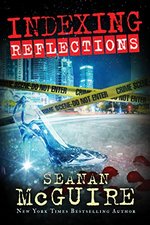
Indexing: Reflections, Episode Seven: False Love’s Kiss by Seanan McGuire

Indexing: ReflectionsIndexing: Reflections, Episode Seven: False Love’s Kiss

by Seanan McGuire
Series: Indexing, #2.7

Kindle
47North, 2015
Read: November 5, 2015

So we were going to do this the hard way. Fine. I’m Sloane Winters: I invented the hard way. “You want to ignore what’s right in front of your faces, that’s okay by me. I’ll just laugh even harder when it turns around and bites you. Assholes.”
“Thanks for the motivational speech, Sloane,” said Andrew, wrinkling his nose. “Any time I start to feel like things are going well, all I have to do is remember your contributions to this team.”

Henry’s a cool character, but man, Sloane is just a fun narrator — assuming that things get back to their heightened “normal,” I’m going miss her.

So there’s a Fairy Tale incursion, a Godfather Death, that I’ve never heard of — but man, it doesn’t sound like fodder for a Disney movie, I’ll tell you that. Opening with this is a great setup for the chapter — there’s drama, a little action, and a few laughs. Have I mentioned I really enjoy reading about Sloane?

Then things take a turn for the dramatic — Henry’s back from her little mission, but . . . something’s not right. Even if it has nothing to do with stopping evil/saving the world, I hope they can take care of whatever’s not right just for Jeffrey’s sake. And then we get a Rapunzel in action — and a not-so-typical Sloane solution.

I’ve enjoyed what we’ve seen from Ciara so far — but her working on the locks, and how she describes it? It’s just gold. Probably the highlight of the episode. I hope, if there’s another sequel, she doesn’t disappear into HR.

I think having this chapter before the last would’ve been more interesting — just to see if we’d have been able to figure why Sloane’s Spidey-Sense was going off, without a very strong possibility having been talked about last chapter. Even if I’m wrong, watching this unfold is going to be very interesting. Possibly more interesting than seeing what happens with Birdie and Elise.

—–

4 Stars

Reread Project: Suspect by Robert Crais

SuspectSuspect

by Robert Crais

Hardcover, 309 pg.
G.P. Putnam’s Sons, 2013

Read: November 3, 2015

This isn’t steel and nylon. It’s nerve. You clip one end to you, you clip the other to this animal, it ain’t for dragging him down the street. You feel him through this nerve, and he feels you, and what flows through here flows both ways — anxiety, fear, discipline, approval — right through this nerve without you and your dog ever even having to look at each other, without you ever having to say a word. He can feel it, and you can feel it. too.

Thus spake Dominick Leland, LAPD K-9 corps’ sergeant and alpha. It’s that kind of devotion to the animals that characterizes this book. These people take their dogs seriously (well, it takes Scott a little bit, but that’s the point), almost too seriously.*

Someone on the Facebook Robert Crais FanClub mentioned re-reading this to prepare for the release next week of Crais’ The Promise which will feature (who knows how much) the two stars of this novel. Seemed like such a good idea, I pounced on it, too. So glad I did, I remember really liking this book, but I didn’t remember how much I really, really, really liked this book.

This is the story of two partners grieving the loss of their most recent partners, and recovering from wounds both physical and psychological while trying to move past the trauma by gearing up for a new assignment for the future. One of the pair is a once-SWAT-bound LAPD officer, and the other is a former explosive sniffing German Shepherd with the Marines in Afghanistan. Which adds a bit of novelty to the situation.

That Prologue is one of the most effective opening chapters I can think of — it’s like the first ten minutes or so of Pixar’s Up — warmth, purpose, courage, heartbreak — there’s almost nothing more you could ask of it.

I love the way Crais describes Maggie’s sniffing/scenting for work. For that matter, Maggie’s perspective in general is great — not goofy or cartoonish, played for laughs or anything like that. Sure, some of it is projection, some of it is just guess-work, some of it is poetic license — but it’s all good, authentic, writing.

I guess the same could be said for what Officer Scott James goes through — I don’t know what PTSD is like, really. I just know about it from various literary/dramatic sources. But this sure seems to work — the guilt, the fear, the stress, the nightmares, the obsession, it rings as true. Granted, Maggie’s got a greater emotional pull (who doesn’t love a good dog?), and is a little less familiar than Scott — but at least we can relate to his suffering and him.

As with almost everything Crais writes, this takes place in the world inhabited by Elvis Cole, Joe Pike and the rest. We see that by a brief interaction between one of the detectives and John Chen (who as also mentioned by name earlier). Brief interactions with Chen are probably the best for all involved, and here he was John Chen at his John Chen-iest — I just love it. Although thanks to Gotham, I’m getting an Edward Nigma-vibe off of him, thankfully, I know better. (right?)

From the start, this gets you right in the emotions, and Crais keeps you there. You’re drawn to Maggie, and because of her, Scott. You get invested more easily than with other new characters because of Maggie With about 40 pages to go, even though I knew how it ended, I still was tense. That’s good writing. Period. End of discussion. And for the record, my eyes totally did not get misty at the end, I don’t know why you’d ask.

When I blogged about this back in 2013, I said “I don’t think this is the best Crais novel . . .but, given the way this worms into your heart, it’s probably my favorite.” It’s still probably not his best, but it’s better than I thought it was initially (I was more concerned with plot and character than craft, I think) — probably in the top 5, and it is my favorite so far.

—–

* Yeah, totally kidding. Not possible to be too serious about your dog.

—–

5 Stars

From the Mailbag: Reading the Wolfe Books for the First Time

I received this email in response to my Happy Birthday, Archie! post last week.

Soooooo, each year you post this, each year I say I’m going to start…just put a request in for Fer-de-Lance, the first of the Nero Wolfe books, right?

Thanks for the question! This is a tricky one for me, and one that I’ve thought too long about already. I’m going to write for the person already interested in the series, and not to convince you to read them — this is practical advice only, no incitement.

Short answer: Maybe.

Longer answer (which I’ll still try to keep under control, because I tend to be hard to stop on this subject, and some of this is adapted from other things I’ve written. Also, because if I start fact-checking some of this, I’ll find myself spending hours, even days, on this, so I might make some minor errors)*:
Rex Stout’s Fer-de-Lance is the first of 40+ books (novels or short story collections) featuring the exploits of private investigator Archie Goodwin (2 parts Huck Finn, 1 part Philip Marlowe) and his eccentric employer, Nero Wolfe (1 part Sherlock Holmes, 1 part Mycroft Holmes)–yes, I am one of those who think that Archie’s the main character in the mis-nomered Nero Wolfe Mysteries. It makes perfect sense to start with Fer-de-Lance and read chronologically. I did it myself a couple of years back for the first time (I’ve been reading these books for about 30 years now, and its odd that it took me so long), and I picked up subtle nuances, little callbacks and references that I’d missed before. There are almost no story or character arcs that go beyond a book (exceptions are noted below), and (most of) those that do, are easy enough to pick up and don’t spoil too much. Yes, there are introductions of new characters, a character death or two, but by and large you can dip in anywhere and not notice.

    Two quick semi-parenthetical notes on the reading this chronologically before I continue.

  • Yes, read the short story collections when you come across them in the chronology. Even if you’re not a short fiction reader, do it. There are some utter gems tucked away in those (and I spent too much time ignoring them).
  • The short story collection Death Times Three was published posthumously, but I’m pretty sure they were published in magazines, etc. before the last novel, A Family Affair. Read the collection after Please Pass the Guilt and before A Family Affair. A Family Affair works so, so well as a series finale that it should be treated as one whether or not Stout wrote it as one. It’s oft-debated, but I’m convinced that if Stout lived another year, we’d have had another novel. But he didn’t. So, again, A Family Affair should be the last you read — even if you don’t read chronologically.


In reading about Rex Stout/Nero Wolfe (either by fans or professionals), there’s an oft-quoted line from Walter D. Edmonds that you simply cannot avoid seeing, “I shall never forget my excitement on reading Fer-de-Lance, sprung like Athena perfect form the Jovian brow, fresh and new and at the same time with enough plain familiar things in scene and setting to put any reader at his ease.” Aside from Oliver Wendell Holmes’ margin note (“This fellow is the best of them all.”), there’s nothing that sums up Fer-de-Lance better, sprung like Athena indeed.

It really doesn’t matter how many times you’ve read it, but upon re-reading (and probably even initial reading if this isn’t your first encounter with Wolfe and Archie) you can’t help be struck by how much Fer-de-Lance fits the model of a mature Wolfe novel–almost all the elements are there. These characters are introduced in practically their final format — a little tweak here and there over the course of the first few novels will get them in their final form. The addition of a few other characters will be necessary, but the cast of characters is already over 90% complete. In the first chapter alone we already have Wolfe, Archie, Fritz, Theodore, Fred and Saul presented in a manner fully recognizable to the familiar reader. The story follows a fairly typical route (although the identity of the murderer is revealed far earlier than is the norm), and the essential environmental elements are there — the beer, Wolfe’s eccentric schedule, the orchids, a relapse, the food, a cocky scheme to land a client, an outrageous stratagem for getting that last essential piece of evidence (not that Wolfe needs it to solve the crime, merely to prove he was correct) — the only thing missing is the gathering of the witnesses/suspects/clients for Wolfe to reveal everything in his characteristically dramatic fashion. One recurring thought I had while reading it the last time was that Fer-de-Lance could just as easily have been the fifteenth installment in the series as the first.

If you didn’t understand half of what I wrote above because you’re new to the corpus, well, you’ll get it soon enough. There’s a formula of sorts to Wolfe/Archie novels — violated all the time, despite what we purists like to think, these variations on the theme are some of our favorite moments. You’ll pick the formula up quickly, and find it as comfortable as Wolfe’s nigh-inviolable daily schedule.

So while there is glacial development, the order is almost negligible. I do endorse and suggest a chronological read — but it’s not essential. In fact, I typically recommend The Golden Spiders (#22) or Before Midnight (#25) to newbies before plunging into Fer-de-Lance, they’re among my favorites, and are pretty representative of the fully-developed Wolfe/Archie. A&E used The Golden Spiders as the pilot to their recent series, so I’m not alone in thinking it serves as a good introduction. If you like them in their final form, you’ll have an easier time appreciating Wolfe/Archie in their almost-final form in the early books. Think of the development of Bugs Bunny over the first few shorts as a rough analogue.

Therefore, if your library/used bookstore isn’t sufficiently stocked to do the chronological read, you shouldn’t avoid the series and can dip in wherever you can. It’s like old episodes of Law & Order that you come across on cable. But there are a few things you should read in a certain order for full understanding/emotional impact, and a few others you should read after you’ve acclimated to the world/series a bit, you’ll enjoy/appreciate them more than in they’re in the first five:

  • The Doorbell Rang (#41)
  • Too Many Women (#12) — a lot of people think Archie comes off like a cad here, it’s never bothered me, however. Still, if you already like him, you’ll forgive him this.
  • And Be a Villain (#13), The Second Confession (#15), and In the Best Families (#17) — just seeing the numbers now, surprises me — I’d have thought these were in the 30’s. If Stout had been planning out a 40+ book series, he’d have put them later. Not only should you read them with experience in the series, these three need to be read in this order. There is an omnibus edition in many libraries with these three called Triple Zeck.
  • The Black Mountain (#24) would be best read after Over My Dead Body (#7), and after you’re acclimated to the world.

A couple of other suggestions:

  • Some Buried Caesar (#6) — should be read early (but not first) and often.
  • A Right to Die (#40) should be read only after Too Many Cooks (#5), it’s one of the only times that a non-regular character shows up again. There’s some racially-tinged language in Too Many Cooks that Archie’d grow out of almost immediately. Remember it was originally published in 1938 and cut him a little slack — mostly, be happy that he grows out of it.
  • And again, A Family Affair should be read pretty much when there’s nothing left.

Granted, these are all only suggestions. But ones made by a passionate fan. Still, at the end of the day, just read these books, you’ll enjoy them.

Maybe sometime I’ll get into the official continuations by Robert Goldsborough in a post like this.


* Okay, I lied — I pulled up the goodreads page for the series so I could get the numbers on them just to help. But that’s it.

Reflecting the Sky by S. J. Rozan

Reflecting the SkyReflecting the Sky

by S. J. Rozan
Series: Lydia Chin & Bill Smith, #7

Hardcover, 312 pg.
Thomas Dunne Books, 2001

Read: October 24 – 26, 2015


I love reading the conversations that Lydia and Bill have — especially those that have little-to-nothing to do with their work. In the opening pages of this book, where Lydia explains to Bill what Grandfather Gao wants them to do, and where he wants them to do it, we get one of their better conversations. Bill has a lot of fun with the idea that the venerated Grandfather Gao wants him to do anything for him, much less travel to the other side of the planet for him.

Grandfather Gao, who looms large over Chinatown in general and Lydia’s life in particular, wants the two of them to make a couple of deliveries to Hong Kong: the ashes of an old friend, and a package for that friend to be delivered to his brother.

Of course this simple errand doesn’t go as planned — it’d be a very short book if it did. As entertaining as it might be to read about these two playing tourist in Hong Kong, that’s not the type of book Rozan wrrites. Soon, this errand plunges the partners into at least one kidnapping plot, a murder, and all sorts of other crimes. How much of this was predicted by Grandfather Gao is a question on everyone’s mind.

The best part of this book is seeing Lydia in a strange land — in NYC, the accent is on the “Chinese” in Chinese-American, by the way she was raised, where she lives (both neighborhood and with her mother), her family, and her appearance. But here? The accent is on “American.” She gets a bit more of the culture and customs than your typical tourist, and a lot more of the language, but at the end of the day, she’s a foreigner even where Bill’s the one who looks different than most people she’s around.

Now, no American detective (or pair) can wander around a foreign city, stirring up trouble and solving crimes without one ally. Lydia and Bill are helped out by Mark Quan, a detective raised in the American South who moved to Hong Kong later and became a police officer there. He, of course, has his own connection to Grandfather Gao — which, at least, means that he can be trusted. At the end of the day, we’re reminded more than once, that a cop is a cop no matter where you are, so even if he can be trusted, he’s not that open to P.I. help (especially American P.I. help). I really enjoyed him as a character, and hope that he gets sent to NYC in the future to help with something in a Rush Hour/Red Heat-type move.

Bill, as usual, comes across as a better guy than he does in the books from his perspective. I appreciate that dynamic, he comes across as more heroic (if semi-annoyingly interested in Lydia — from her perspective), and she comes across a bit more clever and resourceful in his books. He didn’t get nearly enough to do, in my opinion, but I know he’ll get his turn soon enough.

Not the best in this series, but man, it was entertaining. Loved seeing these two as fish out of water, yet still doing their thing. Bring on the next!

—–

3.5 Stars

Indexing: Reflections, Episode Six: Frostbite by Seanan McGuire

Indexing: ReflectionsIndexing: Reflections, Episode Six: Frostbite

by Seanan McGuire
Series: Indexing, #2.6

Kindle
47North, 2015
Read: October 22, 2015

While Jeff and Sloane were fretting in the last chapter, this is what Henry was going through — and pretty soon you start to think that maybe Jeff and Sloane were better off (as worried as they were). But honestly, there really wasn’t a lot of plot movement here. It’s primarily a chapter that expands what the reader knows about the story. We get a better understanding of how things work in the whiteout wood that the Snow Whites like Henry in habit, we get a little backstory on Henry and Gerry, and the beginnings of an understanding what’s going on with Elsie.

Which isn’t just to say is all exposition, or dull — because it’s not. But the fight scenes, the danger, the tension takes are of secondary importance. It’s a good chapter, and does a good job of establishing a foundation for whatever is going to come next.

The ending could be cliff-hanger-y. But didn’t really feel that way, it felt more like one more hurdle for Henry to conquer. It seems like a pretty big hurdle and one not easily overcome. But I, for one, am not that worried about the outcome.

Of course, with my track record of predicting McGuire means I should probably be sweating bullets.

—–

3 Stars

October 27, 1975: The Death of Rex Stout

Rex Stout

Forty years ago today, Rex Stout died at the age of 88. It doesn’t take much effort looking around here to know that he had a pretty big impact on my life — even if I didn’t “meet” him until over a decade later — so I didn’t realize how significant the date was at the time (hey, I was only 2 at the time). Outside of Scripture and various preachers/theologians, there’s a trifecta of authors who’ve left indelible fingerprints on my mind — Robert B. Parker, Douglas Adams, and Rex Stout.

John McAleer, in Rex Stout: A Biography, tells us:

On the ABC Evening News, Harry Reasoner told the nationwide television audience:

The news today was as usual full of politicians and other movers and shakers. But the odds are overwhelming that when historians look at the bright blue late October of 1975 the only thing that will keep about the 27th is that it was the day Rex Stout died and the 28th was the day the death was reported. Rex Stout was a lot of things during his eighty-eight years, but the main thing he was was the writer of forty-six mystery novels about Nero Wolfe and Archie Goodwin. A lot of more pretentious writers have less claim on our culture and our allegiance.

That same day the latest issue of Time appeared on the newsstands. It carried a review of A Family Affair, which lauded Rex’s “elastic, contemporary mind” and his capacity “to confound the actuarial tables.”

Reasoner might have overstated Stout’s impact on history a but, but I appreciate the sentiment.

The man lived quite a life — for a taste, you could read McAleer’s 532 page biography, or check out this obituary from The Congressional Record(!!) (thanks to NeroWolfe.org for this, and a few other obituaries at the link).

Happy Birthday, Archie!

My annual tribute to one of my favorite fictional characters (if not my all-time favorite). Revised and expanded this year! Revising it mostly just reminded me that it’s been too long since I read any of these. Must fix that.

On Oct 23 in Chillicothe, Ohio, Archie Goodwin entered this world–no doubt with a smile for the pretty nurses–and American detective literature was never the same.

I’m toasting him in one of the ways I think he’d appreciate most–by raising a glass of milk in his honor.

Who was Archie? Archie summed up his life thusly:

Born in Ohio. Public high school, pretty good at geometry and football, graduated with honor but no honors. Went to college two weeks, decided it was childish, came to New York and got a job guarding a pier, shot and killed two men and was fired, was recommended to Nero Wolfe for a chore he wanted done, did it, was offered a full-time job by Mr. Wolfe, took it, still have it.” (Fourth of July Picnic)

Long may he keep it. Just what was he employed by Wolfe to do? In The Black Mountain he answers the statement, “I thought you was a private eye” with:

I don’t like the way you say it, but I am. Also I am an accountant, an amanuensis, and a cocklebur. Eight to five you never heard the word amanuensis and you never saw a cocklebur.

In The Red Box, he says

I know pretty well what my field is. Aside from my primary function as the thorn in the seat of Wolfe’s chair to keep him from going to sleep and waking up only for meals, I’m chiefly cut out for two things: to jump and grab something before the other guy can get his paws on it, and to collect pieces of the puzzle for Wolfe to work on.

In Black Orchids, he reacts to an insult:

…her cheap crack about me being a ten-cent Clark Gable, which was ridiculous. He simpers, to begin with, and to end with no one can say I resemble a movie actor, and if they did it would be more apt to be Gary Cooper than Clark Gable.

I’m not the only Archie fan out there:

  • A few months back, someone pointed me at this post, The Wit and Wisdom of Archie Goodwin. There’s some really good stuff here that I was tempted to steal, instead, I’ll just point you at it.
  • Robert Crais himself when writing an introduction to a Before Midnight reprint, devoted it to paying tribute to Archie. — one of the few pieces of anything written that I can say I agree with jot and tittle.

In case you’re wondering if this post was simply an excuse to go through some collections of Archie Goodwin quotations, you wouldn’t be totally wrong…he’s one of the fictional characters I like spending time with most in this world–he’s the literary equivalent of comfort food. So just a couple more great lines I’ve quoted here before:

I would appreciate it if they would call a halt on all their devoted efforts to find a way to abolish war or eliminate disease or run trains with atoms or extend the span of human life to a couple of centuries, and everybody concentrate for a while on how to wake me up in the morning without my resenting it. It may be that a bevy of beautiful maidens in pure silk yellow very sheer gowns, barefooted, singing “Oh, What a Beautiful Morning” and scattering rose petals over me would do the trick, but I’d have to try it.

I looked at the wall clock. It said two minutes to four. I looked at my wrist watch. It said one minute to four. In spite of the discrepancy it seemed safe to conclude that it would soon be four o’clock.

“Indeed,” I said. That was Nero Wolfe’s word, and I never used it except in moments of stress, and it severely annoyed me when I caught myself using it, because when I look in a mirror I prefer to see me as is, with no skin grafted from anybody else’s hide, even Nero Wolfe’s.

If you like Anglo-Saxon, I belched. If you fancy Latin, I eructed. No matter which, I had known that Wolfe and Inspector Cramer would have to put up with it that evening, because that is always a part of my reaction to sauerkraut. I don’t glory in it or go for a record, but neither do I fight it back. I want to be liked just for myself.

When a hippopotamus is peevish it’s a lot of peeve.

It helps a lot, with two people as much together as he and I were, if they understand each other. He understood that I was too strong-minded to add another word unless he told me to, and I understood that he was too pigheaded to tell me to.

I always belong wherever I am.

A Serpent’s Tooth by Craig Johnson

A Serpent's ToothA Serpent’s Tooth

by Craig Johnson
Series: Walt Longmire, #9

Paperback, 335 pg.
Penguin Books, 2014
Read: October 17 – 19, 2015

So it seems that Craig Johnson had some things about religion that he wanted to get off of his chest. It almost felt like that came first, and the story came second — maybe not, maybe he just took the opportunity that the story gave him, what do I know? Raised by a Methodist mother and an atheistic/agnostic/irreligious father, Walt and Martha repeated that pattern once he came home and married (although it appears Walt attended services fairly frequently with her), after her death, he’s left the Church behind. As he told Henry, he’s spent more time in Indian religious ceremonies than Christian since Martha.

So, he’s in a jaded state of mind when he encounters a LDS splinter group — add in Vic’s lapsed Catholicism, and the Absaroka County Sheriff’s Department spends a lot of time almost offending a few World Religions. It helps (both the insulting, and insulating Walt/Johnson from giving actual offense) that this particular splinter group is a little more unhinged than normal.

On the one hand, there are comic elements involving the cult — a senior citizen of indeterminate age claiming to be a historic figure over 200 years old, a yet-older nude sunbather who builds spaceships in his backyard. There are also heart-tugging elements, the teenager who’s never seen a television or movie before (and becomes obsessed), him and other teens being cast out of their homes/families and left to wander, the little girl with a developmental disability abandoned on the roadside for entire days to sell baked goods. But, at least for Walt, more importantly there suspicious elements surrounding a Texas-based cult that moved to South Dakota and now seems to be expanding in a handful of Western and Mid-Western states — and the missing mother of the movie junkie. And guns, lots of new, expensive guns.

In addition, we get a lot of good time with the citizenry of Absaroka County (not as much time in the diner as usual), learn a little bit more about the youth of Walt and Henry, see things move along for Walt and Vic, and see a major shakeup for the Sheriff’s Department. Throw all this together, and you get a solid, satisfying read.

Absolutely nothing here did anything to remove the worries Walt has for Cady thanks to Virgil’s warning/prophecy/vision from Hell is Empty. Hoping that gets resolved soon, if only so Johnson stops teasing.

Not Johnson’s best, but there’s nothing to complain about here, and plenty to enjoy.

—–

3 Stars

Review Catch Up: Walking the Perfect Square; The Drop; and A Bitter Feast

Time for another catch-up post because: A. I should’ve had these taken care of months ago, and B. because I’m having a really hard time writing up Butcher’s The Aeronaut’s Windlass

Walking the Perfect SquareWalking the Perfect Square

by Reed Farrel Coleman
Series: Moe Prager, #1

Hardcover, 264 pg.
Permanent Press, 2002
Read: April 19 – 23, 2014

Moe Prager is waiting to call his daughter on her birthday, but before he can do that he answers a phone call that may lead him to solving an old missing persons case. It’s a case that he investigated twenty years previously, shortly after an injury forced his retirement from the NYPD. We spend most of the novel in the 70’s, with brief looks at Prager’s present, tracing his work on the case.

As a mystery novel, it’s okay. Nothing special, but it kept my attention, kept me guessing, and was entertaining enough. Which is a decent start for a series. By the end, I’d really started to enjoy Prager and wanted to see where he goes from here — either the 70’s or 90’s (although I’m pretty sure the series sticks with the latter).

Stylistically, this was pretty cool. Though published in the early 2000’s, the flashback segments feel like they could’ve been written in the 1970’s/80’s. The present day material felt like it was written in the late 1990’s, and yet they were definitely of a piece. I’m very impressed that he pulled that off.

The last few paragraphs turned this from a decent mystery novel into a really good one — and if my mood had been a bit different at the time, they could’ve earned it a 4-start rating. The ending really does elevate the whole — while it sends you reeling from a serious gut punch.

I really should’ve gotten back to this series, but I didn’t want to color my take on him as he started his tenure with Jesse Stone — but that’s passed now, time to get busy.
3 Stars

The DropThe Drop

by Dennis Lehane

Paperback, Large Print, 229 pg.
HarperLuxe, 2014
Read: September 30 – October 01, 2014

For Lehane, this was light and breezy. Bob Saginowski is a bartender in his cousin Marv’s bar (well, it’s not really Marv’s anymore — the Chechen mafia owns it now, Marv just runs it). Bob’s down-on-his luck, living in his deceased mother’s house, going to her Church, and trying to get by. A couple of days after Christmas, he finds a dog in a trash can. He takes the dog home and finds himself a reason to keep going — it doesn’t hurt that there’s a woman tangentially involved, but he’d be a devoted dog owner regardless. There’s a possibility for romance on the horizon, but there are a few obstacles.

Said Chechen mafia, for one. Marv’s dreams for getting one over on them. A couple of armed robbers. A Boston PD detective that attends the same Masses as Bob. The guy who disposed of the dog and seems to be having second thoughts. And Bob’s own mysterious past — and penance can’t seem to erase it for him.

But if Bob can manage all that, he just might find himself a little slice of happiness.

It’s not a typical Lehane story, but it works. Lines like these help:

Happiness made Marv anxious because he knew it didn’t last. But happiness destroyed was worth wrapping your arms around because it always hugged you back.

and

The traffic had thinned considerably as they drove past Harvard Stadium, first football stadium in the country and yet one more building that seemed to mock Marv, one more place he’d have been laughed out of if he’d ever tried to walk in. That’s what this city did — it placed its history in your face at every turn so you could feel less significant in its shadow.

(the movie based on this novel — adapted by Lehane — ain’t too shabby, either.)
4 Stars

TitleA Bitter Feast

by S. J. Rozan
Series: Lydia Chin & Bill Smith, #5

Hardcover, 309 pg.
Minotaur Books, 1998
Read: December 11 – 13, 2014

Throughout this book — but especially in the first chapter — if you don’t feel the foreign-ness, the other-ness, of Lydia’s Chinatown, you aren’t reading it right. Which doesn’t really make it different from the other books in this series that are from Lydia’s POV, it just seemed particularly strong in this one.

There’s more than a clash of cultures with this case — there’s a clash of generations. Between those who think like transplanted Chinese, and those who think like American Born Chinese. Some restaurant workers are trying to unionize, and some owners (who may or may not have less-legitimate other businesses) aren’t too keen on it. There are some bullets and some bombs involved — which is pretty much where Lydia comes in. If she can identify, once and for all, who is taking this clash and making it violent, it can be stopped (and, well, the other side will probably end up carrying the day).

I’m not really certain that I need a case — or a plot — I could read a short novel-length work of Lydia and Bill just chatting over tea and espresso. Outside of Wolfe and Archie — or maybe early Spenser and Hawk — I can’t think of two characters I enjoy “listening” to more conversing with each other.

Narrative-wise and character-wise there’s nothing particularly interesting here, instead it’s just what you expect from a Lydia Chin book. Good, solid entertainment from a very reliable author.
3 Stars

Indexing: Reflections, Episode 5: Sleeping Beauty by Seanan McGuire

Indexing: ReflectionsIndexing: Reflections, Episode Five: Sleeping Beauty

by Seanan McGuire
Series: Indexing, #2.5

Kindle
47North, 2015
Read: October 7, 2015

Henrietta Marchen was a perfect exemplar of her kind. Her skin was white as snow, and never tanned or freckled; the best she’d ever been able to accomplish was a violent burn that turned her entire body as red as her lips, which were the color of fresh-drawn blood. Once, in the third grade, she had gotten in a fight with another student who insisted on calling her a clown. She had blackened both his eyes, and he had mashed her red lips back against her white teeth, until real blood appeared to make the contrast in her coloration even more glaring. She had smiled, bloody toothed and feral, until he started crying for his mommy, and he’d never called her clown again, and her classmates had stopped looking her in the eye.

Thanks to the events of the last episode, Henry’s not available to narrate this one. Which is frustrating because we readers want to know what’s going on with her, but is ever so cool and rewarding because we get this episode narrated by Sloane instead.

A first-person narrator change can be annoying, no doubt, but sometimes it’s just the breath of fresh air that a work needs (or can find useful). In this case, we get passages like this:

I lifted the apple, turned it to the side without tooth marks, and took a bite. It was firm and crisp and a little too floral for my taste. I’ve never understood the way Snow Whites yearn for apples, but then, they’ve never understood the way I long to kill them all, so I figure it balances out in the end.

Which absolutely makes this change worth it.

So we’re treated to some more of Sloane’s backstory than we’ve gotten before, we learn a bit more about the AFI’s Deputy Director, we get the return of the HR shrink from Episode 1 (we all knew we weren’t done with Ciara). We also see the team through Sloane’s eyes, as well as her unmediated take on Elise and Birdie.

There was nothing not to like about this Episode, it moved the story along well, was entertaining as all get out and shook up the status quo in a way that served the story and characters rather than being change for change’s shake.

If you’re reading this serially, or will read it when the whole is complete, I can assure you, this is going to be a favorite installment.

—–

4 Stars

Page 92 of 123

Powered by WordPress & Theme by Anders Norén