Category: A Few Quick Questions With… Page 8 of 19

LITERARY LOCALS: Treasure Valley Indie Book Fair/Book Haul

Literary Locals logo
Like I said a couple of weeks ago, the Nampa Public Library hosted the Treasure Valley Indie Book Fair and I wanted to take a minute or two to talk about it.

I’d seen the numbers of authors—and had tried to look them up to know who I wanted to be sure to talk to. But in person, it seemed like a lot more authors had tables. The library’s conference room was filled, and it spilled out into the main lobby area, too. My daughter and I went pretty early because we had other commitments—but there were lines at most tables when we arrived, and they were longer when we left.

Many of these authors wrote romances of various types—so we could skip those (not to be snobs, but we only had so much time, and neither of us were going to read any of them), and there were a couple of others we couldn’t make time for. But we did manage to have a nice conversation with J.C. Jackson (I feel bad about the fact that her first reaction to me was apologizing for not getting back to me about some emails—I just wanted to say hi), Jeremy Billups, Danielle Parker, and Troy Lambert. Names that I’ve mentioned a time or six here.

We also got to introduce ourselves and chat with a few others like novelists Justin Reed (who is a self-published author who takes the design of his books very seriously—and it pays off), Laura Jenski, and Amy Maren Rice. Rice was accompanied by her son, who a few years ago wrote a book that I was able to snag a copy of. There was another young author there, Elliot Linker, selling the graphic novel he wrote and drew. I tell you what, if you ever get the chance to have an elementary school-aged author sign their book for you—do it. The care they put into it… We also met children’s book author S. E. Richey and had a very nice conversation with her. Most, if not all, of these authors, will be showing up here in the near future, I hope.

All in all, it was a great event with a large range of genres, target audiences, and authors represented (which was pretty encouraging) and one I hope is repeated.

Now, I can’t be expected to show up to an event like that and walk away empty handed can I?
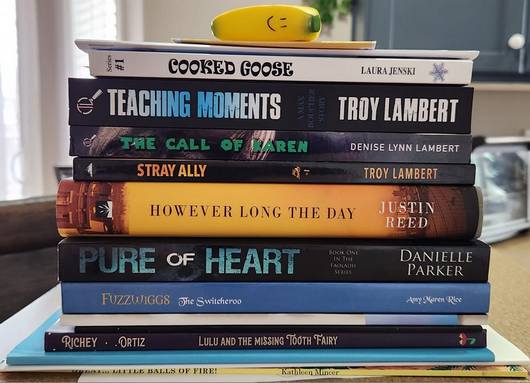
NPL Indie Fair Book Haul
What you see there (in addition to my lousy photography skills) is:
bullet Cooked Goose—the first in Laura Jenski’s Motorhome Murder Mystery series
bullet Teaching Moments—the second in Troy Lambert’s Max Boucher Mystery series
bullet The Call of the Karen by Denise Lynn Lambert, a book I’m not going to try to describe until I read it.
bullet Stray Ally—a military/dog adventure by Troy Lambert
bullet However Long the Day by Justin Reed—essentially The Prince and the Pauper in 1918 New York
bullet Pure of Heart—the first in Danielle Parker’s Faoladh Series
bullet Fuzzwiggs: The Switcheroo by Amy Maren Rice—a YA fantasy adventure
bullet My Border Collie World by Ruth Simerly, which pretty much looks like what the title says.
bullet Lulu and the Missing Tooth Fairy and Trouble with Truffles (do you have any idea how hard it is to get my fingers to not type “Tribbles” there?) by S. E. Richey
bullet Red Stripes VS Miles the Mutant Mouse by Kyson Rice, and illustrated by Amy Rice
bullet George the Banana: Book One by Elliot Linker (he was also giving away the banana toy on top of that stack—with the hand-drawn face)

I’m so glad I knocked off so many books from Mt. TBR last month, I need the space…


Literary Locals logo

A Few Quick Questions with…Andi Ewington

A couple of hours ago, I belatedly posted about Ewington’s Comedic Epic The Hero Interviews, and now we get to hear a little from the author himself. I’ve had very few less-than-completely pleasant interactions with authors on this side, but some really stand out on the positive side. Andi Ewington fits into that category–in all our interactions over the last few months, Ewington has been kind, patient, gracious, generous, and funny. So it brings me a great deal of pleasure to share a little bit more of him with you all.

Andi EwingtonAndi Ewington is a writer who has written numerous comic titles including Forty-Five45, Campaigns & Companions, S6X, Sunflower, Red Dog, Dark Souls II, Just Cause 3, Freeway Fighter, and Vikings. Andi lives in Surrey, England with a plethora of childhood RPGs and ‘Choose Your Own Adventure’ gamebooks he refuses to part with. He’s usually found on Twitter as @AndiEwington.


Why don’t we start with a quick introduction—who is Andi Ewington, and how did he get into writing? What made him jump from comics to novels?
I’m a creative at heart; initially, I was a graphic designer for over 30 years, designing computer game packaging, advertising and branding. I got into comics with my critically acclaimed debut novel (Forty-Five), published in 2010. For nearly ten years, I built a small comic-writing side hustle alongside my day job, writing for IPs such as Just Cause, Dark Souls, World of Tanks, Vikings, and Pac-Man. In late 2018, I switched from design to writing games full-time before being promoted to Game Director. During this time, I was finding it harder and harder to secure regular comic work, so I published a series of funny tweets about cats and dogs playing Dungeons & Dragons called ‘Campaigns & Companions’. After that, my desire to see my words published as a complete novel consumed me—thus, ‘The Hero Interviews’ was born.

All authors have more ideas running around in their head than they can possibly develop—what was it about this idea that made you commit to it? What’s the appeal to you as an author about the interview structure?
I have a huge affinity for fantasy (having spent endless hours playing Dungeons & Dragons, Middle Earth RPG, Fighting Fantasy, Talisman, and Warhammer) and comedy (watching endless repeats of Blackadder, Father Ted, Alan Partridge, Monty Python). The idea slowly came to fruition after influences from The Incredibles, Creature Comforts, and World War Z—all of whom employed the Q&A format in their narrative. With so many epic fantasy yarns on the market, I wanted to publish something a little different that gave readers small nuggets of information that, when pulled together, create a bigger picture. Plus, you don’t have to believe everything in an interview—sometimes, what’s being said is only one side of a gold coin. I had done something similar with my debut graphic novel, Forty-Five—but The Hero Interviews resonates more with me because it’s written from the heart, with a plethora of personal experiences thrown in.

Between this and Campaigns & Companions, it’s pretty obvious that D&D is a pretty big influence in your mind. Do you trace your interest in storytelling to the game, or was it the other way around (assuming you can trace that in the first place)? What, for you, is the draw of that kind of game?
First and foremost, Dungeons & Dragons was the perfect social game growing up—it allowed me to stay up late with my mates, eat pizza, drink bottles of coke, and roll with laughter at the stupid situations we found ourselves in. Those were amazing days back then—and certainly a massive influence on where I am now. I especially loved subverting a carefully crafted adventure by doing things the DM hadn’t planned. Much of my storytelling spawned from Choose Your Own Adventure/You Are The Hero gamebooks (Fighting Fantasy, Way of the Tiger, Falcon, Lone Wolf). Being an only child meant I needed an escape from the boredom of solitude; those books did more to forge my love of narrative than anything else—especially as they put me central in the story as an active participant rather than a reader dragged along for the ride.

How do you approach humor in your books? Do you work to maintain a balance between it and the action/tension? Does it come naturally? Do you have to come back on a later draft and insert or delete jokes to get it right? (or I guess, insert other material to balance out the jokes?)
I find humour comes naturally; I’m always thinking of funny conversations, gags, one-liners, retorts, or situations—I love making people laugh! So, when it came to The Hero Interviews, it was a very organic process. I’d start with an overall idea, then try to subvert it somehow in a funny way—usually, as I’d work out the scene, I’d find the jokes would write themselves. Sometimes, I’d massage a joke more if I felt I hadn’t stuck the landing or cut it altogether if a beta reader didn’t respond well to the gag. As for action versus comedy, there’s always a delicate balancing act to ensure the jokes don’t get in the way of the plot or the action—killing a funny moment. So, I approached action in two ways—with what information was being shared in the interview and what was happening during the interview. This way, I’d have two opportunities for comedy to appear during an action scene, either through observations or slapstick.

I love a novel with comic footnotes. Can you talk a little about the choice to use that technique—in general, and how you decide when to use a footnote to deliver the joke rather than keeping it in the text? Do you add the footnotes while writing the “main” text or do you go back and add them later?
The footnotes came about after finishing the main draft of the story; I was struggling to further Elburn’s personality, using only questions—but I had just been reading ‘Tales From Small Planets’ by Nate Crowley, and I enjoyed the banter between the editor and the author which developed through the footnotes. I reasoned I could do something similar but have Elburn’s personality shine through the footnotes as off-the-cuff commentary. I know there are over 1700 footnotes, which can be quite a task to negotiate through—but I felt just incorporating them into the Q&A would weaken Elburn’s voice and potentially lose some of the joke’s impact (especially jokes that ran across several other footnotes). Ultimately, I feel it was the correct choice—even though I’m sure a few don’t enjoy the way it pulls them out of their reading experience*.

*If that happened to you, I’m really sorry—but I’m not sorry enough not to do it all again!

This was a long novel—even by the standards of Fantasy novels. Did you consider releasing it in smaller books (like whatshisname did with the thing about the ring)? Did you spend time thinking about the length at all, or was it a case of “this is what it took to tell my story, so that’s as long as it is”?
Oh, for sure, I knew it would be a beast of a book—and the idea of breaking it down into smaller volumes briefly crossed my mind. But, I think if I had, then it would severely hamper the whole experience of cross-referencing interviews with one another. I also wanted ‘The Hero Interviews’ to be the spiritual successor to my debut novel ‘45’, which spanned forty-five interviews—as you probably know, that’s the same number of interviews found inside ‘The Hero Interviews’.

Let’s play “Online Bookstore Algorithm” (a game I made up for these Q&As). What are 3-5 books whose readers may like The Hero Interviews?
The Hitchhiker’s Guide to the Galaxy (Douglas Adams)
Notes from Small Planets (Nate Crowley)
World War Z (Max Brooks)
Guards! Guards! (Sir Terry Pratchett)

What’s next for Andi Ewington, author?
I’m currently editing a book for a friend of mine; after that, I will start work on the sequel to The Hero Interviews—The Hero Diaries!

Thanks for your time—and thanks for The Hero Interviews, I had a blast with it and I hope you have plenty of success with it.


LITERARY LOCALS: A Q&A About Writing in Idaho with Danielle Parker

Literary Locals logo
Last week, I said that we’d be taking a quick break while I worked on recruiting some more participants for this. I hadn’t accounted for how quickly Danielle Parker would respond to the questions. I’m really looking forward to diving into her werewolf books soon–but for now, let’s dive into her thoughts about writing in Idaho.

I think we’re taking a break for a couple of weeks after this, but I’m not going to try to make any predictions.

N.B. This was done before March 4th, so our discussion about the event then is clearly anachronistic.


Before we get into things, why don’t you give the reader a brief introduction to you and your work.
I write using the pen name of Danielle Parker. I’ve been a soldier since 2006 and I’m retiring soon to write full-time and raise my son. My husband and I are very excited about that! My books are primarily under the Urban Fantasy umbrella with lots of sarcastic characters. I like horror/comedy and think it shows in my stories. I’m hoping to branch out into thrillers soonish.

I don’t exist much online – usually too busy writing – but I’m probably the most active on Tumblr (at the moment), Werewolves Don’t Sparkle – Tumblr.

That’s a great title!
Thank you! It makes me laugh every time I see it.

What brought you to Idaho in the first place? What is it about Idaho that keeps you here?
I wasn’t born here, but we moved to Idaho when I was around 7 or 8, so I would say I grew up here. My father was in the military as well and when he left the service we moved to Boise to be closer to relatives. I’ve stayed in Idaho mostly for family, but I also really enjoy a lot of things about the state. The writing culture is one big thing, but I also love the mountains.

Are you tied into some sort of local author/bookish group/culture? If so, tell us about it and how it helps you as an author. If you’re not, is there a reason for it?
I’m a founding member of the Treasure Valley Critique Group, I co-own Bert Books Publishing with my bestie, Troy Lambert, and I’m a member of the Idaho Writers Guild (and recently elected Vice President). I find that the more like-minded people I’m around, the more networking I do, the more encouraged and enthusiastic I am about writing! It’s nice to be around people who share your passion, and super helpful when it comes to navigating things like publishing.

What kind of events in the area do you attend—either to sell/promote your books or to network with authors? Are there any outside of this area that you hit regularly and wish we had something like it here?
I try to go to a lot of local events but haven’t had a lot of time prior to this year. Retirement will hopefully open my schedule up to do more in the community. I will be at the Nampa Library book fair on the 4th of March. This summer Idaho Writers Guild has their conference and I’ll be at that. There’s also a festival called Boise Books and Brews that Bert Books put together last year with a huge help from CopenRoss Growlers that will be happening again in June, I believe. Troy Lambert and I will also be going out to connect with the writing community more this Spring/Summer and I’d love to meet up with more local authors!

I’m hoping to make the Nampa Library event on the 4th, too—it looks promising. I tried, but failed, to get to the Books and Brews event (this series came out of my missing it!), shooting for this year! For you, what was the best part of the events you’ve made (or are hoping will be for things like the Nampa Library)–connecting with authors, or reaching out to readers? I can see either being a draw for an author. How do readers react to you at these events (other than the lack that type of reaction you mention below)
Boise Books and Brews was a blast and I hope you can make it out this year. We had so much fun! I definitely enjoy the networking aspect of events. Not that I don’t enjoy meeting readers, because I do, but I also get into some really interesting conversations with other authors. Readers tend to be enthusiastic and ask a lot of questions, which I like and I end up asking them a lot of questions. It’s a different vibe between a reader and an author.

What’s the breakdown of your audience—do you have a strong local base, or are your readers from other parts of the world?
Most of my readers are from other parts of the United States. I’m hoping to connect with more readers locally this year. I’ve been a recluse for a fair minute and it’s time to make some new friends.

How have you gotten the word out to those other parts of the US? Or is that one of those things that just happened?
I think it probably has to do with how my books are advertised on Amazon, maybe? That’s one of those things that I would be asking Troy. I’m always surprised to see sales or page reads popping up in places like Canada or Germany!

Do you think there are particular challenges or advantages to being a writer in the Treasure Valley? (possibly both)
It’s a bit of both, really. The challenge is that we’ve got a small community of writers and we don’t always talk to each other, so that can be difficult to navigate. I think that’s also an advantage though – because we’re small it makes it easier to bring everyone together!

I write a lot for the LGBTQ+ community, so I’m often wary of someone coming out of the woodwork to yell at me – but I’ve yet to have an altercation and that’s made me very, very happy about our readers in the Treasure Valley. My parents were worried.

Do you bring Idaho (or some sort of Idaho-sensibility, assuming one exists) to your work? Whether or not anyone else sees it, can you look at some aspect of your writing and think “That’s Idaho” or “I would do ____ differently if I was a Kentuckian or from Illinois?”
I’m not sure it counts, but the outdoors features heavily in my werewolf series (The Faoladh Series). I think that’s a thing here in Idaho, a shared love of nature. Even the glampers are outside in their own way, enjoying the majesty of the Idaho wilds. I may be answering the question wrong, but I also think being outdoorsy and growing up in Idaho had an impact on my love of monsters – and most of my characters are the outdoorsy kind too. They’d fit right in.

I definitely think outdoorsy characters/settings definitely are (or can be) an Idaho-sensibility. Now, when it comes to the “Idaho wilds” there’s a bit of variety—what type/area is your favorite? Is that the same kind your werewolves are found in, or do they differ from you?
I like the woods. There’s nothing wrong with a mountain or a lake/river, but I like being in trees. Something about it feels soothing. Though I have to admit, I’m also very wary and respectful of predatory animals like bears. The deep woods at night are frightening.

My werewolves are very similar. Harper spends a lot of time in the woods. She lives in Montana though, which is another place I’m very familiar with. I used to summer in the Glacier area with my grandparents.

One final question, is there a book (or two…or 18, if you get really carried away), that embodies Idaho/the Idaho spirit to you to recommend to my readers?
Well, Troy Lambert writes stories set in Idaho a lot. There’s Rick Just for another Idaho author who writes about Idaho. I also haven’t read The Boys of Boise, but I’ve been informed that my grandmother-in-law was somehow involved in that story. Just don’t tell my husband I haven’t gotten around to reading it! Oh, and Troy and I put out a short story collection called “Monster Marshals: Incidents in Idaho” – that’s two short stories about monster hunting, set in Idaho.

I promise I won’t tell a soul. Also, your Bert Books cohort, James, mentioned Rick Just and your Incidents in Idaho. I’m definitely going to check into both at this rate!

Thanks for your time and participation! Hope you enjoyed it!


Literary Locals logo

LITERARY LOCALS: Upcoming Event—Treasure Valley Indie Book Fair

Literary Locals logo
I’ve shared posts about this a little on various social media platforms, but now I see a final line-up/details, so I figured I might as well throw up a quick post about this event coming up on March 4th for anyone in the area who might be interested.

The Nampa Public Library will be hosting the Treasure Valley Indie Book Fair (or, if you prefer snazzy images to a text link, try this one)—there will be panels/workshops about Writing the American sonnet, talking about Youth Books, the oft-mentioned Idaho Writers Guild, Comic Books and Zines. Almost 50 local writers/illustrators/publishers will be in attendance, and I’m going to try to overcome my introversion and talk to as many of them as I can while picking up more books than I should. Three of them have or will be participating in this series already, so I’m looking forward to some face-to-face interaction with them.

If you can, you should come out to this—it looks like a good time (and will likely take away all that progress I made on Mt. TBR last month).


Literary Locals logo

LITERARY LOCALS: What Have We Learned So Far?

Literary Locals logo
So, I’ve finished with the first batch of authors for this series—and before we take a break while I work on a second batch, I thought I’d see if I’ve learned much about writing in Southwest Idaho.*

* Yes, there’s the one outlier in Eastern Oregon—which may end up being part of “Greater Idaho” in the next few years. But I’m not going to take the time to add that disclaimer throughout here. Can we just agree it’s implied?

Of the nine people I’ve talked to, two have been native to Idaho and most moved here young enough to be “as close to being a native Idahoan as you can get without getting your eye wet,” as Danielle Higley put it, with a couple of people who came later in life. I honestly expected the native/close-enough to be closer to 50%, to that’s nice. The beauty and the people are what keep people here.

Almost everyone is involved in (or wants to get back involved) with a local writers’ group—Idaho Writers Guild being the most popular, but some good stuff has been said about others. The outliers do have friends they can turn to for support, though. No lone wolves here.

Rediscovered Books in Boise and Caldwell is far and away these authors’ choice for local events—the Boise Library’s Comic Arts Festival, Gem State Comic Con, Books and Brews, Nampa’s Festival of the Arts, plus miscellaneous arts and crafts fairs, got some good representation, too. As did LTUE in Utah and Montana’s MisCon.

One thing I found interesting is that essentially authors said their audience was very local, or it’s not very local. I’d expected some sort of mix. With those who are still starting out, it makes sense that local readers would make up the bulk of the audience (along with the all-important friends-and-family base)—but I’d figured those who were more established would have a decent local following in addition to sales in other areas of the country/world.

Everyone said essentially the same thing when it came to strengths/weaknesses about writing around here—the smallness of the market and distance from bigger markets is a hindrance but not that much of one thanks to the internet. Also, local writers and local people are the strengths of writing here.

When it comes to “do you bring an area-specific sensibility or feel to your work, most say no—other than subconsciously. It’s where they live and who they’re around, so sure…but no one’s doing it deliberately (other than setting the occasional book in this area).

The last question I ask is for recommendations for books “that embody Idaho/the Idaho spirit.” Here’s what we’ve gotten so far:
bullet Farmhouse by Sophie Blackall
bullet The Indifferent Stars Above: The Harrowing Saga of the Donner Party by Daniel James Brown
bullet The How and The Why by Cynthia Hand
bullet Into The Darkness by Marlie Harrs and Troy Lambert
bullet Big Jim Turner by James Stephens
bullet Incidents in Idaho: A Monster Marshals Collection by Troy Lambert and Danielle Parker
bullet The Giver of Stars by Jojo Moyes
bullet All the Bright Places by Jennifer Niven
bullet Educated by Tara Westover
bullet Fearless: The Story of Farris Lind, the Man Behind the Skunk by Rick Just
bullet And then a few authors were mentioned without specific books: Ivan Doig, Hemingway (“it’s like reading about the romanticized version of Idaho that I have in my head,” said Jeremy Billups), Craig Johnson, and Norman Maclean.

So, I don’t know that I’ve learned a lot—it’s a small sample size, for one thing. But, there are some themes—and a lot of exceptions to those themes. Which feels pretty Idahoan to me.


Literary Locals logo

LITERARY LOCALS: A Q&A About Writing in Idaho with Troy Lambert

Literary Locals logo
Unless a very swamped author manages to find the time to get back to me soon, this will be the last in the first wave of these Q&As—I’m at work on the next batch, though. I’m really enjoying them and hope you are, too.

I talked to Troy Lambert a couple of weeks ago about his book Harvested, and now I’m glad to share his thoughts about writing in this corner of Idaho.


Before we get into things, why don’t you give the reader a brief introduction to you and your work.
I’m Troy Lambert, the author of over 30 novels, mostly mystery and thriller, but a few others as well. I currently live in the mountains of Idaho with my wife and a couple talented dogs. You can learn more about me at troylambertwrites.com.

Are you a native Idahoan? What is it about Idaho that keeps you here?
I have lived in Idaho most of my life, starting when I was four, so I didn’t really “choose” to move here. However, I love it, and have been all over the state. I have left several times and moved away, but keep coming back over and over, so it’s kind of in my blood. I love mountains, rivers, and the diversity of nature in Idaho. It’s an amazing place.

Are you tied into some sort of local author/bookish group/culture? If so, tell us about it and how it helps you as an author. If you’re not, is there a reason for it?
I’m actually the current president of Idaho Writers Guild, and I think connecting with other writers is super important. We often work alone, and networking with others like us is good for our mental health. And there is always something to learn, and writers’ organizations like the guild offer those opportunities in ways you could not find them on your own.

Almost every person I’ve talked with in this series has mentioned IWG—it’s clearly a valued group. All right Mr. President—give these readers your sales pitch. Why should they join up with IWG (or what kinds of things should they look for in a local group outside of Idaho?)
Well, first Idaho Writers Guild has some great speakers at our conference this year, and some great plans for more in the coming months. But also, it’s an opportunity to network with other writers and to give back to the writing community. We want you to be part of what we’re doing, and that means you can volunteer and with our support make things happen in our community that you want to see more of.

What kind of events in the area do you attend—either to sell/promote your books or to network with authors? Are there any outside of this area that you hit regularly and wish we had something like it here?
So I attend book signings, and when I have book releases, I often partner with Rediscovered Books for those launches. I also attend writers’ conferences and workshops whenever I can. I attend a lot of conferences outside the area as well, including LTUE in Utah, 20Booksto50K in Vegas, and others. I think we are headed the right direction with conferences and workshops here, and I hope we can bring more great teachers here going forward.

What’s the breakdown of your audience—do you have a strong local base, or are your readers from other parts of the world?
That’s a funny question. Because I was just telling a friend of mine that I go to L.A. or Utah and I get recognized. In Boise, nobody knows who I am. I mean not quite, but my following is mostly digital and from all over the place.

I’m getting answers like yours or the opposite—doing well here, and not much everywhere else. Do you have plans to change your local profile—or are you doing well enough that it’s not a concern? How have you gotten the word out to places like Utah or L.A. or wherever?
So the short answer? Most of my growth in “fans” happens organically. So I probably won’t change my local profile, but I don’t shy away from it either. As to getting the word out? Sometimes that is just about being out there in the writing and reader community. Being present and someone that people can connect with is probably the single most important thing you can do.

Do you think there are particular challenges or advantages to being a writer in the Treasure Valley? (possibly both)
Like any other place, I think a bit of both. There is a challenge here in that we have a lot of writers’ groups, and while we are working on better working together, there are still times when the community is fractured in many ways. In addition, there is a challenge from the rising cost of living. It is hard for artists and writers to make ends meet anyway, and finding affordable housing makes that even more challenging.

However, on the plus side, there are a lot of writers who live here. And living and working in a gorgeous place like this has some definite upsides for your mental health.

Do you bring Idaho (or some sort of Idaho-sensibility, assuming one exists) to your work? Whether or not anyone else sees it, can you look at some aspect of your writing and think “That’s Idaho” or “I would do ____ differently if I was a Kentuckian or from Illinois?”
I’ve been told I put Idaho or the west in all my books, and that is almost 100% true. I also put dogs in most of my books, so I guess the things I love the most come through whether I want them to or not.

Idaho and Dogs…a good combination.
Heh. I think so. But I may be biased. Only slightly.

One final question, is there a book (or two…or 18, if you get really carried away), that embodies Idaho/the Idaho spirit to you to recommend to my readers?
Well, my latest book Teaching Moments is set in Idaho, so there is that. But it is also about a serial killer, so maybe not the spirit of Idaho. However, there are a lot of local authors with some amazing books about the area, so that is probably too long a list to include here.

But if you get down to Rediscovered Books, ask those folks for a recommendation. They know their stuff.

Thanks for your time and participation! Hope you enjoyed it!


Literary Locals logo

A Few Quick Questions with…Josef Matulich

This morning, I talked about Matulich’s The Silk Empress and now I’m glad to bring you this Q&A with the author—great answers!


Let’s start off by introducing yourself to the readers—talk about your background, path to publication, etc.
I am a writer/artist that specializes in horror comedy, with a few interesting side-quests like make-up special effects artist and theater tech. My first publication was a humorous think-piece in Science Digest at eighteen. I had various small successes with short plays, RPG games and such until about eight years a small press published Camp Arcanum. Since then, I’ve published four novels through different publishers. When rights reverted for the Arcanum Faire trilogy (Camp Arcanum, Power Tools in the Sacred Grove, & The Ren Fair at the End of the World) I released them myself with Seth Lyons covers. The Silk Empress is my first original indie book released through both Amazon and Ingram. Not willing to just do what I knew I was safely capable of, this project included front and back covers by Seth, plus interior illos by him for each of the chapters. I think I broke my artist.

All authors have more ideas running around in their head than they can possibly develop—what was it about this idea that made you commit to writing it? It’s not like anything else you’ve done—was that part of the attraction?
There was a recurring situation at book events where I sat behind a table full of books suitable for the 16+ crowd filled sex, magick, and power tools and have to tell a 12 year old and his parents that these books really weren’t for them. I decided to write my next book without anything inappropriate for my 12-year-old hero. Several years ago, a local library had the vintage and costume shop my wife and I own present a Steampunk fashion show. The theme was an airship hauling silk from China to Europe and each model was a member of that crew. In my three years of Cancer, Chemo, and Covid lockdown I was able to mesh those two concepts.

Stephen King’s recent comments notwithstanding, let’s talk worldbuilding. In general, and with this book specifically, what’s your approach? Do you sit down and figure it all out ahead of time (setting, technology, culture(s), etc.?) or do you just make up most/all of it on the fly as you come across the need while writing?
I started with the concept of the High Silk Road and the industrial revolution that allowed China to win the Second Opium War and shrug off the colonial powers of Europe. Then the various technologies like the stiffened silk airship hulls, phlogiston, Liu Industries explosives, and karakuri automata were added to the mix. Then I started peppering the map of the old Silk Road with locations and notes while throwing in my revisions to history like the U.S. Civil War only lasting a few months after the introduction of German manufactured airships. Researching the Turfan caravanserai and the Uyghurs I found the perfect place for intrigue and adventure. On top of that, I liberally sprinkled Ship’s Cant, a patois of Chinese, French, and Portuguese, along with a bit of Asian folklore. Some swearing in Mandarin and Scots Gaelic added for taste. Backtracking to add new bits that I discovered ten or twenty chapters in was a constant process.

How do you approach humor in your books? I recall there being a decent amount in Camp Arcanum and there’s plenty here (including jokes that will likely fly above the target audience’s head). Do you work to maintain a balance between it and the action/tension? Does it come naturally? Do you have to come back on a later draft and insert or delete jokes to get it right?
Humor is something I naturally do; it kept me from getting flattened on the school yard and kept me sane in my adult years. The Silk Empress was always intended as a misadventure, which has all the elements of a great boy hero story, but things consistently go horribly wrong. Most of the jokes are baked in from the beginning. The majority of the rewrites involved improving description, character, and narrative. My editor had me remove a few remarks by the 19th century insular boy hero that were fitting for the character, but not acceptable for modern readers.

I don’t have a specific question here, but why don’t we take a moment to talk about finding and working with Seth Lyons—how much (in your mind) did those illustrations benefit the book?
Seth Lyons came to us through our store where we have a large Steampunk costume section, and he had a great collection of his steampunk art prints we carried. When I republished The Arcanum Faire books, he and I got our heads together for the covers. The original small press covers I had given specific input to the artist and the result was disappointing. With Seth, we got together at a Chinese restaurant and went over characters and visual elements, and then I let him run amok. The results were far superior. We did the same for Silk Empress, producing a great front and back cover worthy of the novel’s penny dreadful roots. Seth also created the logo, and then a few interior illos. I would have settled for a half-dozen, but he created one for each chapter. Some people disapprove of pictures in novels, but since this was written as an adult novel with YA sensibilities, I think it adds quite a bit.

Let’s play “Online Bookstore Algorithm” (a game I made up for these Q&As). What are 3-5 books whose readers may like Silk Empress?
I can’t really say with any confidence what books are like this one. I once pitched it as Scott Westefeld’s Leviathan X Jonny Quest. Those who enjoy the humor and wanton destruction of The Dresden Files might enjoy it. Or perhaps the free-wheeling adventure and criminality of The Stainless Steel Rat?

(A fantastic pitch, and the other comparisons are great. I’m very tempted to go back and make all these comparisons in my post…)

What’s next for Josef Matulich, author? A Silk Empress sequel, or do you have something else in the pipeline?
I’m still ruminating on where the Silk Empress will fly next on the High Silk Road, but I am returning to a supernatural Ohio with my WIP Dead People’s Houses. It’s the story of a man who makes his living from estate and tag sales, reselling some pieces and then renting out vintage props for advertising, TV, and film. Things get exciting when the hero begins to see the ghosts attached to those items. And there is still the threat of my Squirrel Apocalypse sequel: World War Squirrel.

Thanks for your time—and thanks for introducing me to Algie, Feng Po, and the rest. I had a blast hanging out with them.


LITERARY LOCALS: A Q&A About Writing in Idaho with Bryan McBee

Literary Locals logo
This is another connection made by my friend who had a nearby booth an Arts fair (or something like that). I don’t know if either my pal or McBee sold much that day, but I appreciate them conversing at least! If you look at his material and compare it to others from this series of posts, one thing you’ll see off the top is the wide variety of genres we have here. It ain’t all potatoes and mountain scenes here, folks.
Anyway, sit back and enjoy this chat with Bryan McBee–and go check out his site and books afterward.


Before we get into things, why don’t you give the reader a brief introduction to you and your work.
My name is Bryan McBee. I am an Idaho author. I served in the US Army for five years. After which, I attended BSU and graduated in 2018. I have been a bookworm for most of my life, thanks in large part to my mom, who caved in to my constant pestering, and read to me from Stephen King’s The Night Shift in third grade. I have been in love with reading and writing pretty much all my life. I finished writing my first novel, Vector Zero, in 2013, and found a publisher for it in 2021. My second novel, Afterworld, came out in 2022, and I just signed a contract for my third novel which is titled Abnormal Ends. A few of my favorite authors are Dan Simmons, Stephen King, Robert McCommon, Megan O’Keefe, John Scalzi and Brandon Sanderson.

What kept you going from 2013-2021? Also, how many revisions did Vector Zero go through in that time? Incidentally, what I’ve heard of Abnormal Ends on social media has me really intrigued—looking forward to that.
Some of the time in between was taken up by college. I took advantage of the GI Bill and returned to school. For much of that time Vector Zero sat in a file on my computer collecting metaphorical dust. I took it out from time to time trying to find an agent to represent it. Each time I reread and revised it a little. Then came working with an actual editor with an eye towards publication and release. All told the novel went through at least five or six major revisions/rewrites before hitting the shelves.

I’m glad to hear that you’re looking forward to Abnormal Ends. I was excited to write it. It’s with the editor as we speak. I will send out updates as they come in.

Are you a native Idahoan? What brought you to Idaho in the first place? What is it about Idaho that keeps you here?
I’ve lived in Idaho most of my life. I moved here from Oregon when I was 13. My mom’s job transferred her here, and I being her only remaining dependent, was carted along with the rest of her luggage. I love it here. It’s clean, the people are nice, and the country is beautiful.

Are you tied into some sort of local author/bookish group/culture? If so, tell us about it and how it helps you as an author.
I am still pretty new to the whole published author thing, so I’m still trying to find my place in the local culture. I’ve joined the Idaho Writer’s Guild. They’ve been pretty helpful with finding events and giving support to a newby like me.

I’m hearing a lot of good things about the IWG from this series of Q&As. What kind of support/help have you found from it? Here’s a chance for a newby to do some outreach so he can become a respected vet 🙂
I’ve only been a part of the Guild for a year, and due to work haven’t had as much time as I would like to take advantage of the conferences and other events they hold. I am hoping to change that this year and become more active within the Guild.

What kind of events in the area do you attend—either to sell/promote your books or to network with authors? Are there any outside of this area that you hit regularly and wish we had something like it here?
I’ve gotten in touch with several bookstores in the Boise area to do signings. They’ve all been very accommodating. Most recently, I was at Barnes and Noble. In addition to bookstores, I will be at the Gem State Comic Con for the second year in a row, and the Idaho Halloween and Horror Con for the third year in a row. Both are great events. Very fun, and I get to meet lots of awesome nerdy people like me. I attended FanX, the Salt Lake City Comic Con in 2022. That was amazing, and almost overwhelming.

I haven’t made it to Gem State yet—what’s it like for authors? (or in general, come to think of it). I don’t think I’ve heard of the Halloween and Horror Con, either—but if you’ve gone twice and are coming back, it’s got to have something going or it, what’s it like and where is it held?
Gem State Comic con was pretty fantastic. I’m told that last year was the first year back after a hiatus. I found the crowd very welcoming and friendly. Lots of people from all sorts of different fandoms gathered to celebrate the things they love.

The Halloween and Horror Convention was my first big show since becoming a published writer. Last year and the year before they held the convention at the Red Lion hotel downtown. But they’ve outgrown that and will be holding it at Expo-Idaho, like Gem Comic Con. It’s a really great show if you like all things Halloween or Horror.

I will try to keep going back to both shows, as long as they will have me.

What’s the breakdown of your audience—do you have a strong local base, or are your readers from other parts of the world?
I am still a very new author on the scene, and in the process of building my audience. Much of my audience is local to the Boise area, because that’s where I live and can easily reach. However, several of my old army buddies have become dedicated readers, so I have some out of state reach. According to the demographics function on my Facebook page, I even have a follower in Malta. Which I think is tremendous!

Malta? Sounds very exotic. You need to arrange a signing there. (The snarky part of my brain just flashed on Cliff Poncier from the movie Singles, “we’re huge in Europe right now. I mean, we’ve got records… uh, a big record just broke in Belgium.”)

Are those buddies spreading the word as well? I’d think that could be good marketing (especially if they’re still enlisted and stuck on base somewhere with other people who need something to fill downtime).
I just rewatched Singles for the first time in years a little while ago!

My army buddies are spreading the word about my books. A few of them have been fans as well as friends for a long time! Every little bit of exposure helps when it comes to building an audience, and word of mouth is absolutely invaluable!

Do you think there are particular challenges or advantages to being a writer in the Treasure Valley?
I can’t say that I’ve seen any particular challenges to being an author here in the Treasure Valley. The internet has made it so that one doesn’t need to be in New York to be discovered. One thing I have noticed, is there is a strong feeling of local pride among people when they see that I’m a local writer. People here love to support local artists and creators. Which I think bolsters the strong sense of community that we all share here.

Do you bring Idaho (or some sort of Idaho-sensibility, assuming one exists) to your work? Whether or not anyone else sees it, can you look at some aspect of your writing and think “That’s Idaho” or “I would do ____ differently if I was a Kentuckian or from Illinois?”
I’m not really sure. My main focus as I’m scribbling away is to try and make my characters and situations as believable as possible, especially when it’s completely unbelievable. I feel like a writer has to be true to the world they have created and the people who inhabit it. On the main, I like to write what I like to read. Which is a little bit of everything. Hence, my first book is a military thriller, my second is a post-apocalyptic fantasy, and my third is going to be a cyber-punk serial killer novel. The only sensibility I try to bring to my work, is to tell the best story I can.

One final question, is there a book (or two…or 18, if you get really carried away), that embodies Idaho/the Idaho spirit to you to recommend to my readers?
Cloud Cuckoo Land by Anthony Doerr. Such a good book.

That’s my first Doerr response, which really surprises me.
In college, especially in English classes, especially in the writing classes, and most especially in the fiction writing classes, the professors name drop Anthony Doerr constantly. Not quite to the point of annoyance, but only just. It did make me curious about his work. So after I graduated (and gained free time with which to read what I wanted to read) I checked out his work. Very impressive, in my opinion. Well worth all the name dropping I heard as an English major in school.

Thanks for your time and participation! Hope you enjoyed it!
Thank you for the opportunity to chat with you!


Literary Locals logo

A Few Quick Questions with…Troy Lambert

A couple of hours ago, I posted about Lambert’s novel, Harvested, the first of a series I know I’m coming back to soon. Now, I have the chance to get some more information about him and the book in this Q&A. He’ll be back in a couple of weeks for a Q&A about writing in Idaho as part of the Literary Locals series—be sure you come back for that.


All authors have more ideas running around in their head than they can possibly develop—what was it about this idea that made you commit to writing it? Also, what was the starting point for this book? Was it the story about the missing dogs or the ongoing story (I’m being deliberately vague here) that required you to invent Max, or did you have Max and need to figure out some stories to put him in? Or is that kind of answer impossible—and you got the whole ball of wax at once?
So the idea of Max as a character came first, although the idea for the plot came shortly after. The idea of missing dogs appealed to me in a lot of ways, and I saw the twist in my head after only a little research, and it kinda all came together after that.

The same was true for Teaching Moments, although in that case the idea for the killer came to me first, and then I worked it into the Max series. The next book in that series is much the same, although I think the main villain in that case is even worse. That one will be out late this year or early next.

Multiple authors have talked about the unbreakable rule even in Crime Fiction is “you don’t kill the dog (or other pets).” But you not only kill some, but threaten several more. Did you think much about the danger inherent in this plot? What compelled you to go forward with it? Or was that danger what drew you into it?
So that is often a “rule” but I think it is all in how you handle it. The dogs for me are just like people in this book: they are valuable characters, and they are even heroic at times (no spoilers, of course)

And the story of dogs continues in Teaching Moments as one of them becomes Max’s partner throughout. Of course, a lot of my other work features dogs as well, and that is because I love them, and can’t help myself when it comes to casting them in books.

Supporting characters really make or break a book for me more than the protagonist does. Dr. Gamble is a great example of that—she was such a fun character. When she was introduced, I really didn’t expect much of her, she seemed like a typical “generic subject matter expert to help the PI get to the next step” that we’re all used to seeing, but you really fleshed her out and made her a big part of the story. Was that the idea all along, or did you just enjoy her so much that you changed her role?
So I liked her from the start. She was a favorite character who came to me pretty fleshed out. I think supporting characters are key to a good story: they produce conflict, tension, but also from time to time just some pleasant relief to that tension. I think she serves all those roles in this story, and she may play additional roles in the series going forward, even becoming more of a key character in Book 5, but that is down the road a bit.

Who are some of your major influences? (whether or not you think those influences can be seen in your work—you know they’re there)
There are several. I would say that Stephen King and Dean Koontz top the list, at least for writing style and in some cases subject matter. They’re also both inspiring on a personal level. But there are certainly others: Lee Child, Vincent Zandri (a good friend now) and others.

Let’s play “Online Bookstore Algorithm” (a game I made up for these Q&As). What are 3-5 books whose readers may like Harvested?
Ha! A fun game. L.T. Ryan readers, stories like Unmasked and that series, Brad Lee, A Team of One, anything in the Chase Baker series by Vincent Zandri, and the Finding Reacher series by Diane Capri.

Your Amazon Author Page lists a lot of titles—you’ve been a busy man for the last decade or so. What is it about storytelling/writing that keeps it fresh for you? Is this a compulsion to keep going, or is it more pleasure?
That’s a two part answer: it is a compulsion, yes, in some ways. But it is also pleasure. I love telling stories, and plan to do it until I just can’t any more. I hope that day is a long way in the future. I don’t ever plan to retire, and there are so many more titles coming out even just this year. I can’t wait to see what I come up with next.

In somewhat of a related question, what’s next for Troy Lambert, author? Also, are there more Max Boucher books to come, or is it a duology? (I largely ask for myself, so I’m in the right frame of mind before I start the next)
So there is another book in the Capital City Murders, and one that signals a major change in the series story, coming in April. Right now there are at least three more Max books planned along with a novella that will be out this year as well, and a new series coming sometime either later this year or the first part of next.

There will be a couple of anthologies and story collections coming, and even a book of poetry at some point. So stay tuned!

Thanks for your time—and thanks for Max Boucher, he’s the kind of PI that the Northwest needs more of (at least in fiction).
You bet. Thanks for having me.


Literary Locals logo

LITERARY LOCALS: A Q&A About Writing in Idaho with Danielle Higley

Literary Locals logo
Back before this series had a name, I posted about Danielle Higley’s book (described below) and she participated in a nice Q&A about it. Now, I’ve got her back to talk about writing in Idaho. I can’t recommend her book enough and I think she gave some great answers below. Hope you enjoy!


Before we get into things, why don’t you give the reader a brief introduction to you and your work.
Sure! I’m Danielle Higley, author of The Stories Behind the Stories: The Remarkable True Tales Behind Your Favorite Children’s Books” rel=”noopener” target=”_blank”>The Stories Behind the Stories: The Remarkable True Tales Behind Your Favorite Children’s Books.

It’s a nonfiction collection of backstories that details how books like Charlotte’s Web, The Very Hungry Caterpillar, and even Captain Underpants came to be. In 2022, it was selected by the Idaho Center for the Book—an affiliate of the Library of Congress—to represent Idaho at the National Book Festival. Since then, I’ve done some public speaking engagements, school visits, and local events to help promote the book. I’ve also been learning how to promote myself as an author and reader online, so if anyone is interested in finding me, you can do so on Instagram at @bookishinboise.

Are you a native Idahoan? What is it about Idaho that keeps you here?
I’m as close to being a native Idahoan as you can get without getting your eye wet. My family moved to Boise from Arizona when I was five, and my parents actually still live in the house I grew up in. I left Idaho a couple times in my 20s—twice for internships and once for fun—and I came back loving Idaho all the more.

To me, Idaho is the stuff of love notes. [IR: That’s such a great line!] It’s beautiful and generous; bountiful with mountains, wildlife, and opportunities to explore the outdoors. I grew up near the foothills, where people spent long minutes waving one another forward at a three-way stop. We borrowed sugar from our neighbors and traded vegetables across the fence.

Idaho is changing. We’re proud of our state, and rightly so. But I hope we always keep our kindness, our welcoming hearts, and our neighborly compassion. More than our simple freeways, our four colorful seasons, our ski resorts, and our beautiful downtown, it’s the culture that keeps me close.

Are you tied into some sort of local author/bookish group/culture? If so, tell us about it and how it helps you as an author.
Boise has several great groups for authors and book lovers. My favorite group is the Society of Children’s Book Writers and Illustrators (SCBWI), which has a local chapter that meets monthly. Since I write almost exclusively for kids, it’s a good fit for me. I’ve also done some events with the Idaho Writers’ Guild and found that group to be welcoming and well-established.

If you’re a local writer, I’d encourage you to consider joining such a group for several reasons: First, there’s the community aspect. Writers are solitary workers, but the revision process requires us to bring in other perspectives to see where we can improve. Getting input from fellow writers can help uncover plot holes, inaccuracies, and inconsistencies.

Second is the education component. Writing groups often offer conferences and other literary events that can help writers and illustrators hone their craft. Such events sometimes also bring in publishing professionals and, for a fee, you may be able to show your work to an agent or editor who could offer you a contract.

What kind of events in the area do you attend—either to sell/promote your books or to network with authors? Are there any outside of this area that you hit regularly and wish we had something like it here?
Last year (in 2022), I attended the first-ever Idaho Books and Brews event, which brought together local authors and local breweries—seriously, what a genius marketing idea that was! I also attended a local author’s event at the Eagle Public Library. Other than that, you can sometimes find me at Rediscovered Books—either the Boise or Caldwell location—and I try to attend any school that wants to have me for an author’s event.

I missed the Books and Brews event (and doing so led to this series!). What was that experience like?
It was great! Basically, the space was divided in two—local authors and their books along the outside edge, and a bunch of local breweries in the middle. Attendees could buy tokens to be exchanged for books or beer. The beer was served in small glasses, perfect for tasting a variety of flavors. The best part, I think, was that authors had plenty of time to talk to readers and sign books.

I hope it does become an annual thing. If so, I definitely plan to attend again.

What’s the breakdown of your audience—do you have a strong local base, or are your readers from other parts of the world?
That’s a great question! I do get messages sometimes from readers, librarians, and booksellers around the country, but most of the people I’ve talked to about my book have been local.

I’m fortunate to have found a really wonderful partnership with Rediscovered Books in Boise, and they’ve supported me by including my book at events and putting it on display in prominent spots in their store. My book doesn’t have a huge marketing budget behind it—Bushel & Peck is a small, independent publisher—so having that kind of attention from a bookseller has made all the difference. I’m truly grateful.
It’s hard to say enough good things about Rediscovered, isn’t it? (incidentally, my copy was on a big display there before it was on my shelf). I’ve imagined the experience as an author would be good—it’s great (and dangerous to the checking account) for the reader.

Do you think there are particular challenges or advantages to being a writer in the Treasure Valley? (possibly both)
People always say “write what you know,” but what we know is a culmination of our life experiences, opportunities, and surroundings. To me, that makes my challenges and advantages one and the same.

Do you bring Idaho (or some sort of Idaho-sensibility, assuming one exists) to your work? Whether or not anyone else sees it, can you look at some aspect of your writing and think “That’s Idaho” or “I would do ____ differently if I was a Kentuckian or from Illinois?”
Hmm… I definitely picture my books in Idaho when I write fiction. Strolling my childhood sidewalks, marching the practice field of my high school, walking along the canal behind my parents’ house. I suspect others could point out my Idaho-isms better than I could, as I’m often guilty of being blind to my own assumptions and generalizations.

One final question, is there a book (or two…or 18, if you get really carried away), that embodies Idaho/the Idaho spirit to you to recommend to my readers?
There’s a really beautiful picture book that just came out and made me think of the Idaho pioneering and family spirit. It’s called Farmhouse by Sophie Blackall, and it’s absolutely gorgeous.

For YA, I’d say All the Bright Places by Jennifer Niven. My mom and I once made a tour of unique Idaho landmarks, including Balance Rock, Soda Springs, and Hagerman (home of the Hagerman horse fossil). That sort of “explore your own backyard spirit” is a cornerstone of that book.

For adult fiction, The Giver of Stars by Jojo Moyes comes to mind. Once upon a time, before there was a library in Garden City, my mom and I would visit our local bookmobile to check out new reading material each week. Not exactly books in saddlebags delivered on horseback, but that sounds quite “Idaho” as well.

And lastly, for nonfiction readers I really must mention The Indifferent Stars Above: The Harrowing Saga of the Donner Party by Daniel James Brown. Had they taken the conventional path through Idaho, the Donner party might have escaped their terrible fate. As it was, we know what happened, and unfortunately I have to admit that had I been a pioneer in their shoes, I absolutely would have opted to take the shortcut…
Wow…this is a great (and thorough) list. My TBR is bigger!

Thanks for your time and participation! Hope you enjoyed it!


Literary Locals logo

Page 8 of 19

Powered by WordPress & Theme by Anders Norén