Category: Opening Lines Page 3 of 7

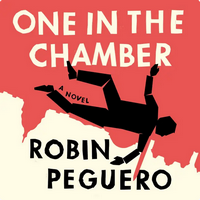
Opening Lines: One In the Chamber by Robin Peguero

Head & Shoulders used to tell us that, “You never get a second chance to make a first impression.” That’s true for wearing dark shirts, and it’s especially true for books. Sometimes the characters will hook the reader, sometimes the premise, sometimes it’s just knowing the author—but nothing beats a great opening for getting a reader to commit.

You aren’t born a killer. You don’t gradually become one, either. One minute, you’re not, and the next, you just are. Like your first time having sex. Just as thrilling. Just as awkward. Nothing much changes but the label. you’re still you. But now, you’re a quote-unquote murderer. You played God and took a human life.

It’s entirely natural, but it still shocks people. Some people want other people dead. We visualize our goals, and we achieve them. Shouldn’t that be celebrated?

You swish someone wanted you dead. Not that you have a death wish. You’re too self-involved for that, and suicide is so gauche. you just wish you were that important to someone. It’s a compliment really: to have given another person’s endpoint more than a passing thought. To decide for them that today is enough. And not just today, but at this very minute, their contribution to history should meet its unceremonious finish. High Flattery.

You’re welcome.

from One In the Chamber by Robin Peguero
Cover to One in the Chamber
I’m not sure what happens over the next 369 pages (in a sense). I just want almost 400 pages like this.

Opening Lines Logo

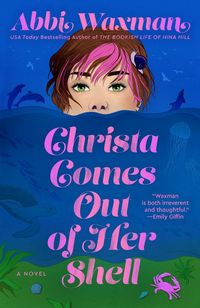
Opening Lines: Christa Comes Out of Her Shell by Abbi Waxman

Head & Shoulders used to tell us that, “You never get a second chance to make a first impression.” That’s true for wearing dark shirts, and it’s especially true for books. Sometimes the characters will hook the reader, sometimes the premise, sometimes it’s just knowing the author—but nothing beats a great opening for getting a reader to commit.

So, I’m going to kick off by making one thing very clear: None of this was my fault. I was part of it, sure, but only like a flea is part of a cat. I was carried along, contributing my own pain-in-the-ass factor, no argument there, but I was mot, in any sense, driving the bus. Let’s not forget that when this story starts, was literally on an island in the middle of nowhere. Hands full, head busy, heart well guarded. Safe as houses, baby.

Wait, that’s not completely accurate. The island of Violetta isn’t in the middle of nowhere; it’s slightly to the right of Africa, many hundreds of miles into the Indian Ocean. It’s a geography cal, political and sociological anomaly, It’s also home to a frozwn vodka drink called the Barrier Island, beyond which no man may safely travel, but that’s a sidenote. It lies two days’ sail from a large French-speaking island more than five hundred miles off the east African coast, which is probably why the French didn’t bother to claim it. It was ignored by the Mauritians, because they thought the French already nabbed it, and blithely disregarded by the British, who had no idea who owned it, but had no reason to think was them.

No one paid much attention to it at all until the 1950s, when an enterprising young Violettan by the name of Agnes Bottlebrush did a school project on the even younger United Nations and then quietly applied for membership for Violetta (Agnes was an overachiever with time on her hands). As the result of a series of fortunate and slightly comedic events, Violetta became the smallest member of the United Nations, and Agnes received a rapid promotion to Head Girl. Then she walked around to everyone’s houses and handed them a copy of the UN Charter and gathered suggestions for what to put on the flag.

from Christa Comes Out of Her Shell by Abbi Waxman
Christa Comes Out of Her Shell Cover
I’m not sure what happens over the next 369 pages (in a sense). I just want almost 400 pages like this.

Opening Lines Logo

Opening Lines: Miracles by C.S. Lewis

from Miracles by C.S. Lewis:

In all my life I have met only one person who claims to have seen a ghost. And the interesting thing about the story is that that person disbelieved in the immortal soul before she saw the ghost and still disbelieves after seeing it. She says that what she saw must have been an illusion or a trick of the nerves, And obviously she may be right. Seeing is not believing.

For this reason, the question whether miracles occur can never be answered simply by experience. Every event which might claim to be a miracle is, in the last resort, something presented to our senses, something seen, heard, touched, smelled, or tasted. And our senses are not infallible. If anything extraordinary seems to have happened, we can always say that we have been the victims of an illusion. If we hold a philosophy which excludes the supernatural, this is what we always shall say. What we learn from experience depends on the kind of philosophy we bring to experience. It is therefore useless to appeal to experience before we have settled, as well as we can, the philosophical question.

If immediate experience cannot prove or disprove the miraculous, still less can history do so. Many people think one can decide whether a miracle occurred in the past by examining the evidence “according to the ordinary rules of historical inquiry.” But the ordinary rules cannot be worked until we have decided whether miracles are possible, and if so, how probable they are. For if they are impossible, then no amount of historical evidence will convince us. If they are possible but immensely improbable, then only mathematically demonstrative evidence will convince us: and since history never provides that degree of evidence for any event, history can never convince us that a miracle occurred. If, on the other hand, miracles are not intrinsically improbable, then the existing evidence will be sufficient to convince us that quite a number of miracles have occurred, The result of our historical enquiries thus depends on the philosophical views which we have been holding before we even began to look at the evidence, The philosophical question must therefore come first.

Here is an example of the sort of thing that happens if we omit the preliminary philosophical task, and rush on to the historical. In a popular commentary on the Bible you will find a discussion of the date at which the Fourth Gospel was written. The author says it must have been written after the execution of St. Peter, because, in the Fourth Gospel, Christ is represented as predicting the execution of St. Peter. “A book,” thinks the author, “cannot be written before events which it refers to.” Of course it cannot—unless real predictions ever occur. If they do, then this argument for the date is in ruins, And the author has not discussed at all whether real predictions are possible. He takes it for granted (perhaps unconsciously) that they are not. Perhaps he is right: but if he is, he has not discovered this principle by historical inquiry. He has brought his disbelief in predictions to his historical work, so to speak, ready made. Unless he had done so his historical conclusion about the date of the Fourth Gospel could not have been reached at all. His work is therefore quite useless to a person who wants to know whether predictions occur, The author gets to work only after he has already answered that question in the negative, and on grounds which he never communicates to us.

This book is intended as a preliminary to historical inquiry. I am not a trained historian and I shall not examine the historical evidence for the Christian miracles, My effort is to put my readers in a position to do so. It is no use going to the texts until we have some idea about the possibility or probability of the miraculous, Those who assume that miracles cannot happen are merely wasting their time by looking into the texts we know in advance what results they will find for they have begun by begging the question.


Opening Lines Logo

Opening Lines: City on Fire by Don Winslow

We all know we’re not supposed to judge a book by its cover (yet, publishing companies spend big bucks on cover design/art and we all do judge them that way). But, the opening sentence(s)/paragraph(s) are fair game. So, when I stumble on a good opening (or remember one and pull it off the shelves), I like to throw it up here. There are so few writers that can grab you like Winslow can from the get-go.

from City on Fire by Don Winslow:

Danny Ryan watches the woman come out of the water like a vision emerging from his dreams of the sea.

Except she’s real and she’s going to be trouble.

Women that beautiful usually are.

Danny knows that; what he doesn’t know is just how much trouble she’s really going to be. If he knew that, knew everything that was going to happen, he might have walked into the water and held her head under until she stopped moving.

But he doesn’t know that.

So, the bright sun striking his face, Danny sits on the sand out m front of Pasco’s beach house and checks her out from behind the cover of his sunglasses.

Opening Lines Logo

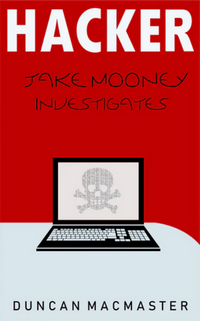
Opening Lines: Hacker by Duncan MacMaster

Head & Shoulders used to tell us that, “You never get a second chance to make a first impression.” That’s true for wearing dark shirts, and it’s especially true for books. Sometimes the characters will hook the reader, sometimes the premise, sometimes it’s just knowing the author—but nothing beats a great opening for getting a reader to commit.

I will not start this story at the moment I found an eyeball floating in my Coke.

from Hacker by Duncan MacMaster
Hacker Cover
Hard to top this. You have to keep going, right?

Opening Lines Logo

Opening Lines: The Last Dance by Mark Billingham

We all know we’re not supposed to judge a book by its cover (yet, publishing companies spend big bucks on cover design/art and we all do judge them that way). But, the opening sentence(s)/paragraph(s) are fair game. So, when I stumble on a good opening (or remember one and pull it off the shelves), I like to throw it up here. This one characterizes so much of this book–good, solid detective/procedural kind of writing, served up with a perfectly off-kilter line that doesn’t belong there, but improves the whole thing so much that it actually has to be there.

from The Last Dance by Mark Billingham:

The coloured lights from more than a million lamps seem to dance above the town’s main street and their reflections shimmer on the surface of the black sea just beyond. On the street itself, a thousand neon signs dazzle and buzz and the slow-moving traffic has become a pulsating necklace of red and white beads. To the casual observer, gazing down from the top of the Tower perhaps, or from a penthouse apartment in one of the expensive blocks that have sprung up in recent years, this might be Las Vegas.

If that casual observer really squinted.

And had never been to Las Vegas.

Opening Lines Logo

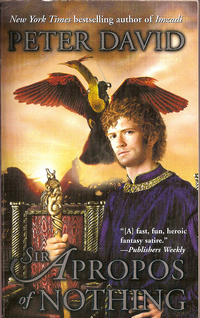
Opening Lines: Sir Apropos of Nothing by Peter David

Head & Shoulders used to tell us that, “You never get a second chance to make a first impression.” That’s true for wearing dark shirts, and it’s especially true for books. Sometimes the characters will hook the reader, sometimes the premise, sometimes it’s just knowing the author—but nothing beats a great opening for getting a reader to commit.

Going back a couple of decades for this one, but I came across it recently and it just about pulled me in for a day or three.

As I stood there with the sword in my hand, the blade dripping blood on the floor, I couldn’t help but wonder if the blood belonged to my father.

The entire thing had happened so quickly that I wasn’t quite sure how to react. Part of me wanted to laugh, but most of me fairly cringed at what had just occurred. I didn’t do particularly well with blood. This tended to be something of a hardship for one endeavoring to become a knight, dedicated to serving good King Runcible of Isteria, a ruler who more often than not had his heart in the right place.

The recently slain knight also had his heart in the right place. This had turned out to be something of an inconvenience for him. After all, if his heart had been in the wrong place, then the sword wouldn’t have pierced it through, he wouldn’t be dead, and I wouldn’t have been in such a fix.

from Sir Apropos of Nothing by Peter David
Sir Apropos of Nothing Cover

Opening Lines Logo

Opening Lines: Nasty, Brutish, and Short by Scott Hershovitz

We all know we’re not supposed to judge a book by its cover (yet, publishing companies spend big bucks on cover design/art and we all do judge them that way). But, the opening sentence(s)/paragraph(s) are fair game. So, when I stumble on a good opening (or remember one and pull it off the shelves), I like to throw it up here. This one grabbed me with the voice and the humor–this was not going to be your typical book about philosophy.

from Nasty, Brutish, and Short: Adventures in Philosophy with My Kids by Scott Hershovitz:

“I nee a philosopher.” Hank was standing in the bathroom, half-naked.

“What?” Julie asked.

“I nee a philosopher.”

“Did you rinse?”

“I nee a philosopher,” Hank said, getting more agitated.

“You need to rinse. Go back to the sink.”

“I nee a philosopher!” Hank demanded.

“Scott!” Julie shouted. “Hank needs a philosopher.”

I am a philosopher. And no one has ever needed me. I rushed to the bathroom. “Hank, Hank! I’m a philosopher. What do you need?”

He looked puzzled. “You are not a philosopher,” he said sharply.

“Hank, I am a philosopher. That’s my job. What’s bothering you?”

He opened his mouth but didn’t say anything. “Hank, what’s bothering you?”

“DER’S FOMETHING FUCK IN MY FEETH.”

A flosser. Hank needed a flosser—one of those forked pieces of plastic with dental floss strung across it. In retrospect, that makes sense. A flosser is something you could need, especially if you are two and your purpose in life is to pack landfills with cheap pieces of plastic that provided a temporary diversion. A philosopher is not something that people need. People like to point that out to philosophers.

Opening Lines Logo

Opening Lines: The Blonde Identity by Ally Carter

Head & Shoulders used to tell us that, “You never get a second chance to make a first impression.” That’s true for wearing dark shirts, and it’s especially true for books. Sometimes the characters will hook the reader, sometimes the premise, sometimes it’s just knowing the author—but nothing beats a great opening for getting a reader to commit. This is one of the better openings I’ve heard recently. Would it make you commit?

Here’s the thing about waking up with no memory in the middle of the night, in the middle of the street, in the middle of Paris: at least you’re waking up in Paris. Or so the woman thought as she lay on the cold ground, staring up through a thick layer of falling snow at the Eiffel Tower’s twinkling lights.

She didn’t know about the bruise that was growing on her temple.

She didn’t see the drops of blood that trailed along the frosty white ground.

And she absolutely, positively didn’t remember why she was lying in the street like someone who had tried to make a snow angel and fell asleep midswoop.

I should finish my angel, she thought.

I should get up.

I should go home.

But she didn’t actually know where home was, she realized. So why not take a nap right there? It seemed like an excellent plan. After all, the snow was fluffy and soft, and the world was quiet and still; and sleep was such a wonderful thing. Really, the best thing. She didn’t know her own name, but she was certain that sleep had to be her favorite hobby ever, so why not close her eyes and drift off for a little while? Really, no one would blame her.

from The Blonde Identity by Ally Carter
The Blonde Identity Cover

Opening Lines Logo

Opening Lines: Killing Me by Michelle Gagnon

We all know we’re not supposed to judge a book by its cover (yet, publishing companies spend big bucks on cover design/art and we all do judge them that way). But, the opening sentence(s)/paragraph(s) are fair game. So, when I stumble on a good opening (or remember one and pull it off the shelves), I like to throw it up here. This one grabbed me with the voice, the perspective, and the attitude. Gagnon tells you everything you need to know about the book–nasty things will happen, and the protagonist is going to be snarky about it the whole way.

from Killing Me by Michelle Gagnon:

The worst part was that I felt stupid.

Well, that’s not entirely true. The real worst part was that I was tied up in the back of a van with a hood over my head, and based on recent news reports, something truly horrific was about to happen.

But feeling stupid was definitely second worst.

Opening Lines Logo

Page 3 of 7

Powered by WordPress & Theme by Anders Norén