Category: Blog Series Page 205 of 230

Magic For Nothing by Seanan McGuire

Something — time constraints, distractions, deadlines, big shiny things in the corner — kept me from finishing this post last year. I tried every now and then to finish it, but at a certain point my copious notes weren’t enough. Thankfully, reading the next book in the series helped me remember enough that I thought I could finish this post. It’s not everything I wanted it to be, but short of a re-read, nothing was going make it that.

Magic For NothingMagic For Nothing

by Seanan McGuire
Series: InCryptid, #6


Mass Market Paperback, 358 pg.
Daw Books, 2017
Read: Mach 18 – 21, 2017

And you shouldn’t believe all the press about Ouija boards. They can’t be used in an exorcism. Trivial Pursuit can, but that’s another story.

This has nothing to do with the story, I just really liked that line. It comes from one of the best (probably the best, I don’t keep notes on that) openings to an InCryptid novel that McGuire’s done yet.

So after Verity declared war on the Covenant in the closing pages of Chaos Choreography, the Price family has to follow suit and step things up. Their first step? Having Antimony go undercover with the Covenant as a new recruit. This could be a suicide mission but she knows it’s the best shot to understand what’s going on with the Covenant and their plans for the United States.

You could make the claim that Annie’s infiltration of the Covenant is a little too easy — but why? It’s far more interesting for her to have infiltrated the Covenant and get assigned for a probationary task quickly than it would be for there to be a realistic screening and training process — I’m sure McGuire could have pulled it off, because what can’t she write? But this was better. Very quickly the Covenant comes up with an assignment that’ll test her loyalty and maybe score them some dead American monsters. Part of Annie’s cover is that her circus family was wiped out by a bunch of somethings and she wants revenge, the Covenant has wind of a monster or two at a circus in the midwest killing people in the towns it visits. Her assignment: infiltrate the circus, find the responsible creatures (and any others) and call in her handlers to wipe them all out.

So she’s going undercover as part of her undercover assignment. Thankfully, she’s had multiple aliases since she was a wee girl, so she’ll probably be able to keep her names straight.

Once she gets there, she finds more than one person that the Covenant will want killed just for being — so Annie has to figure out how to keep that from happening and keep her cover intact long enough that she can learn something for her family.

I loved the circus atmosphere, I pretty much always do, come to think of it. As is her norm, McGuire’s cast of characters for the Price adventures, is a whole lot of fun. But I think she stepped her game up with this one — even her Covenant characters have a bit more going for them than her normal baddies. But the key to this novel being so entertaining is Annie. We’ve seen her a little bit here and there throughout the series, but never for very long. She’s just great. Her attitude, gumption, grit and talents make for a fun character. The complicated hero-worship/jealousy thing she has going on regarding Verity (not so much with Alex, but a little bit) is a nice realistic and humanizing touch. I’m not going to blather on about her too much, but of the siblings, I think she’s my favorite.

The big climatic battle and the aftermath from that setting up at least the next novel? Thick, rich icing on an already tasty cake.

Oh, the mice. How did I get this far without mentioning the mice? The Aeslin mice are a great source of laughs as well as heart throughout this series — but man, this time Mindy (Annie’s Aeslin companion) really got me. I was moved. I . . . well, yeah,let’s just leave it there. Mindy’s just great.

If there’s one thing in this world that I know I can rely on, it’s the joyous cheering of the Aeslin mice.

Ditto, Annie, ditto. Joyous cheering of Aeslin mice and Seanan McGuire’s writing — wholly reliable. If you haven’t gotten around to picking up this volume of the InCryptid series yet, you need to. It’d make an okay jumping on point, too — but a lot of the little things won’t mean as much to you as they should. Still, I think it’d convince you to go read the earlier books.

—–

4 1/2 Stars

Opening Lines: Everything is Normal by Sergey Grechishkin

We all know we’re not supposed to judge a book by its cover (yet, publishing companies spend big bucks on cover design/art) (also, this has a great cover). But, the opening sentence(s)/paragraph(s) are fair game. So, when I stumble on a good opening (or remember one and pull it off the shelves), I’ll throw it up here. Dare you not to read the rest of the book.

from Everything is Normal: The Life and Times of a Soviet Kid by Sergey Grechishkin:


Anekdot

n.: the most popular form of Soviet humor, a short story or dialogue with a punch line, often politically subversive. “Being simultaneously independent from and parasitically attached to mass cultural production and authoritative discourse, the anekdot served as a template for an alternative, satirical, reflexive, collective voice-over narration of the Soviet century.”

Many of the anekdots under this book’s chapter headings were once punishable in the USSR by up to ten years of forced labor under article 58 of the criminal code (“ Anti-Soviet Propaganda”). This article was used freely to put critics of the Soviet government behind bars. Today, of course, things are very different in Russia. Now it’s article 282.

Maybe it’s just given the subject matter, I was expecting something dreary or earnest or incredibly serious — or all three, but man, I cracked up at that last sentence. I tell you, my friends, this book is going to have to work for less than 4 stars from me at this point.

My Little Eye by Stephanie Marland

My Little EyeMy Little Eye

by Stephanie Marland
Series: Starke & Bell, #1

eARC, 351 pg.
Trapeze Books, 2018

Read: March 9 – 12, 2018

They say I was dead for three thousand and six seconds. They say that when I woke I was different, but I don’t know if that’s true. What I do know is that my world became a different place once every one of those precious seconds had expired.

No matter how gripping the prologue might have been, when those’re the first words you get from a character’s POV, you sit up and pay attention.

The Lover is a serial killer just beginning to plague London, and a semi-distracted DI Dominic Bell with his team are making little progress in apprehending him (he’s trying his level best not to be distracted by the press and the brass won’t let him leave his last operation in the dust). Given that the Lover’s technique is improving as the time between kills is decreasing, the pressure is mounting for Bell and the police. One group dissatisfied with their achievements are the members of True Crime London — a group of True Crime aficionados from (duh) London. Some of them have decided to take matters into their own hands so they’ll investigate these crimes themselves — some for the thrill, some to show up the Police, some to draw attention to the fact that the Police are understaffed and underfunded. Clementine has her own reasons — she’s spent some time studying these people as part of her doctoral work in psychology; she hopes to get a better understanding of online communities through this group and she has a theory about “crowd-sourcing justice” she’d like to establish.

We meet both groups (through Dom’s POV and Catherine’s) as they begin to look into the third victim of The Lover. The race is on (even if only one group realizes there’s a race) to find and put a stop to The Lover. I wouldn’t mind more time getting to know the individuals in the respective teams as this goes along — we do get to know some of the people involved in the investigation a bit, but this book focuses on Dom, Clementine and their hunts — everyone else doesn’t matter as much. I could talk a little more about the context for Dom, Clementine and the hunt for the killer — but you don’t want to know more until you get into this book.

The killer? We learn exactly as much as we need to in order that we know that the right guy has been taken care. He is not the most interesting character in the novel — I guess he might be, but Marland didn’t give us enough detail. This is such a great change from serial killer novels that dwell on the obsessions/fetishes/compulsions/methods of the killer, that seem to relish the opportunity to revel in the depravity. Marland shows us enough to be disturbed and utterly sickened by him, to believe that he’s capable of the heinous acts he’s guilty of — and no more. I’m not saying everyone has to write a serial killer this way, but I love that approach.

The protagonists are far more interesting — possibly more damaged even — than the killer. They are wonderfully flawed characters and repeatedly — and I do mean repeatedly — do things that readers will not want them to — because it’s unwise, stupid, dangerous, unethical, immoral, or all of the above. And as much as I was saying “No, no, don’t do that,” I was relishing them do that because it meant great things for the book. At times it’s almost like Marland wants you to not like Dom or Clementine, maybe even actively dislike them. Set that aside, because you will like them, because they are the protagonists hunting for a serial killer; because despite themselves they are likeable characters; and because they’re so well written, with so many layers, and nuances that it’s impossible for Marland to fully explore them and you want to know more. Both are in the middle of professional and personal crises as the book opens — and all of those crises are going to get worse before we leave them (yeah, Dom’s professional life is in worse shape than Clementine’s and Clementine’s been in crisis since just before those 3,006 seconds, so they’re not exactly parallel).

Sometimes the police investigation and the True Crime London’s investigation dig up the same information at about the same time, but on the whole the two follow very different approaches — one more methodical, careful and predictable. The other is haphazard, reckless and (at times) criminal. But both get results, and for the reader, we get a full-orbed view of the investigation which is almost as engrossing as the protagonists carrying it out.

The book is able to say a lot about online communities, True Crime (and some of those who love it as a genre), public acts of grief, criminal investigations and the media — and even a little about memory. All while telling a great story.

While I enjoyed the whole thing, the last quarter of the book was full of surprises that kept me leaning forward in my chair and completely glued to my screen as the plot raced from shock to shock to reveal to [redacted]. There’s a reveal that took me utterly by surprise, but made sense when you stopped and thought about it. There’s another reveal at the end that seemed fitting but wasn’t what you expected — and it followed an event that I never would’ve predicted. Oh, and that last sentence? I can’t tell you how many times I swiped my Kindle screen trying to get what comes next, unwilling to believe that was it.

I was a fan (almost instantaneously) of Marland’s alter ego’s Lori Anderson and that series. My Little Eye has made me a fan of the author — Broadribb, Marland, whatever names she’s publishing under, it’s an instabuy. This book got its hooks into me straightaway and didn’t let go, I resented work and family as they distracted me (however good or pressing the reason) from Clementine and Dom’s quests. I can confidently say that I’ve not read a mystery novel like this one — and that’s not easy this many decades into my love of the genre. I have no idea how Marland’s going to follow this one up — there’s no way that book 2 is a repeat of My Little Eye, but beyond that? No clue what she’ll be able to do. I don’t care — I just want to read it soon.

Disclaimer: I received this eARC from Orion Publishing Group via NetGalley in exchange for this post — thanks to both for this.
N.B.: As this was an ARC, any quotations above may be changed in the published work — I will endeavor to verify them as soon as possible.

—–

4 1/2 Stars

Don’t Ever Look Behind Door 32 by B.C.R. Fegan, Lenny Wen

Don't Ever Look Behind Door 32Don’t Ever Look Behind Door 32

by B.C.R. Fegan, Lenny Wen (Illustrator)

Kindle Edition, 32 pg.
TaleBlade Press, 2018

Read: March 10, 2018

I was excited — yes, really — to get the email from TaleBlade asking if I’d like a copy of this book. Fegan/Wen’s previous book, Henry and the Hidden Treasure, was one of my favorite books of last year. Could they live up to that one? Thankfully, they could at least come close.

In these pages, Mr. Nicholas Noo takes two children on a tour of “the magical Hotel of Hoo” showing them all the wonderful things in store and repeatedly warning them, “Don’t Ever Look Behind Door 32.” He shows what’s behind every other door in between the warnings, most of which is wonderful, some of which is just . . . odd (which I prefer, really). Unlike Disney’s Beast, however, Hoo does more than tell the children not to go somewhere, he ultimately tells them why they shouldn’t go there.

I can’t tell you what a pleasant change that is — even if this book is intended for kids — to get a book where a character just tells the others characters everything they need to know to react in a responsible manner. But this isn’t the place for that rant (as tempting as it is).

This book isn’t as good as last year’s Henry and the Hidden Treasure but it’s close — the last page or so of Henry was a sweet note, this ended with a reveal/punchline. Is it bad? No — not at all, it’s just not as good in my eyes. That said, a punchline ending isn’t going to satisfy even a 3-4 year old on the 32nd read through (at least not on its own), but Fegan and Wen don’t rely on that — the book is full of jokes, clever lines, visual wonder, and lots of things to pay attention to along the way.

Sure, you want the book to be appealing to kids, but the real key to success for a kid’s book is appealing to parents/grandparents/caregivers. They’re the ones who have to read, reread, rereread, and rereread again these things. Dr. Seuss and Sandra Boyton enjoy long-lived success because adults enjoy reading them. I think I judge books like this on this standard, but I rarely do it self-consciously. This is one of those books that adults can have fun with even on the fourth “just one more time” of the night. Which has nothing to do with the big reveal at the end, but the trip you take along the way.

Wen’s art is just delightful. Really — the colors are vibrant, the characters look great, there’s something extra to grab your eye on every page. (which is also great for adult readers)

I’d say something neat about the typeface — it’s part of the look of the book, it’s fair game. But I say anything beyond “even the typeface is great looking” I’ll show I have no idea what I’m talking about, so that’s all I’m going to say there.

I can honestly say that I never envisioned having this much to say about a 32 page book, but once I got started, I couldn’t really stop. I really dug this book, you will, too — especially if you have kids to read it to.

Disclaimer: I received a copy of this book from the publisher in exchange for my honest opinions about this book.

—–

4 Stars

A Few (more) Quick Questions With…David Ahern

David Ahern was nice enough to answer some questions for me when his debut novel, Madam Tulip, came out and somehow, I got him back for another round as we prepare for the release of Book 3 in the series, Madam Tulip and the Bones of Chance. I talked about it earlier today, and really recommend you go grab it (pre-orders are being taken now, it releases April 12).

Anyway, here’s the new batch of questions:

So it’s been almost 2 years since your first novel came into the world, How’s the reality of that (and the follow-up book) match up with your hopes/expectations? Other than James Patterson, I’m sure every writer wants better sales, but are readers being generally receptive?
The important thing for me is that readers enjoy the books, especially the characters; and happily people seem to love Derry and her friends. That’ll do. There are a lot of books out there, and anyone who imagines they’ll be an overnight best-seller isn’t paying attention.
Has your writing process changed? Are things coming easier now — or are you finding yourself working harder as your craft improves?
Writing is a funny old thing. Parts are a hoot, and hugely enjoyable. Other parts are a pain, and like any craft hard work. In a way the job does get harder in that you’ve set the bar for yourself and you want each book to be better than the last. At the same time, you’ve got a comfortable storytelling rhythm you can settle into, and that’s nice.
In Madam Tulip, it seemed like most of this fortune-telling was a joke, Derry being a good listener with a flair for the dramatic and possibly a touch of something else (if you believed in that sort of thing). But in each book since, you seem to be emphasizing the reality of Derry’s gift. Unless I’m misreading that, was that your plan all along, or something you stumbled on to? Do you see this continuing, or will there be a resurgence of the ambiguity?
Hey, this is Ireland. We can believe stuff and laugh at the same time. Seriously though, the main thing is that Derry’s modest powers don’t help her solve mysteries – that would be cheating. But a sensitive person, psychic or not, will sense disturbances and respond unconsciously to situations that don’t seem right or are somehow contradictory or even dangerous. Derry has that ability. It can be scary.
Talk to me a little about Bruce — your Hawk/Joe Pike/Wallace Fennel/Ranger character. I’m not really sure I have a question about him — just tell me something about him and/or writing him.
Almost every woman I know has a close gay male friend they love. I guess because there’s the possibility of a strong friendship without romantic complications. It’s a happy kind of relationship and often a lot of fun. The other side of Bruce is his background as a Navy SEAL. When I was a film maker, I developed a tremendous respect for a certain type of military personality. Bruce has the balanced confidence and extreme competence I associate with the best soldiers (and sailors, of course, as Bruce would remind you).
What’s the one (or two) book/movie/show in the last 5 years that made you say, “I wish I’d written that.”?
Ooh, that’s too hard. I’m probably strange, but I only envy non-fiction writers. I read some people and I think, ‘how do you get to be that clever?’ But then I relax, remembering that mostly it’s best not to have a clue.
Thanks so much for the book, these characters and for spending some more time answering my questions — I hope The Bones of Chance is a success!

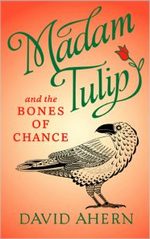
Madam Tulip and the Bones of Chance by David Ahern

Madam Tulip and the Bones of ChanceMadam Tulip and the Bones of Chance

by David Ahern
Series: Madam Tulip, #3

Kindle Edition, 368 pg.
Malin Press, 2018

Read: March 5 – 6, 2018

Many people doubt psychic powers exist, but the doubters do not include actors. Everyone in showbusiness knows that as soon as one actor learns of a casting, actors of all ages, ethnicities, creeds and genders are instantly aware of every detail. Einstein claimed that faster-than-light communication is impossible. Einstein was not an actor.

But not even the actors that Derry, Bruce and Bella knew had an inkling of the dash of good fortune heading toward Derry and Bruce — they were given roles in a movie without the need to audition, if they could get themselves to Northern Scotland and Derry might have to give a reading or two. For readers new to this, Derry played the role of Madam Tulip on occasion — giving psychic readings at parties and the like. Derry was initially reluctant to take the role, but she needed the work — and Bruce only got his job if she took hers.

So they find themselves in Scotland — a land not necessarily ready for or welcoming toward people making a film. Which almost describes the director, too. He’s clearly nuts — and not in the genius filmmaker kind of way. Many of the other professionals on set did seem to know what they’re doing, which went a long way to keeping the production running. But mostly, the antics on the set made for good comedy. Derry is given a set of bones on set to add to her gypsy character’s fortune telling routine in the historical drama.

While practicing with the bones, Derry starts to have visions, we’ll get into that later, but it’s clear that she’s gotten herself into more than meets the eye (again).

The most striking and interesting people in the book aren’t on the film set — believe it or not. As the blurb on the back says,

A millionaire banker, a film producer with a mysterious past, a gun-loving wife, a PA with her eyes on Hollywood, a handsome and charming estate manager—each has a secret to share and a request for Madam Tulip.

As usual, Derry’s desire to help people and natural nosiness gets her involved in these people’s lives (okay, she might have less altruistic motives about the estate manager). And that’s before someone tries to kill her and/or one of her new friends. Once that happens, Derry can’t help but dive into finding out what’s going on. Madam Tulip may be able to guide the direction she goes, but it’s Derry’s on cleverness that will carry the day.

In Madam Tulip, her father seems to actually believe that she had some psychic ability, otherwise it seems like a lark, something she does for giggles. But in book 2, it seemed possible that she might actually have some abilities, but there wasn’t much in the novel that was more than a hint or suggestion that she did. But here? That hint, that suggestion is gone — she sees things when she rolls the bones, her Tarot readings do say a lot that’s true (and future) about the person she’s reading the cards for. I think I liked it better when the reader wasn’t sure if she had gifts or not, honestly — but only a little bit.

I’ve been a fan of this series since chapter two or three of the first book, so you’re not getting anything really objective here (not that you ever do). But this is the best that Ahern’s done yet — there’s plenty of good comedic writing (there are lines I tried to shoehorn into this, but couldn’t, that made me laugh out loud), a mystery you can’t really guess the solution to, a little peril, a dash of romance and some fun characters. That’s not even counting Derry and Bruce. Bones of Chance is a strong entry in the series that will please fans, but it’s also a decent jumping on point for new readers. Basically anyone who enjoys light mysteries with a touch of something extra should have fun with this book.

There are times that I fear my enthusiasm towards a book doesn’t come through, and I usually don’t know how to achieve that better — this is one such time. I found myself grinning frequently while reading this — I chuckled, I even laughed out loud. I had a few theories about the trouble that Derry was getting herself into, and failed with almost all of them (a sign of a good mystery/thriller, if you ask me). If you’re not picking up my enthusiasm, that’s on me, just trust me that it’s there.
Disclaimer: I received this eARC from the author in exchange for my honest opinion..

—–

4 Stars

Pub Day Post: Mr. Neutron by Joe Ponepinto

Mr. NeutronMr. Neutron

by Joe Ponepinto

eARC, 300 pg.
7.13 Books, 2018

Read: March 1 – 3, 2018

It couldn’t be real. Just couldn’t. Besides, if someone brought a cadaver to life today, it would be under controlled circumstances—in a lab at some university, with the media and religious protesters in attendance. It would go viral on the web. He would have heard about it.

Still, Gray couldn’t dismiss the possibility. His timid psyche often cleaved to the supernatural, if only to explain the failures in his life. And dead men had been elected before, although they typically stayed in their graves and didn’t campaign.

Before I get into this — yes, this is a political satire. But it’s pretty apolitical. There are almost no political points made, few actual policies advanced or discussed, and certainly no mainstream parties are either pilloried or lauded. The satire is of this strange thing called American politics — the campaigns, the process, the press, the people involved. Conservatives, liberals, statists, libertarians, and everyone in between can read this safely without worrying about getting much tweaked by the book.

In the opening paragraphs we meet Gray (Davenport, we’re later told) and Reason Wilder. Gray is running a mayoral campaign and one of his candidate’s opponents is Reason. Right away, you can tell this book isn’t going for subtlety. We later meet Patsy Flatley (the advisor to Gray’s candidate), The Reverend Inchoate Hand, Breeze Wellington, and Randy (of various last names) — all of these names tell you a good deal about these characters (and I could’ve listed other examples). Ponepinto lays his cards on the table right away when it comes to his characters and the type of people they are.

Reason isn’t the best funded, most articulate, or most polished candidate — but there’s some impossibly strong magnetism about him and his simple promise that “Together we will do great things for this city,” without ever giving a specific idea how they’ll do that, or what a great thing might be. Virtually everyone who encounters Reason falls under his spell but Gray. Not only does Gray maintain some sort of skepticism about Reason, he notices a disturbing odor about him, the way his body doesn’t seem to work together organically, and frankly, doesn’t seem to belong together. It’s almost as if someone stitched him together from spare parts.

Once Gray starts speculating down that path, he becomes convinced that’s the case — and sets out to prove it. Along the way, this effort causes problems in his marriage (well, it brings problems in his marriage to a head); brings some powerful people into his life; and puts him in league with the strangest journalists you’ve probably encountered. This kicks off some overdue self-examination to go along with his hunt for information about Reason.

All the while, the campaign goes on: Gray’s duller than dull candidate tries to build a voter base, the well-funded front-runner has to work to remain relevant, and Reason’s cult grows in a way no one can believe (or deny). We see a debate, a fundraiser or two, press conferences, polls, and money — and the ways all of those can alter a campaign, especially the money.

One difficulty I had while reading this book was remembering it was a satire — Ponepinto’s writing frequently comes across as highly-crafted and nuanced, and then he’ll have someone named Randy do something filled with innuendo or something equally obvious or ridiculous and I’d have to remind myself I was reading a book about a Frankenstein’s Monster-like being running for mayor, and perhaps I shouldn’t take it too seriously. I do think that’s a strength of the book — I’d forget I was reading nonsense about impossible tings because the narration was just so serious. It is a funny book, at times, but not told in a way that underscores it, which somehow works.

I didn’t love the ending, honestly. But I absolutely get why Ponepinto did it — and good satires rarely have satisfactory endings anyway. This was better than a lot of them — for example, I’ve read almost all of Christopher Buckley’s novels and there’s only one of them that had an ending I can tolerate. So, “didn’t love” is pretty good. I thought the last couple of paragraphs were far too preachy, and could’ve been cut without really harming the novel and/or its message.

But before all that, we’ve got a very strange ride. You’re not going to see a lot like this — a little supernatural/monster, some pointed commentary on politics, a dash of romance, a nice friendship, and an odd collection of characters bringing all this to you. You should give it a shot. I have no idea what kind of follow-up Ponepinto might have in store, but I’m very curious.

Disclaimer: I received this eARC in exchange for this post and my honest opinions.

—–

4 Stars

PubDay Repost: Smoke Eaters by Sean Grigsby

yeah, yeah I told you that I’d get this up last week, but writing while hacking isn’t that easy. Yes, I’m a hack writer, but that means something totally different.

Smoke EatersSmoke Eaters

by Sean Grigsby

eARC, 384 pg.
Angry Robot, 2018

Read: February 2 – 3, 2018

Really, the case for you (or anyone) reading this book is simply and convincingly made in 13 words:

Firefighters vs. Dragons in an Urban Fantasy novel set in a futuristic dystopia.

I’ll just wait here while you open another tab to put in your order. There’s really nothing more that I need to say, is there? What if I throw in robot dogs?

Since you’re here anyway, I’ll talk a little more about the book. In the early 22nd century, dragons show up (technically, come back) and everything changes over night — cities burn, non-urban areas burn, geography changes, societies change, political/governmental realities change. And so on. Where there are dragons, there’s fire; and where there’s fire, there are firefighters. A special division of firefighters soon develops — Smoke Eaters — who specialize in dragon fighting, while the rest take care of fires, saving lives and property, etc. You know, the basic everyday hero stuff.

One such hero is Captain Cole Brannigan. After decades of fighting fires, he’s a week away from retirement when disaster strikes and he finds himself without his air supply in a dragon smoke-filled room, which it turns out that he can breathe. Which means he’s one of a select few people naturally immune to the stuff and is basically pressed into service as a Smoke Eater. Instead of commanding a squad and their respect, he’s a trainee — worse, a trainee who used to be a fire fighter. I’m not really sure I get the level of antagonism that exists between the two groups, but it’s pretty intense. No one respects his expertise, his experience, his perspective. He’s tolerated at best — and that’s really only because of the whole smoke immunity thing.

I cannot stress how much I enjoyed this dynamic — stories about someone learning their way through a new reality, or new abilities, etc. are a staple of the genre. But a fully-realized adult, in a long-term, stable marriage (as stable as they can realistically come), successful already and sure of his place in the world being thrown into a new situation like this is unique. Cole spends as much time fighting his instincts about assuming leadership roles (and assuming people will follow) as he does trying to understand his new teammates and duties. Naturally, his perspective and experience will prove important to understanding a new challenge facing the Smoke Eaters.

I’m not going to get into everyone else, because this is Cole’s story, but that doesn’t necessarily mean he’s the most interesting character (he probably is, though, your mileage may vary). The rest of the characters aren’t quite as well drawn — mostly because we see everyone through Cole’s eyes — but most are close enough that you don’t notice.

I should probably mention that when he’s not writing about fire-breathing lizards, Grigsby’s an actual firefighter. So he knows his stuff — when he says fire behaves a certain way, it’s not because he’s read a lot about that or watched Backdraft a few dozen times (well, both of those may be true, but neither is the primary reason he can say that fire behaves a certain way). The authenticity about this kind of thing shines forth and adds a layer of reality to this novel. He knows guys just like Cole — and probably most of the other firefighters and Smoke Eaters — he knows the devastation that fire leaves behind (both to structures and people), and what it takes to keep pressing on in the face of that.

There is a lot more that I want to try and cover, but this is one if those books that if I said everything I wanted to, it’d take a week to write and an hour to read – so let me wrap this up (man, I didn’t even talk about Grigsby’s Canada…the book is worth a look just for that). This is full of action, and some of the ways a gentleman of Cole’s age keeps up with the action are pretty smartly conceived, but there’s some thinking involved, too. Still, you’ll be kept leaning forward in your seat. It’s a good story; with great, developed characters; a wonderful concept; all executed like a seasoned pro was behind it all. There are some little details that will make you chuckle as you read them (the misunderstandings of barely remembered 20th century culture, for example). Smoke Eaters is going to be one of the best UF reads you find this year.

Disclaimer: I received this eARC from the good folks over at Angry Robot via NetGalley in exchange for this post and my honest take on the book — thanks to both for their generosity and this rockin’ read.

—–

4 1/2 Stars

Resurrection Men by Ian Rankin

Resurrection MenResurrection Men

by Ian Rankin
Series: John Rebus, #13

Hardcover, 436 pg.
Little Brown and Company, 2002

Read: Rebruary 26 – 27, 2018

Another ghost in need of justice. Rebus had confessed to her once, after too many late-night drinks in the Oxford Bar, that he saw ghosts. Or didn’t see them so much as sense them. All the cases, the innocent — and not so innocent — victims . . . all those lives turned into CID files . . . They were always more than that to him. He’d seemed to see it as a failing, but Siobhan hadn’t agreed.

We wouldn’t be human if they didn’t get to us, she’d told him. His look had stilled her with its cynicism, as if he were saying that “human” was the one thing they weren’t supposed to be.

Thanks to sickness, a little bit of travel, and general increased busy-ness in my non-blog life, I almost missed my monthly check-in with John Rebus. Thankfully, for my Bookish-OCD, I made it just in time. Even better? This was one of the best in the series.

Rebus’ drinking and displeasure at Gill Templar’s handling of a murder investigation results in him being sent back to school. Literally. There’s a “retraining” course at the Police College for long-serving officers with discipline problems — sort of a last chance before the end of the road. These detectives are pretty similar, they’ve (mostly) been at this for years and aren’t going to change, no matter what happens in the course. Most of them know each other by reputation, Rebus is well-known, apparently — and he knows another classmate by reputation, he’s “the Glasgow Rebus.” After some counseling sessions, and some class lectures, the detectives are given a cold case to work to help learn something about teamwork. A couple of the detectives were associated with the original investigation in Glasgow, and even Rebus brushed up against it in Edinburgh. It’s not so clear how much teamwork is being learned, it’s clear that there are people who know things about the case that aren’t in the files — and they’re not sharing.

There is something about the case that could involve Big Ger, so guess who gets volunteered to talk to him? Rebus is not the only one talking to Cafferty, Siobhan Clarke (now a DS) has a couple of conversations with him. Watching Cafferty try to treat the two of the similarly, with different results, was quite entertaining — Clarke reacts to him differently than Rebus, but she doesn’t take the same angle with him that I think most would. I look forward to seeing the two of them lock horns in the future.

Speaking of Siobhan — never call her Shiv, by the way — once again, she threatened to take over the book for the first half or so. Rebus’ drinking with the other problem police and their cold case just didn’t grab my attention at first. But Siobhan’s dealing with the investigation — without her mentor to bounce ideas off of — and the various and sundry male detectives around her. Some of which work with her just fine, others . . . not so much — at the end of the day, DS Clarke is the one who puts the case together, and in a pretty compelling way. Did I enjoy things a little bit more when Rebus came along to interact with a bit? Yeah, but it wasn’t necessary. I also like the way that Rebus and Templar were the ones (along with Siobhan herself) noticing her doing things like Rebus this time, not just other police. He’s clearly left his stamp on her — for good or ill, the trick is watching her approach things the way he would, but remaining her own person. Which she has so far — and, I bet, will continue to do so.

But this is a Rebus novel, at the end of the day, and he does get the better material — as I mentioned, he interacts with Siobhan some because he and the others come to Edinburgh to follow a pretty shaky lead (mostly, it’s an excuse to get away from the college and drink somewhere else). Around this point, that storyline became more intriguing — and it did end up being the better part of the novel.

No one will ever say that the Rebus novels are a fun romp, but there was something about Rankin’s writing in Resurrection Men that seemed darker than usual — not a darkness because of violence or anything, just in the telling. Everything seemed worse, everything seemed sinister — it’s hard to put my finger on it exactly, but there was something grim going on. Yeah, I laughed a couple of times, smiled more often than that, but overall, the noir in this book was blacker. We see areas of Rebus’ psyche we haven’t seen much of before — ditto for Clarke — we also get some good Rebus/Cafferty backstory.

The structure of this novel is the real star — it was just perfect — we get a couple of mysteries to watch our detectives solve, plus a couple of other things go on. It even seems like Rankin doles out the information in an unusual way, only telling us what we need to know when we need to know it — there are times when we’re more in the dark than Rebus because he’s hiding the information from his fellow Last-Chancers and us (what does that say about Rankin’s readers?), but it works — this isn’t a case of a mystery writer cheating, it’s a deliberate attempt to build suspense. Complex without being complicated, brilliantly plotted but not in a way that feels totally organic. At a certain point, the way that all the storylines end up seem inevitable (even when you’re still not sure who the various killers are going to be), yet you’re surprised when the inevitable happens. But along the way, each step in the stories, each reveal, each development catches you off guard. Just fantastic structure to the book.

I thought it was strange that Rankin started this one off (I’m guessing for the American edition only) with a little description of the Scottish Police’s organization and rankings, which was nice (but most readers can figure it out on their own). Also included was a list of the cast of characters — organized by storyline. That was helpful, too. Unnecessary, but very nice. I’m not sure why these were used, but I’ll take them.

This one checked almost every one of my boxes — at least once, and never didn’t hold my interest. Rankin clearly knows what he’s doing and you should read this one — and the twelve before it.

—–

5 Stars
2018 Library Love Challenge

February 2018 Report

My numbers should’ve been a little better — but between Iron Gold taking more time than I was prepared for, and ongoing sickness, I got a little behind with reading — and the writing took another hit this month, that I really can’t explain. Oh well. Onward and upward, and all that, right?

Anyway, here’s what happened here in February:

Books/Novels/Novellas Read/Listened to:

Like a Champion Golden Gremlin A Blogger's Manifesto
4 Stars 2 1/2 Stars 3.5 Stars
Uber Diva Smoke Eaters Fated (Audiobook)
3 Stars 4 1/2 Stars 4 Stars
Sanctification Iron Gold The Fed-up Cow
3 Stars 4 Stars 3 Stars
Brighton Beach Memoirs (Audiobook) The Meifod Claw The Strange Death of Fiona Griffiths
3.5 Stars 2 Stars 4 1/2 Stars
The Late Show (Audiobook) Timekeepers Blood Binds the Pack
4 Stars 4 Stars 4 1/2 Stars
The Ark of Safety Illinois Native Americans: A 9,000 Year Civilization Resurrection Men
3.5 Stars“> 3 Stars 5 Stars
The Armored Saint            
3 Stars            

Still Reading:

Volume 9: Sermons to the Church Secular Jewish Culture      

Reviews Posted:

Book Challenge Progress:

Angel's Guilty Pleasures Iron Gold by Pierce Brown
Brighton Beach Memoirs by Neil Simon, Max Casella, Peter Michael Goetz, Valerie Harper, Alexana Lambros, Anna Sophie Loewenberg, Jonathan Silverman, Joyce Van Patten
The Late Show by Michael Connelly, Katherine Moennig
Resurrection Men by Ian Rankin (link forthcoming)

Like a Champion by Vincent Chu
Golden Gremlin by Rod A. Walters
A Blogger’s Manifesto: A Modern Day Guide to Blogging by Aman Mittal
Uber Diva by Charles St. Anthony
Smoke Eaters
The Fed-up Cow by Peta Lemon, Maria Dasic Todori
The Meifod Claw by JW Bowe
Timekeepers by Simon Garfield
Illinois Native Americans by in60Learning.com

Like a Champion by Vincent Chu
Golden Gremlin by Rod A. Walters
A Blogger’s Manifesto: A Modern Day Guide to Blogging by Aman Mittal
Uber Diva by Charles St. Anthony
The Fed-up Cow by Peta Lemon, Maria Dasic Todori
The Meifod Claw by JW Bowe
Illinois Native Americans by in60Learning.com
Smoke Eaters by Sean Grigsby
Timekeepers by Simon Garfield

Whoops. Nothing this month!

How was your month?

Page 205 of 230

Powered by WordPress & Theme by Anders Norén