Category: Blog Series Page 226 of 230

A Few Quick Questions With…Larry Higdon

I’ll be posting about Larry Higdon’s first novel, The Storms of Deliverance, tomorrow (Spoiler: It’ll be positive), but before that, I wanted to post this Q&A that he was kind enough to participate in with me. Kept it short and sweet, because I’d rather he work on his next book than take too much time with me, y’know?

Why don’t you start by giving me the elevator pitch for this book.
(Warning: His answer reveals a little more than I’d want to know about the book before reading it)
           A former baseball player, who has wasted his life through alcoholism and violence, seeks to win back his ex-wife and daughter. On this quest he suffers a traumatic experience, a bout of amnesia, and encounters with supernatural phenomena. He emerges from these experiences a better man with at least a chance of realizing his dream of reuniting his family.
What prompted this particular story? What was the genesis of the book?
           Most of my life I had three or four scenes in my head that didn’t seem to connect with each other. Then all of a sudden they did, and I decided to try to put them together in a novel.

Just a great answer

In the writing of Storms, what was the biggest surprise about the writing itself? Either, “I can’t believe X is so easy!” or “If I had known Y was going to be so hard, I’d have skipped this and watched more TV”.
           This novel wrote itself. I felt as though I were taking dictation. Of course, when the editors got involved, the work became more like work.
Describe some your influences (whether or not you think they’re on display in Storms).
           I had given up writing–sick and tired of rejection slips. One Christmas my niece, who is also a writer, gave me a copy of Stephen King’s On Writing. That plus King’s novels have influenced me. Some wags might say that I kill off children because King often does so, but that’s not true. That was one of those scenes in my head.
So, it’s been a few years since the publication of Storms — is there more on the way?
           The sequel should be published this year. It’s called The School from Hell. Johnson’s ex Katy narrates it. She’s assigned as a counselor to a high poverty elementary school. Johnson, Zoe, McBroom, and Ellen all make appearances.

This is about as far from the answer I’d have guessed at/hoped for as you could imagine. And I’m really looking forward to this sequel.

Opening Lines – Staked by Kevin Hearne

Head & Shoulders used to tell us that, “You never get a second chance to make a first impression.” That’s true for wearing dark shirts, and it’s especially true for books. Sometimes the characters will hook the reader, sometimes the premise, sometimes it’s just knowing the author — but nothing beats a great opening for getting a reader to commit. This is one of the better openings I’ve read recently. Would it make you commit?

I didn’t have time to pull off the heist with a proper sense of theatre. I didn’t even have a cool pair of shades. All I had was a soundtrack curated by Tarantino playing in my head, one of those songs with horns and a fat bass track and a guitar going waka-chaka-waka-chaka as I padded on asphalt with the uncomfortable feeling that someone was enjoying a voyeuristic close-up of my feet.

from Staked by Kevin Hearne

United States of Books – The Adventures of Huckleberry Finn by Mark Twain

The Adventures of Huckleberry FinnThe Adventures of Huckleberry Finn

by Mark Twain

Author: Laura at http://125pages.com

Welcome to another installment of the United States of Books! See full details here. Today we will visit Missouri with The Adventures of Huckleberry Finn by Mark Twain. Entertainment Weekly says “Twain’s masterpiece about Missouri’s most iconic literary contribution, Huck Finn, will resonate for as long as America’s rivers flow.”

I’m not sure how I never read The Adventures of Huckleberry Finn before now. I read The Adventures of Tom Sawyer in high school and upon looking on my shelves I discovered I already owned both of them. Finn takes place soon after the events of Sawyer, with both boys wealthy and Finn living with the Widow Davis as his alcoholic father has not been seen in a year. Stifling under the rules, Finn seeks adventure. He rejoices when he is able to sneak past Jim, a slave who keeps watch over the house, to join his friends as they play robbers at night. When his Pap finds out about his windfall, he returns to town seeking the money. He kidnaps Huck and locks him in an isolated cabin. Huck the stages his own death to escape and sets off down the river. He happens upon Jim, who is also running after hearing about plans that he is to be sold. A series of madcap adventures follow, including grifters pretending to be royalty, cross-dressing, family feuds and an elaborate plan to save Jim.

This was a hard book to rate as it is not on the same level as current books. The six distinct dialects used made it not flow as modern literature does, but added a unique aspect to each word said. The writing was humorous and full of heart. Yes, at times, the words used do not match what we consider proper, but for the time it is accurate. The plot was all over the place, but always made its way back to Huck at the center. The pacing was quick and the story never lagged.

A true classic in terms of setting, language and speech patterns, The Adventures of Huckleberry Finn, is a unique look at a not so shiny time in our country’s past. That being said, the correlation between Huck running from what he considered slavery, and an actual slave running with him for real freedom was powerful. Seen from a child’s eyes, what was normal became unthinkable, as Huck learned to count on Jim. Mark Twain crafted a nuanced picture of such a specific time frame, I think The Adventures of Huckleberry Finn will never not be read by those seeking to understand the past.

Favorite lines – It was kind of solemn, drifting down the big, still river, laying on our backs looking up at the stars, and we didn’t ever feel like talking loud, and it warn’t often that we laughed—only a little kind of a low chuckle. We had mighty good weather as a general thing, and nothing ever happened to us at all—that night, nor the next, nor the next.

Biggest cliché – “Running away will be super easy and fun.”

Have you read The Adventures of Huckleberry Finn, or added it to your TBR?

—–

4 Stars

Saturday Miscellany – 1/23/16

Odds ‘n ends over the week about books and reading that caught my eye. You’ve probably seen some/most/all of them, but just in case:

    This Week’s New Releases I’m Excited About and/or You’ll Probably See Here Soon:

  • Orphan X by Gregg Hurwitz — The premise alone makes this worth a look. When you add in the endorsement’s on this (Crais, Baldacci, Child, etc.), the comparisons to Bourne, Reacher and others . . . this has got to at least be worth a try.
  • The Rogue Retrieval by Dan Kobold — shades of Terry Brooks and Christopher Stasheff help this debut fantasy sound like a winner.

Lastly, I’d like to say hi and welcome to Dr. Joseph Suglia for following the blog this week.
(cat is absolutely not necessary)

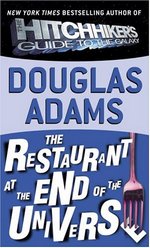
Reread Project: The Hitchhiker’s Guide to the Galaxy by Douglas Adams

The Hitchhiker's Guide to the GalaxyThe Hitchhiker’s Guide to the Galaxy

by Douglas Adams
Series: The Hitchhiker’s Guide to the Galaxy Trilogy, #1

Mass Market Paperback, 216 pg.
Del Rey Books, 1995 (originally, 1979)
Read: January 14 – 15, 2015

If I’m not really careful, this will be the longest thing I ever post here. Let’s see how much restraint I have, shall we?

I think I read The Hitchhiker’s Guide to the Galaxy for the first time in 1987 (maybe 1988), and have read it countless times since then. I quote it all the time (frequently unconsciously and unintentionally) — I think I’ve even plagiarized it a couple of times (really unintentionally). The only reason that my PIN isn’t 4242 is because it seems to be too obvious. I love this book. Rereading it is still fun. Even though I have paragraphs committed to memory, I can hear large portions of it in the voices of the original radio play actors, still the act of reading it is enjoyable, it’s like coming home after a long day at work.

The fixation on digital watches seems so quaint. It starts in the first paragraph and doesn’t really let up until late in the book. I so wish Adams was with us to see what he’d do with our smartphone addictions.

So much of what Adams does here has been repeated by others that he inspired, it’s tough to see some of it as fresh anymore, but he didn’t so much break the mold as ignored it and accidentally created a new one.

The Vogons are fantastic creatures. From the description of their evolutionary process — abandoned though it may be — their anatomy, their inherent meanness, to the commentary on civil servants. Just a fun alien race to read about. But is Adams satisfied with that? No. He adds the monstrosity that is their poetry (and the swipe at the old schoolmate) and they near perfection.

The Babel fish, what can you say about that? They are inspired. They take care of a problem that every space-bound Science Fiction story has to deal with in a way that’s actually more believable than technology-based solutions (Doctor Who does the same thing a bit less convolutedly, but less amusingly, too).

The Python-esque dialogue of the representatives of the Amalgamated Union of Philosophers, Sages, Luminaries and Other Thinking Persons. Is just a delight and picks up what could be a lull in the story.

Another little bonus that’s easy to over look is cop ex machina appearance of the Blagulon Kappa police officers — they’re a great commentary on law enforcement, notions of masculinity, depictions of both in the media — and how all three were undergoing a change at the time.

Strip away all the laughs, the jokes, the satire, the general zaniness and you still have a decent story — not a great one, mind you, but a decent one. There’s some good character work here, too — but it’s hard to see. The reactions of both Arthur and Trillian to the destruction of Earth are a lot deeper and real then Adams needed to make them. Unfortunately, that’s about all the good that Adams does with Trillian. Arthur still has some good treatment in his future.

It’s not perfect, don’t get me wrong — there are some problems with the characters (see Trillian), it being an adaptation of the radio program makes things a bit episodic with clunky transitions, and other hiccups (like the multiple introductions of Ford Prefect). Still, the highs are higher than the lows are low and there are a lot more of them.

    I stopped taking notes of particular lines on page 5 this time, there are just too many to count, and far too many to list. Still, there are a few I have to note:

  • “Time is an illusion. Lunchtime doubly so.”
  • “This must be Thursday. . . I never could get the hang of Thursdays.”
  • “You’d better be prepared for the jump into hyperspace. It’s unpleasantly like being drunk.”
    “What’s so unpleasant about being drunk?”
    “You ask a glass of water.”
    (I’m not sure why, but this has always made me chuckle, if not actually laugh out loud. It’s just never not funny)
  • “He had found a Nutri-Matic machine which had provided im with a plastic cup filled with a liquid that was almost, but not quite, entirely unlike tea.”
  • “In those days spirits were brave, the stakes were high, men were real men, women were real women and small furry creatures from Alpha Centauri were real small furry creatures from Alpha Centuari. And all dared to brave unknown terrors, to do mighty deeds, to boldly split infinitives that no man had split before . . . “
  • “Look,” said Arthur, “would it save you a lot of time if I just gave up and went mad now?”
  • Slartibartfast
    (okay, not technically a line, but that name…c’mon)

It’s a classic, you just need to read it if you haven’t. If you have, is it time for a re-read?

—–

5 Stars
(only because I don’t have time to make a 6-star graphic) 6 out of 5 stars, easy.

Coming Soon / Introducing The United States of Books!

I’m still putting the finishing touches on my plans for next year, but for a few months now, I’ve had 1 major project in mind. I’m going to be involved in my first group blog project.

Laura at 125pages announced The United States of Books project today. Normally, I’m going to be posting everything from the series right here, but today I want to send you all over there (just come back, please, I’ll be ever-so-lonely if you don’t!).

The first in this blog series just hit my inbox and confirmed my suspicion that this is going to be a great series. I’m looking forward to reading some books I probably wouldn’t have opened otherwise. I also have to reread a book that I didn’t blog about here and I wasn’t going read again — it was a great book, seriously, one of the best I’ve read this decade. But I’m intimidated by its size, subject matter, quality — anyway, my point was: give Laura’s post a read and come back on Jan. 4th!

Opening Lines – My Grandmother Asked Me to Tell You She’s Sorry

Head & Shoulders used to tell us that, “You never get a second chance to make a first impression.” That’s true for wearing dark shirts, and it’s especially true for books. Sometimes the characters will hook the reader, sometimes the premise, sometimes it’s just knowing the author — but nothing beats a great opening for getting a reader to commit. This is one of the better openings I’ve read recently. Would it make you commit?

Every seven-year-old deserves a superhero. That’s just how it is. Anyone who doesn’t agree needs their head examined.

That’s what Elsa’s granny says, at least.

Elsa is seven, going on eight. She knows she isn’t especially good at being seven. She knows she’s different. Her headmaster says she needs to “fall into line” in order to achieve “a better fit with her peers.” Other adults describe her as “very grown-up for her age.” Elsa knows this is just another way of saying “massively annoying for her age,” because they only tend to say this when she corrects them for mispronouncing “déjà vu” or not being able to tell the difference between “me” and “I” at the end of a sentence. Smart-asses usually can’t, hence the “grown-up for her age” comment, generally said with a strained smile at her parents. As if she has a mental impairment, as if Elsa has shown them up by not being totally thick just because she’s seven. And that’s why she doesn’t have any friends except Granny. Because all the other seven-year-olds in her school are as idiotic as seven-year-olds tend to be, but Elsa is different.

She shouldn’t take any notice of what those muppets think, says Granny. Because all the best people are different–look at superheroes. After all, if superpowers were normal, everyone would have them.

from My Grandmother Asked Me to Tell You She’s Sorry by Fredrik Backman

It was really hard to stop where I did, I wanted to use the first three pages, but am pretty sure that it’d get me in copyright trouble.

Reread Project: Suspect by Robert Crais

SuspectSuspect

by Robert Crais

Hardcover, 309 pg.
G.P. Putnam’s Sons, 2013

Read: November 3, 2015

This isn’t steel and nylon. It’s nerve. You clip one end to you, you clip the other to this animal, it ain’t for dragging him down the street. You feel him through this nerve, and he feels you, and what flows through here flows both ways — anxiety, fear, discipline, approval — right through this nerve without you and your dog ever even having to look at each other, without you ever having to say a word. He can feel it, and you can feel it. too.

Thus spake Dominick Leland, LAPD K-9 corps’ sergeant and alpha. It’s that kind of devotion to the animals that characterizes this book. These people take their dogs seriously (well, it takes Scott a little bit, but that’s the point), almost too seriously.*

Someone on the Facebook Robert Crais FanClub mentioned re-reading this to prepare for the release next week of Crais’ The Promise which will feature (who knows how much) the two stars of this novel. Seemed like such a good idea, I pounced on it, too. So glad I did, I remember really liking this book, but I didn’t remember how much I really, really, really liked this book.

This is the story of two partners grieving the loss of their most recent partners, and recovering from wounds both physical and psychological while trying to move past the trauma by gearing up for a new assignment for the future. One of the pair is a once-SWAT-bound LAPD officer, and the other is a former explosive sniffing German Shepherd with the Marines in Afghanistan. Which adds a bit of novelty to the situation.

That Prologue is one of the most effective opening chapters I can think of — it’s like the first ten minutes or so of Pixar’s Up — warmth, purpose, courage, heartbreak — there’s almost nothing more you could ask of it.

I love the way Crais describes Maggie’s sniffing/scenting for work. For that matter, Maggie’s perspective in general is great — not goofy or cartoonish, played for laughs or anything like that. Sure, some of it is projection, some of it is just guess-work, some of it is poetic license — but it’s all good, authentic, writing.

I guess the same could be said for what Officer Scott James goes through — I don’t know what PTSD is like, really. I just know about it from various literary/dramatic sources. But this sure seems to work — the guilt, the fear, the stress, the nightmares, the obsession, it rings as true. Granted, Maggie’s got a greater emotional pull (who doesn’t love a good dog?), and is a little less familiar than Scott — but at least we can relate to his suffering and him.

As with almost everything Crais writes, this takes place in the world inhabited by Elvis Cole, Joe Pike and the rest. We see that by a brief interaction between one of the detectives and John Chen (who as also mentioned by name earlier). Brief interactions with Chen are probably the best for all involved, and here he was John Chen at his John Chen-iest — I just love it. Although thanks to Gotham, I’m getting an Edward Nigma-vibe off of him, thankfully, I know better. (right?)

From the start, this gets you right in the emotions, and Crais keeps you there. You’re drawn to Maggie, and because of her, Scott. You get invested more easily than with other new characters because of Maggie With about 40 pages to go, even though I knew how it ended, I still was tense. That’s good writing. Period. End of discussion. And for the record, my eyes totally did not get misty at the end, I don’t know why you’d ask.

When I blogged about this back in 2013, I said “I don’t think this is the best Crais novel . . .but, given the way this worms into your heart, it’s probably my favorite.” It’s still probably not his best, but it’s better than I thought it was initially (I was more concerned with plot and character than craft, I think) — probably in the top 5, and it is my favorite so far.

—–

* Yeah, totally kidding. Not possible to be too serious about your dog.

—–

5 Stars

Opening Lines – If I Fall, If I Die

We all know we’re not supposed to judge a book by its cover (yet, publishing companies spend big bucks on cover design/art). But, the opening sentence(s)/paragraph(s) are fair game. So, when I stumble on a good opening (or remember one and pull it off the shelves), I’ll throw it up here. Dare you not to read the rest of the book

The boy stepped Outside, and he did not die.

He was not riddled with arrows, his hair did not spring into flame, and his breath did not crush his lungs like spent grocery bags. His eyeballs did not sizzle in their sockets, and his heart’s pistons did not seize. No barbarian lopped his head into a blood-soggy wicker basket, and no glinting ninja stars were zinged into his throat.

Actually, incredibly: nothing happened–no immolation, no blood-bath, no spontaneous asphyxiation, no tide of shivery terror crashing upon the shore of his heart–not even a trace of his mother’s Black Lagoon in his breath.

Somehow Will was calm.

from If I Fall, If I Die by Michael Christie

Provoke Not The Children by Michael W. Anderson

Provoke Not The ChildrenProvoke Not The Children

by Michael W. Anderson


Kindle Edition, 348 pg.
Amazon Digital Services, Inc., 2014
Read: August 27 – 31, 2014

Some dystopian futures seem plausible — even inevitable — 1984, The Hunger Games; while others seem impossible — Divergent, Red Rising. Anderson’s world is possibly the most plausible I’ve read.

In this future U. S., parents are no longer responsible for the day-to-day raising, nurturing, or educating of their children (they are still responsible for paying for all that). Instead, they entrust their children to the care of Proxies. Proxies are professional child-raisers. The idea is that these people know exactly what an individual child needs for full academic, social, psychological and physical progress and health, and are far better suited to ensuring children receive this care than an y parent could hope to. So after years and years of more and more parents turning to this option, it becomes mandatory for all children in the U. S. to be handed over to the professionals.

What do parents do with all this time they’re not, you know, parenting? Why, they’re making themselves the best possible versions of themselves that they can. Kids just get in the way of paying attention to yourself, your career, your well-being, and so on. (other than having someone to show off at parties and to inherit what you have left, I’m not sure what the point is to having kids in this world — but let’s just assume the biological imperatives win out or something.)

Now, with a government mandate of this size, regulations are going to come into play. And where there are regulations, you need people to enforce them. Enter our hero, Chase Stern. Chase is a Proxy Review Officer — he travels the Northwest working to make sure that children are being cared for by Proxies, and that the Proxies are doing things right.

Naturally, not all are. In fact, there’s a very disturbing number of Proxies getting away with fraud, abuse, and neglect. Chase blows the proverbial whistle on this unpleasant truth and is first publicly pilloried for this, but that soon turns into the opportunity for Chase to be part of the reforms of the Proxy Industry. The cure proposed may turn out to be worse for society as a whole, and the children in particular, than the disease.

Great premise, right? Hard to go wrong with a setup like that.

And yet, Anderson doesn’t quite pull it off. He’s close. I don’t think he was ready to write characters and a story to go with ideas this big quite yet. The pacing was strange at times, and I think the book would’ve been better served if we’d gotten to see more of the process involved — not just opening chapters with a “In the months/years since the end of the last chapter, many things happened”-type summary. Also, there’s a whole lot more telling than showing going on here, his characters gave a lot of speeches. Not quite as bad as Asimov in Foundation*, but along the same lines.

The biggest problem with this book is the characters. They’re flat. They’re not people. The novel is entirely from Chase’s perspective and he comes closest to being a person. But even he’s flat. There’s no growth, nothing other than his crusade to reform. Yes, Chase had been the kind of parent who was in a rush to get his kids Proxied so that he could fulfill himself, and then something happens and he changes into the kind of guy who cares about the welfare of children. Whatever changes he goes through — say, learning how to lobby congresspeople — just appear in between chapters.

That said, Maria, is one of the — I want to say evil, but she’s too shallow for that. Maria’s about the most wretched, vile, hateful character I’ve ever read (her husband, Conrad, is about as bad — but he does less, so maybe he’s just a self-centered twit, not a force for all that is wrong with the world). There are a couple of other characters here that are more actively malicious, too. Still, they’re all little more than amalgamation of characteristics. But Anderson has trouble with the white hat characters. Perhaps he understands human nature too well for that.

There was a very unfortunate typo in the edition I read — and I was taken out of the scene during the climatic confrontation. I’ve emailed the author and he said he’d be fixing it. That’s the big advantage of self-publishing ebooks. Anton Strout, for example, tells the story about someone pointing out a similar problem in one of his fight scenes years after the publication, which will remain in the paperbacks. Anderson’s error is gone. Welcome to the 21st century.

Provoke Not the Children had a killer concept, and a chilling world that you’ll keep thinking about for days. The story’s almost, but not quite where it needs to be. I still recommend it in the end, but don’t expect too much from the narrative. I expect in a book or two, Anderson’s execution will match his world-building.


* I remember that being very speech-filled, I think that’s even talked about in the forward Asimov wrote in the edition I last read 20+ years ago. Hope I’m not wrong about that, it’s just the best example I could come up with at the moment. Besides, being compared to Asimov in Foundation should be seen as a compliment.

—–

3 Stars

Page 226 of 230

Powered by WordPress & Theme by Anders Norén