Category: Blog Series Page 3 of 220

WWW Wednesday—March 25, 2026

The way this week is shaping up, I’m not expecting to get a lot more audiobook time in–I’ll hopefully finish my current book this week, but I don’t expect to move on. I should actually wrap up my March TBR, with a couple of bonus reads, to boot. That’s a pleasant change (and probably a more realistic TBR than I went for in the first two months of the year).

WWW Wednesdays Logo

This meme was formerly hosted by MizB at A Daily Rhythm and revived on Taking on a World of Words—and shown to me by Aurore-Anne-Chehoke at Diary-of-a-black-city-girl.

The Three Ws are:
What are you currently reading?
What did you recently finish reading?
What do you think you’ll read next?

Seems easy enough, right? Let’s take a peek at this week’s answers:

What are you currently reading?

Cover of True Color by Kory Stamper Cover of Return to Sender by Craig Johnson
True Color: The Strange and Spectacular Quest to Define Color—from Azure to Zinc Pink
by Kory Stamper
Return to Sender
by Craig Johnson, read by George Guidall

Stamper’s book is just fascinating. I’m not sure what else to say. But this book about defining colors is full of drama, grief, suspense, and a delicious use of vocabulary. I’m eager to see what’s around the corner.

Man, I was annoyed when the work day ended today–I got over it quickly, I should stress–I was right in the end game of Return to Sender. I’m enjoying revisiting the book and am getting hyped for May’s release of the next book.

What did you recently finish reading?

Cover of Ancillary Justice by Ann Leckie Cover of The Spellshop by Sarah Beth Durst
Ancillary Justice
by Ann Leckie
The Spellshop
by Sarah Beth Durst, read by Caitlin Davies

Ancillary Justice is a heckuva read. I’m not sure yet what I think about it–I’m still chewing. But Leckie can write.

The Spellshop is probably too Romance-forward for a lot of my friends/readers. But there’s enough other things going on that the (squeaky-clean) Romance is palatable.

What do you think you’ll read next?

Cover of Nav'Aria: The Marked Heir by K.J. Backer Cover of Violet Thistlewaite Is Not a Villain Anymore by Emily Krempholtz
Nav’Aria: The Marked Heir
by K.J. Backer
Violet Thistlewaite Is Not a Villain Anymore
by Emily Krempholtz, read by Emma Ladji

Looking forward to diving into this Fantasy from K.J. Backer, a Literary Local (who will hopefully appear here in a Q&A soon)

I recall reading some good things about Violet Thistlewaite, but reading the description now leaves me scratching my head about why I’d put this on reserve. It just doesn’t seem like me. But trusting past-me has worked out a couple of times this year, I’m hoping I knew what I was doing.

What’s this week look like for you?

Fantasy with Friends: Portrayals of Religion in Fantasy

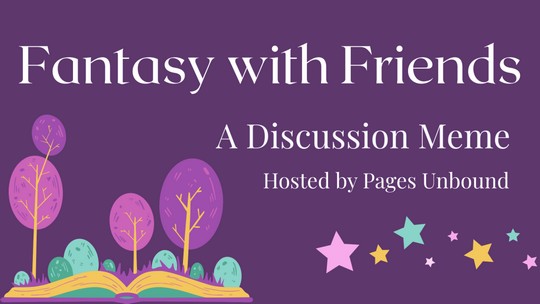
Fantasy with Friends A Discussion Meme Hosted by Pages Unbound

Fantasy with Friends is a weekly meme hosted by the good people over at Pages Unbound. Fantasy with Friends poses questions each Monday about fantasy, either as a genre as a whole or individual works.

This week’s prompt is:

What are some interesting portrayals of religion in fantasy? Do you like seeing invented religions, or do you prefer fantasy worlds to have none?

Let’s get that second question out of the way first–a fantasy world without any religion is completely unbelievable. Now, I’m not saying that every Fantasy novel has to talk about it, give us details, or anything–there can just be a passing mention of a deity, temple, priest, cleric, whatever–even just a religious symbol. This is an invitation for someone to suggest a religion-free fantasy to me to make me eat my words.

Now, I think it’s obvious to anyone who’s even glanced at what I post on weekends that I take religion pretty seriously, and I like to see books that do that, too. There’s a danger in that when it comes to, say, Crime Fiction—because that typically ends up with a religion/church being depicted in a less-than-flattering way, a protagonist throwing out their faith (at least for a time) to get something nasty done, hypocrites run-wild, etc. And actual, according-to-Hoyle, blasphemy is lurking around the corner for an even well-intentioned author to stumble into (or a not-so-well-intentioned author to rush into). This also comes up in SF about humans in either the far-flung or near future. If we get into an alien race’s religion, we’re typically on safer ground. (there are exceptions to this, I said “typically” not “universally.”)*

The same is true in Fantasy—typically, we get totally made-up religions—yes, there might be an analogue to one in our world, but that’s not the same thing. And it’s not just the religions that are made up—the deities and their mythologies are made up, as are the rites, beliefs, etc. When an author chooses to spend some time on this, they can do a lot. This can be fertile ground to display world-building, for creating ethical grounds for the character’s actions/attitudes, and for plot as well. I don’t want to say it’s a must for a Fantasy novel, but it does make the world more “lived-in” when there’s some sort of religion (even if the characters are non-practicing and it’s a wholly background thing mentioned once or twice).

Here are six depictions of religion in Fantasy that leap to mind. (Yes, I could spend some more time and come up with a longer list—but I’ve got to cut it off somewhere). Five of these I really appreciated, and one has bothered me for a long time and bugs me more the more I think about it.

The Princess Beard by Delilah S. Dawson and Kevin Hearne

Let’s start with something silly. Throughout this book (I don’t remember this showing up in the first two books in the series), the Sn’archivist receives direct revelation from the god of Pellanus. He’s spent most of his life on one subject–but now Pellanus has come up with a new book for the Sn’archivist, and the topic is…let’s go with odd. Perhaps even at the level of juvenile humor (okay, not “perhaps.”). We check in on this poor, beleaguered figure throughout the book, and it’s sillier practically every time.

Theft of Swords by Michael J. Sullivan

I’m embarrassed to admit how little I remember about the religion of this one (a good excuse to reread it–and finally the rest of the series). But I do remember a fairly corrupt church leadership, prone to twisting events to fit their own ends. I also remember a faithful priest, dedicated to service and unaware of how corrupt the leadership was (or maybe he was aware and just didn’t let it alter his practices). I remember admiring the priest and hoping the best for him, and can easily imagine several in that sort of position during many time periods in reality.

Widdershins Adventures by Ari Marmell

Well, I did a quick fact check on this, and I was conflating a couple of series together. So, I had to throw out a lengthy paragraph. Still, I really enjoyed this series featuring a young woman thief who is the only follower of a god from another country than her own. As this god’s only follower–she’s possibly the only person alive who’s heard of Olgun–she essentially has him living in her head, communicating with her freely (and inopportunely). The not-always-friendly relationship between these two characters makes the series shine, as together they take on enemies supernatural and mundane.

Spiderlight by Adrian Tchaikovsky

The underlying beliefs of the religion aren’t that terribly outstanding. What stuck with me is the ecclesiastical structure/religious culture of it. (Okay, there’s some bits of the religion that stuck with me, but they all involve ruining the book if you haven’t read it yet). The book focuses on an adventuring party, and their cleric/leader’s religious beliefs inform the telling of the book and are the default setting for the reader. Then, midway through the book, we meet their archbishop (I don’t remember if that’s the actual name, but it’s an episcopalian structure, so that’ll work). His take on prophecy, orthodoxy, interpretation, and the like is significantly different than the cleric’s. But he doesn’t demand she agree with him. Then we meet a sect of the church that disagrees with both, with an even more significantly different take on a particular prophecy. Their existence suggests they’re not the only one around. Basically, you’ve got a bunch of people vying for conceptions of truth (to be commended–even if I can’t sign off on their methods) and power. It’s a kind of Church that feels real, lived in.

The Lies of Locke Lamora by Scott Lynch

The religious lives of the Gentleman Bastards are part of their identity–they are the congregation for their temple. At the same time, they don’t really seem to care about their god, Crooked Warden, the god of thieves. It’s about their duties to the temple. In their youth, Jean Tannen went and trained with students of another god, and could carry out their rites. (I cannot remember if the rest of the group did something similar). While it didn’t seem to be encouraged–or even openly discussed that much–but the idea that the various priests had an understanding where one could step in for another is kinda cool.

Wizard in Rhyme Series by Christopher Stasheff

I haven’t read this entire series, so maybe it gets better–or some of my problems with this get ironed out. But a man is sucked into a parallel universe of some sort. Earth physics work, as does some sort of magic–and the Roman catholic church exists there, too. Well, it’s a pre-Reformation Church (and one without any of the Eastern Orthodox communities). What irks me is the way that Roman Catholicism exists in this world–how does that happen? Also, the way that our Earthling is able to get Saints and others to work things in favor of the rightful ruler (and those working for her cause) just seems odd. It almost makes the religion another form of magic–belittling it. It’s been too many years since I read them last (and I really enjoyed the first book…the next one less so, and the next less…), so my recollection is liable to be faulty, but I’m pretty sure about it.

So, anyway–these are some of the more memorable Fantasy uses of religion. If I took a week or two off, I’d be able to come up with more. This aspect of a Fantasy novel can really make things sing–can make the world feel alive in ways that other things can’t (I should’ve mentioned A Drop of Corruption by Robert Jackson Bennett, I now realize), and I don’t think it gets enough attention compared to other parts of the worldbuilding.

* I’m not trying to suggest that various congregations, church leaders, even ecclesiastical structures don’t have this kind of depiction coming–nor that there’s a good amount of realism to base it off of. I just don’t see as many positive, or even mixed, depictions in SF/Crime Fiction, so I’m not as liable to be able to list depictions of religion in those genres that I like as I can in Fantasy.

I’m sure some of the other posts in response to this prompt will be more thoughtful. I’m looking forward to reading them. Do you have responses to this? (either for the comment section below or from your own post)

Saturday Miscellany—3/21/26

Odds ‘n ends about books and reading that caught my eye this week. You’ve probably seen some/most/all of them, but just in case:
bullet Let’s start off with this feel-good story. Make-a-Wish Idaho helps a fifteen-year-old cancer survivor become a published author with an assist from Ridley Pearson. The book can be ordered here.
bullet Do You Actually Have to Finish That Novel?—I’ve linked to several pieces about DNFing over the years, but this one is from The Yale Review, so it has to be smarter, right? (snark aside, it’s worth your time)
bullet How To Read Sixteen Books at Once (At All Times)—this might make you tired just reading it. My hat’s off to Jo Walton for this, I just cannot imagine doing this.
bullet Benjamin Stevenson on the “Gamification” of Crime Fiction: How fair play mysteries invited readers in even further.—a good piece on Gamification that’s at least as charming as his books.
bullet Paperback vs. Hardcover: Which is Better For Readers (and For Writers)?
bullet How to Find Your Book Twin—In which Carol introduces me to a new term.
bullet Quirky Picturebooks to Read Aloud for Rhyme Times and School Classes!—making notes for Grandpappy’s Corner.

A Book-ish Related Podcast episode (or two) you might want to give a listen to:
bullet Belated Binge The Rise and Fall of Sonder in the Alex Verus series —I haven’t finished it yet, but Sonder’s arc in the Verus series is one of the most intriguing (and not one I would’ve guessed at). Glad to see it getting attention.

To help talk about backlist titles (and just for fun), What Was I Talking About 10 Years Ago This Week?
bullet Dead is Better by Jo Perry—one of the better books I read that year. Still an all-time fave.
bullet Risen by M. T. Miller—I’ve been reading Miller that long, too? Impossible.
bullet And I mentioned the releases of: The Watcher in the Wall by Owen Laukkanen; An Unattractive Vampire by Jim McDoniel; and Snakewood by Adrian Selby

This Week’s New Releases that I’m Excited About and/or You’ll Probably See Here Soon:
bullet Stakeouts and Strollers by Rob Phillips—”Amateur private investigator and new dad Charlie Shaw gets more than he bargained for when he agrees to track down a young girl’s missing father.” I talked about it earlier this week. It’s just so much fun.
bullet Black Bag by Luke Kennard—”An out-of-work actor accepts the role of a lifetime—sitting soundlessly in a lecture theater, zipped into a large leather bag—to aid a professor’s psychological experiment. What could possibly go wrong?” I wrote about this absurd and thoughtful book last week.
bullet The Lost Daughter of Sparta by Felicia Day, illustrated by Rowan MacColl—”a feminist graphic novel about the lost mythical character of Philonoe—Helen of Troy’s sister.” I’ve started this, and am enjoying it.
bullet Everyone in This Bank Is a Thief by Benjamin Stevenson—”Ten heists. Ten suspects. A murder mystery only Ernest Cunningham can solve in this delightfully clever and twisty new novel.” I’m finding Ernest himself harder to put up with the more the series goes on, but these are too clever to stop with.
bullet Finlay Donovan Crosses the Line by Elle Cosimano—Finlay attempts to come to Vero’s rescue from the law and a stalker.

@CaffeinatedLiha There is a specific type of grief that only exists in the 30 seconds after you finish a book and realize you now have to find a new personality.

WWW Wednesday—March 18, 2026

WWW Wednesdays Logo

This meme was formerly hosted by MizB at A Daily Rhythm and revived on Taking on a World of Words—and shown to me by Aurore-Anne-Chehoke at Diary-of-a-black-city-girl.

The Three Ws are:
What are you currently reading?
What did you recently finish reading?
What do you think you’ll read next?

Seems easy enough, right? Let’s take a peek at this week’s answers:

What are you currently reading?

Cover of Ancillary Justice by Ann Leckie Cover of The Spellshop by Sarah Beth Durst
Ancillary Justice
by Ann Leckie
The Spellshop
by Sarah Beth Durst, read by Caitlin Davies

I haven’t gotten very far (40 or so pages) into Leckie’s book, but there’s something interesting afoot. I just need to figure out what it is.

Yes, some of what I’ve heard makes me think that The Spellshop is too heavy on the romance for my taste. But at the same time, a lot of what I’ve heard makes me think the cozy fantasy is just what I need. So, let’s give it a shot, eh?

What did you recently finish reading?

Cover of City of Last Chances by Adrian Tchaikovsky Cover of Blind Date with a Werewolf by Patricia Briggs
City of Last Chances
by Adrian Tchaikovsky
Blind Date with a Werewolf
by Patricia Briggs, read by Holter Graham

There were so many things about City of Last Chances that were great and entertaining. But at least an equal amount that fell flat. And I’m not sure that all the good bits belonged in the same book. I’m really looking forward to the Book Club discussion next week to help me work through some of these things.

The premise for this book seems like a stretch—and while I enjoy Asil, I don’t know that I needed this much of him all at once. Still, it was a fun listen.

What do you think you’ll read next?

Cover of True Color by Kory Stamper Cover of Return to Sender by Craig Johnson
True Color: The Strange and Spectacular Quest to Define Color—from Azure to Zinc Pink
by Kory Stamper
Return to Sender
by Craig Johnson, read by George Guidall

I’m looking forward to learning a lot in this focused bit of word-nerdery from Stamper.

I think I could use a return to Longmire’s Wyoming. Might as well take a minute for it now.

What’s been grabbing your interest lately (or, I suppose, what’s been failing to?)?

Saturday Miscellany—3/14/26

Odds ‘n ends about books and reading that caught my eye this week. You’ve probably seen some/most/all of them, but just in case:
bullet I don’t think I noticed last October when Southern Living named its 50 Books From The Past 50 Years Everyone Should Read At Least Once—an impressive and daunting list, to be sure. But I did notice that Books of Brilliance talked about that list this week: Southern Living’s 50 Best Books of the Past 50 Years: The Novels That Defined Modern Literature
bullet Why Motive Matters Even More than Truth in Crime Fiction:
Nadine Matheson mulls how to create narrative satisfaction rather than random violence
—Matheson nails this
bullet Acclaimed crime fiction writer M. W. Craven on upcoming TV adaptation —a good interview about upcoming adaptations, his MG James Bond series, and more.
bullet Popular Book Genres Seen as “Easy Reading”—a typically thoughtful post from Briana at Pages Unbound.

A Book-ish Related Podcast episode (or two) you might want to give a listen to:
bullet The Conversation with Nadine Matheson Coffee Break with Neil Lancaster: The Dark Heart—a fun chat.
bullet In Person With Paul Neil Lancaster—a more serious and wide-ranging conversation (that includes several great recommendations)

To help talk about backlist titles (and just for fun), What Was I Talking About 10 Years Ago This Week?
bullet I had a light posting week due to running around getting things like fingerprints and drug tests for a then new job. But I did mention the releases of Fire Touched by Patricia Briggs; Stop the Presses! by Robert Goldsborough; The Stone Bearer by Jacque Stevens

This Week’s New Releases that I’m Excited About and/or You’ll Probably See Here Soon:
bullet Butterfly Effects by Seanan McGuire—Nunc hoc in marmore non est incisum I tried to express my enthusiasm for it earlier this week.
bullet The Shadow Carver by Nadine Matheson—DI Henley is on the hunt for another grizly serial killer
bullet The Dark Heart by Neil Lancaster—As you probably guessed from the above, Lancaster has a new book out. This time DS Craigie tangles with some spies.
bullet The Best Dog in the World: Essays on Love edited by Alice Hoffman—”Fourteen beloved authors celebrate the life-changing bond with their canine companions in this heartwarming essay collection.” Something tells me that a Kleenex or eight on-hand would be a good idea.
bullet The Most Dangerous Pet Shop by Paul Regnier—”On the night of his thirteenth birthday, Tristin is pulled through an enchanted mirror into a medieval fantasy realm with no way home. Stranded in the magical town of Springhaven, the fate of his family’s otherworldly pet shop is in his hands. But dealing with snapping dragons, talking animals, and mischievous pixies is a lot to handle.”
bullet This Story Might Save Your Life by Tiffany Crum—”Best friends Benny and Joy like to say they’ve been saving each other’s lives since the moment they met. Until the day Joy disappears and Benny is suspected of murder . . .” Check out the review over at Before We Go Blog.
bullet Nobody’s Baby by Olivia Waite—A cozy sci-fi mystery novella set on an interstellar passage liner. This is the second in a series, but looks so good I’m getting my hands on the first one!
bullet Magic and Mischief at the Wayside Hotel by Elizabeth Everett—”When a magical hotel appears smack-dab in the middle of the most unmagical of worlds, the last thing the residents expect is to fall in love.”
bullet The First Step by Tao Wong—”In a spectacular world of immortals, spirit beasts, and mystical martial arts, the young farmer Wu Ying’s life will be changed forever when he is unexpectedly invited to join an elite school of cultivation.”

@SparkNotes Once again reminding you all that the Ides of March is a scam holiday invented by Big Dagger to sell more daggers

WWW Wednesday—March 10, 2026

No post from me last week–I was probably asleep. I also took most of the week off from books, so I wouldn’t have had anything to say. But I’m over the flu now and back.

WWW Wednesdays Logo

This meme was formerly hosted by MizB at A Daily Rhythm and revived on Taking on a World of Words—and shown to me by Aurore-Anne-Chehoke at Diary-of-a-black-city-girl.

The Three Ws are:
What are you currently reading?
What did you recently finish reading?
What do you think you’ll read next?

Seems easy enough, right? Let’s take a peek at this week’s answers:

What are you currently reading?

Cover of Black Bag by Luke Kennard Cover of Rabbit Cake by Annie Hartnett
Black Bag
by Luke Kennard
Rabbit Cake
by Annie Hartnett, read by Katie Schorr

Black Bag is very likely going to be the oddest book I read this year. It’s making me think a lot, too. So…don’t take odd as a criticism/complaint. I should finish this today and to say that I have no idea what the last 25 percent is going to hold is putting it mildly.

I forgot my headphones at home yesterday, so I didn’t get any time with Rabbit Cake, I’m looking forward to getting back to it today.

What did you recently finish reading?

Cover of Stakeouts and Strollers by Rob Phillips Cover of Head Fake by Scott Gordon
Stakeouts and Strollers
by Rob Phillips
Head Fake
by Scott Gordon, read by Nick Mondelli

I’ll hopefully have a full post about Phillips’ book up tomorrow–short version, this is a completely pleasant and warm mystery featuring a girl-dad, while not being at all cozy.

Head Fake is going to be one of those books I’m talking about at the end of the year. It’s a funny and heartwarming book filled with broken people.

What do you think you’ll read next?

Cover of Ancillary Justice by Ann Leckie Cover of The Cyclist by Tim Sullivan
Ancillary Justice
by Ann Leckie
The Cyclist
by Tim Sullivan, read by John Heffernan

After Kennard gets done messing with my head, I should benefit from running into some epic SF. Don’t let me down, Leckie!

I’m trying to keep my expectations in the right place for The Cyclist, but it’s hard after the way the first book in the series wowed me.

What’ve you been reading lately?

Saturday Miscellany—3/7/26

I’ve been sick most of this week, and spent so little time with my eyes open it’s a wonder they still function (reading online posts really didn’t happen–nor did reading anything longer). Somehow I’m getting this post up, and I might be able to get some things up next week, too.

Odds ‘n ends about books and reading that caught my eye this week. You’ve probably seen some/most/all of them, but just in case:
bullet Ageless Literature (@agelessliterature) posted some provocative slides “What happens when a society stops reading”
bullet I get that almost none of you can take advantage of this program at a local bookstore, but it’s such a good idea, you should give it a look. Shared Stories is starting a Junior Booksellers series in March—where you casn “Meet neighborhood kiddos who are passionate about reading & hear all about their favorite books so you can love them too!” Like Hans today.
bullet Can the Dictionary Keep Up?—an in-depth look at Stefan Fatsis’ Unabridged: The Thrill of (and Threat To) the Modern Dictionary
bullet What We Lose When We Gamify Reading: Marissa Levien Makes the Case for Slowing Down—It may seem like hypocrisy for someone like me to like this kind of thing. But honestly, this is how I think–I just think like this while reading a lot. Both can be true (because the number is really never my goal, it’s just a game).

To help talk about backlist titles (and just for fun), What Was I Talking About 10 Years Ago This Week?
bullet No Problem, Mr. Walt by Walt Hackman—still up there as one of my favorites.
bullet Morning Star by Pierce Brown—remember back in our innocence when we thought that Brown was going to have mercy on us and end it as a trilogy? Good times–harrowing times, but good times. (we all know I’m not complaining here, I’m just saying)
bullet I noted the releases of: The Passenger by Lisa Lutz; Chaos Choreography by Seanan McGuire; Borderline by Mishell Baker; East Of The City by Grant Sutherland; Who Wants To Be The Prince Of Darkness? by Michael Boatman; The Courier by Gerald Brandt; and Arkwright by Allen Steele

This Week’s New Releases that I’m Excited About and/or You’ll Probably See Here Soon:
bullet The Politician by Tim Sullivan—The fourth DC George Cross mystery had it’s American re-release this week. I’m assuming the victim was a politician of some sort. I’m resisting the urge to read the description until I catch up.
bullet We Interrupt This Program by Randee Dawn—”Welcome to Seaview Haven. A delightful village of charming humans, quaint homes – and cozy mysteries! Fortunately, there’s silver-haired author-turned-sleuth Winnie Arrowmaker on hand to solve them all.

But things aren’t exactly as they seem. Seaview Haven is one of the Seelie Court Network’s many invented TROPE towns, and the “mysteries” are scripted and streamed for the entertainment of enchanted creatures across the Veil. Or, rather, they were…”
bullet Flour & Forge by Herman Steuernagel—”A weary warrior. A restless baker. A magical side quest neither of them asked for, but both might need…perfect for anyone who believes that while pastry might not save the world, it can help make it a world worth saving.”

Think before you speak. Read before you think. ― Fran Lebowitz  @weareteachers

Book Blogger Hop: What Will Happen to Your Books?

Hemingway talked about writing drunk and editing sober. I wrote and edited this sober, and then revised and added to it feverish and sleep-deprived. I think Hemingway’s strategy was better. I hope this is coherent.

Book Blogger Hop


This prompt was submitted by Billy @ Coffee Addicted Writer:

If you had to, would you pass your book collection on to someone special? If not, what would you prefer your family or friends do with your books after you’re gone?

So I had this drafted last week, and then the minister at church reminded us all during the sermon that we are going to die. And it felt a little strange to have this scheduled to go given the tone of this post and that reminder. Humans have a tendency to form outsized attachments to possessions. I am fully aware that my books are just ink, paper, and glue (with a little stitching and leather thrown in for good measure). Yes, I can admit that my attachments to them are frequently outsized–and I (almost) as frequently realize that.

Still, I can have some fun with it.

I’ve ended up getting many books from family members after they’re gone (mostly before that happened). For example, I received many Nero Wolfe books from the aunt who’d introduced them to me in Middle School. Sure, most were duplicates of books I got for myself–but a lot of these were the first copies I read, and that’s kind of special. So I get the impulse behind that passing them on–and appreciate it.

There are individual books that I’d like to pass on to friends/family. I can’t imagine anyone would like them all. I wish they would. I mean, I like to think my children picked up on my impeccable taste, but sadly, they insist on possessing their own (potentially peccable) taste. Still, Son #2 will likely get my Adams collection. My daughter and Son #1 will get parts of my graphic novels/manga collections, and so on. Most likely only ones that I think they’d appreciate having (but I might sneak some posthumous recommendations/nagging in, too–I’m not giving away my last shot).

Assuming she survives me, I’ll leave the bulk of my library to my beloved spouse—with the strict instruction that she is not to dispose of them in a manner I’d find untoward. Primarily by finding them a loving home. I’m not entirely sure she’ll follow that instruction—I know she’s not into library maintenance. But I (have to) assume what she’ll do with them is right.

Maybe she can send them to a farm upstate, where they’ll have room to run around and have fun with other beloved books…

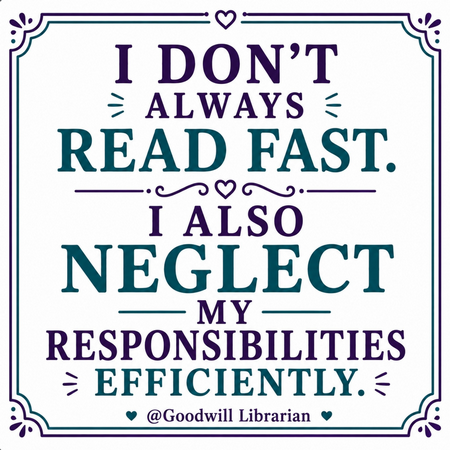
At the same time…I can’t help but think of this meme I saw at the Goodwill Librarian’s page:
A man sitting up in a coffin, looking at someone or something with the caption: 'When you're dead but your family starts talking about selling your books'

or this bit of gold from Jonathan Edward Durham (although I’m not sure what you’re supposed to do with that reading/lending paperback in his scenario…maybe that’s the one that my wife had to deal with)
Jonathan Edward Durham @thisone0verhere I recommend no fewer than 4 copies of any beloved book. A paperback for traveling and lending to friends, an eBook for reading with greasy snack fingers, an audiobook so you know how the characters' names are actually pronounced, and a pristine hardcover to be buried with you like a pharaoh.

Have you started making plans?

REPOST (and a note): The Long Way to a Small, Angry Planet by Becky Chambers: A charming, earnest and frequently delightful space opera that pretty much matches the hype.

We talked about this at Book Club last night, so I thought I’d dust this off and run it again. I think I get what I was going for in the 8th/ante-penultimate paragraph back in ’18, but I wouldn’t write it today, or anything like it, really. I’m also pretty sure that I’d rate it higher, if I were still rating things with stars–at the very least, I wouldn’t dither about it like I did. Still, this is close enough to what I’d say now that I don’t feel like redoing it.


The Long Way to a Small, Angry PlanetThe Long Way to a Small, Angry Planet

by Becky Chambers
Series: Wayfarers, #1Paperback, 443 pg.
Harper Voyager, 2018
Read: July 18 – 20, 2018

We are all made from chromosomes and DNA, which themselves are made from a select handful of key elements. We all require a steady intake of water and oxygen to survive (though in varying quantities). We all need food. We all buckle under atmospheres too thick or gravitational fields too strong. We all die in freezing cold or burning heat. We all die, full stop.

Ohhhh boy. One of yesterday’s posts was easy — I state the premise, say the book lived up to the premise, and there ya go. A finished post. Today? I’m not sure I could succinctly lay out the premise in 6 paragraphs, much less say anything else about the book. It’s deep, it’s sprawling, it’s fun and full of heart. What isn’t it? Easy to talk about briefly.

So I’m going to cut some corners, and not give it the depth of discussion that I’d like to.

So you know how The Hitchhiker’s Guide to the Galaxy starts off with the Vogon Constructor Fleet constructing a hyperspace bypass right through our Solar System? Well, if the Vogons were the megacorp doing that, the crew of the Wayfarer is your mom & pop-level company doing the same kind of work. But there are no Vogons, and it’s not a hyperspace bypass they’re constructing, but the metaphor works — the Wayfarer is building/cutting/creating ways for spaceships to make it from point A to point B faster — I’ll leave the detailed explanation to Sissix or Kizzy to explain when you read it (I think it was Kizzy, but I could be wrong — my copy is in another state, so it’s hard for me to check things like that).

The Wayfarer is made up of a mix of species — including human (some of which were raised on a planet, others not), the others? Well, they’d fit right in with the customers in the Mos Eisley Cantina (with names like Sissix or Kizzy) — too difficult to explain, but they’re all radically different from pretty much anything you’ve seen or read before. Chambers’ imagination when it comes to their physiology, culture, mannerisms, beliefs is just astounding. Really it’s fantastic. And the crew is a family — when a new crew member joins, they’re greeted with “welcome home.” And that’s just what they mean.

This new crew member is Rosemary Harper, our entry point into this world, too. She’s never been off-planet before, doesn’t understand the science behind the work they do, really only has textbook knowledge of most of the species they run into. As she learns, so does the reader. Phew. Essentially, the plot is this: the captain of Wayfarer gets a chance to make history and make more money than he’s used to — he jumps at it, but his crew has to take a freakishly long trip to get to the (for lack of a better term) construction site (see the title). This long trip is filled with dangers, encounters with family members no one has seen in ages and old friends. And pirates. Even when they get to the construction site, the challenges are just beginning and everyone on board is going to be put through the wringer just to survive.

In the midst of all this is laughter, love, joy, pain, sorrow, and learning. Rosemary becomes part of the family — by the actions of the crew bringing her in, and through her own reciprocal actions. Now, many parts of this book seem slow — but never laboriously slow — it’s the way that Chambers has to construct it so that we get the emotional bonds between the characters — and between the characters and the reader — firmly established, so that when the trials come, we’re invested. I was surprised how much I cared about the outcomes of certain characters at the end — it’s all because Chambers did just a good job building the relationships, nice and slow. The book frequently feels light — and is called that a lot by readers — but don’t mistake light for breezy.

I want to stress, it’s not laboriously slow, it’s not boring. It’s careful, it’s well-thought out. It’s your favorite chili made in the slow cooker all day, rather than dumping the ingredients in a pot an hour or so before dinner. It occasionally bugged me while reading, but by that time, I was invested and had a certain degree of trust for Chambers — and by the time I got to the end, I understood what she was doing in the slow periods and reverse my opinion of them.

I frequently felt preached at while reading this book. There were agendas all around and these characters did what they could to advance them. Most of the speechifying and preaching worked in the Wayfarer Universe, but not in ours. When I read it, I had no problem with it — but the more I think about it, the less I agree and the more annoyed I get. The opening quotation was one of the themes pushed, another had to do with family and/or brothers — but the best lines about those involve spoilers or need the context to be really effective, so go read them yourselves. I don’t want to get into a debate with the various characters in the book, so I’ll bypass the problems I have with just the note that I have them. But in the moment and in the context of the novel, the writing behind the characters’ points/values, the emotions behind them are moving, compelling and convincing — and that’s what you want, right?

It is super, super-easy to see why this won buckets of awards — and probably deserved most (if not all) of those awards. This is one of the better space operas I’ve read in the last few . . . ever, really. It’s easy to see why it got the hype and acclaim it did, and while I might not be as over-the-moon as many readers are with it, I understand their love. I heartily enjoyed it, and can see myself returning to this universe again soon.

As far as the star rating goes? I’ve vacillated between 3-5 a lot over the last week or so (including while writing this post), usually leaning high — so take this one with a grain of salt, it’s how I feel at the moment. (that’s all it ever is, really, but I’m usually more consistent)

—–

4 Stars

Fantasy with Friends: Do You Enjoy Books with Schools of Magic?

Fantasy with Friends A Discussion Meme Hosted by Pages Unbound

Fantasy with Friends is a weekly meme hosted by the good people over at Pages Unbound. Fantasy with Friends poses questions each Monday about fantasy, either as a genre as a whole or individual works.

This week’s prompt is:

Do you enjoy books about schools of magic, or do you think they are overdone? Do you have any favorite magical schools or magical school books?

On the one hand, I feel like I’ve read a million of these, but I’m having trouble coming up with actual names:

  • There’s Hogwarts, of course, that’s going to be pretty much everyone’s first thought, right? (as much as many of us don’t want it to be, for variety of reasons)
  • Of course, you’ve got Brakebills University for Magical Pedagogy, which is both cooler, and freakier than that.
  • I remember liking The Osthorne Academy of Young Mages from Sarah Gailey’s Magic for Liars, but don’t ask me anything about it.
  • I’ve never gotten around to reading about Novik’s Scholomance (I don’t even know the full name), but I’ve heard a lot of good, bad, and meh about it. So I don’t know if I actually will get around to it.
  • I’ve also never gotten around to reading Rowell’s books about the Watford School of Magicks (and I really only skimmed the bits from Fanboy about it, too).
  • Annnd…that’s it. That’s all I can remember.

This suggests that I haven’t read as many as I think I have, or that my memory is garbage. I’m ready to believe either.

The Summer Program at the Bureau of Supernatural Affairs kind of counts, but not really. Ditto for Camp Half-Blood or Camp Jupiter. Drew Hayes’ Trestlevend University comes close, too. But all of these are really for parahuman/supernatural beings, not quite magic schools.

So, do I think they’re overdone? Maybe, but I clearly haven’t over-read from them. But also, anything can be “overdone” until it’s not. It’s all about the execution, not the elements that make it up. Sure, many things could scream “Hogwarts Knockoff,” but it could be written in such a distinct, clever, and engrossing way that we’ll all start saying that “Hogwarts walked so [insert name] could run.” Any trope, theme, setting, or character type can be overdone, tired, or used enough to be a cliche. But if the right author comes along and deals with them in their own particular way, we just won’t care.

Do I enjoy these? Sure–if everything else is compelling. That’s kind of the core, really–I liked the silly escapism of Hogwarts, and the almost complete lack of silliness to Brakebills. I can’t tell you why I enjoyed Osthorne, but I think it was just a step or two away from a typical American High School depiction, just with that magic flair. It’s really not the school–it’s the depiction of it and the world it’s in.

Basically, if you throw a bunch of mages (or whatever you want to call them) of various skill levels in a building together, and insert some sort of outside complication or inside conflict, something entertaining is bound to happen. Kids with adults, rookie adults with experienced adults? Doctorates and grad students mixing together? Whatever. All of those can be a source of whimsy, comedy, horror, drama, trauma, adventure, and so many other things. So yeah, bring ’em on.

I’m sure some of the other posts in response to this prompt will be more thoughtful. I’m looking forward to reading them. Do you have responses to this? (either for the comment section below or from your own post)

Page 3 of 220

Powered by WordPress & Theme by Anders Norén