Category: A-F Page 12 of 16

Series A-F

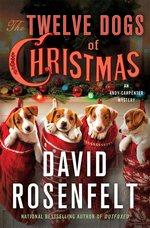
The Twelve Dogs of Christmas by David Rosenfelt

The Twelve Dogs of ChristmasThe Twelve Dogs of Christmas

by David Rosenfelt
Series: Andy Carpenter, #15

eARC, 336 pg.
Minotaur Books, 2016

Read: August 27, 2016


I’m not a big fan of holiday-themed installments of long-running series (see the Holiday Plum novels or the Silent Night Spenser novel as glaring examples of how bad these can be). But you know I’m a completist — and if I could make it through the aforementioned books, I could handle this. Thankfully, this was pretty light on the Christmas theme (sure, there are trees and gifts and whatnot, but it’s not really that different from your standard Andy Carpenter novel. So, if you think like I do — don’t worry. If you don’t mind/like a little holiday cheer — don’t worry, you’ll find it.

A friend of the Tara Foundation, “Pups” (so-called because she takes care of stray puppies until they’re old enough to adopt out, and might be pickier than Willie when it comes to worthy humans). Is facing eviction because of the large number of puppies she has in her home, and a new neighbor is complaining. Pups isn’t really what you call “friendly,” “polite” or someone who “should be allowed to interact with people.” She’s crabby, opinionated, blunt and has no patience for fools — particularly fools that seem intent on messing with her and her puppies. So Pups has said a few things that make it sound like she’d be happy if the neighbor stopped breathing.

Which, naturally, means that he ends up killed and that someone did a really sloppy frame job on ol’ Pups. The frame job is actually bigger than just this one killing, but you can read that for yourself.

Why prosecutors continue to play hardball with Carpenter clients, I just don’t get. I never understood why Hamilton Burger insisted on taking Perry Mason’s clients to trial, and I can’t understand why New Jersey’s prosecutors don’t just dismiss charges the instant that Carpenter and Hike show up on the other side of a courtroom. But they don’t, which means we get to watch Andy do his thing, fret about his jury deliberation superstitions, and annoy a judge. Who could ask for more?

I really think the mystery, the culprit and the way things unfold in Twelve Dogs is better than the last few books in this series. Everything’s clicking just like it should in these pages. This may be some of the best Marcus material in quite a while — the way that the gang leader acts around and talks about “Mr. Marcus” tells you more about Marcus than anything that Andy could possible tell us. The book would be worth reading just for that.

Minor spoiler: and hopefully once the book is published, this’ll be taken care of. It was a shame to see Andy betting since he and Ricky and just made a promise to stop doing that about a third way through the last book (I’m too lazy to look up page number, an approach Andy would probably endorse) — and Laurie made it clear that he was expected to keep that promise. It’s a minor note that I probably only caught because I read the two passages in the same 24-hour period.

It’d be really hard to rank Carpenter books in terms of happy and/or sweet endings. But if you were bored/ambitious enough to take on that task, I’m pretty sure that this would find itself close to the top. A great addition to one of the more entertaining mystery series around.

Disclaimer: I received this eARC from Minotaur Books via NetGalley in exchange for this post — thanks to both for this.

—–

4 Stars

Outfoxed by David Rosenfelt

OutfoxedOutfoxed

by David Rosenfelt
Series: Andy Carpenter, #14

Hardcover, 326 pg.
Minotaur Books, 2016

Read: August 26 – 27, 2016


Last week, I talked about how difficult it is to come up with things to talk about with a long-running series like the Walt Longmire books — at a certain point, series like that hit a good stride and only vary a little in quality or interest for readers. Well, the Andy Carpenter series is even longer and more difficult to write about. I don’t know if I can do much, but I’ll try.

This time out, Andy has inherited a client already in prison, he’s basically supposed to deal with routine things and be ready to help him at the end of his sentence. This is made easier in that the client, Brian Atkins, is working with a dog training program that the Tara Foundation has going with the minimum security prison he’s in.

But then he breaks out of prison and is found leaving the scene of the murder of his estranged wife and his former partner.

But it’s so much bigger than just this (really, the case doesn’t seem as difficult as many of his — finding the actual killer is, but not the case) — Andy’s going to find himself at odds with one of the most dangerous foes he’s tangled with. Speaking of easy, I sort of think that everything ended a bit too easily, a bit too pat — I’m not sure how doing what they did really keeps Andy and his family safe.

I was wondering how Andy and Laurie were going to deal with juggling parenting and these cases, and man, do I hope they come up with better ways than this one. It works once, but not twice. I liked the little bit of fathering we get to see from Andy, though, and Ricky seems like he can be a decent addition to the series.

I don’t want to sound like I’m down on this book — or this series. It was a whole lotta fun, a nice puzzle, and watching the pieces fall into place was pretty satisfying. If you’re not reading these books, you’re missing out.

—–

3.5 Stars

Dead is Best by Jo Perry

Dead is BestDead is Best

by Jo Perry
Series: Charlie & Rose Investigate, #2

Kindle Edition, 296 pg.
Fahrenheit Press, 2016

Read: May 2, 2016

You’d think that having given up the ghost I’d be beyond the grasp of my ex-stepdaughter, the parasite.

Sure, Charlie’s less-than-charitable assessment, doesn’t make it sound like death has mellowed him at all — or that we really want to spend a novel looking into the trials and tribulations of his ex-stepdaughter, Cali. (a quick aside: I loved Charlie’s rant about the pretentious names given to Cali and her peers, “Truth, Canyon, Druid, Turquoise, Vanilla and Road. Don’t tell me those are names–– they’re brands. “) But last time we learned that 1. Charlie has actually mellowed a bit, we just need more time to see it; 2. He’s generally right about his family; and it won’t take long before the reader will actually care about Cali. As difficult as she’ll make it.

Textbooks will tell you that Cali is a “troubled teen.” Which is a pretty vague, and a likely outdated, term. She’s a drinker, a drug user, defiant daughter (although once you meet her mother and current stepfather, you kind of get that) in trouble with the law. But it doesn’t take long once Charlie and Rose start to follow her for her to end up in more trouble than she — or anyone — deserves.

Once again, there’s very little that Charlie and Rose can do other than watch what’s happening and put two and two together in the almost vain hope that Charlie can do something about it. Rest assured, they do, and it doesn’t involve another near death experience (I was a little afraid they’d just be hanging around Surgical Centers waiting for the next opportunity to talk to another ghost). It’s hard to believe that a mystery series where no one knows that the main characters did anything works. But this does.

What can I say about Rose? She’s at once one of the most realistic dog characters I can remember reading lately (she doesn’t talk, narrate, have a point of view chapter, or communicate telepathically), and yet, as a ghost, is the hardest to believe. She’s such a good influence on Charlie, I’m glad whatever or Whoever brought them together after their deaths.

Charlie said something in the last book about death not being about learning anything or insight or growth, that he stays the same. I don’t believe it, he’s not the same guy. But it’s probably a good sign that he doesn’t realize it.

Something I should’ve mentioned when I talked about the previous novel, these chapter epigraphs are great. They represent a truly impressive collection of quotations about death, some funny, some thoughtful, just about all of them keepers. The book is worth the effort just to read these (but you should really focus on the rest of the book).

Perry’s freakishly short chapters make you think Robert Parker was prone to be long-winded and rambling, but they work. You could probably make the case that they’re a commentary on the transient nature of human life or something (if you wanted to, and I don’t). They keep things moving, really keep anything from dragging, and help you get how Charlie and Rose can jump from place to place with ease.

Funny, poignant, all-around good story-telling. Plus there’s a dog. You really can’t ask for more than that. It’s easy to see why people as diverse as Cat Warren and Eric Idle commend these books. I strongly recommend this one (and the predecessor).

—–

4 Stars

Dead is Better by Jo Perry

Dead is BetterDead is Better

by Jo Perry
Series: Charlie & Rose Investigate, #1

Kindle, 282 pg.
Fahrenheit Press, 2016

Read: March 12 – 14, 2016

In its young life, Fahrenheit Press has put out some great looking titles, not your typical mystery fare. I’ve only read 2 (bought 1 other), so far — but they’ve shared the off-kilter flavor that the Press’ twitter feed/publicity displays (and descriptions for the other books indicate). I don’t typically talk about publishers when I’m talking about books, but there’s something about Fahrenheit’s project — and the books they put out — that draws your attention. Dead is Better is typical of FP — a mix of darkness and light, unlikely protagonists, unlikely crime-solvers, and atypical crimes (at least as far as crime fiction goes).

Charles Stone is our protagonist, but he’s not really the character that will grab your imagination. That’d be Rose — but we’ll get to her in a moment. Charles is dead — very dead, shot several times. His ghost carries the wounds, as well as the clothing, even the hospital ID bracelet, from the time he died. He can’t remember the shooting however, and can’t think of a reason why he’d be shot. He’s (to his reckoning) no one important, and it doesn’t seem anyone around him even cares enough to kill him/arrange for his killing. After a little bit, he starts to come up with a possible motive or two. But his murder doesn’t seem to be the thing he’s most curious about. What he’d really like to know is, why does he have a constant companion?

Rose is a dog. Well, technically, she was a dog, now she’s the ghost of one. We don’t know why she’s alongside Charles, but she’s been with him the entire time he’s been a ghost. It seems that she had a really unpleasant life; and at last, in Charles, has someone caring for her. Rose is not going to challenge Crais’ Maggie, Quinn’s Chet, or Hearne’s Oberon anytime soon as the greatest dog in fiction — which is not a dig. Rose is great, she’s just not legendary. Rose does have one thing going for her that the other’s don’t — she’s pretty realistic (not that the others don’t have their moments — but even Maggie gets Point-of-View chapters), she can only communicate through suggestion — and even then, the people around her have to guess. Sometimes, they guess wrong.

The two begin investigating Charles’ murder — with the occasional glance at his family and former life. But before long, Charles becomes convinced he’s not around to look into his death, but something else. Rose, somehow, seems to know more about what’s going on than Charles, but he’s the one who needs to do the work. The pair do uncover some answers — and others uncover some others (I’m not convinced that all the answers the readers/Charles are given about anything beyond the main crime are correct, but . . . ).

More importantly, Charles finds a measure of redemption — sure, it might be too late, but nevertheless, there is some. You get the idea that if he maybe had a dog while living, he might’ve turned out to be a better person. Sure, that describes most of humanity to me, so I responded to that, but I think Perry sells it well enough that just about anyone would.

I’ve often thought of trying to do an Urban Fantasy for NaNoWriMo featuring a ghost, but I’ve never figured how to bridge the communication gap between the living and the dead without it feeling like a cheat. I liked Perry’s solution to this (I worry about the sequel repeating it — but that’s not my problem, is it?). I’m not convinced that the police could’ve/would’ve used the information that Charles got to them, but in the moment — you don’t care, you’re just glad that someone did something.

This is a fast and lean read — Perry doesn’t waste a word (actually leaves a couple of them out, but nothing too distracting). You’ll grow to like Charles, you’ll want to adopt Rose, and you’ll want to finds out what happens to them next. Thankfully, their story will continue in Dead is Best.

—–

4 Stars

Talking to the Dead by Harry Bingham

Talking to the DeadTalking to the Dead

by Harry Bingham
Series: Fiona Griffiths, #1

Hardcover, 337 pg.
Delacorte Press, 2012

Read: February 16 – 17, 2016

One thing I need to do a better job of is remembering how I found out about a book/series/author that I need to try, this novel is a great example of why. I remember putting it on my TBR, and that there was something about it that made me move it ahead of the others — but I can’t tell you when or why I did so. Sometimes, like with this book, that drives me crazy. I just had to trust that I knew what I was doing when I picked it up. Thankfully, it didn’t take long to convince me that Fi Griffiths had something special going on — mostly it was the voice, the attitude, her humor as seen when she’s going through stacks and stacks of financial documents to make a case air-tight (before the inevitable guilty plea for ripping off a private school):

My desk is covered with paper. I loathe all banks and credit card companies. I hate every digit between 0 and 9. I despise every dopily run Catholic boys’ school in South Wales. If Brian Penry were in front of me now, I would try to force-feed him my calculator, which is as large and chewable as Bakelite phone.

It didn’t take too long before the merits of the case drew me in (not the drudgery of the case above, but the one that drove the novel’s action), and would have even without Fi’s narration. But it was a lock with her as a character. The grim nature of the killings grip the reader, the way they do Griffiths’ colleagues and superiors. What really impressed me was that it is one of the sickest, grossest descriptions of a corpse this side of a Bones episode — and Bingham doesn’t dwell on it — oh, he could’ve, and most authors would have. It’s there stark enough to give the reader the willies, in a just-the-facts-fashion, but Bingham doesn’t exploit the nature of the killing or the state of the body.

To put it charitably, Fi is quirky. To be more accurate, she’s suffering from a serious mental condition — she’s (mostly) got it under control, however. Social skills aren’t really in her wheelhouse — at least not automatically — which presents an additional challenge for her work. Early on, I kept picturing Diane Kruger’s performance from The Bridge, it diminished eventually, but I think Fi will always be Kruger-esque to me. We do eventually get actual information about her condition — which is nice, but we don’t need it to understand her enough to empathize with her. There’s an Author’s Note at the end with more details about the actual condition — don’t read it until the end. Get to know her absent the condition first.

Bingham creates a good bench of supporting characters — a potential boyfriend, a couple of supervisors (who have differing levels of concern for her), a former therapist, an old friend (former trainer/sensei-type), parents, sisters, and a few other detectives. One or more of these can be summoned from the bench with ease in the future, but we don’t get to spend a lot of time with any of them here — just enough to establish them. We spend some good time with her potential boyfriend, old friend/trainer/sensei and dad — I like them all and want to see more of them. But this is really Fi’s book and the narrative weight falls on her troubled, yet capable shoulders.

We hardly get an idea for what kind of men the bad guys are here — it’s just shadowy criminals, up to shadowy criminal things. I like the idea that we only get things through law enforcement eyes, not through the killer’s — that happens far too often for my taste. Like Fi says, I know this way we don’t get the full story, but I prefer not being in the mind of the sickos at work here. We, and the police, get most of the story in the end, and that’s good enough for me.

The book closes with a couple of the most heartfelt, moving scenes that I can think of in Detective Fiction (give me time, and I could probably make a decent list of competitors, still pretty sure this would be near the top — sure, that scene in Gone, Baby, Gone has this beat, but not many others would). I had a hard time believing that it would work as effectively given the fact this is a first novel for the character — but Bingham has laid a lot of ground work to get us ready for these moments, and it paid off well.

Talking to Strangers grabbed me in just the right way. I want to devote the next few days to just reading the rest if this series (I won’t, I know I need to pace myself, but… Oh, I really want to just binge). Fi is an early leader for favorite character of the year (a thing I just decided to do).

—–

4 Stars

Santa 365 by Spencer Quinn

Santa 365Santa 365

by Spencer Quinn
Series: Chet and Bernie
Kindle Edition, 47 pg.
Atria Books, 2015

Read: December 15, 2015


There’s not a whole lot to say about this short story, but I’ll give it a whirl. Taking place sometime before The Dog Who Knew Too Much (the duo’s adventures involving a wilderness camp), this is the story of Bernie trying to throw a Christmas party for his friends and, more importantly, his son, Charlie. Naturally, because it’s a Chet and Bernie story, crime ensues, and Bernie’s able to set things right (and take care of another problem at the same time). Sure, given that most of Bernie’s social circle are either cops or perps that he and Chet have busted, there should be a lot more crime in Bernie’s life.

Suzie, and we, get to meet Bernie’s mother, Minerva. Something Bernie’s not too excited about (well, I don’t think he cares about us meeting her, Suzie, on the other hand . . . ). She was amusing, but I think Minerva could become too much very quickly. If she returns in a novel, I hope her appearance has about the same number of words.

I trust it’s because of the size of this story, but wow, this was a shallow and rushed thing. Still, it’s a pleasant read, fun to see Chet’s reaction to a Christmas tree and what not. There are a couple of lines from this story that belong in Quinn’s Top 20 All Time lines (a contested field, I realize), so I’m glad I read it, but I was left wanting a bit more.

—–

3 Stars

The Promise by Robert Crais

The PromiseThe Promise

by Robert Crais
Series: Elvis Cole, #14 / Joe Pike, #5
Hardcover, 402 pg.

G.P. Putnam’s Sons, 2015

Read: November 10 – 11, 2015


Elvis has been hired to find Amy Breslyn, from her pictures he says, “She looked like a sad version of someone’s marshmallow aunt: a kindly woman, slightly out-of-date, who wore sensible shoes and minded her own business.” But his client paints a picture of a woman who has been making some very unwise life choices lately, and she’s worried. Once Elvis scratches beneath the surface of Amy’s life, her recent lifestyle is far worse than “unwise.” Can the World’s Greatest Detective help her?

You strip away all the bells, whistles, multi-perspectives, co-mingling of series, and whatnot and you’ve got yourself a classic, prototypical Elvis Cole story. There’s a missing person that he’s hired to find, he goes through a bunch of stuff to find that person — ticking off a police department and a criminal enterprise in the process. At some point, he finds the person, but also discovers this person is in a world of hurt from the government/the criminals she’s crossed paths with, which he will try to extricate them from. Excitement, deception and bullets ensue. Pike does his thing. Elvis does his. Happy ending — or as close as you can get in this world we live in.

It’s with the bells and whistles that this one stands apart from your usual Elvis Cole book — which is both a good and a bad thing for the book.

Good, because we got to see so many characters that we enjoy and/or love interacting and teaming up.

But . . .

For the first few chapters it didn’t feel right — as an Elvis Cole book, it worked as a suspense novel — there was just too much bouncing around between the various point-of-view characters. By chapter 6 or 7, things settled down and back to what it should be. Still, The Promise probably stretches the limit of acceptable point-of-view characters: Mr. Rollins (the criminal we meet in the opening pages), Elvis, Joe, Jon Stone, Scott, and even Maggie — we’re an imp, a bastard and a khaleesi short of George R. R. Martin epic.*

It’s in trying to serve all these characters that the novel struggles — for example, I could’ve used more Pike. Sure, he’s effective when he’s around — but he’s barely around. After bringing in Jon Stone, Pike’s more of a backup than anything else — okay, fine, this was Stone’s kind of work. But still, if it’s listed as a Joe Pike novel we should see Joe do some Pike-level stuff. I don’t even think that Elvis said anything about him twitching the corner of his mouth in response to a joke! That might even disqualify it as an Elvis Cole.

Now, the Jon Stone material — especially his POV chapters — was great, and if it hadn’t been at the expense of Pike, I would write a healthy paragraph praising it.

The Maggie and Scott story might have been the most compelling part of the book. Scratch that, for me (at least, your mileage may vary) the Maggie and Scott story was the most compelling part of the book. It was fairly predictable, but executed so well that you just don’t care. This is a problem when they’re not the central figures in the book. I think the novel suffered from Spider-Man 3 Syndrome** — just too many characters running around to do a good job with.

I got enough of the Maggie and Scott material, same for the Jon Stone (except for the bit that you’re designed to want more of). But I needed more Joe being Joe, I wanted more Joe/Elvis interaction, more Elvis/Scott, more Elvis investigating, more — well, more Elvis, I guess is what I’m saying. Every time it seemed that the story was picking up steam and we were on track, we got someone else’s POV and had to start building momentum again.

Don’t get me wrong, I talked so much about the problems I had to fully explain them — I really enjoyed it, I just didn’t love it. After waiting so long, you’d hoped that this would’ve been dazzlingly great, instead The Promise will have to settle for being very enjoyable. Like I said at the outset, it’s a classic Elvis Cole story — and there are few things I’d rather read. I’m looking forward to re-reading this in a year or so, and I may put up a more favorable post when I do.


Okay, now that I’m thinking about it, who wouldn’t love to see Joe Pike smack Joffrey around a little bit?
8
I’d call it Batman Forever or Batman and Robin Syndrome, but those two had much worse problems than a plethora of characters

—–

4 Stars

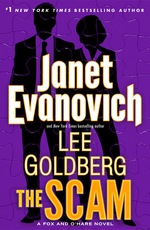
The Scam by Janet Evanovich and Lee Goldberg

The ScamThe Scam

by Janet Evanovich and Lee Goldberg
Series: Fox and O’Hare, #4
Hardcover, 286 pg.

Bantam, 2015

Read: September 24 – 24, 2015

“You can never have too many weapons,” Jake said.
“Does that mean you brought your rocket launcher?”
“It’s in the trunk of my car in case of a roadside emergency.”
“What kind of roadside emergency would require a rocket launcher?” she asked.
“You don’t want to find out and not have one hand,” Jake said. “It’s also why you should always have a paper clip in your pocket. You can do just about anything with a paper clip.”

I was prepared — even half-way expected — for this to underwhelm me. There wasn’t anything driving me to that expectation, maybe it was just my mood. Thankfully, this surpassed my expectations/fears — not for one second. This was another breezy, fun, adventure for Nick, Kate and the crew.

From page 1, The Scam was firing on all cylinders. The main mission was a lot of fun, with a believable target, just dangerous enough. The side missions were interesting and did a good job pushing the plot forward, not just being B stories.

There was even some tie-ins to previous cases — up to and including a recurring character that’s not part of the team.

Boyd is pretty much the most annoying character in the series, but this time, they struck the right one with him. He was insufferable as always, but he didn’t get on my nerves at all. Which means the book probably deserves a bonus 1/2 star rating just for that. The rest of the team was used only minimally — just little tastes of them all. I don’t think I’d want that all the time, but it worked here. Kate and Nick were…well, Kate and Nick. I think Kate was a bit more honest with herself about her motivations — both professional and personal — than we’re used to seeing her. Maybe the same could be said for Nick, too.

The ending (always the trickiest part of a con story) worked — Kate’s improvised weaponry was just great. Even if we didn’t get to see either the roadside emergency rocket launcher or pocket paper clip (which doesn’t mean it wasn’t a great line), sorry Chekhov.

There were a couple of things in the closing pages that floored me. I didn’t think Evanovich would do either of them, just doesn’t seem her style. I like the fact that she can surprise me (maybe it’s Goldberg’s influence — maybe not, but I like the guy, let’s give him the credit). Anyway, there were things in these pages I never expected that I’d get out of Fox and O’Hare. Bravo.

Book five needs to arrive soon. I realize my saying so isn’t going to make it happen. But just in case I’m wrong about that, I should get it on the record.

—–

4 Stars

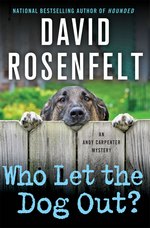
Who Let The Dog Out? by David Rosenfelt

Who Let The Dog Out?Who Let The Dog Out?

by David Rosenfelt
Series: Andy Carpenter, #13
Hardcover, 324 pg.
Minotaur Books, 2015
Read: September 4 – 5, 2015

As Michael Corleone said in The Godfather, Part Ill, “Just when I thought I was out, they pull me back in.” The fact that it was the worst movie in the history of movies does not take away from the truth of that statement, as it relates to my legal career.

Poor, beleaguered Andy Carpenter. Dragged, kicking and screaming back into the courtroom to defend someone he really doesn’t care about, but by doing so he gets to investigate a crime he’s really concerned with.

As we all expect, that crime involves a dog.

The Tara Foundation, the dog rescue shelter that Andy runs with his former client, Willie, is broken into. The thief does a very professional job and takes off with one dog. Professional or not, the thief didn’t take into account how devoted Andy and Willie are to these animals and how obsessive they can be about them. It doesn’t take them long at all to track down the dog…and the corpse he’s next to.

Andy wants to know more about the dog, and the dog’s owner who turns out to be a fugitive, suspected of murder. The only way he can keep his foot in this case is to defend the man accused of the killing. He eventually does figure out who kills the thief, but it’s almost accidental — it’s certainly incidental to anything else going on. Just one of the little bits of pleasure this provided was that “ah ha” moment.

During the trial — the stage of many of this series’ highlights — Andy treats us to an amusing clinic on all the ways that a couple of lawyers (and people in other professions) can use the word “frankly,” including all the shades of meaning that word can provide. Like so many of Andy’s lessons, this was worth the ticket price.

Rosenfelt brings us yet another storylines that could summed up as: It looks like a simple crime, but is actually the linchpin to uncovering a major terrorist plot/international crime syndicate (minor spoiler that if you read more than a couple of chapters you’d see for yourself). I’m getting a little sick of these. The terrorist plot, by the way, makes me reconsider the plausibility of a similar plan in Robert B. Parker’s Night Passage. I’d always thought that the weakest part of an otherwise compelling read, seeing it now in light of this book makes me think there was something there. Still, for crying out loud, Mr. Rosenfelt, let major criminal enterprises and terrorist organizations figure out that a trip through Patterson, NJ is asking for trouble. Local conspiracies, okay. But major international conspiracies? You’ve got to stop going to that well so often. Or period.

My other worry about this is Ricky. If you haven’t read this far in the series, you may want to skip the rest of this paragraph. About half of the material around Ricky was cute and fun — just like it was in Hounded. The other half (mostly involving stale sit-com like bits about kids’ sports) teetered on painful. I fear that this series might be like the older comedies who felt compelled to add the cute little kid late in the run (Andy on Family Ties, Cousin Oliver on The Brady Bunch, Olivia on The Cosby Show, Chrissy on Growing Pains, etc., etc., etc.). If that’s the case, I worry about the future of the series.

Don’t get me wrong — I enjoyed this overall. I can suspend my beefs with this series as it goes on and enjoy Andy’s laziness, his awe of Marcus, Marcus’ awe-inducing self, the hacking seniors, and all the rest. I don’t open up an Andy Carpenter novel expecting to be hanging in suspense, to be chilled, to be challenged in any way; I expect to spend a couple of hours in some pleasant company and sometimes to get a fun puzzle. In that sense Who Let the Dog Out? delivered enough.

—–

3 Stars

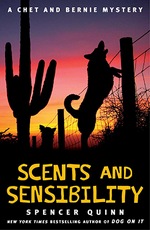
Scents and Sensibility by Spencer Quinn

Scents and SensibilityScents and Sensibility

by Spencer Quinn
Series: Chet and Bernie, #8

Hardcover, 305 pg.

Atria Books, 2015

Read: July 16 – 17, 2015Bernie Little is back from his cross-country adventures, not much worse for wear, probably with a little coin in his pocket (knowing Bernie. He gets home to find one of his elderly neighbors in the hospital and her husband being investigated by some overreaching environmental authority. Which gets Bernie’s protective instincts engaged. Oh, yeah, and there’s a hole in Bernie’s wall where a safe used to be. That’s in the mix, too — but it takes a back seat to the Parsons’ plight.

It seems that the Parsons’ son was recently released from prison, making the timing of Mr. Parson’s troubles (and the missing safe), a little suspicious. Bernie starts investigating the son — which leads into looking at the crime that put him away in the first place. Which leads Bernie to cross paths with an old rival. An old rival who may have had something to do with the fact that Bernie is no longer employed by the Phoenix Police Department.

The past and present mingle with the personal and professional for Bernie as the case gets more complicated and dangerous. Which makes this a pretty decent detective novel — then throw in our loyal narrator, Chet with his uniquely irrepressible voice and perspective. That’s a thick layer of icing on a pretty good cake.

Which I guess makes the presence of a young dog who looks and smells like Chet (he’s the source of the latter observation) a nice fondant?

I think the illustration is getting away from me, so I’d better move on.

There are a few certainties in crime fiction, in every novel: a vehicle operated by Stephanie Plum will explode; Nero Wolfe will have beer; Harry Bosch will listen to jazz; and Chet will be separated from Bernie. Sometimes, this annoys me because it seems so forced, but this time it snuck up on me so naturally that I was three or four paragraphs into it before I realized it had happened. There’s some other Ce and Bernie mainstays here: Bernie says something he regrets to Suzie; Bernie’s ex seems to go out of her way to misunderstand Bernie, Chet is spoiled and eats like a goat. Really, it has all the elements of this series, Quinn just uses them better than usual here.

A compelling story, the characters back in their stride, and we learn a little bit more about Bernie — if that’s all this had, I’d jumping with excitement. But when you add those last few paragraphs? Forget it — this is the best thing Quinn’s done since introducing us to this pair.

—–

4 1/2 Stars

Page 12 of 16

Powered by WordPress & Theme by Anders Norén