Category: A-F Page 14 of 16

Series A-F

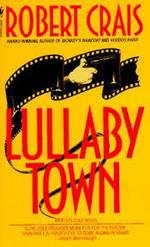
Reread Project: Lullaby Town by Robert Crais

Lullaby Town (Elvis Cole, #3)Lullaby Town

by Robert Crais
Series: Elvis Cole, #3

Mass Market Paperback, 352 pg.
Bantam, 1993
Read: August 21, 2014


The third book in the Elvis Cole series is about sixty pages longer than the previous — and it was about sixty pages longer than the first. This isn’t a trend that will continue, I say with some relief (in fact, I believe the next will be shorter). But the growth isn’t just in page count; it’s in depth of story, depth of character, and the way Crais deals with making sure neither plot nor character get short-shrifted in this.

There’s an obvious effort here to establish a series continuity here with The Monkey’s Raincoat. We get the return of Pat Kyle and her laugh — and that would be enough to help establish this book’s place in the Cole-verse, but we get more. As he spends time sticking out like a sore thumb in a small town, he reminisces about the first time he visited Watts with Cleon Tyner and felt the same way. We also see (and get a reference to) Ellen Lang, briefly. She’s doing much better than she was when we saw her last. In Stalking the Angel, Elvis makes reference to keeping in touch with a couple of former clients, and with Ellen’s appearance we see him doing that again. Unlike with the clients in Stalking, she wasn’t there as a plot device, she was just there to let series readers know that she was still around. I really appreciate little touches like that.

If one’s an incident, two’s a coincidence, and three’s a pattern, we have ourselves a legitimate pattern established. For the third book in a row, Elvis is approached by a potential client/representative of a potential client who is difficult or obnoxious. Elvis will say that he’s not taking the case for the difficult client/client representative, but he will for the likable/put-upon representative/client. I can see why Crais uses this — Elvis gets to show some independence, some graciousness to the non-obnoxious person, and even a little wit in the way he phrases it. But, it’s getting to be lazy returning to this so often. Then again, if I wasn’t reading these so close to each other, I probably wouldn’t have noticed this pattern. So who am I to say?

So here’s the setup: Peter Alan Nelson, the 3rd biggest director in the world (mostly action flicks, apparently — a proto-Michael Bay, but one who’s not as Bay-ish, let’s hope) dumped his wife and kid just before he made it big. It’s been ten years and he’s feeling bad about that now, and wants to get to know his son. So the studio hires Elvis to find them. He does so, she’s living on the other side of the country, appears to have actually done okay for herself, the boy seems good — really, the last thing they need is a brash, self-obsessed, Hollywood type to interrupt their lives. But that’s what Elvis was paid to help with — but first he wants to check into something odd about Nelson’s ex. Turns out, she’s under the thumb of the capo di tutti capi. So before Elvis unleashes Hurricane Peter into their lives, he and Joe Pike will have to see about removing that thumb.

The tension is high, the solution isn’t obvious — and isn’t easy to achieve, either. Elvis does a pretty neat job investigating things to find Heather Lloyd in the first place and he has to do plenty more to figure out how to extricate her from this situation. There’s a good deal of sleuthing in this book, which really makes up for last time. Teach me to be snarky about that. Sure, they’ve got the ex-cop with all the connections and some power, Rollie George, to act as a font of all knowledge and help them navigate a city they aren’t familiar with. But that really doesn’t come across as a cheat — Elvis still has to act on the info given and turn it into something. Rollie cuts out a lot of time, but he doesn’t hand him anything wrapped in a bow. Having someone be a source of local information can really help keep things moving plot-wise.

This time out, the Peter Pan quest, protection of innocence — whatever you want to call it — is very brief and understated. If anything we see the dangers of that kind of life — Peter Alan Nelson could arguably be considered an eternal youth, with expensive toys to play with — but his demeanor, self-centeredness and lack of ethical code make him a very different kind of child than Elvis. If you’re going to hold on yo your childhood, do it the right way, or you end up as a petulant slob. There’s a child-like way of approaching things, and a childish manner. Cole’s not interested in the latter one bit. It’s interesting to watch Elvis draw the distinctions, or at least act on distinctions that he’s drawn, so that we can see what they are. You also have to wonder, seeing Peter Alan Nelson throw a fit, if Cole seeks to shed a bit of his version of Peter Pan so that he won’t act like “that guy.”

Lullaby Town has moments of humor throughout, but like Stalking, it’s not as jokey as Monkey’s was. The wit is there, he just doesn’t feel the need to break it out as often. Or when he does (and he’s not just provoking annoying clients or self-important mafia persons), there’s a purpose, to illustrate something, to reveal something — or to break monotony. Either way, Crais is learning how to let situations drive this kind of thing.

Portrait of the Big City Detective sitting on a small-town bench, ferreting. In the cold. People passed on the sidewalk, and when they did they nodded and smiled and said hello. I said hello back to them. They didn’t look as cold as me, but perhaps that was my imagination. You get used to the weather where you live. When I was in Ranger School in the Army, they sent us to northern Canada to learn to ski and to climb ice and to live in the snow with very few clothes. We got used to it. Then they sent us to Vietnam. That’s the Army.

Our knowledge of Elvis isn’t enhanced a lot by this novel, but what we do get is important. On the not-so-important side, we get a definitive note from him about giggling – he doesn’t like it (which maybe was hinted at before, but his displeasure wasn’t as explicit). We do get confirmation of a good deal here, his character, his willingness to help those who need it, but can’t afford him — that sort of thing. He gives Karen a concise explanation for why he decided to help her rather than turn things over to the police.

“And you haven’t told the police?”
“No.”
“But those men beat you up.”
I said, “I knew something was wrong and I wanted to find out what it was. Cops deal with the law. The law isn’t usually concerned with right and wrong. Ofttimes, there are very large differences.”
She shook her head as if I’d spoken Esperanto.

Elvis is solidified here as your hard-boiled hero. It’s not about legal/illegal, it’s about right and wrong — an objective morality. This is the core of Elvis Cole, and even Joe Pike — why do they do what they do? From tearing up Ellen Lang’s check, to carrying on the search for Mimi Warren after being fired, to putting themselves out on the limb for a client they were only hired to find (and who can’t pay them anything). This is it.

As the action in this one takes place no where near the LAPD, we don’t get to see the antagonism they have for Joe Pike, but we learn a little bit about him. Bit by bit, we’re getting a picture of Pike so that when we do eventually learn a good deal, there’s an impact. As tensions are at their highest between Elvis and the mafia, we get this exchange:

I asked Pike, “Are you afraid?”
He shook his head.
“Would you be afraid at midnight if we were alone?”
He walked a moment. “I have the capacity for great violence.”
I nodded. So did I. But I thought that I might still be afraid.

“Elvis?”
“Yeah?”
“I remember being afraid. I was very young.”

and that’s all we get about that. For now. But it hints at something serious — that we will explore in the future. As serious a moment as that was, I have to chuckle at Pike’s “I have the capacity for great violence.” Yeah, no kidding, buddy — never would’ve guessed.

I don’t know if I can successfully describe why I like this one so much — not that I had real problems with the first two books, but this one seems to have everything clicking and only the minor-est of problems. Funny, snappy writing, solid action, a complex solution, and growth and development in multiple secondary characters. There will be higher points in the series, but for awhile, this will be the standard by which Cole novels are measured by me.

Coming up next: Free Fall which is definitely a departure for Crais, Cole and Pike in many ways.

—–

4 1/2 Stars

—–

Drawing by Kirsty Stewart, chameleonkirsty on deviantART, used with permission.
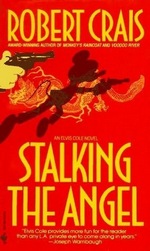
Reread Project: Stalking the Angel by Robert Crais

Stalking The Angel (Elvis Cole, #2)Stalking The Angel by Robert Crais
Series: Elvis Cole, #2

Mass Market Paperback, 260 pg.
Crimeline, 1992
Read: August 13 – 14, 2014


Okay, here we go with the second Elvis Cole adventure — I hesitate to call this a mystery, the amount of investigating that Elvis performs before finding what he’s been hired to is pretty minimal. What can I say, the guy’s got himself some great instincts.

The book opens with a great visual — Elvis is doing a headstand in the middle of his office when in walks the man who will go on to hire him, and his lawyer — “the best looking woman [Elvis has] seen in three weeks.”

I said, “You should try this. Invigorates the scalp. Retards the aging process. Makes for embarrassing moments when prospective clients walk in.”

Bradley Warren is not amused, but is in a hurry and needs an investigator so he sticks around to hire Elvis.

Crais packs a lot into the description of Warren’s lawyer — giving us his initial impressions of her, as well as revealing a little about himself to (re-)familiarize readers to his character, in addition to the obvious physical description:

Jullian Becker was in her early thirties, slender in gray pants and a white ruffled shirt with a fluffy bow at the neck and a gray jacket. She held a cordovan Gucci briefcase that complemented the gray nicely, and had very blond hair and eyes that I would call amber but she would call green. Good eyes. There was an intelligent humor in them that the Serious Businesswoman look didn’t diminish.

They explain, Warren does a lot of business (he’s a very influential and wealthy man, they make sure Elvis realizes) with Japanese investors — and in a promotional stunt, he’d arranged a loan of one of the few original copies of The Hagakure from the thirteenth-century, and it was stolen from his home safe. He needs it back in a couple of days, and as distasteful as he fins Elvis, he needs his help. He and Elvis spend a little time annoying each other, before Elvis relents — for Jullian’s sake — and agrees to help find the manuscript. While Warren and Becker jet off to Japan, he starts investigating at the scene of the crime, where he runs into Warren’s very drunk wife who makes several passes at Elvis. Tiny spoiler: Elvis keeps it in his pants for the whole book. Maybe having established his noir cred in Monkey, Crais didn’t have to keep that going (not that Elvis doesn’t notice attractive women, flirt, etc).

Elvis taps a source for someone who dabbles in stolen art and leans on him to get an idea who’d have motive and means to steal The Hagakure, he gets a name. Elvis pushes the dabbler to the edge of despair — he know that his world could come crashing down around him and ruin the lives of his family. Elvis is disturbed by that, musing to his cat later,

“You ever notice . . . that sometimes the bad guys are better people than the good guys?”

It’s a small moment, but reveals a lot about Elvis that the reader needs to know without just telling us the information. The bad guy as a better person (and vice versa) is something we’ll see again in this book — and frequently from here out.

Elvis takes that lead he bullied out of that man and finds someone with ties to the yakuza — and the LAPD task force watching him. Things don’t go well with either group and he has to bring Joe into the picture. Oddly, things escalate with Warren and he starts receiving threats. But he goes ahead with business as usual. After failing to convince him to cancel a public event despite these threats against him and his family, Elvis and Joe help out with security in a location almost impossible to secure.

Pike drifted up to me. “This sucks.”
That Joe.
“I could off anybody in this place five times over.”
“Could you off someone and get away with you here?”
Head shake. “I’m too good even for me.”

Technically, Joe didn’t joke there — but he came close.

Things get worse from there, spiraling out of control and pushing Elvis to the brink. Which allows Crais to explore the friendship between the two — Pike spends a lot of time reassuring Elvis, trying to keep him from going over the edge. With more sensitivity than he showed Ellen Lang in Monkey, Pike’s there, keeping Elvis on track.

“You were doing your best for her, something that no one in her life has ever done.”
“Sure.” Mr. Convinced.
“Ever since the Nam, you’ve worked to hang on to the childhood part of yourself. Only here’s a kid who never had a childhood and you wanted to get some for her before it was too late.”

I know I noticed that theme of protecting childhood — Elvis’ own, and others’ — as I read the series before, but I don’t think I saw how prominent it is, this will be interesting to track.

Speaking of Joe, we get more of the Pike myth — at some point the FBI gets involved in the case. The agent talking to Elvis knows Pike’s name, and understands something of his reputation. He doesn’t want to meet Joe, but he does want to take a look at him. The Agent’s attitude is different than the LAPD’s, Pike’s not despised by him, it’s more like an urban legend that he gets to verify exists. Later, Elvis and Joe have to do a little skulking around a home that the police have staked out, and Pike stays back in case he’s recognized by them. By this point, Crais is making sure you’re wondering what’s going on here.

Elvis — both in dialogue and in narration — is still funny, but I think there are fewer jokes per inch in this book, but I think they’re funnier. Elvis cracks me up, and I appreciate that. He also drops the jokes toward the conclusion, when things get violent and deadly. I noticed that some readers were critical of Elvis’ joking at the similar point in the last book, and Crais must’ve seen something similar twenty years ago — or it’s just him being more disciplined as an author. Hopefully the latter, but I’d assume the former is possible.

Crais seems more confident, more sure of his characters and story this time out — as he should be, this is a stronger book. In addition to a strong hard-boiled detective story, we see themes of friendship, honor; the protection of childhood; criminals acting nobly, “good guys” who need someone like Elvis to threaten to kill them.

A very successful sequel to The Monkey’s Raincoat, Stalking the Angel secures Crais’ place at the top of the field. That’s about all I have to say about it, so I’ll see you next week for one of my favorites, Lullaby Town.

—–

4 Stars

—–

Drawing by Kirsty Stewart, chameleonkirsty on deviantART, used with permission.

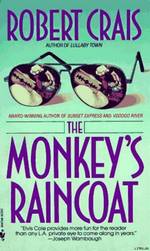
Reread Project: The Monkey’s Raincoat by Robert Crais

The Monkey's Raincoat (Elvis Cole, #1)The Monkey’s Raincoat

by Robert Crais
Series: Elvis Cole, #1

Mass Market Paperback, 201 pg.
Crimeline, 1992 (originally 1987)
Read: August 6, 2014


We start the Reread Project with The Monkey’s Raincoat, which should be read as the pilot for the Elvis Cole series. It establishes the characters, the world, the tone — the story is secondary to that. It’s also the foundation — everything after this will be building on this, and will be an improvement (if for no other reason than Crais gets better). It does all the establishment work pretty well — and some points of the non-establishment work is standard, some of it is quite well done. In the end, its a successful pilot, showing the promise to be delivered in ensuing novels.

“Peter Pan. You told Ellen you wanted to be Peter Pan.”
“Unh-hunh.”
“That’s crap. Stay a little boy forever.”
“It’s not age. Childhood, maybe. All the good things are in childhood. Innocence. Loyalty. Truth. You’re eighteen years old. You’re sitting in a rice paddy. Most guys give it up. I decided eighteen was too young to be old. I work at maintaining my self.”
“So at thirty-five, you’re still eighteen.”
“Fourteen. Fourteen’s my ideal age.”
The left corner of her mouth ticked.

Now, I contend that something happens in a few books to get Elvis to decide to grow up (I’m not convinced he realizes it though) — but for at least a handful/handful-and-a-half novels, this is a great summary of Elvis’ core.

A lot of people will compare Elvis Cole to Spenser and while it’s frequently over-stated, it is a legitimate comparison. And Raincoat Elvis compares pretty strongly with The Godwulf Manuscript Spenser, but Elvis is a lot closer to the character he’ll be from now on, than Godwulf Spenser is to the character he will be following it. Which says something about the thought that Crais put into Elvis before writing, and his experience working with character — Parker really ever had this until he had a few novels under his belt.

Before we get to the Peter Pan self-disclosure, we see that in action — in the decorations of his office, his dress style, the way he talks to prospective clients — all in the first few paragraphs. Which also contain a nice info dump disguised as dialogue, as way to introduce himself to the reader as well as the client who asked him about his qualifications. It gets the job done and it doesn’t feel all clunky and Dan Brown-like. Crais doesn’t do anything ground-breaking here, but so often (especially in first books of a series) this is done in a clumsy way, so it’s nice to see it done smoothly.

There’s a lot to Elvis Cole here that seems straight from the hard-boiled detective starter-kit: he’s got the relationship with a police detective that’s based on mutual respect, but the police detective can’t color outside the lines like Elvis can. He’s got the friend who’s a newspaper reporter — far too busy to have a real conversation with him, but will give him just the right quick answers (while being a real smart aleck) to move the investigation along (in return for tickets to a sporting event). He’s got quite the way with the ladies. He’s a lone wolf type, will drink a lot, he’ll constantly have a wise-crack at the ready, he had a few odd jobs related to law enforcement prior to this, but he can’t work within the system — and so on. It’s what Crais does with these elements — and the rest of Elvis’ characteristics that elevate the character.

So much of the what will separate Elvis from Spenser/Patrick Kenzie/Lincoln Perry/Cormoran Strike/etc. are the quirks and the little details: The nameless, beer drinking cat; the morning yoga; his Elmore Leonard fixation; his Hawaiian shirts and Disney stuff. I liked the fact that Elvis keeps a roll of nickels in his car to use in case of a fist fight. Even more, I like that he had to dig around under the seat to find the roll (and if the interior matches the exterior, it’s not easy to find anything under the seat).

Now, you can’t talk about Elvis Cole without talking about Joe Pike — his business partner with the empty office. Yes, in many ways Joe’s the Hawk to Elvis’ Spenser. But he’s more. By the time we meet him, Elvis has had a couple of very brief phone chats with him, but even the terseness of those won’t prepare us for actually meeting him. Our first introduction to Pike is striking:

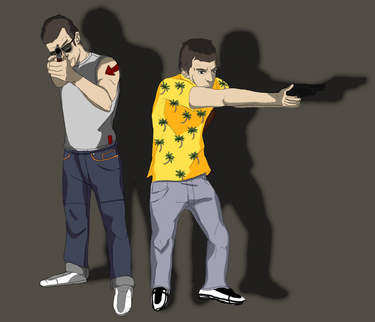
The next morning I woke with brilliant white sunlight in my face, smelling coffee. The sliding glass doors were open and Joe Pike was out on the deck. He was wearing faded jeans and a great sweat shirt with the sleeves cut off and blue Nikes and government issue pilot’s sunglasses. He rare takes the glasses off. He never smiles. He never laughs. I’d known Joe Pike since 1973 and he has never violated those statements. He’s six feet one with short brown hair and muscled the way a fast cornerback is muscled, weighing in somewhere between one eighty-five and one-ninety. He had a red arrow tattooed on the outside of each shoulder when he was in The Nam. They pointed forward.

The description today would be a little different. A little. But on the whole, Joe’s consistent, he’s grown a little bit as a character (because of Elvis, he’d assure us), but even with growth, the Joe you get in Monkey’s is the Joe you get in Taken.

Every time Joe’s name is mentioned around someone from LAPD, it’s answered with scorn (at best). Elvis will shed a little light on this eventually when Ellen asks (again, info dump — however small — and dialogue that doesn’t feel forced). But on the whole, all Crais is doing is a bunch of seeds that he’ll harvest later in a way that probably no one reading this can guess. Since this is Elvis’ narration, and Elvis is his friend, we trust that the LAPD is out to lunch on this, and this is reinforced by the clueless way they handle the disappearance of Perry Lang. Time will tell if our trust in Elvis is well-placed.

There’s a clear affection between Elvis and Joe. They trust each other, they tease each other — they depend on each other (without ever coming out and saying it). They’ve known each other more than 15 years at this point, as partners for most of that, and a lot doesn’t need to be communicated anymore

The thing that truly separates Pike from your typical mercenary/bonebreaker-as-sidekick is the way he deals with Ellen Lang. He tells her things about his past, he helps her learn to shoot, he goes out of his way to empower her — and through that, comfort her. Elvis will give her pep talks, he’ll encourage her — even force her to see reality. But Joe (unintentionally) inspires her, and then will (intentionally) show her the inner strength, the character she has and needs to meet the future. Hawk would never do that.

I’m sure I should say something about the story, too. So, Ellen Lang comes (with a lot of prompting from her friend Janet Simon) to Elvis needing help finding her estranged husband, who seems to have taken off with their son (but not their daughters). Elvis isn’t crazy about the idea, but he has rent to pay — so he takes the case and starts poking around looking for the missing talent agent. He finds Mort’s girlfriend, but that doesn’t help but it sheds some interesting light on Mort’s lifestyle. Before long, there’s a body, a couple of kidnappings, a lot of missing cocaine, and a crime boss’ Eskimo enforcer roughly the size of a small bull.

As Elvis goes through the investigation, it’s good, solid stuff carried along by his narration. But there’s nothing other than his narration and the character work he’s started to make it distinctive over any other of a dozen PI’s. But then you get to the conclusion — a big, guns-blazing, bullets-flying, implausible-but-not-really, story climax — and you really start to see the potential for this Crais guy and his pair of Vietnam Vets.

I’m not sure I’d give this 4-stars if I this was my first read of the series, or even of this book (rather than the 6th or 7th). But it’s not, I know what seeds Crais planted (whether he intended to or not), I know where’s he’s going with this and how well this sets up the books to follow. As such, it deserves no less than 4-stars.

—–

4 Stars

—–

Drawing by Kirsty Stewart, chameleonkirsty on deviantART, used with permission.
Coming soon: The Reread Project

Joe Pike and Elvis ColeOne of the things I’ve been thinking about lately is that I don’t re-read as much as I used to, so I’m making a greater effort to do that, starting in January of this year. Think I’ve managed to reread 1 book before this week. Whoops.

Anyway, I got to talking about Robert Crais with a buddy last week who was wanting to dip his toe in the water, and wanted to know if he needed to read the Cole/Pike books in order or if he could just read which ever he could get his hands on. I’m sure he regretted asking because rather than the 1 sentence answer that he was probably looking for, he got most of a page of text. And if I’d had more time before needing to get to sleep, I’d have probably written pages. And that was just off the top of my head.

I honestly couldn’t stop thinking about Elvis and Joe after that email — I’d read everything up to book nine, The Last Detective, at least twice. But had only managed to reread the first two Joe Pike books since. So the series is ripe for this kind of thing. If I manage myself correctly, I’ve got enough time to read the series before the next novel hits my doorstep in November. Which makes it a bit more appealing — I love a good deadline.

My reviews will be a bit longer (I think) than usual, if the first one is any indication, anyway (1400 words or so) — looking both at the novel and their place in the series, the changes, developments, ties between novels, themes, etc. I don’t think I’ll have time for the two stand-alone novels that introduced characters now part of the series, so we’ll have to rely on my memory for that. These should go up on Mondays — leaving the few “Dusted Off” posts that I have for those weekdays I just can’t get anything else finished.

Once I’m done with Elvis/Joe, I’ll move on to something else. I like the discipline of one reread a week. I did it with the Nero Wolfe series a couple of years ago, and really enjoyed that.

Hope you enjoy this — and if you’ve read the series, please, please contribute to the comments.

—–

Drawing by Kirsty Stewart, chameleonkirsty on deviantART, used with permission.
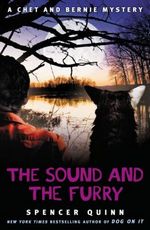
The Sound and the Furry by Spencer Quinn

The Sound and the Furry (A Chet and Bernie Mystery #6)The Sound and the Furry

by Spencer Quinn
Series: Chet and Bernie, #6

Hardcover, 320 pg.
Atria Books, 2013
Read: July 23, 2014

I cannot think of another narrator in contemporary fiction as charming, as relateable, as endearing Chet — unreliable as all get out, but utterly trustworthy. I’m sure there are readers out there who are not susceptible to Chet’s canine charms, but I’m not one of them. I chuckle, I laugh, I am drawn in instantly — and as long as the stories are passable, that combination is a winner.

Thankfully, usually the stories are more than passable, which is just frosting on the cake. This time out, the Little Detective Agency finds itself on the road to New Orleans, of all places — a far cry from their normal stomping grounds. It’s good to see Quinn shake things up a little, he can’t be as dependent on things like Bernie chasing down a former C.I. or a familiar source of information. They also don’t know the lay of the land at all, and Bernie has to acclimate himself quickly.

Sure, some of Quinn’s tropes are here — Bernie not making sound financial choices, Chet causing a little trouble (tho mostly charming people), Chet getting separated for a time from Bernie (although this time it felt more organic than in any other of these books — I was a little bit into the separation before it dawned on me that, “yup, it’s about time for this”). But that doesn’t detract from the change in setting — or make it seem like less of a change. Instead, the presence of Quinn’s usual moves just underlines their universality.

It’s not uncommon for the sidekick of a detective to notice something missed by their associate — and it’s not uncommon for the sidekick to be unable to get the detective to see what they want them to/understand what they’re excited about, etc. And in almost any other detective novel where the detective is so clueless about so much of what the sidekick notices would be full of griping and complaining from the sidekick (justified griping, but griping, nonetheless). Not these books , however – except for his questionable financial decisions, Chet can’t even think of Bernie negatively, and he forgets anything that approaches negative almost instantly. This leaves the reader to chew on all the clues that Bernie’s missing while Chet’s focused on other things. I Love that. Typically, it’s the detective that has access to clues before the reader/independent of the reader (and that’s true here to an extent) but these books turn the tables on that, giving us readers the advantage.

Don’t know of its because Chet’s a dog, or if Quinn’s just that good at what he does (or some other thing), but when Chet’s in danger I get tenser than I do reading just about anything else — even if the danger’s not that great ultimately. But when Chet tussles with a certain critter in this book, I know my adrenaline levels jumped up and I read a lot faster just so I could get to the resolution of the fight.

My main (only?) problem with the book is its treatment of Suzie Sanchez. She seemed more like a refugee from Three’s Company than the reporter we’ve come to know and like. Quinn’s bounced between from treating her as a strong, capable character and this disappointment — she deserves better (as do Bernie & Chet, and the readers). If I’m drawing the right inferences from the cover image on the seventh Chet & Bernie book, it looks like he’ll give it a shot. If I’m wrong, Quinn should just write the character out of the series and start over with a new love interest.

We’ll never see it — I don’t imagine — but Chet kept hinting at this deeper, darker story, this side of Bernie we haven’t really seen (I think we’ve gotten glimpses before, but nothing like in this book). The kind of thing that belongs in a far more hard-boiled novel than this one. And unless we get someone else’s point of view, we’ll never see this side of Bernie in full because Chet can’t really admit it to be true. But we got a few hints this time — I sure wouldn’t want to be on the wrong side of Bernie.

Until then, we get these light, joy-filled mysteries equal parts puzzle and entertainment. Who’d ask for more?

—–

4 Stars

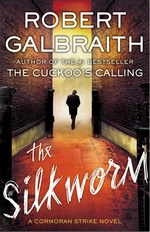
The Silkworm by Robert Galbraith

The Silkworm (Cormoran Strike, #2)The Silkworm

by Robert Galbraith
Series: Cormoran Strike, #2

Hardcover, 455 pg.
Mulholland Books, 2014
Read: July 2 – 5, 2014

Cormoran Strike is back, and I couldn’t be much happier. After the events described in The Cuckoo’s Calling, Strike’s enjoyed a few minutes of fame — a degree of notoriety with the police, and a profile big enough to land him bigger clients, plus his fair share of would-be clients with a weak grasp on reality and/or not a lot of money. Leonora Quine certainly appears to be in the latter camps when she comes to hire Strike to find her missing husband — but he sees an opportunity to collect eventually, and he likes her. The missing husband, Owen Quine, is a writer of some measure of success and renown. He’s been known to disappear for a few days every now and then, but this time seems longer, and with a special needs child at home, Leonora needs her husband back. Something’s fishy, and his soon-to-published next book is at the heart of it. While juggling his other clients — the ones with large checkbooks — Strike starts poking around, and it doesn’t stay a missing person’s case for long.

Cormoran Strike continues to be reminiscent of several mystery fiction types and specific characters — yet he still feels mostly fresh. There’s your typical hard-boiled loaner (Spillane, Spenser, Marlowe, Cole, etc.), the armed services background (same list, come to think of it), the troubled family history, and so on. There were a couple of detectives that I kept coming back to this time around (and I’m probably alone in this, I realize). Strike’s musings on the way he still works like he did in SIB removed me of the way Danny Boyle talks about John Ceepak. It’s odd to see the two ex-military men in the same light, while on opposite sides of the Atlantic. Yet, it’s also incredibly fitting. Strike and Robin also remind me a great deal of Yancey’s Highly Effective Detective and his assistant. Except Strike actually is highly effective.

The description of Quine’s new book in question was fantastic — it is not a book I want to read, in any shape or fashion, but I really enjoyed reading about it. Galbraith is able to give us enough to get the idea without having to take the time to compose another book in the process — very well done there.

This is slow, yet deliberately moving (like the protagonist, really) until it doesn’t need to be any more — once the pieces are in place and it’s time to reveal and trap the killer, then it moves on at a brisk clip and forces the reader to pick up the pace, too (or at least it felt that way). But it never drags, never meanders — it’s always on point, and is building to something.

It’s tough to say that Strike develops much over the course of this book — we grow in our understanding of him, but he’s pretty much the same man at the end. Not so for Ellacot — she grows and becomes stronger throughout, and its only a matter of time before she’s going to be a 50-50 partner in the agency, I bet — and maybe Strike’s partner in other ways, too. I’m looking forward to watching Galbraith develop this character more in the books ahead, but I can tell I’m already getting impatient for it to happen, rather than trusting him and his timeframe. The other supporting characters not involved in Quine’s disappearance are great additions and make everything better, helping us understand the characters more (e.f., Strike’s family, Ellacot’s family — still not the fiancée, Strike’s old friends).

The biggest selling point (for me) with this book is an intangible quality — a je ne sais quoi — about one-third of the way in I noted I was enjoying it. It was a good, solid detective novel — but in a real sense, nothing I hadn’t seen before. Yet — I noticed I was really “into” the book. I couldn’t explain why I was invested as much as I was — but my goodness, I was in whole hog. I have to chalk it up to Rowling’s super power — she can tell a story that grabs you in a way you just can’t explain. If you’ve read her, you know the effect.*

As I read the last couple of paragraphs and closed the book I noticed something — I was smiling. Not a usual reaction for me as I complete a book, no matter what it is. That has to say something, doesn’t it?

—–

* Unless, of course, she’s talking about a little town called Pagford and its residents. Then there’s nothing at all that will grab you.

—–

4 Stars

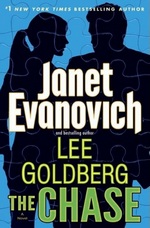
The Chase by Janet Evanovich and Lee Goldberg

The Chase (Fox and O'Hare, #2)The Chase

by Janet Evanovich and Lee Goldberg
Series: Fox and O’Hare, #2

Hardcover, 320 pg.
Bantam, 2014
Read: March 20-21, 2014

Nicolas Fox and Agent Kate O’Hare are back in action — better yet, Janet Evanovich and Lee Goldberg are back and better than ever. This time their target is none other than the head of a multinational security force/private army owned by the former White House Chief of Staff. Easy pickings, right?

This is just the ticket for readers who miss The A-Team or Leverage — clever schemes improbably pulled off by team of pros to take down a real scoundrel. This team gets around a bit more than the others do (better budgets in books than TV shows) — they globe hop from D.C. to Shanghai, to Montreal and more — even the Scottish hinterlands. The shenanigans in Montreal, in particular, were hilarious and ever so smooth.

I enjoyed The Heist (my review) — a lot, actually — but this was better. Everything — the interplay between the characters, the plot, the crazy schemes that Fox & O’Hare cooked up (individually and together), the new guys, the villains — all of it worked better this time out. If these two are this polished on book two, I can’t wait to see what Evanovich and Goldberg are like by the time they get to five or so.

—–

4 Stars

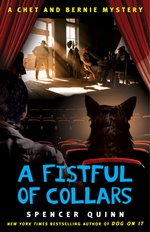
Dusted Off: A Fistful of Collars by Spencer Quinn

A Fistful of Collars (A Chet and Bernie Mystery #5)A Fistful of Collars

by Spencer Quinn
Series: Chet and Bernie, #5

Hardcover, 320 pg.
Atria Books, 2012

Little makes me as happy as a good Chet & Bernie story — and this one fits the bill. Quinn avoids some of the pitfalls of his other books — certain scenes/plot points that are becoming more than threadbare are absent here.

The main storyline was pretty predictable, but it was well — and entertainingly — executed. The subplots are the key to this one, and most of those were handled deftly.

Good, solid entry in this series with one of the best narrative voices around — give this one a read!

—–

4 Stars

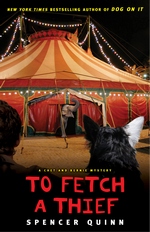
Dusted Off: To Fetch a Thief by Spencer Quinn

To Fetch a Thief (A Chet and Bernie Mystery, #3)To Fetch a Thief

by Spencer Quinn
Series: Chet and Bernie, #3

Hardcover, 307 pg.
Atria Books, 2010

What can I say about this? Read it. Love this series. At this point, I think the only “voice” I enjoy reading more in this world than Chet is Archie Goodwin, and Chet’s still with us, so he could pass Archie.

On my first read, I didn’t love it as much as the first — but slightly more than the second — in this series. I think Quinn did a bit more with Bernie’s character than he has in the past — Bernie could probably carry his own story w/o Chet now (Heaven Forbid). Less Suzie, more Charlie and the ex. Good subplot involving the latter two.

Good mystery, nice action, etc. like always. I just love these books, wish I could articulate it better and get more folks to read ’em.

—–

4 Stars

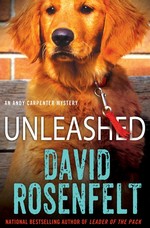
Unleashed by David Rosenfelt

Unleashed
Unleashed

by David Rosenfelt
Series: Andy Carpenter, #11

Hardcover, 308 p.
Minotaur Books, 2013

Granted, he has 13 less books under his belt, but at this point Rosenfelt’s Andy Carpenter series is managing to do something that Evanovich’s Stephanie Plum series has failed at — it’s still funny, still smart, and the criminal/suspense elements are as serious as any hard-boiled novel. Sometimes, sure, certain elements of the series — Hike’s depression, Marcus’ size/appetite, Edna’s allergy to work, for example — are overdone, and by being overdone, aren’t as funny as they could be. But Rosenfelt can rein in his impulses and produce a book that balances the whackiness with the grim and result it’s easy to forgive him for indulging his too-silly moments.

MAJOR COMPLAINT: How long has it been since Sam & Andy have song talked? Multiple books, not sure how many, but far, far, far too many books. Sure, part of the upside is Sam being a more critical character, and well-rounded. But it’s too high a price to pay.

This starts off like a typical Andy Carpenter book — a trip to the Tara Foundation, someone wanting Andy to take a job and him not being interested (I actually thought he was wrong in this — Sam was asking, not a stranger), and then Andy getting sucked in anyway — and away we go. Laughs, twists, Andy talking about his dog (and other people’s, too), smart-aleck courtroom antics, and so on. And that’s good enough for me. Sign me up for another 11 of them right now. But this one’s a little special.

The first adult mysteries I ever read were Erle Stanley Gardner’s Perry Mason books — I read and reread my public library’s collection I don’t know how many times — and when I could find them, I bought every one I saw. Andy’s more entertaining then Mr. Mason ever was, but his legal strategies aren’t quite up to his level. By this time, I really thought I knew all of Rosenfelt’s tricks (and he plays them well enough I don’t care if I can see them coming), but he pulled the rug out from underneath me in Unleashed. I may have gasped audibly, I’m not sure — I do know my jaw literally dropped.

Without giving too much away, Andy gets a little more into the nitty-gritty of the outside the courthouse action this time, as shown here:

[Marcus] does give me the handgun I’ll be using. He had shown me how to use it in the motel — basically just pointing and pulling the trigger. If I have to use it, I may add in some moaning and whimpering, just to jazz it up.

Perfect Rosenfelt, real, self-deprecating, and just funny.

Unleashed is another successful outing for this series — imagine Janet Evanovich ghostwriting Erle Stanley Gardner.

EVEN MAJOR-ER COMPLAINT: I’ve now worked through the Andy Carpenter series. I have to wait until Rosenfelt finishes the next one. Ugh.

—–

4 Stars

Page 14 of 16

Powered by WordPress & Theme by Anders Norén