Category: Mystery/Detective Fiction/Crime Fiction/Thriller Page 116 of 154

October 32 by Larry Rodness

October 32October 32

by Larry Rodness

Kindle Edition, 230 pg.
Deer Hawk Publications, 2015

Read: December 13, 2016


Alexander Malefant is a traveling life insurance agent who comes into a small town on October 31st. He witnesses a few events in a local county festival — pie competitions, largest pumpkin contest, apple bobbing, and so on — an exercise in small-=town civic pride and rivalry. The first person he meets in town intrigues him, especially when she’s accused of being a witch by a kid.

It’s not like he took it seriously, it just struck him as odd. Not long after that, he sees an apple-bobbing child being held under the water by something/someone that no one can see. The “witch” rescues him (no spells involved), and issues a warning about something happening in town. She’s promptly ignored by everyone and the festivities resume, as does Alexander’s sales day.

Once evening comes, a sales visit ends strangely when the family’s children go missing. It doesn’t take long to discover that other children are missing — not just a few, but every child (including teenagers). Alex (like everyone in town), gets wrapped up in the search. He’s also a suspect in the disappearances (like many people — especially the strangers).

To the reader, it’s pretty clear that no one is going to find a mundane explanation for the disappearance — it takes the people going through it longer. Which makes sense.

This is well-told, well-paced with a strong voice. Rodness took a bunch of long-standing ideas and combined then in an effective, creepy and entertaining way. The characters were well drawn, and I regretted not getting to spend more time with some of them. I wanted a couple of more chapters at the end (not that we were cheated in the ending, I just wanted a bit more following it). All in all, a fun read.

Disclaimer: I received this book from the author in exchange for my honest opinion about it. Note that the word is “honest,” not “timely” — I should have read this months ago, sorry, Mr. Rodness.

—–

3 Stars

Dead Down East by Carl Schmidt

Dead Down EastDead Down East

by Carl Schmidt
Series: Jesse Thorpe, #1

Kindle Edition, 244 pg.
Carl Schmidt, 2016

Read: December 8 – 9, 2016


Jesse Thorpe is a carpenter and member of a local band, who happens to be a P. I. on the side. The P. I. part doesn’t seem to take up too much of his time or draw much attention to itself, few people in his life know that’s one of his professions. Still, he’s had a few clients, taken care of a few cases — enough to give him some confidence in what he does. Then one day, a fishing trip is interrupted by a former client, who just found herself in the middle of circumstances surrounding the murder of her married lover. Who happens — well, happened — to be the Governor of Maine.

Maybe Jesse could use a little more experience.

It doesn’t take long before Jesse is working for his former client and two other people to investigate the murder, while the FBI and local police are stymied. Jesse’s client isn’t the only one that the Governor had an affair with, and the investigation into the affairs keeps Jesse busy and turns up plenty of motives for murder. It’ll take all of Jesse’s creativity, and the efforts of a motley crew of clients, bandmates, his sexy girlfriend, a friendly policeman, and a lotta luck for Jesse to clear the innocent and make sure the guilty pay.

I really don’t think the psychic adds anything beyond a chuckle or two, but that could just be me.

There were a few places where the book could’ve used some editing and proofreading — but only one that took me out of the scene, so I’m not going to get into it. Well, there was also the repeated use of “FBI Officers” instead of “Agents,” but that was easy enough to chuckle about and move on.

The first couple of chapters were difficult to wade through — dialogue seemed to be more about short speeches than anything, and the first few people talking about the murder sounded like they were contributing to or reading a news release about it. But once Jesse gets hired and things start to happen, Schmidt settles in and the writing improves. The only complaint I have after this is that he tends to over-explain things — especially the humor. He needs to trust himself and his readers a bit more and dial that back.

There’s not much more to say, Dead Down East is a pretty good mystery with a cast of characters that I’d enjoy seeing more of. Give Jesse a shot.

Disclaimer: I received this book from the author in exchange for my honest opinion — which influenced me not one whit, but I do appreciate it. I’m sorry that I filed it under “December Reads” and not “October Reads” like I’d said I would.

—–

3 Stars

A Few Quick Questions With…Nicky Peacock

Earlier today, I blogged about Nicky Peacock’s Lost in Wonderland, not only did she send me her book, she agreed to take part in the little Q&A. Not only does she write a fun book, but she helps me generate content — a couple of my favorite traits in people. Hope you enjoy her answers, I did.

Tell me a little about your road to publication.
It’s been a long and bumpy road and, to be honest, I’m still not at my final destination yet. I’d like to write for a living, and right now that’s not a reality. I have to fit in writing with a full-time job. My dream would be to wake up every morning and know that I had all day to write and plot and socialise online with readers and other authors.

I’d always wanted to be an author; I can’t remember a time I didn’t. I’m passionate about stories, but unfortunately, I tended to lose excitement before I finished anything! I wrote a lot of beginnings and not many endings, so never sold anything. I then found the short story market. Thanks to eBooks it’s thriving and finishing a short story is much easier than a 90,000-word novel, so I wrote them for a few years. Next thing I knew I had over 35 stories published and thought I’d better start writing something longer and my first novella, Bad Blood came tumbling out of my imagination.

What was the genesis of this book/novel? Of all the dozens of ideas bouncing around your cranium — what was it about this idea that made you say, “Yup — this is the one for me.”?
It was always in my head, but last year was Alice in Wonderland‘s 150th anniversary, so I thought the time had come to get Lost in Wonderland out and set it free upon the unsuspecting world. I write YA fiction and had read lots of books about spies and the like, but wanted to take it one step further with teens who bait and catch serial killers. There’s a rather disturbing statistic that, right now, there are at least 3 active serial killers in the UK every year (The UK is about the size of just one US state, so that’s even scarier math!) and very few are caught. It boggles the mind to think of how technological advanced we are, but still can’t nail down these devils preying on the innocent. In my book, Wonderland is a vigilante agency set up to do just that, to work above the law and sometimes even under it, and to do whatever it takes to stop serial killers. The Lewis Carroll connection is through the founders of Wonderland, their daughter Alice was murdered, and the killer was only caught when they took the law into their own vengeful hands.
What’s the one (or two) book/movie/show in the last 5 years that made you say, “I wish I’d written that.”?
I’d probably have to say Twilight. Vampires are my favorite monster, and although it didn’t break the bank with uniqueness, the author really developed her world and the characters in it. This is something that can be lacking with vampire stories as they are so larger than life, the creatures themselves can act as a crutch for a storyline so the writer doesn’t bother to delve any deeper. Also, it made a tonne of money, and I’m not too proud to say that I could really use even a fraction of that right now!
What is it about YA/”Teen” fiction that attracts you? Are all your works targeted to that audience?
I do some work for adult audiences (wait, does that sound rude? LOL) But I enjoy writing for teens. Their books have come a long way since The Famous Five and to be honest, you don’t even need to pull your punches that much when it comes to violence anymore. I’d hate to think that I’d written anything patronizing to my readers or even unrealistic – even when my subject matter is anything but real. There’s also the double dip effect in this market where adult readers will buy teen books too so you can gain more exposure an author.

The YA market is very loyal. I’d like to think that my readers, as they get older will still want to read my books.

I’ve often heard that writers (or artists in general) will forget hundreds of positive reviews but always remember the negative — what’s the worst thing that someone’s said about one of your books, and has it altered your approach to future books?
I’m very lucky in that the majority of my reviews are good. It can be frustrating when reviewers effectively ‘mark you down’ for opposite opinions, for example saying the book was too descriptive and then saying it wasn’t descriptive enough. I also get annoyed when someone gives me a low star rating but doesn’t put a review with it, that way I never know why they didn’t like it and what I could change in the future to help my work.

One of the things that reviewers have said about Lost in Wonderland is that they wish it had been longer. I’m currently writing the second book in the series, The Assassin of Oz and am making this longer now to make up for it.
Thank you so much for having me here today. If you’d like to find me online:

Blog:   Twitter: Y A Facebook Page:   UK Amazon Author Page: 

US Amazon Author page:   Good Reads: Tumblr:  Authorgraph:

Thanks for your time — and the book. Looking forward to what happens next.

Lost in Wonderland by Nicky Peacock

Lost in WonderlandLost in Wonderland

by Nicky Peacock
Series: The Twisted and The Brave, #1

Kindle Edition, 124 pg.
Evernight Teen, 2016

Read: November 30, 2016


This story focuses on Kayla — a young woman who looks years younger than she is (young enough to be appealing to the Humbert Humberts of the world as well as old enough to come across as a young co-ed), which is helpful in her vocation. She’s basically bait for serial predators (who the authorities can’t/haven’t done anything to) as part of her work with Wonderland. Wonderland is a group run by former federal agents bankrolled by a largely mysterious billionaire. Each “Wonderlander” goes by a code name derived from the Lewis Carroll book, and can quote sections relevant to their moniker (and recognize others quoting their parts). She and her colleagues — Rabbit and Chesire (Kayla’s Mouse) — lure the killers/molesters somewhere, take them out and then have someone come in clean up after them.

Her brother, Shilo, is locked up in a Mental Health facility for a handful of reasons, but the largest is his insistence that a man who dresses in orange is his constant companion who tells him what he should do. No one else can see or hear Mr. Custard, naturally, so Shilo is on the receiving end of all sorts of treatments. Neither the drugs, the talk therapy, or anything else seems to be working — Mr. Custard is still there, as much as Shilo might try to pretend he’s not.

Both siblings are reacting to the disappearance/abandonment of their mother while they were young and the suicide of their father not long after in very different ways, but both of their atypical lives can be traced to these incidents. Now it seems that someone is killing women near their childhood home, and there’s something drawing both of them back their to confront the killer.

The story is an interesting mix of Supernatural and Thriller stories, and once I saw that’s where she was going, I wasn’t sure that Peacock was going to be that successful with it — very few are. I’m not talking straight-up Urban Fantasy, I’m talking about a Suspense/Thriller that mixes in some sort of magic/monster where bullets and explosions should be. The last time I read a mystery where the author tried this, it ruined the book — it’s tricky. The heightened reality that she was using already helps, but it doesn’t guarantee success, Peacock tried a tricky thing and made it work, that’s no small feat.

Still, there’s only a little supernatural to this — there’s a human villain, human protagonists, human costs, human relationships at the core of this novel. Peacock’s up to the challenge of writing them, no doubt about it.

I liked the characters — especially Kayla. The story moved along well, the action was convincing — and the predators were just horrible enough that you didn’t really care that much that vigilante action took care of them rather than the law. Sure, the book could really have used one more thorough edit. More importantly, the facility that Shilo lives in draws more from One Flew Over the Cuckoo’s Nest or Gotham‘s depiction of Arkham than reality — and as annoying as that is, really, if you’re looking for realism, you’ve dropped this book before it gets to that.

Can she follow this up with an equally successful sequel? That might be trickier, but I’m looking forward to seeing her try.

Disclaimer: I received a copy of this novel from the author in exchange for my honest opinions.

—–

3 Stars

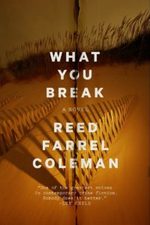
What You Break by Reed Farrel Coleman

This is one of those I spent a couple of days futzing around with — not sure I made it better (or worse) by doing so — I re-arranged a lot, that’s the best I can say. Both Murphy novels are tough to talk about in the abstract, which I think is a pretty good thing. There’s not a lot of fat on them — just good lean prose.

What You BreakWhat You Break

by Reed Farrel Coleman
Series: Gus Murphy, #2

eARC, 368 pg.
G.P. Putnam’s Sons, 2017

Read: December 1 – 5, 2016


Why? It’s three letters that permeate this novel. We’re all familiar with the need for an answer to that question. From the time that a toddler starts ever so persistently asking that question until the end, we keep wondering, “why?” Few need the answer as much as someone who has to deal with the unexpected death of a younger family member. In Where It Hurts, we saw just what the lack of an answer did to Gus Murphy and his life. So when a grandfather comes to Gus for help finding out why his granddaughter was brutally murdered, there’s no way that he can turn his back on the request. Especially given the inducements being offered.

He wasn’t recruited to solve the murder — the police have a man awaiting sentencing for the crime. But he won’t tell anyone anything about the crime or his relationship (or lack thereof) to the victim. The grandfather, Micah Spears, rubs Gus wrong from the get-go — if it weren’t for Father Bill’s endorsement, and his understanding of Spears’ deep need to know, Gus would’ve walked. It probably would’ve been better for him if he had. Almost no one — especially her family, the police (many of whom are still angry for what Gus turned up in the last book) — wants him to pursue this. The more Gus learns about Linh Trang (she preferred “LT”), the more he becomes convinced that there’s no reason for the killer to want her dead, which just makes the “Why?” even more pressing.

Before he can really start to work for Spears, Gus has a few other why’s to answer — why did his friend/co-worker, Slava, just drive off with the mysterious new guest at the hotel? Why did a Russian gangster get assassinated before Gus’ eyes shortly after Slava and the guest talk to him? Why is there a very formidable Russian running around Long Island looking for Slava? The focus of the novel is on the Spears case, but this storyline casts a shadow over everything. I didn’t really spend too much time in Where It Hurts worried about what would happen to anyone, and the Spears case is more of a puzzle than anything — but there’s peril to this Russian story, and the reader will become convinced that whatever happens in it, will have a large impact on Gus (and not just because of Slava’s involvement).

Gus has grown a bit, made some steps toward health since we last saw him, but he has a lot of work to do. Things with his ex- are about where they were previously, but with less anger (mutually), his romance is progressing with Maggie, and so on. Basically, Gus is becoming someone different from just the ex-cop with a dead son. That sill the core of his being, but there’s something more to it than that — maybe even some room for happiness. It’s hard to discuss briefly, but simply: Gus was better off by the end of Where it Hurts than he was at the beginning, and at the start of this novel, he was better off yet. As for the ending of this book? Well, read it and decide for yourself.

This book deals with some pretty potent things — as Coleman did when we met Gus — there’s love, friendship, loss, grief, confusion and resentment, to name a few of the ingredients in the emotional cauldron everything in the novel is steeping in. Not just from Gus, Slava and Spears — but everyone in the book is dealing with things that no one should have to, but most of us do. I’d like (but cannot expect) to circle back around and see how LT’s friends are doing in a couple of years, ditto for her sister and ex-step-grandmother. I’d like a lot more time with a judge that Gus interviews, as well as Gus’ lawyer. I expect the latter, at least, will be granted to me.

Spears and Gus do get some answers as to why LT was killed — but, as is so often the case, really those answers don’t satisfy much and lead to further questions. No tidy bows here for anything — which isn’t to say the concluding scenes of the novel won’t satisfy the reader, just that there’s no pat endings or rides off into the sunset. Just survivors (not saying how many of them there’ll be) moving on. The Epilogue will stay with you. That’s really all I can say.

This book put me through the wringer — not as much as Gus and Slava were, but still — Coleman has really topped himself from Where it Hurts, we know these people better now, so he can push them further. I lost sleep with this one, which isn’t that unusual, but I lost more sleep staying up to get through this than I have in a long time. There’s a darkness, an emptiness throughout that wasn’t there in our first encounter with Gus — or if it was, it’s changed in source and intensity. I’m not sure many readers will like where Gus is by the time we get to book 3 or 4 (including me) — but I’ll understand it. Coleman’s making sure his writing and characterization is honest, as real as fiction can get.

Once again, he delivers a crime novel that could be mistaken for a non-genre novel (as if such a thing exists), suitable for thoughtful crime readers or those who don’t mind crime to show up in a novel about a parent redefining himself after the death of a child.

Disclaimer: I received this eARC from G.P. Putnam’s Sons via NetGalley in exchange for this post — thanks to both for this. It didn’t change my opinions on the book, I was simply able to form them a couple of months early.

—–

4 1/2 Stars

Titanborn by Rhett C. Bruno (revised)

TitanbornTitanborn

by Rhett C. Bruno

Kindle Edition, 246 pg.
Hydra, 2016

Read: November 28 – 29, 2016

I’ve been to the rotting sewer tunnels submerged beneath the Martian domes. I’ve been to the most remote slums on Earth, and to the depths of asteroid mining colonies where being able to see the outline of your own hand in front of your face was considered bright. I’ve seen death all over and been on the end of the killing more times than I cared to count . . .

When he’s not reminiscing like an inverse-Roy Batty, Malcolm Graves is a bounty hunter of sorts — working for one of the handful of corporations that really run the solar system. He’s been at it longer than most, and has no intention of retiring anytime soon. His body, however, might have other things in mind — he’s slowing a bit, both in reflex and thought — add in a little bad luck, and Malcolm’s starting to worry about his future.

So when he’s near the site of a terrorist attack during Earth’s biggest celebration, he seizes the opportunity to get some justice and re-establish his position with the company. Sure, they’re saddling him with a partner rather than letting him work alone, but if that’s what it takes. . . . Only it’s not just a partner, it’s a young guy, fresh from an elite training program for exceptional cadets. Zhram is almost an android, it seems.

Their investigation brings them into contact with a seditious group, trying to overthrow the ruling forces on Saturn’s moon, Titan, so that the descendants of the original colonists (Titanborn). It soon becomes a race against time — can the duo find those responsible for the crime on earth and bring them in before the movement can grow and begin to make inroads against the ruling powers? Why they attempt to do so, their partnership grows and the two being to trust and learn from each other. Zhram is one of the more promising characters in the Lt. Commander Data/Odo/Sheldon Cooper-vein of people trying to learn to be more human that I’ve seen recently.

At its core, the central relationship is the classic mismatched police partners (see the Aykroyd/Hanks Dragnet, Lethal Weapon), but with a SF twist (see The Caves of Steel and Almost Human). The book is full of themes, tropes and scenarios straight from these (and similar) sources. Which isn’t to say that Titanborn is derivative — it’s part of the tradition, reflecting the best parts of its antecedents, shaping them to tell Bruno’s story.

The writing was strong (I thought a couple of times early on that he overwrote a line or two, but nothing too horrible) — the fight scenes good, the tech was believable, etc. An all-around well constructed novel.

I’ve said it before, I’ll say it again — it doesn’t matter if you tell a story that’s been told before, or using tropes commonly used — it’s how you use those tropes, how you tell the story — and Bruno did it in a very satisfactory way. I liked Malcolm from the get-go, I enjoyed watching the budding partnership between he and Zhaff, and even though I pegged (most of) the solution very early on, I really dug the reveal. I liked the characters, I appreciated the way that Bruno paced things and guided us through the shaky political landscape (and at least some of the reasons for the instability). I’d gladly read another half-dozen (at least) novels about these two racing around the solar system.

Disclaimer: This was provided to me by the author in exchange for my honest take on the book — note that I said “honest” and not “timely.” I was supposed to have this done months ago. My thanks for the book and apologies for the tardiness, Mr. Bruno.

—–

3 Stars

INVIVO by Robert A. Brown

INVIVOINVIVO

by Robert A. Brown

Kindle Edition, 233 pg.
Denro Classics, 2016

Read: November 24 – 26, 2016


I’m not sure I can list the problems with this book without hitting the character limit on a post (not sure if WordPress has one, Goodreads does, though). Were this only the story of a grieving scientist driven to some sort of insanity (temporary or otherwise), I might have been able tolerate it. But no, it’s so much worse.

    I’m just going to do this one in bullet points because I can’t muster enough will to really write anything.

  • The book promises to be about X, quickly becomes about Y (with a hint of Z) and then ends up being about R and S. I can live with that kind of things sometimes (maybe even enjoy it), but since X and S are so far removed from each other I had no tolerance for it with this novel.
  • The dialogue is wooden, clunky, and far too wordy.
  • The characters act more due to authorial fiat rather than organically (this isn’t 100% true, but it happens enough that I can list it here in good conscience.
  • There’s a mystery here “solved” in a ridiculous and fanciful way — the police were so useless that a medical doctor and genetics researcher is able to read a couple of books (that he received in record time) about sociopaths and is equipped to solve. And he does so in ridiculously short manner.
  • Maybe I’m wrong — I could be — but the science here is so outlandish that Jules Verne wouldn’t buy it. It’s so far beyond “fringe” science that Walter Bishop would scoff at it.

This is just poorly constructed, and I just can’t buy any of the plot-lines. The writing is stiff, lifeless and yet sloppy. For example, one scene starts in a staff meeting with the main characters and his assistants, and mid-conversation it jumps to another mid-conversation with his wife. Also, I’m not sure if the repeated use of a racial slur was because Brown was trying to show just how despicable a character was or if Brown was showing us how despicable he was (given the fact that the character seemed to be being shown in a redemptive light while using the slurs, I’m pretty sure it wasn’t that). Even the stuff that I could say was better about this book seemed too contrived — the romances, the scientific breakthroughs, the friendships, and so on. It just was lousy.

Disclaimer: Actually, this probably doesn’t need a disclaimer, because I clearly wasn’t influenced by anything — but I received this book from the author in exchange for my honest opinion. Sorry about that, Mr. Brown. Also sorry that it took me 8 more months than I expected to get to it, but . . . something tells me you wouldn’t have minded me waiting longer.

—–

1 1/2 Stars

Pub Day Repost: Good Behavior by Blake Crouch

Good BehaviorGood Behavior: Letty Dobesh Chronicles

by Blake Crouch
Series: Letty Dobesh Chronicles, #1-3eARC, 288 pg.
Thomas & Mercer, 2016
Read: October 25, 2016

She’d been out of prison now almost ten months, had been clean for half a year, but she hardly felt free.

She was thirty-six years old and she had just worked herself into a sweat cleaning a toilet in a diner.

Bad as prison had been, the walls that had kept her in her cell and in the yard had never screamed hopelessness as loud as the barred window in this tiny bathroom.

Letty Dobesh is an ex-con (repeatedly), a (sometimes) recovering addict, a thief, and (biologically) a mom — she wants to reunite with her son, she wants to be a mother — but she doesn’t know how. She does know how to make a mess of her life, ruin her health, get high and steal anything she wants to.

The three novellas collected here give us glimpses in to some of her professional highs — and we see bits of her lows, too.

Her life seemed to be defined by moments like these.

Moments of pure self-hatred.

And this was just one more in a long, long line.

These are fast reads — you get sucked in to Letty’s world, her way of looking at things and you root for her to get away whatever she’s trying to get away with. There’s a story about her trying to save a life, another with her first attempt at becoming an art thief, and then a story about her getting in over her head by working with some criminals who are far more willing to use brawn and guns than Letty’s ever been. Each of these feel different — Letty’s the same, but the settings and the way that Crouch tells the stories vary enough to keep things very fresh.

The other characters that fill these pages (or those that flit across a line or two) are interesting enough to fulfill whatever narrative duty they have to, but these are all about Letty. If you like reading about her, you’ll like this book. If you aren’t interested by her at all after 10 pages or so, you’d better skip the rest.

It wasn’t the first or the second or even the third time she’d had a firearm pointed at her. But she never got used to that gaping black hole. Couldn’t take her eyes off of it. If [spoiler] chose to pull the trigger in this moment, it was the last thing she’d ever see.

This book is being released to coincide with the debut of TNT Network’s series based on these novellas, starring Michelle Dockery, in her attempt to avoid being typecast. I tried not to, but I kept seeing Dockery saying some of these lines. It was easier to avoid thinking of her in the first novella; but in the second it was almost impossible not to — especially when not-Lady-Mary is talking with Johnny. I must say, my mental-Dockery did a great job — those lines are perfect for her (it’s a shame, really, the second novella is the only one not being mined for season 1 of the show). There are supplemental materials included with these novellas discussing the novellas and how elements of them will be used in the show. Those were interesting enough, but I really couldn’t care that much.

I don’t care how the TV show does (easier to say before I watch a second of it), but I’ll gladly read more novellas/novels about Letty. Actually, maybe novella length is best for her kind of story, something about the compressed timeline works well for the high-stakes energy that these are filled with.

Disclaimer: I received this eARC from Thomas & Mercer via NetGalley in exchange for this post — thanks to both for this.
N.B.: As this was an ARC, any quotations above may be changed in the published work — I will endeavor to verify them as soon as possible.

—–

3.5 Stars

Washed Hands by Jonathan Charles Bruce

Washed Hands Washed Hands

by Jonathan Charles Bruce

Kindle Edition, 204 pg.
Scarlet River Press, 2016

Read: November 7 – 8, 2016

They were all cheap, terrible beers that screamed more of desperation than any kind of desirability. Not that I could ever really tell the difference between the cheap and quality stuff, except that cheap tasted like unfiltered gutter water and quality usually like uncooked bread juice. People would usually counter that beer was an acquired taste that you get used to before you learn to want it, at which point I would suggest that what they just described was essentially culinary Stockholm Syndrome.

I am a hit at parties.

My appreciation for this one was pretty much ensured within the first page or so — Monica Deimos’s character grabbed me that quickly. I can’t promise you will, but this character’s voice was so strong, so fun. This voice . . . I haven’t clicked with a voice like I did with this since, I’m not sure, maybe Mark Watney? If I quoted every pith/insightful/chuckle-worthy line that I wanted to, I’d probably get sued for copyright infringement. I know, a tough, quippy, self-deprecating, cynical female detective(-ish) character isn’t exactly new, but Bruce just nails the voice on a consistent basis. Monica may not be unique on that front, but she’s really well done.

Deimos works for this firm called Washed Hands, who are break-up specialists. If you want to/need to end a relationship with someone who just may flip out, get violent, refuse to listen, whatever — you hire them and one of their rejection counselors will make sure that everything works out. Monica Deimos is about the best they have — until one day she enters a client’s home to find the soon-to-be-dumped very murdered. Monica then finds herself very framed for this murder. Things get rolling from there.

She’s on the run from the cops (almost getting nabbed a few times), dead tired and with few people she can trust. She decides that the IT guy from Washed Hands, Jasper, is trustworthy (probably) and could help out. So the two of them team-up to find out the real killer’s identity and to clear Monica before tis’ too late.

Jasper is almost a stereotypical nerd — but there’s a little more to him. Some of the others in the office are probably just what they appear, but you can’t be too careful. Or so Monica thinks. She’s abrasive, socially awkward, and desperate enough to try anything — the frame job was good, and she’s pretty sure that she can’t beat it. Thankfully, Jasper has faith enough for both of them. I really liked him — actually, I really liked Monica, too, beyond the voice. There weren’t a lot of other characters developed that well (little time for that with Monica on the run), but there was potential with all of them.

This novel was very well constructed and plotted — enough humor and enough excitement to keep you engaged. I guessed the whodunit pretty early, and came close to the motive, too. But I wouldn’t have figured the how until about 2 or 3 sentences before Monica did. Bruce pulled off some very clever storytelling there.

Things I would enjoy seeing in future novels, if that’s what Bruce is thinking: More at Washed Hands — I can’t believe he’s got this great concept and uses it so little; More with Jasper (perhaps independently of Monica); More Monica — with Jasper, at Washed Hands, without Jasper, after Washed Hands, I don’t care, I just want to read more of her.

I don’t think I can say much more without reveling too much, so I won’t say much more at all.. Clever story, good characters, told in a way to keep me glued to the page, and a conclusion that I almost saw coming but couldn’t come close to predicting. Really can’t ask for much more.

Disclaimer: I received a copy of this from Scarlet River Press in exchange for this post and my honest take on the book — thanks, Scarlet River!

—–

4 Stars

The Chemist by Alan J. Field

The ChemistThe Chemist

by Alan J. Field

Kindle Edition, 340 pg.
ThrillRide Media, 2016

Read: November 8 – 10, 2016

I don’t want to spend a lot of time talking about this — mostly because I just don’t care, but also because this is going to fall into the “if you can’t say something nice” category — but I told the author I’d say something, so here goes.

This is a dull, poorly written, cliché-filled, convoluted thriller that forgot the thrills. You have a mustache-twirling terrorist (atheistic, but willing to pretend to get what he wants); a couple of mustache-twirling CIA honchos (willing to sell out the Bill of Rights, CIA charter, and anything else to get the “bad guys”); a cosmetics executive that decides to try to sell chemical weapons; a drug-addicted chemist able to be a genius and do something no one’s done before while hallucinating; a CIA op-turned addictions counselor/vigilante; and a few other assorted mustache-twirlers, criminals with hearts of gold, and assorted special-ops types.

Danny Strong (yes, a bit of Buffy-fan pandering), is called out of retirement to help save the world — because he’s the only one who can. He needs to convince a hot young chemist to give him the most deadly toxin ever created to him before it’s sold on the black market in an effort to save her mother’s cosmetics company. Oh, and the chemist does enough coke and heroin to kill a middle school’s worth of kids — yet she does something no one else can duplicate. There are multiple conspiracies afoot here — some never explained well — but that’s the core story. Naturally, he falls for her (in something like 10 days) and is able to finally free himself from grieving over his murdered wife.

There’s a misguided, but probably well-intentioned, Castle tribute here that just annoyed the tar out of me (and I’ve watched every episode at least once, so I’m not complaining about a Castle tribute — I just hope Fillion, Katic, etc. don’t read this novel).

There are so many storylines and details that go nowhere and mean nothing, so many plot points that just don’t work, inconsistent narration, scenes that are impossible to follow (and not just because the book desperately needs a couple of copy edits, see below) that transform this book from a bore to a bad novel.

Now, I know when you self-publish a book, there’s going to be more typos and whatnot in it than your typical book (or, at least, there are bound to be) — but even stuff put out by the Big 5 contains errors that cause copy editors to lose sleep, so I generally don’t hold that against a book. But this was just ridden with spelling and grammatical mistakes — any drinking game invented along the lines of tracking them would leave me unable to write for a week. Repeated sentences/paragraphs, many homonyms (e.g., “hear” instead of “here”), wrong pronouns, sentences that aren’t really anything, simple misspellings, and more. Too often I’d have to stop what I was reading and spend time examining a paragraph/section for a while to see if I could suss out the meaning. Now, I have no problem doing that when something is beautiful or thought-provoking — but when it’s not worth it? No.

I didn’t actively hate this book — but man, there’s just nothing to say to recommend it.

Disclaimer: This book was provided to me by the author in exchange for my honest opinion — he clearly didn’t bribe me. I thank him for the opportunity,

—–

2 Stars

Page 116 of 154

Powered by WordPress & Theme by Anders Norén