Category: Mystery/Detective Fiction/Crime Fiction/Thriller Page 134 of 154

Review Catch Up: Broken Homes; Black Arts; The Player; Speaking from Among the Bones

I’ve got a backlog of 50 or so reviews I’ve been meaning to write — some of them, I just have to admit aren’t going to get done. But I’m going to try my level best. The four books I’ve decided to tackle in one fell swoop are books I enjoyed, from series I enjoy, and yet I’ve had trouble reviewing them. In the end, I decided that was because by and large, I don’t have anything to say about these books that I haven’t said about others in the series.

But I do want 1. clear these off my to-do list and 2. more importantly, encourage readers to give these a look. So, without further ado:

Broken Homes (Peter Grant, #4)Broken Homes

by Ben Aaronovitch
Series: The Rivers of London, #4

Mass Market Paperback, 324 pg.
DAW, 2014
Read: February 15, 2014

The plot took its own sweet time getting where it was going, with a lot of strange little turns here and there — which works because it’s probably what actual policemen go through investigating a crime. But almost doesn’t work because it makes it feel like Aaronovitch didn’t pace this correctly (which is silly, because he did).

I really, really liked the undercover stuff. The conclusion is probably the best that this series has been. It’d be great if Peter learned a bit more though, his stumbling efforts are amusing, but it’s time for more proficiency.

I’m eager for the next one of these (and would be even without the big twist) — such a great world he’s created here, and I want to learn more about it and the characters that inhabit it.
4 Stars

—–

Black Arts (Jane Yellowrock, #7)Black Arts

by Faith Hunter
Series: Jane Yellowrock, #7
Mass Market Paperback, 325 pg.
Roc, 2014
Read: March 25 – 29, 2014

What’s to say about this one, that I haven’t said about other books in the series already?

The action’s tight, the vamp politics and Jane’s interaction with it are pretty interesting, Faith’s coming to grips with more of her background was really compelling, and her growing relationship with the brothers is fun.

Obviously, this is the most personal case that Jane’s had yet — for someone to be messing around with Molly, that’s just beyond the pale. Those raised stakes (pun fully intended), and the ongoing drama with Leo’s grip on the New Orleans vampires made this the best of the series.
4 Stars

—–

The Player: A Mystery (Carter Ross, #5)The Player

by Brad Parks
Series: Carter Ross, #5

Hardcover, 336 pg.
Minotaur Books, 2014
Read: April 1 – 4, 2014

What’s to say about this one, that I haven’t said about other books in the series already?

A lot of fun — great characters, love Carter’s voice, everything that you want to see in a Carter Ross novel was here — twisty conspiracy, some good laughs, Carter’s personal life in shambles. It was nice to meet his family.

Sadly, I’m at a loss for words here (something that never seems to be Carter’s problem), this was a lot of fun. I want a lot more of these.
4 Stars

—–

Speaking from Among the Bones (Flavia de Luce, #5 )Speaking from Among the Bones

by Alan Bradley

Hardcover, 372 pg.
Delacorte Press, 2013
May 16 – 14, 2014

Flavia’s her typical charming, precocious, incorrigible self. Perhaps a bit more clever than we’ve seen her before, definitely with less a sense of self-preservation than we’ve seen previously. Her sisters are a bit, more human? Or maybe Flavia’s portraying them more honestly/more sympathetically. The financial pressures her father’s under are more and more pressing, causing everyone to be a bit more realistic, it seems.

Still, that doesn’t deter Flavia from doing her thing when a body is discovered. It’s everything you want in a Flavia de Luce novel — very, very smart conclusion to this mystery.
3 Stars

Reread Project: The Monkey’s Raincoat by Robert Crais

The Monkey's Raincoat (Elvis Cole, #1)The Monkey’s Raincoat

by Robert Crais
Series: Elvis Cole, #1

Mass Market Paperback, 201 pg.
Crimeline, 1992 (originally 1987)
Read: August 6, 2014


We start the Reread Project with The Monkey’s Raincoat, which should be read as the pilot for the Elvis Cole series. It establishes the characters, the world, the tone — the story is secondary to that. It’s also the foundation — everything after this will be building on this, and will be an improvement (if for no other reason than Crais gets better). It does all the establishment work pretty well — and some points of the non-establishment work is standard, some of it is quite well done. In the end, its a successful pilot, showing the promise to be delivered in ensuing novels.

“Peter Pan. You told Ellen you wanted to be Peter Pan.”
“Unh-hunh.”
“That’s crap. Stay a little boy forever.”
“It’s not age. Childhood, maybe. All the good things are in childhood. Innocence. Loyalty. Truth. You’re eighteen years old. You’re sitting in a rice paddy. Most guys give it up. I decided eighteen was too young to be old. I work at maintaining my self.”
“So at thirty-five, you’re still eighteen.”
“Fourteen. Fourteen’s my ideal age.”
The left corner of her mouth ticked.

Now, I contend that something happens in a few books to get Elvis to decide to grow up (I’m not convinced he realizes it though) — but for at least a handful/handful-and-a-half novels, this is a great summary of Elvis’ core.

A lot of people will compare Elvis Cole to Spenser and while it’s frequently over-stated, it is a legitimate comparison. And Raincoat Elvis compares pretty strongly with The Godwulf Manuscript Spenser, but Elvis is a lot closer to the character he’ll be from now on, than Godwulf Spenser is to the character he will be following it. Which says something about the thought that Crais put into Elvis before writing, and his experience working with character — Parker really ever had this until he had a few novels under his belt.

Before we get to the Peter Pan self-disclosure, we see that in action — in the decorations of his office, his dress style, the way he talks to prospective clients — all in the first few paragraphs. Which also contain a nice info dump disguised as dialogue, as way to introduce himself to the reader as well as the client who asked him about his qualifications. It gets the job done and it doesn’t feel all clunky and Dan Brown-like. Crais doesn’t do anything ground-breaking here, but so often (especially in first books of a series) this is done in a clumsy way, so it’s nice to see it done smoothly.

There’s a lot to Elvis Cole here that seems straight from the hard-boiled detective starter-kit: he’s got the relationship with a police detective that’s based on mutual respect, but the police detective can’t color outside the lines like Elvis can. He’s got the friend who’s a newspaper reporter — far too busy to have a real conversation with him, but will give him just the right quick answers (while being a real smart aleck) to move the investigation along (in return for tickets to a sporting event). He’s got quite the way with the ladies. He’s a lone wolf type, will drink a lot, he’ll constantly have a wise-crack at the ready, he had a few odd jobs related to law enforcement prior to this, but he can’t work within the system — and so on. It’s what Crais does with these elements — and the rest of Elvis’ characteristics that elevate the character.

So much of the what will separate Elvis from Spenser/Patrick Kenzie/Lincoln Perry/Cormoran Strike/etc. are the quirks and the little details: The nameless, beer drinking cat; the morning yoga; his Elmore Leonard fixation; his Hawaiian shirts and Disney stuff. I liked the fact that Elvis keeps a roll of nickels in his car to use in case of a fist fight. Even more, I like that he had to dig around under the seat to find the roll (and if the interior matches the exterior, it’s not easy to find anything under the seat).

Now, you can’t talk about Elvis Cole without talking about Joe Pike — his business partner with the empty office. Yes, in many ways Joe’s the Hawk to Elvis’ Spenser. But he’s more. By the time we meet him, Elvis has had a couple of very brief phone chats with him, but even the terseness of those won’t prepare us for actually meeting him. Our first introduction to Pike is striking:

The next morning I woke with brilliant white sunlight in my face, smelling coffee. The sliding glass doors were open and Joe Pike was out on the deck. He was wearing faded jeans and a great sweat shirt with the sleeves cut off and blue Nikes and government issue pilot’s sunglasses. He rare takes the glasses off. He never smiles. He never laughs. I’d known Joe Pike since 1973 and he has never violated those statements. He’s six feet one with short brown hair and muscled the way a fast cornerback is muscled, weighing in somewhere between one eighty-five and one-ninety. He had a red arrow tattooed on the outside of each shoulder when he was in The Nam. They pointed forward.

The description today would be a little different. A little. But on the whole, Joe’s consistent, he’s grown a little bit as a character (because of Elvis, he’d assure us), but even with growth, the Joe you get in Monkey’s is the Joe you get in Taken.

Every time Joe’s name is mentioned around someone from LAPD, it’s answered with scorn (at best). Elvis will shed a little light on this eventually when Ellen asks (again, info dump — however small — and dialogue that doesn’t feel forced). But on the whole, all Crais is doing is a bunch of seeds that he’ll harvest later in a way that probably no one reading this can guess. Since this is Elvis’ narration, and Elvis is his friend, we trust that the LAPD is out to lunch on this, and this is reinforced by the clueless way they handle the disappearance of Perry Lang. Time will tell if our trust in Elvis is well-placed.

There’s a clear affection between Elvis and Joe. They trust each other, they tease each other — they depend on each other (without ever coming out and saying it). They’ve known each other more than 15 years at this point, as partners for most of that, and a lot doesn’t need to be communicated anymore

The thing that truly separates Pike from your typical mercenary/bonebreaker-as-sidekick is the way he deals with Ellen Lang. He tells her things about his past, he helps her learn to shoot, he goes out of his way to empower her — and through that, comfort her. Elvis will give her pep talks, he’ll encourage her — even force her to see reality. But Joe (unintentionally) inspires her, and then will (intentionally) show her the inner strength, the character she has and needs to meet the future. Hawk would never do that.

I’m sure I should say something about the story, too. So, Ellen Lang comes (with a lot of prompting from her friend Janet Simon) to Elvis needing help finding her estranged husband, who seems to have taken off with their son (but not their daughters). Elvis isn’t crazy about the idea, but he has rent to pay — so he takes the case and starts poking around looking for the missing talent agent. He finds Mort’s girlfriend, but that doesn’t help but it sheds some interesting light on Mort’s lifestyle. Before long, there’s a body, a couple of kidnappings, a lot of missing cocaine, and a crime boss’ Eskimo enforcer roughly the size of a small bull.

As Elvis goes through the investigation, it’s good, solid stuff carried along by his narration. But there’s nothing other than his narration and the character work he’s started to make it distinctive over any other of a dozen PI’s. But then you get to the conclusion — a big, guns-blazing, bullets-flying, implausible-but-not-really, story climax — and you really start to see the potential for this Crais guy and his pair of Vietnam Vets.

I’m not sure I’d give this 4-stars if I this was my first read of the series, or even of this book (rather than the 6th or 7th). But it’s not, I know what seeds Crais planted (whether he intended to or not), I know where’s he’s going with this and how well this sets up the books to follow. As such, it deserves no less than 4-stars.

—–

4 Stars

—–

Drawing by Kirsty Stewart, chameleonkirsty on deviantART, used with permission.

Coming soon: The Reread Project

Joe Pike and Elvis ColeOne of the things I’ve been thinking about lately is that I don’t re-read as much as I used to, so I’m making a greater effort to do that, starting in January of this year. Think I’ve managed to reread 1 book before this week. Whoops.

Anyway, I got to talking about Robert Crais with a buddy last week who was wanting to dip his toe in the water, and wanted to know if he needed to read the Cole/Pike books in order or if he could just read which ever he could get his hands on. I’m sure he regretted asking because rather than the 1 sentence answer that he was probably looking for, he got most of a page of text. And if I’d had more time before needing to get to sleep, I’d have probably written pages. And that was just off the top of my head.

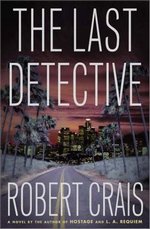
I honestly couldn’t stop thinking about Elvis and Joe after that email — I’d read everything up to book nine, The Last Detective, at least twice. But had only managed to reread the first two Joe Pike books since. So the series is ripe for this kind of thing. If I manage myself correctly, I’ve got enough time to read the series before the next novel hits my doorstep in November. Which makes it a bit more appealing — I love a good deadline.

My reviews will be a bit longer (I think) than usual, if the first one is any indication, anyway (1400 words or so) — looking both at the novel and their place in the series, the changes, developments, ties between novels, themes, etc. I don’t think I’ll have time for the two stand-alone novels that introduced characters now part of the series, so we’ll have to rely on my memory for that. These should go up on Mondays — leaving the few “Dusted Off” posts that I have for those weekdays I just can’t get anything else finished.

Once I’m done with Elvis/Joe, I’ll move on to something else. I like the discipline of one reread a week. I did it with the Nero Wolfe series a couple of years ago, and really enjoyed that.

Hope you enjoy this — and if you’ve read the series, please, please contribute to the comments.

—–

Drawing by Kirsty Stewart, chameleonkirsty on deviantART, used with permission.

He Drank, and Saw the Spider by Alex Bledsoe

He Drank, and Saw the Spider (Eddie LaCrosse, #5)He Drank, and Saw the Spider

by Alex Bledsoe

Hardcover, 320 pg.
Tor Books, 2014
Read: August 6, 2014

After a couple of adventures which aren’t quite typical in their nature, Eddie La Crosse gets back to basics with a fairly straightforward case. Well, that’s not exactly true — it ‘s just that the last two were more outlandish, more grand-adventure-y, less LaCrosse-as-sword-jokey. This is Eddie doing what he does best. Yes, there’s magic, and monsters, and all the other trappings that keep this from being something that Sue Grafton or Dennis Lehane would’ve written.

Sixteen years ago, Eddie promised a dying man on the run that he’d take care of the baby that the other man was running to protect. He found a seemingly-trustworthy family willing to take the infant in, and went on his merry way, and actually forgot all about the incidents surrounding that. Until years later, when Eddie and his girlfriend, Liz, are on vacation in that area, when suddenly it all comes back to him and he decides to try and track down the (now) young woman and see how she’s doing.

Naturally, things start to go poorly about there. He does find her — pretty easily, too — it is a small community, with an economy largely-based on sheep-herding and farming, so it’s not really a bustling metropolis where no one knows anyone else. But there’s a whole lot of interesting things happening around the young woman — royalty in disguise, a meddling sorceress, an untrustworthy mercenary-type, an over-protective mother, a dose of sibling rivalry, and some sort of articulate and super-strong inhuman creature with a healthy interest in the girl.

Even though he was just supposed to check on her and not interfere with her life — he had no intention of even introducing himself to her. Eddie can’t help himself, and before you know it, he’s neck-deep in intrigue, and danger.

On the whole, this is a fun, brisk novel — a lot of humor, some good action, nice banter and interaction between the characters (especially Eddie and Liz). A good change of pace over Dark Jenny and Wake of the Bloody Angel, which tended to be more on the serious, emotionally-charged side. Yet, even as the answers to the questions surrounding the girl’s mysterious origins become obvious, and some of the characters get to the point where they seemed a irredeemable, Bledsoe (as he can every so well) keeps you completely drawn in and even tugs the heart strings a bit as the truth is revealed to the characters. Just really, really well done.

There’s a lot of nice little touches along the way. For example, towards the end of the book, Eddie and those he’s traveling with encounter a preteen who joins their little band for a while. She’s pretty new to swearing and tries to get in as much practice as she can while with them. At first, I thought she was an odd (but entertaining) and pointless distraction. It didn’t take too long to see she was a perfect tension-breaker, just what that part of the novel needed to keep from being too tense and so much more serious than what had come before.

Eddie’s narration has never been better — humor-tinged and hard-boiled, a medieval Philip Marlowe or Elvis Cole. I liked all of these characters, and really wanted to spend more time with each of them — I don’t know how Bledsoe could’ve pulled that off without getting the whole thing to slow and ponderous (which would’ve sucked the fun out of 60-70% of these characters). This is really such a well-done and fully realized series. I can’t wait to see what happens next.

—–

4 Stars

FaceOff by David Baldacci, ed.

FaceOffFaceOff

by David Baldacci

Hardcover, 384 pg.
Simon & Schuster, 2014
Read: July 15-25, 2014

When I was a kid, one of the go-to moves to increase circulation/awareness of a comic book title was to have it cross-over with another title. Or if you had two already well-selling titles, and you wanted a little spike in the selling, that’d work, too (particularly if one title was from DC and the other from Marvel). I, as I was supposed to, grabbed a lot of these. They tended to follow a pattern — Group/Individual A runs into Group/Individual B, for no explicable reason they start to fight. Eventually, they figure out they’re all heroes fighting for good and turn their collective energies to defeating the bad guys. This was fine, because it let you see who would win in a fight — Thor or Superman (answer: neither), Halo or Starfire — that kind of thing.

That’s what a lot of these stories reminded me of — classic cross-over tales, and many fit that pattern. Which was okay, but thankfully not all of them did. At the end of the day, there were 2 stories I wanted to read, a couple of others that I was somewhat interested in, and the rest — well, might as well take a look at them, as long as I had the book. I picked up a couple of new names to try — and a couple to avoid. All in all, this was a mixed bag.

    Some specific thoughts:

  • Red Eye by Michael Connelly and Dennis Lehane (Harry Bosch vs. Patrick Kenzie)
    This first story was the primary motivation for me to get my hands on this book. Two of my all-time, personal Hall of Fame characters together. The story was a bit . . . meh. The criminal was definitely in the wheelhouse for both Kenzie and Bosch, but it was a little too easy to find him — and once the two detectives decided to work together, the solution was a bit too quick and easy (yet just the kind of ending that I could see either character coming up with on their own — so together it absolutely made sense). I’m pretty sure (without taking the time to verify) that this was the shortest story in the collection, and it needed at least another 10 pages to be satisfactory. Still, I’m putting this down as a winner.
  • In the Nick of Time by Ian Rankin and Peter James (John Rebus vs. Roy Grace)
    This was so dull, so predictable, no actual detective work was done here — all of it happened “off screen” so to speak. Maybe, maybe if you liked Rebus or Grace on their own, this would appeal to you. But even then, yawn.
  • Gaslighted by R.L. Stine, Douglas Preston, and Lincoln Child (Slappy the Ventriloquist Dummy vs. Aloysius Pendergast)
    I think you’d need a lot more familiarity with these characters (particularly Pendergast) to enjoy this one — really to understand it all.
  • The Laughing Buddha by M.J. Rose and Lisa Gardner (Malachai Samuels vs. D.D. Warren)
    Okay, after two novels and now one short story, I still don’t see what D. D. Warren brings to anything. Did she do much at all here? It was an interesting enough story, and if I hadn’t spent so much time waiting for Warren to do something, I might have enjoyed it more. Then again, I’m not sure how much I can buy the whole setup for Samuels’ character.
  • Surfing the Panther by Steve Martini and Linda Fairstein (Paul Madriani vs. Alexandra Cooper)
    Neither one of these lawyer characters appeared all that terribly interesting — but the crime in question, the way it was presented, and the solution to it? That made this one worthwhile. Very clever stuff (even if, again, most of the action took place off-screen).
  • Rhymes With Prey by Jeffery Deaver and John Sandford (Lincoln Rhyme vs. Lucas Davenport)
    Early on in the story, I jotted in my notes, “What this story really needs are more unfamiliar characters whose names start with an ‘L’.” But once I got past that, it was probably the most complex and compelling story in the book and the most likely to provoke further reading — I’m interested in following up with both series. Not sure it’ll happen soon, but it’ll happen.
  • Infernal Night by Heather Graham and F. Paul Wilson (Michael Quinn vs. Repairman Jack)
    Doubt I’ll misquote the “hell hath no fury like a woman scorned” line again, because like Repairman Jack, I “just like to get things right.” After reading the introduction, I wasn’t at all interested in these characters. But the story intrigued me, and I’m pretty sure I’ll check out both series. I have one friend I really see getting into Repairman Jack. The story was creepy and cool. And slightly predictable. But still, creepy and cool.
  • Pit Stop by Raymond Khoury and Linwood Barclay (Sean Reilly vs. Glen Garber)
    Perfect start to this kind of story – – killer first sentence, and the closing sentence of the first section is almost as compelling. The ending wasn’t as good as wanted it to be, but it seemed like they needed an easy ending or another fifty pages — so easy ending, it had to be. The stuff in the middle was pretty fun. Garber’s daughter is the coolest little girl this side of space/time constraints. Garner’s daughter is the coolest little girl this side of Flavia de Luce.
  • Silent Hunt by John Lescroart and T. Jefferson Parker (Wyatt Hunt vs. Joe Trona)
    A couple of law enforcement guys on fishing vacations. Didn’t do much for me — my guess is that fans of Hunt and Trona would probably enjoy this, like I did with Bosch and Kenzie. More for the experience of seeing the two together rather than for the strength of this pretty tired tale.
  • The Devil’s Bones by Steve Berry and James Rollins (Cotton Malone vs. Gray Pierce)
    The way their target talked was the only false note in this action-packed story. And man, oh man, was it false. But the action, the interplay between Malone and Pierece, the story, everything else worked really, really well. One of the best things in this book.
  • Good and Valuable Consideration by Lee Child and Joseph Finder (Jack Reacher vs. Nick Heller)
    I’ve never read Finder before, but probably will now (of any in this book, he’ll probably be first). I loved this one, it may not be the best-written story in the collection, but it’s my favorite. Funny (very), yet true to Reacher’s almost-never funny character (and I assume also true to Heller’s). The banter and cooperation between the two was great. The way they came to a consensus without speaking about how to help the poor guy they met in the bar brought a smile to my face. It was a decent story, too, but one of those that didn’t have to be, because the character work was so fun. It was the perfect thing to close this with.

So again, your results may vary — but overall, a worthwhile read — some real highs, and some moderate lows. Good fodder for a TBR list.

—–

3 Stars

W is for Wasted by Sue Grafton

W is for Wasted (Kinsey Millhone, #23)W is for Wasted

by Sue Grafton
Series: Kinsey Millhone, #23

Hardcover, 486 pg.
A Marian Wood Book/Putnam, 2013
Read: July 25 – 26, 2014

There are two (dead) men that we focus on in this novel — the first, Pete Wolinksy, I’m pretty sure we’ve met before. He did some work for the men that Kinsey apprenticed with, and she’s run across him at least once before in the novels (but I’m not going to run off an verify that). The other deceased individual was a homeless alcoholic who died on the beach with Kinsey’s name and phone number in a pocket. With business slow, and her back account healthy — that’s enough to let her curiosity take over and find out what happened to this man, and to find out why he was carrying her name.

Along the way, Kinsey finds some relatives from her father’s side of the family — in recent years, she’d learned a good deal about her mother’s family, but hadn’t looked into her father’s. Now she has the opportunity, and while she doesn’t find as much (for now), but it’s something. This allows her to reflect a little on her current relationship with her mother’s side, too. I appreciate Kinsey’s self-awareness about how whiny she is can be (and usually is) regarding her extended family and how she really doesn’t feel that way any more except out of habit. Hopefully, in the next book or two, we see some real development and some degree of closure with her maternal grandmother, aunts and cousins. I’ve read a lot of criticism lately (particularly focused on this book) about how little character development there’s been here. This book — the 23rd — takes place 5-6 years after A is for Alibi, right? So of course, the development will be incremental — that’s how people change in such a short amount of time. It seems natural to me.

The mysteries weren’t all that compelling to me, and mostly seemed to be excuses to expose Kinsey to her family, Dietz, and to allow her to comment on the homeless problem in Santa “Theresa.” It took me a long time to get/care about the subplot told in flashbacks — once I did figure it out, I felt pretty stupid, to tell you the truth. Regardless, it wasn’t the most interesting flashback sequence Grafton’s done. It was effective enough, I guess, it just seemed to be missing something.

The new stuff aside, what about our old friends? We got a little time with Henry — Henry as meddling, advise-giving, semi-authority figure. William is his regular annoying self, and his wife, Rosie, was around just enough. There was a quick appearance from Con Dolan, and another from Cheney Phillips. Best of all, we get to hang out with Robert Dietz for a few chapters, and see a slightly different part of him. It seems very likely, and maybe even probable, that we won’t be seeing (at least) one of these characters again, based on what we saw here (and the number of books left).

The main quibble I have with this one is the dialogue — too often it’s just dreadful here. Painful to read — some of these characters read like technical manuals, or brochures for a tourism board. I’d b e willing to bet another editing pass from Grafton could’ve taken care of almost every flat, dull, or expositional line of conversation. But at this point, who’s going to make Grafton do something like that? If she catches it on her own, great — but there’s no editor in the world that’ll hold her feet to the fire.

Not her best work, there was almost no suspense at all here, and at a certain point, the whodunit became so obvious it was almost impossible to care about any more. But Grafton did enough to keep my interest and keep my fingers turning pages, and that’s enough. Kinsey’s never been the flashiest P.I. around — she’s stable, down to earth, and gets the job done. Which is pretty much what we got here.

—–

3 Stars

The Competition by Marcia Clark

The Competition (Rachel Knight, #4)The Competition

by Marcia Clark

Hardcover, 416 pg.
Mulholland Books, 2014
Read: July 28, 2014

So, Rachel Knight and her pal Det. Bailey Keller are called to the scene of a deadly shooting at a high school. Very deadly — it soon becomes clear that there will be a higher death count here than any other school shooting, which is exactly what the gunmen were going for. Students of mass shootings throughout our nation’s recent past, these criminals have set out to out-perform those they see as their inferiors.

The Rachel Knight novels are typically legal tension, wrangling, and some suspense — but mostly it’s about how do we catch this guy up in a lie?, how do we prove what we know?, and so on. But from page 8 when the bullets start flying, The Competition is pure, old-fashioned thriller-style tension. How long will it take to find the guys?, what will happen before they do? Riots, panic, more shooting? Yes, there’s also plenty of twists and turns, and the requisite Rachel Knight et al. cuteness. But mostly, this one’s a race against time and danger.

Marcia Clark steps out into some risky territory here — one only has to look back to the season premier of Sons of Anarchy last year to see the very divided critical and fan reaction to the school shooting. She manages it very well, not pushing any of the several political or social debates that she could here. The focus is kept on the criminals, trying to figure out why they did what they did, how to stop their evil. I can’t help but think of the old Nero Wolfe line, “Nothing corrupts a man so deeply as writing a book; the myriad temptations are overwhelming.” It’d have been so easy for Clark to succumb to temptation and pontificate here, to push her particular viewpoint on gun-issues, but she doesn’t. Well done.

I did guess almost every plot twist she used (and one I was convinced she was going to pull, but didn’t — even after the moment passed, I was looking for it). But it didn’t matter, she played every note just the way she should’ve, and even if I saw a trick coming, it worked. Was an edge-of-your-seat page-turner through and through. Hope to see a little more of Rachel the lawyer rather than Rachel the investigator next time, but chalk this up as another win for Knight and Clark.

—–

4 Stars

Never Go Back by Lee Child

Never Go Back (Jack Reacher, #18)Never Go Back

by Lee Child
Series: Jack Reacher, #18

Hardcover, 400 pg.
Delacorte Press, 2013
Read: July 23 – 24, 2014

The journey that Reacher started following 61 Hours is at an end — he’s back at the 110th MP, his old unit to meet the person the goes with the voice at the other end of the phone line — the new CO, Maj. Susan Turner. He’s planning on asking her to dinner, and to see what happens from there. Sure, walking from South Dakota to get a date seems extreme — but other than bringing justice to various locations between South Dakota and Virginia, what else does Reacher have in his day planner?

Sure, since this is Jack Reacher — it won’t go all that easily for him. He arrives at the gate, hoping to get a date — instead he gets a global conspiracy, a cross-country trip, a chance to visit life-changing mistakes he may have made over a decade ago, and a return to active duty. On the whole, this is a lot less violent than most Reacher novels — with a comparatively very small body count (but it is violent, and there is a body count — never fear).

This story alone is fun — Reacher being Reacher. This time he’s got a version of himself along for the ride. Turner has the job he used to have, has a lot of the same opinions, skills, background — but Turner’s made some different choices in her life, has different attitudes, making her a mirror image in many ways (not just being small and female). She’s willing to do a lot to take down the criminals behind the conspiracy, but not as far as Reacher will. She’s far more interested in the courts and the Army having a crack at the conspirators, while Reacher’s just focused on stopping them and breaking as many eggs as he has to go get his omelet made.

Turner’s own appraisal of Reacher and the reader’s own look at her in contrast to Reacher tells us a lot more about the ex-MP than what we’ve seen before (at least adding depth and color to our impression of him, if not actual new information). In many ways Susan Turner is the most objective look we’ve ever gotten of Reacher (our typical omniscient third-person narrator isn’t terribly objective when it comes to Jack Reacher). She likes him — a lot — but is very critical. I like her and think there’s probably a lot her appraisal.

This was a very satisfying read — Lee Child and his hero, firing on all cylinders, doing what they do best. Told in a pretty fresh way, with added insight into the character. Just what the doctor ordered.

—–

4 1/2 Stars

The Sound and the Furry by Spencer Quinn

The Sound and the Furry (A Chet and Bernie Mystery #6)The Sound and the Furry

by Spencer Quinn
Series: Chet and Bernie, #6

Hardcover, 320 pg.
Atria Books, 2013
Read: July 23, 2014

I cannot think of another narrator in contemporary fiction as charming, as relateable, as endearing Chet — unreliable as all get out, but utterly trustworthy. I’m sure there are readers out there who are not susceptible to Chet’s canine charms, but I’m not one of them. I chuckle, I laugh, I am drawn in instantly — and as long as the stories are passable, that combination is a winner.

Thankfully, usually the stories are more than passable, which is just frosting on the cake. This time out, the Little Detective Agency finds itself on the road to New Orleans, of all places — a far cry from their normal stomping grounds. It’s good to see Quinn shake things up a little, he can’t be as dependent on things like Bernie chasing down a former C.I. or a familiar source of information. They also don’t know the lay of the land at all, and Bernie has to acclimate himself quickly.

Sure, some of Quinn’s tropes are here — Bernie not making sound financial choices, Chet causing a little trouble (tho mostly charming people), Chet getting separated for a time from Bernie (although this time it felt more organic than in any other of these books — I was a little bit into the separation before it dawned on me that, “yup, it’s about time for this”). But that doesn’t detract from the change in setting — or make it seem like less of a change. Instead, the presence of Quinn’s usual moves just underlines their universality.

It’s not uncommon for the sidekick of a detective to notice something missed by their associate — and it’s not uncommon for the sidekick to be unable to get the detective to see what they want them to/understand what they’re excited about, etc. And in almost any other detective novel where the detective is so clueless about so much of what the sidekick notices would be full of griping and complaining from the sidekick (justified griping, but griping, nonetheless). Not these books , however – except for his questionable financial decisions, Chet can’t even think of Bernie negatively, and he forgets anything that approaches negative almost instantly. This leaves the reader to chew on all the clues that Bernie’s missing while Chet’s focused on other things. I Love that. Typically, it’s the detective that has access to clues before the reader/independent of the reader (and that’s true here to an extent) but these books turn the tables on that, giving us readers the advantage.

Don’t know of its because Chet’s a dog, or if Quinn’s just that good at what he does (or some other thing), but when Chet’s in danger I get tenser than I do reading just about anything else — even if the danger’s not that great ultimately. But when Chet tussles with a certain critter in this book, I know my adrenaline levels jumped up and I read a lot faster just so I could get to the resolution of the fight.

My main (only?) problem with the book is its treatment of Suzie Sanchez. She seemed more like a refugee from Three’s Company than the reporter we’ve come to know and like. Quinn’s bounced between from treating her as a strong, capable character and this disappointment — she deserves better (as do Bernie & Chet, and the readers). If I’m drawing the right inferences from the cover image on the seventh Chet & Bernie book, it looks like he’ll give it a shot. If I’m wrong, Quinn should just write the character out of the series and start over with a new love interest.

We’ll never see it — I don’t imagine — but Chet kept hinting at this deeper, darker story, this side of Bernie we haven’t really seen (I think we’ve gotten glimpses before, but nothing like in this book). The kind of thing that belongs in a far more hard-boiled novel than this one. And unless we get someone else’s point of view, we’ll never see this side of Bernie in full because Chet can’t really admit it to be true. But we got a few hints this time — I sure wouldn’t want to be on the wrong side of Bernie.

Until then, we get these light, joy-filled mysteries equal parts puzzle and entertainment. Who’d ask for more?

—–

4 Stars

Those Who Wish Me Dead by Michael Koryta

Those Who Wish Me DeadThose Who Wish Me Dead

by Michael Koryta

Hardcover, 388 pg.
Little Brown, 2014
Read: June 21, 2014

Once Koryta left Lincoln Perry behind and started writing stand-alones, I read one and never got around to the rest — but something about this one drew me in (and it doesn’t look like my typical suspense preference) — and now I’ve got to find time to go back and pick up the three or four I’ve missed. It was just so good.

The elements are all here: characters, plot, pacing, setting. As cliché as some of the characters may be in theory, they really aren’t that in Koryta’s hands — the 13 year-old murder witness, the scarred (emotionally and physically) hero firefighter, the survival expert being pushed beyond his limits, the hapless federal Marshall, the troubled teens on the wilderness survival course, the pair of killers who are possibly creepier and deadlier than Breaking Bad‘s Salamanca Cousins. All of these are drawn sensitively and realistically.

The first couple of chapters were enough to keep you reading, but that’s about it — set up the story, establish the main characters, typical stuff. But it takes almost no time at all to go from that to shut-off-the-phone/ignore-the-wife-and-kids exciting. Gritty, fast-paced, visceral, with a strong sense of character and realism. Exactly what you want in this kind of book.

I don’t know if this particular bit of Montana actually exists — but Koryta gives you a strong enough sense of place that it might as well. From the Serbins’ home, to the trail the teens travel, to Hannah’s look out tower, to the mountain the bulk of the action takes place on, I feel like I could hop in the car, drive a few hours and be right there in the midst of them. Not now, during fire season, obviously — don’t need that level of realism.

Koryta has so many opportunities to drown us in details about the backstory of the characters — which is not to say that he doesn’t give us enough to get to know these people. But most authors would’ve given us a lot more about the history of everyone — particularly Ethan and Allison. He hints at things, the characters are still acting in response to what’s gone on before these events, but we’re only told a bit more than we need to know. His restraint is commendable, and only adds to the immediacy of the action and the pace.

From the point where Koryta kicks things into high gear to the gut-wrenching climax, this is an edge-of-your-seat thriller that delivers exactly what it promises — action, suspense, and as much entertainment as you can squeeze into just under 400 pages. How good was it? Just writing this up has whet my appetite for a re-read.

—–

4 Stars

Page 134 of 154

Powered by WordPress & Theme by Anders Norén