Category: Fiction Page 145 of 341

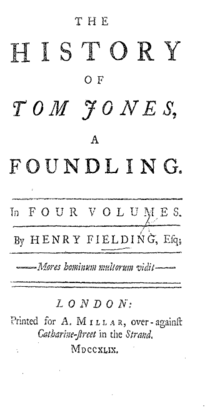
The History of Tom Jones, a Foundling by Henry Fielding: BOOK X., vi-BOOK XI., ii.

Fridays with the Foundling
Tom Jones Original CoverPartridge tries to talk Tom in to returning home, rather than getting further inolved with the military. That doesn’t go well at all, and the two start to bicker, when Tom finds the Muff, recognizes it and suddenly can only care aonly about it. He tries to set out to track Sophia down.

And, yeah, Mrs. Fitzpatrick was, after all, probably at the Inn—just not the woman that Tom was found with, and is already on the road. The coach that had likely brought Mrs. Fitzpatrick to the end is described:

The Coach which had brought the young Lady and her Maid, and which, perhaps, the Reader may have hitherto concluded was her own, was, indeed, a returned Coach belonging to Mr King, of Bath, one of the worthiest and honestest Men that ever dealt in Horse-flesh, and whose Coaches we heartily recommend to all our Readers who travel that Road. By which Means they may, perhaps, have the Pleasure of riding in the very Coach, and being driven by the very Coachman, that is recorded in this History.

According the footnotes in my edition, this was an actual business, making this appear to be one of the earliest examples of product placement?

Chapter vi ends with:

Here, Reader, it may be necessary to acquaint thee with some Matters, which, if thou dost know already, thou art wiser than I take thee to be. And this Information thou shalt receive in the next Chapter.

This is one of my all-time favorite chapter endings. I love it when Fielding narrates his narration like this. It’s the simple things in life, right?

The next chapter is such the comedy of errors, mistaken identities, mistaken motives, wild accusations, and general running about that I can’t summarize it well—I’d really have to just reprint the whole chapter. Suffice it to say that Squire Western is a couple of hours behind Sophia, and is still no friend of Tom’s. Oh, and Mrs. Fitzpatrick is the cousin of Sophia.

We then get flashback chapters, detailing how Sophia ran away from her home, and how her father reacted (hint: poorly) upon discovering it—oddly, her aunt defended her actions. Naturally, Fielding uses the chance to indulge his weakness for the young lady,

It is now Time to look after Sophia; whom the Reader, if he lovers half as well as I do, will rejoice to find escaped from the Clutches of her passionate Father, and from those of her dispassionate Lover.

We get a beginning of a Book digression—this one into a harangue against literary critics, who are nothing more than slanderers, attacking an author when they attack a book—

for, as no one can call another Bastard, without calling the Mother a Whore, so neither can any one give the Names of sad Stuff, horrid Nonsense, &c., to a Book, without calling the Author a Blockhead; which, though in a moral Sense it is a preferable Appellation to that of Villain, is perhaps rather more injurious to his worldly Interest.

(as much as I quibble with his argument, I enjoyed it)

Then we resume with Sophia’s journey after her close miss with Tom, she, her maid, and their guide rush toward London, and soon discover they’re being followed (unintentionally). It turns out that they’re being followed by none other than Sophia’s cousin, Mrs. Fitzpatrick. They had been very close not that long ago and decide to travel together. But are both so tired after their last couple of days that they don’t talk much, and resolve to keep their stories until they’ve had a chance to sleep. They get to an inn, and collapse almost immediately, so we’ll get to see them catch up with each other next week.

Some of this was just a bit too busy for my taste. I prefer Fielding a bit more streamlined, but overall, this was eventful, fun and should prove to make life interesting in the chapters to come.

Betty by Tiffany McDaniel: A Beautiful Novel about a Tragic Childhood

Betty

Betty

by Tiffany McDaniel

eARC, 480 pg.
Knopf, 2020

Read: July 25-28, 2020
Grab a copy from your local indie bookstore!


I’ve struggled with this one for days now and was tempted to say something like, “It’s a Tiffany McDaniel book. This means the writing is gorgeous, the subject will provoke you, you will be moved. And did I mention it’s wonderfully written?” But I knew I couldn’t post that…it doesn’t actually tell you anything about this book (“Tiffany McDaniel” and “gorgeous writing” is essentially a tautology) and since when do I express myself in twenty-seven words?

Who’s Betty About?

Yeah, I normally ask what a book is about, but the what is so unimportant in this book a reader could be excused for not remembering. You won’t forget the who anytime soon. The who is what matters.

It’s about a young, poor family’s struggles between 1939 and 1973—with a focus on 1961-73 (when Betty was 7-19) when the family settles in Appalachian Ohio (and largely stays there). The father is of Cherokee descent (Tsa-la-gi. A-vn-da-di-s-di), the mother is white—and you can imagine how easy life was for them and their children in that time (harder for Betty who takes more after her Cherokee lineage, while her siblings favor their mother). While none of the children has an easy life, there’s a greater degree of difficulty of Betty.

I could spend a good deal of time talking about various family members, but I’m going to focus on two of them.

Landon Carpenter (a.k.a. “Dad”)

When Landon Carpenter met Alka Lark, he was working as a gravedigger, he later worked at a clothespin factory—and then several other jobs, including a stint in a coal mine (which left him with a permanent limp due to a beating given by racists), while the family moved from state to state. When they settled in Breathed, Ohio*, he became known for selling moonshine, herbal remedies (based on “Cherokee wisdom” that was essentially what he happened to make up on the spot), and hand-crafting furniture.

* A fictional city that also served as the setting for The Summer that Melted Everything—one of several nods to that work included here.

But really, what he does with his time is father his children and try to take care of his wife. They don’t all appreciate it, or understand what he’s doing, but they’re (largely) devoted anyway. He will be frequently found passing on a bit of received knowledge through myths or parable form. He wasn’t ready to be a father when he became one and two decades later, he still wasn’t entirely ready when Betty arrived (or her younger siblings, either), but he rises to the occasion as best as he can. I don’t get the picture that he’s the easiest guy to get to know or get along with for prolonged periods. But for those who do get to know him, he’s clearly a loyal and supportive friend.

Betty (a.k.a. “Little Indian”)

Either as a quirk of personality or because she’s physically closer to her Cherokee heritage (likely a combination), Betty embraces the cultural lessons her father passes down more readily than her siblings do—and always wants more. She’s naive, inquisitive, and somehow despite everything she witnesses innocent and optimistic (not precisely, but that’s the best word I can come up with). Life hands her horrible experience after horrible experience, and while momentarily cowed, she comes back, wiser, but still innocent. Toward the end of the book, she has a couple of experiences (one thing she’s told about, one thing she witnesses) that drive her to the breaking point—but even then she holds on for a little longer.

She’s our Point of View character and doesn’t understand everything that’s going on around her for most of the book—things really kick off when she’s seven, after all. So we see a lot of the book through unreliable eyes, but very reliable emotions and reactions. From the latter, we can get a good understanding of what’s going on, better than she can.

The Magic (for lack of a better word)

In McDaniel’s The Summer that Melted Everything, many things happen that may be supernatural or magical in origin, there’s a semi-magical realism feel to it. That’s not the case here. Nor is the source of the “magic” in this novel one mysterious stranger.

The power that keeps Dad and Betty—and the rest of the family—going comes from story. Dad’s constantly telling stories to his children, Betty in particular—and, we learn, he even tells stories to his friends (I don’t think Landon’s wife has much patience for many such stories, as much as she needs them). Betty typically doesn’t tell her stories to anyone, but she writes them down, filling notebooks with them. Some she keeps, some she buries (to preserve or to hid), some she gives away. By their use of story—sometimes use of words—Dad and betty keep themselves, and those around them, going. They inspire, encourage, and teach with them.

A story that Betty’s mother tells her is arguably the most powerful story in the novel—and it explains more of the novel than anything else. Her story, is wholly true, and wholly heartbreaking, but even that comes down to the power of storytelling.

Drawbacks to the book

I don’t really want to label these as problems with the book, but there are a few things that keep me from being as enthusiastic about Betty as I was for The Summer that Melted Everything (which I am enthusiastic about to this day). I basically proselytized readers over that book, I won’t go that overboard for this.

The first is that it took me far longer than it should have to get what McDaniel was trying to accomplish, I kept waiting for a plot to emerge, and there’s never much of one by design. Instead, as I indicated above, this is about the characters. Growing, developing, faltering, stumbling, and retreating. It’s about how they react to the events (or non-events) in their lives that matters, now the events themselves. It’s entirely possible that this is all me and not the text. But I don’t think that’s the case (or I wouldn’t have gone on about it).

Secondly, the non-Carpenter characters. With two notable exceptions (the town Doctor who comes running when they call; and a friend of Landon’s who rents them the house they settle in. But the rest of the people (almost without exception), are simply horrible. Some of the Carpenters are okay, and most of them demonstrate growth (at least). But everyone else is horrible, blatantly so…so many people in authority of varying degrees are just horrible, spiteful, evil people. And it’s just hard to read that. I firmly believe in man’s inhumanity to man, but it’s usually tempered, at least on the surface/occasionally, with something positive. We aren’t given anything to look to and say, “Hey, there’s someone decent”, or “There’s someone doing something decent. Spiteful, racist, ignorant, misogynous, capricious, and evil. Those are the words that come to mind as I think about the non-Carpenter characters, and it’s just hard to read them.

So, what did I think about Betty?

I started off liking it, and that feeling slowly grew. There weren’t many moments that wow’ed me, but there were a handful that broke my heart. I sincerely want another 50 pages of the Dad’s odd little myths (some of which, I’m pretty sure contradict themselves, which Betty sees and rolls with). I wanted to help Betty through her challenges, to at least shoulder some of her burden with her.

And did I mention the prose is fantastic?

That said, I don’t think I connected with the characters (particularly those who aren’t Dad or Betty) the way McDaniel wanted me to. I don’t think there’s enough going on to urge people to read this, but I will recommend it strongly. That said, I think I will be in the minority with this book and most readers won’t understand my hesitation to rave over this. I do recommend this book, I do plan on re-reading it in a year or two, and I will be first in line for McDaniel’s next book.

Disclaimer: I received this eARC from Knopf Doubleday Publishing Group via NetGalley in exchange for this post—thanks to both for this. I also want to thank McDaniel for approaching me to let me know it was available for request. None of the above kept me from giving my honest opinion.


4 Stars
20 Books of Summer

This post contains an affiliate link. If you purchase from it, I will get a small commission at no additional cost to you. As always, opinions are my own.

The Heirs of Locksley by Carrie Vaughn: Robin’s Kids Go Looking for Fun and Find Trouble Again

The Heirs of Locksley

The Heirs of Locksley

by Carrie Vaughn
Series: The Locksley Chronicles, #2

Kindle Edition, 128 pg.
Tor.com, 2020

Read: August 4, 2020
Grab a copy from your local indie bookstore!

“Well,” Marian said calmly. “Perhaps they found an adventure.”

“Marian, they were supposed to be nothing like me. They were supposed to be sensible and quiet and not at all prone to adventures.”

“Hmm,” she said, refusing to state any opinion about what Robin’s children were meant to be like. If they were wild, she’d blame Sherwood Forest before she blamed Robin. Something about that place got into one’s bones and made one rash.

What’s The Heirs of Locksley About?

It’s about four years after the events of The Ghosts of Sherwood, King John is dead and the Locksley’s are at the coronation of his son, King Henry III.

Robin pushes his son John into taking care of some of the courtly duties as his heir (also, he’s the Locksley without any political baggage). His sisters accompany him to meet the new king, one thing leads to another, and Henry calls for an archery competition to see them at work.

The Locksleys being the Locksleys, trouble follows them—some comes at the competition, some comes later. Basically (like their father), the children go looking for fun, and adventure ensues—maybe it is Sherwood’s fault.

“So what did you think would happen, coming here? Knowing who their father is?”

[Redacted] was trapped. He had the look of a hound who had cornered a boar all by himself and then didn’t know what to do with it. “Those . . . They’re just stories. You aren’t him, not really.”

“No, of course not. That man lived a long time ago,” Robin murmured. “I am much angrier right now than he ever was.”

You can just see the glint in his eye as he said that…(and the way he laughed about that line when recounting this over the fire).

So, what did I think about The Heirs of Locksley?

Like its predecessor, this is a quick read. A fun read—it feels like one more entry in a long-running series, not just the second. We’ve only got to spend roughly 250 pages with these three and they already feel like old friends.

Vaughn tapped into something here and I’m so glad she did. In the afterword, she writes:

What makes a good Robin Hood story?

Adventure. Charm. Good people we like looking out for each other— it’s not enough to have a story about Robin Hood. He needs all his friends around him, and they need to be witty and skilled and admirable. Archery, of course we need archery. Clint Barton and Katniss Everdeen insist that we still need archery even in this modern day. And Robin needs to help people. He needs to denounce corruption and tyranny. He rebels and resists.

From where I sit, that’s exactly what Vaughn delivered. Most modern retellings (on-screen or in print) seem to miss the charm and witty parts in the gritty reboots—but Vaughn kept them.

I know it’s a duology, but I’d buy more—either the further adventures of the heirs or if she wanted to go back and tell some of Robin’s adventures.


4 Stars

This post contains an affiliate link. If you purchase from it, I will get a small commission at no additional cost to you. As always, opinions are my own.

The Silence by Luca Veste: A Chilling Look at Spiraling Consequences of One Fatal Night

The Silence

The Silence

by Luca Veste

eARC, 400 pg.
Sourcebooks Landmark, 2020

Read: July 17-20, 2020
Grab a copy from your local indie bookstore!


This is one of those thrillers where it feels like if you say anything, you’ll ruin something. But, I’ve got to try (if only for the sake of my NetGally Feedback Ratio).

What’s The Silence About?

I’m going to borrow the blurb, because if that says too much, it’s on Sourcebooks, not me.

It was supposed to be our last weekend away as friends, before marriage and respectability beckoned. But what happened that Saturday changed everything.

We killed a stranger and covered it up.

In the middle of the night, someone died.

We didn’t know our victim was a serial killer.

The six of us promised each other we would not tell anyone about the body we buried.

But now the pact has been broken.

We don’t think he was working alone.

And the killing has started again …

The year following the killing of the serial killer was not easy on these six friends, the toll on them all is great. Then when the killing starts again, it’s even worse, the fragile hold that Matt (the narrator) has on his life and mental health is about to shatter. Sone of his friends are doing somewhat better, while others…well, you should read that for yourself.

While we what happens to these six around the one-year anniversary we get some quick glimpses at some of the formative experiences they shared through childhood, adolescence, and university that shaped who they are and how they reacted to the present crisis.

What can I talk about?

That borders on too much about the plot, and I really don’t think I can talk much about the characters for the same reason—almost everything we learn about them is tied to the story.

Let’s focus instead on the feel of the book, the atmosphere. Wow. The opening pages are upbeat, joyful—but you can tell that won’t last for long (and not just because you’ve read the blurb). Then it gets bad, and worse, and worse yet. And you can’t look away—like the proverbial car wreck you see coming. Not only can you not look away, you have to see more, you have to keep turning the pages to see just what kind of damage will be done. How these lives will be further shattered.

It’s horrible. It’s tragic. It’s compelling.

So, what did I think about The Silence?

I don’t know that I can honestly say that I enjoyed this book—I don’t think anyone can. It’s not that kind of book. It’s a serial killer novel like you’ve never read before. If for no other reason than the focus isn’t on the killer or the hunt for the killer. It’s about the victims, prospective victims, and those that are left behind. It’s about seeing the ripple effects of trauma.

It’s a great experience. An intense read. This will be lurking in my subconscious for a while. Veste tapped into something here, and you’ve gotta try it.

Disclaimer: I received this eARC from Sourcebooks Landmark via NetGalley in exchange for this post—thanks to both for this.


4 Stars

This post contains an affiliate link. If you purchase from it, I will get a small commission at no additional cost to you. As always, opinions are my own.

Catch-Up Quick Takes Timeless; Point Blank; Smarter Faster Better; Heartburn; In Plain Sight; Wonder Woman: Tempest Tossed; The Bitterroots

The point of these quick takes post to catch up on my “To Write About” stack—emphasizing pithiness, not thoroughness. Half of this particular group bothers me to include here, but I’m afraid I’m about to lose track of them. The other half? Well, I might have trouble coming up with enough to talk about even in this format.

Timeless

Timeless

by Gail Carriger, Emily Gray (Narrator)
Series: The Parasol Protectorate, #5
Unabridged Audiobook, 11 hrs., 25 mins.
Hachette Audio, 2012
Read: May 13-18, 2020
Grab a copy from your local indie bookstore!

(the official blurb)
I won’t deny that there were a couple of moments that had me on the edge of my seat, but overall this concluding novel felt like a letdown. There was just a lot of treading water going on, the plot just wouldn’t move for ages, it seemed.

An audiobook narrated by Emily Gray Unabridged Audiobooks a multitude of shortcomings, however. She’s just so much fun to listen to.

I’m glad I listened to this series, but I’m also glad that I’m done. It started strong, but over the course of the series, it kept getting weaker and weaker. A fun mash-up of Urban Fantasy and Victorian Steampunk, but ultimately unsatisfying.
3 Stars

Point Blank

Point Blank

by Anthony Horowitz, Simon Prebble (Narrator)
Series: Alex Rider, #2
Unabridged Audiobook, 5 hrs., 42 min.
Recorded Books, 2013
Read: May 29, 2020
Grab a copy from your local indie bookstore!

(the official blurb)
Alex Rider is back with another dose of escapist spy fiction for the MG set. It’s fun, but disposable. It’s the audiobook equivalent of NCIS, an entertaining way to spend some time, but that’s about it. I liked what Horowitz did with his character and I appreciated the growth in Alex.

This time, Alex is sent to an exclusive private school in the guise of a child of a rich and powerful man. Two similar fathers, from different parts of the world, with sons at this school, had recently been assassinated and M16 wants to get to the bottom of it.

Prebble did a fine job with the narration, I hope he continues.

This was clever and pretty exciting, I hope the series continues in this veinI can absolutely see why my son tore through them (and re-read them, probably the only things he re-read). I’ll be back for more (just wish I’d made myself do this back when he was reading them).
3 Stars

Smarter Faster Better

Smarter Faster Better: The Secrets of Being Productive in Life and Business

by Charles Duhigg, Mike Chamberlain (Narrator)
Unabridged Audiobook, 10 hrs., 23 min.
Random House Audio, 2016
Read: July 2-6, 2020
Grab a copy from your local indie bookstore!

(the official blurb)
My chief complaint about Duhigg’s book, The Power of Habit, was that I expected something the reader could use for themselves. This isn’t as easy to apply as you might want, but it’s clearly written with an eye for the reader not just to understand the principles of efficiency and productivity, but to show some ways to bring the lessons home.

That said, it’s not a how-to book, it’s not self-improvement, it’s largely about the science/study/understanding of productivity. I found it just as fascinating as the last book, and can see where it’d be a useful guidebook for people in some sort of position of authority in an organization.

Duhigg also shows us his process while illustrating his own application of the book’s lessonswhich I really enjoyed.

I’m absolutely on board for whatever book Duhigg puts out next, Chamberlain is a great narrator for his material, too.
3.5 Stars

Heartburn

Heartburn

by Nora Ephron, Meryl Streep (Narrator)
Unabridged Audiobook, 5 hrs., 30 min.
Random House Audio, 2013
Read: July 7, 2020
Grab a copy from your local indie bookstore!

(the official blurb)
A very pregnant cookbook writer/TV host/new mom’s marriage crumbles around her, as she attempts to salvage it, protect her children, and make a way for herself in the world. Really, she’s trying to do it all, and do it well. (that’s a lousy summary, just click the link above, will ya?)

The narrator? This Meryl Streep person? I tell you what, I think she’s going placesthere’s something special about her performance. Seriously, she did a great job, no surprise there.

Nor is it a surprise that Ephron can write a clever little book. I’m a long-time fan, I knew I should’ve picked this up when it was released. I don’t know that it’s necessarily deep, or that you walk away with new insight into the human condition, marriage, or love. But it was funny, it felt honest and real, and you get caught up in the life of Rachel Samstat right away. Solidly entertaining.
3.5 Stars

In Plain Sight

In Plain Sight

by C. J. Box, David Chandler (Narrator)
Series: Joe Pickett, #6
Unabridged Audiobook, 8 hrs., 23 min.
Recorded Books, 2008
Read: July 22-24, 2020
Grab a copy from your local indie bookstore!

(the official blurb)
So this is all about chickens coming home to roostalmost everything that happened in this novel ties into one or more of the previous novels. And never the fun stuff from those novels. There’s the marital issues we got a glimpse at since Day 1 (and getting worse all the timeespecially in the last book), the dead former Sheriff, the new Sheriff and his issues with Joe, Joe’s new bossand more that I will just gloss over and let you read.

There’s a truly disturbing secret unearthed that really sheds light on so much of what happened in the book, most authors would’ve spent a lot more time on it than Box did here, he just let it be something that happened on the way to the major showdown. I like that he did it, but also kind of wish he’d given us a little more about it.

I did like the new governor and hope we get to see him again. (I especially like the fact that he’s a fictional politician and governs a neighboring state, not my own, I don’t even think I could enjoy him as a fictional Idaho governor).

There’s a lot left hanging at the close of this novel, I know the series continues (for many, many books to come), but I really have no idea what it’ll look like when I come back for Free Fire. Joe will be different, too, no matter what the circumstances around him are like. I assume Box is going to address it and I’m very curious about it.
3 Stars

Wonder Woman: Tempest Tossed

Wonder Woman: Tempest Tossed

by Laurie Halse Anderson, Leila del Duca (Art)
Paperback, 208 pg.
DC Comics, 2020
Read: July 25, 2020
Grab a copy from your local indie bookstore!

(the official blurb)
I really didn’t need this book, Leigh Bardugo’s YA retelling of Wonder Woman’s origin was good enough, and superior to this one. But I’d read some largely positive reviews and decided to give it a shot.

It felt less like a Wonder Woman story, and more like Anderson wanted to find a way to talk about certain issues and shoved Diana into the necessary circumstances and then shaped the character around that, rather than making it feel organic and earned. Also, there was too much left unexplained. There was so much I didn’t understand about what was going on with Diana on the Themyscira and physically that it felt more like Anderson dropped the ball and less like she was being understated.

It wasn’t bad, but it sure wasn’t good.
2 1/2 Stars

The Bitterroots

The Bitterroots

by C. J. Box, Christina Delaine (Narrator)
Series: The Highway Quartet, #5
Unabridged Audiobook, 9 hrs., 49 min.
Macmillan Audio, 2019
Read: July 30-31, 2020
Grab a copy from your local indie bookstore!

(the official blurb)
Cassie’s done with law enforcement (but like Harry Bosch, will always think like a cop), and is making a living as a PI. A blast from the past calls in a favor owed and hires her to do some work as an investigator for the defense in a criminal proceeding. Cassie hates the idea in general, and loathes it in particularthe client is clearly guilty. Clearly guilty of raping his teenage niece, no less. He’s also a highly unpleasant personshe wouldn’t want to work for him even before the rape charge. But a debt’s a debt, and she figures she’ll find enough evidence to get him to switch his plea to guilty and work out a deal.

Readers/Listeners know all too well that the clearly guilty part guarantees that Cassie will eat some crow on this point, but that’s for later.

So Cassie travels to the very small town in northern Montana where the crime took place and the client’s estranged family runs everything from their ranch to the school board and all things in betweenincluding the Sheriff’s Office and Courts. Things do not go well for her and her investigationwhich just makes her think there’s something for her to find to help the client after all.

I definitely listened to this too soon after In Plain Sight, one of the themes of it is repeated herenot something I’d have noticed (at least not as much) if a few more weeks had passed.

Box ultimately won me over, but I came close to DNFing this a time or two, and I really didn’t enjoy most of the book. It was just a little heavy-handed, and the tie-in to a prior nemesis really didn’t work for me at all (and I’m not sure the introduction of the tie-in works now that I’ve seen where Box was taking itit’s too complicated to explain, especially for this post, let’s just say I didn’t like it). But by the end, I liked what Cassie got up to and how she handled herselfand I like the way that Box dealt with the climax and denouementboth were really strong (and semi-unexpected).
3 Stars

2020 Library Love Challenge
This post contains affiliate links. If you purchase from any of them, I will get a small commission at no additional cost to you. As always, opinions are my own.

Luck and Judgement (Audiobook) by Peter Grainger, Gildart Jackson: Death at Sea, Corruption and Destruction on Land

Luck and Judgement

Luck and Judgement

Peter Grainger, Gildart Jackson (Narrator)
Series: A DC Smith Investigation, #2

Unabridged Audiobook, 11 hrs., 57 min.
Tantor Audio, 2016

Read: June 10-12, 2020
Grab a copy from your local indie bookstore!

…this was, when you thought about it, typical of the places that Smith brought you to, of the situations that you could find yourselves in when working with him…He had these ideas which somehow seemed to be more than hunches and a way of making things happen before you realized it. Half suggestions would have momentum before you could blink.

I’ve said it before, and I’ll keep saying it until it’s no longer true* but there’s a certain magic, an ineffable alchemy about Jackson narrating Grainger’s work. It’s just fantastic, I think I’d have liked these audiobooks with another narrator (or in print), but I don’t think I’d have liked them as much. I’ve enjoyed Jackson’s narration before, but it was (no offense intended) good, not great. But you put the two of them together? It’s fantastic.

* I expect that will be roughly the time that one of them retires.

The downside here is, that I don’t have a lot to say beyond that. And it kind of drives me crazy. I made a couple of notes, but I’ve misplaced them (which is pretty annoying).

What’s Luck and Judgement About?

We start off with Smith and Waters taking a helicopter to an oil rig with some other police to investigate a death/missing person (the helicopter rides inject a much-needed bit of levity to keep the beginning of this novel from being too dark). Smith and Waters are really along for the ride, most of the work will be done by the others, but the victim was in Smith’s jurisdiction—as it the rig. Or close enough, so they have to come along.

The higher-ups and the executives on the rig are willing to write it up as a suicide, but are leaning on an unfortunate accident as the explanation. Smith, shockingly, isn’t convinced. Suicide seems unlikely for several reasons, and one would have to work really hard to get around all the safety measures, guard rails, fences, gates, and whatnot in order to have an unfortunate accident. It makes him no friends, but Smith is convinced (and is more so by the hour) that this is a homicide.

As bad as it is for the victim, their suffering is over—but for their survivors, the crime (if there was one) will affect their lives for years to come. In this case, we’re talking about his wife and a small child. They didn’t have a lot of money coming in before his death, but now, there’s nothing. A small apartment, little financial security, and nothing else. Without becoming maudlin, or focusing on them too much, Grainger does allow us to see how these events will alter their lives and what the future may hold for them. We got a little bit of that in the previous novels, but it plays a larger role this time. It’s a small thing, but one that’s too often over-looked in Crime Fiction.

There’s a new detective on the team, a transfer, and one that Smith has a hard time relating to—he’s trying to be cautious and make sure she’s acclimating. At the same time, he’s worried that he’s not using her, and that the best way to get her acclimated is to throw her in. With the rest of the detectives (including those he doesn’t appreciate), you don’t see him uncertain or reflective. So watching Smith trying to figure out how to manage someone is a new side to him.

That same detective plays a role in an undercover operation that Smith undertakes to follow a lead—it’s possibly the most comedic part of the series to date—while not really being that funny at all. Judge for yourself.

As much as Smith’s hunches, his intuition, might start his team down a road, or help him to see a connection that others miss, once he makes that intuitive leap to start an investigation, procedure takes over. I can’t think of another “police procedural” where the procedure is as effective as it is in these books. Smith and the team (mostly the team) grind and grind and grind, doggedly going through all the steps before them, and it pays off—at least to a degree. I really respect that as a narrative choice—sure, Smith’s (or someone else’s) intuition (experience guided by intelligence, as Nero Wolfe would put it) will sometimes help set the direction, but it’s legwork that gets it done.

What’s Going On Other than the Main Case?

Smith continues to work with the True Crime writer on that previous case of his, and a friendship develops between the two As an ongoing arc, this is a real slow burn, and I’m enjoying it, as much as I don’t understand what Grainger is up to. I’m assuming instead of a B (or C) story, this will eventually become the A story for a novel—maybe the last in the series? But unless this is just going to demonstrate that Smith’s biggest case ever was his biggest failure and he’s going to have to find the real killer now, I’m not sure I see how.*

* Okay, I just came up with a half-baked idea where it would work, but I’ll hold off on that idea until it can get solidified.

Lastly, it’s time for Smith to be recertified as physically fit to carry on his duties. He’s missed two previous opportunities to qualify and he has no choice but to show up for this one. It feels pretty personal, the DCI who’s had it in for him since before the series started seems to be using this to force him out. The reasons he missed the previous two are legitimate reasons, and the DCI just looks petty for forcing his hand like this. But then when doesn’t this guy look petty? In the last book, he tried to get Smith to transfer to another office, and that didn’t work, so this is his new attempt. It’s short-sighted and small-minded to force Smith out, but the dies have been cast. While the new assignment was being dangled in front of Smith, a private-sector job was also offered—the lengths (the questionable, reckless, and likely illegal) that Smith goes go to pass this test demonstrates how un-tempting he actually found the offers last time, no matter what he may have thought. Smith loves this kind of police work and will have to be forced into retirement, kicking and screaming.

So, what did I think about Luck and Judgement?

So much for the three paragraphs that I was hoping to come up with for this post, I guess, eh?

I pretty much gave that away in my first paragraph, didn’t I? There is something about the combination of Grainger’s novels and Jackson’s performance that make these books so satisfying. Are they the best written, most exciting and suspenseful Police Procedurals? No. But they are just about the most satisfying, most immersive, most effective that I can think of—even when the ending isn’t what you’d want. There is a strong sense of humanity in these books, not just in the protagonists, but in the victim, the killer, the witnesses, the people who aren’t the killer but who aren’t up to anything legal/moral/ethical…everyone. There’s no one cartoon-y or over the top (in any direction). You just don’t see enough of that.

I was sucked into the intricacies of this case and thoroughly enjoyed spending time with Smith and the rest of the team—and I can’t wait to return to this world.


4 Stars

This post contains an affiliate link. If you purchase from it, I will get a small commission at no additional cost to you. As always, opinions are my own.

BOOK BLITZ: The End of the Road by Anna Legat

I’m running inexcusably late, but today I’m pleased to welcome the Book Blitz Tour for Anna Legat’s The End of the Road. This was published yesterday and we’re celebrating that with this blitz. This looks like a gripping read, you should definitely check this out, why not escape our dystopian moment for a few hours with this dystopian nightmare?

Book Details:

Book Title: The End of the Road by Anna Legat
Release date: July 30, 2020
Format: Ebook/Paperback
Publisher: Crooked Cat / darkstroke
Length: 225 pages

Book Blurb:

The fight for survival has begun

All-out war spins out of control, and it doesn’t discriminate. Governments fall, continents are obliterated, deadly viruses consume everything in their path, and what’s left of humanity is on the run. Caught in this global refugee crisis are a few unlikely survivors.

Tony, a philandering London lawyer, escapes the doomed city and his own murky past as he evacuates to the continent.

A hapless flock of Belgian nuns prays for a miracle as they watch their city turn to rubble.

Bella, a naïve teenager, thinks she is going on holiday when her father drags her across the globe to New Zealand.

Reggie, a loyal employee of a mining corporation, guards a hoard of diamonds in the African plains, fending off desperate looters.

Alyosha, a nuclear scientist, has been looking for the God-particle in Siberia, but now the world is at an end, he wishes to return home to Chernobyl.

A pair of orphaned children are cowering in the Tatra Mountains, fearing the sky will fall in on them.

Will they find an escape route before it is too late? Or are they doomed to fail?

About the Author:

Anna LegatAnna Legat is a Wiltshire-based author, best known for her DI Gillian Marsh murder mystery series. A globe-trotter and Jack-of-all-trades, Anna has been an attorney, legal adviser, a silver-service waitress, a school teacher and a librarian. She read law at the University of South Africa and Warsaw University, then gained teaching qualifications in New Zealand. She has lived in far-flung places all over the world where she delighted in people-watching and collecting precious life experiences for her stories. Anna writes, reads, lives and breathes books and can no longer tell the difference between fact and fiction.

Purchase Links:

Amazon.UK ~ Amazon.US

My thanks to Love Books Group for the invitation to participate in this tour and the materials (including the novel) they provided..

Love Books Group

20 Books of Summer 2020: July Check-In

20 Books of Summer
So, I did a lousy job of taking into account new releases, review copies, and life when I made the original list. I only read 4 of the remaining 13 books in July, which doesn’t bode well for August. I think I can still pull this off, but I’m going to have to make a couple of more substitutions, based on how long it took me to read Winslow’s The Cartel and Hearne’s A Plague of Giants, I’m not going to be able to tackle their follow-ups in August (which annoys me greatly, I was counting on this challenge to help force my hand with these). So I’m substituting Hearne’s next book, the launch of a new series, Ink & Sigil (there’s a balance to that) and The Revelators by Ace Atkins (not as epic in scope as Winslow, but … it’s the best I can realistically do).


✔ 1. Nothing Is Wrong and Here Is Why by Alexandra Petri
2. The Last Smile in Sunder City by Luke Arnold
3. Screamcatcher: Dream Chasers by Christy J. Breedlove
✔ 4. The Finders by Jeffrey B. Burton
✔ 5. Fair Warning by Michael Connelly
✔ 6. One Man by Harry Connolly
✔ 7. The Curator by M. W. Craven
8. The Ninja Daughter by Tori Eldridge
9. The Rome of Fall by Chad Alan Gibbs
✔ 10. American Demon by Kim Harrison
11. Ink & Sigil by Kevin Hearne
12. Betty by Tiffany McDaniel
✔ 13. Imaginary Numbers by Seanan McGuire
14. Curse the Day by Judith O’Reilly
✔ 15. Of Mutts and Men by Spencer Quinn
16. Rather Be the Devil by Ian Rankin
✔ 17. Muzzled by David Rosenfelt
18. Bad Turn by Zoë Sharp
✔ 19. The Silence by Luca Veste
20. The Revelators by Ace Atkins

20 Books of Summer Chart July

Pub Day Repost: Spells for the Dead by Faith Hunter: Nell and Her Team Face a New Type of Deadly Threat

Spells for the Dead

Spells for the Dead

by Faith Hunter
Series: Soulwood, #5

eARC, 384 pg.
Ace, 2020

Read: July 13, 2020

What’s Spells for the Dead About?

PsyLED is called to the home of a country music superstar to investigate some mysterious deaths—the and her band had recently returned from a pretty successful tour and now many of them are dead and several of those who aren’t are in desperate need of First Responders to act quickly.

Sadly, no First Responder is equipped to cope with whatever happened to them, much less recognize and understand it. That goes for people later to the scene, including PsyLED. However, under the direction of T. Laine, their witch, they’re able to makes some guesses about treatment. Nell, Occam and Lainie focus on documenting everything they can as well as beginning preliminary interviews.

One of the first things they determine is that a witch was not behind this attack. Sadly, they reach this conclusion too late to prevent a local sheriff, with the aid of a less than ethical senior FBI agent, to lock up the band member who is a witch. Their logic is impeccable—paranatural crime, arrest the nearest paranatural. This anti-paranatural tendency shows up frequently among the humans in this book—particularly when it comes to witches. I appreciated the way that Lainie dealt with it (both in her more honest and then in her more politic approaches). Our trio being joined by their upline boss, Ayatas FireWind, helps in this manner somewhat (both because of his rank, and FireWind’s general demeanor).

On a semi-related note, you would think that people who believe/proclaim very loudly that lycans, witches, vampires, and so one are horrible monsters that want to kill all humans would be a little more circumspect when they’re around. Maybe it’s just me, but if I thought someone wanted to rip my limbs off and snack on them, I would go out of my way to not antagonize them.

Anyway, the team’s focus here is a little split—on the one hand, they need to both identify the type of magic behind the attack and continue to find better ways to treat those fighting off the effects; and on the other, figure out who had the motive and/or means to carry it out. Neither goal was really that easy.

So That’s the Main Story, What Else is Going On?

As with all books in this series, as much as this is about the PsyLED team, it’s really about Nell Ingram, her integration into the world outside the cult she left, even as she continues to deal with it and her family. God’s Glory Church really doesn’t factor heavily in this book, but it’s always in the back of her mind, shaping (either directly or in reaction to it) how she reacts to things.

There is a pretty intense moment related to the Church, but it has more to do with Nell’s family, than the Church itself. Nell doesn’t yet have full custody of Mud, but everyone’s pretty much acting as if she does. Mud’s continuing to settle in and push Nell in ways she wasn’t prepared for. Which is just fun. Both Nell and Mud are having to deal with their very pregnant sister, Esther. Esther’s pregnancy is causing her powers (and flowers) to come forward, and unlike her sisters, she’s not that interested in them. It’s a nice contrast—and it provides Mud with some great opportunities for growth.

On the work side, the team’s recent successes—particularly as the only predominately non-human team in PsyLED—are causing the Agency to make some changes to the way the Agency works—and this is going to spill over onto the team. By and large, the changes look positive and will provide good opportunities for the various members of the team. However, Nell doesn’t like change—doubly so when it applies to those things in her life she holds most dear. And since we read all this from her perspective, it’s hard to look objectively at all this.

If we’re looking at the Venn Diagram of Nell’s families (natural and found), the overlap is Occam. I’ve always loved this relationship, and now that they’re openly seeing each other and professing love? Occam’s so good, saying all the right things, doing all the right things, he’s practically a Gary Stu/Marty Stu. That “practically” there is important—Hunter’s written him in such a way over these few books that he comes across as earnest in all this, he’s not perfect, he’s just really close to perfect for Nell. They’re just fun together.

As for Nell herself? She’s continuing to work on herself, her approach to life. She makes some wise decisions and actions with her relationship with FireWind. She makes some great leaps with the relationship (if you can call it that) with the Vampire Tree. And we get some of the most solid information on just what kind of paranatural creature Nell is (watching her stifle her curiosity on this front to focus on the case was a great moment). Basically, Spells for the Dead contains more of that sure and steady, organic character development that’s been the hallmark of this series.

So what did I think about Spells for the Dead?

One of my favorite parts of these books is Nell’s reactions to new-to-her foods. We don’t see her introduced to anything here, but we still get to see her relish a few things she wasn’t exposed to for most of her life—Krispy Kreme donuts and pizza. This is actually kind of a good way to think about most of this book—unlike the previous books (particularly the first two), we’re not seeing Nell experience much that’s new here—mostly she’s living in this new world, rather than figuring things out. Hunter has established her world, has set up the characters, creatures, overarching conflicts, and whatnot. Now she gets to play with that world.

This means (at least for me, and at least for this book), that without the earth-shattering reveals, the Big Moments in Nell’s (or other characters’) life, the book has less of an impact on me. Spells for the Dead is just as good as the rest of the series has been, it just doesn’t hit me the same way. Which leads to a slightly lower rating. Hunter’s plotting, writing, and characters are still top-notch, it just didn’t blow me away. I got to spend some time with some really good friends—and I’m so happy I did—but it was comfortable, not exploratory. I trust that won’t always be the case, and that Hunter will certainly do things in this series that will cause my jaw to drop, but sometimes it’s simply going to be a really good/great novel instead of a fantastic one. Still making it one of the best series I follow.

I really got into this case—it wasn’t as fraught as some of the previous ones were, but it was interesting and unexpected. The side stories did everything they needed to. Spells for the Dead just solidifies the Soulwood books as one of the best UF series going.


4 Stars


My thanks to Let’s Talk! Promotions for the invitation to participate in this tour and the materials (including the book via NetGalley and Berkley Publishing Group) they provided.

Classic Spenser: Looking for Rachel Wallace by Robert B. Parker

Classic Spenser

Looking for Rachel Wallace

Looking for Rachel Wallace

by Robert B. Parker
Series: Spenser, #6

Mass Market Paperback, 217 pg.
Dell, 1980

Read: June 26, 2020
Grab a copy from your local indie bookstore!

“What is it you want to know?”

“Why you engage in things that are violent and dangerous.”

I sipped half a glass of beer. I took another bite of veal. “Well,” I said, “the violence is a kind of side-eiffect, I think. I have always wanted to live life on my own terms. And I have always tried to do what I can do. I am good at certain kinds of things; I have tried to go in that direction.”

“The answer doesn’t satisfy me,” Rachel said.

“It doesn’t have to. It satisfies me.”

“What he won’t say,” Susan said, “and what he may not even admit to himself is that he’d like to be Sir Gawain. He was born five hundred years too late. If you understand that, you understand most of what you are asking.”

“Six hundred years,” I said.

What’s Looking for Rachel Wallace About?

Spenser is hired to act as a bodyguard for Rachel Wallace. Wallace is a no-nonsense feminist activist and lesbian author. There have been threats made against her if her book exposing the discriminatory practices of several New England companies is published. The threats make little sense since the galleys have already been released (and therefore the material is out there), but they’re still there.

Despite clashing in their first meeting, Wallace agrees to her publisher’s choice in Spenser and he agrees to try not to annoy her. The two continue to squabble for the first eighty or so pages. Wallace keeps trying to provoke Spenser, questioning his professionalism, wanting to debate her brand of feminism with him. Spenser really doesn’t care about all that—and as much as he’s willing to discuss and think about those issues at other times (he’d read Wallace’s previous work before going to work for her)t—this is about work for him. He doesn’t care who she sleeps with, what she thinks, he’s about keeping her as safe as he can.

There is a moment where Wallace knows she’s going into somewhat hostile territory and tells Spenser to stand down beforehand. When security guards arrive to drag her off, and she goes limp to make it hard for them, Spenser intervenes. Which robs Wallace of the opportunity to make her statement, get the attention she wants, and hopefully a hearing with her target-audience. Wallace takes this as an insult, thinking Spenser’s machismo forced him to protect a (seemingly) helpless woman. And, yes, that’s true. But it’s also true, that if Wallace had been a male academic attracting this kind of response, he’d have done the same thing.

It was the wrong thing for Spenser to do regardless, which he admits later. Wallace fires him—and apparently doesn’t replace him. A couple of months later, she’s kidnapped. Belson* brings Spenser in for his perspective—and of course, that just spurs Spenser into his own investigation. He blames himself for not being a better employee, so he wasn’t around to protect her.

* It’s never explained why a homicide detective is brought in to discuss an abduction, but let that pass.

Spenser has very little to go off of here. He has one name, from a minor incident on his first day with Wallace to look into, and he essentially spends a lot of time trying to find evidence to tie this guy to the kidnapping. There’s also a KKK leader that Spenser arrested back when he was a law enforcement officer and hasn’t lost track of. Working off the assumption that a racist is going to operate in the same circles as a militant misogynist, Spenser harasses him for information. It works out (to a degree), but watching Spenser bully this guy on less than a hunch really bothered me.

Almost randomly, the one piece of evidence that Spenser (and Belson, to be fair) needs to tie everything together is essentially dropped into their lap. As a record blizzard descends on Boston, Spenser decides to walk (almost all roads are closed) fifteen miles to make the best of that piece of information. And well, you can guess the rest.

I Feel Compelled to Share this Quotation that has Nothing to do with the Plot

The Main Entrance to the Boston Public Library used to face Copley Square across Dartmouth Street. There was a broad exterior stairway and inside there was a beautiful marble staircase leading up to the main reading room with carved lions and high-domed ceilings. It was always a pleasure to go there. It felt like a library and looked like a library, and even when I was going in there to look up Duke Snider’s lifetime batting average, I used to feel like a scholar.

Then they grafted an addition on and shifted the main entrance to Boylston Street. Faithful to the spirit, the architect had probably said. But making a contemporary statement, I bet he said. The addition went with the original like Tab goes with pheasant. Now, even if I went into study the literary influence of Eleanor of Aquitaine, I felt like I’d come out with a pound of hamburger and a loaf of Wonder bread.

So, what did I think about Looking for Rachel Wallace?

I guess I’ve made it clear that this isn’t my favorite Spenser. But it’s not that I dislike it. I enjoy spending time with Spenser and Susan. I liked when Wallace and Spenser engaged with each other—seeing Spenser in these settings tells a lot about him, as does the way he reacts to Wallace. At the same time, it’s interesting seeing Spenser through her eyes (as mistaken as I think her estimation of him is, it’s not merit-less). The dialogue is great, Spenser verbally sparring with Wallace’s publisher and a prosecutor looking into her disappearance is just fun to read. I can’t forget there are some pretty good action scenes (even if Spenser does bring a handgun to a pie fight).

It’s just that this is the first one since The Godwulf Manuscript that I have to add provisos to my enjoyment. I have had the impression on many re-reads (including this time), that Parker was more interested in bringing up some of Wallace’s ideas, positions, and practices than he was in telling a good story. At the very least, he was frequently distracted during the telling.

Do I recommend it? Yeah, it’s a good read. It’s a great way to understand the character, and the story is okay. Am I in the same kind of fan-boy mode for it as I was for Mortal Stakes, The Judas Goat or Promised Land? Nope. Still, I’ll take this over almost Spenser novel from the 2000’s.

This post contains an affiliate link. If you purchase from it, I will get a small commission at no additional cost to you. As always, opinions are my own.

Page 145 of 341

Powered by WordPress & Theme by Anders Norén