Category: Fiction Page 157 of 346

Breath Like the Wind at Dawn by Devin Jacobsen: Obscure When not Vile. A book that Simply Didn’t Work for Me.

 Breath Like the Wind at Dawn

Breath Like the Wind at Dawn

by Devin Jacobsen

eARC, 208 pg.
Sagging Meniscus Press, 2020

Read: May 18-19, 2020

Let’s keep this short for everyone’s sake by kicking things off with the Publisher’s blurb

Spanning two decades, Breath Like the Wind at Dawn tells the epic story of the Tamplin family—of outlaw-twins Quinn and Irving; their brother Edward, who is on the run from a dark past; and their mother Annora, who has been left to defend their haunted Minnesota homestead. Yet at the center of the novel is Les, patriarch of the Tamplins, Civil War veteran, and sheriff of Utica, who is possessed by an indelible lust to strangle his victims. Only when the brothers set about to rob Utica’s bank will the family at last converge in an unforgettable finale when blood will be met with blood.

Combining the multi-perspective family drama of As I Lay Dying with the violent lyricism of Blood Meridian, Breath Like the Wind at Dawn brings a brave new voice to American fiction.

Of the 208 pages in this book, I’m going to estimate that maybe 15 worked for me. I didn’t connect with the prose, the characters, the story, or anything. I thought Jacobsen’s style got in his way, that attempts to be artistic rendered the text obscure; word choice (particularly when attempts were made at a vernacular) was off-putting; and the characters were lifeless (when they weren’t vile or abhorrent).

I’m just not up for enumerating my problems with the novel beyond that. I didn’t see the appeal to any of it. I’m not saying that no one will or could, but it’s incomprehensible to me that anyone would.

Disclaimer: I received this eARC from the author via Lori @ TNBBC Publicity in exchange for this post—thanks to both for this, I do appreciate the opportunity (despite what it may read like).

Noam’s Monsters by Shai Levinger, Kaustuv Brahmachari (Illustrator): A Young Boy Battles His Anxieties and Fears

Noam’s Monsters

Noam’s Monsters: Helping children to cope with anxiety, behavioral functions and shyness

by Shai Levinger, Kaustuv Brahmachari (Illustrator), Ephrat Abisror (Translator)

Kindle Edition, 30 pg.
2020

Read: May 16, 2020


Noam is a five-year-old kid riddled with anxiety——but in a relatable way. Monsters such as Spiteful Blames, Worried Fearona, and Shaming Embarrassitis plague him—affecting his mood, causing him to act out and costing him sleep.

We see him try to deal with these things on his own, failing but persevering. Which isn’t to say that it’s a dire book, or super serious. Levinger’s come up with a clever and cute way to introduce these concepts to young readers. It’s a fun read with some subtle lessons.

In the end, Noam’s problems aren’t resolved, they don’t go away. But he takes the most important step—he tells his parents (another responsible adult would work here) what’s going on. I really, really appreciated this approach and didn’t expect it—I would have guessed someone said an encouraging thing or two to him and he’d defeat the monsters (or learn to play with them or something). But nope. He just tells his parents and we’re left to assume they’re going to do the right thing and work with him.

Levinger is a Clinical Psychologist, and he brings his expertise to bear here. Abisror’s text flowed pretty smoothly—anyone who can translate rhyming text deserves major credit. Brahmachari’s art was spot on, his monster designs do a great job of embodying the anxieties.

I’d gladly recommend this for parents—whether or not their child is particularly anxious, they’re going to deal with some of these concepts in their life, might as well get them used to them soon.


3.5 Stars

Note: I received a copy of this book from the author in exchange for this post and my honest opinion. I thank him for that.

BOOK BLITZ: The Strange Book of Jacob Boyce by Tom Gillespie

I’m pleased to host a Book Blitz for Tom Gillespie’s The Strange Book of Jacob Boyce today, a book that defies a snappy one-sentence synopsis.

Book Details:

Book Title: The Strange Book of Jacob Boyce by Tom Gillespie
Publisher: Vine Leaves Press
Release date: July 21, 2020
Format: Ebook/Paperback
Length: 298 pages
Purchase Link: Amazon UK/Amazon US

Book Blurb:

A spiralling obsession. A missing wife. A terrifying secret. Will he find her before it’s too late?

When Dr Jacob Boyce’s wife goes missing, the police put it down to a simple marital dispute. Jacob, however, fears something darker. Following her trail to Spain, he becomes convinced that Ella’s disappearance is tied to a mysterious painting whose hidden geometric and numerical riddles he’s been obsessively trying to solve for months. Obscure, hallucinogenic clues, and bizarre, larger-than-life characters, guide an increasingly unhinged Jacob through a nightmarish Spanish landscape to an art forger’s studio in Madrid, where he comes face-to-face with a centuries-old horror, and the terrifying, mind-bending, truth about his wife.

About the Author:

Tom Gillespie grew up in a small town just outside Glasgow. After completing a Masters in English at Glasgow University, he spent the next ten years pursuing a musical career as a singer/songwriter, playing, recording and touring the UK and Europe with his band. He now lives in Bath with his wife, daughter and hyper-neurotic cat, where he works at the university as an English lecturer. Tom writes long and short stories. His stories have appeared in many magazines, journals and e-zines. He is co-author of Glass Work Humans-an anthology of stories and poems, published by Valley Press. Visit Tom at tom-gillespie.com.

My thanks to Love Books Group for the invitation to participate in this tour.

Love Books Group

Top 5 Tuesday – Top 5 Opening Lines


I love a good opening line. A solid opening paragraph or page is great, but an opening line that sells you on the next 200-500 pages? Magic. When I saw this list topic listed, these 5 jumped to mind—they may not be the best I’ve ever read, but they’re the most memorable.

(I tried, tried, tried to limit myself to the opening line, but I failed on a couple of them, couldn’t help myself.)

5 A Portrait of the Artist as a Young Man
A Portrait of the Artist as a Young Man by James Joyce

I remember in our English class in High School when we were assigned this book, pretty much no one was interested. When Mr. Russo passed out the paperbacks, a few of us flipped it opened and read these first words—and suddenly we were open to the idea (didn’t last long for all of us, but that’s beside the point, we’re focused on the opening lines here). It’s stuck with me for almost 30 years, that’s gotta say something.

Once upon a time and a very good time it was there was a moocow coming down along the road and this moocow that was coming down along the road met a nicens little boy named baby tuckoo….

4
Neuromancer by William Gibson

This sentence was love at first glance for me. Still love it. Naturally, no one knows what color this is referring to anymore.

The sky above the port was the color of television, tuned to a dead channel.

3
The Big Sleep by Raymond Chandler

Oft-parodied. Oft-imitated. Often-celebrated. Does it get better than this?

It was about eleven o’clock in the morning, mid October, with the sun not shining and a look of hard wet rain in the clearness of the foothills. I was wearing my powder-blue suit, with dark blue shirt, tie and display handkerchief, black brogues, black wool socks with dark blue clocks on them. I was neat, clean, shaved and sober, and I didn’t care who knew it. I was everything the well-dressed private detective ought to be. I was calling on four million dollars.

2
Harry Potter and the Sorceror’s Stone by J. K. Rowling

Why bother saying anything here?

Mr. and Mrs. Dursley, of number four Privet Drive, were proud to say that they were perfectly normal, thank you very much. They were the last people you’d expect to be involved in anything strange or mysterious, because they just didn’t hold with such nonsense.

1
The Hitchhiker’s Guide to the Galaxy by Douglas Adams

I’ll go on and on about this book next week, so I’ll just keep my trap shut here. But man…there was something about these lines that got into my blood.

Far out in the uncharted backwaters of the unfashionable end of the Western Spiral arm of the Galaxy lies a small unregarded yellow sun.

Orbiting this at a distance of roughly ninety-eight million miles is an utterly insignificant little blue-green planet whose ape-descended life forms are so amazingly primitive that they still think digital watches are a pretty neat idea.

Trophy Hunt by C. J. Box: Pickett takes on an X-Files-y case

Trophy Hunt

Trophy Hunt

by C. J. Box
Series: Joe Pickett, #4

Paperback, 375 pg.
G. P. Putnam’s Sons, 2004

Read: May 15-16, 2020
Grab a copy from your local indie bookstore!


I’m short on time, so I’m going to cut a corner and use the official blurb:

It’s an idyllic late-summer day in Saddlestring, Wyoming, and game warden Joe Pickett is fly-fishing with his two daughters when he stumbles upon the mutilated body of a moose. Whatever – or whoever – attacked the animal was ruthless: half the animal’s face has been sliced away, the skin peeled back from the flesh. Shaken by the sight, Joe starts to investigate what he hopes in an isolated incident.

Days later, after the discovery of a small herd of mutilated cattle, Joe realizes this something much more terrifying than he could have imagined. Local authorities are quick to label the attacks the work of a grizzly bear, but Joe knows otherwise. The cuts on the moose and the cattle were too clean, too precise, to have been made by jagged teeth. Are the animals only practice for a killer about to move on to another, more challenging prey? Soon afterward, Joe’s worst fears are confirmed. The bodies of two men are found within hours of each other, in separate locations, their wounds eerily similar to those found on the moose and cattle.

There’s a vicious killer, a modern-day Jack the Ripper, on the loose in Saddlestring – and it appears his rampage is just beginning.

Pro tip: don’t read C. J. Box describing a moose corpse while eating lunch.

That aside, I had a lot of fun reading this. Joe ends up being the Game and Fish representative on the task force the governor calls for to investigate these mutilations. Sheriff Barnum is also on the task force, giving us more opportunities to be annoyed by him (I’m really looking forward to the upcoming election which should remove him from office).

I have a note to compare Nate Romanowski and his approach to spirituality and nature and Henry Standing Bear’s—and I think that could be a fruitful discussion, but I think I need to see Nate wax spiritual a little more in future books. But at least at this point, Nate seems like some white dude getting a little strange, whereas Henry seems genuine (which isn’t to say Nate’s fake, he’s just…new at it?). Regardless, it was good to see Nate again, and I like the way that he’s settling into the series (if only so there’s someone around who can shoot and is generally on Joe’s side).

On the one hand, the constant discussion about the precarious financial situation the Picketts face is a refreshing and bracing bit of realism—but if Box would ease off on it a little bit, that’d be nice, just a bit. I like seeing Marybeth struggling to find her place in the world in a way that helps her family—if nothing else, her bouncing around from employer to employer (as her small business allows) she can be put in all sorts of interesting places to tie into Joe’s cases (see these last two books).

Lucy took a bigger role than she usually gets, which sadly took a little bit of space from Sheridan. But she still gets a chance to shine, which makes me happy.

But what brings readers back is Joe Pickett. He’s not the smartest, the quickest, the most insightful mystery protagonist around. But he’s dogged. He’s persistent. He’s one of those rare good guys. He gets the job done, eventually, because that’s what he needs to do. Easy to like a character like that, he’s not really Everyman. He’s the kind of guy an Everyman would like to be.

(which does mean that the reader figures things out a lot faster than he does, but oh, well)

This was the first Joe Pickett novel that I read instead of listening to (my library doesn’t have the audiobook)—this is the first time I’ve gone from audio to print. It was interesting, but I think I prefer Chandler’s narration to my own (but I liked getting the spelling of a couple of names).

It’s a solid mystery, a good time with some characters that I liked. It’s a little heavy on the “woo-woo” stuff (Joe’s term), but I can live with that. I don’t know that this is the best one to come to the series with, but it’s a good installment for those that are familiar with the characters.


3.5 Stars

2020 Library Love Challenge

This post contains an affiliate link. If you purchase from it, I will get a small commission at no additional cost to you. As always, opinions are my own.

The King of the Crows by Russell Day: Prescient. Gripping. Haunting. Unpredictable. What stories should be.

King of the Crows

King of the Crows

by Russell Day

Kindle Edition, 456 pg.
Fahrenheit Press, 2020

Read: April 28-May 9, 2020

… for me at least, the first week of the Lockdown was the worst.

Knowing it had happened to me. I hadn’t escaped, I wasn’t one of the lucky ones. Lucky to be safe or lucky to be dead. Take your pick. I was neither.

That right there gives you a pretty good idea what kind of light and fluffy read this is going to be.

There are two timelines in this story—the primary focuses on a post-pandemic London, while the other shows what happened to a couple of the characters mid-pandemic (with plenty of material describing what the pandemic was like for others). In the primary timeline, Europe is a disaster—a “wasteland”—and eight years after the Outbreak, it’s beginning to put itself back together. But it’s going to take a long, long time to recover from this. Don’t let the fact that “eight years after” this fictional outbreak is 2028 bother you at all.*

* Good luck with that. I’ll get back to this in a bit.

I’m not going to try to list all the various ways that Day uses to tell this story: I’m certainly going to forget several. So here’s a partial list: here’s a third-person 2028 narrator describing a police investigation, a first-person perspective on the same investigation; a first-person account of that same detective’s life during the Outbreak; selections from a screenplay made about a group of Londoners during the Outbreak; selections from the Outbreak-memoir of one of those Londoners; and third-person narration of the same (N.B.: these three will vary in telling ways); redacted 2028 prison correspondence about the Outbreak; excerpts from scholarly works on aspects of the Outbreak (including a very illuminating work on the slang of the time); graffiti from 2021; internet message boards. Day weaves these together to tell his story, build the world, and help you to understand it. Frequently, I read something from the 2028 timeline, and understood it—only to find a new depth to it several pages later after getting another piece of the puzzle from 2020/2021. It’s hard to juggle that many narrative forms/voices/perspectives/calendars as a reader or a writer—Day pulled it off better than I did (any problems I had following things I attribute to myself, and it was pretty easy to clear out my misunderstanding with a minimum of backtracking*). It definitely helps paint the picture of the scope and variety of effects the sickness had on the world more efficiently than a consistent first- or third-person narrative would be able to.

* This would be easier in hardcopy than on an e-reader in my opinion. But that’s just a guess.

There are times (several of them) when I felt that the characters were getting lost amongst the plot and worldbuilding and sickness. But when I stopped and thought about it—and eventually got to the point where I didn’t have to—I realized I had a pretty solid idea about who these people were and was more invested in them than I expected. I thought there was so much going on that the people were getting hidden, but really, Day’s work was subtle—working in the characters into my subconscious like you give a dog its medicine. Normally, this isn’t something I require (or would like)—and it’s not Day’s usual M. O. (quite the opposite), but I think this approach really fit the novel and the story/world.

“They weren’t zombies,” he says, softly. “Don’t call them zombies.”

No one who was involved in the Outbreak for real uses the zee word.

So exactly what was the sickness?

I remember reading a couple of years ago about these ants that would succumb to a fungus which would short-circuit their brain and make them do certain things before killing them—or something like that, vague memories here. Then there were stories about parasites controlling the host’s actions—both of these stories had their 15 seconds of fame on social media around the same time (I may be messing the details up a little bit, but I’m not writing history here).

In Day’s world, one of these kinds of parasites will reside—asymptomatically, I should stress—in cats, who would pass it on to humans. Skipping the details, the humans would get very sick and then, survivors would maybe succumb to a psychosis that would make them violent. This sickness, HV-Tg (Human Variant-Toxo gondii), in a little more than a year would kill more than 20 million in Europe (at least 33% of France’s population) Et voilà!—an easy to believe pandemic that results in Zombie-like people wandering around.

Now, if one of those who’d “switched” and become violent infected you during an assault, well, you were likely to succumb. There were enough of these (“psychos” or “Gonzos”), and the sickness was so widespread, that the police and military couldn’t keep up, that civilians were forced to take action and defend themselves, their family and neighbors. People quickly forming into gang-like associations for mutual protection. It was a literal kill-or-be-infected (and likely killed) situation.

One such association became known as The Crows or The Kings of the Crows. They developed a legendary status mid-and post-Outbreak—and are the subjects of the memoir and film mentioned above. One of their number who happened to survive (and gain notoriety enough to get a publishing deal for a memoir) is the subject of the 2028 investigation. They survived the worst of the worst in one of the hardest-hit cities. They did so via means and methods that many (including their own) would find deplorable, but under circumstances that not only permitted, but required, those actions.

We also see what happens to an American in Paris for work when the Outbreak reaches the point that International travel is canceled (particularly to the U.S.). Her allies will never be considered the Kings of anything, and the contrast between how she survives to what the Crows do is pretty striking.

In 2028…eh…you know what? You should read that for yourself. I’m going to say something I’ll regret.

The biggest killer in those days wasn’t the disease or the psychos, it was stupidity.

However, it has been pointed out by many historians, logic was one of the first casualties of the Outbreak.

Some of the best moments of this book have nothing to do with advancing the plot, they’re little bits showing what the world of the Gondii-pandemic looks like. The man telling the story about taking his girlfriend to the ER because of a burn—how they were treated, and how she became infected. The soldiers coming back from a Middle East deployment being completely unprepared for what had happened to their home country. The mother and son who traveled with the Crows for awhile.

Ultimately, it’s not the story you think you’re getting…or is it? The marketing tag line is, “Ocean’s Eleven meets 28 Days Later.” It is, all things considered, a good, catchy line. I’m not sure it’s all that accurate a description of the novel (but it’s not inaccurate). What it is, really slides up on you—and when you see it it feels like it was obvious all along (even if you wouldn’t have said that 20 pages earlier). There’s a straightforward crime story at the heart of this novel—it’s just surrounded by so many layers, that you can miss it—there’s the sickness, there’s the horrible social and political context (both mid- and post-Outbreak), there’s what the characters are going through otherwise—and the whole thing is drenched in social commentary about 2020 society, e.g., sexism, economics, medical care.

And that’s not even touching the context we’re reading it in now. I truly wonder what I’d think of this book if I’d read it last Fall. I’d still like it, I’d still be impressed by it—but I don’t know if it would resonate with me the same way. There’s almost nothing about Gondii that’s comparable to COVID-19. But the way that people and governments respond—well, that’s pretty different, too. but if you can’t see what’s going on around us reflected in this novel? You’re not paying attention. That Day appears so prescient says something about his skill and observation (and a lot about Western culture, too).

I can see why people cling to the idea that the Gonzos were trying to tell us something. Something’s out there trying to get a message through: there’s a plan. Compared to the idea that it was all just chance, it’s a comfort of a type. Chance doesn’t care and can’t be appeased and can’t be reasoned with. Chance means it could all happen again.


5 Stars

The Sword-Edged Blonde (Audiobook) by Alex Bledsoe, Stefan Rudnicki: This Hard-Boiled Fantasy Mixes the Best of Both Genres

The Sword-Edged Blonde

The Sword-Edged Blonde

by Alex Bledsoe, Stefan Rudnicki (Narrator)
Series: Eddie LaCrosse, #1

Unabridged Audiobook, 8 hrs., 28 min.
Blackstone Audio, 2012

Read: April 22-24, 2020
Grab a copy from your local indie bookstore!


I’ve read this novel at least twice (13 and 11 years ago), and apparently have forgotten almost all of it. In fact, what I did remember as the climactic scene must belong to the second novel in the series, Burn Me Deadly. I can do better with the rest of the series (and not just because I actually wrote something about them—but I’m looking forward to taking another look at them in the coming months.

But I’m getting ahead of myself, I should introduce you to Eddie LaCrosse and his world. It’s your basic Fantasy world—swords, rumors of sorcery, small kingdoms, and so on. Eddie’s an ex-soldier, ex-mercenary, now “sword jockey” (basically a private cop). He’s got a little more on his résumé, but you’ll learn more about that as you dive in yourself. He’s been hired by an old friend, the King of a neighboring country to clear his wife of the horrific murder of her son. She doesn’t remember him, but when he meets her, Eddie realizes that he knew the Queen long before the King did.

Eddie’s investigation takes him through multiple kingdoms, into the remains of a cult, and into a criminal network that rivals anything that Varys put together for efficacy or ruthlessness. At the same time he does this, Eddie takes a trip through his personal history, reliving the time he knew the Queen (and events leading up to that). The two storylines are interwoven to help Eddie solve what seems like a perfect crime.

Both in the narration, LaCrosse’s character and the kinds of people we meet along the way, Bledsoe channels Chandler. LaCrosse is casually violent in a way that Marlowe indulged in a bit too often for me, and the (for lack of a better word) grotesque (in physical appearance and morality) criminals Eddie deals with in the latter parts of the book felt particularly Chandler-esque to me.

There’s some things that happen at the end that point to Eddie coming to terms with parts of his past that he’s been unable/unwilling to acknowledge existed. The character won’t change as a result of this (at least not much), but I think it opens the door for some of his rougher edges to be rounded out. How well that actually happens, I’ll have to see (I don’t trust my memory enough right now)—but at the very least, Bledsoe made it possible for the character to grow and evolve here.

Rudnicki’s narration didn’t really work for me initially—there was a quality to his voice that just didn’t click with me. But, I kept going because I liked the novel. Before the halfway mark, however, he’d won me over. I can’t put my finger on it (either good or bad), but he sold the emotional moments, the humor, and Eddie’s general attitude. Which is good enough for me.

It’s hard for me to rate this one on its own terms—I remember liking it. I remember what Bledsoe does with the characters. And those things color my rating, leading me to probably giving this another half-to-whole star more than I would otherwise. But also, for the world. The merging of Fantasy and Hard-boiled genres in a way that’s seamless and well-executed. I recommend this one and will be back for more soon.

Bookstooge posted about this book yesterday. It’s probably worth a read (I’ll read it later today, I didn’t want his voice in my head as I wrote this).


4 Stars

This post contains an affiliate link. If you purchase from it, I will get a small commission at no additional cost to you. As always, opinions are my own.

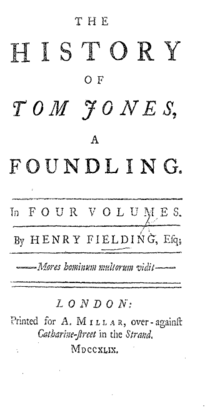
The History of Tom Jones, a Foundling by Henry Fielding: BOOK VI., ix.-xii.

Fridays with the Foundling
Tom Jones Original CoverWe left Sophia and Tom all but declaring their love for one another in the sweetest chapter thus far, and we rejoin the novel with a chapter called “Being of a much more tempestuous Kind than the former.” Which doesn’t bode well.

So Sophia’s aunt spills the beans to her father—it’s not just that she doesn’t care for Blifil, she’s in love with Tom—and, well:

The idea of a marriage between Jones and his daughter, had never once entered into the squire’s head, either in the warmest minutes of his affection towards that young man, or from suspicion, or on any other occasion. He did indeed consider a parity of fortune and circumstances to be physically as necessary an ingredient in marriage, as difference of sexes, or any other essential; and had no more apprehension of his daughter’s falling in love with a poor man, than with any animal of a different species.

He became, therefore, like one thunderstruck at his sister’s relation. He was, at first, incapable of making any answer, having been almost deprived of his breath by the violence of the surprize. This, however, soon returned, and, as is usual in other cases after an intermission, with redoubled force and fury.

He storms off to come give the pair a piece of his mind, but Sophia’s overcome by fear at the ruckus he makes along the way and faints. The first thing her father sees is her unconscious and he focuses on her well being, forgetting everything else. Until she’s carried away to be cared for, and then like a switch he’s back to being enraged and has to be physically restrained from Tom. It’s suggested by the Parson restraining Mr. Western that Tom get going, and he’s quick enough to agree.

The next day, Allworthy gets done listening to Blifil’s account of how well things went—because Allworthy cares about her character, not her (or her father’s) wealth, he’s pleased. When Western bursts in with a very different story. He gets Allworthy up to speed, swears up and down in a dozen ways that his “Sophy” will be cut off and left destitute if she continues to pursue Tom, threatens violence against Tom, and assures Blifil that he won’t let Sophia marry anyone else before he rushes back home to try to instill some order there.

When Allworthy and Blifil were again left together, a long silence ensued between them; all which interval the young gentleman filled up with sighs, which proceeded partly from disappointment, but more from hatred; for the success of Jones was much more grievous to him than the loss of Sophia.

Blifil takes this occasion to slander Tom, accusing him of drunken carousing while Allworthy was ill and then assaulting both Blifil and Thwackum unprovoked. Thwackum is called as a witness, who backs up that no-good, vindictive twerp (why should I pretend to be unbiased toward the creep?)

Allworthy confronts Tom and Tom agrees to the bare facts, without addressing the motivation for the fight, etc. At which point, Allworthy gives Tom a check to help him get established and kicks him out—vowing to never speak to him again. He closes the speech by saying:

there is no part of your conduct which I resent more than your ill-treatment of that good young man (meaning Blifil) who hath behaved with so much tenderness and honour towards you.”

These last words were a dose almost too bitter to be swallowed. A flood of tears now gushed from the eyes of Jones, and every faculty of speech and motion seemed to have deserted him. It was some time before he was able to obey Allworthy’s peremptory commands of departing; which he at length did, having first kissed his hands with a passion difficult to be affected, and as difficult to be described.

The reader must be very weak, if, when he considers the light in which Jones then appeared to Mr Allworthy, he should blame the rigour of his sentence. And yet all the neighbourhood, either from this weakness, or from some worse motive, condemned this justice and severity as the highest cruelty. Nay, the very persons who had before censured the good man for the kindness and tenderness shown to a bastard (his own, according to the general opinion), now cried out as loudly against turning his own child out of doors. The women especially were unanimous in taking the part of Jones, and raised more stories on the occasion than I have room, in this chapter, to set down.

One thing must not be omitted, that, in their censures on this occasion, none ever mentioned the sum contained in the paper which Allworthy gave Jones, which was no less than five hundred pounds; but all agreed that he was sent away penniless, and some said naked, from the house of his inhuman father.

Yeah, that quotation went on a bit, but I couldn’t help myself.

So, Tom (in a fit of anguish) loses his belongings (including the money), writes a farewell letter to Sophia (not wanting to drag her down with him) and gets his ol’ pal Black George to get that letter to her (via her maid). We learn that George found the money and everything else, but neglected to tell Tom that. Sophia sends a return letter warning Tom from seeing her father and vowing, “that nothing but the last violence shall ever give my hand or heart where you would be sorry to see them bestowed.”

Wow. That’s a lot of plot in a very few pages. A decent amount of fun and sets us up for the next part—which can’t be nearly as exciting, but I’m eager to see what happens.

N.B.: I went a little quote happy with this one, and wasn’t in the mood to do all the typing. So I went with a text file from Project Gutenberg–which doesn’t follow the atypical (for our eyes) capitalization that the book I use does. Makes it a little easier to read, but a little more drab.

Apex Predator by M.R. Miller: Nothing goes According to These Plans

Apex Predator

Apex Predator

by M. T. Miller
Series: The Culling, Book 2

Kindle Edition, 238 pg.
2020

Read: April 17-20, 2020
Grab a copy from your local indie bookstore!

“Nothing ever goes according to plan,” Shast said. That was why contingencies existed. Layers upon layers of them.

That’s from Chapter 4. By the time the book ends 11 chapters later, Shast is going to a whole new understanding of that.

But I’m getting ahead of myself there’s some sort of monster infestation in a city—forces have been sent to take care of it–two different waves, actually. But they didn’t work. So now, The Culling–the organization that handles these kinds of things, has sent a full Hand to clear it out. A Hand is a team of five hunters, each with a different specialty. With those combined talents, they should be able to handle anything.

Only Shast and the most senior member of the Hand have worked together before, the other three are experienced, but not that much. It’s a diverse group of people who usually work along and there’s a good deal of bickering and being at loggerheads on the way to the city. Once there, once the hunt gets underway, that gets compartmentalized and the Hand gets to work.

For a completely foreign world—that we still don’t really know that much about (but we’re learning)—it’s a testimony to Miller’s story-telling that the reader is able to plug into their activities, get an idea what’s at stake and why they’re doing what they’re doing.

It doesn’t take long for every theory they have to be proven wrong, everything they try to not have any success. And before long, it’s clear that what they’re facing is something most of them had never heard of—or if they had, they thought was a myth. It’s not a myth, and soon the hunters are the hunted.

Interspersed with that story are flashbacks to a hunt from early in Shast’s career, and enduring that was pivotal in his development into the hunter that he is. He gained the perspective, the cold-heartedness that he requires to survive the hunt that’s the focus of this novel. I don’t remember Miller doing anything like this before, he pulls it off pretty well. There are times when you get a story like this that you really wonder what the flashback storyline has to do with anything, but I gave Miller the benefit of the doubt and was rewarded for it.

Last time out, I praised Miller’s design of monsters. This time, I need to do the same. I don’t remember reading monsters like this before—while they were completely original, I had no trouble getting a clear idea how these things looked or acted. They were disturbing, powerful and you have little trouble understanding why the Hand wants to destroy them.

Even better is his character design—each member of the Hand is a fully realized character–and we learn their backstory, culture, specialties, and the rest without ever feeling like we endured an info drop. Through them, we get a better idea how this world works and how the Culling developed. I’m still trying to get a handle on this world, not that it bothers me much, I know what I need to know—but I’m intrigued, I’m curious. I appreciate getting a little more information about this place.

Now in the first book of the series, Shast and his companions face off with a large and unprecedented force of monsters, but it’s something they can get a handle on, something they can understand and adapt to. This time, the Hand is completely blindsided and maybe outclassed. How he moves on from this point to book 3, I have no idea—I assume Miller has a few tricks up his sleeve and I’m looking forward to seeing what they are. In the meantime, I’d encourage you all to go pick this one up.


4 Stars

Note: I received a copy of this book from the author in exchange for this post and my honest opinion. I thank him for that.

This post contains an affiliate link. If you purchase from it, I will get a small commission at no additional cost to you. As always, opinions are my own.

Pub Day Repost: Robert B. Parker’s Grudge Match by Mike Lupica: Sunny Randall’s Forced to Work for an Enemy as Lupica Settles into the Series

Grudge Match

Robert B. Parker’s Grudge Match

by Mike Lupica
Series: Sunny Randall, #8

eARC, 210 pg.
G.P. Putnam’s Sons, 2020

Read: April 21-22, 2020
Grab a copy from your local indie bookstore!


As I said last year when Lupica debuted his continuation of the Sunny Randall books with Blood Feud, I’ve had a complicated relationship with Sunny and was ambivalent with the series re-starting. However, I enjoyed Blood Feud (although comments on my post said I came across as lukewarm, I didn’t mean to) and really thought that Lupica had a good take on the character.

Thankfully, we don’t have a sophomore slump here, I think Lupica’s feeling more comfortable in these shoes and delivered something a little more ambitious. Tony Marcus begins this book by describing the best way to hold a grudge—and then goes on to point out all the reasons Sunny has recently given him to hold one against her. If nothing else is clear from this, you do not want Marcus harboring anything for you. He does this just to impress upon Sunny that his offer of employment is something she should strongly consider.

Tony’s lover, confidante, right hand, and former employee has left him. Without warning, without notice—and Tony wants her back. He’s not that concerned for her safety, he’s a little concerned that she defected to some new competition for his turf, but mostly he just wants to know what happened and how he can win her back. Sunny (and this reader) is fairly convinced by Marcus—she doesn’t think Marcus wants to hurt her, he just wants her back. Sunny hems and haws, but agrees to take on the case—for her own safety and because she’s able to convince herself that she’s actually working for Lisa Morneau, not Marcus.

This puts her on a path to explore the world of prostitution in Boston—this isn’t the first time Sunny’s done something like this, but this time she’s working for Marcus, which opens a few more doors. She meets with Lisa’s closest friend, someone she helped get out of the life, as well as former colleagues. Sunny also has several run-ins with Marcus’s new competitor, who seems like he’s wanting to start a war with him.

At some point, the trail leads to Paradise—leading to Sunny meeting up with Jesse Stone. The two banter and flirt a bit, and Jesse offers some help on the Paradise front. It was nice to see them together again (I’ve often thought the best use of the Sunny character was as Stone’s associate).

Now, it’s not long before the search for Lisa results in murder—and Lisa herself is frightened, sure that she’s next. Which drives Sunny to start to look into why would someone want to threaten her. What does Lisa know that makes her dangerous? And can Sunny use this knowledge to save Lisa and prevent the gang war on the verge of erupting?

While that’s going on Richie’s (other) ex-wife moves back to Boston with their son, Richard, and now wants Richie to play the role in Richard’s life that she’d previously blocked him from. Richie responds as any father worthy of the title would—he’s overjoyed and turns his life upside down to accommodate that without a second thought. Sunny recognizes that this is the way he should react, but can’t quite get on board with it herself in the same way—for a combination of reasons, some petty, some understandable (maybe some fit under both columns). It’s a dicey story for all characters involved and Lupica deals with it well.

Lupica goes out of his way to make sure it’s obvious that this takes place in the Parker-verse outside of Paradise. Of course, Sunny sees her therapist, Susan Silverman; Sunny consults Lee Farrell a few times (nice to see him again) and they talk about Frank Belson once or twice (the new captain, too); Vinne Morris pops in briefly; there’s a mention of Patricia Utley, and something Tony Marcus says places this at the same time as Angel Eyes. That’s nice and pretty fun, but he’s almost name-dropping enough to make him seem desperate to prove his legitimacy as a Parker fan. “No, really, I’m qualified to write these books, let me show you how familiar I am with all the series.” I think Atkins came close to this in his first two Spenser books, Coleman in his first Jesse Stone, so it’s not unique to Lupica. Also, he doesn’t get to the point of desperation, but he’s close—if he can just dial that back a bit now, he’s proved himself.

Feel free to skip this paragraph, I dance right down the border of The Spoiler Zone (and might put a couple of toes into it). My gut reaction to the way things were left with the Richie/Richard storyline is pretty negative. It’s hard to get into without spoiling things, but…Richie reacted irrationally to things given his family and who he knows Sunny is, and Sunny took the easy way out with things (Susan Silverman would not approve—if she let herself approve/disapprove of Sunny’s actions). Now, this doesn’t mean that Lupica fell down in the writing—he’s actually writing the characters the way they were created, flaws and all. I’d like to see some growth in the characters and we didn’t get that yet—but that could be because he’s setting things up for future books. Or, he could be letting these two stagnate where they are (see Parker’s treatment of Stone in the later books).

Sunny has a good deal of internal discussion about how she’s finding herself in the situations she’s facing because of decisions men have reached, and not herself—she’s reacting too much to men’s choices. She resolves not to be the threatened, but to be the one threatening. I think there’s a lot of merit to these lines of thinking—but she seems to go through this (or something pretty close to it) in every book (by Lupica or Parker). At some point, it’d be nice to see her move past this—or add some nuance or wisdom to this consideration.

Lupica keeps things moving throughout—even when Sunny’s investigation starts going in circles, the plot keeps going. He writes confidently and with just enough flair to make this fit in the Parker-verse. There’s a joke or two that he returns to too often, but it feels in-character for Sunny’s narration to do that, so I’m not complaining.

The last line…I’m not going to say anything about it, but I could fill an entire post with what I like about it, what it makes me fear, and how I should’ve seen it as inevitable. But… I’m not going to say anything about it because I don’t play that way. Feel free to talk about it in the comments after the book comes out, though.

So, I have a lot to say about this, it turns out—but it boils down to this: Grudge Match was a fast, easy read—the plot and the prose were as smooth as you could want. Lupica has captured the voice of the Sunny Randall books and has made it his own. While I was bothered by a couple of the character beats toward the end—they didn’t take away from my enjoyment of the book. If you’re a Sunny fan, you’ll be entertained. This actually would work as a pretty decent entry point to the series, too—it’s pretty accessible (including the ongoing arcs, Lupica makes sure that people who are new to the series or haven’t read them since the last Parker in ’07 have enough information to tap into them).

Disclaimer: I received this eARC from Putnam Books via NetGalley in exchange for this post—thanks to both for this.


3.5 Stars

This post contains an affiliate link. If you purchase from it, I will get a small commission at no additional cost to you. As always, opinions are my own.

Page 157 of 346

Powered by WordPress & Theme by Anders Norén