Category: Fiction Page 159 of 348

Towel Day ’20: Some of my favorite Adams lines . . .

(updated 5/25/20)
There’s a great temptation here for me to go crazy. I’ll refrain from that and just list some of his best lines . . .

The Hitchhiker’s Guide to the Galaxy

bullet Time is an illusion. Lunchtime doubly so.”
bullet This must be Thursday. . . I never could get the hang of Thursdays.”
bullet “You’d better be prepared for the jump into hyperspace. It’s unpleasantly like being drunk.”
“What’s so unpleasant about being drunk?”
“You ask a glass of water.”
(I’m not sure why, but this has always made me chuckle, if not actually laugh out loud. It’s just never not funny)
bullet He had found a Nutri-Matic machine which had provided him with a plastic cup filled with a liquid that was almost, but not quite, entirely unlike tea.
bullet In those days spirits were brave, the stakes were high, men were real men, women were real women and small furry creatures from Alpha Centauri were real small furry creatures from Alpha Centuari. And all dared to brave unknown terrors, to do mighty deeds, to boldly split infinitives that no man had split before . . .
bullet “Look,” said Arthur, “would it save you a lot of time if I just gave up and went mad now?”
bullet The ships hung in the sky in much the same way that bricks don’t.

The Restaurant at the End of the Universe

bullet It is a curious fact, and one to which no one knows quite how much importance to attach, that something like 85 percent of all known worlds in the Galaxy, be they primitive or highly advanced, have invented a drink called jynnan tonnyx, or gee-N-N-T’Nix, or jinond-o-nicks, or any one of a thousand or more variations on the same phonetic theme. The drinks themselves are not the same, and vary between the Sivolvian “chinanto/mnigs” which is ordinary water served at slightly above room temperature, and the Gagrakackan “tzjin-anthony-ks” which kills cows at a hundred paces; and in fact the one common factor between all of them, beyond the fact that the names sound the same, is that they were all invented and named before the worlds concerned made contact with any other worlds.

Life, the Universe, and Everything

bullet The Hitchhiker’s Guide to the Galaxy has this to say on the subject of flying.There is an art, it says, or rather, a knack to flying.The knack lies in learning how to throw yourself at the ground and miss.

(It goes on for quite a while after this — and I love every bit of it.)

bullet “One of the interesting things about space,” Arthur heard Slartibartfast saying . . . “is how dull it is?””Dull?” . . .”Yes,” said Slartibartfast, “staggeringly dull. Bewilderingly so. You see, there’s so much of it and so little in it.”

So Long, and Thanks for All the Fish

bullet Of course, one never has the slightest notion what size or shape different species are going to turn out to be, but if you were to take the findings of the latest Mid-Galactic Census report as any kind of accurate guide to statistical averages you would probably guess that the craft would hold about six people, and you would be right.You’d probably guessed that anyway. The Census report, like most such surveys, had cost an awful lot of money and told nobody anything they didn’t already know — except that every single person in the Galaxy had 2.4 legs and owned a hyena. Since this was clearly not true the whole thing eventually had to be scrapped.
bullet Here was something that Ford felt he could speak about with authority.”Life,” he said, “is like a grapefruit.””Er, how so?”

Well, it’s sort of orangy-yellow and dimpled on the outside, wet and squidgy the middle. It’s got pips inside, too. Oh, and some people have half a one for breakfast.”

“Is there anyone else out there I can talk to?”
bullet Arthur had a swordfish steak and said it made him angry. He grabbed a passing waitress by the arm and berated her.”Why’s this fish so bloody good?” he demanded, angrily.”Please excuse my friend,” said Fenchurch to the startled waitress. “I think he’s having a nice day at last.”

Mostly Harmless

bullet A common mistake that people make when trying to design something completely foolproof is to underestimate the ingenuity of complete fools.

Dirk Gently’s Holistic Detective Agency

bullet If it looks like a duck, and quacks like a duck, we have at least to consider the possibility that we have a small aquatic bird of the family anatidae on our hands.
bullet Let’s think the unthinkable, let’s do the undoable. Let us prepare to grapple with the ineffable itself, and see if we may not eff it after all.

(I’ve often been tempted to get a tattoo of this)

The Long Dark Tea-Time of the Soul

bullet There are some people you like immediately, some whom you think you might learn to like in the fullness of time, and some that you simply want to push away from you with a sharp stick.
bullet It can hardly be a coincidence that no language on earth has ever produced the expression, ‘As pretty as an airport.
bullet The impossible often has a kind of integrity to it which the merely improbable lacks.”
bullet She stared at them with the worried frown of a drunk trying to work out why the door is dancing.
bullet As she lay beneath a pile of rubble, in pain, darkness, and choking dust, trying to find sensation in her limbs, she was at least relieved to be able to think that she hadn’t merely been imagining that this was a bad day. So thinking, she passed out.

The Last Chance to See

bullet “So what do we do if we get bitten by something deadly?” I asked.He looked at me as if I were stupid.”You die, of course. That’s what deadly means.”
bullet I’ve never understood all this fuss people make about the dawn. I’ve seen a few and they’re never as good as the photographs, which have the additional advantage of being things you can look at when you’re in the right frame of mind, which is usually around lunchtime.
bullet I have the instinctive reaction of a Western man when confronted with sublimely incomprehensible. I grab my camera and start to photograph it.
bullet Human beings, who are almost unique in having the ability to learn from the experience of others, are also remarkable for their apparent disinclination to do so.
bullet The aye-aye is a nocturnal lemur. It is a very strange-looking creature that seems to have been assembled from bits of other animals. It looks a little like a large cat with a bat’s ears, a beaver’s teeth, a tail like a large ostrich feather, a middle finger like a long dead twig and enormous eyes that seem to peer past you into a totally different world which exists just over your left shoulder.
bullet One of the characteristics that laymen find most odd about zoologists is their insatiable enthusiasm for animal droppings. I can understand, of course, that the droppings yield a great deal of information about the habits and diets of the animals concerned, but nothing quite explains the sheer glee that the actual objects seem to inspire.
bullet I mean, animals may not be intelligent, but they’re not as stupid as a lot of human beings.

And a couple of lines I’ve seen in assorted places, articles, books and whatnot

bullet I love deadlines. I love the whooshing noise they make as they go by.
bullet A learning experience is one of those things that says, “You know that thing you just did? Don’t do that.”
bullet The fact is, I don’t know where my ideas come from. Nor does any writer. The only real answer is to drink way too much coffee and buy yourself a desk that doesn’t collapse when you beat your head against it.
bullet Solutions nearly always come from the direction you least expect, which means there’s no point trying to look in that direction because it won’t be coming from there.

Towel Day ’20: Do You Know Where Your Towel Is?

(actually updated and slightly revised this 5/25/20!)

The Hitchhiker’s Guide to the Galaxy has a few things to say on the subject of towels.

A towel, it says, is about the most massively useful thing an interstellar hitchhiker can have. Partly it has great practical value. You can wrap it around you for warmth as you bound across the cold moons of Jaglan Beta; you can lie on it on the brilliant marble-sanded beaches of Santraginus V, inhaling the heady sea vapors; you can sleep under it beneath the stars which shine so redly on the desert world of Kakrafoon; use it to sail a miniraft down the slow heavy River Moth; wet it for use in hand-to-hand-combat; wrap it round your head to ward off noxious fumes or avoid the gaze of the Ravenous Bugblatter Beast of Traal (such a mind-bogglingly stupid animal, it assumes that if you can’t see it, it can’t see you); you can wave your towel in emergencies as a distress signal, and of course dry yourself off with it if it still seems to be clean enough.

More importantly, a towel has immense psychological value. For some reason, if a strag (strag: non-hitch hiker) discovers that a hitch hiker has his towel with him, he will automatically assume that he is also in possession of a toothbrush, face flannel, soap, tin of biscuits, flask, compass, map, ball of string, gnat spray, wet weather gear, space suit etc., etc. Furthermore, the strag will then happily lend the hitch hiker any of these or a dozen other items that the hitch hiker might accidentally have “lost”. What the strag will think is that any man who can hitch the length and breadth of the galaxy, rough it, slum it, struggle against terrible odds, win through, and still knows where his towel is is clearly a man to be reckoned with.

Hence a phrase that has passed into hitchhiking slang, as in “Hey, you sass that hoopy Ford Prefect? There’s a frood who really knows where his towel is.” (Sass: know, be aware of, meet, have sex with; hoopy: really together guy; frood: really amazingly together guy.)

Towel Day, for the few of who don’t know, is the annual celebration of Douglas Adams’ life and work. It was first held two weeks after his death, fans were to carry a towel with them for the day to use as a talking point to encourage those who have never read HHGTTG to do so, or to just converse with someone about Adams. Adams is one of that handful of authors that I can’t imagine I’d be the same without having encountered/read/re-read/re-re-re-re-read, and so I do my best to pay a little tribute to him each year, even if it’s just carrying around a towel.

One of my long-delayed goals is to write up a good all-purpose Tribute to Douglas Adams post, and another Towel Day has come without me doing so. Belgium.

Next year . . . or later. (he says for at least the 5th straight year, a work ethic I like to believe Adams would recognize).

In the meantime, here’s some of what I’ve written about Adams. A couple of years back, I did a re-read of all of Adams’ (completed) fiction. For reasons beyond my ken (or recollection), I didn’t get around to blogging about the Dirk Gently books, but I did do the Hitchhiker’s Trilogy:
bullet The Hitchhiker’s Guide to the Galaxy
bullet The Restaurant at the End of the Universe
bullet Life, The Universe and Everything
bullet So Long, and Thanks For All The Fish
bullet Mostly Harmless
Also, I should mention the one book Adams/Hitchhiker’s aficionado needs to read is Don’t Panic by Neil Gaiman, David K. Dickson and MJ Simpson.

I’ve only been able to get one of my sons into Adams, he’s the taller, thinner one in the picture from a few years ago.

TowelDay.org is the best collection of resources on the day, recently posted this pretty cool video, shot on the ISS by astronaut Samantha Cristoforetti.

Even better—here’s an appearance by Douglas Adams himself from the old Letterman show—so glad someone preserved this:

Love the anecdote (Also, I want this tie.)

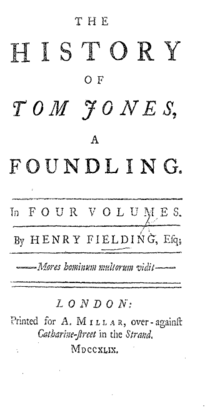
The History of Tom Jones, a Foundling by Henry Fielding: BOOK VI., xii.-VII., iv.

Fridays with the Foundling
Tom Jones Original CoverWe start off this week seeing what Sophia was up to in around the letter Tom wrote her as he was leaving town (I really should’ve read this chapter a couple of weeks ago)—there’s not much there, but a little bit of humor involving Black George and his conscience. Mr. Western and his sister get into an argument over the way he’s raised Sophia, and he essentially gives his daughter over to her management.

We then move on to the next Book, and as usual, we begin with Fielding treating us to another digression and commentary. This time his focus is on the world as a stage. Unlike most (for example, Shakespeare), Fielding focuses not on those who strut and fret on the sage, but on the audience. Which is an interesting way to do it, you have to admit. He closes with this reminder about judging:

Upon the whole, then, the man of candour and of true understanding is never hasty to condemn. He can censure an imperfection, or even a vice, without rage against the guilty party. In a word, they are the same folly, the same childishness, the same ill-breeding, and the same ill-nature, which raise all the clamours and uproars both in life and on the stage. The worst of men generally have the words rogue and villain most in their mouths, as the lowest of all wretches are the aptest to cry out low in the pit.

With some encouragement from Blifil, Tom resolves to take to the Ocean, while the Western household is in turmoil—we get more conversations between Sophia and her aunt; Sophia and her father; her aunt and her father all about how Sophia— has to marry Blifil and her steadfast refusal to do so.

These chapters really feature a lot of talking, but very little actual communication—after the last couple of weeks, full of action, this was really quiet. It was all about setting the stage, I just hope the stage is fully set for a bit. I’m really curious about what Tom has in mind for his expedition.

But For The Grace (Audiobook) by Peter Grainger, Gildart Jackson: DC Smith Investigates an(other) Unexpected Killing

But For The Grace

But For The Grace

by Peter Grainger, Gildart Jackson (Narrator)
Series: A DC Smith Investigation, #2

Unabridged Audiobook, 9 hrs., 17 min
Tantor Audio, 2016

Read: April 20-21, 2020
Grab a copy from your local indie bookstore!


When I talked about the first installment in this series last year, I said, “There’s something about this one that got under my skin more than a typical procedural does—it’s maybe DC Smith, it’s maybe Grainger’s style (there’s a lot of subtle humor in a dark text)—it’s a Gestalt thing, I think. I really dug it.” I’m tempted to leave this at that, too. But that’s giving this short shrift.

There are three main stories—the least interesting to me (at present, but it keeps coming up, so I expect that it’ll be of vital importance and interest at some point) is the “big case” that defined Smith’s career. There’s a True Crime writer who wants to revisit the case with DC’s help. There’s a couple of good moments revolving this, but I’m not (yet) seeing the appeal.

The more interesting thread centers on DC Smith’s future. Smith’s old partner, and father of the newly-minted detective Smith’s training, owns a private security firm and wants him to come aboard in a senior position. At the same time, there’s an opportunity that many are urging Smith to take in a regional criminal investigation task force. But Smith’s inclination is to stick with his current duty—but he’s tempted by both over the course of the novel.

But the focus for the book is a death in a retirement home that’s identified as suspicious. Smith and his team start investigating this pretty colorful home. The characters—staff and residents—are well-drawn, colorful and the kind of characters you want to spend time with. The case goes pretty much how you’d expect (motive, culprit, and resolution), but there are a couple of twists that keep the reader/listener on their toes. Watching Smith and his colleagues pursue the killer is the joy in this. The pleasure is in the journey, not just the destination here.

Once again, Jackson weaves a spell with his narration—he sucked me in once again. A perfect combination of narrator and text.

A solid follow-up novel, that also provides plenty of incentive to move on to the rest. This is a series you should jump into—in print or audio.

4 Stars

This post contains an affiliate link. If you purchase from it, I will get a small commission at no additional cost to you. As always, opinions are my own.

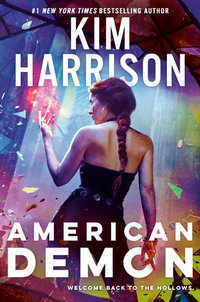
Breath Like the Wind at Dawn by Devin Jacobsen: Obscure When not Vile. A book that Simply Didn’t Work for Me.

 Breath Like the Wind at Dawn

Breath Like the Wind at Dawn

by Devin Jacobsen

eARC, 208 pg.
Sagging Meniscus Press, 2020

Read: May 18-19, 2020

Let’s keep this short for everyone’s sake by kicking things off with the Publisher’s blurb

Spanning two decades, Breath Like the Wind at Dawn tells the epic story of the Tamplin family—of outlaw-twins Quinn and Irving; their brother Edward, who is on the run from a dark past; and their mother Annora, who has been left to defend their haunted Minnesota homestead. Yet at the center of the novel is Les, patriarch of the Tamplins, Civil War veteran, and sheriff of Utica, who is possessed by an indelible lust to strangle his victims. Only when the brothers set about to rob Utica’s bank will the family at last converge in an unforgettable finale when blood will be met with blood.

Combining the multi-perspective family drama of As I Lay Dying with the violent lyricism of Blood Meridian, Breath Like the Wind at Dawn brings a brave new voice to American fiction.

Of the 208 pages in this book, I’m going to estimate that maybe 15 worked for me. I didn’t connect with the prose, the characters, the story, or anything. I thought Jacobsen’s style got in his way, that attempts to be artistic rendered the text obscure; word choice (particularly when attempts were made at a vernacular) was off-putting; and the characters were lifeless (when they weren’t vile or abhorrent).

I’m just not up for enumerating my problems with the novel beyond that. I didn’t see the appeal to any of it. I’m not saying that no one will or could, but it’s incomprehensible to me that anyone would.

Disclaimer: I received this eARC from the author via Lori @ TNBBC Publicity in exchange for this post—thanks to both for this, I do appreciate the opportunity (despite what it may read like).

Noam’s Monsters by Shai Levinger, Kaustuv Brahmachari (Illustrator): A Young Boy Battles His Anxieties and Fears

Noam’s Monsters

Noam’s Monsters: Helping children to cope with anxiety, behavioral functions and shyness

by Shai Levinger, Kaustuv Brahmachari (Illustrator), Ephrat Abisror (Translator)

Kindle Edition, 30 pg.
2020

Read: May 16, 2020


Noam is a five-year-old kid riddled with anxiety——but in a relatable way. Monsters such as Spiteful Blames, Worried Fearona, and Shaming Embarrassitis plague him—affecting his mood, causing him to act out and costing him sleep.

We see him try to deal with these things on his own, failing but persevering. Which isn’t to say that it’s a dire book, or super serious. Levinger’s come up with a clever and cute way to introduce these concepts to young readers. It’s a fun read with some subtle lessons.

In the end, Noam’s problems aren’t resolved, they don’t go away. But he takes the most important step—he tells his parents (another responsible adult would work here) what’s going on. I really, really appreciated this approach and didn’t expect it—I would have guessed someone said an encouraging thing or two to him and he’d defeat the monsters (or learn to play with them or something). But nope. He just tells his parents and we’re left to assume they’re going to do the right thing and work with him.

Levinger is a Clinical Psychologist, and he brings his expertise to bear here. Abisror’s text flowed pretty smoothly—anyone who can translate rhyming text deserves major credit. Brahmachari’s art was spot on, his monster designs do a great job of embodying the anxieties.

I’d gladly recommend this for parents—whether or not their child is particularly anxious, they’re going to deal with some of these concepts in their life, might as well get them used to them soon.


3.5 Stars

Note: I received a copy of this book from the author in exchange for this post and my honest opinion. I thank him for that.

BOOK BLITZ: The Strange Book of Jacob Boyce by Tom Gillespie

I’m pleased to host a Book Blitz for Tom Gillespie’s The Strange Book of Jacob Boyce today, a book that defies a snappy one-sentence synopsis.

Book Details:

Book Title: The Strange Book of Jacob Boyce by Tom Gillespie
Publisher: Vine Leaves Press
Release date: July 21, 2020
Format: Ebook/Paperback
Length: 298 pages
Purchase Link: Amazon UK/Amazon US

Book Blurb:

A spiralling obsession. A missing wife. A terrifying secret. Will he find her before it’s too late?

When Dr Jacob Boyce’s wife goes missing, the police put it down to a simple marital dispute. Jacob, however, fears something darker. Following her trail to Spain, he becomes convinced that Ella’s disappearance is tied to a mysterious painting whose hidden geometric and numerical riddles he’s been obsessively trying to solve for months. Obscure, hallucinogenic clues, and bizarre, larger-than-life characters, guide an increasingly unhinged Jacob through a nightmarish Spanish landscape to an art forger’s studio in Madrid, where he comes face-to-face with a centuries-old horror, and the terrifying, mind-bending, truth about his wife.

About the Author:

Tom Gillespie grew up in a small town just outside Glasgow. After completing a Masters in English at Glasgow University, he spent the next ten years pursuing a musical career as a singer/songwriter, playing, recording and touring the UK and Europe with his band. He now lives in Bath with his wife, daughter and hyper-neurotic cat, where he works at the university as an English lecturer. Tom writes long and short stories. His stories have appeared in many magazines, journals and e-zines. He is co-author of Glass Work Humans-an anthology of stories and poems, published by Valley Press. Visit Tom at tom-gillespie.com.

My thanks to Love Books Group for the invitation to participate in this tour.

Love Books Group

Top 5 Tuesday – Top 5 Opening Lines


I love a good opening line. A solid opening paragraph or page is great, but an opening line that sells you on the next 200-500 pages? Magic. When I saw this list topic listed, these 5 jumped to mind—they may not be the best I’ve ever read, but they’re the most memorable.

(I tried, tried, tried to limit myself to the opening line, but I failed on a couple of them, couldn’t help myself.)

5 A Portrait of the Artist as a Young Man
A Portrait of the Artist as a Young Man by James Joyce

I remember in our English class in High School when we were assigned this book, pretty much no one was interested. When Mr. Russo passed out the paperbacks, a few of us flipped it opened and read these first words—and suddenly we were open to the idea (didn’t last long for all of us, but that’s beside the point, we’re focused on the opening lines here). It’s stuck with me for almost 30 years, that’s gotta say something.

Once upon a time and a very good time it was there was a moocow coming down along the road and this moocow that was coming down along the road met a nicens little boy named baby tuckoo….

4
Neuromancer by William Gibson

This sentence was love at first glance for me. Still love it. Naturally, no one knows what color this is referring to anymore.

The sky above the port was the color of television, tuned to a dead channel.

3
The Big Sleep by Raymond Chandler

Oft-parodied. Oft-imitated. Often-celebrated. Does it get better than this?

It was about eleven o’clock in the morning, mid October, with the sun not shining and a look of hard wet rain in the clearness of the foothills. I was wearing my powder-blue suit, with dark blue shirt, tie and display handkerchief, black brogues, black wool socks with dark blue clocks on them. I was neat, clean, shaved and sober, and I didn’t care who knew it. I was everything the well-dressed private detective ought to be. I was calling on four million dollars.

2
Harry Potter and the Sorceror’s Stone by J. K. Rowling

Why bother saying anything here?

Mr. and Mrs. Dursley, of number four Privet Drive, were proud to say that they were perfectly normal, thank you very much. They were the last people you’d expect to be involved in anything strange or mysterious, because they just didn’t hold with such nonsense.

1
The Hitchhiker’s Guide to the Galaxy by Douglas Adams

I’ll go on and on about this book next week, so I’ll just keep my trap shut here. But man…there was something about these lines that got into my blood.

Far out in the uncharted backwaters of the unfashionable end of the Western Spiral arm of the Galaxy lies a small unregarded yellow sun.

Orbiting this at a distance of roughly ninety-eight million miles is an utterly insignificant little blue-green planet whose ape-descended life forms are so amazingly primitive that they still think digital watches are a pretty neat idea.

Trophy Hunt by C. J. Box: Pickett takes on an X-Files-y case

Trophy Hunt

Trophy Hunt

by C. J. Box
Series: Joe Pickett, #4

Paperback, 375 pg.
G. P. Putnam’s Sons, 2004

Read: May 15-16, 2020
Grab a copy from your local indie bookstore!


I’m short on time, so I’m going to cut a corner and use the official blurb:

It’s an idyllic late-summer day in Saddlestring, Wyoming, and game warden Joe Pickett is fly-fishing with his two daughters when he stumbles upon the mutilated body of a moose. Whatever – or whoever – attacked the animal was ruthless: half the animal’s face has been sliced away, the skin peeled back from the flesh. Shaken by the sight, Joe starts to investigate what he hopes in an isolated incident.

Days later, after the discovery of a small herd of mutilated cattle, Joe realizes this something much more terrifying than he could have imagined. Local authorities are quick to label the attacks the work of a grizzly bear, but Joe knows otherwise. The cuts on the moose and the cattle were too clean, too precise, to have been made by jagged teeth. Are the animals only practice for a killer about to move on to another, more challenging prey? Soon afterward, Joe’s worst fears are confirmed. The bodies of two men are found within hours of each other, in separate locations, their wounds eerily similar to those found on the moose and cattle.

There’s a vicious killer, a modern-day Jack the Ripper, on the loose in Saddlestring – and it appears his rampage is just beginning.

Pro tip: don’t read C. J. Box describing a moose corpse while eating lunch.

That aside, I had a lot of fun reading this. Joe ends up being the Game and Fish representative on the task force the governor calls for to investigate these mutilations. Sheriff Barnum is also on the task force, giving us more opportunities to be annoyed by him (I’m really looking forward to the upcoming election which should remove him from office).

I have a note to compare Nate Romanowski and his approach to spirituality and nature and Henry Standing Bear’s—and I think that could be a fruitful discussion, but I think I need to see Nate wax spiritual a little more in future books. But at least at this point, Nate seems like some white dude getting a little strange, whereas Henry seems genuine (which isn’t to say Nate’s fake, he’s just…new at it?). Regardless, it was good to see Nate again, and I like the way that he’s settling into the series (if only so there’s someone around who can shoot and is generally on Joe’s side).

On the one hand, the constant discussion about the precarious financial situation the Picketts face is a refreshing and bracing bit of realism—but if Box would ease off on it a little bit, that’d be nice, just a bit. I like seeing Marybeth struggling to find her place in the world in a way that helps her family—if nothing else, her bouncing around from employer to employer (as her small business allows) she can be put in all sorts of interesting places to tie into Joe’s cases (see these last two books).

Lucy took a bigger role than she usually gets, which sadly took a little bit of space from Sheridan. But she still gets a chance to shine, which makes me happy.

But what brings readers back is Joe Pickett. He’s not the smartest, the quickest, the most insightful mystery protagonist around. But he’s dogged. He’s persistent. He’s one of those rare good guys. He gets the job done, eventually, because that’s what he needs to do. Easy to like a character like that, he’s not really Everyman. He’s the kind of guy an Everyman would like to be.

(which does mean that the reader figures things out a lot faster than he does, but oh, well)

This was the first Joe Pickett novel that I read instead of listening to (my library doesn’t have the audiobook)—this is the first time I’ve gone from audio to print. It was interesting, but I think I prefer Chandler’s narration to my own (but I liked getting the spelling of a couple of names).

It’s a solid mystery, a good time with some characters that I liked. It’s a little heavy on the “woo-woo” stuff (Joe’s term), but I can live with that. I don’t know that this is the best one to come to the series with, but it’s a good installment for those that are familiar with the characters.


3.5 Stars

2020 Library Love Challenge

This post contains an affiliate link. If you purchase from it, I will get a small commission at no additional cost to you. As always, opinions are my own.

The King of the Crows by Russell Day: Prescient. Gripping. Haunting. Unpredictable. What stories should be.

King of the Crows

King of the Crows

by Russell Day

Kindle Edition, 456 pg.
Fahrenheit Press, 2020

Read: April 28-May 9, 2020

… for me at least, the first week of the Lockdown was the worst.

Knowing it had happened to me. I hadn’t escaped, I wasn’t one of the lucky ones. Lucky to be safe or lucky to be dead. Take your pick. I was neither.

That right there gives you a pretty good idea what kind of light and fluffy read this is going to be.

There are two timelines in this story—the primary focuses on a post-pandemic London, while the other shows what happened to a couple of the characters mid-pandemic (with plenty of material describing what the pandemic was like for others). In the primary timeline, Europe is a disaster—a “wasteland”—and eight years after the Outbreak, it’s beginning to put itself back together. But it’s going to take a long, long time to recover from this. Don’t let the fact that “eight years after” this fictional outbreak is 2028 bother you at all.*

* Good luck with that. I’ll get back to this in a bit.

I’m not going to try to list all the various ways that Day uses to tell this story: I’m certainly going to forget several. So here’s a partial list: here’s a third-person 2028 narrator describing a police investigation, a first-person perspective on the same investigation; a first-person account of that same detective’s life during the Outbreak; selections from a screenplay made about a group of Londoners during the Outbreak; selections from the Outbreak-memoir of one of those Londoners; and third-person narration of the same (N.B.: these three will vary in telling ways); redacted 2028 prison correspondence about the Outbreak; excerpts from scholarly works on aspects of the Outbreak (including a very illuminating work on the slang of the time); graffiti from 2021; internet message boards. Day weaves these together to tell his story, build the world, and help you to understand it. Frequently, I read something from the 2028 timeline, and understood it—only to find a new depth to it several pages later after getting another piece of the puzzle from 2020/2021. It’s hard to juggle that many narrative forms/voices/perspectives/calendars as a reader or a writer—Day pulled it off better than I did (any problems I had following things I attribute to myself, and it was pretty easy to clear out my misunderstanding with a minimum of backtracking*). It definitely helps paint the picture of the scope and variety of effects the sickness had on the world more efficiently than a consistent first- or third-person narrative would be able to.

* This would be easier in hardcopy than on an e-reader in my opinion. But that’s just a guess.

There are times (several of them) when I felt that the characters were getting lost amongst the plot and worldbuilding and sickness. But when I stopped and thought about it—and eventually got to the point where I didn’t have to—I realized I had a pretty solid idea about who these people were and was more invested in them than I expected. I thought there was so much going on that the people were getting hidden, but really, Day’s work was subtle—working in the characters into my subconscious like you give a dog its medicine. Normally, this isn’t something I require (or would like)—and it’s not Day’s usual M. O. (quite the opposite), but I think this approach really fit the novel and the story/world.

“They weren’t zombies,” he says, softly. “Don’t call them zombies.”

No one who was involved in the Outbreak for real uses the zee word.

So exactly what was the sickness?

I remember reading a couple of years ago about these ants that would succumb to a fungus which would short-circuit their brain and make them do certain things before killing them—or something like that, vague memories here. Then there were stories about parasites controlling the host’s actions—both of these stories had their 15 seconds of fame on social media around the same time (I may be messing the details up a little bit, but I’m not writing history here).

In Day’s world, one of these kinds of parasites will reside—asymptomatically, I should stress—in cats, who would pass it on to humans. Skipping the details, the humans would get very sick and then, survivors would maybe succumb to a psychosis that would make them violent. This sickness, HV-Tg (Human Variant-Toxo gondii), in a little more than a year would kill more than 20 million in Europe (at least 33% of France’s population) Et voilà!—an easy to believe pandemic that results in Zombie-like people wandering around.

Now, if one of those who’d “switched” and become violent infected you during an assault, well, you were likely to succumb. There were enough of these (“psychos” or “Gonzos”), and the sickness was so widespread, that the police and military couldn’t keep up, that civilians were forced to take action and defend themselves, their family and neighbors. People quickly forming into gang-like associations for mutual protection. It was a literal kill-or-be-infected (and likely killed) situation.

One such association became known as The Crows or The Kings of the Crows. They developed a legendary status mid-and post-Outbreak—and are the subjects of the memoir and film mentioned above. One of their number who happened to survive (and gain notoriety enough to get a publishing deal for a memoir) is the subject of the 2028 investigation. They survived the worst of the worst in one of the hardest-hit cities. They did so via means and methods that many (including their own) would find deplorable, but under circumstances that not only permitted, but required, those actions.

We also see what happens to an American in Paris for work when the Outbreak reaches the point that International travel is canceled (particularly to the U.S.). Her allies will never be considered the Kings of anything, and the contrast between how she survives to what the Crows do is pretty striking.

In 2028…eh…you know what? You should read that for yourself. I’m going to say something I’ll regret.

The biggest killer in those days wasn’t the disease or the psychos, it was stupidity.

However, it has been pointed out by many historians, logic was one of the first casualties of the Outbreak.

Some of the best moments of this book have nothing to do with advancing the plot, they’re little bits showing what the world of the Gondii-pandemic looks like. The man telling the story about taking his girlfriend to the ER because of a burn—how they were treated, and how she became infected. The soldiers coming back from a Middle East deployment being completely unprepared for what had happened to their home country. The mother and son who traveled with the Crows for awhile.

Ultimately, it’s not the story you think you’re getting…or is it? The marketing tag line is, “Ocean’s Eleven meets 28 Days Later.” It is, all things considered, a good, catchy line. I’m not sure it’s all that accurate a description of the novel (but it’s not inaccurate). What it is, really slides up on you—and when you see it it feels like it was obvious all along (even if you wouldn’t have said that 20 pages earlier). There’s a straightforward crime story at the heart of this novel—it’s just surrounded by so many layers, that you can miss it—there’s the sickness, there’s the horrible social and political context (both mid- and post-Outbreak), there’s what the characters are going through otherwise—and the whole thing is drenched in social commentary about 2020 society, e.g., sexism, economics, medical care.

And that’s not even touching the context we’re reading it in now. I truly wonder what I’d think of this book if I’d read it last Fall. I’d still like it, I’d still be impressed by it—but I don’t know if it would resonate with me the same way. There’s almost nothing about Gondii that’s comparable to COVID-19. But the way that people and governments respond—well, that’s pretty different, too. but if you can’t see what’s going on around us reflected in this novel? You’re not paying attention. That Day appears so prescient says something about his skill and observation (and a lot about Western culture, too).

I can see why people cling to the idea that the Gonzos were trying to tell us something. Something’s out there trying to get a message through: there’s a plan. Compared to the idea that it was all just chance, it’s a comfort of a type. Chance doesn’t care and can’t be appeased and can’t be reasoned with. Chance means it could all happen again.


5 Stars

Page 159 of 348

Powered by WordPress & Theme by Anders Norén