Category: Fiction Page 183 of 341

Don’t Panic by Neil Gaiman, David K. Dickson and MJ Simpson: An Indispensable Guide to Douglas Adams and his Work

I’d intended to get this up and ready for Towel Day last week — but, obviously, I failed. Schemes once again, Gang aft a-gley. It’s pretty fitting, really that this is late.

Don't PanicDon’t Panic: Douglas Adams & The Hitchhiker’s Guide to the Galaxy (Third Edition)

by Neil Gaiman; Additional Material by David K. Dickson & MJ Simpson
Series: The Hitchhiker’s Guide to the Galaxy Trilogy (related)

Hardcover, 207 pg.
Titan Books, 2003
Read: May 22 – 23, 2019

          
The idea in question bubbled into Douglas Adams’s mind quite spontaneously, in a field in Innsbruck. He later denied any personal memory of it having happened. But it’s the story he told, and, if there can be such a thing, it’s the beginning. If you have to take a flag reading THE STORY STARTS HERE and stick it into the story, then there is no other place to put it.

It was 1971, and the eighteen year-old Douglas Adams was hitch-hiking his way across Europe with a copy of The Hitchhiker’s Guide to Europethat he had stolen (he hadn’t bothered ‘borrowing’ a copy of Europe on $5 a Day, he didn’t have that kind of money).

He was drunk. He was poverty-stricken. He was too poor to afford a room at a youth hostel (the entire story is told at length in his introduction to The Hitchhiker’s Guide to the Galaxy: A Trilogy in Four Parts in England, and The Hitchhiker’s Trilogy in the US) and he wound up, at the end of a harrowing day, flat on his back in a field in Innsbruck, staring up at the stars. “Somebody,” he thought, “somebody really ought to write a Hitchhiker’s Guide to the Galaxy.”

He forgot about the idea shortly thereafter.

Five years later, while he was struggling to think of a legitimate reason for an alien to visit Earth, the phrase returned to him. The rest is history, and will be told in this book.

I distinctly remember purchasing the first edition of Don’t Panic from BookPeople of Moscow in the fall of 1991 — I remember being blown away by the idea that someone would write a book about Douglas Adams’ work. I had no idea who this Neil Gaiman fellow was, but I enjoyed his writing and loved the book he wrote — and read it several times. It was a long time (over 2 decades) before I thought of him as anything but “that guy who wrote the Hitchhiker’s book.” The Hitchhiker’s Trilogy had been a favorite of mine for years by that point, and getting to look behind the scenes of it was like catnip.

This is the third edition, and as is noted by Gaiman in the Forward, it “has been updated and expanded twice.” The completist in me would like to find a second edition to read the original 3 chapters added by David K. Dickson in 1993, but the important change was in 2002, when “MJ Simpson wrote chapters 27-30, and overhauled the entire text.” If you ask me, Gaiman’s name should be in the smaller print and Simpson’s should be the tall letters on the cover — but no publisher is that stupid, if you get the chance to claim that Neil Gaiman wrote a book, you run with it. Overhauled is a kind way of putting it — there’s little of the original book that I recognize (I’m going by memory only, not a side by side comparison). This is not a complaint, because Simpson’s version of the book is just as good as the original, it’s just not the original.

This is a little more than the story of The Hitchhiker’s Trilogy, but it’s certainly not a biography of Adams — maybe you could call it a professional biography. Or a biography of Adams the creator, which only touches upon the rest of his life as needed. Yes there are brief looks at his childhood, schooling, etc. But it primarily focuses on his writing, acting, producing and whatnot as the things that led to that revolutionary BBC Radio series and what happened afterward. Maybe you could think of it as the story of a man’s lifelong battle to meet a deadline and the lengths those around him would go to help him not miss it too much.

Once we get to the Radio series, it follows the The Hitchhiker’s Trilogy through each incarnation and expansion — talking about the problems getting it produced (in whatever medium we’re talking about — books, TV show, movie, stage show) and the content. Then the book discusses other Adams projects — Dirk Gently books, The Last Chance to See, his computer work, and other things like that.

It’s told with a lot of cheek, humor, and snark — some of the best footnotes and appendices ever. It’s not the work of a slavish fanboy (or team of them) — there are critical moments talking about problems with some of the books (some of the critiques are valid, others might be valid, but I demur). But it’s never not told with affection for the man or his work.

Don’t Panic is a must for die-hard fans — and can be read for a lot of pleasure by casual fans of the author or his work. I can almost promise that whatever your level of devotion to or appreciation of Adams/his work, it’ll increase after reading this. Any edition of this book should do — but this third edition is an achievement all to itself. Imagine someone being able to say, “I improved on Gaiman’s final draft.”

I loved it, I will return to this to read as well as to consult for future things I write about Adams, and recommend it without hesitation.

—–

5 Stars

Humor Reading Challenge 2019

The Flintstones, Vol. 1. by Mark Russell, Steve Pugh: A Yabba-Dabba-Doo time awaits the reader.

The Flintstones, Vol. 1The Flintstones, Vol. 1.

by Mark Russell (Writer), Steve Pugh (Art)
Series: The Flintstones, #1


Paperback, 170 pg.
DC Comics, 2016

Read: May 27, 2019

Credit where credit’s due: If not for Paul’s Picks blog, I wouldn’t have even been aware this existed. I’m glad he blogged about it — I’d have missed out on something pretty unusual if he hadn’t.

This is a wildly inventive telling of The Flintstones for a contemporary age. Like the original Hanna-Barbera show, it’s written with an adult audience in mind — unlike the original show, it is not written with kids in mind. That was a strength of the original, and a weakness of the comic. Fred and Barney are war vets, dealing with the atrocities they witnessed (as are some others, but not as well). Mr. Slate’s an greedy, untrustworthy sort (he was probably that way in the cartoon, but he was at least funny). Pebbles and Bam-Bam are teens, but pretty much what you remember. Wilma’s a frustrated artist, Betty’s . . . well, Betty. Same for Dino.

Really, all the markers of the show are present — punny business/location names, animals-as-appliances that talk to each other, the ridiculous clothing choices for Fred and Barney. Russell uses our Modern Stone Age Family to make all sorts of social commentary (again, like the original) while telling pretty episodic stories about religion, marriage, war, consumerism, elitism, and aliens. Russell draws on the source material, but changes it as he sees fit, without mocking much about it — and while I have giant issues with his social commentary, I think it was the right way to go with this. But man . . . he started with a fairly joy-less perspective (but there was some sense of fun, some sense of play) and he got more series as the collection went on.

I mean . . . how do you not have fun with those folks from the town of Bedrock?

The real saving grace of this collection, the highlight is Pugh’s art. I simply love it — covers, panels, everything. I couldn’t get enough of it. I don’t know if there was a drawing anywhere in it that I didn’t think was in the neighborhood of perfect. And I don’t know how much credit Russell gets for background elements (store names, etc.), but since I don’t know, I’m going to give it all to Pugh. There sense of play, the sense of fun is present in his drawings (while not betraying the feel of the script). His character design was fantastic, the art was dynamic and he simply captivated me. But man, give Bam-Bam a haircut.

I appreciated the effort — and figure many people will appreciate it more than me — and I’m glad I read it. But I can’t help but feel that Russell squandered a bit of the opportunity. Still, a Yabba-Dabba-Doo time awaits the reader.

—–

3 Stars

2019 Library Love Challenge

Instant Karma by Todd Morr: Nasty, brutish, and short (I mean that as a compliment)

Instant KarmaInstant Karma

by Todd Morr


Kindle Edition, 120 pg.
Fahrenheit 13, 2019

Read: May 24, 2019

           Teller was the next to clue in, he sprung from his chair drawing his service revolver while Doyle started crawling for the back exit. The shooter was tall, wearing wraparound shades, a black baseball cap turned so it was shading the back of his neck, and a long leather trench coat. He had a gun in each fist, big semi-automatics with extended magazines. Teller was thinking this guy was an idiot, the kind of dumbass who thinks John Woo movies are documentaries, until he took two in the chest.

The gunman alternated firing each gun. Teller fell to floor and bounced the back of his head off the hard tile, putting him to sleep. Jones had just cleared his pistol when a bullet caught him in the shoulder, spinning him around. The next two bullets hit him in the back and sent him sprawling face first to the floor.

Nah, I didn’t give anything way (really). That’s at the 3% mark. The real action comes later. But that’s a good taste.

I hate being trite. I hate being cliche. I don’t want to say the same thing that everyone else in the world is saying. I don’t want to be the 3487th person to say that Instant Karma is Tarantino-esque. But you read this book and not say something like that, I dare you (like Ralphie’s classmate, Schwartz, I’ll skip to the coup de grâce — I triple-dog-dare you to).

Let’s start with a underworld organization that may or may not exist — Instant Karma, Inc. (think of a West Coast Murder, Inc., with a smaller staff) and the intimidation (and worse) they inspire by maybe existing. Then you’ve got yourself an aging, but still vital, yakuzza Mr. Yasuda (called Mr. Burns by everyone not in his presence due to his age/resemblance to a certain Nuclear Plant owner) who disapproves of the man his daughter is sleeping with (and who expresses that disapproval in extreme fashion). That man is a disgraced ex-cop named Hondo, a security consultant for people like Mr. Yasuda/Burns. His daughter is an ex-kindergarten teacher who decided she was devoting her prime years to a bunch of annoying kids and decided to toss that career to the side to have fun and make bad choices (see: Hondo). Throw in a couple of cops who are hewing a little too close to the line; some people in Yasuda’s organization who want to make a name for themselves; a recovered addict and her pastor; and a lot (I mean a lot) of bullets and blood. Throw all that into a blender and this book comes out.

I want to keep this post as snappy as the book, so I’m not going to get bogged down in plot details — just know that there’s a few people just trying to stay alive and get a little bit of happiness in their lives, and there’s a whole lot of other people who are willing to stop them (and anyone else who’s in the way).

There’s a lot of humor in this book, as well as the action — some nice character moments and a lot of heart (frequently coming from directions you don’t expect). It’s also one of the most violent books I’ve read this year (actually, probably the most violent book this year to date). It’s about vengeance, hope, justice, love and a hope for a little bit of peace — but little of that is as flashy as all the violence.

I’m glad this weighs in at a slim 120 pages — I’m not sure I could’ve take much more. This is like a good double-shot of espresso — why waste time sipping a cup or two to get your caffeine fix? Knock back the 60 ml and move on with your day. This quick read feels all the quicker because of the pacing of the narrative, the action of the scenes and the smoothness of the prose — the adrenaline rush doesn’t hurt either. I’m not sure I can say enough good about it, actually. I had a blast, and bet that you will, too.

Okay, I’ll stop now and get out of the way so that the the 3488th Tarantino comparison can get underway.

—–

4 Stars

LetsReadIndie Reading Challenge 2019 Cloak & Dagger Challenge

COVER REVEAL: Death Will Find Me by Vanessa Robertson

Welcome to The Irresponsible Reader’s part in the Cover Reveal for Vanessa Robertson’s Death Will Find Me — although, guessing by the people taking part in this Reveal, geography/time zones, etc. at this point, it’s more of a Cover Confirmation. Still, welcome. Pretty pictures ahead.

But first, some words. In particular, words that you’d find on the . . .

Back of the Book

Scotland, 1920.
Meet Tessa Kilpatrick; heiress and war-time covert operations agent.

Finding her husband – the feckless James – with another woman at a 1920s country house party, she demands a divorce. But when his body is discovered in a lonely stone bothy the next morning, Inspector Hamish Rasmussen sees Tessa as his only suspect.

Back in Edinburgh, links to another murder convince Rasmussen of her innocence. He enlists her help and together they set off on a pursuit that will bring Tessa once again face to face with the brutality of war as well as revealing to her the lengths that desperate people will go to in order to protect those they love.

Will Tessa be able to prevent a final murder or will she become the killer’s latest victim?

This book will be perfect for anyone who’s enjoyed the work of Catriona McPherson, Sara Sheridan and Jessica Fellowes.

You’ve got to love a blurb that uses a word like “feckless,” don’t you? It’s such a fun word, it’s a shame you have to use it in a disparaging way. Also, I now know that “bothy” is a thing.

This book will weigh-in at 262 pages and will be available on Feb. 20 from Amazon UK and US (I’m not sure about other Amazons).

Without further ado…

The Cover


That’s pretty eye-catching, isn’t it?

I particularly like the “W” and the little dashes next to the “Me” — I’m not sure why those are the points that catch my eye, but they do. Also, Tess’ eyebrows (I’m assuming this woman is our heiress and war-time covert operations agent) look like the kind of eyebrows that should be arched when someone tells a lie or says something that the Tess objects to. Sorry, I’m blathering here, but I feel compelled to talk about the cover a little . . .

But wait, H.C., you say — I have an e-reader and a limited imagination. What will the cover look like for me? Well, I’m glad you asked. It’ll look like this:

And if you’re wondering what a few paperbacks would look like stacked up next to each other (you know, in case you wanted to set up a display in your bookstore, or, I don’t know, your living room or foyer), it’s look like this:

And if you had a couple of paperbacks and an e-reader on the back of a unicorn, it look like — nah. Just kidding… I don’t have the graphic for that.

Now, I’ve done my part — I’ve revealed and/or confirmed the cover. So it’s your turn, follow this link to sign up for Vanessa Robertson’s newsletter (you’ll also receive special offers, new release details, and a welcome gift delivered right to your inbox). Better yet, go pre-order the book at Amazon UK or Amazon US.

The Controller by Matt Brolly: The Good, The Bad and The Iffy

I’m putting stars here because I feel I have to (this book is another one tipping me against the practice), but I reserve the right to revise these when book 2 is released — and because I know I’ll round up for Goodreads/Amazon. The words are the important bit here.

The ControllerThe Controller

by Matt Brolly

Series: Lynch and Rose, #1

eARC, 404 pg.
Oblong Books, 2019

Read: May 17 – 21, 2019


FBI Special Agent Sandra Rose is called out to the scene of a home invasion turned hostage situation. It feels routine, but serious — and when things go wrong in pretty unexpected ways, it goes really, really wrong — and lets you know right away that this is not a book for the faint of heart. As nasty as things start out, the tattoo on the perpetrator’s back points to things getting worse, “half tattoo, half scar tissue,” is how it’s initially described. Later we’re told a bit more:

It was a Railroad tattoo. Carved by machete onto the man’s back, coloured by blue tattoo ink. Two long parallel lines stretched the length of Razinski’s back interspersed with a number of horizontal lines joining the two lines together.

Yeah, “carved by a machete.” You read that right.

Two thoughts spring to mind. I’ll never complain again about the needles on a tattoo machine during shading again; and Brolly is really not messing around here.

This tattoo is the mark of an Urban Legend, an “X-file”, a Wild Goose, an FBI Snipe Hunt — one that unfortunately might not be a legend, a Snipe or anything but a reality that the Bureau should’ve taken seriously years ago rather than writing off as a myth. Immediately Rose arranges for the one man who believed in The Railroad’s existence, former Special Agent Samuel Agent to be brought in for a consultation.

Lynch not only believed in their existence, he’s a victim of The Railroad. Six years ago — when he started to make some progress against them (if you ask him), Samuel Lynch’s 7 year-old son, Daniel, went missing. Lynch has long believed — scratch that, known that The Railroad was responsible for that disappearance and that knowledge and drive to uncover the truth about Daniel’s disappearance and The Railroad’s existence is what led to his dismissal a few months later. Now he’s being told that Daniel hasn’t been killed by The Railroad, but that he’s alive, and still in their custody. There’s hope. A small bit of hope.

At this point, I don’t know how to talk much about the plot without spoiling things. So I’m going to get vague. Things go wrong in ways that boggle the mind and stretch credulity (not beyond the breaking point, however). Not only is The Railroad real, its influence and power is, too — its reach extends into the FBI and likely is the reason that Lynch found himself out of the Agency. Things start to happen very quickly once Lynch and Rose begin interrogating the hostage taker, and soon they’re working together against the clock for one last shot at The Railroad. Rose working within the system and Lynch once again very far away from it.

The pacing is great, the plot is riveting, the writing is compelling — and the reader will be with these two right up to the very explosive ending, holding your breath frequently enough that an asthma attack might be triggered. Beyond that, I’m going to do something here I don’t normally do (but may begin doing more often, I like it) for “the opinion” portion of this post. As I thought about The Controller in preparation for this post, I found my thoughts falling into three categories — let’s take a look at them in order: The Good, The Bad and The Iffy:

The Good:
I’ve already talked about the pacing, plot, etc. — all the mechanics are really well done and serve the mood and tenor well. So let’s focus on some of the character work here in this section.

While diving into this investigation with the drive and passion almost equal to Lynch, Rose does have an outside life. Her sister is on her case continually to see their mother, to look in on her — she’s suffering from some sort of dementia. It’s so hard on Rose to see her mother that way that she’s responded by virtually abandoning her, she’s had no contact with her for ages. It’s hard to sympathize with, to have empathy for Rose because of this attitude — but it’s as real and understandable as it is despicable. The way that this daughter avoids the mother who has forgotten her stands in stark contrast to the way that Lynch will stop at nothing to see and help his son (who has likely forgotten him after all this time). Brolly could’ve spent time beating the reader over the head with this, but he doesn’t. It’s just there for you to see and draw your own conclusions about.

Lynch isn’t a broken man — well, he is, but he’s not broken down and beaten by life (although you couldn’t blame him if he had been). Life, circumstance and some truly evil men broke him — he’s a shell of who he used to be (in probably every sense). But what’s left in the ruins is a hard, almost merciless, near obsessed man on a mission who will not deviate one iota from that mission once he has a glimmer of hope.

Rose, she’s flawed, but she’s the kind of law enforcement agent you want to believe the world is full of.

She was working on little more than a hunch, and hunches were something she couldn’t abide. Real police work was completed by hard work and diligence, by analysing facts and evidence. Hunches were for a bygone era, for rogue detectives, for fiction and television.

Not that I think many FBI Special Agents consider themselves “police,” but I like the sentiment anyway. And while she’s this kind of Agent — she’s got all that baggage. She is not a perfect character. She’s probably one of my favorite characters this year — her partner for this case (the official one, anyway), McBride is a fun character, too. We don’t get a lot of him, he essentially functions as Rose’s assistant, but he’s a lot of fun (in a book that doesn’t bring the fun very often), and I’m so glad he’s around.

The criminals are well conceived of and well executed. There are monsters walking around in human skins — and we get to see a few of them here. However, this leads us to…

The Bad:
I don’t understand The Railroad. I don’t get their purpose, their actions, how they accumulate power and how. I do get that they’re one of the most evil shadowy conspiracy organizations that I’ve read about. They don’t seem to want to take over the world, or bring down governments or anything — but they’re horribly evil. Monstrous doesn’t come close to capturing their brand of evil. My lack of knowledge stems from the fact that we don’t get a big motive-explaining, super-villain-gloating, exposition-heavy monologue or three from anyone from The Railroad. And I love that. I also am fine with not understanding the group in a certain way.

But if you’re going to give me some big conspiracy that wields influence in at least one national government, I need to believe they have a reason, something. As Walter Sobchak said, “I mean, say what you want about the tenets of National Socialism, Dude, at least it’s an ethos.” The Railroad probably as an ethos, but no one tells us what it is, and I have a really hard time accepting it because of that.

Earlier, I referred to something stretching credulity — that particular event results in far too many dead bodies and far too little fuss surrounding that event. Given the nature of that event, there would be great internal FBI pressures — and likely Homeland Security reasons to keep it quiet. I’m fine with that, but that wouldn’t stop it from kicking off a major — probably multi-agency — investigation, preventing almost everything that happens in the FBI offices from happening for the rest of the book. I’m not saying Rose and McBride couldn’t have done what they do, and Lynch obviously could’ve pulled off a lot of what he did — but there needs to be more Federal Agents of various stripes on the ground making life hard for them to accomplish what they do. That should’ve been explained away/justified/something. It’s not The Railroad’s influence, unless their reach extends that far into the Government, and we’re not given that indication.

The Iffy:
Let’s start with the easy one, and one that bugged me from early on in the book: how has this obsessed and unemployed man paid rent, bought the copious amounts of alcohol he uses and funded his obsessed investigation? Lynch has no visible means of support and a decent amount of expenses. It wouldn’t take much to explain it away, but we’re not given it.

I get why this is set in the US — Texas in particular. The Railroad needs the space, the extensive rail system, etc. to exist. The plot demands decentralized law enforcement. But if something is set in the US, the characters shouldn’t all talk like people from the UK. The term “Jumper” connotes something very different in Texas than London. Nor should anyone be seeing a lorry on the Texas Interstate, use a Sat-Nav, call their mother “Mum” or “Mummy” and many other things. Brolly is not the only writer to do this kind of thing (many of my favorite novels over the last couple of years do this, too), he just seems to be one of the worst offenders I’ve run across. It takes me out of the moment, re-engages whatever disbelief I’ve suspended and draws attention to any other problems there might be.

Lastly, a couple of days after I finished this, I noticed that this is labeled as “Lynch and Rose #1,” and it made me re-evaluate a lot. I’m not sure how this works as a series. Maybe a duology — possibly a trilogy (I can’t see it as an ongoing series — Rose and McBride, on the other hand…). That would likely take care of a lot of my questions about The Railroad, so I’m happy about that. But knowing there’s a second book leaves me with a different idea about the end of the book — the last line particularly. But there’s nothing in the novel that makes you think there’s another book on the horizon. It’s not impossible, and I trust that Brolly has a strong idea about what’s next. But I didn’t, at any point, think “I can’t wait to see what Lynch and Rose do next.” I did think, “I wonder what Brolly has coming out next,” and am curious how something he writes set in his own country feels.

Now, I’m afraid that given the space I’ve given The Iffy and The Bad that The Good has been overshadowed — also I can’t talk about all of The Good without removing any reason you might have to read the thing — which is sort of the opposite of my point. This is an exciting read with some very interesting and flawed characters (flawed by design, not by Brolly messing up), and a kind of evil, conspiratorial organization that ticks every box on your wishlist for evil conspiratorial organizations. Yes, I have questions, and yes, I found the ending less than entirely satisfying. But all that came up when I started thinking about the book for the purposes of this post and in terms of a series. Were this a stand-alone that I just read and hadn’t written about? I honestly think I’d have just shrugged off the issues if they’d occurred to me. Also, I’m pretty confident from the way he put this together that Brolly knows precisely what he’s doing and that many of my misgivings will be addressed in Lynch and Rose #2 — and I will be pouncing on that as soon as I know it’s available.

It’s exciting, I like the characters, I was genuinely surprised and shocked a couple of times, horrified a couple of times and I want to know more about what happened — Brolly made me curious when he could’ve easily made me disinterested. I can’t list precisely just what it is about his story telling that did the trick, but it worked, and that’s what counts. It’s by no means a perfect novel, but it’s good.

—–

3.5 Stars

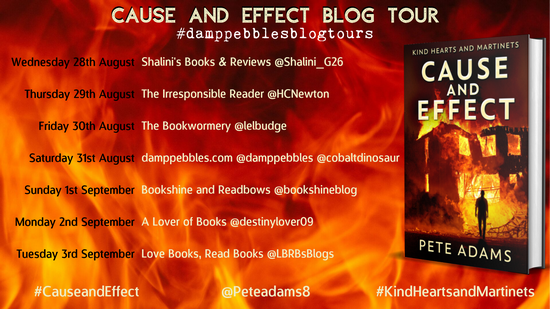
My thanks to damppebbles blog tours for the invitation to participate in this tour and the materials (including the novel) they provided.


BOOK SPOTLIGHT: The Controller by Matt Brolly

Today I welcome the Book Tour for the dark and gripping thriller The Controller by Matt Brolly. Along with this spotlight post, I’ll be giving my take on the novel here in a bit.

There are so many people on this tour, you may not be able to read all names on the graphic, click here for a larger image (for me, there’s no underline there, but it will take you to the image, I assure you). There’s a lot of good stuff out there about this book already and more to come — you should see it all (not sure why they’re bothering with a small time bloviator like me).

Book Details:

Book Title: The Controller by Matt Brolly
Publisher: Oblong Books
Release date: May 24, 2019
Format: Ebook
Length: 407 pages

Book Blurb:

From the bestselling author of the acclaimed DCI Lambert series comes The Controller, a gripping serial killer thriller introducing Sam Lynch and Special Agent Sandra Rose.

It is six years since special agent Samuel Lynch left the FBI following the disappearance of his son, Daniel. Lynch believes an underground organization known as The Railroad is responsible and has never stopped searching.

When Special Agent Sandra Rose investigates a house invasion gone wrong, she discovers the assailant has the legendary, and infamous, Railroad tattoo carved onto his back and he claims to know Daniel’s whereabouts.

Rose draws Lynch in to her case, and together they become embroiled in an unparalleled world of violence and evil.

It seems that to see his son again, Lynch will have to confront his greatest fear and face the ultimate test: an encounter with the Railroad’s enigmatic and deadly leader, The Controller.

About Matt Brolly:

Matt BrollyFollowing his law degree where he developed an interest in criminal law, Matt Brolly completed his Masters in Creative Writing at Glasgow University.

He is the bestselling author of the DCI Lambert crime novels, Dead Eyed, Dead Lucky and Dead Embers. The fourth in the series, Dead Time, was released by Canelo in May 2018 and a prequel, Dead Water, will be published in September 2019. In 2020 the first of a new crime series set in the West Country of the UK will be released by Thomas and Mercer (Amazon Publishing).

The Controller, released in May 2019, is the first of a new thriller series set in Texas.

Matt also writes children’s books as M.J. Brolly. His first children’s book, The Sleeping Bug, was released by Oblong Books in December 2018.

Matt lives in London with his wife and their two young children. You can find out more about Matt at his website MattBrolly.co.uk or by following him on twitter: @MattBrollyUK

Matt Brolly’s Social Media:

Twitter ~ Facebook ~ Website

Purchase Links for I Want You Gone:

Amazon UK ~ Amazon US


My thanks to damppebbles blog tours for the invitation to participate in this tour and the materials they provided.

Towel Day ’19: Some of my favorite Adams lines . . .

(updated 5/25/19)
There’s a great temptation here for me to go crazy. I’ll refrain from that and just list some of his best lines . . .

The Hitchhiker’s Guide to the Galaxy

  • Time is an illusion. Lunchtime doubly so.”
  • This must be Thursday. . . I never could get the hang of Thursdays.”
  • “You’d better be prepared for the jump into hyperspace. It’s unpleasantly like being drunk.”
    “What’s so unpleasant about being drunk?”
    “You ask a glass of water.”
    (I’m not sure why, but this has always made me chuckle, if not actually laugh out loud. It’s just never not funny)
  • He had found a Nutri-Matic machine which had provided him with a plastic cup filled with a liquid that was almost, but not quite, entirely unlike tea.
  • In those days spirits were brave, the stakes were high, men were real men, women were real women and small furry creatures from Alpha Centauri were real small furry creatures from Alpha Centuari. And all dared to brave unknown terrors, to do mighty deeds, to boldly split infinitives that no man had split before . . .
  • “Look,” said Arthur, “would it save you a lot of time if I just gave up and went mad now?”
  • The ships hung in the sky in much the same way that bricks don’t.

The Restaurant at the End of the Universe

  • It is a curious fact, and one to which no one knows quite how much importance to attach, that something like 85 percent of all known worlds in the Galaxy, be they primitive or highly advanced, have invented a drink called jynnan tonnyx, or gee-N-N-T’Nix, or jinond-o-nicks, or any one of a thousand or more variations on the same phonetic theme. The drinks themselves are not the same, and vary between the Sivolvian “chinanto/mnigs” which is ordinary water served at slightly above room temperature, and the Gagrakackan “tzjin-anthony-ks” which kills cows at a hundred paces; and in fact the one common factor between all of them, beyond the fact that the names sound the same, is that they were all invented and named before the worlds concerned made contact with any other worlds.

Life, the Universe, and Everything

  • The Hitchhiker’s Guide to the Galaxy has this to say on the subject of flying.There is an art, it says, or rather, a knack to flying.The knack lies in learning how to throw yourself at the ground and miss.

(It goes on for quite a while after this — and I love every bit of it.)

  • “One of the interesting things about space,” Arthur heard Slartibartfast saying . . . “is how dull it is?””Dull?” . . .”Yes,” said Slartibartfast, “staggeringly dull. Bewilderingly so. You see, there’s so much of it and so little in it.”

So Long, and Thanks for All the Fish

  • Of course, one never has the slightest notion what size or shape different species are going to turn out to be, but if you were to take the findings of the latest Mid-Galactic Census report as any kind of accurate guide to statistical averages you would probably guess that the craft would hold about six people, and you would be right.You’d probably guessed that anyway. The Census report, like most such surveys, had cost an awful lot of money and told nobody anything they didn’t already know — except that every single person in the Galaxy had 2.4 legs and owned a hyena. Since this was clearly not true the whole thing eventually had to be scrapped.
  • Here was something that Ford felt he could speak about with authority.”Life,” he said, “is like a grapefruit.””Er, how so?”

    Well, it’s sort of orangy-yellow and dimpled on the outside, wet and squidgy the middle. It’s got pips inside, too. Oh, and some people have half a one for breakfast.”

    “Is there anyone else out there I can talk to?”

  • Arthur had a swordfish steak and said it made him angry. He grabbed a passing waitress by the arm and berated her.”Why’s this fish so bloody good?” he demanded, angrily.”Please excuse my friend,” said Fenchurch to the startled waitress. “I think he’s having a nice day at last.”

Mostly Harmless

  • A common mistake that people make when trying to design something completely foolproof is to underestimate the ingenuity of complete fools.

Dirk Gently’s Holistic Detective Agency

  • If it looks like a duck, and quacks like a duck, we have at least to consider the possibility that we have a small aquatic bird of the family anatidae on our hands.
  • Let’s think the unthinkable, let’s do the undoable. Let us prepare to grapple with the ineffable itself, and see if we may not eff it after all.

(I’ve often been tempted to get a tattoo of this)

The Last Chance to See

  • “So what do we do if we get bitten by something deadly?” I asked.He looked at me as if I were stupid.”You die, of course. That’s what deadly means.”
  • I’ve never understood all this fuss people make about the dawn. I’ve seen a few and they’re never as good as the photographs, which have the additional advantage of being things you can look at when you’re in the right frame of mind, which is usually around lunchtime.
  • I have the instinctive reaction of a Western man when confronted with sublimely incomprehensible. I grab my camera and start to photograph it.
  • Human beings, who are almost unique in having the ability to learn from the experience of others, are also remarkable for their apparent disinclination to do so.

And a couple of lines I’ve seen in assorted places, articles, books and whatnot

  • I love deadlines. I love the whooshing noise they make as they go by.
  • A learning experience is one of those things that says, “You know that thing you just did? Don’t do that.”
  • The fact is, I don’t know where my ideas come from. Nor does any writer. The only real answer is to drink way too much coffee and buy yourself a desk that doesn’t collapse when you beat your head against it.

Towel Day ’19: Do You Know Where Your Towel Is?

(actually updated and slightly revised this 5/25/19!)

           The Hitchhiker’s Guide to the Galaxy has a few things to say on the subject of towels.

A towel, it says, is about the most massively useful thing an interstellar hitchhiker can have. Partly it has great practical value. You can wrap it around you for warmth as you bound across the cold moons of Jaglan Beta; you can lie on it on the brilliant marble-sanded beaches of Santraginus V, inhaling the heady sea vapors; you can sleep under it beneath the stars which shine so redly on the desert world of Kakrafoon; use it to sail a miniraft down the slow heavy River Moth; wet it for use in hand-to-hand-combat; wrap it round your head to ward off noxious fumes or avoid the gaze of the Ravenous Bugblatter Beast of Traal (such a mind-bogglingly stupid animal, it assumes that if you can’t see it, it can’t see you); you can wave your towel in emergencies as a distress signal, and of course dry yourself off with it if it still seems to be clean enough.

More importantly, a towel has immense psychological value. For some reason, if a strag (strag: non-hitch hiker) discovers that a hitch hiker has his towel with him, he will automatically assume that he is also in possession of a toothbrush, face flannel, soap, tin of biscuits, flask, compass, map, ball of string, gnat spray, wet weather gear, space suit etc., etc. Furthermore, the strag will then happily lend the hitch hiker any of these or a dozen other items that the hitch hiker might accidentally have “lost”. What the strag will think is that any man who can hitch the length and breadth of the galaxy, rough it, slum it, struggle against terrible odds, win through, and still knows where his towel is is clearly a man to be reckoned with.

Hence a phrase that has passed into hitchhiking slang, as in “Hey, you sass that hoopy Ford Prefect? There’s a frood who really knows where his towel is.” (Sass: know, be aware of, meet, have sex with; hoopy: really together guy; frood: really amazingly together guy.)

One of my long-delayed goals is to write up a good all-purpose Tribute to Douglas Adams post, and another Towel Day has come without me doing so. Belgium.

Next year . . . or later. (he says for at least the 4th straight year, a work ethic I like to believe Adams would recognize)

Last year, I did a re-read of all of Adams’ (completed) fiction. For reasons beyond my ken (or recollection), I didn’t get around to blogging about the Dirk Gently books, but I did do the Hitchhiker’s Trilogy:


Adams is one of those handful of authors that I can’t imagine I’d be the same without having encountered/read/re-read/re-re-re-re-read, and so I do my best to pay a little tribute to him each year, even if it’s just carrying around a towel. Although, I do have the planet logo from the series tattooed on my forearm — so I do carry around a tribute to him constantly. I’ve only been able to get one of my sons into Adams, he’s the taller, thinner one in the picture from a couple of years ago below.

TowelDay.org is the best collection of resources on the day, recently posted this pretty cool video, shot on the ISS by astronaut Samantha Cristoforetti.

Even better — Here’s an appearance by Douglas Adams himself from the old Letterman show — so glad someone preserved this:

Love the anecdote (Also, I want this tie.)

Killer Thriller by Lee Goldberg: The Best-Selling Author/Hapless Hero Ian Ludlow Returns to Save the Day Again

I wrote about half of a post about this book to go up yesterday. But I realized I’d spent a lot of time talking about things I really didn’t care about, and hadn’t spent any time talking about the bits I did care about. But I couldn’t turn the ship around (much to my annoyance). So, I let one more day go without a post — a truly annoying trend for the week/month. This isn’t quite what I wanted it to be. But it’s done. So that’s a start.

Killer ThrillerKiller Thriller

by Lee Goldberg
Series: Ian Ludlow Thrillers, #2

Kindle Edition, 277 pg.
Thomas & Mercer, 2019

Read: May 21 – 22, 2019

           “…I want Ludlow under constant and total visual, audio, digital, and personal surveillance,” Yat added. If anybody in Beijing asked about it, he’d explain that it was part of his ongoing investigation into Wang Kang’s activities, which wasn’t far from the truth. Those were always the most effective lies. “Mobilize every resource that we have.”

“Including the assassins?”

“Especially the assassins,” Yat said.

In True Fiction, Lee Goldberg introduced us to Ian Ludlow — former TV writer, now thriller writer extraordinaire — who discovered (the hard way) that terrorists were using his fiction as a playbook. Then he had to go on the run for his life from these people who didn’t appreciate the fact that he’d be able to identify what they were doing. Running alongside him (frequently behind, more frequently ahead of him) was the poor girl who was supposed to schlep him from bookstore event to bookstore event in Seattle. Margo didn’t like Ludlow, but finding their fates bound together, she threw herself into surviving — and is very likely the reason he did survive.

Not only did they survive, they uncovered and defeated a group within US Intelligence that were actively plotting against the US. It’s a highly improbable story that didn’t feel that improbable — yet was told in a way that played up the tension, the suspense and the fun. It was one of the funniest and most enjoyable books I read last year.

Now it’s time for the inevitable sequel — Killer Thriller — and Lee Goldberg has somehow done what almost every good sequel strives to do (and few succeed) — he tells pretty much the same story with just a couple of differences, yet does so in a way that feels completely fresh and original — in most ways, superior to the original. I don’t think it’d be hard to take a semi-thorough outline of both novels to compare against each other and find that they’re freakishly similar. But I only thought about that when I sat back to think about the book and its predecessor. While reading, I didn’t care about True Fiction or any similarities the current book had to it. I just had too much fun while reading the sequel I couldn’t be bothered to compare it.

Which is a pretty neat trick, really. It’s like when Chandler Bing said, ” Oh–I think this is the episode of “Three’s Company” where there’s some kind of misunderstanding.” Just because every episode of Three’s Company featured a few misunderstandings — it didn’t keep things (usually) from not being funny. The same kind of thing here — just because Ludlow and Margo are once again thrown in to the middle of things they’re not ready for, it doesn’t keep the action scenes from being riveting and the funny bits from being funny.

So, if you haven’t read the first book, let me tell you a little bit about Ian Ludlow. He’s overweight, doesn’t take care of himself in anyway, shape or form. He doesn’t seem to be attractive (and bounces between knowing it and forgetting it). His ego is pretty big, but he’s also realistic about himself. He’s lazy about everything but his writing — and he could likely be more disciplined about it. Okay, based on what we’re told about his greatest creation, Clint Straker — imagine the combination of Bond and Reacher — he’s pretty lazy. Still, he comes up with incredible plots (don’t take my word for it, take the word of people who based terror campaigns on his work). Deep down (Margo would argue very, very deep) he’s a decent guy. Especially for the 15-25 minutes a day he’s not hitting on some unwilling woman, or thinking about hitting on her.

Margo, meanwhile, is a would-be singer/songwriter, a former dog walker, and is really vocationally lost. She’s smart, she’s tough, and adaptable — even if she’s still trying to figure out how to adapt after the events of True Fiction. She’s picked up some self-defense skills along the way, which will prove to be handy.

Ludlow brings Margo with him to Hong Kong to act as his research assistant and hopefully relax a little from the stress that’s eating at her from her recent harrowing experiences (almost being killed counts as harrowing, right?). He’s going to Hong Kong to do a little promotion for the studio that’s turning his first Straker book into a movie. While there, he wants Margo to scope out some places and things he can use in his upcoming novel. In this novel, the Chinese government is waging a secret campaign to take over the US through political manipulation and selling us cheap products they can use to spy on us. Straker’s going to fight against them in Hong Kong, so he needs some local color.

Once in the hotel (and on the hotel’s wi-fi), a group of Chinese espionage agents tap into Ludlow’s laptop and make an unsettling discovery. The plot laid out in Ludlows “novel” is ridiculously close to the plan this same group has spent years devising and implementing to take over the US government through manipulation, cash, and fear. Clearly this man’s novels are just a cover story, he has to be the most wily of secret agents — using this preposterous writer character as a cover for his actual abilities and mission to stop this Chinese plot.

So the Chinese begin their dangerous game of cat and mouse with the “spy” Ian Ludlow. It’s more of a cat-and-clueless-yet-incredibly-lucky-mouse game. But you get the point. But hey, it works. Think Inspector Gadget and Penny — without the robotic arms and sentient dog.

Like Ludlow, Goldberg spent a lot of time as a writer/producer of television. And in both books he does a great job of lampooning the men and women writing, directing and starring in TV and movies. You can’t help but feel Goldberg exorcising some personal demons as he does so — particularly in the table read scene and everything that Damon Matthews (the actor playing Straker) says and does. Incidentally, I’m sure any parallels people might draw between Matthews/Straker and Cruise/Reacher are completely unintentional on Goldberg’s part. For my money, if doing this sort of thing helps Goldberg deal with the frustrations that seem to plague most TV writers/screenwriters, I hope he keeps pouring out his frustrations on the page — I love ’em.

Goldberg seems to have learned a lot from the Fox and O’Hare books he co-wrote with Janet Evanovich — there are huge chunks of this book that feel like they were originally planned for one of them. Whether Goldberg repurposed the scenes or was just influenced by his time with that series really doesn’t matter — the sensibility that made that series work so well is making this one work very well, too.

From the big things — like fight scenes or car chases — to the way he describes a Washington D. C. restaurant, to little touches like the way that someone smuggles information out of China, Goldberg is at the top of his game — which is an accomplishment. I think I’ve read almost 30 of his books and there are maybe one or two that are more satisfying than Killer Thriller. Thrills and laughs together — and maybe maybe a little surprising character depth and development (just a bit, we don’t want Ludlow to stop being a cad and a loser), this is a whole lotta fun. You can come into this one fresh, you won’t appreciate the changes in character (particularly Margo), but you’ll have just about as much fun as the rest of us.

—–

4 Stars

2019 Cloak & Dagger Challenge Humor Reading Challenge 2019

Reposting Just ‘Cuz — True Fiction by Lee Goldberg: A Writer on the Run

Here’s the second of my Lee Goldberg reposts for the day — by the time you read this, I’ve probably finihsed the sequel to this one, which might be even more fun than this. Do yourself a favor and check out these books — but first, let me try to lay out the argument that you should.

True FictionTrue Fiction

by Lee Goldberg
Series: Ian Ludlow Thrillers, #1

Kindle Edition, 248 pg.
Thomas & Mercer, 2018
Read: July 20 – 21, 2018

“Sorry I’m late,” Ian said. “I’ve been on the run all morning.”

It was a line worthy of Clint Straker and Ian knew it. He couldn’t stop being a writer, always thinking of the next line in one of his thrillers. But he was living a thriller now and it was no thrill at all.

This is one of those books that’s super easy to write about — if you like the premise of the book, you’ll like the book. It’s just that simple. The tricky part is finding someone who wouldn’t like this premise.

Ian Ludlow, television writer turned thriller novelist, can’t believe his eyes — a terrorist attack in Hawaii went exactly the way that he designed and he’s pretty sure that someone is trying to kill him. Ludlow was part of a group of writers (movie, TV, novelists) that came up with some scenarios for the CIA that terrorists might use, so the CIA could design counter-measures. This is a thing that actually happened (maybe still does) following 9/11, because writers have much better imaginations than government employees do. One of those scenarios is playing out in real life and Ludlow doesn’t know what to do. Clearly someone out there doesn’t want Ludlow spreading the word that he’s the source for this attack.

Before he realizes what’s happening, Ludlow is running for his life and has dragged Margo along with him. Margo’s a dog-sitter, house-sitter, aspiring musician, and occasionally drives authors visiting Seattle to their signings. That’s how this poor girl gets sucked into Ludlow’s mess — she saves his life (and then he returns the favor), dooming her to having to run with him.

Add in some over-the-top villains (I hope, see below), and Goldberg’s signature wit and solid writing, and you’ve got yourself a winner.

This is a fast fun ride featuring about the most unlikely of all thriller protagonists. Ian Ludlow isn’t really in any kind of shape; he has no skills with hand-to-hand combat, cars, or weapons — his people skills are suspect, really; all he has going for him is a pretty agile mind. Margo’s a little better off, but not much. They quickly run to the home of one of Ian’s friends who lives off of the grid and is paranoid enough he’ll believe their story. Which may not really be the strongest of qualifications, but they can’t afford to be choosy. The three of them will have to figure out a way to survive — and possibly stop whoever it was behind the attack.

Does anyone else remember Condorman? The Disney film about a comic book writer/artist who accidentally (very accidentally) becomes a super-spy? I was 7 or 8 when it came out and loved it. Anyway, I had a flash-back to that when Ludlow stumbles his way into taking out one of the many assassins that come after him — one of the many times I had an honest audible response to this book (not a book I recommend reading in an ICU ward, for what it’s worth, people tend not to like noises there).

Now, I called the villains over-the-top. I’m not really sure they are — they seem over the top, but there’s a little part of me wonders how hard it really would be for someone to pull off something like this. John Rogers, of Leverage, frequently talked about how some of their over-the-top bad guys were watered down versions of the real thing (because no one would believe the real thing). Take my word for it, I don’t have time to track him down saying it. Let’s put it this way — they’re perfect for this book, and like just about every thriller villain ever, it’s best that they stay inside the book.

While he’s telling a very fun story, Goldberg takes a little bit of time to satirize thrillers, thriller writings, and thriller heroes — I loved every bit of that. It helps that Goldberg writes and reads the same books he’s satirizing, so you know he does it with love and honesty. Some of the excerpts from Ludlow’s books are just awful, it must’ve been hard to write (but so much fun). Ditto for the TV shows that Ian’s friend Ronnie starred in, I really hope that those are things that Goldberg made up for this book (and fear they aren’t).

This feels like Goldberg and Evanovich’s Fox & O’Hare books, or maybe The Man with the Iron-On Badge (which features a protagonist only slightly more likely than Ian) — not his more serious work like King City. The story moves quickly, deftly and will leave you smiling — I can’t imagine Goldberg writing a disappointing book at this point, I just don’t think he can. Pick this up, you will be entertained.

—–

4 Stars

Page 183 of 341

Powered by WordPress & Theme by Anders Norén