Category: Fiction Page 290 of 346

Reread Project: The Van by Roddy Doyle

The VanThe Van

by Roddy Doyle
Series: The Barrytown Trilogy, #3

Trade Paperback, 311 pg.
Minerva, 1991
Read: August 25 – , 2015
Jimmy Rabbitte, Sr. started off as a supporting character in The Commitments, moved up to co-star in The Snapper, and finally moves to the forefront in The Van, which is more about him than the other two were about any one person. Which isn’t to say that Jimmy, Jr., Sharon, Veronica, Darren and the twins aren’t here, they’re just in the background — as are most of Jimmy, Sr.’s friends (actually, I think Jr.’s in this far more than he was The Snapper).

Not only is the focus more narrow, the final installment in the trilogy is different in other ways — it’s almost 100 pages longer (depending on the printing) than The Snapper which was about 50 pages longer than The Commitments. Which gives Doyle more space to do things he hadn’t really before. It’s still primarily told through heavily stylized In the first 90 pages, I estimated I’d read more (significantly more) narration than I did in the first two volumes of the trilogy.

It’s not been clear before what Jimmy did for a living, but whatever it was, it was pretty clear the bills were barely paid. They stretched what they had pretty far, but they seemed to manage. Somewhere along the line, pretty sure it was post-Snapper, but I’m not sure, Jimmy lost his job. Unemployment isn’t setting well with him — he can’t support his family, he’s bored, he can’t even go down to the pub to have a few pints with his friends.

Jimmy’s trying to grow — he’s reading the classics. Thinking of taking some classes. But it’s not enough. At some point his friend, Bimbo, also gets laid off. The two spend a lot of time together — having a companion in his unemployment makes the whole thing tolerable for Jimmy — almost like summer vacation from school. Bimbo isn’t quite as accepting of this new reality — he almost applies to work at McDonald’s, but is shamed out of it by Jimmy. Bimbo’s wife is even less satisfied with his job status. Which leads to a reckless move on Bimbo’s part — reckless, yet maybe inspired — he uses some of his last dollars on a Chip Van (minus an engine). In the midst of the U.S.’ current Food Truck craze, this might not seem so risky, but in the early 90s? (then again, what do I know of early 90’s Dublin, other than what I’ve picked up from Doyle’s novels and the movies based on them?)

They’ve just a few weeks until the World Cup games start when they hope they can cash in on the post-game crowds. So Jimmy and Bimbo rush to clean the, learn to cook, design a menu, etc. And now you’ve got yourself a plot — can these two make a go of this? Can they remain friends and co-workers? Will they start a grease fire that destroys the whole of Barrytown?

There was, it seemed to me, a maturing of Jimmy that started back in The Snapper. Not that he wasn’t a good father before, but he kicked it into a higher gear with Sharon during her pregnancy. Here, that seems to manifest itself in a paternal pride — Junior’s having some sort of success out there, is getting married; his other son, Darren, is doing very well in school (better than anyone else in the family, that’s sure). Part of Jimmy’s reaction to it is finding pleasure in someone else’s success for what it means to them. I’m not convinced that the Jimmy of The Commitments or the first part of The Snapper could do that.

That’s not to say that he’s Man of the Year material or anything. There are some real (human) flaws to him. He’s petty, he’s jealous, he’s proud — there’s some sort of mid-life crisis that he’s got a half-hearted interest in involving Other Women. As in all good fiction, these just make him someone you can like, someone you can relate to, someone you can get annoyed with — even pity.

There’s some great, great stuff about sports fans here — national pride around The World Cup, the joy in sports, the very real camaraderie that can exist for a few moments around a shared experience. That’s not my typical milieu, but I’ve tasted it a time or two — and I can’t imagine many capture it better than Doyle did here. Even if I didn’t like the rest of the book, I think that part would’ve been worth it.

In the end, this is Doyle’s best work (to date), not the most enjoyable, but the best. It’s impossible after reading this, to ignore Jimmy, Sr.’s brief appearances in The Commitments, to not pull for him earlier than you should in The Snapper, and really to forget him. Just a great character in a world you really don’t want to leave.

—–

4 Stars

Hostile Takeover by Shane Kuhn

Hostile TakeoverHostile Takeover

by Shane Kuhn
Series: John Lago Thriller, #2

Hardcover, 246 pg.

Simon & Schuster, 2015

Read: August 24, 2015


John Lago is back, folks — and he picks up right where he left off, with some of the most adrenaline and testosterone-fueled writing you’ll come across this year. That may not be your cup of tea.

Hostile Takeover is one of those sequels I didn’t think needed to exist. Seriously, who was dissatisfied with where things ended up for Lago? It was narratively sufficient as it was — but as the opening lines of this book could’ve literally been the next page in The Intern’s Handbook, it’s hard to complain.

So, John decides to tie up two loose ends: 1. Alice and 2. HR, Inc. He marries Alice and the two take over HR but it doesn’t take too long (at least not many pages) before both of those go wrong — they break up and she kicks him out of the company (not really spoiler material, folks, it’s in the Jacket Copy). John switches to Plan B, the complete destruction of both. Which is not the most mature of plans, you’ve got to admit.

Which is the bulk of the book — John going undercover again, John trying (and/or being the target of) elaborate assassination schemes, great fight scenes and enough munitions used to make Michael Bay choke. All delivered in that movie-obsessed, rapid-fire (no pun intended) narration that won over so many fans before.

I thoroughly enjoyed, have used already, and will continue to do so, Lago’s comments on the movie Fletch. It was that line that reminded me how much I liked the first book.

Did I enjoy this as much as The Intern’s Handbook? Nope. Only because it didn’t blow me away with it’s freshness. But it’s a worthy sequel, as good as it’s predecessor and leaves me wanting more. An intense, fast read — buckle up and enjoy the ride.

—–

4 Stars

Hell is Empty by Craig Johnson

Hell is EmptyHell is Empty

by Craig Johnson
Series: Walt Longmire, #7

Hardcover, 312 pg.

Viking, 2011

Read: August 21, 2015

Where Junkyard Dogs started off with a chuckle inducing bang, this one starts slower, and makes it clear early on that creepy and foreboding are going to be the order of the day.

We join Walt and Deputy Santiago ‘Sancho’ Saizarbitoria as they’re transporting three felons to meet up with a prison transport and a FBI team. Two of them are pretty hardened guys, guys who scare people like me — but the third? He’s the kind who scares people like them. He goes by the name Shade, and right away, he fixates on Walt in a pretty unhealthy way. And you know that the rest of the novel is going to be about this.

Turns out, Shade is going to help the FBI locate his first victim’s remains, they’re somewhere around where the meet up is to happen. Naturally, the remains are in Absaroka County, so Walt and Sancho get to spend more time with Shade and the FBI. It doesn’t take a genius to figure out what’s going to happen — Shade’s going to escape, he’s going to kill many law enforcement officials, and Walt’s going to have to save the day. Johnson telegraphs this (there’s no way to avoid it), and even though you know it’s inevitable, you still watch it through half-opened eyes.

Oh, naturally, there’s a record-setting winter storm about to hit, too. Can’t forget that.

As standard, boiler-plate as much of this sounds, Johnson makes it work. It’s taught, it’s gripping, with just the right mix of tension, determination, and humor. It will keep you turning the pages, needing to know what’s coming next. Even as most readers are going to have the whole thing pretty-well mapped out in their heads from the beginning — it’s how Johnson executes this so well is a testimony to his skill and the reason that you’ll keep turning those pages as fast as you can.

Vic and Henry are almost absent through this book — and Cady’s appearance is token at best. But Johnson uses their brief appearances to their most. This novel is about Walt’s struggle against Shade and against nature — both seem to be focused on killing him.

Sancho, who is really becoming my favorite non-Walt character in the series is around more than those other three combined; although after the introductory chapters he’s off-screen until the end as well. Before then, he not only makes amusing contributions to a very dark book, he’s an important part of the plot. After his recent near-death experience and career crisis, Sancho’s taken to trying to expand his horizons and catch up on the Liberal Arts education he skipped over. So he had those who did get that education to compile a reading list for him — a copy of which is included as an Appendix. It’s a good list and would be helpful for most people — and gives us a nice look into the personalities of those that compiled the list.

In the acknowledgments, Johnson talked about how difficult this novel was to write — and I can see why. But, as we have come to expect form him, when he set his mind to it, he pulled it off. A gripping tale of man against nature, man against man, man against himself, told with Johnson’s signature style and wit, with one foot in Dante and the other in Indian folklore. Not an easy task, but one well done.

—–

4 Stars

212 by Alafair Burke

212212

by Alafair Burke
Series: Ellie Hatcher, #3


Hardcover, 368 pg.
Harper, 2010
Read: February 25 – 26, 2015
It’s a law that in detective novels if you have two completely unrelated crimes being investigated, that one of the things the detectives are going to discover before all the pieces fall into place is that the crimes are completely related — one is very likely the cause of the other.* So, in 212 we start with Crime A, and then move onto Crime B — and sure, there’s a chance that A was just to reintroduce to this world, maybe show how Ellie and her partner are just frustrated in general, and maybe set them up for something. Maybe A is there simply to remind us all that she’s human and vulnerable and not perfect.

We leave Crime A for B. It doesn’t take too long before it’s clear that B is going to be the focus of the novel, and that frankly, you’d like the novel to be short, because you don’t want the perpetrator walking even fictional streets for long.

Right away, I started to wonder just how she was going to the the two crimes together, and by page 93 I was pretty sure that the theory I’d been percolating would be correct, and I was feeling a little clever. Which lasted a while, until Burke showed me that I was no where near to the right path. For my ego’s sake, I’m just assuming that an early draft matched my thinking but then she had a brain storm to make everything better.

As usual, this is nicely plotted, well-paced, filled with likeable (when they’re supposed to be) and relatable characters. Also typically, Burke nails a lot of the little moments. It’s this kind of thing that elevates this over other similar novels. For example, when the parents of the central victim are notified of her death, Burke’s description of the scene is striking. She captured the moment perfectly (at least, as I imagine it’d play out). Ellie’s speculation about the future of their marriage? Icing on a tasty cake.

There is one hefty Coincidence Ex Machina essential to the plot that stretches credulity, but somehow Burke pulls it off.

My other quibble with this is that Ellie acts too much like a super-cop for someone so young. I’m not denying that she’s got good instincts and that she should be given more credit than she frequently is. But Ellie isn’t Harry Bosch, she shouldn’t treat J. J. like Bosch does his partners. I’d really like to see her work with J. J. a bit more, take advantage of his experience more. I like Ellie, I think in a few years she would be NY’s equivalent to Bosch and then could be excused for treating her partner like an assistant (although, she’s mostly too nice to do that — another problem I have with this treatment — and no one’s ever accused Harry of being nice).

My complaints do nag at me while I read — but Burke’s plotting and voice are strong enough that I can push them aside until I’m done enjoying the book. Could this book be better? Could the series? yes and yes. But there’s little in the world that can’t.

A quick, enjoyable read — solid work that’s a little better than it needs to be.

—–

* The Law of Interconnected Monkey Business talked about in the Gideon Oliver novels, applies in a special way to all mystery novels.

—–

3.5 Stars

Seconds by Bryan Lee O’Malley

SecondsSeconds

by Bryan Lee O’Malley

Hardcover, 323 pg.

Ballantine Books, 2014

Read: August 14 – 15, 2015


This is a story about Katie — a pretty successful young chef, with a personal life in shambles (are there any chefs in fiction whose extra-kitchen life aren’t in shambles?), on the verge of opening her second restaurant while handing over the reins of her first. She’s been given a gift — from a source she doesn’t understand — to undo the events of one day, to rewrite history — just one, there are rules. After one not-that-terrible-but-certainly-regrettable day, she decides to use it.

Katie’s as surprised as the next guy when it works (assuming, of course, the next guy isn’t in a work of fiction). And she finds a way to break the rules. And does fixes another bad day, and another, and another and soon she’s like the guys in Richard Curtis’ (IMHO underrated) About Time, tweaking and massaging the details of the past to make her present perfect.

However, like I said, there are rules. And we all know what happens when you break the rules concerning magic. Or time travel (ask Marty McFly how things were going for him during The Enchantment Under The Sea dance). Now, actually, I thought emotionally and character-wise were richer and more interesting before the wheels come off Katie’s machinations, but it’s here where things start to count.

If I was a better judge of visual art, I’d have the vocabulary to express this next point. So apologies for that, if I’m confusing here — well, that’s what comment boxes are for. I’m not knocking in any way, the penciling here (or in other works) when I think of O’Malley’s people as cartoon-y, like children (occasionally very adult looking children) doing very non-childlike things. To me, the artwork here in O’Malley’s signature style, isn’t a fit the way it was with Scott Pilgrim. There’s a darkness to the story, a flavor to it that seems at odds with the art. Which makes the art more effective — these are twisted forces that should happen to people that look like they were drawn by Lan Medina or Peter Gross, not the fun and innocent-ish looking characters we meet in these pages. It’s more jarring, unnatural, in O’Malley’s hands.

Very entertaining, a good follow-up to his magnum opus — a different direction, feel, and populated by people with a different set of issues. Did I heart this as much as Scott Pilgrim? No. Because it’s not the kind of story I prefer. Is there anything wrong with it? No. It’s just it didn’t strike the same chord with me, mostly because O’Malley was going for a different chord. Worth your time.

—–

3.5 Stars

Veiled by Benedict Jacka

VeiledVeiled

by Benedict Jacka
Series: Alex Verus, #6

Mass Market Paperback, 295 pg.

Ace, 2015

Read: August 11 – 13, 2015


This was not at all what I expected going in to this (granted, I only read the first couple of lines of the Publisher’s Description) — sure, I knew Alex’s mouth would get him in trouble, he’d have to outwit someone more powerful than him, Luna would be underused — despite Alex depending on his friends to pull him out of trouble.

What I didn’t expect was Alex Verus vs. Bureaucracy, not the catchiest of titles, but pretty accurate. Don’t get me wrong, it’s not like the Star Wars prequels with all the bureaucracy, trade negotiations, etc. Jacka keeps things tense, keeps things interesting, even as what Alex is battling is really just Office Politics (along with other kinds of politics).

Alex tries to take one more step towards credibility, of shedding his Dark mage past (not that almost anyone will let him), to a position where he can do some good, and hopefully have allies when Richard steps out into the limelight. Long-term, strategic thinking — I like it when UF heroes act like that. It’s brains, not brawn, that carry the day here.

This isn’t to suggest, that this is a dry — or combat-free — book. Alex gets down and dirty, as usual — against some pretty tough characters. But, I’m not convinced that the worst people that Alex and his friends went up against were the ones wearing the Black Hats. Not that they were angels, but, man, there were some nasty people in these pages.

There are some really interesting developments with Luna’s training and development. Alex makes a couple of useful allies — including a combat mage who is quite possibly the most entertaining character in the series thus far. And because that’s never enough for him — Alex picks up one new enemy and deepens tensions with another.

And Richard? Well, something tells me that specter’s going to be looming for a bit longer. But then again, I thought we were going to get a few more Kitty Norville books and that we’d see Richard in action here — so what do I know?

I seem to be mostly rambling here, so I’m just going to say: Alex Verus is a character you should get to know, in a series that should be on your TBR list. I wouldn’t start with this one, I really think Fated is where you want to climb aboard.

—–

4 Stars

Go Set a Watchman by Harper Lee

Go Set a WatchmanGo Set a Watchman

by Harper Lee
Hardcover, 278 pg.

HarperCollins, 2015

Read: August 14 – 15, 2015

Maycomb did not have a paved street until 1935, courtesy of F. D. Roosevelt, and even then it was not exactly a street that was paved. For some reason the President decided that a clearing from the front door of the Maycomb Grammar School to the connecting two ruts adjoining the school property was in need of improvement, it was improved accordingly, resulting in skinned knees and cracked crania for the children and a proclamation from the principal that nobody was to play Pop-the-Whip on the pavement. Thus the seeds of states’ rights were sown in the hearts of Jean Louise’s generation.

I don’t know what to think. I just do not. It’s that simple. I probably shouldn’t even be blogging about this one, but I feel compelled to.*

There are so many things that’d help me know what to think about this; for example: 1. if there wasn’t the cloud of controversy over the publication — did Lee really want it published? Is she of sound enough mind to make that choice now? and so on. 2. If there’d been a third book of hers published, it’d be easier to know which is the aberration — Mockingbird or Watchman (because there is a clear qualitative distinction) — it’d be easier to cut her some slack if we knew this wasn’t her typical work.

Am I glad I read this? I think so. There are phrases, sentences, paragraphs, vignettes, scenes, that I relished. I do think I like the story of Jean Louise here. I think I appreciate Atticus as father, not necessarily Atticus as a man making certain choices. I’m pretty sure I like Jean Louise’s Uncle Jack.

But there’s bits about this novel that just confound me. Some of the speechifying seems so out of place (and I won’t get into what I think of the points of them). A lot of the speechifying makes it seem like an unfinished draft — where Lee could’ve come back, fleshed it out, edited it and made the same points through dialogue, not monologues.

Maybe in time, after weeks/months of thought, a few re-reads, some distance, I’ll have an opinion about the book that I can stand behind. Right now, best I can manage is a shrug.

—–

* And because I’m really close to having blogged about every novel this year, haven’t missed one since February — and I don’t want to break my streak.

—–

? ? ? ? ?

The Most Useless Page Ever?

Is there anyone holding this book in their hands that needs to be given this information? Why waste the ink?
Also by Harper Lee
“Oh, To Kill a Mockingbird, huh? Never heard of it. Wonder if it’s any good.”

Obviously, there are people who haven’t heard of the Mockingbird — but none of them are going to be tempted to pick up Go Set a Watchman.

Now, the question is, once the initial furor/money-grab over this new book has died down, are there going to be future printings of Mockingbird printed with an “Also by Harper Lee” page? And if so, will the font size be legible?

At this point, I’ve got a little less than a hundred pages to go in the book, and I have no idea what I think of it. Individual sentences or paragraphs? I have very strong opinions about some of them.

But the novel?

I just don’t know.

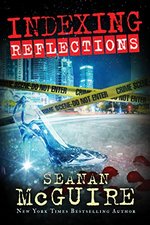
Indexing: Reflections, Episode 1: Forbidden Doors by Seanan McGuire

Indexing: ReflectionsIndexing: Reflections, Episode One: Forbidden Doors

by Seanan McGuire
Series: Indexing, #2.1

Kindle
47North, 2015
Read: August 12, 2015

Fairy tales are not for children, and they don’t care who dies. They never have.

Seanan McGuire’s Indexing is back, and it’s like we never left.

It’s been a few weeks since the team saved the world, but the ATV’s investigation into the matter isn’t quite finished. They’ve got one more hurdle to get through: a series of interviews with an HR Department shrink.

It’s a nice little narrative device — we’re reintroduced to the characters (or new readers are introduced), get the last series recapped (and interpreted from a couple of angles), we get to see how the team’s reacting to the rather dramatic turn of events they lived through, and get ready for what’s next. Since there are (an estimated) eleven more episodes to go through — you know going in that things are going to go pretty well for the majority of them. Sure, there’s a chance that one or two will be packed off somewhere for some “treatment” or “observation”, but the team, as a whole, will be fine.

It’s a lot like a lot of TV season premiers, actually.

There were a couple of highlights for me:

  • Sloane made me laugh, hard, at her apologetic for keeping Henry around (and I liked pretty much everything else she did here).
  • I probably enjoyed Demi more than I have before.
  • The more time we spend with Jeff, the more he threatens Sloane as the series’ most interesting and/or entertaining character.
  • I hope (and sorta fear) that we get to spend a little more time with Dr. Ciara Bloomfield –in her professional capacity, she’d be fun to have around; if it’s about her personal life, I can’t imagine that’d be pretty.

https://irresponsiblereader.com/2015/08/13/indexing-reflections-episode-1-by-seanan-mcguire.

—–

3 Stars

Spell or High Water by Scott Meyer

 Spell or High WaterSpell or High Water

by Scott Meyer
Series: Magic 2.0, #2

Kindle, 443 pg.
47North, 2014
Read: August 1 – 7, 2015

“It was an act of stubbornness, not intelligence.” Vic nodded . “Sadly, I find that stubbornness often beats intelligence eventually. Stubbornness will beat anything eventually. That’s the whole point of stubbornness.” Martin didn’t like that idea. He agreed with it, but he did not like it.

This was not as impressive or surprising (or even funny, despite bits like the above) as Off to Be the Wizard. But it was probably a better novel. It’s not as fun, but it’s a better quality read.

It’s been a couple of months since Philip assumed the leadership of the wizards in Medieval England, and he’s getting bored. When the invitation to a summit of all the magic users in the world comes, he and Martin agree to represent their group. The women of Atlantis are the organizers, and they bring 2 of every group — all over the world and from all sorts of times. Turns out a lot of people have figured out how to tap into the computer program, and they’ve come up with unique ways of interacting with it. The summit is to come up with some rules to govern the use of magic (or whatever the groups call it) and how to stop/punish people like Jimmy (more on him in a bit) who abuse it. Before they can get into the meat of the summit, these two have to deal with a murder mystery, political intrigue, romance, romantic problems, and questions of free will/determinism (because who doesn’t think that sounds fun?).

Naturally, there’s a heckuva surprise waiting for them when they get back. But that’s not for me to get into.

Atlantis is run by sorceresses, and is really the only place on Earth (throughout history) that they’ve felt safe and comfortable — which is a pretty big indictment of the rest of the world, really. This is not to say it’s the land of the Amazons or anything — there are plenty of men around. Someone has to do the non-magical work around the city, right? The male culture that has arisen is the source of plenty of cheap jokes as well as a little cultural criticism for Meyer. Atlantis as a whole — the city and how it’s made, the political structures, the male/female roles, the culture — this is the best thing that this book has to offer. Meyer really had to put the thinking cap on to come up with this — and to keep it entertaining.

I realize the previous book ended with a strong indication that the vanquished foe wasn’t down for the count. But I’d hoped that we wouldn’t see too much of him anytime soon. So much for that. Jimmy, the Wizard formerly known as Merlin, was around for a major role in this book. A larger role, really, than he played last time. Now, I didn’t really like Jimmy as a character — I know we’re not supposed to “like” him because he’s the bad guy, but that’s not what I mean. As a character, he was okay enough for one book (especially a book focused on introducing us to the other characters and world), but I didn’t want/need more of him. I’m still not crazy about him, even after the events of this book that make him a better rounded character.

There’s probably fewer jokes per inch here than in its predecessor. But those that are there were solid, the voice of the narration is light and humorous enough that you don’t miss jokes. I’m not saying there aren’t jokes — there are entire scenes that are little more than extended jokes (most of them worth it). Like its predecessor, there are bits of this book that are just great, are worth going through the whole book for, even if the book isn’t your thing. For example, the conversation that Martin has with Gilbert and Sid, who are magic users who make a living doing stage magic. That conversation hits a sweet spot for me that little else can. You may not react that way to that conversation, but there’ll be similar moments for you (that don’t work that way for me). Actually, almost every conversation between Gilbert, Sid and Martin are pretty good, particularly where the former two explain to Martin why they don’t get along.

It’s the same world as Off to Be — same kooky guys, unique magic system and plenty of chuckles; but with a richer, better developed plot, and a more expanded world. Fans of the first will definitely want to check this one out.

And, hey, learning who it was on the grassy knoll? You can’t pass that up.

—–

3 Stars

Page 290 of 346

Powered by WordPress & Theme by Anders Norén