This should’ve been done at the beginning of the month, but I wanted to do this book justice, and if I couldn’t hit this out of the park, I didn’t want to swing. Also, (this is partially justification for the delay) I wanted to think about it some before putting pen to paper, so to speak. But it’s now at the point that if I didn’t get something written, I wasn’t going to — so I just did my best, and hopefully have a base hit here. As for thinking about this? Pretty sure I haven’t had a new thought about the book since I put it down — and I’ve thought about it a good deal — I’m just less prone to hyperbole about how great it is now.
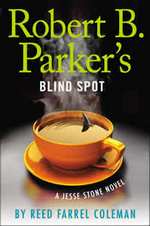 Robert B. Parker’s Blind Spot
by Reed Farrel Coleman
Series: Jesse Stone, #13
Advance Review Copy, 339 pg.
Putnam Adult, 2014
Read: August 1 – 5, 2014
One of the major drags (I’d imagine) for the writer in Coleman’s position is all the comparisons — to Parker himself, and to Michael Brandman. But, I don’t really have a choice, how else to you talk about the merits of the 13th book in a series without comparing it to the previous? I guess you could act like this was the first in a series, but that just disrespects what’s gone before (however much one might want to forget some of that).
I know I’ve said a lot of this before — this will (probably) be the last time: When Night Passage was released, I was hooked immediately. Spenser’s series was in the midst of the really rocky post-Taming a Sea Horse period, and it was so refreshing to see Parker really on his game, and with something so fresh, so different. He kept that up for three additional books, and then the series started slipping in quality. I kept buying and reading them — there’d always be a few lines or a couple of chapters that had that ol’ Parker magic, and I liked the characters, but a couple of these were the worst things that Parker ever published. Then following his death, Michael Brandman tried to carry on in three books, none of which were good, and were generally worse than anything Parker had done on a bad day. So, I was pretty hopeful and enthusiastic when it was announced that Reed Farrel Coleman was going to take over the series — at this point, all I’d read by him was his essay about Jesse in Penzler’s In Pursuit of Spenser, but that was enough to get me hopeful.
Unlike what Atkins is doing (pretty well) with Spenser — trying to retain Parker’s voice; and what Brandman did (disastrously) with Jesse — trying to keep the feel of the CBS/Selleck movies; Coleman is keeping the characters and the world, but writing them in his own voice (or maybe not his natural voice, but in a voice unique to him). This, coupled with Coleman’s own strengths as a writer, gives Jesse Stone a freshness, a richness, and a quality that’s been missing since the end of 2003’s Stone Cold. Just in word count alone, Coleman shines above the sparseness of Parker’s writing — it doesn’t feel bloated, it’s well-paced, but Coleman takes a lot more time and words to tell his story — this is a strength, everyone gets fleshed out. Ideas are followed up on, shades of gray are introduced to events — this is a more complex novel than others in the series.
There are, of course, several references to events and people in earlier books — far more than is typical for a Jesse Stone novel. Some of them come across as natural, others are more like nods to the reader, some feel like Coleman trying to establish his bona fides — “Trust me, I know the series.” At this point, I welcome them all — I like to be reassured, I like being reminded of books I liked — but if he keeps it up at this pace, it could get old really quick.
One of thing that gets mentioned in every Jesse Stone novel is that he was in the Minor Leagues and probably would’ve made it to the Major League, if he hadn’t suffered a career- ending injury. He keeps a large picture of Ozzie Smith on prominent display in his sparsely furnished and decorated home. He tosses a ball into an old glove while he thinks. It is the great unknown in Jesse’s life — and probably what really got him drinking seriously. He knows that he and Jen couldn’t ever make it work (as much as he still wants it to), he knows what kind of cop, employee, and leader he is — he even knows just how much his drinking is messing up his life. What he doesn’t know? Could he have made the Big Leagues? Could he have been a great — or even just good — player. But we’ve never seen Jesse spend much time on that — a little here and there. An occasional toast in the general direction of Smith’s picture. But that’s it, until now. Now Coleman gives us a Jesse brooding over how things turned out — a few times, beyond brooding and moved right into nasty and bitter. It never occurred to me before how little Jesse thinks about this chapter in his life — maybe it’s because Parker (apparently) lived without a good deal of self-reflection that he didn’t know how to write Jesse doing just that. I don’t know, but it was a mistake — and I’m glad that Coleman has addressed it. It doesn’t need to become an obsession or anything, but something that he thinks about from time to time is good. It might even be healthy.
Jesse’s ruminations on his thwarted career are prompted by a reunion of his Minor League team, hosted by the only member of that group to make it to the Major League, Vic Prado. During the festivities, both Vic and his wife approach Jesse individually, saying they want to talk to him about something. Neither tells him what they want to talk about, but it’s serious, and has nothing to do with a reunion. Meanwhile, in Paradise, a rich college kid and his girlfriend are crashing his parents’ vacation home for some undisturbed time together. One will be killed and the other kidnapped. Add in a vicious mob boss and his Irish enforcer, a wealthy man and his criminal defense lawyer. a federal agent obsessed with a target, and one of the scariest hit-men I can remember. The result is a novel with a lot of moving pieces, shifting targets and high stakes. That said, it didn’t take long to figure out what’s going on with the various and sundry criminal interests and enterprises involved here — but it’s still very intriguing to watch the pieces be put in place until there’s a very clear picture of everything that’s going on .
Coleman took better advantage of what a third-person omniscient narrator could do than Parker ever did. Not only are we told Jesse’s story, we see a lot more of the stories of the other characters — particularly the various criminals running around here. In the end, I felt like I understood why each character did something, and who they were in general — not just Jesse’s interpretation of their motivations.
There were a lot of little moments in this book that worked so well, that moved this out of the range of Brandman — and out of the range of a lot of books in the genre. Two examples were the chapter where the “woman the folks in Scottsdale knew as Dee Harrington” evaluated her last (and lost) opportunities, and came to some big decisions — and the chapter where the parents of the murder victim arrive with Molly to identify the body. The way that Coleman is able to reveal and establish character, or to underline what we knew about other characters while showing us new sides or aspects to them, is such a pleasure to watch. Character and plot development aside, just some of what he’s able to say about the human experience is impressive.
Of course, at one point, Jesse comes across a woman being harassed by tough guy of some sort. Rather than mind his own business, arrest the guy (he has an excuse this time — he’s out of his jurisdiction), or involve some other authority; Jesse proceeds to beat the guy up. It’s borderline gratuitous, and it’s fairly typical of the series. We get a little flash of the mean, brutal side of Jesse that he normally keeps under wraps, but that really informs most of his life; this is also a bit of Jesse letting off steam from the frustrations of his murder case, there’s also a bit of chivalry. This is really Jesse Stone in a nutshell. This does nothing to the overall search of the killer and for answers for what’s behind the kidnapping. But it reminds us about the person that Jesse Stone is — he’s hard, he’s not that emotional, and he has a very strong sense of what’s legitimate and what’s just wrong when it comes to public behavior.
Seeing echoes of Harry Bosch’s creed of “Everyone matters or no one matters” in John Ceepak last year started me looking for things that revealed other detective’s guiding philosophies, or drives, and doing so has helped me understand a lot of these characters better (whether it’s a new character to me or one that I’ve been reading for years). When Jesse arrives at the initial crime scene, we’re given insight into what makes Jesse the cop he is:
Jesse understood that his demeanor at crime scenes sometimes led his cops to believe he thought hat one corpse was like the next, that one murder victim was like any other. He supposed that it was okay for them to believe that. He also supposed it was true, if not completely. Every murder victim deserved justice, needed an advocate. Just as every living citizen was entitled to equal protection under the law, so too were the murdered entitled. Yet some victims were more equal than others. Maybe that wasn’t fair or right, but it was human, and cops were owed that much leeway.
There’s a semi-redemption for one of the criminals involved in this mess that struck me. It’s not one that I think Parker would’ve given that particular guy — I’m not altogether sure that Parker would’ve paid as much attention to him as Coleman did. However, both the character and his semi-redemption are consistent with Parker’s world. Jesse, Spenser, Virgil and maybe even Hawk, would approve of this guy’s change, his reasons for doing so and how he attempted it.
There’s one other character I’d like to talk about, but I can’t quite figure out how to do so without spoiling far too much. But if you read the book, you’ll understand the one sentence I’m allowing myself, “I found myself really liking __________, and hope we see a lot more of her in future novels.”
I do have a few minor gripes and I’m going to list all of them to provide a little balance (I feel like I’m gushing more than is becoming). Some word choices repeated too often (at least often enough that one noticed). The way that the Joe Breen talked seemed off somehow — and not in a purposeful way. I either got used to it, or eventually Breen’s dialogue improved, I got too involved in everything else about him that I forgot to track that.
I’m not loving the fact that Jen comes back into the picture, while he was never really going to get over her, Jesse seemed to have moved on in Parker’s last books. But, Coleman did brought her back in just the right way, so I’m only complaining about it as a formality.
My real problems are about the way that Suit and Molly were treated. Coleman says that he loves Suit (“How can you not?” he correctly asks in some of the promotional material). But he doesn’t use him as much in this book as he should. Coleman nails every line involving Officer Simpson, which is encouraging, but there aren’t enough of them.
I have three distinct problems with the way he used and depicted Molly. There’s a set banter between Jesse and Molly — she’ll say something disparaging or critical (in jest or not) about him, he’ll echo her jab adding “Chief” to the end — and she’ll eventually do the same. It’s cute enough, and Parker over-used it, too. But not as much as Coleman did — wow, dude. You’re on the verge of parody here. Honestly, Coleman might use the catchphrase as frequently as Parker did, but since Coleman has more Molly/Jesse conversations in this book than in a typical Parker, it seems worse.
Secondly, yes, Molly had one brief dalliance with Crow back in Trouble in Paradise, and yes, Jesse has brought it up on occasion. But Coleman has the Chief doing so several times in this book — almost brow-beating her with it. I don’t have a count, but I’d be willing to believe Jesse brings it up as often here as he has in the last ten books. Hyperbole aside, it seems out of character.
Lastly, in various points in the past, we’ve read, “Molly Crane had a pretty good body, Jesse thought, for a cop with three kids.” Parker’s Jesse keeps using that qualifier “for a cop with three kids.” But in this book we get a different kind of reaction — at least from the other males that see her (I don’t remember Jesse reflecting on her body in general or on specifics of it like others do). Maybe Molly’s been spending time with Tony Horton DVDs, I don’t know, it just didn’t feel right to read the comments made about her. Part of Molly’s appeal is that she’s — for lack of a better term — “real.” She’s not the glamorous type from Los Angeles. She’s a small-town cop and a Roman Catholic mom of three. Keep her that way.
None of this is a deal killer for me, but I hope that Coleman makes some adjustments to the way he uses Molly in the future, and that he just uses Luther “Suitcase” Simpson more.
All in all — a great read. Coleman has made Jesse Stone his own, while maintaining the universe that Parker created. Lee Goldberg said that Coleman “has saved Jesse Stone.” Indeed he has, and I’m so happy to be able to say that.
One more comparison to Parker before I’m done — not in his almost 70 novels did Parker end one like Coleman did here. Bravo. It was a gutsy move and it worked just the way you want an ending like this to. Jesse Stone #14 can’t hit the shelves fast enough.
—
Note:I received this book as an uncorrected proof from the publisher. Which was generous and cool of them, but didn’t impact what I said about the book, I care too much about Jesse to be swayed by that (which isn’t to say I couldn’t be bought if someone wanted to try). I’ll endeavor to verify my quotations with the printed book as soon as I can.
—–