Category: Fiction Page 55 of 341

A Good Rush of Blood by Matt Phillips: A Life at the Cruel Intersection of Bad Luck and Poor Choices

A Good Rush of BloodA Good Rush of Blood

by Matt Phillips

DETAILS:
Publisher: Runamok Books
Publication Date: November 1, 2023
Format: ARC
Length: 299 pg.
Read Date: October 23-26, 2023
Buy from Bookshop.org Support Indie Bookstores

What’s A Good Rush of Blood About?

Creely Nash is almost forty, single, a waitress in downtown Portland, and a drug runner. That last item may be eye-catching, and it’s really the only thing in Nash’s life that could be described that way.

She’s been driving for Animal for long enough for him to trust her implicitly—she gets the job done with no muss, no fuss, and no questions. Pick up from some place in the Western US and deliver it somewhere else. Period. She gets a nice flat fee and goes back to work. She’s started a savings account so that one day she can move south of the border and forget everything else.

And then Animal has her do a job in Palm Springs, California. When she was 16, Creely ran away from her mother there and never looked back. She’d never been back, either. She should’ve told Animal no—it might not have been good for their working relationship if she had, but it’d be better than it ended up being.

One thing leads to another, and she runs into a face from her past who tells her that Creely’s mother is doing life in Chino for murder. The wheels come off at that point—there’s no love lost between Creely and Blossom, but you don’t shake off news like that. Creely delays returning to Portland (angering Animal) to stop in Chino. Blossom tells Creely she’s innocent, but not much else.

Creely decides to stay in Palm Springs and get some answers—at least for herself, but maybe for her mother, too. Animal is beyond angry at this point and promises Creely that if she’s not home soon, she’ll be killed.

She’s about as unlikely an amateur detective as you’re going to find—and this is no cozy where gumption and banter are going to get her anywhere. But luck, making a good friend or two, and a knack for being in the wrong place at the wrong time just might put her on the right trail.

So, what did I think about A Good Rush of Blood?

I didn’t think of Know Me from Smoke once while reading this book. But I’ve had a hard time not thinking about it every time I’ve thought about the book since then. Briefly—this is a better novel in just about every way that I can think of. But I didn’t care about what was happening or the people it was happening to nearly as much as I did with Know Me from Smoke. This probably says more about me than either book (I’m not sure what it says, however).

Now that I’ve got that out of the way, hopefully, my subconscious will allow me to focus on this book by itself.

The characters are so well-drawn that it’s hard to think of them as characters. It’s common to talk about a well-depicted as “flawed.” These characters are beyond flawed—some of them seem to be nothing but flaws. This is not a criticism in any way—these characters are real. The kind of people that we pass by every day—some of us even are these people.

Throughout the book, Creely accumulates people to help her in one form or another. And she does very little to obtain these helpers—in fact, she sometimes tries to shake them off. But it’s only through the addition of her allies that she comes closer and closer to getting the answers that she’s looking for. It’s not that she’s been friendless before—or ally-less even. But I didn’t get the impression that she’s had this many at once before.

I don’t understand the motivation for two of her allies—the two who end up personally most important to her. The more I consider the novel—and what these two characters say about themselves and their reasons for helping Creely—the less I understand them. It’s not that I find them unbelievable as characters (see what I said above), nor that I think we have to understand the motivations of everyone in life or fiction. But I really want to sit them down and ask, “Why are you putting yourself through this for this stranger? I know what you said, but really, why?” Maybe it’s because they’re easily the most likable characters in the book that their involvement in this mess (to put it succinctly)—and the ones who will benefit the least from it—that I’ve spent so much time thinking about them.

But those are secondary matters—the focus of this book is Creely. The murder mystery and what she (and others) must accomplish and endure to get answers is secondary, too. This is ultimately a matter of Creely understanding herself and getting a better understanding of the world. That is not to say the reader will necessarily agree with the latter—but it’s important. Creely would, I believe, sneer at the notion of “self-discovery” (I’m not sure that Phillips would be crazy about it either), so I won’t say she’s on a voyage of self-discovery here—although that’s the cliché one would appropriately use for any other protagonist in similar circumstances.

Creely’s life has been characterized by survival—I imagine her aspirations have been low, characterized primarily by “different than now” and “less bad.” Even her vague plans for getting out of drug running (eventually) could be seen as “getting by in better weather.” But this news about her mother and how it impacted Creely give her the opportunity to do something that counts. Something that could have a lasting impact for someone (in a positive way). It’s not about making a mark on the world in a way that draws attention to herself, garners fame, or any of the usual things we see in fiction. Creely finds an opportunity to accomplish something that will affect people. She’s not had that ever—and is unlikely to have it again (especially if Animal finds her.

That’s what drives Creely, what drives the novel—and she discovers, like so many of us, that she really didn’t understand much about her childhood, her parents, and what set her on her path. Sure, there’s more tragedy and drama in her past than some experience—and few have as hazardous a path to learn this as she does. But most readers will be able to relate to what she goes through in some way. By the end of this experience, Creely might be able to do more than simply exist, there might be more for her than getting to the next day. I doubt self-reflection has been a big part of her life prior to these events—and it might not be a huge component after. But she does do some now—and that’s no small thing.

I’ve gone on a lot about character, self-discovery, and whatnot—and you may be saying to yourself that this is a far cry from the “sweaty, fast-paced neo-noir” “[p]eopled with bent cops, grizzled reporters, hardened drug dealers, eccentric sidekicks, and sexy librarians” that the back of the book promises. You’re absolutely right to do that. I can only blather on like that because I’m late with this post—if I’d written this immediately (as intended), I’d have focused on that kind of thing and maybe devoted a paragraph to the things I’ve started to explore above. But I’ve had time to ponder.

“Sweaty” is an incredibly apt word. I kept thinking greasy and grimy for some reason while reading—just a present and real sense of wanting to wipe your hands off on something throughout. It’s like that hole-in-the-wall restaurant where you know why the lights are dim and you don’t care what kind of dodgy things happen in the kitchen because the food is great. “Fast-paced: might be an exaggeration, but it is propulsive—once the “murder” comes into play, there’s a momentum that carries you forward and you can’t get off. Like the moment the roller coaster starts to move and you get the sense that nothing can stop it now.

There’s both a rawness and a cleanness to the prose that makes you know that Phillips sweated over every line—possibly every syllable. It was absolutely worth it—it’s been five years since I first read Phillips, and he’s put them to good use (and the memory of the quality of that writing has remained with me longer than other books I read that year). The power of what he’s given the readers is going to linger in your subconscious.

This is one of the noir-est books I’ve read in 2023—a statement that would hold up in almost any year you read it—solidifying my impression of Runamok Crime as an imprint to stalk. Fans of Jordan Harper, Eli Cranor, or Vern Smith would do well to pick this up.

Disclaimer: I received this ARC from the publisher, but my opinions are my own and honest.

This post contains an affiliate link. If you purchase from it, I will get a small commission at no additional cost to you. As always, the opinions expressed are my own.

Irresponsible Reader Pilcrow Icon

Partial Function by JCM Berne: A Mom With A Particular Set of Skills

Partial FunctionPartial Function

by JCM Berne

DETAILS:
Publication Date: November 7, 2023
Format: eARC
Length: 361 pgs.
Read Date: October 9-10, 2023

The First Chapter

Don’t worry, I’m not about to go through this book chapter-by-chapter talking about each one—there are thirty chapters, and while I know I can go on and on about books that I like…

No, I’m going to focus on the first chapter for a moment for one reason—your reaction to the first chapter is going to tell you everything you need to know about this book. If you read that chapter (and everyone who’s stumbled onto this post should do at least that) and you think “Yeah, I can see myself enjoying this book.” You almost certainly will. If you read it and think, “Oh yeah! Give me more of that!!” You definitely need to read on. If you read this chapter and aren’t that interested in going on—trust that instinct and move on with your life. Also, I feel bad for you. (but I say that without judgment, even if it doesn’t sound like it).

This chapter isn’t quite the novel in microcosm, but it comes close—it has the spirit, the humor, the action, the supernaturally-charged martial arts, and the panache that will characterize the rest of the book. Anddddd, best of all, it features a very good dog. The book will bring in more characters than just Akina Azure and her dog (frustratingly named Dog*), which is the biggest reason I can’t say this chapter is a microcosm.

* It’s not just this that Akina has in common with Walt Longmire—I actually could write a post comparing the two—but this is my biggest complaint with both of them. You two have great canine companions, they deserve a great name.

So, What’s Partial Function About, Anyway?

I don’t know that I can do better than the description I was given for the cover reveal a couple of weeks ago—I’ve tried, and I keep unintentionally borrowing elements from it, so let’s just use it:

If Taken starred Michelle Yeoh and was set on a Jurassic Park-inspired Cradle.

Monster hunter Akina Azure inherited the most powerful weapon in the martial world before retiring to a peaceful life raising her twin girls.

The Reaver has them kidnapped, thinking Akina will trade that weapon for their safe return.

Will she? Or will she use it to wreak a terrible retribution on the men who took her girls?

You get one guess.

I’ll expand a bit on that, though.

Akina was part of a legendary band of adventurers, The Five Fangs, and then she and her husband Petrick (also one of the band) retired to go live far away and start a family. None of their friends have seen—or heard—from them or of them in years. Long enough for them to raise twins into their teens before Petrick died of blood plague (I don’t know what that is, but the name alone…).

Now, Akina tracks down one of the Fangs, Remy, to help her. She needs his connections to put her in touch with the people she needs to put her rescue plan into action. It wouldn’t hurt to have one of the few people alive that she trusts to have her back, either.

Remy isn’t crazy about the idea, but he can’t say no to Akina. These two past-their-prime warriors are soon joined by a much younger fighter (who is not quite in her prime and has a lot to learn first) that they can’t entirely trust, but can certainly use. Three people and a dog against the most powerful, feared, and twisted warrior (and his army) living. That’s if they can dodge the kaiju-esque monsters along the way.

It’s really not a fair fight.

Fantasy’s Answer to Sam Axe

I predict that most people talking about this book are going to focus on Akina—as they should. And I’m tempted to spend a lot of time talking about Dog, because he’s such a good boy.

But I want to hone in on Remy for a bit. He’s so essential to the way this book works, and I think he’s so easy to overlook. Sure, Akina and Zhu have some good, snappy, dialogue, and Dog being dog is amusing. Remy’s easily the funniest character in the novel and can be seen as only comic relief. That’s an error.

A couple of days ago, in an earlier draft of this post, I made a joke about him essentially being Sam Axe from Burn Notice. I haven’t been able to get that comparison out of my mind. It’s so on the nose. Remy serves as Akina’s Devil’s Advocate, voice of reason, conscience, and confessor. He’s the only one she fully trusts anymore. He knows someone (or knows someone who knows someone) everywhere they go and can get them whatever resources they need. In a fight, he’s almost as good as Akina and saves her on more than one occasion.

He covers all this with a commitment to doing nothing but drinking, womanizing, and lazing about all day—which is pretty much what he’s been doing since Petrick took Akina off to who-knows-where. When called upon, he steps into action, griping the entire time about how it’s cutting into his drinking. Again—Sam Axe.

If you’ve ever wondered what a wuxia-adjacent Bruce Campbell would be like, this is the book for you.

Okay, setting that all aside—at the end of the day, you’re going to like Remy and trust him to do the right thing more than pretty much anyone else in the book (see the next section for a hint of that). His agenda is pretty clear—do the right thing by his friend, do the right thing in general, and then leave everyone to their business so he can get back to pickling his liver. He may not understand the nuances of everything going on—but he’s honest, he’s clever, and he’s tough. Just the kind of guy you want to have around.

The Central Question of the Book

Most—possibly all—of the “bad guys” in this novel wouldn’t describe themselves that way. They think they’re doing the right thing to save the world, or at least civilization. Not just the right thing—the only thing that will save humanity.

But they’re so focused on the ends that they cross all sorts of lines when it comes to means. They do things to increase their power that are repugnant to the reader and just about every character in the novel. Honestly, kidnapping Akina’s twins in order to compel her to surrender her weapon is pretty much the mildest thing the “villains” like the Reaver do to secure the ability they think will help them.

It’d be easy to write them off here—ends don’t justify the means and all that, right?

But when you stop and think about the steps that Akina takes to enable her to rescue the twins? It’s hard to think of her as a hero (and she doesn’t pretend to be one, in fact, she outright denies it).

The novel focuses on Akina; she’s nice (generally) to Remy, Zhu, and her dog as they travel; she’s funny; she defends young women from creeps and slavers…and so on. So you reflexively think of her as a “good guy” a “hero.”

As we read Partial Function, we’re thinking about things like Taken. So let’s start there—are the actions that Bryan Mills takes to rescue Kim, the right thing to do? Sure some of them—but all of them? How about John Wick—think of the death and destruction that comes from him getting his vengeance? We’re inclined to think of Mills* and Wick as the heroes—but are they? I’d ask the same thing about Akina.

* Who am I kidding? None of us think of him as Mills, we think “Liam Neeson”—or “Liam Neesons,” maybe. No one thinks of him as Bryan Mills.

Now, that isn’t a criticism of her as a character. I loved Akina. I wanted to see her win, her whole plan was brilliant, I enjoyed watching her fight, banter, be corrected, and wreak vengeance. Maybe even more than I enjoyed Neeson or Wick doing the same.

I’m just not sure I should.

So, what did I think about Partial Function?

I have a couple of pages of notes that I can’t get to. There are so many quotable moments—because of heart or laughs. Berne’s got a way with words that I’m tempted to call Butcher-esque, and I just want more of it. But I need to get moving, so let’s just say that I had so, so, so much fun with this. Between this, Chu’s The War Arts Saga, and talking a little to Tao Wong this summer, I’ve decided I need to make more room in my reading for wuxia-inspired works.

The world-building deserves a paragraph or five to celebrate it (but it’s taken me 2 weeks to get this much written, I’m not risking putting this off any longer). For example, I should talk about the kaiju-ish creatures, but beyond saying they’re dinosaurish animals with powers that love snacking on humans (when they’re not stomping on them), I don’t know what to say. The political/clan system serves the whole thing well and I’d enjoy seeing more of it in a future installment.

Partial Function is a fast, enjoyable, action-packed read with a lot of heart and just enough humor to help you deal with the stakes and destruction. And these characters? I loved getting to know them and spending time with them. There’s a lot to chew on in these pages if you’re in a thoughtful mood, and if you’re not? You don’t need to, you can just enjoy the ride.

This was intended as a stand-alone, but the door is open for another adventure or so for the survivors. If we get a sequel, I’ll be first in line for it. If we don’t? This is going down as one of my favorite fantasy stand-alones. Either way—I’m encouraging you to read the first chapter and apply what I opened with. I’m sure there will be those who don’t get into this, but I can’t understand why.

Disclaimer: I received this eARC from the author—after repeated requests—in exchange for this post and my honest opinion.


5 Stars

 
Irresponsible Reader Pilcrow Icon

Opening Lines: Sir Apropos of Nothing by Peter David

Head & Shoulders used to tell us that, “You never get a second chance to make a first impression.” That’s true for wearing dark shirts, and it’s especially true for books. Sometimes the characters will hook the reader, sometimes the premise, sometimes it’s just knowing the author—but nothing beats a great opening for getting a reader to commit.

Going back a couple of decades for this one, but I came across it recently and it just about pulled me in for a day or three.

As I stood there with the sword in my hand, the blade dripping blood on the floor, I couldn’t help but wonder if the blood belonged to my father.

The entire thing had happened so quickly that I wasn’t quite sure how to react. Part of me wanted to laugh, but most of me fairly cringed at what had just occurred. I didn’t do particularly well with blood. This tended to be something of a hardship for one endeavoring to become a knight, dedicated to serving good King Runcible of Isteria, a ruler who more often than not had his heart in the right place.

The recently slain knight also had his heart in the right place. This had turned out to be something of an inconvenience for him. After all, if his heart had been in the wrong place, then the sword wouldn’t have pierced it through, he wouldn’t be dead, and I wouldn’t have been in such a fix.

from Sir Apropos of Nothing by Peter David
Sir Apropos of Nothing Cover

Opening Lines Logo

Healed by Carrie Alani: She Can’t Do This All on Her Own

HealedHealed

by Carrie Alani

DETAILS:
Publication Date: August 13, 2023
Format: PDF
Length: 357 pg.
Read Date: October 19-23, 2023

What’s Healed About?

I’m pretty sure I’ve said this before, but after deciding to read a book, I basically forget whatever it was that I read it was about. That’s certainly the case here, in the month and a half between being sent it and opening it up, I’d forgotten everything—I dimly remembered it was about a nurse. That was it.

I was right, Cuppy Valentine is a nurse—she has been working for some time now for a urologist, who isn’t the best guy in the world, but he pays pretty well. Cuppy supplements this wage by picking up shifts here and there when she can and where there’s a need. Because this is 21st Century America, there’s always a need—she works in a Pediatric ICU, covers shifts for patients in hospice, and so on. She doesn’t have much of a social life—and will frequently work instead of dating. There’s one pretty cute doctor in the Pediatric ICU, however…

But the most important thing to know about Cuppy is that she works hard to care for her patients—no matter age, class, gender, etc.—or her fellow nurses. This will frequently involve flaunting/bending/fracturing rules/protocols/laws on their behalf. Think Nurse Jackie without the affairs or drug addiction.

That’s what we see for the first 40% or so of the book—Cuppy bouncing between the urology office and various assignments. We meet some patients, we see their distress, we occasionally laugh at situations the jerks find themselves in, we feel bad for the sympathetic ones, and our hearts break over the children kept alive by machines in the ICU.

Then (and this is what I’d forgotten, but it’s in the description so I can say it), Cuppy is given a gift (or a curse). She can heal people by her touch alone. She can hardly believe it—but she can. She begins going around and helping favorite patients, people she’s watched suffer for months and years—and then she broadens her horizons.

Cuppy’s aunt/surrogate-mother, a friend, the aforementioned cute doctor, a local Roman Catholic parish priest, a medical researcher, and more try to direct how she uses this ability. A would-be radio personality/medical specimen driver and a washed-up medical reporter have their own ideas for Cuppy. Legions want her help. All Cuppy wants to do is to help some people—but what’s the best way?

The Tone of the Book

It’s tricky to do medical-based humor—as anyone who’s watched a movie or TV show about it can tell you (the writers, cast, and directors can probably tell you more about it)—particularly if you want to get the medicine right. Alani frequently hits it right—basing things in a urology office probably helps. We all tend to laugh a little easier at things involving that set of plumbing—if only as a defense mechanism.

But she gets the serious stuff right, too. Those dealing with cancer, loneliness, and other heart-breaking conditions—especially the elderly and the very, very young—aren’t treated as avenues for comedy, we get to see them in their honestly tragic settings.

So, what did I think about Healed?

I wasn’t crazy about the way the book started—but I’d gotten into the groove of the episodic nature. It was enjoyable enough, but a series of set pieces like we were given is almost never going to be something I celebrate.

But when she gained her abilities, the book really took off. I’m not 100% sure I liked how Cuppy was treated by the author for the last half of the book—she really lost a lot of her maverick nature and agency. Alani largely justified it through circumstance—and eventually Cuppy started being herself again, but I think it went on too long without it.

I didn’t buy—or care one whit about—the love story. I think there’s a better way for Alani to get the doctor and his point of view into Cuppy’s story. But it wouldn’t surprise me to find I’m in the minority there.

Her fellow nurse and the receptionist in the Urology office (along with a couple of patients) made this book for me, though. They ground Cuppy, tell us more about her than the narration does, and get you to like her.

Occasionally—and Cuppy’s not around when this happens—Alani’s humor gets mean and insulting, usually in a condescending manner. That turned me off big time. Frequently, that has something to do with someone in the media (but not always). Perhaps she was trying to say something bigger about reporters, the press, TV/Radio personalities—but it fell flat. Maybe Alani had to cut some bigger pieces of that somewhere along the way that would’ve made these sections work, and inadvertently left these brief bits in where they stood out a little more. I don’t know—but it would’ve helped to cut all of those things.

The first chapter in the pediatric ICU was heartwrenching. Cuppy’s take on what we do to keep a little one alive—at the costs for the children and families (on all levels)—is likely to make you uncomfortable. And that’s the point. Even if you ultimately disagree with her (as I do), it’s something we should all think more about.

I do recommend this to those who read medical comedies/dramas and can appreciate a little supernatural element to them. Healed is an occasionally bumpy ride, but it’s an enjoyable one.

Disclaimer: I received this book from the author via Exclusive PR in exchange for this post and my honest opinion—thanks to both for this.


3 Stars

Irresponsible Reader Pilcrow Icon

Happy Birthday, Archie!

My nearly annual tribute to one of my favorite fictional characters (if not my all-time favorite). I’ve got to do an overhaul to this soon, but it is slightly updated and tweaked from two years ago.

Archie GoodwinOn Oct. 23* in Chillicothe, Ohio**, Archie Goodwin entered this world—no doubt with a smile for the pretty nurses—and American detective literature was never the same. He’s the narrator (and, I’d argue protagonist) of the questionably named Nero Wolfe mysteries. While the eccentric and overweight genius might be what brings people to the series, it’s Archie’s wit, attitude, and snappy narrative voice that brings people back.

* About 34 years ago, no matter what year it is that you read this.
** Although, in Too Many Women, we read: “Your father’s name is James Arner Goodwin, and you were born in Canton, Ohio, in nineteen-fourteen. Your mother’s maiden name was Leslie. You have two brothers and two sisters.” Stout claims that the PI who looked into Archie got it wrong.

When my aunt first gave me a Nero Wolfe book to read, she sold me on the Wolfe character, but when I read it, I wasn’t so sure that I liked the guy. But his assistant? He was cool. Sure, it didn’t take me long to get into Wolfe, but Archie’s always been my favorite. Since I was in Middle School, if I was suffering a slump of any kind (reading, emotional, physical), time with Archie Goodwin could get me out of it. There were a few years that when I got sick, I’d grab a Nero Wolfe novel to help me get through it (along with the Vitamin C and Chicken Noodle soup), and you can’t tell me it didn’t work. Noted critic Jacques Barzun says it well:

If he had done nothing more than to create Archie Goodwin, Rex Stout would deserve the gratitude of whatever assessors watch over the prosperity of American literature. For surely Archie is one of the folk heroes in which the modern American temper can see itself transfigured. Archie is the lineal descendant of Huck Finn.

While Archie’s about as far from a teetotaler as you can get, to commemorate his birthday, I’m toasting him in one of the ways I think he’d appreciate most—by raising a glass of milk in his honor.

Who was Archie? Archie summed up his life like this:

Born in Ohio. Public high school, pretty good at geometry and football, graduated with honor but no honors. Went to college two weeks, decided it was childish, came to New York and got a job guarding a pier, shot and killed two men and was fired, was recommended to Nero Wolfe for a chore he wanted done, did it, was offered a full-time job by Mr. Wolfe, took it, still have it.” (Fourth of July Picnic)

Long may he keep it. Just what was he employed by Wolfe to do? In The Black Mountain he answers the statement, “I thought you was a private eye” with:

I don’t like the way you say it, but I am. Also, I am an accountant, an amanuensis, and a cocklebur. Eight to five you never heard the word amanuensis and you never saw a cocklebur.

In The Red Box, he says

I know pretty well what my field is. Aside from my primary function as the thorn in the seat of Wolfe’s chair to keep him from going to sleep and waking up only for meals, I’m chiefly cut out for two things: to jump and grab something before the other guy can get his paws on it, and to collect pieces of the puzzle for Wolfe to work on.

In Too Many Women, he’s a bit more concise and describes himself as the:

heart, liver, lungs and gizzard of the private detective business of Nero Wolfe, Wolfe being merely the brains

In Poison a la Carte (and echoed in Bullet for One and If Death Ever Slept), he describes his job as:

[Wolfe’s] assistant detective and man Friday, Saturday, Sunday, Monday, Tuesday, Wednesday, and Thursday

In Black Orchids, he reacts to an insult:

…her cheap crack about me being a ten-cent Clark Gable, which was ridiculous. He simpers, to begin with, and to end with no one can say I resemble a movie actor, and if they did it would be more apt to be Gary Cooper than Clark Gable.

Over at The Thrilling Detective, he’s described this way:

If Goodwin hadn’t gone to work for Wolfe, he’d certainly have his own agency by now (and temporarily does, in one novel). Far more of a traditional eye, Goodwin is a tough, handsome guy with a photographic memory, a .32 under his well-tailored suit (and sometimes an extra .38 in his overcoat pocket), and a well-developed appreciation for the ladies. And, in the opinion of more than a few cops, officials and stuffed-shirt executives, a mouth that ought to be nailed shut permanently. (Wolfe isn’t immune either–part of Goodwin’s job, as he sees it, is needling the fat man into taking cases, if only to make sure the bills get covered.) He’s not the deductive genius that Wolfe is, but a smart and tenacious op with a good right hook, and a decent and personable man. Most of all, in his narration of the books, he’s a helluva storyteller; it’s his view of the world, and his interaction with Wolfe, that keeps us coming back for each new mystery.

Archie’s Corner at The Wolfe Pack has more details..

I’m not the only Archie fan out there:

  • Someone pointed me at this post, The Wit and Wisdom of Archie Goodwin. There’s some really good stuff here that I was tempted to steal, instead, I’ll just point you at it.
  • Robert Crais himself when writing an introduction to a Before Midnight reprint, devoted it to paying tribute to Archie—one of the few pieces of anything written that I can say I agree with jot and tittle.

In case you’re wondering if this post was simply an excuse to go through some collections of Archie Goodwin quotations, you wouldn’t be totally wrong…he’s one of the fictional characters I like spending time with most in this world—he’s the literary equivalent of comfort food. So just a couple more great lines I’ve quoted here before:

I would appreciate it if they would call a halt on all their devoted efforts to find a way to abolish war or eliminate disease or run trains with atoms or extend the span of human life to a couple of centuries, and everybody concentrate for a while on how to wake me up in the morning without my resenting it. It may be that a bevy of beautiful maidens in pure silk yellow very sheer gowns, barefooted, singing “Oh, What a Beautiful Morning” and scattering rose petals over me would do the trick, but I’d have to try it.

I looked at the wall clock. It said two minutes to four. I looked at my wrist watch. It said one minute to four. In spite of the discrepancy, it seemed safe to conclude that it would soon be four o’clock.

I shook my head. “You’re flattering me, Inspector. I don’t arouse passions like that. It’s my intellect women like. I inspire them to read good books, but I doubt if I could inspire even Lizzie Borden to murder.”

She turned back to me, graceful as a big cat, and stood there straight and proud, not quite smiling, her warm dark eyes as curious as if she had never seen a man before. I knew damn well I ought to say something, but what? The only thing to say was ‘Will you marry me?’ but that wouldn’t do because the idea of her washing dishes or darning socks was preposterous.

“Indeed,” I said. That was Nero Wolfe’s word, and I never used it except in moments of stress, and it severely annoyed me when I caught myself using it, because when I look in a mirror I prefer to see me as is, with no skin grafted from anybody else’s hide, even Nero Wolfe’s.

If you like Anglo-Saxon, I belched. If you fancy Latin, I eructed. No matter which, I had known that Wolfe and Inspector Cramer would have to put up with it that evening, because that is always a part of my reaction to sauerkraut. I don’t glory in it or go for a record, but neither do I fight it back. I want to be liked just for myself.

When a hippopotamus is peevish it’s a lot of peeve.

Among the kinds of men I have a prejudice against are the ones named Eugene. There’s no use asking me why, because I admit it’s a prejudice. It may be that when I was a in kindergarten out in Ohio a man named Eugene stole candy from me, but if so I have forgotten all about it. For all practical purposes, it is merely one face of my complex character that I do not like men named Eugene.

It was nothing new for Wolfe to take steps, either on his own, or with one or more of the operatives we used, without burdening my mind with it. His stated reason was that I worked better if I thought it all depended on me. His actual reason was that he loved to have a curtain go up revealing him balancing a live seal on his nose.

It helps a lot, with two people as much together as he and I were, if they understand each other. He understood that I was too strong-minded to add another word unless he told me to, and I understood that he was too pigheaded to tell me to.

I always belong wherever I am.

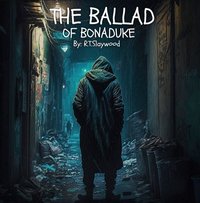
The Ballad of Bonaduke—Episode 37: Last Leg by R. T. Slaywood: Some Aftermath, and a Glimpse of What’s to Come


The Ballad of BonadukeThe Ballad of Bonaduke—
Episode 36: Roadside Assistance

by R.T. Slaywood

DETAILS:
Series: The Ballad of Bonaduke, #37
Format: Kindle Vella Story
Read Date: October 19, 2023

“C’mon, we need to get going.” His words pinballed in my mind and took me a couple seconds to take hold. He offered me a hand.

“I don’t think I can.”

“I told you, I can’t leave you, and we need to go before we draw any more attention.”

“No, I mean I don’t think I can move.” I said barely clinging to consciousness. Looking down I could see how bad I was beat up. A wet borrowed shirt, covered in blood and watered down ink was now torn in a dozen places. Beneath which were scraps and gouges at various points of bleeding. My legs and jeans were not looking much better.

I also seemed to have lost a boot.

The Story So Far…

A drunken Michael Bonaduke decides to use a grift (with maybe some sort of magic/magic-like “help”) to win on a scratch-off lottery ticket so he has money to buy more to drink. He pulls off whatever he did, gets his money and some booze and stumbles off into the darkness to drink himself into oblivion so he can start again the next day. He’s hit by dark memories (probably what’s driving him to the drinking) of fire, pleading, and screaming. There’s going to be a price to pay for his grift, and he’s trying to be ready.

He’s abducted by some representatives of a mysterious group who subject him to a test—if he passes, everything will be explained to him (and hopefully the reader, too). He passes—and is brought somewhere for answers, or maybe training, or maybe another test. Time will tell (or things are going to get really annoying). Answers aren’t quick to come—but the mysteries and questions keep piling up.

Things get hairy and Bonaduke leaves and finds himself back in the neighborhood he started from. He takes refuge in a homeless encampment shortly before a police raid. He’s apprehended and finds himself an interrogation room and shortly escapes after using his grift (but with results he didn’t quite intend). He finds himself by a group of squatters who seem to have strapped a woman to a chair for reasons that can’t be good. He attempts to rescue her before he even realizes what he’s doing, and seems to have succeeded—well, the two of them got away from the group anyway—breathing but bruised. They make their way to a fast-food taco joint and Bonaduke really needs to refuel to keep going. He tries, but fails to get food because he keeps passing out. Thankfully, the clerk is the same guy from the liquor store and he both recognizes him and gives him first aid. The woman (Zero) wakes up and shows some abilities of her on as she helps them escape from her captors who’ve tracked her down. One thing leads to another—Zero and Bonaduke’s magics don’t mix well (at least until they understand what each other can do?), and they end up in a video-game race against the squatters in a tricked-out version of Eric (the clerk’s) car. Note, I said video-game race, not a video-game-style race. They’re actually in one. When dumped back into reality, he’s surrounded by bruised and broken bodies (of people and cars).

What’s Last Leg About?

It takes some work for Bonaduke to pull himself together after the ending of Episode 36–no matter what he knows really happened, his mind saw something else. And you just can’t shrug that off.

But he has to get moving–Zero helps him (one boot and all) to the car so they can go get some medical attention, get off the street, and regroup.

Eric’s not doing well–everything he’s experienced is so far from what he’s capable of understanding that his mind is having a hard time coping.

And, well, that’s about it, really.

So, what did I think about Last Leg?

This felt longer than usual (but I’m not doing word counts, so who knows). Which is good–things got to breathe a little bit. This is still very much a transition from the last mini-arc to the next, but Slaywood accomplished a little more than that.

I think we’re about done with Eric–which is good and bad, I liked him, but I think he’s served his purpose. Although it’s possible that he’s going to get drawn in even deeper with Bonaduke and the rest. Which will not end well for him.

I may have an idea where we’re headed for the next episode or two, and I’m intrigued.

I don’t have much to say, really. Good episode overall.


3 Stars

COVER REVEAL: Partial Function by JCM Berne

I’m very pleased to welcome Day 2 of the Cover Reveal for JCM Berne’s Partial Function to The Irresponsible Reader this morning! This means you’ve likely seen it already, but just in case…also, it’s such a cool cover, for such a cool book (as i’ll hopefully expand upon in a day or three), how could I say no? Before we get to revealing the cover, let’s learn a little bit about the book and author, shall we? I won’t take too much of your time, and then we can lay our eyes on the cover.

Book Details:

Book Title: Partial Function by JCM Berne
Genre: (wuxia-adjacent) Fantasy
Release Date: November 7, 2023

About the Book

If Taken starred Michelle Yeoh and was set on a Jurassic Park-inspired Cradle.

Monster hunter Akina Azure inherited the most powerful weapon in the martial world before retiring to a peaceful life raising her twin girls.

The Reaver has them kidnapped, thinking Akina will trade that weapon for their safe return.

Will she? Or will she use it to wreak a terrible retribution on the men who took her girls?

You get one guess.

About the Author

JCM BerneJCM Berne has reached middle age without outgrowing the notion that superheroes are cool. Code monkey by day, by night he slaves over a hot keyboard to prove that superhero stories can be engaging and funny without being dark or silly.

Linktree ~ Author Website ~ Twitter ~ Instagram ~ Facebook ~ Threads ~ BlueSky ~ Book Berne-ing authortube show ~ Free short story

and now…

The Cover

Partial Function Cover

That’s a spiffy cover, right? I’m telling ya, the book is even better.

It’s out November 7, be ready to jump on it then!

Irresponsible Reader Pilcrow Icon

COVER REVEAL: Serpentus by A.J. Calvin

Serpentus Cover Reveal Banner

I’m very pleased to welcome the Escapist Book Tour’s Cover Reveal for A.J. Calvin’s Serpentus to The Irresponsible Reader this morning! Before we get to revealing the cover, let’s learn a little bit about the book and author, shall we? It’ll just take a moment, and then we can all feast on the cover.

Book Details:

Book Title: Serpentus by A.J. Calvin
Series: Standalone related to The Relics of War series
Genre: Epic Fantasy
Intended Age Group: Adult
Length: 250 pg.
Release date: August 4, 2023
Publisher: February 27, 2024 (tentative)

About the Book

Dispatched to Stone Hill to oversee the city’s defenses among nebulous rumors of the Shadow Council’s threat, Owen Greenwaters must rely on the city’s guard and its natural defenses to protect the citizens.

But when an army of mythical hooded ones bolstered by a sea serpent and the Soulless arrive in the wake of a terrible storm, he knows there is little he can do beyond hope the walls hold – and pray to the gods he and Stone Hill’s people will survive.

They are outnumbered, outmatched, and without magical support. Owen is the only knight present in the city. They will be overrun.

The Soulless are merciless and rarely take prisoners, but Owen and the survivors of Stone Hill are exceptions…

And some fates are worse than death.

Book Links

Author Website (where other retailer links will be posted once preorders are set up) ~ Goodreads

About the Author

A.J. CalvinA.J. Calvin is a science fiction/fantasy novelist from Loveland, Colorado. By day, she works as a microbiologist, but in her free time she writes. She lives with her husband, their cat, and a salt water aquarium.

When she is not working or writing, she enjoys scuba diving, hiking, and playing video games.

Website ~ Twitter ~ Instagram ~ Facebook ~ BlueSky

and now…

The Cover

Serpentus Cover

Okay, I don’t know what those things in his hands are called, but they look like they would hurt. My guess is that behind that cover, more than one character will get to find out just how much that’s true.


My thanks to Escapist Book Tours for the invitation to participate in this tour and the materials they provided. The opinions expressed by me are honest and my own.

Escapist Book Tours

PUB DAY REPOST: ‘Twas the Bite Before Christmas by David Rosenfelt: All Through the Courthouse, Andy Carpenter Was Stirring @stmartinspress @netgalley

'Twas the Bite Before Christmas‘Twas the Bite Before Christmas

by David Rosenfelt

DETAILS:
Andy Carpenter, #28
Publisher: Minotaur Books
Publication Date: October 10, 2023
Format: eARC
Length: 304 pg.
Read Date: September 20-21, 2023
Buy from Bookshop.org Support Indie Bookstores

What’s ‘Twas the Bite Before Christmas About?

On the night of the Tara Foundation’s holiday party, Andy’s friend Pete Stanton, of the homicide department, calls him to ask Andy to bring one of his volunteers outside, so the police don’t have to cause a scene. Andy does so and immediately steps into the role of the volunteer’s attorney. He doesn’t know Derek Moore very well, but he likes Derek—and Derek’s dogs (more importantly), and wants to protect him at least until they both know what’s going on.

Andy quickly learns something about Derek—as he’s arrested, it’s revealed that his real name is Robert Klaster. Up until a couple of years ago, Bobby was in a gang in South Jersey. It was growing more and more violent, up to the point that Bobby was the wheelman for a murder. He went to the cops and turned in the men he drove—after their conviction, the state witness protection program moved him to Patterson with a new name.

Bobby’s made the most of this second chance and has become an upstanding citizen and moderately successful business owner—in addition to a great dog shelter volunteer. But now one of the leaders of his old gang has been killed in Patterson, and a tip led Stanton’s men straight to Bobby—with just enough evidence for them to make an arrest. The case is strong, but not air-tight. The question in front of Andy is can he take advantage of the weaknesses while finding the real killer?

And just why would someone bother setting Bobby up now?

The Recurring Cast

Almost the whole (and continually expanding) cast of regulars is around. Edna’s traveling, but we still get a couple of jokes about her work habits. Eddie shows up, but barely gets any dialogue—and not one sports cliché!—I really enjoyed those (see also: Sam’s song-talking), but the rest are about in their typical form.

Which is important—as much as these books are about the mystery/mysteries surrounding Andy’s case, it’s Andy and the crew we come back to spend time with. Including Tara, Sebastian, and Hunter—Sebastian particularly has some good moments in this book.

I do wonder if the supporting cast is getting too large, which is why Edna and Eddie get barely more than mentions. This makes sense, and it’d be good for Rosenfelt to rotate some of these in and out from book to book. It’d be better than cutting any of these for whatever reason—and better than just a token mention.

That said, Rosenfelt gave us some more than typical reflection on members of the cast. It was good to see Andy explain the specialization of work in his firm and for Andy to bring up the ethics of what he gets Sam to do in his narration. Cory’s been good about that in the companion series, but it’s not that frequent in this series.

I’m not sure if I had a point when I started this section, it’s basically turned into “assorted thoughts on the use of the supporting characters.” So let’s see if I can summarize my take on them for this novel—I enjoyed seeing them all, and am glad we got to spend time with them. I do wonder, however, if more judicious use of some of them per book rather than all of them each time, would be a better experience for the reader.

The Holiday-ness of It

So, this is the holiday-themed release for the series this year, as the title and cover image tell you. Very little in the book tells you that, however.

We don’t even get the typical (and always enjoyable) rant about Laurie’s months-long commemoration of Christmas. He gives a compressed version, but it’s not the same. In its place, we get Andy’s extended (and not favorable) review of egg nog. There are a few references to Christmas and a couple of the following holidays—but it’s not focused on too much. Honestly, we spend more time on Ricky’s soccer-fandom* than on any Federal or religious holiday.

* That was great to read about. Poor Andy. I get the same feeling when my kids prefer other SF franchises to Star Trek.

Do I care? Nope. I’ll take any excuse to hang with Andy and the gang. But I figure since it’s part of the theme of the book I should nod in it’s direction.

So, what did I think about ‘Twas the Bite Before Christmas?

This has nothing to do with anything, but Andy references the case in Flop Dead Gorgeous at one point in the book. It’s been a long time since he’s mentioned a previous case (outside of Willie Miller’s, which gets mentioned from time to time). It’s a nice touch to keep the series building on itself.

There were a couple of other things that stood out to me about this book compared to the rest of the series: Bobby’s about as close to an unsympathetic client as Rosenfelt gives us anymore (maybe ever—this is the twenty-eighth book in the series, I don’t remember the client in every one). And it’s good that Rosenfelt gives us some characters that are hard to root for—although a reformed criminal is pretty easy to root for, come to think of it.

Secondly, Andy slips up (at least in his mind, although Laurie disagrees) and it leads to some tragic consequences. Now, no one’s out there thinking that Andy’s infallible by any means, but it’s rare that a move on his part has such an obvious negative consequence. I’m not suggesting that we need to see major mistakes from our hero in every novel—but it’s good to see that just because Andy Carpenter gets involved, not everything is going to be sunshine and roses.

That said, he’s definitely at the point where I have to wonder why the DA keeps taking Andy’s clients to trial—when will they learn? Also, Pete sounds far too convinced that Andy’s client is guilty, you’d think he, in particular, would have more faith in his friend. This is a question countless readers have asked about Hamilton Burger and Lt. Tragg, as well, and the answer is simply: we wouldn’t get to see Andy or Perry Mason do their thing otherwise.

‘Twas the Bite Before Christmas delivered just what I expected—a good time with characters I enjoy, a clever whodunit, some fun moments with fictional dogs, and a satisfying resolution. Rosenfelt delivers that and more—there’s a sweet bonus moment to the resolution that adds a little holiday glow to the book (that works equally well in mid-September as it will closer to the holiday, or at any point in the calendar year that you happen to read this in). You’d do well to pick it up, whether you’re new to the series or a die-hard fan.

Disclaimer: I received this eARC from St. Martin’s Press via NetGalley in exchange for this post—thanks to both for this.


4 Stars

This post contains an affiliate link. If you purchase from it, I will get a small commission at no additional cost to you. As always, the opinions expressed are my own.
Irresponsible Reader Pilcrow Icon

PUB DAY REPOST: An Inheritance of Magic by Benedict Jacka: I Cannot Recall the Last Time I was This Excited about a New UF Series

An Inheritance of MagicAn Inheritance of Magic

by Benedict Jacka

DETAILS:
Series: Stephen Oakwood, #1
Publisher: Ace Books
Publication Date: October 10, 2023
Format: eARC
Length: 384 pg.
Read Date: September 22-26, 2023
Buy from Bookshop.org Support Indie Bookstores

This is Hard

I want to limit my comparisons between this new series and Jacka’s previous series to just one section—but that’s not going to happen. It makes sense, I suppose. It’s Jacka’s first non-Alex Verus book (other than the two hard-to-find children’s novels), so comparisons are inevitable, but I don’t want to turn this into an X vs. Y situation.

I will say at the outset, that if it wasn’t for the name on the cover, I don’t know that I’d have known they had the same author—so that tells you something about the comparisons. (except in quality—this is definitely up to the standards Jacka has established)

What’s An Inheritance of Magic About?

This is tricky. The Author’s Note at the beginning of the book tells us that this book is an introduction to the series. We are introduced to the world, the characters, the magic, and so on. Yes, there is a plot—a handful, actually—but the main point is for us to get oriented.

Basically, we meet Stephen—he’s roughly 20 and is fairly aimless. He doesn’t have the money (or, really, ambition) to go to University. He bounces from temp job to temp job, hangs out at his local with his friends regularly, takes care of his cat, and works on his magic in his spare time. It’s his real passion, but he doesn’t do much with it.

Then one day, some distant relatives that he’s never heard of come into his life (it’d be too complicated to list the reasons they give, and I think they’re half-truths at best, anyway). Suddenly, Stephen is thrown into a dangerous, high-stakes world of money and power—and he’s just a pawn to be used in the games of his “family” (and by family, I mean people that 23andMe would identify as relatives, but he’s never been in contact with or aware of for his entire existence). He’s a relatively unimportant pawn at that. He’s sort of grateful for that as he realizes it—but he’d have been happier if they never bothered him in the first place. Happier and with significantly fewer bruises.

However, through their machinations, he’s introduced to new levels of magic society and ways that the magic in this world works. Best of all he finds ways that he can be employed and use his magic—the best of both worlds. Sure, his friends don’t get it (not that he tells many of them, because he prefers that they think he’s sane), but he’s bringing in enough money to live and he’s getting stronger and more capable.

The World and Its Magic System

So, where the Alex Verus series was about one man and his friends/allies trying to navigate (and survive) the politics and power of the magical society in England (largely), at this point the Stephen Oakwood series appears to be about one man making his way (and hopefully surviving) the money and power of a different sort magical society—and it’s intersection with the non-magical world. We’re not just talking Econ 101 kind of stuff here—Stephen’s family appears to be some of the 1% of the 1% and there are huge multi-national corporations involved here with defense contracts to governments all over the world.

Basically, Alex had an easier place to navigate.

Most of the magic that’s used in this world comes from sigils—physical objects created from various kinds of energy wells (earth magic, life magic, light magic, and so on) to do particular tasks (shine a light, augment strength, heal minor wounds, etc.). There are likely bigger and better things along those lines (hence defense contracts), but that should give you an idea. The overwhelming number of these sigils are pumped out by some sort of industrial companies and are only good for a limited amount of time.

Stephen was taught (by his father, and by himself) to make sigils on his own—his are individualized, artisanal kinds of things. Think of a sweater you get from some hobbyist off of Etsy vs. the kind of thing you can get for much less at Walmart or on Wish—quality that lasts vs. cheap and disposable. He also reverse engineers almost all of his sigils—he sees something in a catalog (no, really, this is how people get their sigils for personal use) or in use and tries to figure out how such a thing will work and then sets out to create one.

I don’t know where Jacka is going to go with all of this, obviously. But I love this setup.

Alex and Stephen

It wasn’t until I was just about done with the book that I finally figured out what Alex and Stephen had in common—which is odd, it was staring me in the face for most of the novel. But before that, I really wouldn’t have said they had much in common at all.

Stephen is our entry point to this world, and he only knows a little bit about it so as he learns, so does the reader. Alex pretty much knew everything that was going on in his world, so he had to catch the reader up—or he could help Luna understand something (and make it easier for the reader to learn that way). Stephen has to learn almost everything by getting someone to teach him, or through trial and error—either way, the reader is along for the ride and learns with him.

Similarly, Stephen’s really just starting to get the knack of his abilities where Alex was already a pro—sure he had more to learn (and his power increased), but Stephen’s not even a rookie, really when things get going.

Stephen had a loving and supportive father growing up, a strong group of friends, and experience outside the area of magic users—something we never got a strong idea that Alex ever had. Alex had trauma and hardships behind him—Stephen doesn’t. So their personalities, outlooks, etc. are very different from the outset.

It’s not really that shocking that the protagonists of two different series wouldn’t be that similar. And yet…we’ve all read a second or third series from an author with a protagonist that’s just a variation of their initial breakout character. So it’s good to see that Jacka’s able to make that transition between his two series—it gives you hope for what he’s going to do in the future.

Oh, what did I finally realize the two characters shared? They watch and learn. Alex does it because that’s essentially what his abilities were—he could sift through the various futures and decide what to do based on that. Stephen just doesn’t know enough about anything so he has to sit and observe—and from there he can decide how to act. But where others will try to think first and act second, Stephen and Alex watch first—and for a long time—before they think and then act. It’s something not enough characters (especially in Urban Fantasy) seem to spend much time doing. So I’m glad to see it.

So, what did I think about An Inheritance of Magic?

I am just so excited about this series. I didn’t know how Jacka could successfully follow up the Verus series. I trusted he would, because he’s earned that over the last decade—but, I didn’t expect that I’d respond so positively so soon.

We need to start with Stephen’s spunky attitude—with a little bit of a chip on his shoulder due to his circumstances in life (that grows to a degree as he learns how much he and his father missed out on and starts to guess why)—is a real winner. He’s got a gritty (in an Angela Duckworth sense, not Raymond Chandler or William Gibson sense) outlook, is generally optimistic—and can even be funny—all the attributes you want in an underdog.

Then there’s the world-building that I tried to sketch out above—and did a not-wholly-inadequate job of. I want to know more about it—and figure increased familiarity is just going to make me more curious.

I have so many questions about the family members who’ve inserted themselves in Stephen’s life related to their motivations, trustworthiness (I suspect at least one will turn out to be an ally, however temporary), goals, and abilities. I have those questions about Stephen’s guides and allies—and think at least one of them is going to turn on him in a devastating way (thankfully, he doesn’t trust most of them completely). There’s also this priest who keeps assigning him theological work to study. Some good theology, too. I don’t fully know where this is going—but I’m dying to find out.

Are we going to get a Big Bad—or several—for Stephen to face off against? Or is this simply going to be about a series of obstacles Stephen has to overcome until he can carve out an okay existence for himself? Is this about Stephen becoming one of those 1% and the corruption of his character that will necessitate?

I’m not giving this a full 5 stars mostly because of the introductory nature of the book—also because I want to be able to say that book 2 or 3 is an improvement over this (which I fully expect). But that says more about me and my fussy standards than it does about this book. I loved it, and am filled with nothing but anticipation for the sequel/rest of the series. It’s entirely likely that as this series wraps up that we’re going to talk about the Alex Verus series as Jacka with his training wheels on.

I’m now in danger of over-hyping. Also, I’m going to just start repeating laudatory ideas. Urban Fantasy readers need to get on this now.

Disclaimer: I received this eARC from Berkley Publishing Group via NetGalley in exchange for this post—thanks to both for this.

<

div class=”aligncenter” style=”width: 125px;”>


4 1/2 Stars

This post contains an affiliate link. If you purchase from it, I will get a small commission at no additional cost to you. As always, the opinions expressed are my own.

Irresponsible Reader Pilcrow Icon

Page 55 of 341

Powered by WordPress & Theme by Anders Norén