Category: Science Fiction Page 10 of 37

20 Books of Summer 2024: June Check-In

20 Books of Summer
Here’s a quick check-in for this challenge run by Cathy at 746 Books.

So far, I’ve read 4—which puts me a 2/3 of a book behind last year. I should read at least 1 more this coming week, but I’m a little intimidated about my picks for the rest of the summer. A little. Really 8 books a month doesn’t sound that bad for the rest of the summer, but I know full well that other things are going to pop up to distract me. It’s a self-inflicted problem—and one I fully predicted. But still…

I’m more intimidated by the fact that I haven’t written about any of these four yet—am hoping that I can get at least one posted about by Friday. (stranger things have happened, I hear).

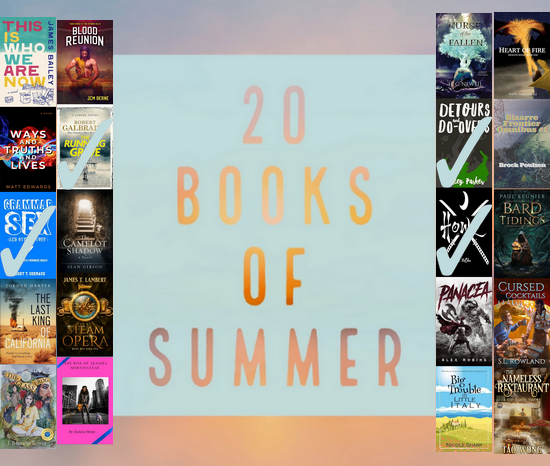
Let’s take a quick look at my progress in June:

1. This is Who We Are Now by James Bailey
2. Blood Reunion by JCM Berne
3. Ways And Truths And Lives by Matt Edwards
✔ 4. The Running Grave by Robert Galbraith
✔ 5. Grammar Sex and Other Stuff: A Collection of (mostly humorous) Essays by Robert Germaux
6. The Camelot Shadow by Sean Gibson
7. Last King of California by Jordan Harper
8. Steam Opera by James T. Lambert
9. The Glass Frog by J. Brandon Lowry
10. Rise of Akaisha Morningstar by Kataya Moon
11. Curse of the Fallen by H.C. Newell
12. Heart of Fire by Raina Nightengale
✔ 13. Detours and Do-overs by Wesley Parker
14. Bizarre Frontier Omnibus #1 by Brock Poulson
✔ 15. Howl by e rathke
16. Bard Tidings by Paul J. Regnier
17. Panacea by Alex Robins
18. Cursed Cocktails by S.L. Rowland
19. Big Trouble in Little Italy by Nicole Sharp
20. The Nameless Restaurant by Tao Wong

(subject to change, as is allowed, but I’m going to resist the impulse to tweak as much as I can).

20 Books of Summer '24 June Check In Chart

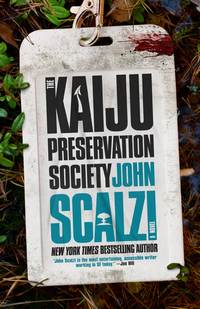
REPOSTING JUST CUZ: The Kaiju Preservation Society by John Scalzi: Delivers Everything the Title Promises

Things are afoot at Irresponsible Reader HQ that made posting today impossible. However, I started the audiobook for this just for something to do. I remember thinking it was great, but I’d forgotten just how ridiculously fun this book is. Incidentally, Wil Wheaton is a fantastic choice to read this.


Kaiju Preservation SocietyThe Kaiju Preservation Society

by John Scalzi

DETAILS:
Publisher: Tor Books
Publication Date: March 14, 2022
Format: Hardcover
Length: 258 pg.
Read Date: April 1-4, 2022
Support Independent Bookstores - Visit IndieBound.org

You have no idea how difficult it was for me to not say, ‘Welcome to Jurassic Park!’ to all of you just now.”

“Jurassic Park didn’t end well for anyone in it,” I pointed out. “Book or movie.”

“Well, they were sloppy,” Tom said. “We’re not sloppy. And, they were fictional. This is real.”

What’s The Kaiju Preservation Society About?

Jamie Gray drops out of his Ph.D. program (writing a dissertation on utopian and dystopian literature) thanks to a quarter-life crisis that gets him to want to make a lot of money. So he goes to work for a tech startup, starts to make decent money, and gets fired just as COVID lockdowns start. He starts scraping by on his savings and meager work for a food-delivery app.

Until he delivers shawarma to Tom one day—the two were acquaintances in college, and they have a brief conversation where a couple of things come out—Jamie hates delivering food, and the NGO that Tom works for has an immediate need of someone on his team. He doesn’t give Tom a lot of information, but that the work involves travel and large animals. His team is set to depart soon, and they can’t without a full team. They just need someone who can, and is willing to, lift things. Tom points out his nice condo as proof that they pay well. Jamie signs on.

A few days later, Jamie and a few other new people on the team find out what the initials in KPS stand for—after it’s too late for them to back out. They’ve traveled to a parallel Earth populated by Kaiju for a six-month stint at one of the human bases.

Obviously, like the book and movie referenced above, things go wrong. They just have to for the sake of a novel, right? (but up until then, I think I could’ve made a case for this being an entire novel without that—it exists as one for longer than I expected—and I would’ve liked it just as much as the one Scalzi delivered).

The Science Fiction-y bits

Given Tom’s work, and Jamie’s, Scalzi’s able to gloss over a lot of the how-they-eat-and-breathe (and other science facts…la! la! la!) stuff, but he does reference things like the square-cube law when it comes to enormously big creatures. Jamie’s new friends include scientists who can deliver some of the biology, chemistry, etc. that are needed for the story—but when it’s needed, they’re always explaining it to the liberal arts guy on their team, so the reader doesn’t have to wade through the heady stuff (something Michael Crichton could’ve used, for example).

It’s not a perfect way to deal with these things, but it sure works well, and Scalzi feeds it to the reader in his usual charming way, so I embraced it.

Pop*.* Fiction

In his Author’s Note, Scalzi states:

KPS is not, and I say this with absolutely no slight intended, a brooding symphony of a novel. It’s a pop song. It’s meant to be light and catchy, with three minutes of hooks and choruses for you to sing along with, and then you’re done and you go on with your day, hopefully with a smile on your face. I had fun writing this, and I needed to have fun writing this. We all need a pop song from time to time, particularly after a stretch of darkness.

I’d been describing it as a popcorn movie in a book. He says pop song. It’s pop-something.

It’s the movie you escape to in the middle of a heatwave and forget about the oppressive weather, the sun, and everything else to enjoy the heat and some pure entertainment. It’s the song you find yourself overplaying because it’s just so catchy until you get sick of it (although you can’t help singing along) and abandon it for years until it comes up on some random mix and you become obsessed with it again for a couple of weeks.

What I found striking about Scalzi saying that is that it reminds me of Seanan McGuire’s comments about the last Toby Daye novel—she needed to write something like that (and I enjoyed it for similar reasons to this one). Are we going to see more books like this from other authors soon? Did 2020/2021 gift us a slew of authors writing happy books as a way to shake it off? (I wonder if Winslow’s Free Billy fits here).

Frankly, I hope so.

So, what did I think about The Kaiju Preservation Society?

“Why isn’t he eating us?” I asked. We were now close enough to Edward that this was not an entirely irrelevant question.

“He’s asleep,” Satie said.

I glanced over at him. “Asleep?”

“They sleep, yup.”

“How can you tell when he’s asleep?”

“He’s not eating us, for one,” Satie said. “You can’t see his eyes, for another.”

I love popcorn movies, I love pop songs like that…and well, you can probably see where that’s going. I’m not the world’s largest Kaiju fan (don’t actively dislike them, either), but it really doesn’t matter, this book skips all that and jumps right to the pleasure center of the brain the same way a catchy tune can.

Reading The Kaiju Preservation Society reminded me of the first time I read Ready Player One (before the movie, distance, and the sequel made me take a second/third/fourth look at it). Or Snow Crash (a wise reference for Scalzi to make early on). It sort of reminded me of the first time I read High Fidelity, too. The catchy, irreverent narrative; the snappy dialogue; the first-person narrator you click with right away*…it just took me a few pages to know that I was going to find nothing but joy in these pages.

*or probably never.

And really, I don’t have a lot to say about the book beyond this. It brought me joy for a couple of days. Thinking about it now is doing the same thing. Go get your hands on this text-based dopamine hit in your preferred medium (I bet Wheaton’s audiobook narration is perfect), sit back, and enjoy yourself.


5 Stars

This post contains an affiliate link. If you purchase from it, I will get a small commission at no additional cost to you. As always, opinions are my own.

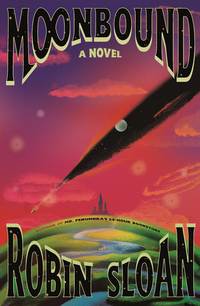
PUB DAY REPOST: Moonbound by Robin Sloan: The White Stripes Save the World (but not really)

MoonboundMoonbound

by Robin Sloan

DETAILS:
Publisher: MCD
Publication Date: June 11, 2024
Format: eARC
Length: 432 pg.
Read Date: May 21-27, 2024
Buy from Bookshop.org Support Indie Bookstores

Let’s Get This Out of the Way Right Now

This is not like the Robin Sloan books you may have read. This is not Mr. Penumbra’s 24-Hour Bookstore (even if everything I’ve seen from the publisher says it’s part of the Penumbraverse) and this isn’t Sourdough. If you’re looking for something like that, I can’t help you by talking about this book.

And yet…some of the same themes, the same kind of ideas, the same oddball ways of thinking, the same characters that will fascinate and (sometimes) frustrate you, the same quality of writing are present. So it is like the Robin Sloan books you may have read. But not really.

What’s Moonbound About?

Maaaannnn….I don’t know, I really don’t know. In case those semi-contradictory paragraphs above didn’t give you a clue. Also, to really talk about it would involve a few pages on my part and several spoilers.

Let’s start with this: the events of the book begin in the year 13777. The number of things that the human race has gone through—cultural, technological, societal, scientific, and political changes (revolutions, really) are impossible to describe. Civilizations have come and gone—the planet Earth looks little like it does now, and humanity isn’t much like it is now (except humans are going to be human—it’s like Doctor Who‘s far future episodes that way—just without the space travel). Even the Moon—the Moon, for crying out loud—isn’t the same.

In William Goldman’s The Princess Bride (and the movie does something very similar), Goldman talks about his father coming in while he’s sick to read him a book by S. Morgenstern.

“Does it have any sports in it?”

“Fencing. Fighting. Torture. Poison. True Love. Hate. Revenge. Giants. Hunters. Bad men. Good men. Beautifulest Ladies. Snakes. Spiders. Beasts of all natures and descriptions. Pain. Death. Brave men. Coward men. Strongest men. Chases. Escapes. Lies. Truths. Passion. Miracles.”

“Sounds okay,” I said and I kind of closed my eyes.

Similarly, let me tell you a little about what Moonbound contains:
Knights. Brothers. Talking swords. Dragons. Friendship. Robots. Bogs (which are very different than swamps). Raiders. Wizards. Bees that give direction. Gleaning coffee shops. Climate Warrior Beavers. Constructive debates (literally). Genetic engineering. Legendary warriors. Forty-three million dimensions.* Pizza rolls. Trash-pickers.

* Not really like Marvel’s Multiverse, more like the mathematical concept of three-dimensional or four-dimensional space, but much, much more expanded.

I’m not sure that’s helpful, but it’s something.

We begin when our protagonist, a boy named Ariel de la Sauvage, finds the remains of one of the greatest warriors in human history. This discovery ends up starting a chain of events that will lead to Ariel being on the run from the Wizard who rules the valley Ariel and his brother have grown up in—not just grown up in, but have never left. They have no knowledge of anything outside this valley—if anything exists beyond it, really. But to overthrow the Wizard and save his brother, Ariel will have to go into the wider world and learn about it. He needs experiences that his valley cannot give him. Equipped with this education and experience, Ariel should be able to confront the wizard and rescue his brother and the rest of the people he grew up surrounded by.

Oh, and he’s guided throughout this by an AI who has the accumulated knowledge of most of human history and is currently residing in a microorganism that has implanted itself in Ariel’s body.

Clear as mud, right?

Story

More than anything else—and there’s a lot of “anything else”—this is a novel about Story. The power of story to shape reality, to shape our expectations, the way we go about our lives, and the way we need others to go about their lives. The stories we tell ourselves about ourselves. The stories we tell others about ourselves. The stories that others tell us about themselves—and us. The stories that societies, governments, and other groups tell us and others about themselves and us.

Lastly, and maybe most importantly, Moonbound about the way we can re-write our stories, the way we can take control of them (once we realize the story being told) and change things.

So, what did I think about Moonbound?

That’s a great question, and one I’ve been chewing on for more than a week now. I want to read this at least two more times before I think I’ll be ready to answer that. Maybe the fact that I want to read this at least two more times in the next year or so gives you and me both a hint about what I think about it.

I haven’t been able to stop thinking about this book since I started reading it two weeks ago. Part of that is to think about what I read and decide what Sloan was doing and what I thought about it. Another part of that thinking is just reveling in just how strange and wonderful it was.

While reading, when I was able to stop thinking things like, “what is going on here?” or “What is Sloan trying to accomplish?” and just enjoy it and get caught up in the story—I was able to lose myself in the book. And that got easier the further into the book I got. But I also spent an awful amount of time just trying to suss things out and overthinking things.

I don’t think that’s a bug when it comes to this book—it’s a feature. Sloan has given the reader so much to take in, that if you’re not chewing on almost every idea, you’re doing the book and yourself a disservice. But it’s also the kind of book you can relax with and enjoy. At a certain point in the book, Ariel learns to lay back and float in water—which is both one of those things that takes effort and can be incredibly relaxing at the same time. Like him, the reader has to learn how to “float” in this book. And when you do, you’ll be rewarded. How greatly you’ll be rewarded, I’m not sure—but you will be.

I’m not going to give this a star rating—sorry if that’s what you’re looking for. I just don’t know (in case I haven’t used that phrase enough yet in this post)—I can both defend every rating from 3-5 Stars, and I can wage a better argument against each of those. I encourage readers who find anything I’ve rambled about above intriguing, fans of Sloan, or people who read what the Publisher’s site says to give it a shot. And then let’s get together and talk about it, because I’d love to bounce some spoilery ideas off of someone.

Disclaimer: I received a copy of this book from Farrar, Straus and Giroux via NetGalley—thanks to both for this.

This post contains an affiliate link. If you purchase from it, I will get a small commission at no additional cost to you. As always, the opinions expressed are my own.
Irresponsible Reader Pilcrow Icon

Moonbound by Robin Sloan: The White Stripes Save the World (but not really)

MoonboundMoonbound

by Robin Sloan

DETAILS:
Publisher: MCD
Publication Date: June 11, 2024
Format: eARC
Length: 432 pg.
Read Date: May 21-27, 2024
Buy from Bookshop.org Support Indie Bookstores

Let’s Get This Out of the Way Right Now

This is not like the Robin Sloan books you may have read. This is not Mr. Penumbra’s 24-Hour Bookstore (even if everything I’ve seen from the publisher says it’s part of the Penumbraverse) and this isn’t Sourdough. If you’re looking for something like that, I can’t help you by talking about this book.

And yet…some of the same themes, the same kind of ideas, the same oddball ways of thinking, the same characters that will fascinate and (sometimes) frustrate you, the same quality of writing are present. So it is like the Robin Sloan books you may have read. But not really.

What’s Moonbound About?

Maaaannnn….I don’t know, I really don’t know. In case those semi-contradictory paragraphs above didn’t give you a clue. Also, to really talk about it would involve a few pages on my part and several spoilers.

Let’s start with this: the events of the book begin in the year 13777. The number of things that the human race has gone through—cultural, technological, societal, scientific, and political changes (revolutions, really) are impossible to describe. Civilizations have come and gone—the planet Earth looks little like it does now, and humanity isn’t much like it is now (except humans are going to be human—it’s like Doctor Who‘s far future episodes that way—just without the space travel). Even the Moon—the Moon, for crying out loud—isn’t the same.

In William Goldman’s The Princess Bride (and the movie does something very similar), Goldman talks about his father coming in while he’s sick to read him a book by S. Morgenstern.

“Does it have any sports in it?”

“Fencing. Fighting. Torture. Poison. True Love. Hate. Revenge. Giants. Hunters. Bad men. Good men. Beautifulest Ladies. Snakes. Spiders. Beasts of all natures and descriptions. Pain. Death. Brave men. Coward men. Strongest men. Chases. Escapes. Lies. Truths. Passion. Miracles.”

“Sounds okay,” I said and I kind of closed my eyes.

Similarly, let me tell you a little about what Moonbound contains:
Knights. Brothers. Talking swords. Dragons. Friendship. Robots. Bogs (which are very different than swamps). Raiders. Wizards. Bees that give direction. Gleaning coffee shops. Climate Warrior Beavers. Constructive debates (literally). Genetic engineering. Legendary warriors. Forty-three million dimensions.* Pizza rolls. Trash-pickers.

* Not really like Marvel’s Multiverse, more like the mathematical concept of three-dimensional or four-dimensional space, but much, much more expanded.

I’m not sure that’s helpful, but it’s something.

We begin when our protagonist, a boy named Ariel de la Sauvage, finds the remains of one of the greatest warriors in human history. This discovery ends up starting a chain of events that will lead to Ariel being on the run from the Wizard who rules the valley Ariel and his brother have grown up in—not just grown up in, but have never left. They have no knowledge of anything outside this valley—if anything exists beyond it, really. But to overthrow the Wizard and save his brother, Ariel will have to go into the wider world and learn about it. He needs experiences that his valley cannot give him. Equipped with this education and experience, Ariel should be able to confront the wizard and rescue his brother and the rest of the people he grew up surrounded by.

Oh, and he’s guided throughout this by an AI who has the accumulated knowledge of most of human history and is currently residing in a microorganism that has implanted itself in Ariel’s body.

Clear as mud, right?

Story

More than anything else—and there’s a lot of “anything else”—this is a novel about Story. The power of story to shape reality, to shape our expectations, the way we go about our lives, and the way we need others to go about their lives. The stories we tell ourselves about ourselves. The stories we tell others about ourselves. The stories that others tell us about themselves—and us. The stories that societies, governments, and other groups tell us and others about themselves and us.

Lastly, and maybe most importantly, Moonbound about the way we can re-write our stories, the way we can take control of them (once we realize the story being told) and change things.

So, what did I think about Moonbound?

That’s a great question, and one I’ve been chewing on for more than a week now. I want to read this at least two more times before I think I’ll be ready to answer that. Maybe the fact that I want to read this at least two more times in the next year or so gives you and me both a hint about what I think about it.

I haven’t been able to stop thinking about this book since I started reading it two weeks ago. Part of that is to think about what I read and decide what Sloan was doing and what I thought about it. Another part of that thinking is just reveling in just how strange and wonderful it was.

While reading, when I was able to stop thinking things like, “what is going on here?” or “What is Sloan trying to accomplish?” and just enjoy it and get caught up in the story—I was able to lose myself in the book. And that got easier the further into the book I got. But I also spent an awful amount of time just trying to suss things out and overthinking things.

I don’t think that’s a bug when it comes to this book—it’s a feature. Sloan has given the reader so much to take in, that if you’re not chewing on almost every idea, you’re doing the book and yourself a disservice. But it’s also the kind of book you can relax with and enjoy. At a certain point in the book, Ariel learns to lay back and float in water—which is both one of those things that takes effort and can be incredibly relaxing at the same time. Like him, the reader has to learn how to “float” in this book. And when you do, you’ll be rewarded. How greatly you’ll be rewarded, I’m not sure—but you will be.

I’m not going to give this a star rating—sorry if that’s what you’re looking for. I just don’t know (in case I haven’t used that phrase enough yet in this post)—I can both defend every rating from 3-5 Stars, and I can wage a better argument against each of those. I encourage readers who find anything I’ve rambled about above intriguing, fans of Sloan, or people who read what the Publisher’s site says to give it a shot. And then let’s get together and talk about it, because I’d love to bounce some spoilery ideas off of someone.

Disclaimer: I received a copy of this book from Farrar, Straus and Giroux via NetGalley—thanks to both for this.

This post contains an affiliate link. If you purchase from it, I will get a small commission at no additional cost to you. As always, the opinions expressed are my own.
Irresponsible Reader Pilcrow Icon

20 Books of Summer 2024: This is Going to Be A Tough One

20 Books of Summer
Cathy at 746 Books is hosting 20 Books of Summer for the 10th year, which is impressive. This is the fourth year for me (not nearly as impressive), and it’s proved to be fun and a good way for me to actually focus on things I’ve gotten distracted from and/or impulse buys. This year I had a plan since January or February, and then when it came time to put it into action threw all of it out. I’m a little apprehensive about this list, it’s ambitious—I think both length and content are going to make several of these slower reads—and risky—I haven’t read most of the authors before, and don’t know what I’m getting into. However, I’ve wanted to read all of these (some of them for years), and I own all but one of these already. Yup! Nineteen books (at least) are leaving Mt. TBR this summer*!

I typically use the unofficial US Dates for Summer—Memorial Day to Labor Day (May 27th through September 2nd), just because it’s easier for me to think that way. And I’ve needed those first few days of September more than once, but let’s not think about that. Now, here it is almost a week later and I’ve just finalized my list—and I probably won’t get started reading any until June 6, this is almost certainly going to come back to bite me somewhere sensitive. But that’s a problem for tomorrow…or August, I guess.

There’s still time to join in the fun—if you’re into this kind of thing. (there are 10 and 15 book versions, too)

* Technically, I guess, one of these has only been on the mountain for a week, but it still counts.

This summer, my 20 are going to be:

1. This is Who We Are Now by James Bailey
2. Blood Reunion by JCM Berne
3. Ways And Truths And Lives by Matt Edwards
4. The Running Grave by Robert Galbraith
5. Grammar Sex and Other Stuff: A Collection of (mostly humorous) Essays by Robert Germaux
6. The Camelot Shadow by Sean Gibson
7. Last King of California by Jordan Harper
8. Steam Opera by James T. Lambert
9. The Glass Frog by J. Brandon Lowry
10. Rise of Akaisha Morningstar by Kataya Moon
11. Curse of the Fallen by H.C. Newell
12. Heart of Fire by Raina Nightengale
13. Detours and Do-overs by Wesley Parker
14. Bizarre Frontier Omnibus #1 by Brock Poulson
15. Howl by e rathke
16. Bard Tidings by Paul J. Regnier
17. Panacea by Alex Robins
18. Cursed Cocktails by S.L. Rowland
19. Big Trouble in Little Italy by Nicole Sharp
20. The Nameless Restaurant by Tao Wong

(subject to change, as is allowed, but I’m going to resist the impulse to tweak as much as I can).

20 Books of Summer '24 Chart

BLOGIVERSARY REPOST: The Girl with the Iron Touch by Kady Cross

To commemorate the 11th Blogiversary of The Irresponsible Reader, I’m reposting the first six books I blogged about this week.


The Girl with the Iron Touch (The Steampunk Chronicles, #3)The Girl with the Iron Touch by Kady Cross

My rating: 4 of 5 stars

Another fun installment in Cross’ Steampunk Chronicles. As silly as I feel reading a book with the Harlequin Teen logo on it, I really enjoy this series (‘tho maybe I should switch to the ebook edition to protect my rep). Once again, Cross balances a steampunk-y adventure story with strong emotional plotlines, with some fun banter between her characters, making for an addictive read.

This time out the primary focus is on Emily — the technomancer, and on both her personal and professional crisis. Just as it seems she’s making some progress on getting Sam to say how he feels about her, as well as to accept what she did to save his life, she’s kidnapped by a bunch of automatons so she can perform a brain transplant from a very injured scoundrel into a semi-organic android. No really, that makes sense in context.

Everyone else, in one way or another, is dealing with the fallout from their trip to the U.S. (and from the events in the first book), while also trying to find Emily and bring her home safely. Obviously, it’s worst for Jasper, more withdrawn from both his friends and the events in the book as a whole.

Griffin and Finley are also dealing with their relationship’s progress — with all the complications, ups adn downs that such entails. Griffin started dealing with something relating to his power in the States and it’s having a devastating impact on him back home (and in turn, that’s impacting everyone around him), causing Finlay to fret over him. My biggest beef with this book comes from the Finlay/Griffin interactions, which are far too similar to the Emily/Sam interactions, covering nearly the same grounds with both couples.

There’s a new character introduced that should provide a good deal of fodder for storylines in the future, and I eagerly await more of her. Really can’t say more without entering Spoiler City, so, I’ll just limit myself to saying that Cross’ creativity and inventiveness is on full display with her creation, and she’s already one of my favorites in the series.

One other note, one of the automatons we spend the most time with was described as a spider with a doll’s head. I certainly hope Cross was trying to get her readers to envision that creepy doll from Toy Story — because every one I know whose read this is seeing that.* Griffin and his team find her just as unnerving as Woody and Buzz did (don’t blame them), either.

Things are getting harder, and stakes are getting higher for our intrepid adventurers — whatever’s next will likely push them further yet.

This was a fun, quick read and I’m already impatiently waiting for the next installment.

*That’d be my wife and I.

Towel Day ’24: One Closing Item (Indulge a Grandpappy)

Towel Day

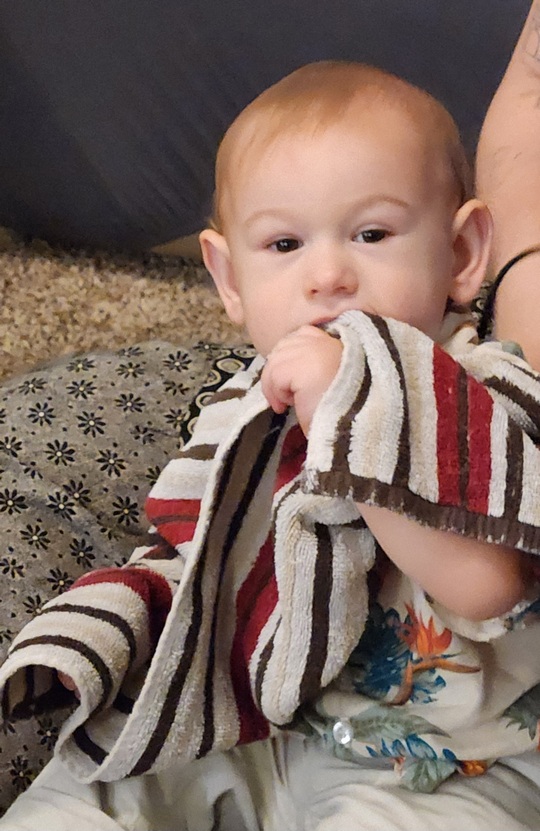
Grandcritter Towel Day '24
The indoctrinationtraining has begun…the kid’s got promise.

Towel Day ’24: Scattered Thoughts about Reading The Hitchhiker’s Guide to the Galaxy Trilogy

(updated and revised this 5/25/24)

Towel Day
I’ve been trying for a few years now to come up with a tribute to Adams. This isn’t quite what I had in mind, but it’s a start. In my mind, this is a work in progress, but I’m posting it anyway. Next year’s version will be better—or at least more complete.


Some time in 7th or 8th grade (I believe), I was at a friend’s house and his brother let us try his copy of the text-based Hitchhiker’s Guide game, and we were no good at it at all. Really, it was embarrassing. However, his brother had a copy of the first novel, and we all figured that the novel held the keys we needed for success with the game (alas, it did not help us one whit). My friends all decided that I’d be the one to read the book and come back in a few days as an expert.

I fell in love with the book almost instantly and I quickly forgot about the game. Adams’ irreverent style rocked my world—could people actually get away with saying some of these things? His skewed take on the world, his style, his humor…and a depressed robot, too! It was truly love at first read. As I recall, I started re-reading it as soon as I finished it—the only time in my life I’ve done that sort of thing.

It was one of those experiences that, looking back, I can say shaped my reading and thinking for the rest of my life (make of that what you will). Were my life the subject of a Doctor Who or Legends of Tomorrow episode, it’d be one of those immutable fixed points. I got my hands on the next three books as quickly as I could (the idea of a four-volume trilogy was one of the funniest ideas I’d encountered up to that point), and devoured them. I do know that I didn’t understand all of the humor, several of the references shot past me at the speed of light, and I couldn’t appreciate everything that was being satirized. But what I did understand I thought was brilliant. Not only did I find it funny, the series taught me about comedy—how to construct a joke, how to twist it in ways a reader wouldn’t always expect, and when not to twist but to go for the obviously funny idea. The trilogy also helped me to learn to see the absurdity in life.

Years later when the final volume (by Adams) was released, I’d already cemented what I thought about the books from these frequent re-reads. I’m not sure that <b>Mostly Harmless</b> changed things much (except for making me think for the first time that maybe I didn’t want him to write more in this series). His non-Hitchhiker’s work illustrated that he was capable of making you see things in a new light–either with a smile or a sense of regret—even when he wasn’t writing the trilogy, even when he was writing non-fiction. It was never the setting or the genre—it was Adams.

But here on Towel Day—as with most of the time I talk about Adams (but I need to change that), it comes down to where I started—the Trilogy. I read the books (particularly the first) so many times that I can quote significant portions of them, and frequently do so without noticing that I’m doing that. I have (at this time) two literary-inspired tattoos, one of which is the planet logo* featured on the original US covers. In essence, I’m saying that Adams and the series that made him famous have had an outsized influence on my life and are probably my biggest enduring fandom. If carrying around a (massively useful) piece of cloth for a day in some small way honors his memory? Sure, I’m in.

So, Happy Towel Day You Hoopy Froods.

* I didn’t know it at the time, but Adams didn’t like that guy. Whoops.

Towel Day ’24: Some of my favorite Adams lines . . .

(updated 5/25/24)

Towel Day

There’s a great temptation here for me to go crazy and use so many quotations that I’d get in copyright trouble. I’ll refrain from that and just list some of his best lines . . .*

* The fact that this list keeps expanding from year to year says something about my position on flirting with temptation.
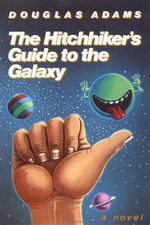
The Hitchhiker's Guide to the Galaxy

The Hitchhiker’s Guide to the Galaxy

Time is an illusion. Lunchtime doubly so.

This must be Thursday. . . I never could get the hang of Thursdays.

“You’d better be prepared for the jump into hyperspace. It’s unpleasantly like being drunk.”

“What’s so unpleasant about being drunk?”

“You ask a glass of water.”

(I’m not sure why, but this has always made me chuckle, if not actually laugh out loud. It’s just never not funny. It’s possibly the line that made me a fan of Adams)

He had found a Nutri-Matic machine which had provided him with a plastic cup filled with a liquid that was almost, but not quite, entirely unlike tea.

In those days spirits were brave, the stakes were high, men were real men, women were real women and small furry creatures from Alpha Centauri were real small furry creatures from Alpha Centuari. And all dared to brave unknown terrors, to do mighty deeds, to boldly split infinitives that no man had split before . . .

“Look,” said Arthur, “would it save you a lot of time if I just gave up and went mad now?”

The ships hung in the sky in much the same way that bricks don’t.

For a moment, nothing happened. Then, after a second or so, nothing continued to happen.

<

blockquote>“Space,” [The Guide] says, “is big. Really big. You just won’t believe how vastly, hugely, mindbogglingly big it is. I mean, you may think it’s a long way down the road to the chemist’s, but that’s just peanuts to space, listen…”

He attacked everything in life with a mix of extraordinary genius and naive incompetence, and it was often difficult to tell which was which.

He felt that his whole life was some kind of dream and he sometimes wondered whose it was and whether they were enjoying it.
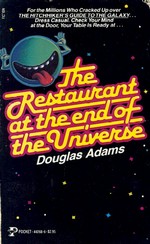

The Restaurant at the End of the Universe

The Restaurant at the End of the Universe

It is a curious fact, and one to which no one knows quite how much importance to attach, that something like 85 percent of all known worlds in the Galaxy, be they primitive or highly advanced, have invented a drink called jynnan tonnyx, or gee-N-N-T’Nix, or jinond-o-nicks, or any one of a thousand or more variations on the same phonetic theme. The drinks themselves are not the same, and vary between the Sivolvian “chinanto/mnigs” which is ordinary water served at slightly above room temperature, and the Gagrakackan “tzjin-anthony-ks” which kills cows at a hundred paces; and in fact the one common factor between all of them, beyond the fact that the names sound the same, is that they were all invented and named before the worlds concerned made contact with any other worlds.

Reality is frequently inaccurate.

Life is wasted on the living.
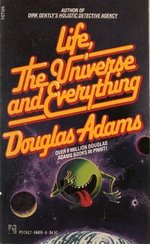

Life, The Universe and Everything

Life, the Universe, and Everything

The Hitchhiker’s Guide to the Galaxy has this to say on the subject of flying. There is an art, it says, or rather, a knack to flying. The knack lies in learning how to throw yourself at the ground and miss.

(It goes on for quite a while after this—and I love every bit of it.)

“One of the interesting things about space,” Arthur heard Slartibartfast saying . . . “is how dull it is?”

“Dull?” . . .

“Yes,” said Slartibartfast, “staggeringly dull. Bewilderingly so. You see, there’s so much of it and so little in it.”
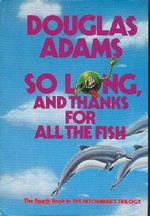

So Long, and Thanks For All The Fish

So Long, and Thanks for All the Fish

Of course, one never has the slightest notion what size or shape different species are going to turn out to be, but if you were to take the findings of the latest Mid-Galactic Census report as any kind of accurate guide to statistical averages you would probably guess that the craft would hold about six people, and you would be right. You’d probably guessed that anyway. The Census report, like most such surveys, had cost an awful lot of money and told nobody anything they didn’t already know—except that every single person in the Galaxy had 2.4 legs and owned a hyena. Since this was clearly not true the whole thing eventually had to be scrapped.

Here was something that Ford felt he could speak about with authority. “Life,” he said, “is like a grapefruit.”

“Er, how so?”

“Well, it’s sort of orangy-yellow and dimpled on the outside, wet and squidgy in the middle. It’s got pips inside, too. Oh, and some people have half a one for breakfast.”

“Is there anyone else out there I can talk to?”

Arthur had a swordfish steak and said it made him angry. He grabbed a passing waitress by the arm and berated her. “Why’s this fish so bloody good?” he demanded, angrily.

“Please excuse my friend,” said Fenchurch to the startled waitress. “I think he’s having a nice day at last.”
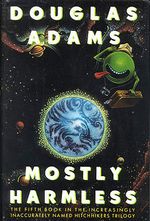

Mostly Harmless

Mostly Harmless

A common mistake that people make when trying to design something completely foolproof is to underestimate the ingenuity of complete fools.

Fall, though, is the worst. Few things are worse than fall in New York. Some of the things that live in the lower intestines of rats would disagree, but most of the things that live in the lower intestines of rats are highly disagreeable anyways, so their opinion can and should be discounted.
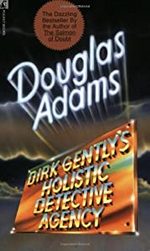

Dirk Gently's Holistic Detective Agency

Dirk Gently’s Holistic Detective Agency

There is no point in using the word ‘impossible’ to describe something that has clearly happened.

If it looks like a duck, and quacks like a duck, we have at least to consider the possibility that we have a small aquatic bird of the family anatidae on our hands.

Let’s think the unthinkable, let’s do the undoable. Let us prepare to grapple with the ineffable itself, and see if we may not eff it after all.

(I’ve often been tempted to get a tattoo of this)
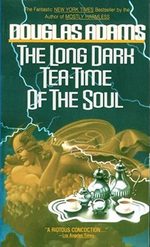

The Long Dark Tea-Time of the Soul

The Long Dark Tea-Time of the Soul

There are some people you like immediately, some whom you think you might learn to like in the fullness of time, and some that you simply want to push away from you with a sharp stick.

It can hardly be a coincidence that no language on earth has ever produced the expression, ‘As pretty as an airport.’

The impossible often has a kind of integrity to it which the merely improbable lacks.

She stared at them with the worried frown of a drunk trying to work out why the door is dancing.

It was his subconscious which told him this—that infuriating part of a person’s brain which never responds to interrogation, merely gives little meaningful nudges and then sits humming quietly to itself, saying nothing.

As she lay beneath a pile of rubble, in pain, darkness, and choking dust, trying to find sensation in her limbs, she was at least relieved to be able to think that she hadn’t merely been imagining that this was a bad day. So thinking, she passed out.
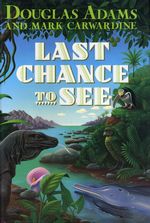

The Last Chance to See

The Last Chance to See

“So what do we do if we get bitten by something deadly?” I asked.

He looked at me as if I were stupid. “You die, of course. That’s what deadly means.”

I’ve never understood all this fuss people make about the dawn. I’ve seen a few and they’re never as good as the photographs, which have the additional advantage of being things you can look at when you’re in the right frame of mind, which is usually around lunchtime.

I have the instinctive reaction of a Western man when confronted with sublimely incomprehensible. I grab my camera and start to photograph it.

Human beings, who are almost unique in having the ability to learn from the experience of others, are also remarkable for their apparent disinclination to do so.

The aye-aye is a nocturnal lemur. It is a very strange-looking creature that seems to have been assembled from bits of other animals. It looks a little like a large cat with a bat’s ears, a beaver’s teeth, a tail like a large ostrich feather, a middle finger like a long dead twig and enormous eyes that seem to peer past you into a totally different world which exists just over your left shoulder.

One of the characteristics that laymen find most odd about zoologists is their insatiable enthusiasm for animal droppings. I can understand, of course, that the droppings yield a great deal of information about the habits and diets of the animals concerned, but nothing quite explains the sheer glee that the actual objects seem to inspire.

I mean, animals may not be intelligent, but they’re not as stupid as a lot of human beings.
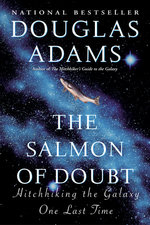

The Salmon of Doubt

The Salmon of Doubt: Hitchhiking the Galaxy One Last Time

We are stuck with technology when what we really want is just stuff that works.

I’ve come up with a set of rules that describe our reactions to technologies:
1. Anything that is in the world when you’re born is normal and ordinary and is just a natural part of the way the world works.
2. Anything that’s invented between when you’re fifteen and thirty-five is new and exciting and revolutionary and you can probably get a career in it.
3. Anything invented after you’re thirty-five is against the natural order of things.


And a couple of lines I’ve seen in assorted places, articles, books, and whatnot

I love deadlines. I love the whooshing noise they make as they go by.

A learning experience is one of those things that says, “You know that thing you just did? Don’t do that.”

The fact is, I don’t know where my ideas come from. Nor does any writer. The only real answer is to drink way too much coffee and buy yourself a desk that doesn’t collapse when you beat your head against it.

Solutions nearly always come from the direction you least expect, which means there’s no point trying to look in that direction because it won’t be coming from there.

Towel Day ’24: Do You Know Where Your Towel Is?

(updated and revised this 5/25/24)

Towel Day

The Hitchhiker’s Guide to the Galaxy has a few things to say on the subject of towels.

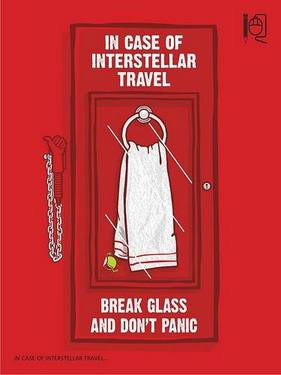
A towel, it says, is about the most massively useful thing an interstellar hitchhiker can have. Partly it has great practical value. You can wrap it around you for warmth as you bound across the cold moons of Jaglan Beta; you can lie on it on the brilliant marble-sanded beaches of Santraginus V, inhaling the heady sea vapors; you can sleep under it beneath the stars which shine so redly on the desert world of Kakrafoon; use it to sail a miniraft down the slow heavy River Moth; wet it for use in hand-to-hand-combat; wrap it round your head to ward off noxious fumes or avoid the gaze of the Ravenous Bugblatter Beast of Traal (such a mind-bogglingly stupid animal, it assumes that if you can’t see it, it can’t see you); you can wave your towel in emergencies as a distress signal, and of course dry yourself off with it if it still seems to be clean enough.

More importantly, a towel has immense psychological value. For some reason, if a strag (strag: non-hitch hiker) discovers that a hitch hiker has his towel with him, he will automatically assume that he is also in possession of a toothbrush, face flannel, soap, tin of biscuits, flask, compass, map, ball of string, gnat spray, wet weather gear, space suit etc., etc. Furthermore, the strag will then happily lend the hitch hiker any of these or a dozen other items that the hitch hiker might accidentally have “lost”. What the strag will think is that any man who can hitch the length and breadth of the galaxy, rough it, slum it, struggle against terrible odds, win through, and still knows where his towel is is clearly a man to be reckoned with.

Hence a phrase that has passed into hitchhiking slang, as in “Hey, you sass that hoopy Ford Prefect? There’s a frood who really knows where his towel is.” (Sass: know, be aware of, meet, have sex with; hoopy: really together guy; frood: really amazingly together guy.)

Towel Day, for the few who don’t know, is the annual celebration of Douglas Adams’ life and work. It was first held two weeks after his death, fans were to carry a towel with them for the day to use as a talking point to encourage those who have never read HHGTTG to do so, or to just converse with someone about Adams. Adams is one of that handful of authors that I can’t imagine I’d be the same without having encountered/read/re-read/re-re-re-re-read, and so I do my best to pay a little tribute to him each year, even if it’s just carrying around a towel.

In commemoration of this date, here’s most of what I’ve written about Adams. I’ve struggled to come up with new material to share for Towel Day over the years, mostly sticking with updating and revising existing posts. But I do have a couple of new things coming today. But let’s start with the old material. A few years back, I did a re-read of all of Adams’ (completed) fiction. For reasons beyond my ken (or recollection), I didn’t get around to blogging about the Dirk Gently books, but I did do the Hitchhiker’s Trilogy:
bullet The Hitchhiker’s Guide to the Galaxy
bullet The Restaurant at the End of the Universe
bullet Life, The Universe and Everything
bullet So Long, and Thanks For All The Fish
bullet Mostly Harmless
bullet I had a thing or two to say about the 40th Anniversary of The Hitchhiker’s Guide to the Galaxy
bullet I took a look at the 42nd Anniversary Illustrated Edition of The Hitchhiker’s Guide to the Galaxy

I should also point to a posts I wrote about Douglas Adams’ London by Yvette Keller and 42: The Wildly Improbable Ideas of Douglas Adams edited by Kevin Jon Davies—both are great ways of illing-out one’s understanding of Adams and his work. I have to mention the one book that Adams/Hitchhiker’s aficionado needs to read is Don’t Panic by Neil Gaiman, David K. Dickson and MJ Simpson. If you’re more in the mood for a podcast, I’d suggest The Waterstones Podcast How We Made: The Hitchhiker’s Guide to the Galaxy—I’ve listened to several podcast episodes about this book, and generally roll my eyes at them. But this is just fantastic. Were it available, I’d listen to a Peter Jackson-length version of the episode.

I’ve only been able to get one of my sons into Adams, he’s the taller, thinner one in the picture from a few several years ago.
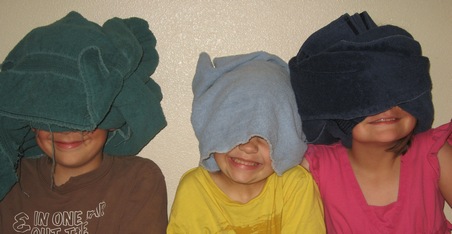
(although I did get he and his younger siblings to use their towels to make themselves safe from the Ravenous Bugblatter Beast of Traal a few years earlier:)

You really need to check out this comic from Sheldon Comics—part of the Anatomy of Authors series: The Anatomy of Douglas Adams.

Lit in a Nutshell gives this quick explanation of The Hitchiiker’s Guide:

TowelDay.org is the best collection of resources on the day. One of my favorite posts there is this pretty cool video, shot on the ISS by astronaut Samantha Cristoforetti.

Even better—here’s an appearance by Douglas Adams himself from the old Letterman show—I’m so glad someone preserved this:

Love the anecdote (Also, I want this tie.)

Page 10 of 37

Powered by WordPress & Theme by Anders Norén