Category: Science Fiction Page 30 of 34

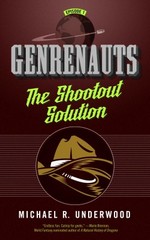
The Shootout Solution by Michael R. Underwood

The Shootout Solution The Shootout Solution

by Michael R. Underwood
Series: Genrenauts, Episode 1

Kindle, 148 pg.

Tor.com, 2015

Read: November 18 – 19, 2016

Because he didn’t have enough series/irons in the fire already, here’s a new series from Michael R. Underwood — the man behind the Ree Reyes/Geekomancy series, Shield and Crocus and The Younger Gods (which may be a series or may be a stand alone). This one is sort of familiar territory, but differs enough that it doesn’t feel tired.

So, Leah is trying to make it as a stand-up comic in Baltimore. I didn’t realize that Baltimore was a good place for this, but sure, why not? So, the stand-up isn’t working for her, her day job is as a receptionist and isn’t the basis for a future. So she can’t help but be interested when some mysterious man who seems to appreciate her act approaches her and says:

I’m Dr. Angstrom King, Department of Comparative Literature. I run a narrative immersion laboratory, and I’m looking for new staff. I think you might be an excellent fit.

The reality behind that gobbledygook is tough to explain in a paragraph, but I’ll try — there are several parallel universes to ours (“Earth Prime”), and each of these correlates to a genre in fiction (not just books), so there’s a Science Fiction World, a Romance World, A Horror World, and so on. Each of these universes impacts ours in the narratives we tell each other. And when something goes wrong the World’s narrative, it spills over in our reality. So there’s a group of people like Quantum Leap or Voyagers! who pop in, fix the problem, and pop out once stability to the narrative returns. The people that are aware of these worlds and that travel between are called Genrenauts — catchy, eh?

So, Leah tries it out, traveling to Western World to clean up a sticky situation. While there, she meets some more of King’s team, helps some people out, and get a real baptism by fire into this strange new world. There’s some fun with tropes, character types, a shootout, bad whiskey — pretty much everything you’d want sans a squinty-Eastwood character.

It’s told with a light touch — the debt to Leverage and The Librarians is obvious (and readily acknowledged), with a good dose of action, a hint of a looming catastrophe/conspiracy. There’s a good deal of literary/narrative theory under-girding this whole project — it’s not as frivolous as it may seem.

There’s so much emphasis on the premise of this series, and with the adventure in Western World, that we didn’t get a good introduction to the characters. In addition to Leah, there was King and 2 teammates, some references to a couple of others, 2 people from the Western world. But Leah’s the only one that I could say has more than 1 dimension to them. I’m confident when I say that’ll be taken care of in short order in the future, though. But for now, the team is full of types, not people.

Leah is further on her way to being a fully developed character, primarily a collection of characteristics and tics at the moment — but close. She’s smart, savvy, quick on her feet, a pop culture junkie. Unlike, Ree, Leah’s a professional smart aleck — or aspires to be one, anyway. Not that anyone needs a justification to be quippy and snarky in the face of danger in SF, but it’s nice that she has one. I enjoyed meeting her, and want to get to know her better while watching these collection of characteristics congeal into a character.

I’m giving this 4 Stars, I think it earns a 3 — it’s so pilot episode-y that it’s hard to tell. I really enjoyed it and I’m in for at least a handful of books, so I’ll give it a one-star bump for the premise. I’m eager, really eager, to get the next one.

—–

4 Stars

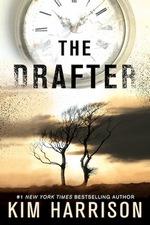
The Drafter by Kim Harrison

The DrafterThe Drafter

by Kim Harrison
Series: The Peri Reed Chronicles, #1
Hardcover, 422 pg.

Gallery Books, 2015

Read: September 17 – 21, 2015

Okay, I haven’t read the second or third Madison Avery book, and I haven’t found the time to read the last Rachel Morgan book (don’t ask, I can’t explain it either), so I might have to revise this a bit later — but I’m betting I won’t — this is the best book Kim Harrison has written to date. Hands down.

So Peri Reed is a Drafter. A covert agent for the U. S. Government in the near future (future enough that there’s all sorts of gear and tech that we have to imagine, near enough that we can relate). She (and 1 in 100,000 or so others) have this handy ability, when things go wrong, she can rewind time a bit and try it again. This is especially handy when mortally wounded. The downside? Doing that erases part of her memory — weeks’ or even months’ worth of it at a time. So each Drafter works with an Anchor. An expert in the Drafter’s personal history to help them put the pieces back together in a manner the Drafter can understand and move forward from.

Things are going well enough, when in the midst of her normal duties Peri finds some evidence that she’s been doing things she shouldn’t be, that she’s a renegade, a corrupt agent. This doesn’t sit easy with her, so she starts to investigate what’s really going on — and as long as she can remember what she’s doing and why, what she finds may shake up more than just her life.

It is almost impossible to track the plotlines of this book — you can experience it, but retell it? No — not without copious notes. One fellow blogger is demanding diagrams just to keep track of everything. And he’s not wrong. Peri keeps getting her memory re-written — memories that the reader is aware of, and others. There’s a mare’s nest of factions, agents, double agents, and possible triple agents; crosses, double crosses, triple and — I lost count of how many crosses a couple of characters were involved in. Plus time resetting itself. Mix in years of backstory that Harrison doles out in drips and drops. The result is that the reader is as disoriented as Peri — when she’s tripped up, we generally are. When she’s surprised by X doing something, we’re not sure what’s going on in X’s mind, either.

It’s hard to render an opinion on most of the characters. Because what we think we know about them may be Peri’s perception, may be reality, may be a cover, or . . . you get the idea? Peri at one point assures one woman that she remembers she likes her — doesn’t know anything about her, but remembers emotions. Which is pretty much all we have to go with as well. There’s a couple of people I know I like — a couple I know I don’t (even if some of them are supposed to be “good” guys) — but as far as how well drawn the characters are, it’s tough to say. Even Peri’s such a work in progress, it’s hard to get a good handle on her as a character.

Nevertheless, this is a book I highly recommend. It starts slow — very slow (I seem to be saying that a lot lately, I’m not sure when I became so impatient), but once all the dominoes are set (somewhere around the 100 page mark), Harrison starts the falling, and wow. It’ll suck you in, it’ll get you wrapped up in the web of deceit and efforts to unravel the deceit. More than anything, it’ll leave you wanting more.

—–

5 Stars

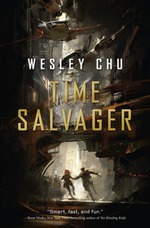
Time Salvager by Wesley Chu

Time SalvagerTime Salvager

by Wesley Chu
Series: Time Salvager, #1
Hardcover, 380 pg.

Tor Books, 2015

Read: September 12 – 15, 2015


Guess I should start with this: there’s nothing in these pages that’ll remind you of Chu’s Tao books. They could be written by completely different authors. Which is a combination of good news and bad news. The good news is that the reader doesn’t get a deja vu feeling reading, Chu’s ability as a writer and worldbuilder is displayed, and we get to see that he’s not a one-trick pony. The bad news is, the Tao books were better.

Not that this is bad, it’s just not Tao.

Chu is really smart about the way that he introduces us to the world, to the concept of Time Laws, and ChronoCom and all the rest of the things that you can read about in the jacket copy (or at the link above). Maybe it shows that I read too much bad SF as a kid, but I’m still really impressed by SF writers who are able to blend things into dialogue and story rather than just resorting to info dumps.

This is a Time Travel story where the Time Travel’s not really all that important. It’s just a tool. Like a cell phone — something that people use, but don’t really understand. No one (well, one person) here understands how it works, but they can use it. Ditto for all the nifty future-gadgets. So it makes it easy for us to not worry about it, too, and just go with the flow.

When you clear away all the bells and whistles this is a pretty straight-forward story about corporate greed, ecological/societal collapse, and a few people trying to do the right thing with the cards stacked against them (even if that pits them against each other). The bells and whistles turn this into a SF/Time Travel/Dystopian Love Story.

Not the best thing I’ve ever read by Chu, but interesting enough to make me glad I read it, and I’ll be back for #2. Maybe with is he can do something to make the series something I can get excited about.

—–

3 Stars

John Scalzi and Shane Kuhn in Boise

If you’d asked me, I would’ve said I’ve written and posted this already. Apparently not. Whoops! Thanks for letting me know, Paul. So, I’ll take a quick break from packing up all my white clothes and get this up now. Better late than never, I guess. . . .
At the end of August, the best bookstore in Boise, Rediscovered Books, brought two authors to town for Readings/Signings. Back in college, I went to readings fairly frequently*, but since then I could count the number on one hand.

Shame on me. I need to do better at this. A good reading is one of the best forms of entertainment around. A less-good reading is pretty bad, but hey, at least you’re supporting the arts.

Anyway, the first author was John Scalzi. Perhaps you’ve heard of him — SF author extraordinaire, blogger, tweeter, etc., etc. Back on August 20, Rediscovered Books brought him to the auditorium of the Boise Public Library! (yes, the exclamation point is necessary). I wondered if that wasn’t overkill for SF in Boise. Not surprisingly, I was wrong and the people that do this stuff for a living were right. If they’d brought him to the bookstore, there’s no way we all could’ve fit, the audience packed the auditorium.

After a little chit-chat, he read a little from his upcoming novella The Dispatcher, his first foray into Urban Fantasy. He asked not to provide any details, as the only people getting this preview were those who came to this book tour. He did give us permission to — maybe even encouraged — gloat about hearing it. So, here we go: neener neener my wife and I got to hear the first chapter of The Dispatcher and most of you didn’t. It was pretty good, and I’ll be grabbing it as soon as I can.

He then read a couple of short humor pieces he wrote for AOL.com back in the 90’s that were appropriate for the Back to School season, and a pretty popular (and funny) blog post, Standard Responses to Online Stupidity. He then he spent 20 minutes or so doing Q&A — he was polite and friendly to the people asking questions, turned even awkward questions into something interesting in his answers (he’s been doing this for awhile).

What didn’t he read? Anything from the book that the tour was promoting — The End of All Things — which I found odd, but I was okay with because I’m way behind on that series. Very entertaining evening — the dude’s a pro.

During the signing, he was again friendly and pleasant and didn’t seem to mind people fanboying/fangirling all over him (which didn’t happen too much or without restraint on the part of the fans). When it was my turn, he laughed at my attempt at humor (which I’m going to believe was because I was moderately funny and not just because he’s sooper polite), gave me a nice, personalized autograph in my copy of The Android’s Dream that went with my joke.

And here’s photographic proof that I met John Scalzi:

A week later, things were a bit different for Shane Kuhn, a favorite around these parts, but largely unknown. Now, Rediscovered Books has been pushing Kuhn lately — he’s a Staff Pick, one of their book clubs read The Intern’s Handbook recently, etc. But a whopping 4 people showed up. Which, sure, provided a nice, intimate setting — but 4? Oh, wait, there were 2 bookstore employees there, too.

That had to be discouraging, but he went on with the show. After taking a poll of who’d read what of his (my wife hadn’t read anything yet, 2 were in various stages of Hostile Takeover, and I’d finished it earlier in the week), he read an early section of Hostile Takeover — the wedding — quitting at just the right spot — it was a good tease, you wanted to know what happened next; and I think the next part would’ve been very, very tricky to read aloud. He then took some questions, it was more of a chat, really. He had this annoying tendency to answer questions I wanted to ask in the middle of another answer, so I ended up not saying anything. Highlights included him talking a little bit about his next book, more of a mainstream thriller; and the process of getting The Intern’s Handbook to the Big Screen. He read another bit from the beginning of The Intern’s Handbook (after teasing my wife about reading the ending), where Alice and John first met.

Despite the low turnout, he didn’t (that I could tell) cut corners or half-ass his way through the reading, and was more than friendly to those of us who were there. If he comes back, we’ll do a better job strong-arming friends and family to come so that his audience will be bigger.

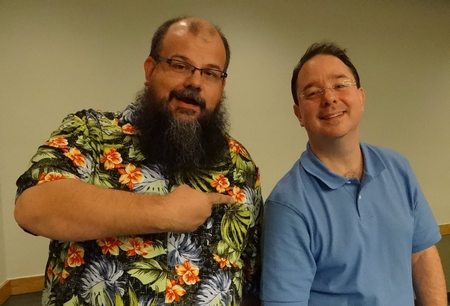
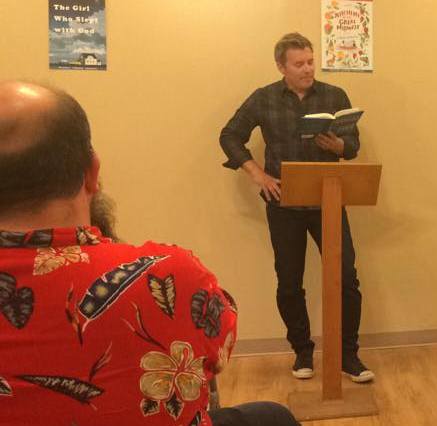
Here’s photographic proof that I saw Shane Kuhn (better angle on me than the other). If you go to Rediscovered’s Facebook page and see the photograph I appropriated, you can see 75% of the audience for the reading)

* And not just for the extra credit either. Although that probably kept me at some until the end.

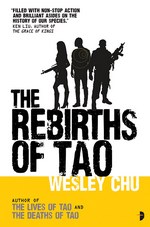
The Rebirths of Tao by Wesley Chu

The Rebirths of TaoThe Rebirths of Tao

by Wesley Chu
Series: Tao Trilogy, #3

Mass Market Paperback, 506 pg.
Angry Robot Books, 2015
Read: June 15 – 20, 2015That was satisfying.

Really, that’s about all I have to say about this one. But let’s see if I can’t expand a bit. Overall, I enjoyed The Lives more than this, and this one engaged me more throughout than The Deaths did, but The Rebirths brought the Tao Trilogy to a satisfying conclusion, wrapping up what needed to be wrapped up, dealing with all the arcs that needed to be concluded and generally leaving things in a place where we can say goodbye to these characters (not that we necessarily want to, but we can) — oh, and was a solid SF adventure in its own right.

One personal note, a large part of the action takes place in Ontario, Oregon. Most people reading this book aren’t going to think much about that at all, but I grew up about 10 minutes away from Ontario — so I thought that was pretty cool. On the other hand, now I know how Bostonians feel when reading Robert B. Parker or Dennis Lehane, or a life-long Chicago resident when reading Jim Butcher. The geography is bad, and if you wanted to buy a nicer car, you wouldn’t bother driving to Boise, you’d get the same car (probably cheaper) in Ontario.

But that matters so little to the book as a whole, that those four sentences are at least two too many.

So, anyway, this book (like The Deaths) takes place a few years after we’d left Roen and the rest. His son, Cameron, is a teenager — with all the stubbornness, rebellion, and hormone-addled fun that entails. Of course, his rebellion takes the form of wanting to join in the war against the Genjix, while his parents do all they can to steer him away.

It’s safe to say that very few (if any) of the Quasing are happy with Jill’s little revelation at the end of The Deaths — Genjix or Prophus — which puts them in the same boat as humanity. Governments all over the world are attempting to hunt down any and all Quasing. Which hasn’t done any favors for the Prophus, but at least seems to have hurt the Genjix effort more.

Which is not to say they’re down for the count by any means. Enzo, the Adonis, is still out there strutting like a peacock and working to bring about the end of humanity. We finally get to see the Genjix plan in full, and I’ve got to say, reading about their plan for re-making Earth makes me really glad that this is fiction.

Right?

So, we’ve got the Ontario storyline — which looks like a pretty routine mission for Roen and Marcos (yeah, not quite Felix & Oscar, but close enough), until it gets bad. And then worse. There’s a conflict in the leadership of the Genjix (so nice to see that even some of them don’t like Enzo). And then there’s a major breach in security which leaves the rest of our Prophus friends on the run — our focus is on Cameron, but not exclusively here. I was a little surprised how Chu concluded the Ontario storyline — which is what made it effective, really. These three threads, ultimately, naturally, converged into one big battle — like the two books before.

Once again, what Chu did with Roen between the books isn’t exactly what one expects, but it fits his character. Ditto for Jill. We didn’t know Cameron enough for me to say. Tao? Sure — Tao’s the same, being centuries old helps him stay consistent. When it comes to the machinery of the Genjix, Prophus and the US Government (and/or everyone else) — things didn’t go the way I figured they would following The Deaths — but I think I liked it more that way. It’s because of the fallout from Jill’s revelation that most of the character changes happened the way they did. Chu really was effective here.

There are some great fight scenes, if that’s your kind of thing (and if it’s not, why are you reading these books?). The final scene is as epic — yet personal — as you want from the end of a third book in a trilogy. Part of that battle are back-to-back hand-to-hand combat scenes featuring an Adonis vessel and people near and dear to us. By this point, I had no idea what Chu was going to give us and I was hanging on every hit. I’m so glad that Chu sprinkles so much humor through these books — after these fights were over, I needed the joke that followed.

It may not work for everyone, but I really liked where everything was left off. Particularly for Enzo.

A really solid novel, a satisfying conclusion — making the Tao trilogy a keeper. I’m very much looking forward to what Chu’s got in store next.

—–

4 1/2 Stars

Towel Day ’15

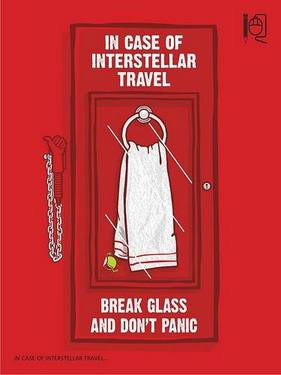
The Hitchhiker’s Guide to the Galaxy has a few things to say on the subject of towels.

A towel, it says, is about the most massively useful thing an interstellar hitchhiker can have. Partly it has great practical value. You can wrap it around you for warmth as you bound across the cold moons of Jaglan Beta; you can lie on it on the brilliant marble-sanded beaches of Santraginus V, inhaling the heady sea vapors; you can sleep under it beneath the stars which shine so redly on the desert world of Kakrafoon; use it to sail a miniraft down the slow heavy River Moth; wet it for use in hand-to-hand-combat; wrap it round your head to ward off noxious fumes or avoid the gaze of the Ravenous Bugblatter Beast of Traal (such a mind-bogglingly stupid animal, it assumes that if you can’t see it, it can’t see you); you can wave your towel in emergencies as a distress signal, and of course dry yourself off with it if it still seems to be clean enough.

More importantly, a towel has immense psychological value. For some reason, if a strag (strag: non-hitch hiker) discovers that a hitch hiker has his towel with him, he will automatically assume that he is also in possession of a toothbrush, face flannel, soap, tin of biscuits, flask, compass, map, ball of string, gnat spray, wet weather gear, space suit etc., etc. Furthermore, the strag will then happily lend the hitch hiker any of these or a dozen other items that the hitch hiker might accidentally have “lost”. What the strag will think is that any man who can hitch the length and breadth of the galaxy, rough it, slum it, struggle against terrible odds, win through, and still knows where his towel is is clearly a man to be reckoned with.

Hence a phrase that has passed into hitchhiking slang, as in “Hey, you sass that hoopy Ford Prefect? There’s a frood who really knows where his towel is.” (Sass: know, be aware of, meet, have sex with; hoopy: really together guy; frood: really amazingly together guy.)

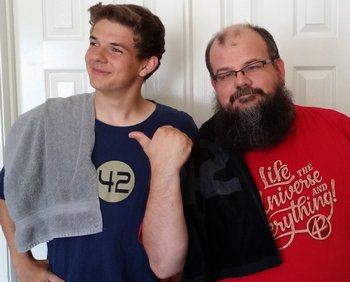
One of my long-delayed goals is to write up a good all-purpose Tribute to Douglas Adams post, and another Towel Day has come without me doing so. Next year . . . or later. Adams is one of those handful of authors that I can’t imagine I’d be the same without having encountered/read/re-read/re-re-re-re-read, and so I do my best to pay a little tribute to him each year, even if it’s just carrying around a towel (I’ve only been able to get one of my sons into Adams, he’s the taller, thinner one below).

TowelDay.org is the best collection of resources on the day, this year were able to post this pretty cool video, shot on the ISS by astronaut Samantha Cristoforetti.

Review Catch Up: Beautiful Redemption; Breach Zone; Chasing the Prophecy; Fiddlehead

I’ve got a backlog of 40-plus reviews I’ve been meaning to write — some of them, I just have to admit aren’t going to get done. But I’m going to try my level best. The four books I’ve decided to tackle in one fell swoop are the concluding novels from series I enjoy, and yet I’ve had trouble reviewing them. On the whole, there’s no reason for it — I should’ve had at least a few paragraphs of material on these, but I can’t seem to muster it (especially given how much time has gone by).

But I do want to clear these off my to-do list, so, without further ado, a few words on these series finales:

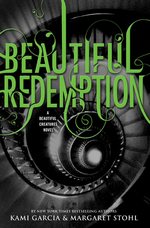
Beautiful RedemptionBeautiful Redemption

by Kami Garcia and Margaret Stohl

Paperback, 451 pg.
Penguin Books, 2012
Read: November 19 – 20, 2013

On the one hand, this was not at all like the rest of the series — and yet it was a very fitting conclusion. Garcia and Stohl wrapped up everything that needed wrapped up, answered every lingering question (not always as I expected), and generally, did so in an emotionally satisfying way. I wouldn’t have thought that this book would lead to a spin-off series, but it fits.

If you’re into Paranormal YA, this was a very satisfying conclusion, and probably the best of that genre I’ve read.
4 Stars

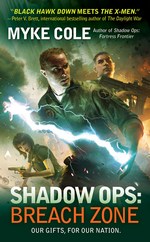
Breach ZoneBreach Zone

by Myke Cole

eBook, 384 pg.
Ace, 2014
Read: January 31 – February 04, 2014

I really, really liked all of Myke Cole’s Shadow Ops series — a gritty, believable mix of Contemporary Military and Fantasy, and yet, I’ve never reviewed one of his books. Don’t ask me why.

This, the conclusion to the trilogy, is just outstanding. You know how at the end of (pretty much) every fantasy novel, there’s this big, epic battle that takes up most of the last ¼ – ⅓ of the novel? That’s pretty much this entire book. Okay, not really — there’s plenty of backstory, character development and wrapping up the trilogy. But while reading, it sure felt like it was an epic fantasy battle on the streets and in the waters of New York. Somewhere in there, Cole looks gain at questions of patriotism, duty, ethics and morality — and how people of integrity can try to harmonize them all (and, more often, how those with integrity can’t harmonize them all). Seriously, awesome stuff.
4 Stars

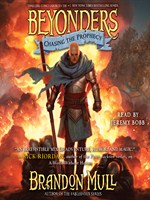
Chasing the ProphecyChasing the Prophecy

by Brandon Mull

Hardcover, 512 pg.
Aladdi, 2013
Read: December 2 – 5, 2013

Wow — Mull concluded his Beyonder’s trilogy in a fantastic fashion. Given the target audience, I couldn’t believe how many deaths there were in this book. But, not in a gory or exploitative way. Just a huge body count. But, the core of this book remained the same: these two Beyonders, Rachel and Jason, risking everything for the sake of Lyrian. There’s sacrifice, honor, loyalty, and courage — all the necessary elements of a tale full of heroes — natives and Beyonders, warriors and children, those with many lives and those with only one to lose. Which is not to say it’s not fun — there’s a lot of fun to be had by the characters and the readers. Great way to go out.
4 Stars

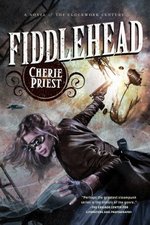
FiddleheadFiddlehead

by Cherie Priest

Paperback, 368 pg.
Tom Doherty Associates, 2013
Read: November 12 – 14, 2013

Nice looking book — love the cover, the layout and the graphics are great. I miss the brown ink — what gives, Tor? Sure, the content is the important thing, it’s just nice when the package it’s wrapped in is nice to look at. Speaking of content — this (like the rest of this group) is a fitting — and thrilling — conclusion to the series. Lincoln (wheelchair-bound following the unsuccessful assassination attempt at Ford’s Theater) and President Grant working together near the end of the Civil War to protect a freeman scientist who built an early computer — the eponymous Fiddlehead. Fiddlehead is the best chance to end the War without making everything worse. The presidents, with the assistance of Pinkerton agent Maria Boyd and intelligence from — well, everywhere else this series has focused — in order to begin to deal with the Rotters. I think it’s possible that Boyd is my favorite character in the series — in the Top 3, anyway.

I just didn’t want this series to end, I understand it needed to, but man…just didn’t want that.
4 1/2 Stars

Opening Lines – Near Enemy

We all know we’re not supposed to judge a book by its cover (yet, publishing companies spend big bucks on cover design/art). But, the opening sentence(s)/paragraph(s) are fair game. Technically, I’m cheating here — I skipped the first eight lines (Chapter 1), this is from Chapter 2, but it’s my blog so I can ignore my own rules, right?

Dare you not to read the rest of the book

—–

This used to be a city of locks.
Every home, at least five, down the door, like a vault.
Chain lock.
Rim lock.
Fox lock.
Knob lock.
Deadbolt.
Funny name, that last one.
Dead. Bolt.
Neither word exactly conjures security.
But no one bothers with that many locks in New York anymore. City’s safer. Or at least emptier. No end of vacancies. And no one bothers to burgle anymore. Nothing left to burgle. Everything’s picked clean, and anyone who still lives in Manhattan and has something of real value to protect — family, dignity, vintage baseball-card collection — does it with a shotgun, not a deadbolt. So the real problem, for the burglar, isn’t getting in. It’s getting back out.
After all, if you apply enough force, deadbolts give.
Shotguns take.

from Near Enemy by Adam Sternbergh

The Best Novels I Read in 2014

I somehow failed at this exercise last year, but I managed to pull it off for 2014. Phew, starting the year off with one in the Win column! Before we get to The Best of, if you’re really curious, here’s a list of every book I read in 2014.

While compiling the best, I started with what I’d rated 5 stars — just 11 novels. I could take just the best 10 of those — piece of cake, right? Wrong. There were titles I expected to see there that weren’t, and a couple that I was surprised to see listed. So I looked at the 4 and 4½ books — and had a similar reaction.

Now, I stand by my initial ratings — for honesty’s sake as much as laziness. But I did put some of my lower rated books in the best, knocking some 5-star books out. They might have been impressive workds, doing everything I wanted — but some of these others stuck with me in ways the 5’s didn’t — emotional impact, remembering details/stories in more vivid detail, that sort of thing.

Eh, it’s all subjective anyway, so why not? I did try to account for recency bias in this — and pretty sure I succeeded, but I may owe an apology or two.

Later today, I’ll post the Honorable Mentions list and the Worst of List — as well as what I’m looking forward to most in 2015. The Day of Lists, apparently. With one exception, I limited these lists to things I hadn’t read before (it shows up in the Honorable Mention post). Enough jibber-jabber, on to the Best Novels I read in 2014:

(in alphabetical order)

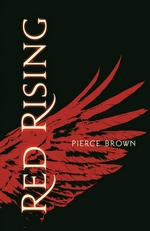
Red Rising (Red Rising Trilogy, #1)Red Rising

by Pierce Brown
My Review
This was exciting, compelling, devastating, thrilling, and occasionally revolting. I can’t tell you the number of people I’ve recommended this one to this year.
5 Stars

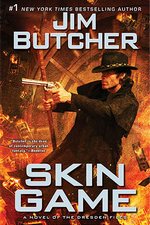
Skin Game (The Dresden Files, #15)Skin Game

by Jim Butcher
My Review
It almost feels like a cheat to put this on the list, but I don’t know if any of the books since Changes would’ve made a year end list, so it’s not like Butcher/Dresden owns a spot here. I laughed, I got pretty darn misty a time or two, I’m pretty sure I audibly reacted to a victory also. Best of this series in awhile.
5 Stars

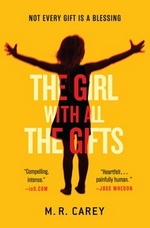
The Girl With All the GiftsThe Girl With All the Gifts

by M.R. Carey
My Review
This probably would’ve gotten 5-star rating from me if it hadn’t had to overcome genre/subject prejudice. Still, freakishly good.
4 1/2 Stars

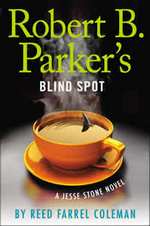
Robert B. Parker's Blind SpotRobert B. Parker’s Blind Spot

by Reed Farrel Coleman
My Review
Coleman knocked this one out of the park, erasing the bad taste that his predecessor had left, and making me look forward to reading this series in a way I hadn’t for years. As good as (better in some ways, worse in others) Parker at his best.
5 Stars

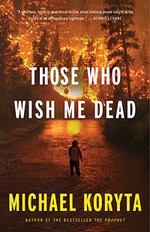
Those Who Wish Me DeadThose Who Wish Me Dead

by Michael Koryta

My Review
Not the best Koryta book I’ve ever read, but something about this one has stuck with me since I finished it. Solid suspense, exciting stuff.
4 Stars

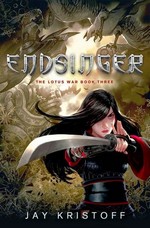
Endsinger (The Lotus War, #3)Endsinger

by Jay Kristoff
My Review
I knew going in that this was going to be a. well-written, b. brutal and c. a good conclusion to the series (well, I expected that last one, expected tinged with hope.). It didn’t let me down. I admit, I shed a tear or two, felt like I got punched in the gut a couple of times and didn’t breathe as often as I should’ve while reading. Such a great series.
5 Stars

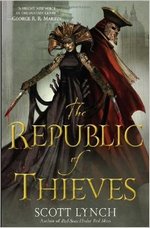
The Republic of ThievesThe Republic of Thieves

by Scott Lynch
My Review is forthcoming
Can’t believe I haven’t finished this review yet — it’s 80% done, I just can’t figure out how to tie the paragraphs together in a way to make it coherent and (I hope) interesting. A lot of this book is a prequel to The Lies of Locke Lamora and yet there was genuine suspense about those parts. Lynch had a big challenge introducing us to a character here that had achieved near-mythic status, and she ended up living up to expectations. Just a gem of a book.
5 Stars

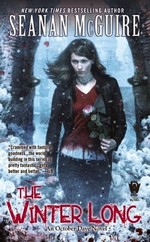
The Winter LongThe Winter Long

by Seanan McGuire
My Review is forthcoming
Again, I’m not sure how I haven’t finished this review yet. McGuire takes a lot of what Toby’s “known” since we met her (all of which is what we’ve “known,” too) and turns it upside down and shakes the truth out. Every other book in the series has been affected by these revelations — which is just so cool. There’s also some nice warm fuzzies in this book, which isn’t that typical for the series. McGuire’s outdone herself.
5 Stars

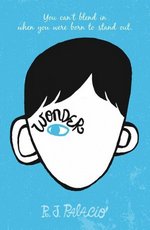
WonderWonder

by R. J. Palacio
My Review
Heart-breaking, inspiring, saved from being cliché by the interesting narrative choices Palacio made. Yeah, it’s After School Special-y. So what? Really well done. I have no shame saying this kids’ book made me tear up (even thinking about it know, I’m getting bit misty-eyed).
5 Stars

The MartianThe Martian

by Andy Weir

My Review
Very science-y (but you don’t have to understand it to enjoy the book); very exciting; very, very funny. Only book I’ve recommended to more people than Red Rising — I think I’ve made everyone over 12 in my house read it (to universal acclaim). Not sure why I haven’t made my 12-year old, yet.
5 Stars

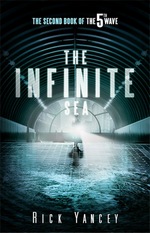
The Infinite Sea by Rick Yancey

The Infinite Sea (The 5th Wave, #2)The Infinite Sea

by Rick Yancey
Series: The 5th Wave, #2

Hardcover, 300 pg.
Putnam Juvenile, 2014
Read: October 4 – 5, 2014
Man, talk about trepidation. Did I want to pick up this book? Was there any chance it could live up to The 5th Wave? Slim to none. But man, I wanted to find out what happens to the Earth. I wanted to know if we ever figure out what the aliens want with the Earth, why they’re eliminating humanity in the way they are. So, prepared to be disappointed, I cracked the cover.

And Yancey doesn’t try to match — or even try to top — The 5th Wave. He writes a very different book. Not one that grabbed me as thoroughly, but one that works in its own way. Where The 5th Wave was a bullet train that you just tried to hang on to — The Infinite Sea was roller coaster you’re riding while blindfolded — the ride lopping, diving, screaming around a corner with no warning, leaving your stomach behind you.

Yancey can’t even give us a Prologue to reorient ourselves to this world, to get our feet under us so we can say, “Oh yeah, this is what’s going on…” before resuming the action. Sure, it starts to seem like that, but nope. He’s right there to pull the rug out from under us at the first possible moment, in a way that catches the reader just as off-guard as the bits of remaining humanity will be.

I read some criticism lately about The 5th Wave that complained about the lack of motivation given for the aliens to do what they’re doing — it makes no sense, and therefore the reviewer couldn’t buy into the book with a motive-less enemy. But to me, that’s why the book worked. Humanity doesn’t understand what’s going on, so there’s no reason we human readers should either. Try as they might, there’s just no figuring out what’s going on other then their great need to survive.

On the whole, we spend time with the characters we met in the first book, those that survived — and, in flashbacks, some that didn’t, Cassie, Sam, Ben/Zombie, and a few others I won’t name because I can’t be sure I won’t spoil something by doing so. We say good-by to some of them, too. We meet a few other characters, too. Some of which we’ll see again. It’s that kind of series. But we get to know almost all of them better, the last book was all about getting to know a couple of these characters really well. This time, we get backstories on everyone, even if it’s pages/paragraphs before they die. This is important, I feel more grounded in this world the more I get to know characters who aren’t Cassie, Evan or Ringer.

And we get some more mature, experienced — and in some cases, informed — hints at what’s really been going on. Still, not enough to placate that other reviewer, I bet — or, really anyone. At one point, Cassie’s complaining about her interactions since Day 1 with Evan.

Every time I edge too close to something, he deflected by telling me how much he loved me or how I saved him or some other swoony, pseudo-profound observation about the nature of my magnificence.

I chuckled as I read it, because this is pretty much Yancey’s modus operandi — just when you get close to learning something, being told something, a character figuring something out, etc. — something explodes or someone starts shooting. Or both. Not a way to tell a narrative that satisfies everyone or to show off brilliant world-building. But a it’s great way to keep pages turning.

I found this to be a very satisfying read. As I said, I didn’t expect to be as taken with this book as I was its predecessor, and I wasn’t — but in a way, I’m sucked into this series more than before. I really don’t know the last time I said “son of a — “* out loud at a book as much as I did with this one. It’s probably not since Butcher’s Changes that I’ve called a writer so many names as I’ve read. Yancey just keeps throwing me for loops. Not the best book I’ve ever read, not high literature, but edge-of-your-seat thrills, convincing characters, and honestly come by surprises. Really entertaining stuff. That’s all I ask for.

—–

* I seriously don’t finish the sentence, because I’m too busy shaking off whatever trauma is thrown my way and getting back into things to bother.

—–

4 1/2 Stars

Page 30 of 34

Powered by WordPress & Theme by Anders Norén