Category: Urban Fantasy Page 43 of 45

Hounded by Kevin Hearne

Hounded (The Iron Druid Chronicles, #1)Hounded by Kevin Hearne
Series: The Iron Druid Chronicles, #1

My rating: 4 of 5 stars

It took no time at all for this book to grab me, and another 15 pages for me to fall in love with this. Right off the bat we get a solid action sequence, get the basics of our hero’s magic system, and meet a goddess. Not a bad start–it helps a lot that Atticus’ personality and charm comes through right away and draws you in.

Then we get a talking dog. Technically a dog (Oberon the Irish Wolfhound) that can communicate telepathically with Atticus, but why get picky? Oberon’s snarky, smart and pop culturally savvy–he runs a close second behind Harry Dresden’s Mouse for coolest pooch in Urban Fantasy. I’d be willing to read a book that’s nothing but Atticus and Oberon hanging out.

Throw in a helpful werewolf pack, a friendly vampire, a troublesome local coven, and a fight with an ancient Celtic deity and you get yourself a dynamic intro to what seems to be one of the best Urban Fantasy series around.

Hunted by Kevin Hearne

Hunted
Hunted by Kevin Hearne
Series: The Iron Druid Chronicles, #6

My rating: 5 of 5 stars

Try as I might, I can’t figure out a way to get Goodreads to let me give this as many stars as it deserves — 6. I don’t think it’s possible for Hearne to write a bad book, but Hunted is beyond good. Not that Hearne has ever seemed anything but self-assured and capable (sorta like Atticus), but he’s really firing on all cylinders here — from the jaw-dropping and series-changing events of Chapter 1 through all the plot, twists, character moments, quips, action, and development that follows — Hearne delivers with verve and panache.

I don’t know how to describe the storyline without plunging neck-deep into spoiler territory, so let’s just say that this picks up minutes (if not seconds) from Trapped and keeps going from there. Virtually every character from the previous five novels makes an appearance (if only with a name-drop), and we get a few new characters from the pages of myth (Irish, Greek and Roman predominantly, but most of Europe is well-represented here) as well from Hearne’s own imagination. Our favorite Druids face off with a couple of new opponents, try to broker a peace with Greek and Roman pantheons, prepare for Ragnarok, and try to suss out who amognst the Tuatha Dé Danann might be working to bring about their untimely demise. (clearly, our heroes don’t get a lot of rest in these fast-moving 300 pages to get all that addressed)

Not that Atticus has had an easy go of it since the beginning of Hounded, but Hearne really puts the hurt on him this time around. He has two of the closest calls I can remember a first-person narrator dealing with in recent history — and he gets both of them in one book! Though honestly, the emotional and intellectual challenges he faces are probably harder for him to deal with — his Bear charm and tattoos can’t help him with those. Naturally, he rises to the challenges and even pulls off a couple of schemes that would make his buddy Coyote proud. While remaining Atticus at his core, there are flashes of a ruthlessness and hardness that we haven’t seen much of before. A good reminder that a Celtic warrior was formidable opponent (thankfully, there are things that still make him balk!)

While most of the book is told from Atticus’ POV as usual, we do get a few chapters from Granuaile’s POV. I appreciated seeing things from her perspective (not just the parts that Atticus couldn’t relate, either) and I learned a lot more about a character I thought I knew pretty well already. I think she’s just about at the point where we could get Granuaile novels with minimal use of Atticus (see the Joe Pike novels) and not feel we were missing much — if anything, the fight scenes might be a bit more savage. There’s a danger here (I think Atticus himself sees this) in her becoming too much of an eco-warrior (think Captain Planet as told by Tarantino), and I think that could make for problematic reading if it went on too long or too extreme. But until then, I’m enjoying the heck out of this warrior woman.

If you’re already reading this series, you’re in love with Oberon (or have no soul). If you’re not reading it, you’ve probably not read this far — but if you have, just know that it’s worth buying the 6 books just to spend time with this most wonderful of Irish Wolfhounds. When I described Chapter 1 in words similar to my first paragraph to my wife (who’s a couple books behind), she simply stopped me, “He didn’t kill Oberon, did he?” I got the distinct impression that my books would be headed for the trash pile (or would be tossed on the barbeque) if I answered yes. Thankfully (on many levels), that’s not the case. Even better, this is the best use of Oberon yet — of course, he’s hilarious and inappropriate as always — but he also gets to be heroic, inspiring and even moving. I’m not kidding, my eyes got misty a couple of times just because of him.

Any book that does all that while pulling off things like citing Wheaton’s Law within a few pages of quoting Dante (in the original!) needs to be celebrated. Now the wait for book 7 begins. (sigh)

Blood Trade by Faith Hunter

Blood Trade
Blood Trade by Faith Hunter
Series: Jane Yellowrock, #6
My rating: 4 of 5 stars

Jane Yellowrock is slowly, but surely, becoming a real favorite of mine. In the beginning, she struck me as a fairly generic vampire hunter, with an obnoxious streak and a complicated ethnic/childhood background that was passed off as interesting. Nothing special, but good enough to keep reading.

But lately, I’ve found myself anticipating the next installment. Blood Trade resolved a few dangling plotlines from previous books, developed a couple more, and set the stage for at least 2-3 more books in the series. And while doing so, provided a story with good action, some nice twists, and some genuine heart.

I really, really liked the new characters introduced here — two former classmates of Jane’s back from her Christian school days and the child of one of those classmates. It was good to see Jane through the eyes of people that didn’t primarily know her as a vampire killer.

Jane’s relationship with Eli and the Kid grew in a positive way, and I really like the shape of their relationships, and hope they continue to develop in this fashion.

One thing I hope Hunter improves on — although I don’t see it happening — is the romance front. I couldn’t care less about Jane’s vacillating between various romantic (using the term as broadly as possible here) interests here. It’s tedious, Jane’s usually shown as little more than base desires, and constantly self-sabotaging. If there was some growth there, some change at least, I might feel differently. But Hunter shows no sign of moving off this point, and I bet I’m one of the few who don’t like it. So I need to continue to deal with it.

Indexing, Episode 2: Musical Patchwork by Seanan McGuire

IndexingIndexing by Seanan McGuire
Series: Indexing, #1.2

My rating: 3 of 5 stars

Episode 2: Musical Patchwork

Now this is settling in to be something I want to read.  Here in Episode 2, things are settling in — we’re getting to know these people as characters, not just as types or names, but as people.
First and foremost in this regard is Demi Santos, who we met last time, the Piper that came to the rescue — at the cost of her own lifestyle.  Watching the others deal with her apparently great and uncommon power should prove compelling.  Henry/Henrietta, our Snow White protagonist also seems a bit more like a person  now, and more like someone I want to read the continuing adventures of (nicely — and not surprising — she’s not a Toby Daye or Verity Price clone).  I could use a little more rounding of Andy, the actual, normal human (the guy who most authors would use as the protagonist, the reader’s entry way to this world), but I like what we have so far.
I think it’s entirely possible that Jeff, the cobbler elf, could be my favorite of this bunch — just for the fun to watch him and his particular traits be exploited by Henry while making him more content than anyone else we’ve met.
Sloane, the gothy Wicket Stepsister with a shoe-shopping fixation is still mostly a small collection of quirks and ticks.  But it’s early days yet.  I do get the impression that McGuire wants us to like her more than I do, but that’ll come.
The biggest development is what the dispatchers, in particular, Birdie (a character who starts off rounder than most in this book), seems to give us the central conflict of the book.  That the stories the Agents are sent out to contain/manage seem to be one type on the initial analysis, but end up being another once agents are on the ground.  Henry seems perplexed (to say the least) and I can’t say I blame her.  I suspect the answer to this will be quite interesting.

London Falling by Paul Cornell

Spent the last hour or so of my shift this morning writing/researching/tweaking a paragraph or two in between my chores for this review. This afternoon, I read what I’d labored over and realized the entire premise is bunk, and needed be round-filed promptly (despite really liking everything I’d written). Lesson for the day: don’t read, just post.

—–

London FallingLondon Falling by Paul Cornell

My rating: 4 of 5 stars

This is not your typical Urban Fantasy. Nor is this your typical Police Procedural. Lastly, this is not your typical UF/Procedural mash-up (see: Diana Rowland‘s Kara Gillian series, or Ben Aaronovitch‘s Peter Grant series). Instead, this is the wow-inducing freak show of a lovechild of Christopher Fowler‘s Bryant & May Peculiar Crimes Unit procedural and Mike Carey‘s Felix Castor UF books.

These series share a certain subdued wit, a cynicism tinged with hope, and a certain amount of a-typical characters for their respective genres. But more importantly for this comparison, they share a richness, appreciation for, and dependence upon London’s geography, culture and history (particularly the bits that few people know about, which are rife for use/manipulation in fiction). If that doesn’t sum up Cornell’s work, I’ll eat a Union Jack emblazoned hat.

Oh, also, the more I read of Bryant & May, the less I understand the London Police Force’s organization and slang (which any number of British TV police shows and other novels convince me I’m pretty familiar with). Cornell outdoes Fowler on that score. Sure, there’s a glossary at the end of this book, but that’s not advertised anywhere, and I didn’t realize it until it was too late. But sussing all that out is part of the charm of these books — I appreciate how little they feel compelled to hold the audience’s hand a little more than I’m frustrated at the extra work.

Enough preamble. What starts off as the ill-advised attempt to wrap up a major undercover operation (based more on economics than police work) turns into a child serial killer case that ends up captivating and frightening the residents of London while a band of four policemen (one of which is technically a civilian aide — or maybe she’s a different type of officer, but I don’t think so, see previous paragraph) track the killer that has the rest of the force completely befuddled. These four spend as much time battling their own demons — within and without, metaphorical and otherwise — as they do working the cases. Oh, and you can forget about any real esprit de corps amongst these four, just to complicate matters further.

The major reason for the befuddlement of the rest of the force is that the killer is using all sorts of magic — in truly horrific ways, for even more horrific reasons, and only our four heroes (for lack of a better word) can see that. These four didn’t start the novel being able to see magic, and spend a good deal of time trying to figure out what’s going on with their eyes and ears now — and not in a fun montage-y way the way they do in Spider-Man movies. Theirs is a real baptism by fire, learning as they work desperately to save children and footballers both from being the killer’s next victims.

Yes, I said children and footballers. Just roll with it.

In the wrong hands, this could be the makings of a mess. Cornell doesn’t play any of this for laughs, or lighter moments — there is practically no joy to be found in this grim novel of a grimmer world of miserable people. But his are the right hands, and Cornell handles all these bits and pieces like a seasoned pro and deftly shapes them in to a kiester-kicking read.

Highly recommended.

Indexing, Episode 1: Attractive Narcolepsy by Seanan McGuire

I’m having a hard time making any headway worth noting with my main read — Hemingway’s For Whom the Bell Tolls, so I was glad when I got the notification that Episode 2 of Indexing was ready to download. A great reminder to take a break from Robert Jordan, et al. and read Episode 1.

—-

IndexingIndexing by Seanan McGuire
Series: Indexing, #1.1

My rating: 3 of 5 stars

Episode 1: Attractive Narcolepsy
What an intriguing concept — and difficult to explain without just quoting either the text or the publisher’s description. But essentially, seemingly at random, Fairy Tales come to life, taking over people’s lives, forcing them to reenact the basic plotlines over and over again — leaving ruined lives and corpses in their wake. There’s an MIB-type organization dedicated to controlling these events and preventing Muggles from realizing what’s going on.

It’s hard to know what to say about this episode, there’s a lot of pipe laying here — setting the stage, introducing the characters/world/concept — and only the barest of stories. But what we got was entertaining enough to keep me reading. As a short story, I’m not sure how engaging it was. As a first chapter, it’s a start — especially since it’s McGuire steering this ship. Future episodes likely can’t come fast enough.

Dusted Off: Turn Coat by Jim Butcher

Turn Coat (The Dresden Files, #11)Turn Coat by Jim Butcher
My rating: 4 of 5 stars

On the whole, Turn Coat is about the problems in the wizarding world that Butcher’s been giving hints about and glimpses at for a while now–and they come into focus in the most surprising of ways–Morgan asking Harry for help.

There’s just so much good stuff to be mined from Harry helping Morgan hide from the Wardens, deal with the Merlin (and others at HQ), investigate a murder/frame-job–it’s almost a shame to see Butcher wrap it up in 400 pages, because I’d love to get more of it. Great stuff.

In addition to all that, we see three important relationships forever altered in important ways (well, maybe one’s only temporarily altered, time will tell)–some good long-term character development for our pal Harry and his gang.

So, so good–Butcher had the ol’ brain firing on all cylinders for this one.

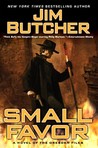
Dusted Off: Small Favor by Jim Butcher

Small Favor (The Dresden Files, #10)Small Favor by Jim Butcher
My rating: 4 of 5 stars

Loved this book the first time I read it, and it’s better the second time around (if for no other reason than I could slow down and enjoy it more rather than have to race to find out what happens). Like he’s been doing for awhile now, the stakes get bigger–as do the foes–in this book, as does the cast.

At the same time–for most of the book anyway–this is a lighter read than the last couple have been, it’s a bit more “fun” in the midst of the darkness and destruction, I guess you could say.

And then the fun goes away and you get only darkness and destruction for awhile–and an emotional punch in the gut that fans really didn’t want (but love anyway).

I’m not sure how well this’d work as a jumping on point for someone new to the Dresden Files, but I think it’d stand on it’s own, and show readers why they’d want to go back and read all of the best Urban Fantasy series going.

Dusted Off: Midnight Riot by Ben Aaronovitch

Midnight Riot (Peter Grant, #1)Midnight Riot by Ben Aaronovitch
Series: The Rivers of London, #1

My rating: 4 of 5 stars

In a very real sense, there’s practically nothing new in this book–neophyte wizard just discovering a world of magic; super-secret police division tasked with investigating (and covering up) supernatural crimes; a whole world of ghosts, vamps, trolls, dryads, nymphs, demigods living unseen amongst mortals; clever (and funny) pop culture references littered throughout the text; and so on…Urban Fantasy 101.

BUT, there’s something about the way that Aaronovitch writes that makes Midnight Riot so fresh, so entertaining, so fun, it feels like I’m reading a brand new genre. He’s basically the British Anton Strout (but a tad bit funnier).

I had a blast reading this–every second of it–laughed out loud, sat on the edge of my seat, and tore through this book.

Dusted Off: Master of None by Sonya Bateman

Master of None (Gavyn Donatti, #1)Master of None by Sonya Bateman

My rating: 4 of 5 stars

I’m way late on this, but really wanted to write something about it, and yet I’m really lazy. So, this isn’t going to be as good as it should be…let me start by quoting from the back of the book (or the amazon/goodreads description anyway, think it’s what the book had on it):

ONE UNLUCKY THIEF. ONE UNLIKELY GENIE. ONE VERY ODD COUPLE. Gavyn Donatti is the world’s unluckiest thief. Just ask all the partners he’s lost over the years. And when he misplaces an irreplaceable item he was hired to steal for his ruthless employer, Trevor—-well, his latest bungle just might be his last. But then his luck finally turns: right when Trevor’s thugs have him cornered, a djinn, otherwise known as a genie, appears to save him.Unfortunately, this genie—-who goes by the very non-magical name of “Ian”—-is more Hellboy than dream girl. An overgrown and extremely surly man who seems to hate Donatti on the spot, he may call Donatti master, but he isn’t interested in granting three wishes. He informs Donatti that he is bound to help the thief fulfill his life’s purpose, and then he will be free. The problem is that neither Donatti nor Ian has any idea what exactly that purpose is.

If that description doesn’t pique your interest, you’d better skip this novel. If it does, on the other hand, grab the book–it delivers on the promise in spades. I mean, come on! A grumpy djinn “serving” a barely competent thief.

It’s a good read, with a heckuva cast of characters, gritty but not grim–ensured by an overly generous supply of wisecracks, and a magic system/overall mythology that’s intriguing and rich enough to mine for a long time.

Master of None is enjoyable enough on its own, but now that the initial bout of setup and world-building is done, I’m really looking forward to seeing what Bateman has in store for this series.

Page 43 of 45

Powered by WordPress & Theme by Anders Norén