

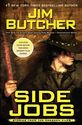
 I’m not big on the short story form. Outside the Nero Wolfe short story collections, I could count on one hand the number of short stories I’ve read in the past 5-10 years. Lately, there’s been a decent number of my favorite Urban Fantasy writers contributing to short story collections–usually on a theme, and usually using characters I really want to read about. But being short fiction, and being surrounded by stories about characters I don’t care about/don’t know/don’t have time to get to know even if I wanted to, I don’t get around to getting my hands on them.
From what I can tell, that’s resulted in me missing some interesting stuff–even the start of a series I’m invested in (maybe more than one, come to think of it, but I’m not going to double check now).
Which is a whole lotta rambling set up to saying why I was very happy to hear that Jim Butcher was going to release a collection of previously published and new Harry Dresden stories. And even happier to get my hands on it last week.
Being short works of fiction, basically every story was this–some sort of problem, Harry investigating rather quickly and then moving right on to the fireworks, usually dazzlingly so. Wham, blam-o, thank you, sir. Each of them also tended to focus on at least one member of the supporting cast in a way we don’t get enough of in the novels. I really appreciated getting to spend a little time with each of these people in this setting.
It was, admittedly, a mixed-bag. The first story, “Restoration of Faith,” was the first Dresden story, and it’s clearly that. There’s a lot to our favorite wizard PI that is recognizable here, and a lot that get’s tossed before Storm Front. A fun read, but I’m glad Butcher tweaked things the way he did.
The rest were better executed–mostly because Butcher’s grown a lot as a writer since then, all were good reads, some better than others.
A couple of other stand-outs for me were the lighter, “Day Off” about Harry’s fruitless quest for a quiet, relaxing day; “The Warrior” in which we get to see post-Small Favor Michael in action–even if it was a tad preachy, Butcher pulled it off, and I was so, so glad to see Michael like this; and “Love Hurts,” which is the kind of story we’ve seen/read countless times about what happens when two will-they/won’t-they friends fall under a spell/temporary delusion/whatever and fall madly, temporarily in love–it’s been done a lot, frequently poorly, but not here.
“Love Hurts” was also a perfect set-up to the novelette Aftermath, which starts up hours after the jaw-dropping/rage-inducing last page of Changes and was, for me, worth the purchase price. If I’d remembered that this was going to be at the end of this collection, I’d have finished the thing in one setting, rather than over a period of days. Great, great story, both for the plot/characters itself, and for what Butcher shows us about how these characters will act without the man in the duster around. Loved it.
Now, this hasn’t convinced me to get these other collections I mentioned earlier–but I just now have hope that some of my other favorite authors will get in gear and publish collections like this one.
 and would like to thank you for one of the best reads I’ve had in months. And by thanks I mean to say that I hope you die a slow, agonizing death. Not anytime soon, mind you, it needs to be after you’ve completed the next novel (if not the whole series). Still, I hope it happens, and I hope you dread its coming.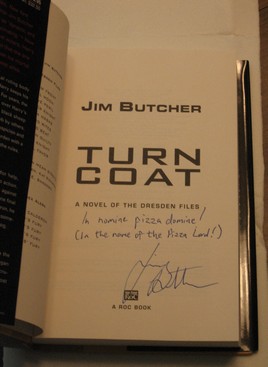
 Just knocked off Jim Butcher’s
  – I’ve read all but one or two of Buckley’s novels, and it’s fair to say he’s my favorite satirist. In
  – The latest (last?) installment in the Leo Waterman series, is definitely the darkest. About half-way through this novel Leo stops going about this the way he normally does and instead assembles a team of criminals to start a major sting/blackmail operation. It bugged me while reading it, and by the time it was over, it bugged me a lot. I can’t really put my finger on it, but it didn’t feel like Leo, more like one of Spenser’s weaker escapades. The romantic subplot really worked for me, as did the b-plot with the runaway, but the A-plot…eh. I really hope that Ford gets back to this series so I can see how he’s going to take things with Leo’s love life–part of me is glad to see him risking the status quo; but the other part of me really likes Rebecca as a character, and I’d rather see more of her than less. But mostly I want to see if Ford continues to take this series in the darker direction this novel heads down (and his newer series seems to take), or if he lets Leo return to being Leo. Personally, I hope he takes the latter route–I miss the fun Elvis Cole (not that I totally mind the darker Elvis), don’t want to lose the fun Leo, too.
 – I really wanted to like this book–DeLillo’s one of my favorites. But this thing? Blah. This is DeLillo’s take on 9/11 and the aftermath. The scenes about the protagonist leaving the scene of the WTC attacks, and those showing how his son and his friends are reatcing to the attacks–those are really well done. And there were sentences, or paragraphs, that were great to read. But on the whole, this was a dreary novel, about dreary people reacting to horror in a dreary way. Worst thing I’ve read by him–which is strange, as many critics hail it as one of his best–who knows, maybe bluewoad’s rubbing off on me.
 – Tropper delivers yet another fun novel about a young man dealing with death (and how often can you say that?). This time, Tropper’s protag married an older woman with a teenage son. A plane crash cuts short their life together and now the widower has to put his life without her together. Of course, the teenage son is a complication that he’s not ready for. Tropper’s characters frequently have a strong woman character as friend/love interest (no matter how taboo). This time a twin sister takes care of the friend part of the equation–and is one of the more interesting characters he’s created. The quirky disfunctional family is along for the ride–the father, of course, being the most screwed up (not that mom is that together). Tropper doesn’t miss a beat, hit a wrong note, or flub the rhythm once in this book. Charming, funny, bleak, and hopeful. Probably his best work to date.
 – Wilson proves that you don’t have to be named J. K. Rowling to write children’s fiction that’s worth reading if you’re over 13. Good, imaginative, adventure story. Wilson’s got a natural (genetic?) way with words, that he’s honed well–would likely be a pleasure to read even if the plot and characters were weak.
 – This one’s a “Young Adult” novel, which again, puts me out of the target audience. Ooops. Actually, I think the target is teenage girls, so I’m really out of the target. Really don’t care. Meyer can tell a story. Even if the story is an implausible love story about a loner teen girl and a vampire whose Byronic personality is on loan from a Bronte novel. Probably one of the better vampire novels I’ve read (and I seem to be reading a lot of them lately for no apparent reason).
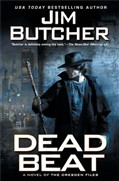 Here’s the set-up, Harry Dresden’s a PI. Loner-type. Has a pal in the police department that feeds him some work. But he free-lances as well. Loose collection of friends who can help him out–Bob, who seems to have background on everything; his half-brother who’s good for added muscle and to bounce ideas off of; Butters in the morgue; and so on. Typical hard-boiled PI novel stuff.
 Like I said, typical. She lives in a small Louisiana town filled with antebellum homes and all the people she’s known her entire life.