Category: Writing Page 3 of 4

A Few Quick Questions With…Michael Landweber


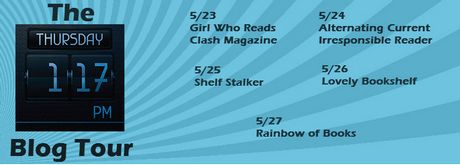
For our third post on this Blog Tour stop, the author of Thursday, 1:17 PM, Michael Landweber was gracious enough to A some of my Q’s. As is typical, I kept it short and sweet, because this dude is busy and he doesn’t need to take up too much time with lil’ ol’ me. There are two questions here about the book we’re focusing on, and then we move on to more general questions. Hope you enjoy.

Michael LandweberMichael Landweber lives and writes in Washington, DC. His short stories have appeared in literary magazines such as Gargoyle, Fourteen Hills, Fugue, Barrelhouse and American Literary Review. He is an Associate Editor at Potomac Review and a contributor to Washington Independent Review of Books. Michael has a soft spot for movies about talking animals and does not believe he would survive the zombie apocalypse. His first novel We was published in 2013.

There are so many questions that I’d like to ask about some of the details of this book, but I’m going to have to settle for something about the process: did you have the rules for the Frozen World set up before beginning the book, or was that something you felt out along the way?
The rules were pretty simple and set from the beginning. Nothing moved unless it was affected by Duck. He would be the only force in the universe capable of changing anything. Otherwise, everything remained in exactly the state it was in when the world froze. Simple, right? Making up the rules was easy; following them was hard. There were many times while I writing when I would decide to do something and realize it didn’t fit in with this world. For example, in an early draft, I thought about shooting someone with a gun. But in order to fire, a gun required more than just Duck power. Similarly, I found myself realizing that he couldn’t cook anything; he could only eat food that was edible at the time the world froze. He couldn’t start a car, but he could ride a bike. So it was never a question of changing the rules. It was a constant struggle forcing myself to not cheat. Hopefully, I policed myself reasonably well. One of the reasons that I had Duck write a guidebook was because it was a great way to share everything about the frozen world I had spent so much time figuring out. That’s why you’ve got multiple pages about how to flush a toilet (and of course because I find details like that amusing).
How hard was it to get into the headspace of an almost 18 year-old (even one of above-average intelligence/thoughtfulness)? Once there — was it as much fun as it seemed?
It is always a challenge to get into a new character’s head. Or maybe the challenge is getting out of your own head. With a teenager, I did have the advantage that I was once 17 years old. However, it is true that when you become an adult, you forgot how desperate everything feels at that age. As adults, we learn to repress some emotions. It’s a survival skill. So, to write Duck, I tried to remember what it felt like when every emotion was on the surface and raw. I think that immediacy is what we lose as adults. Once I got in that mindset, it was fun to write Duck. Anytime I started to think that Duck shouldn’t be doing something, I usually put it in the book, figuring if I thought it was a bad idea then a teenager probably wouldn’t.
What’s the one (or two) book/movie/show in the last 5 years that made you say, “I wish I’d written that.”?
There are so many books and TV shows that I enjoy. I’d love to have written any of them. Of course, the flip side of that is that if I had written them, then I wouldn’t get to experience them the same way. I do surprise myself sometimes when I’m writing, but that’s not the same as the visceral thrill that you can get from watching or reading someone else’s work when the unexpected hits you with a perfectly timed twist. That said, there are two very different works that I wish I could have written. First, The Martian by Andy Weir. I would love to have written something that was so meticulously researched and incredibly readable at the same time. You get to the end of the book thoroughly entertained while somehow convincing yourself that you could now survive on Mars if you had to. Second would be Breaking Bad. The entire series. I admire how strictly it stuck to its vision from the beginning. The writers didn’t seem to care how popular it got. They weren’t trying to make anyone happy. It was unflinching to the very end.
Is there a genre that you particularly enjoy reading or watching, but could never write?
I could never write a good mystery. I don’t watch or read a lot of them, but I do enjoy them when they are well done. As a reader, I never know who committed the crime. Ever. I’ll always think that it is someone who was innocent. I admire the writers who are able to put that puzzle together and keep me guessing to the last piece. But as a writer, my mysteries would probably be more like a pre-schooler’s giant floor puzzle with only four pieces and no irregular edges.
I’ve often heard that writers, or artists in general, will forget hundreds of positive reviews but always remember the negative — what’s the worst thing that someone’s said about one of your books, and has it altered your approach to future books?
There was one reader review posted on a website about my first novel that stuck with me. He said that after reading it he had to bleach his brain and encouraged everyone to keep the book away from children. Actually, now that I think about it, maybe that was one of my good reviews. Seriously though, there are always going to be readers who don’t like certain things I write. So far, it hasn’t changed what I decide to write next.

Guest Post: The Machine Keeps Feeding Me by Clay Johnson


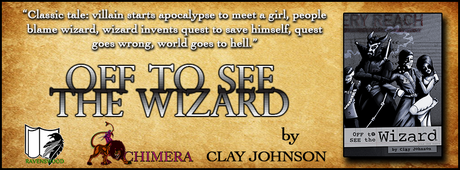
Welcome to Part Two of our participation in the Off to See the Wizard Book Tour (see Part One), a couple more posts will be up in a while. This is a Guest Post by Clay Johnson, the novel’s author, about his process:


I have to hear the words in my head before I start writing, or I’m pretty much hosed. I used to plan out the whole story, or at least try to. I spent a lot of time thinking about it, picturing the action and the plot points, really getting into the thing. I did a lot of imagining while listening to music. I figured if I could see what I wanted to write, then I was golden. Unfortunately, when it came time to actually sit down and do it, I’d hit a dry spot. It wasn’t writer’s block, though; it was more like I was incredibly bored. What I pictured so vividly in my head just wasn’t coming out anywhere nearly so thrilling, and in the few instances that it did I still wasn’t particularly captivated by the process. I kept trying though, and I kept ending up with a bunch of barely started or, at best, half-finished manuscripts.

One day, somewhere around senior year, of high school, instead of an idea, I had just a line. It wasn’t a particularly good line. It was something like: Bill woke up to find death staring down at him and asking if they had any nachos. But I liked what the line made me think of, and I was bored in class, so instead of trying to plan out what that story might be I just went with it. The result was an awesome mess. But it was an “awesome” mess. It was full of great little moments, and a lot of threads that led nowhere. I couldn’t use the story for anything, but I felt invigorated the whole way through. In working on that story I finally figured out my problem. If I knew where the story was going, I didn’t care. I’d already thought that part out; I just wanted to move on to the next story. Somewhere in the transition from over-planning to not planning, I’d found my voice.

I started riffing on just a line, or a vague idea built around a specific image. But the trick was that I had to be able to hear at least the opening line in my head. I had to be able to hear the voice the character would use. As long as I could tap into that, then I could continue the story. The rest seems to take place beneath the surface.

It feels like there is some constantly running story machine cranking away somewhere in the basement of my mind, and while I’m busy doing other things, it’s making connections and drawing paths between two unplanned plot points. Those are the moments I love the most when I write, those moments where two bits that I wrote on a whim meet up and fit together so well that I can’t believe they weren’t planned. Writing this way makes it harder in the revision process, because I end up with a lot of gems I want to keep and can’t, and there’s also a lot of connections that still have to be made after the fact, but almost always less of them than I would expect. As long as I can tap into the sound of the story, the way the words flow and the beat of the thing, the machine keeps feeding me.


A Few Quick Questions With…M. T. Miller

I posted about M. T. Millers’s Risen: First Book of the Nameless Chronicle yesterday (if you didn’t read it, take a moment now — or skip what I said and go get the book). Miller was kind enough to participate in a Q&A with me. I asked some Risen-specific questions and then a couple less-so. I kept it short and sweet, because I’d rather he work on his next book than take too much time with me, y’know?

What got you into writing? Who are some of your major influences? (whether or not you think those influences can be seen in your work — you know they’re there)
Misfortune got me into writing. Due to an unforeseen death, me and my SO found ourselves severely lacking in currency, so I took a ghostwriting gig to plug the leak and save the ship. After some time, having seen quite a bit of the more popular stuff first hand, I decided I was just as good. Time will tell if I was right.

As for my major influences, I’d say those would be George R. R. Martin, Scott Lynch, and on a less conventional note, whoever it is that did the story for the Nier/Drakengard series of games. I think his name is Yoko Taro. I see their presence quite clearly in my work. Martin taught me how to swing the axe, but to do it effectively as opposed to liberally. Lynch helped me with the same thing, but did so with the wit and style I can only hope to match some day. As for Yoko Taro, well. . . he taught me how to handle unhinged characters in a way that works.

How many stories do you have in mind for this? I assume you know what’s going on with Nameless — who he is, where he’s from, what kind of supernatural being he is and so on — how hard is it to give your readers bits and pieces of this information here and there? How long before he figures it all out? Sister Chastity seemed to know — did she? (feel free to not answer those last two — or to make your answer as teasing as you want)
The whole story is planned to run for some six installments, each longer and more complex than the last. For instance, book two will be roughly twice the size of the first one. Of course, I might increase or decrease the number in the future by splitting or fusing story arcs. We’ll see.

I’ve found it much easier than expected, and more fun for that matter, to spread little clues about. I’m not a very subtle person; I go straight for the throat, and I feared that the whole mystery thing would suffer for it. Luckily, I seem to have gotten it under control. At least for now.

Several big reveals will happen sooner than you might think, but answers always come with more questions.

The Sister has seen her fair share of weirdness, but her relation to the Nameless was more defined by his charity than what she knew or didn’t know.

In the writing of Risen, what was the biggest surprise about the writing itself? Either, “I can’t believe X is so easy!” or “If I had known Y was going to be so hard, I’d have skipped this and watched more TV”.
I never expected the epilogue to come out as good as it did. I wrote it in one sitting, and it came out absolutely perfect. It still gives me the chills.
“Horace” is a great name, but not a common one — is there a story behind your selection of it?
There’s a story behind every name, even the lack of one. For me, the name “Horace” invokes the Old West, the American Civil War, and the like. Given that the Nameless Chronicle is more or less “Old West meets apocalyptic fantasy,” it just felt right.

A Few Quick Questions With…Vanya Ferreira

This morning I blogged about Vanya Ferreira’s story, “The Story of Lucius Cane: Book One,” a promising start to a series of stories about an atypical Vampire. Vanya was kind enough to take part in a little Q&A with me about his writing in general and his upcoming projects. I kept it short and sweet, because I’d rather he work on those project than take too much time with me, y’know?

What got you into writing? Who are some of your major influences? (whether or not you think those influences can be seen in your work — you know they’re there)
That’s actually a very interesting question. I remember my parents reading to me as a child and as I got older, my friends would be out and about, while I roamed in the library. I always found the library to be my sanctuary; a place where different worlds, knowledge and realities all overlay. I guess that it was all the reading that got me into writing but this only came much later; I did, in fact, actually despise English as a subject at school. Some of my major influences would have to be Stephen King, Paulo Coehlo, Oscar Wilde, Aldous Huxley, George Orwell, Christopher Paolini and many more.
About Lucius Cane: how many stories do you have in mind for this? Or are you going to expand this into a novel?.
I’m actually thinking about having 3 to 4 books for this series which would include a complete background of who Lucius is. However, to keep something of the mystery and why he is who he is, I plan to release the background as the final book in the series. I don’t think that I’ll expand it into a novel but I’ll rather just keep it as a short story collection that flows into each other. I have noticed with today’s society that our attention spans have gotten rather short and I think that this makes the story easier to read and keeps the excitement for what’s to come next.
Your Amazon bio says that you’ll have Crime Thriller out this year — what can you tell us about that?
Yes, indeed, I am. At the moment it is still very much a work in progress and doesn’t have a title yet. I believe that it will be quite different than most crime thrillers out there since it closely follows the life of the killer himself as the main character. I wanted to create something that would take the reader through the emotional depths and the crevices of madness that I imagine many killers must feel. For example, the serial killer William Heirens (a.k.a The Lipstick Killer) actually wrote a call for help in lipstick at one of his crime scenes, which just goes to show how difficult it must have been for him to be, well, who he was. So my aim for the novel is to try and transform that mental disparity and transport the reader into the world, and hopefully mind, of a killer.
In the writing of “The Story of Lucius Cane”, what was the biggest surprise about the writing itself? Either, “I can’t believe X is so easy!” or “If I had known Y was going to be so hard, I’d have skipped this and watched more TV”.
About the writing itself? Hmm… I think that I was quite surprised at how easily the story unfolded. I remember that I had the vague idea of someone watching a girl from the bushes, as seen in the prologue, and the rest just seemed to flow. I admit, however, that there were days in between where my inspiration just flat-lined but it seems that to just continue writing would spark it back up. Apart from the writing, I would have to say that the biggest surprise, by far, was the amount of work it takes to actually publish and promote a work. Looking back, it’s quite clear that writing was merely the first, and easiest, stage; it’s the promoting and getting it out there where the real work is at.

A Few Quick Questions With…Joe Klingler

I posted about Joe Klingler‘s novel, Missing Mona last week (if you didn’t read it, take a moment now — or skip what I said and go get the book). Klingler was kind enough to participate in a Q&A with me. I asked some Missing Mona-specifc questions and then a couple of generic questions. I kept it short and sweet, because I’d rather he work on his next book than take too much time with me, y’know? It could’ve been a little shorter, but he insisted on providing thoughtful answers (I really appreciated the last one)

Where there challenges in writing someone going through a “technology reallocation phase” that you didn’t expect? I’ve often thought Sue Grafton’s books would be at least 1/3 shorter if Kinsey had a cell phone — there are so many things she has to do to make a call/get messages/get information/etc.
One of the challenges was how to keep Tommy connected to a grid that he wasn’t a part of, since all of the other characters had smartphones, and used them constantly. He was already an outsider from another town, but his lack of a phone also made him an outsider in the virtual world as well. He had to constantly figure out how he was going to solve problems without technical assistance—which wasn’t always even possible. However, his interaction with paper messages, meeting times, and just showing up places unannounced provided experiences that would have never happened if he had just sent a text.

The other challenge he immediately faced was how to fill all the alone time created by not being constantly connected to the stream of text and images most people interact with all day long. This gave him time ponder and appreciate his new experiences, plan his next step, and even practice his guitar.

Seeing the references to Martin Caidin on your website warmed my heart — I was afraid I was the only one who remembered him. Describe some the influences on Missing Mona beyond the initial inspiration from Crais (whether or not you think they’re on display in Missing Mona).
Caidin’s The God Machine started me thinking long ago about the perils of power concentrated in one place (or person, or corporation), which we see in the character of LaRuche. Hammett and Chandler helped me understand how to describe experience as it happens, without much attention to the past or future. John D. MacDonald’s Travis McGee is a masterwork on how to construct a long series, and build story around a single character with enough depth to carry many novels. Lee Child has his character Jack Reacher arrive in a new town on a new adventure in each book, much the way cowboys did in old westerns. His approach inspired me to have Tommy start out on a road trip with only a vague destination.

I also drew on some of my own experience riding an R75/6 BMW motorcycle along the east coast and down the Blue Ridge Parkway in the Smoky Mountains, seeking only to experience different people and places (yes, I rode to Chicago on a number of occasions.)

If you’ve decided, when we next meet Tommy is he going to be on Route 66 (or en route to it), or will he have returned to Chicago? Are we going to see Marvin, Lizzie, Penny and the rest again?
Tommy will likely begin his next mystery in Chicago, right where he left off. He has made new friends, and found a place to play guitar. Will he stay? How does a traveler ever know when it is time to stop, or if it’s best to keep moving? He finally has himself in motion after years at Walmart, and will struggle with the idea of stopping. That said, his new friends might show up at any time in the future, wherever he may be.

(Phew! That’s what I wanted to hear)

Is there a genre that you particularly enjoy reading, but could never write? Or are you primarily a mystery/suspense/thriller reader?
I read widely, though I prefer writing mysteries and thrillers because they integrate the way people, events, social customs, personal decisions, and technology are all interconnected. I’m a big fan of science fiction, and would like to try it at some point. A horror novel would be very difficult for me to write; I’m not sure I could sleep at night while writing one, though I like reading them on occasion.
I’ve often heard that writers, or artists in general, will forget hundreds of positive reviews but always remember the negative — what’s the worst thing that someone’s said about one of your books, and has it altered your approach to future books?
I definitely remember the positive ones, so please keep them coming. In an interview Stephen King said that if one person says something about your book, you can usually safely ignore it, but if ten people have the same criticism, then perhaps you should look at your work and see how you might improve in that area. So, when I read reviews, I look for the same topic to come up (often in different guises). I like to tell a story from many different perspectives (which some people don’t care for), and I have to be careful with how, and how often, I change point of view. One of the reasons Missing Mona was told in the first person is because I wanted to experiment with using a single point of view.

The worst thing is hard to measure, but being misunderstood is way up there on my list. One person hated the name Qigiq because she couldn’t figure out how to pronounce it, another considered RATS not good enough for an airplane ride, and one thought there were too many floozies in Mash Up. Every reader comes to a book with their own background and set of expectations. About the only thing a writer can do is describe the book clearly in their marketing materials, get as many reviews as possible, and trust that the book will find its readers while he or she sets off to write the next book as well as they possibly can.

Another challenge is that some readers try to infer things about an author from their fiction. Stephen King also wrote to never try to figure out his beliefs from his books. Characters in fiction have their own biases and beliefs and are created to fill the needs of the story. What they think has nothing to do with what the author thinks.

A Few Quick Questions With…Larry Higdon

I’ll be posting about Larry Higdon’s first novel, The Storms of Deliverance, tomorrow (Spoiler: It’ll be positive), but before that, I wanted to post this Q&A that he was kind enough to participate in with me. Kept it short and sweet, because I’d rather he work on his next book than take too much time with me, y’know?

Why don’t you start by giving me the elevator pitch for this book.
(Warning: His answer reveals a little more than I’d want to know about the book before reading it)
           A former baseball player, who has wasted his life through alcoholism and violence, seeks to win back his ex-wife and daughter. On this quest he suffers a traumatic experience, a bout of amnesia, and encounters with supernatural phenomena. He emerges from these experiences a better man with at least a chance of realizing his dream of reuniting his family.
What prompted this particular story? What was the genesis of the book?
           Most of my life I had three or four scenes in my head that didn’t seem to connect with each other. Then all of a sudden they did, and I decided to try to put them together in a novel.

Just a great answer

In the writing of Storms, what was the biggest surprise about the writing itself? Either, “I can’t believe X is so easy!” or “If I had known Y was going to be so hard, I’d have skipped this and watched more TV”.
           This novel wrote itself. I felt as though I were taking dictation. Of course, when the editors got involved, the work became more like work.
Describe some your influences (whether or not you think they’re on display in Storms).
           I had given up writing–sick and tired of rejection slips. One Christmas my niece, who is also a writer, gave me a copy of Stephen King’s On Writing. That plus King’s novels have influenced me. Some wags might say that I kill off children because King often does so, but that’s not true. That was one of those scenes in my head.
So, it’s been a few years since the publication of Storms — is there more on the way?
           The sequel should be published this year. It’s called The School from Hell. Johnson’s ex Katy narrates it. She’s assigned as a counselor to a high poverty elementary school. Johnson, Zoe, McBroom, and Ellen all make appearances.

This is about as far from the answer I’d have guessed at/hoped for as you could imagine. And I’m really looking forward to this sequel.

Anton Strout-Apalooza 2013

I want this blog to be about more than just my reviews, like many readers, I’m interested in the process of writing and the people who do it. So I thought I’d try to look at what various authors are up to. One of the best side-effects of one of your favorite authors coming out with a new book in this social media-heavy age, is them being interviewed and/or writing guest posts for various and sundry blogs.

To promote his new book, Stonecast (which I’ll be reviewing here tomorrow), Anton Strout‘s been just about everywhere over the last couple of weeks, talking about Stonecast as well as sharing his thoughts about Urban Fantasy and writing in general. Thought I’d share a sample, there’s a lot to chew on and enjoy here:

Hopefully that gives you a decent flavor of both the author and the book/series. Check out both The Spellmason Chronicles as well as his Simon Canderous books.

Saturday Miscellany – 7/20

Odds ‘n ends over the week about books and reading that caught my eye. You’ve probably seen some/most/all of them, but just in case:

Dusted Off: The Story Board

The thing I mentioned with Arnold the other day is pretty much over, and the family (he in particular) are working on recovering from that, and I am drained mentally and physically, I’m clinging to consciousness here at work the last few days. For example, right now, if I leaned back in my desk chair, I could be asleep in 30 seconds. Which is making the whole writing thing pretty hard — I’m trying to be good, I just know if I let off on the daily writing thing, it’ll take months, if not a year, to reestablish that. So I got about 100 words yesterday, 300 or so today. No where near my minimum requirements, but…

Anyway, by gum, I’m trying to get something new posted by the end of this week.

Trying.

Here’s something that both entertained and inspired me, sorta the point of this post. Geek & Sundry, one of the new Youtube channel things (and the one I watch the most of, all due respect and fealty to The Nerdist notwithstanding) started a new thing yesterday, a monthly google+ hangout conversation hosted by Patrick Rothfuss about writing called The Story Board. Now, that’s enough for me, I’m watching. But this first episode featured Jim Butcher as one of the guests talking about Urban Fantasy. Squee! Good stuff. You must check it out.

Dusted Off: First Paragraphs

Subject A:Renowned curator Jacques Saunière staggered through the vaulted archway of the museum’s Grand Gallery. He lunged for the nearest painting he could see, a Carravagio. Grabbing the gilded frame, the seventy-three-year-old man heaved the masterpiece toward himself until it tore from the wall and Saunière collapsed backward in a heap beneath the canvas.

Subject B:In the history of the world there have been lots of onces and lots of times, and every time has had a once upon it. most people will tell you that the once upon a time happened in a land far, far away, but it really depends on where you are. The once upon a time may have been just outside your back door. It may have been beneath your very feet. It might not have been in a land at all but deep in the sea’s belly or bobbing around on its back.

One of these is the first paragraph of a “Juvenile” novel that will never make the author famous. One of these is from a record-selling novel that received mega-press. One is imaginative, clever; the other seems paint-by-numbers. One is something I wish I could write; the other I could whip off in a few minutes.

In short, one is good. The other, not.

Page 3 of 4

Powered by WordPress & Theme by Anders Norén