Category: Non-Fiction Page 47 of 62

Have You Eaten Grandma? by Gyles Brandreth: A Funny and Accessible Guide to English Usage

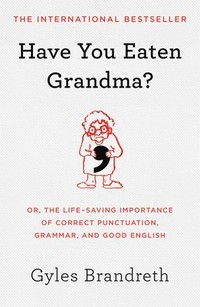
Have You Eaten Grandma?

Have You Eaten Grandma?: Or, the Life-Saving Importance of Correct Punctuation, Grammar, and Good English

by Gyles Brandreth

Hardcover, 285 pg.
Atria Books, 2018

Read: September 12, 2019

…you don’t need to understand all the intricacies of English grammar to be able to communicate well. I use a computer, but I have no idea how it works. I have a wife, but I have no idea why she stays. I take statins, and while the doctor did explain that they inhibit the HMG-CoA reductase—that rate-limiting enzyme of the mevalonate pathway—all I need to know is that they should help lower my bad cholesterol and reduce the risk of a heart attack.

This book can change your life. For the better. Enjoy.

I’ve tried a few times to post about this, and it’s always come out as a mess. So, as I usually do in these circumstances, I’m just going to start with the official blurb:

For anyone who wants to make fewer (not less) grammar mistakes, a lively, effective, and witty guide to all the ins and outs of the English language, reminiscent of the New York Times bestseller Eats, Shoots & Leaves.

Our language is changing, literary levels are declining, and our grasp of grammar is at a crisis point. From commas to colons, apostrophes to adverbs, there are countless ways we can make mistakes when writing or speaking. But do not despair! Great Britain’s most popular grammar guru has created the ultimate modern manual for English speakers on both sides of the Atlantic.

In this brilliantly funny and accessible guide to proper punctuation and so much more, Gyles Brandreth explores the linguistic horrors of our times, tells us what we’ve been doing wrong and shows us how, in the future, we can get it right every time. Covering everything from dangling participles to transitive verbs, from age-old conundrums like “lay” vs. “lie,” to the confounding influences of social media on our everyday language, Have You Eaten Grandma? is an endlessly useful and entertaining resource for all.

That’s just what you get—a funny and accessible guide to grammar, punctuation, and the English language in general (at least in its present form). That’s a distinctively British English, it should be noted, but even those of us who’ve abandoned vestigial “u”s thanks to Noah Webster can profit from it.

A few highlights:
bullet The entire section on the semi-colon is pretty entertaining (and helpful); the entire section covering punctuation makes the entire book worth the purchase price (or library checkout) and the read.
bullet The joke opening his section on the colon is both painful, of questionable taste, and laugh-inducing.
bullet His summary history of the Exclamation Point does in one paragraph, what Shady Characters would do in a page (not saying one approach is better than the other, I enjoyed both books. That paragraph, in particular, made me think of Houston’s book).
bullet Brandreth gives a stirring defense for the correct use of the much-abused apostrophe, culminating with:

Give up on the apostrophe, and you’re giving in to chaos. Without the apostrophe, there’s linguistic anarchy. The apostrophe is the symbol of our cause—the mark we need emblazoned on our banners. If we go weak or wobbly in our defense of the apostrophe, we are on the slippery slope to incomprehensibility and confusion.

bullet Brandreth begins his section on the usage of brackets/parenthesis with:

What the British call “brackets,” the Americans call “parentheses”—when they are round brackets, that is. What the Americans call “brackets” are what the British call “square brackets.” It doesn’t cause as much confusion as the meaning of the word “fanny” on either side of the Atlantic, but it serves to underline the truth of the observation made by Oscar Wilde more than 130 years ago: “We have really everything in common with America nowadays, except, of course, language.”

Which points to one of the great distinctives of this book—Brandreth spends a lot of time explaining/illustrating the differences in the English used on both sides of the Atlantic. He later devotes an entire chapter to British vs. American English (part of which found its way to a Saturday Miscellany post in August). It includes a wonderful table for finding equivalent words/phrases/spellings.

The Brandreth Rule is: when in Rome, do as the Romans do—speak English. And if you’re British, do so with a British accent and spell your English the British way. That isn’t always easy—particularly if you haven’t worked out how to opt out of American English autocorrect when using Microsoft Word.

(there are a handful of Brandreth Rules scattered throughout the book, but this is my favorite)
bullet I appreciated that more than once he got to the point where he had to say (paraphrasing), “I don’t know why this is why it works this way, but it does, just live with it.” Once he said to use the rule or you’ll “look an ignorant oik.” Which might be my favorite phrase of 2019, “oik” is likely my favorite new vocabulary word. I have to work it into more conversation/writing.
bullet The Scrabble help might be the most turned-to part of the book for most readers.
bullet The tips for increasing word power are fantastic.

I actually could keep going, but I’ve gone on longer than I thought I would when I started.

I had a blast while reading this—I honestly don’t expect everyone will, though. If you’re not a language-nerd, aspiring grammar Nazi, or an old-school English teacher, you probably won’t enjoy it as much as me. However, if you enjoy quality humor and could use some help with your writing—you will appreciate it. It’s handy, it’s helpful, it’s entertaining—and how many grammar guides can say that? It’s the kind of thing that my college-bound daughter could use on her dorm bookshelf (and will probably find), and I know more than a few people who find themselves writing reports and the like for work who could use something like that. If you need help, might as well have a good time while you’re at it—and Have You Eaten Grandma is just the thing.



3.5 Stars
2019 Library Love Challenge

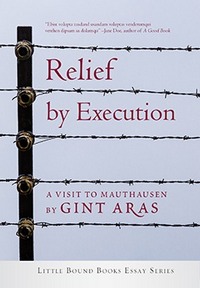
Relief by Execution by Gint Aras: Reflections on Societal Woes from a Different Angle on the Holocaust

Relief by Execution

Relief by Execution: A Visit to Mauthausen

by Gint Aras

eARC, 94 pg.
Little Bound Books, 2019

Read: September 21, 2019


This is a short book (long essay), that to really get into would render the reading of the content pointless, so I’ve got to hold back some of what I want to say. The official blurb is a good starting point for a few thoughts I have in reaction to this essay:

Between the years of 1996-1999, Gint Aras lived a hapless bohemian’s life in Linz, Austria. Decades later, a random conversation with a Polish immigrant in a Chicago coffeehouse provokes a question: why didn’t Aras ever visit Mauthausen, or any of the other holocaust sites close to his former home? The answer compels him to visit the concentration camp in the winter of 2017, bringing with him the baggage of a childhood shaped by his family of Lithuanian WWII refugees.

Thus far, I’m on board with it—Aras blends recollections of the visit with glimpses of his past—the racism, the abuse, the ways of thinking that he was raised in, and then applying that to American society. I think this is a solid idea, but not terribly uncommon. What makes this better is the perspective Aras brings to it. Rather than identifying with the inmates, the victims of the holocaust; he puts himself in the shoes of the guards, of the soldiers carrying out the orders that those of us separated by a distance of miles, years and context can’t imagine.

Or, as the blurb concludes:

The result is this meditative inquiry, at once lyrical and piercing, on the nature of ethnic identity, the constructs of race and nation, and the lasting consequences of collective trauma.

It’s this part that I found wanting. The length of this essay didn’t work for me — Aras either spent too much time on things he didn’t properly develop, or he spent too much time talking about things that didn’t add enough value to the essay. Either fully developing things—which would probably take another 50 or so pages (just a guess)—or trimming about half the length to give a tighter, more controlled argument would have made this a stronger piece of writing.

I enjoyed the writing generally, but too often (not really frequently, but not rarely enough) his writing got in the way of what he was trying to do. His style was too elaborate, his vocabulary obfuscated, and he just got in his own way.

Lastly, I think the essay would’ve been better served with more about his actual time in Mauthausen.

In summary, I think this is a great concept, but I couldn’t get behind the execution—often overwritten, and either too short or too long. Still, this is worth your time. You’ll end up thinking about things in a different way, which is always beneficial. It’s a short read. It’s a compelling read. Sure, it’s a problematic read—but the positives outweigh that.

Disclaimer: I received this eARC from the author via Lori @ TNBBC Publicity in exchange for this post—thanks to both for this.


3 Stars
LetsReadIndie Reading Challenge

Heaven on Earth by Thomas Brooks: A Classic Examination of and Exhortation to Assurance of Faith

Heaven on Earth

Heaven on Earth: A Treatise on Christian Assurance

by Thomas Brooks

eBook, 325 pg.
originally published 1654

Read: July 14 – August 11, 2019

Assurance is not of the essence of a Christian. It is required to the well-being, to the comfortable and joyful being of a Christian; but it is not required to the being of a Christian. A man may be a true believer, and yet would give all the world, were it in his power, to know that he is a believer. To have grace, and to be sure that we have grace, is glory upon the throne, it is heaven on this side heaven.

I am his. I am as sure that I am his, as I am sure that I live. I am his by purchase, and I am his by conquest; I am his by donation, and I am his by election; I am his by covenant, and I am his by marriage. I am wholly his; I am peculiarly his; I am universally his; I am eternally his. This I well know, and the knowledge thereof is my joy in life, and my strength and crown in death.

Here we have a description of assurance, and then an expression of the assured heart. Brooks’ Heaven on Earth is both an explanation of the doctrine and an exhortation to pursue it. Quotations like this are just a hint of that. Brooks is one of the best Puritans on this topic—and everything the Puritans wrote about the doctrine is head an shoulders above their Continental brethren. This is pure gospel gold.

I liked my post about it last time more than anything I’d say this time, so let me just use it (the final paragraph is new):
I just might have myself a new favorite Puritan (I’m not the only one who has a list, right?). I’m kicking myself for not getting to Brooks earlier in life. What a wonderful book—I’m looking forward to getting to read more by him.

Aesthetically, this is fantastic. The language sings—the book begs to be read aloud (and I frequently did so, interrupting whatever anyone around me was doing). You can feel the passion, the fervor throughout. A few paragraphs from different chapters illustrate this:

Divine light reaches the heart as well as the head. The beams of divine light shining in upon the soul through the glorious face of Christ are very working; they warm the heart, they affect the heart, they new mold the heart. Divine knowledge masters the heart, it guides the heart, it governs the heart, it sustains the heart, it relieves the heart. Knowledge which swims in the head only, and sinks not down into the heart, does no more good than the unicorn’s horn in the unicorn’s head.

The only ground of God’s love is his grace. The ground of God’s love is only and wholly in himself. There is neither portion nor proportion in us to draw his love. There is no love nor loveliness in us that should cause a beam of his love to shine upon us. There is that enmity, that filthiness, that treacherousness, that unfaithfulness, to be found in every man’s bosom, which might justly put God upon glorifying himself in their eternal ruin, and to write their names in his black book in characters of blood and wrath. God will have all blessings and happiness to flow from free grace.

Faith is the first pin which moves the soul; it is the spring in the watch which sets all the golden wheels of love, joy, comfort, and peace a-going. Faith is a root-grace, from whence springs all the sweet flowers of joy and peace. Faith is like the bee, it will suck sweetness out of every flower; it will extract light out of darkness, comforts out of distresses, mercies out of miseries, wine out of water, honey out of the rock, and meat out of the eater, Judg 14:14.

But beyond that, the book is sound, it is orthodox, it is Biblical—throughout Brooks points the reader to The Book and The One Who inspired it. His aim is to show “that believers may in this life attain unto a well-grounded assurance of their everlasting happiness and blessedness.” He then goes on to examine the nature of that assurance, hindrances that keep believers from it, reasons to encourage believers to seek it, and how they can go about it, the difference between true and counterfeit assurance, as well as answering questions about assurance. Examining the doctrine from so many angles, you really feel (and probably do) that you come away from this book having an exhaustive look at the doctrine.

Chapter 6—which takes more than its fair share of space, almost half of the book—is an extended detour from the point of the book, but it still serves to support the theme. He begins by saying, “In the previous chapter, you saw the seven choice things which accompany salvation. But for your further and fuller edification, satisfaction, confirmation, and consolation, it will be very necessary that I show you,” these seven choice things. Which are:

(1.) What knowledge that is, which accompanies salvation.

(2.) What faith that is, which accompanies salvation.

(3.) What repentance that is, which accompanies salvation.

(4.) What obedience that is, which accompanies salvation.

(5.) What love that is, which accompanies salvation.

(6.) What prayer that is, which accompanies salvation.

(7.) What perseverance that is, which accompanies salvation.

It is such a great chapter, and would make a remarkable little booklet unto itself that I really can’t complain too much that it’s such a departure from the rest of the book (though it did take me a little bit to get used to the notion).

Banner of Truth puts this out in paperback, monergism.com puts this out as a free e-book. Either way you go for it, this is a treasure I heartily suggest you grab.

When I read this five years ago, it struck me like a breath of fresh air, it was precisely what I needed at the time. I read it again last month, looking for the same thing. I didn’t find it—don’t misunderstand, it was very helpful, inspiring, and insightful. I was reminded and grew in my understanding of assurance. And, I collected a handful of great quotations from Brooks. But…the book as a whole didn’t sing for me. The first time, I didn’t know what to expect. This time, I probably came in with expectations that were too high. Last time I read it, I gave it 5 Stars. This time, I logged it as 3 Stars. So…let’s call it 4, shall we?


4 Stars

2019 Cloud of Witnesses Reading Challenge

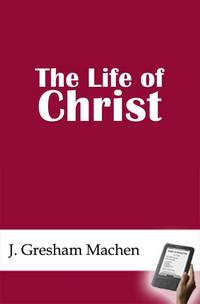
Life of Christ by J. Gresham Machen: Short, Helpful, to the Point

Life of ChristLife of Christ

J. Gresham Machen

Kindle Edition, 50 pg.
Monergism Books, 2015
Read: August 18, 2019

This short work is extracted from the 1922 work A Brief Bible History: A Survey of the Old and New Testaments by Machen and James Oscar Boyd, and it felt similar to portions of Machen’s New Testament Introduction: An Introduction to its Literature and History. I think I’ve heard of the former, I’ve read the latter a couple of times. So, that took a little bit away from the experience for me.

But that doesn’t take away from the value of it—a concise summary of the Life of Christ (harmonized) and the beginnings of the Church in Jerusalem. I’m guessing this was some of the Sunday School curriculum material written by Machen while teaching at Princeton Seminary, and it includes study questions. There’s not a lot of interpretation or application (except in the questions), it’s largely just a boiled down run-through of the gospel accounts.

Machen’s possibly my favorite twentieth-century theologian — he’s definitely the clearest and crispest (with the possible exception of R. C. Sproul). All the things people like to say about C. S. Lewis’ popular apologetics apply to Machen (without the stumbling into troublesome weirdness), and his more academic apologetic work still holds up. This isn’t Machen at his best, but it still displays his style and approach (even if only a little).

Really not much to say about this, so I’ll just recommend it for a nice refresher.

—–

3 Stars
2019 Cloud of Witnesses Reading Challenge

Finding God in the Ordinary by Pierce Taylor Hibbs: Essays to Inspire Devotion

Finding God in the OrdinaryFinding God in the Ordinary

by Pierce Taylor Hibbs
Paperback, 73 pg.
Wipf & Stock Publishers, 2018

Read: August 25, 2019

In the greatness of God, the smallest of things is given tremendous weight.

Hibbs, the associate director of the Theological English Department at Westminster Theological Seminary, has given us a great collection of thirteen essays (semi-inspired by an interview Hibbs heard with Karl Ove Knausgard on NPR but from a very different perspective) based on that idea. As you can guess from the title, Hibbs looks at the minutiae of life and sees how it testifies to the Triune God of the Christian Scriptures.

Some of the everyday, ordinary, common things that he muses on include:

  • dust particles
  • his son’s laugh
  • swirling coffee
  • light
  • wind
  • shadows
  • falling snow

Not your everyday subjects for short essays—particularly not from a theologian, are they? From these everyday things, Hibbs goes on to mediate and wax lyrically on God’s nature, being, truth, care, light, providence, and grace (and other things). These are not theological treatises, but musings on small things around him. Yes, they are theologically-inclined and theologically-informed (and he slips in enough nuggets to make me want to check out his other work). I can’t think of anything else to compare it to, which annoys me, because it’d help explain the volume.

I wondered from time to time if he was going to dance close to pantheism, but he never got that close, really. But he was clearly aware of the hazard, and addressed it in his Epilogue.

The prose is frequently poetic (and there are the occasional bits of actual verse), and gorgeously written. It’s not often that you read theologically-inclined books that possess beautiful language—the ideas are often wonderful, sure, but the language typically fails to live up to it. Not Hibbs—he knows how to phrase things to make an impression, not just impart ideas.

Not only are these essays well-written and thought-provoking, they ought to train the reader to start to find God in the ordinary around them—which is probably the best use of the book. It’s a little on the thin side, honestly, but I don’t know if you could read more than this in a sitting (if you manage to only do one sitting of it) without it losing some power. An interview I heard with him seemed to suggest there might be further collections like this, if there are, I will jump on them. Recommended.

—–

3 Stars

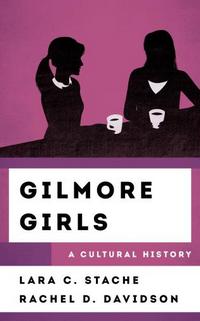
Gilmore Girls: A Cultural History by Lara C. Stache and Rachel Davidson: Oy with the Poodles Already

Of course that headline doesn’t say anything about the book, I’ve just never had an excuse to use that line, and this is as close as I’m going to get.

Gilmore Girls: A Cultural HistoryGilmore Girls: A Cultural History

by Lara C. Stache and Rachel D. Davidson

Series:
The Cultural History of Television

eARC, 248 pg.
Rowman & Littlefield Publishers, 2019
Read: August 16 – 23, 2019

I’m a huge fan of the show Gilmore Girls, and am a bigger fan of Amy Sherman-Palladino and Daniel Palladino. So when I saw this title, I had to jump on it. A cultural history of the show? 200+ pages about the show in more than just a raving-fan mode? Sign me up! The authors are big fans of the show, it must be said, but they can be critical of it, which makes all the difference. This book is an examination of both the show’s reflection of the culture around it as well as what impact it had on the culture—the medium of TV, the casual viewers, and the fans. For a show that depends so heavily on pop culture, the former is easy to demonstrate (it’s more of a question of how to focus the examination and when to stop), but the latter is just as important.

In Part I of the book, the authors look at the various relationships depicted in the show—mothers and daughters; fathers/father-figures and children; romance (with mother/daughter relationships, this is obligatory for the show); and friendship. I thought they were spot-on when it came to mothers and fathers. The romantic relationships they concentrated, and the points they raised about them, were what anyone picking up the book expected (although there was a stronger anti-Logan/pro-Jess bias than one might expect)—I did like the way that Dean and Luke were paralleled, and didn’t appreciate the way that Christopher and Logan were (mostly because I think they were right, and I had to lower my regard for Logan if he’s Rory’s Christopher-equivalent). I thought the looks at Lorelai/Sookie and Rory/Lane and what they said about female friendships was just fantastic.

In Part II the authors switch to themes addressed in the show—feminism, class, pop culture and small-town life. I’ll talk more about the chapter on feminism in a moment, but I thought it was exceptional. The Pop Culture chapter was fun and insightful. I appreciated the Class/Wealth examination, but thought they could’ve done more with it. This is part of the book that you probably can’t find much of in discussions about the show—you can’t swing a LOLcat* online without finding someone talking about Luke and Lorelai or Dean and Rory, but thoughtful takes on the greater cultural themes are rarer (not impossible to find, but harder.) The book doesn’t shine as brightly as it could in this Part, but it handles the subjects deftly.

* I feel like I should apologize to Babette for using this expression.

The chapter examining the show’s depiction of feminism features an extended look at Episode 1.14, “That Damn Donna Reed.” This is at the same time the best and worst part of the book. Let me explain: the authors examine this episode and the main storylines in detail and while reflecting about what those stories say about the feminism of Gilmore Girls and the contemporary American culture (and our contemporary culture). I was entertained and satisfied with the book, but when they hit this high point*—and didn’t accomplish anything like it in following chapters—I was disappointed. If we’d gotten that kind of examination of popular culture and class as shown in particular episodes, I’d have probably rated this book higher. I may have rated it higher if that chapter didn’t have the 1.14 section, too—it just made everything else seem a little more shallow.

* I’m not saying I agreed with all of the analysis, but I appreciated what they did.

Chapter 8, “Small-Town Livin’,” is—like most of this book—a look at the depiction of something and a celebration of it. In this case, it’s Stars Hollow as an ideal small town. We’re shown many examples of the peculiarities of Stars Hollow (taken in every sense of the word)—notably some of the characters, the way the community acts as a large family, how it supports (and doesn’t support) each member, and so on. Then the authors talk about how it represents something in our contemporary culture that many, many feel is missing from our communities and how we yearn for it. I don’t know what it was about this chapter precisely that struck me the way it did—but I didn’t expect it, and the sentiments expressed really resonated with me. Perhaps it’s because the rest of the book focuses (as it should) on Lorelai, Rory, Richard, Emily, Luke, etc., and it’s only here that we focus on everyone else that made this show delightful.

My main complaint is that the authors depend on the same handful of examples too often. Luke did X, or Emily said Y are each trotted out to support 5 or 6 (or a dozen) points rather than finding 5 or 6 (or a dozen) other examples to show the same kind of thing. Luke didn’t just act in a certain manner one time in one episode to cite repeatedly, he does repeated things along certain lines that could be used in a variety of contexts. I don’t want to get bogged down in the details on this, so I’m keeping it vague, but it often felt like I could sing along with Stache and Davidson when they started to illustrate a point with one of the frequently used points. I can understand that it’s easier to keep going back to the same well so that they don’t have to explain the citations as much each time, but it got a bit tired.

There’s an appendix (of sorts) wrapping up this book that is worth the purchase price—”The Episodes: An Opinionated Compendium.” The compendium lists every episode, with a one-paragraph synopses (some are short, some aren’t) and a Best Line (except for in Season 7, which almost doesn’t count for the authors as a real season—like the mythical second and third Matrix movies, the fourth Indiana Jones, or third X-Men). I don’t recommend reading that straight through, you’ll burn out—but it’s a great way to revisit the episodes and refresh your memory. I don’t know the page count on this section, but it’s not inconsequential—it’s 27% of my eARC. Any fan will appreciate this part, even if they’re unimpressed with the main text (and I doubt many fans will be unimpressed with anything in these pages).

This is a fun read, a thought-provoking read, and a comfort-read. It’s like spending a couple of hours talking with some pretty intelligent friends about a TV show you all really like. It’s impossible to watch the show without thinking about it in the terms the authors choose to focus on—relationships, feminism, wealth, community, family—but most fans probably haven’t focused on it to the extent this volume does. I wanted more, but not much more. Not only is this a good book and a good way to examine a beloved show, it’s a great introduction to this series of books. I know I’ll be picking up more of them.

Disclaimer: I received this eARC from Rowman & Littlefield via NetGalley in exchange for this post—thanks to both for this opportunity, I thoroughly enjoyed the experience.

—–

3.5 Stars

Reposting Just ‘Cuz: What the Dog Knows: The Science and Wonder of Working Dogs by Cat Warren

Real Life™ interfered today (a good thing, but time consuming), and I wasn’t able to finish a post, so in honor of yesterday’s (8/26) National Dog Day, here’s my look at Cat Warren’s wonderful book. By the way, a Children’s version is coming out in October, looking forward to that!

What the Dog KnowsWhat the Dog Knows: The Science and Wonder of Working Dogs

by Cat Warren

Hardcover, 280 pg.
Touchstone, 2013
Read: May 7 – 15, 2015

People are smart, just like dogs.

Seriously, how do you not like a book that contains that line?

Honestly, the only reason I gave this book a second glance — okay, a first glance — is that Robert Crais blurbed the paperback edition and it showed up on his Facebook page. It seemed kind of interesting, but I wasn’t sure — then I noticed that Spencer Quinn also wrote a blurb. And if two of my favorite mystery novelists (who have a thing for dogs) tell me the book is good, it must be.*

They were right — Warren was a journalist, is now a professor, and knows her way around a sentence. She clearly cares about the subject and has invested a lot of time and effort into getting to know it, her style is engaging and charming (I was chuckling within a couple of pages), and she doesn’t mind showing her own failings and weaknesses.

Warren basically covers three topics: there’s the science and history of using working dogs (of all sorts of breeds, not to mention pigs(!), birds, and even cats) to find cadavers, drugs, bombs, etc.; there’s the memoir of her involvement with cadaver dogs via her German Shepherd, Solo; and anecdotes of other cadaver dogs and trainers that she’s encountered/learned from/watched in action.

The history and science of dogs/other animals being used for their sense of smell, is probably the most fascinating part of this book, but it’d be really easy for the material to be too dry to bother with — Warren’s voice keeps that from happening. I think it’s terrific that at the end of the day, no one knows what it is about the smell of the human body that dogs sense — she’ll explain it better than me, but that’s the kernel the story. I just really enjoy it when the best and the brightest have to shrug and say, “I don’t know.” The chapter she spends on the future of dogs and/or digital replacements is good for similar reasons. Actually, I could just keep listing little facts/factoids/ideas here, but I don’t want to steal Warren’s thunder.

The best part of the book — the part that I found most interesting, and most frustratingly small — is the Warren’s story about getting Solo, discovering he had just too much energy and personality, and needing to find an outlet for it all. Which is followed by the trials and tribulations of a newbie cadaver dog handler and her pup-in-training, growing into a capable working dog. Anyone who has a dog lover as a Facebook friend knows just how easy it is for someone’s stories about their dog to get to the point where you can’t stand to hear another**. Somehow, Warren avoids this totally — not an easy feat. It probably helps that dog does far more fascinating things than just hiking through the woods or chasing a ball.

The stories about the others — her friends, colleagues, teachers, etc. — round out the book. It’s not just about Warren and Solo, it’s not just about the military/police efforts with training animals — it’s about dedicated volunteers, K-9 officers and dogs all over the country (and the world) making a difference. In places and ways you wouldn’t expect. Really? Sending in one guy and his dogs into Vietnam decades later to search for POW/MIA? Also, seeing how different dogs act differently, yet get the same job done was mind-boggling. Especially for dogs trained together/by the same person, you’d think they’d act similarly.

I imagine it’s to spotlight the work of others, to not brag about Solo too much, to talk about things that she and her dog haven’t done/seen/smelled — or whatever reason there is, I wanted more Solo. A lot more. I have no problem with the rest of the book, it’s just that there’s not enough Solo (or Coda).

Fascinating, entertaining, and educational — can’t ask for much more than that.

—–

* Yes, I’m aware there are flaws in the thinking there.
** Of course, your friends don’t have dogs as cool as mine. Let me tell you a little bit about her . . .

—–

4 Stars

Reposting Just ‘Cuz: Dear Luke, We Need to Talk, Darth by John Moe

I’ve been poking away at a couple of posts about new books for a few days, and am just not getting far enough to post with them, and it’s time for me to fire up the CPAP, so we’re doing some more reruns this week with a couple of posts from 5 years ago this week. I’d actually forgotten about this one, and am now annoyed with myself.

Dear Luke, We Need to Talk, Darth: And Other Pop Culture CorrespondencesDear Luke, We Need to Talk, Darth: And Other Pop Culture Correspondences

by John Moe

ebook, 288 pages
Published June 10th 2014 by Three Rivers Press
Read: August 14, 2014

This is an incredibly amusing collection of pop culture-based humor pieces — I’m tempted to call them columns, but that’s not exactly it.

So these are correspondence (in various forms) associated with gems from Pop Culture — the titular notes from Darth Vader to his son; the entire list of Jay Z’s 99 problems (4. Don’t really enjoy rap music; 55. Shamrock Shake only available once a year.; 84. Worry someone will discover that I’m secretly a member of Bon Iver.); internal e-mails when E.T.’s shipmates discover he was left behind; and so on. I cracked up a lot. I made my wife read bits and pieces, but I resisted reading portions/the entire book aloud. Some of the pieces I wanted to read aloud included: The editorial notes on Guns ‘n Roses “Sweet Child of Mine” (“Redundant. You either have a memory or you’re reminded of something. You’re not reminded of a memory. Your heavy-metal supporters won’t stand for such writing”); a note from the bar manager to Billy “The Piano Man” Joel; the development of the lyrics to the “Batman” show theme; Dora the Explorer’s mother’s letter to CPS (“I know that imaginary friends are a perfectly normal part of childhood, but this was different. Dora would speak to an entire group of people, almost like an audience. And she would demand things of them: “Say map! Say map!’ It was like super-bossy, group-oriented schizophrenia”); a list of changes the Hotel California instituted after being visited by Don Henley (“Acquire steelier knives and/or less resolute beast”).

It probably doesn’t need to be said, but your appreciation of a piece will be directly correlated to your appreciation of the pop culture basis. For example, I don’t like The Walking Dead (yeah, I’m the one guy in the U.S.), so Message Board posts by the Walkers didn’t do anything for me, ditto for the Engineer’s Notes from Fleetwood Mac’s “Rumours” sessions. But I’m willing to bet that fans of either would get a few chuckles.

There are several pieces (perhaps the majority?) that go on too long — maybe two that aren’t long enough. But even with those that do wear out the joke, carry on, More makes persistence worth it.

My only warning is — do not try to read this cover to cover. Read a piece or two. Put the book down. Come back in a day or so. More than that and you’ll stop chuckling, maybe even build up an intolerance. Just sip at this one, no chugging.

I enjoyed it — I laughed, I chuckled, I grinned, I wished I’d thought of that joke first — this is a great coffee table kind of book. I’d buy another volume or three of this just to have around. Give it a shot.

Note:I received this book for free from Blogging for Books for this review. Which was generous and cool of them, but didn’t impact what I said about the book.

—–

3 Stars

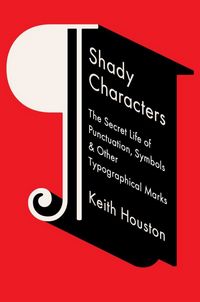
Shady Characters by Keith Houston: This geeky look at symbols and punctuation is as informative as it is fun.

Shady CharactersShady Characters: The Secret Life of Punctuation, Symbols & Other Typographical Marks

by Keith Houston

Hardcover, 246 pg.
W. W. Norton Company, 2013

Read: August 7 – 16, 2019

When the quotation mark does succeed in sparking debate, it attracts mild tut-tutting rather than genuine outrage. Though there is transatlantic disagreement over whether to enclose speech in ‘single’ or “double” quotes, for instance, it comes nowhere near the level of hand-wringing inspired by the semicolon, whose tricky usage has driven it almost to extinction. Neither does the occasional unnecessary “use” of quotation marks induce the howling apoplexy provoked by a simple misplaced apostrophe: whereas one English council was driven to institute an apostrophe “swear box,” café menu offers of “freshly baked ‘bagels,”’ “‘fresh fish,” and the like attract typically little more than a genteel ribbing. Unlike the “Oxford,” or serial, comma, quotation marks or “inverted commas” have never become a trending topic on Twitter, nor have they inspired a pop song in their name.

If that paragraph (from the chapter on quotation marks) or the fact that there’s an entire chapter on quotation marks doesn’t indicate it to you already, let me assure you that this is a book for grammar nerds (or would-be grammar nerds). For a little more flavor, the U. S. subtitle is “The Secret Life of Punc­tu­ation, Sym­bols, & Other Ty­po­graph­ical Marks,” in the U.K., it’s “Am­persands, In­ter­ro­b­angs and Other Ty­po­graph­ical Curi­os­it­ies.”

The book is a historical survey of typography and language as manifested in particular punctuation marks, symbols, and other typographical marks. How they developed, how they’ve been used, and how they are used now. Specifically they are: the pilcrow (¶—you may have seen those around here); the interrobang (‽); the octothorpe (#); the ampersand (&); the @ symbol; the asterisk and dagger (* †); the hyphen (‐); the dash ( ‒ – — ―); the manicule (☞); quotation marks (‘ ’ “ ” ‘ ‘ ” “); and the various attempts to come up with a symbol, typology, or punctuation denoting irony, sarcasm or humor.*

* And I really wish I knew how that paragraph was going to display cross-browsers, devices and in the various places I’ll post this…

The afterward does a pretty good job of describing the book as a whole:

This book, as it turns out, is not just about unusual marks of punctuation, nor even punctuation in general. In following the warp and woof of individual shady characters throughout their lifetimes, it is the woven fabric of writing as a whole that emerges. And in today’s writing, the printed and electroluminescent characters we read on a daily basis and the scrawled handwriting that occupies the diminishing gaps between computer monitors, tablet computers, and smartphone screens, this history stares right back at us.

You don’t have to read this book from cover to cover, you can dip in and read about a particular mark/symbol that you’re curious about and move on. But the chapters do build on each other, and things that are discussed in (for example) the pilcrow chapter will come back for the manicule, the interrobang will inform the ironic/sarcasm indicators, and the octothorpe chapter will come back with the @ and dash chapters. So you’d do well to read it from cover to cover.

It’s not just the individual marks/symbols that you learn about, but the hyphen chapter is a lesson (in a nutshell) on typography in books from Gutenberg to digital publishing. The asterisk and dagger chapter showed a surprising connection between those symbols (and their usage) and the Protestant Reformation, Luther in particular.

The origin alone of the name “ampersand” (and the various attempts at explaining “octothorpe” and the alternatives) are just amusing enough to justify buying a copy of this to have on hand for reference. The history of the ampersand is almost as interesting as the name, too. The reason that @ was used in e-mail addresses — and essentially shaped how much of the world’s communication in the few decades since then is a great example that it’s not just butterflies flapping their wings in China that can make a huge impact on the other side of the world.

Naturally, not all chapters are equally interesting — and that’s going to be a matter of taste — and the more technical bits of individual chapters are easily skimmable until Houston moves on to another aspect of the mark in question or on to the next chapter. I will admit I did that a time or two, but he always got me back within a chapter.

I really wish I could remember how this got on my radar a couple of weeks ago, so I could give a hat-tip and some thanks, I had a great time with this book. Well-illustrated (both anecdotally and with pictures), and with a great mix of style, wit and substance — Shady Characters is a great way for a grammar geek to spend a day or two basking in the things that provide ornamentation to writing and our books. i do recommend it, and am glad I came across it.

—–

3 Stars

2019 Library Love Challenge

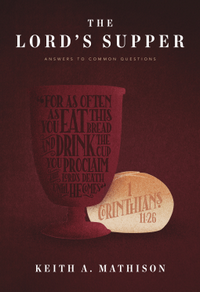
The Lord’s Supper: Answers to Common Questions by Keith A. Mathison: A Helpful, Careful, Encouraging and Challenging Look at some Tricky Questions

The Lord's Supper: Answers to Common QuestionsThe Lord’s Supper: Answers to Common Questions

by Keith A. Mathison

eARC, 99 pg.
Reformation Trust Publishing, 2019
Read: August 4, 2019

There were many laudable things about Mathison’s Given for You: Reclaiming Calvin’s Doctrine of the Lord’s Supper (P & R Publishing, 2002), one of the personal highlights was the final chapter, “Practical Issues and Debates.” This new release from Reformation Trust takes the same impulses that were behind that chapter (and the rest of the book) and delivers a concise introduction to the Reformed doctrine of the Lord’s Supper, looking at the doctrinal landscape, a survey of the relevant passages, and some pressing questions (both theological and practical) for those with little background in the Sacrament, or those who wish to have their understanding sharpened.

Because the chapter titles represent just what you get in this book, let me post them:

1. What Is the Lord’s Supper?
2. What Are the Different Views of the Lord’s Supper?
3. Why Did Jesus Institute the Lord’s Supper on the Passover?
4. What Did Jesus Mean When He Said, “This Is My Body” and “This Is My Blood of the Covenant”?
5. What Does Paul Teach concerning the Lord’s Supper in 1 Corinthians 10– 11?
6. Is Jesus Present In The Lord’s Supper?
7. Is the Lord’s Supper a Sacrifice?
8. What Are the Elements of the Lord’s Supper?
9. How Frequently Should the Lord’s Supper Be Observed?
10. How Should Believers Prepare for and Partake of the Lord’s Supper?
11. Should Children Partake of the Lord’s Supper?

The first two chapters cover the ground that a lot of books on the subject doevery author (and reader) need to start with the basics in view, and Mathison handles a survey these ideas very capably.

Chapter 3 is honestly not something I’ve considered before (at least not in a lot of detail)after all, when else could the Last Supper have been held? But I’m glad he covered this idea, and it gave me a good perspective on redemptive-historical place of the sacrament instituted that night.

Chapters 4 and 5 are very helpful and clear while guiding the reader through the passages in question. He doesn’t get too technical with the passages (due to space and the focus of the book), but is efficient enough in his explanation that he provides a solid grounding for further study and meditation. I particularly appreciated that in Chapter 5, Mathison is careful to point out that not only does the sacrament look back (“Do this in remembrance”), but it looks forward in eschatological hope to the consummation.

Chapter 6 is obviously going to be controversial and might cause problems for many. Mathison is irenic, yet he doesn’t waver from his position (or provide much wiggle room for those who might disagree). Carefully building on the aforementioned texts and the Niceno-Chalcedonian doctrine concerning the person of Christ, he then explains the teachings of the magisterial Reformers (the non-Lutheran ones, anyway) in a way relevant to today’s believer.

Like Chapter 6, Chapter 9 covers ground that he focused on in the longer previous workand those who want more on those subjects have a ready resource in his work. What’s here is a great start, but it’s not everything Mathison has to say on the ideas.

Chapter 10 is pure gold, it’s one of the best things I’ve read this year. It’s helpful and encouraging (and, yes, a little challenging)worth the purchase price alone.

Overall the writing is cleareasy enough for anyone to approach and understand, while not losing the depth and rigor necessary when dealing with something as important as this. Mathison cites other authors (contemporary and historical) to help (and the footnotes provide great fodder for further study), but shoulders most of the work himself. If you’ve never read Mathison, this is a good way to see one of his strengths is always taking complex ideas and presenting them in an accessible fashion.

I have two complaintsneither are enough to keep me from recommending the book, and possibly gifting itbut they’re things that bugged me. Brevity. It’s just too short, it doesn’t have to be as long as Given for You, but each chapter could be just a little longer and more developed.

The second complaint (semi-related) is the lack of a conclusion, just a page or two of wrap-up, an exhortation to use these answerssomething. It just ends abruptly after Chapter 11*, and the absence of anything else was a deafening silence.

*There’s a bankruptcy joke begging to be made there, but it seems cheap.

Those a great resource for those with questions about the Reformed position on the sacrament. Like Guy Prentiss Waters’ The Lord’s Supper as the Sign and Meal of the New Covenant from last year, it’s a great introductory work and would make a great companion to it, the two would round out each other. Mathison helps to deal with practical and theoretical issues that young believers, or believers new to the Reformed tradition, stumble on and struggle with. Faithful, helpful, wise, and encouraging, this book is a great help and you’d do well to check it out.

Disclaimer: I received this eARC from Reformation Trust Publishing via NetGalley in exchange for this post—thanks to both for this, I appreciate the opportunity, but not enough to change my opinion of the book.

—–

3.5 Stars

Page 47 of 62

Powered by WordPress & Theme by Anders Norén