Category: Non-Fiction Page 46 of 62

My Favorite Theology/Christian Living Books of 2020

I read a lot of good, inspirational, thoughtful and devotional work this year, but these were the ones that stuck out in my mind. I’d encourage the careful reading of all of them.

(in alphabetical order by author)

None GreaterNone Greater: The Undomesticated Attributes of God

by Matthew Barrett

I haven’t had a chance to write about this book yet, but it’s great. Barrett provides a wonderful tool to introduce believers of all ages/background to the main attributes of God to shape belief and practice. It’s a corrective, but not scoldy. It’s deep, but not hard to understand. It appreciates mystery and doesn’t try to overexplain anything but it also grapples with what we’re given to understand. I’ll say more in a week or two, but for now, just know it’s one of the best things I read last year.

4 Stars

Reformed Dogmatics, Volume 1: Theology ProperReformed Dogmatics, Volume 1: Theology Proper

by Geerhardus Vos, Richard B. Gaffin, Jr. (Translator and Editor)

My original post
Yeah, it’s only a picture of one of the volumes (but they all pretty much look alike). This set concisely, yet comprehensively, discusses the major theological loci in a way that’s scholarly and yet warm and practical.

5 Stars

Saving the Reformation: The Pastoral Theology of the Canons of DortSaving the Reformation: The Pastoral Theology of the Canons of Dort

by W. Robert Godfrey

My original post
This look at the Synod of Dort, as well as the Canons produced by it, is well-researched, careful, encouraging and pastoral—this is not dry and dusty history, nor dry and dusty doctrine. This book, like the Synod it focuses on, seeks to defend, protect and further the cause of the Protestant Reformation, the Gospel itself. As such, it succeeds and you’d do well to study it.

5 Stars

 Grace Worth Fighting ForGrace Worth Fighting For: Recapturing the Vision of God’s Grace in the Canons of Dort

by Daniel R. Hyde

My original post
Is a fantastic companion to the previous book. Hyde focuses on the Canons themselves and what they’re getting at, showing how Church History developed those ideas to this point and how the Reformed church built on them. I didn’t expect anything to beat the Godfrey volume in this year where we got multiple books (thanks to the Canons’s anniversary), but this one did. it’s warm, pastoral and approachable. Anyone over 13 should have no problem with it. Sure, some of the topics will leave some scratching their heads and pondering for a while, but that’s because these are weighty, thought-provoking topics, not because of Hyde’s text. I may have read a better theological book this year, but I can’t think of it off the top of my head. This is simply excellent—rich theology, rich application, solid history, smartly writing, occasionally stirring.

5 Stars

Beyond Authority and SubmissionBeyond Authority and Submission: Women and Men in Marriage, Church, and Society

by Rachel Green Miller

My original post
This book made me re-examine a lotand will probably continue to do so as I mull on what she has to say (and I’ll probably find a lot to disagree with ultimately, and a lot to agree withas it ought to be). How much of what I think about how women and men should interact with each other (in the home, Church and society) comes from Scripture and how much from the culture? How much of what I think it means to be a man or what it means to be a woman has more to do with Ancient Greek culture or the Victorians? (more than it should). The core of the message should be heard and weighed, and hopefully, after the hubbub around its publication has died down a bit, we can start to deal with it.

4 Stars

Theological Retrieval for EvangelicalsTheological Retrieval for Evangelicals: Why We Need Our Past to Have a Future

by Gavin Ortlund

My original post
A fantastic mix of theory and practice—showing why and how Evangelicals should mine the treasures of the past to shape the theology of today and tomorrow.

4 Stars

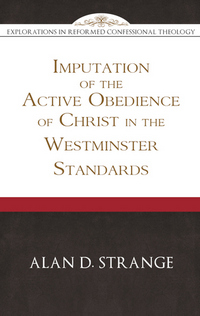
The Imputation of the Active Obedience of Christ in the Westminster StandardsThe Imputation of the Active Obedience of Christ in the Westminster Standards

by Alan D. Strange

I was sure I’d written a post about this book, and was embarrassed to discover that I hadn’t—I somehow let this not be included in the November Retrospective, too. This is why I don’t get paid for this blog, folks.

Anyway, Strange packs a lot into this 176 page tome. It is dense. But somehow, it’s also an easy read. He explores the historical debate—particularly around the Westminster Assembly—around this doctrine and explains why the Standards express things the way they do. Then he applies it to contemporary debate in a straightforward manner. Pound for pound, possibly the most helpful book I’ve read this year.

4 Stars

Grace & GloryGrace and Glory: Sermons Preached in the Chapel of Princeton Theological Seminary

by Geerhardus Vos

My original post
This is exactly what a collection of sermons ought to be—the language is clear, precise and almost lyrical. You can almost hear them as you read them. Solid theology, warm application and gospel-centered. My only problem with this collection is that it was so short.

5 Stars

Books that almost made the list (links to my original posts for those I wrote about): The Future of Everything: Essential Truths about the End Times by Willaim Boekestein, The Whole Armor of God: How Christ’s Victory Strengthens Us for Spiritual Warfare by Iain M. Duguid, Rediscovering the Holy Spirit: God’s Perfecting Presence in Creation, Redemption, and Everyday Life by Michael S. Horton, The Prayers of Jesus by Mark Jones, and Baptism: Answers to Common Questions by Guy M. Richard.

Reformed Dogmatics (5 vols.) by Geerhardus Vos, Richard B. Gaffin Jr.: A Twentieth-Century Classic for Heart and Mind Alike

This is going to be a record-setting header section here, get your scrolling finger ready..

Reformed Dogmatics, Volume 1: Theology Proper

Reformed Dogmatics, Volume 1: Theology Proper

by Geerhardus Vos, Richard B. Gaffin, Jr. (Translator and Editor)
Hardcover, 256 pg.
Lexham Press, 2012
Read: January 6-February 17, 2019
Grab a copy from your local indie bookstore!

Reformed Dogmatics, Volume 2: Anthropology

Reformed Dogmatics, Volume 2: Anthropology

by Geerhardus Vos, Richard B. Gaffin, Jr. (Translator and Editor)
Hardcover, 176 pg.
Lexham Press, 2013
Read: February 24-March 31, 2019
Grab a copy from your local indie bookstore!

Reformed Dogmatics, Volume 3: Christology

Reformed Dogmatics, Volume 3: Christology

by Geerhardus Vos, Richard B. Gaffin, Jr. (Translator and Editor)
Hardcover, 288 pg.
Lexham Press, 2012
Read: April 7-June 23, 2019
Grab a copy from your local indie bookstore!

Reformed Dogmatics, Volume 4: Soteriology

Reformed Dogmatics, Volume 4: Soteriology

by Geerhardus Vos, Richard B. Gaffin, Jr. (Translator and Editor)
Hardcover, 272 pg.
Lexham Press, 2012
Read: June 30-August 25, 2019
Grab a copy from your local indie bookstore!

Reformed Dogmatics, Volume 5: Ecclesiology, the Means of Grace, Eschatology

Reformed Dogmatics, Volume 5: Ecclesiology, the Means of Grace, Eschatology

by Geerhardus Vos, Richard B. Gaffin, Jr. (Translator and Editor)
Hardcover, 352 pg.
Lexham Press, 2016
Read: September 1-November 24, 2019
Grab a copy from your local indie bookstore!


Why am I talking about this as a set instead of individual volumes? That’s a decent question, but I guessed when I finished Volume 1 that I’d end up saying the same things each time. And now looking back on the set, I think I agree. Sure, I could’ve talked some in some more detail about each one, but I’m not sure there’d have been a lot of profit in that for anyone reading this.

Honestly, what I should do here is just post a link to Lane Tipton’s review/article, Vos’s Reformed Dogmatics and be done with it. Lipton says in two paragraphs, what I would flail around for 10-12 paragraphs to say:

Richard B. Gaffin Jr.’s editorial oversight of the translation of Geerhardus Vos’s Gereformeerde Dogmatiek has brought to light yet another theological treasure from perhaps the finest Reformed theologian since Calvin. The sustained depth of penetration of the traditional loci of systematic theological discussion is coupled with the warmth of a theological reflection pursued in vital communion with the absolute, triune God through Spirit-gifted, faith-union with Christ. This renders it ideal for both seminary instruction and devotional reading.

On the one side, Vos’s work displays the proper, and it seems to me necessary, task of retrieving creedal doctrine in the preservation of Christian theology. On the other side, his work displays the proper, and it seems to me equally necessary, task of reforming that creedal doctrine in the formulation of a confessionally constructive, Reformed theology, tethered to its preceding creedal and confessional expressions, yet advancing organically beyond both, through biblical and systematic theological methods of interpreting the inerrant Scriptures. Vos not only expounds orthodox creedal theology in a faithful way, but, within the boundaries of confessionally Reformed theology, he advances that confessional theology with unparalleled insight. His work presents us with an orthodox, yet constructive, expression of the truth of the Scriptures that faithfully serves to instruct the church in the gospel of Jesus Christ.

But just pointing to (and/or reposting) Tipton would be cheating, albeit efficient. So let’s see what I can say.

This was my big project read for the year and was so worth it. As Tipton said, it’s great devotional reading—and you even learn a little bit. Okay, that’s a gross understatement, you can learn a great deal from these (relatively) slim volumes.

Vos displays a fantastic economy of words here—especially if you contrast his Dogmatics with, say, Bavinck. He’s basically the Hemingway of Reformed Theology. There are no wasted words here, he says everything he needs to say and you rarely say to yourself, “I wished he’d covered something more thoroughly.” The segment on Individual Eschatology, however, works as an example of something he could’ve done more with—if you ignore his addressing the errors like purgatory, soul sleep, and annihilation, there’s practically nothing there.

The downside to his style and vocabulary is, like Hemingway, you can look at his writing and think “oh, this is simple and basic” and read too quickly and without reflection. This is a giant mistake. Vos is subtle. He’s profound. He’s also, thankfully, clear. You read this carefully and you’ll benefit greatly.

As the titles of the individual volumes suggest, he covers the major loci, and not much else. But he covers everything you’d need to cover in those, the topics covered are:

bullet The Knowability of God
bullet Names, Being, and Attributes of God
bullet The Trinity
bullet Of God’s Decrees in General
bullet The Doctrine of Predestination
bullet Creation
bullet Providence
bullet The Nature of Man
bullet Sin
bullet The Covenant of Grace
bullet Names of Christ
bullet Person and Natures of Christ
bullet Offices of Christ
bullet States of Christ
bullet The Ordo Salutis
bullet Regeneration and Calling
bullet Conversion
bullet Faith
bullet Justification
bullet Sanctification
bullet The Doctrine of the Church
bullet Essence of the Church
bullet Organization, Discipline, Offices of the Church
bullet The Means of Grace
bullet Word and Sacraments
bullet Baptism
bullet The Lord’s Supper
bullet Eschatology: The Doctrine of Last Things
bullet Individual Eschatology
bullet General Eschatology

Which looks like a lot for so few pages, but Vos somehow pulls it off.

I expected that I’d have a favorite volume or two out of the set, but I really didn’t. There were sections within each I found more interesting/useful to me, but I am willing to bet that your list would vary from mine. Except maybe the section on the covenants in Volume 2, I can’t imagine there’s anything else in that one nearly as interesting to anyone. Not that the rest of the volume is lacking or uninteresting, it’s just that it’s so good.

The book is clearly written for his Dutch-speaking students in Michigan, focusing on that Church Order and controversies in contemporary Holland. So there are bits and pieces of it that will seem awfully foreign to those of us not in those circles. But even those parts have something we can profit from if we don’t get too bogged down in trying to suss out names/positions/etc.

Gaffin does provide the occasional footnote to explain the text or translation choice, but he’s largely silent, letting Vos speak for himself. I wouldn’t have minded a little more commentary, but honestly, it wasn’t necessary (but maybe was helpful).

I’m glad I read this and will be returning to it in years to come, both for reference and re-reading. I’m also glad that I found an electronic copy on sale over a year ago, so I can keep it on my phone for easy reference. One side-benefit of his pithiness is that you can do a quick check on the high points while having a conversation (something you can’t do so easily with Hodge, Turretin or Bavinck). Scholarly, yet approachable, simple and profound—oh, and piously orthodox–I really can’t recommend it highly enough.


5 Stars

2019 Cloud of Witnesses Reading Challenge
This post contains affiliate links. If you purchase from one, I will get a small commission at no additional cost to you. As always, opinions are my own.

The Art of War by Sun Tzu, James Trapp (Translator): A Classic that Easily Demonstrates Its Classification As One

The Art of War

The Art of War: A New Translation

by Sun Tzu, James Trapp (Translator)

Chinese Bound, 95 pg.
Amber Books Ltd., 2011

Read: December 19, 2019
Grab a copy from your local indie bookstore!

Understanding the nature of war is of viral importance to the State. War is the place where life and death meet; it is the road to destruction or survival It demands study. War has five decisive factors, which you must take into account in your planning; you must fully understand their relevance. First is a Moral Compass; second is Heaven; third is Earth; fourth is the Commander; fifth is Regulation.

So…The Art of War, the classic about military strategy that’s been the inspiration for countless military leaders, business leaders, and all other sorts of people (leaders and would-be leaders alike). I tried a few times in middle/high school to read it, but never really got that far into it.

Having read it now, I wonder what my problem was back then. Also, that version I had was 2-3 times the length of this one. I can’t help but wonder what extra material was in that to get me so distracted.

The quotation above contains the purpose statement of the book as well as an outline—Sun Tzu briefly works through each topic in a simple, practical manner. Sun-Tzu demonstrates wisdom in both the large scope and human psychology.

This is the kind of book that people quote all the time, it’s like the movie The Godfather. You’ve heard/read so many lines from this book over the years, so much of it seemed almost cliché and/or obvious—but, like so many foundational texts, most of it is cliché because Sun Tzu said it first (although he did cite/draw upon sources himself, many of which we don’t have, so…let’s give him the credit).

Once you get past that, it’s easy to see why everyone reads this, why it’s still relevant, and even an idea or two about how you can apply it in your own life/job.

The footnotes are largely about translation choices and textual variants—there’s almost no commentary provided, which I appreciate.

I never do this (but I should), but I want to talk about the physical edition of this thing. I’d originally planned on reading this and then passing it on to my philosophy-reading son for his collection. But as soon as I opened the box, I knew he’d have to buy his own. It’s bound in a Traditional Chinese style (so the book says), abandoned in the early 1900s in favor of Western binding. In it, “single sheets of paper are printed on one side only, and each sheet is folded in half, with the printed pages on the outside. The book block is then sandwiched between two boards and sewn together through punched holes close to the cut ends of the folded sheets.” Also, on the left pages are the Chinese text, with the translation on the right. Which looks great—I have no idea what any of the Chinese texts says, but it’s fun to look at.

So anyway, great, historic text that lives up to its reputation. A translation that’s easy to read in an eye-catching package, and an enjoyable and insightful read. It feels silly to be rating Sun Tzu, of all people, but hey—that’s what’s supposed to come at the end of one of these posts, so:


5 Stars

✔ A book mentioned in another book: Mentioned (a lot) in Lingering by Melissa Simonson and alluded to in System Failure by Joe Zieja

This post contains an affiliate link. If you purchase from it, I will get a small commission at no additional cost to you. As always, opinions are my own.


Quick Takes: God, You, & Sex by David White; Entering God’s Rest by Ken Golden; Redemptive Reversals by G. K. Beale; Grace and Glory by Geerhardus Vos

The point of these quick takes post to catch up on my “To Write About” stack—emphasizing pithiness, not thoroughness.

 God, You & Sex

God, You, & Sex: A Profound Mystery

by David White
Paperback, 240 pg.
New Growth Press, 2019
Read: November 3, 2019
Grab a copy from your local indie bookstore!

(the official blurb)
Okay, I’ve read Ephesians 5:32 and Solomon’s Song—I know there’s much to be learned about the relationship between Christ and the Church from human marriage (and vice versa), but…I still feel squeamish about aspects of that. Nothing against Mr. White, but he’s not Solomon, and I couldn’t really get behind much of what he said on that topic (not that he was wrong, necessarily, I just couldn’t agree with him).

But beyond that—it was refreshing to read actual positive teaching about human sexuality from a Christian perspective and not just a list of “No”s, “Don’t Do That”s, and so on. Yes, the positive teaching necessitates some of the “Nope”s, and I have no problem with that, but it just seems that all the conservative Protestant world can come up with are the anti-whatever books.

In the end, I quite liked most of this and got something out of it.
3 Stars

Entering God's Rest

Entering God’s Rest: The Sabbath from Genesis to Revelation—And What It Means for You

by Ken Golden
Kindle Edition, 112 pg.
Alliance of Confessing Evangelicals, 2018
Read: November 17, 2019
Grab a copy from your local indie bookstore!

(the official blurb)
This is a really good book to cut your teeth with on the subject of the Christian Sabbath/The Lord’s Day. Golden does a decent job in tracing the doctrine of the Sabbath through the Scriptures, gives some good principles for modern observance of the Christian Sabbath and how we ought to think of it—and those who disagree with us.

In the end, he gives some examples of ways one might put those principles to use. Honestly, this last chapter is the weakest, and it seems to me that he wasn’t consistent in his application of his own principles, and ended up with suggestions that were pretty weak (and maybe a compromise?)

Ignoring the last chapter, it was a decent, quick and easy read. But I’d recommend Ryan McGraw’s The Day of Worship: Reassessing the Christian Life in Light of the Sabbath, Joseph A. Pipa’s The Lord’s Day, or Nicholas Bownd’s The True Doctrine of the Sabbath instead (ranked by increasing length, depth, and complexity).
3 Stars

Redemptive Reversals

Redemptive Reversals and the Ironic Overturning of Human Wisdom

by G. K. Beale
Series: Short Studies in Biblical Theology
Paperback, 189 pg.
Crossway, 2019
Read: November 10, 2019
Grab a copy from your local indie bookstore!

(the official blurb)
I’m not really certain what it was that I expected this book to be, but I didn’t get it. What Beale gave us are looks at various topics in Scripture, showing how the way God has/is working is both counter to the ways of the world as well as human intuition.

It was a pretty approachable book, almost deceptive in its simplicity—most of what he says is worth more thought and meditation than your initial impressions might lead you to think. There’s also a lot of rich application for both thought and life—I didn’t expect a book about irony to give me things to do.

I’m not convinced that I walked away from this having learned anything, but Beale did make me think of things that I knew in a different way, with ideas on how to approach similar Scriptural topics/themes in a similar fashion in my own study.
3.5 Stars

Grace & Glory

Grace and Glory: Sermons Preached in the Chapel of Princeton Theological Seminary

by Geerhardus Vos
Paperback, 155 pg.
Solid Ground Christian Books, 2007
Read: December 8-15, 2019
Grab a copy from your local indie bookstore!

(the official blurb)
For most people (who’ve heard of him), Geerhardus Vos is known as a theologian—one of the Twentieth Century’s brightest stars, the man who showed that the academic discipline known as Biblical Theology wasn’t the domain solely of Theological Liberalism, but that a robust, Bible-believing thinker could (and should) contribute to the field.

But before he was a theologian or professor, Vos was a preacher. And this small collection of sermons shows how capable he must have been.

Yes, there’s rich theology behind these sermons, but they’re primarily expositions and applications of the texts for the hearers. And, yes, the audiences of these sermons were students at Princeton Theological Seminary (before the downgrade that led to the creation of Westminster Theological Seminary), but these were not airy, academic addresses.

I don’t think it was by design, it just worked out this way, but the second, fourth and sixth sermons were the ones that I appreciated most—my notes weren’t really that helpful, especially now. All I wrote about #2 “Hungering and Thirsting after Righteousness” was “Wow! Fantastic.” True, but that’s not really helpful—Vos opens up the idea about how Christ uses the believer’s faith (hungering and thirsting) to fill and bless them. The sermon “‘Rabboni'” (about Mary’s encounter with the risen Christ near the tomb) is less than twenty pages long, but was better than Richard Sibbes’ sermon series (184 pages in the Banner of Truth edition) on the same passage—I can’t do it justice here, so I won’t try. And the last sermon? It’s worth more than the purchase price of the whole book.

(I fully expect when I re-read this book in 2021 or so, I’ll say something just as strong about the odd-numbered sermons and wonder what I was talking about now.)

As Scott Clark mentions in his forward, Vos was a poet (particularly in retirement, but before then, too). And you can see that in some of these sermons—they practically sing. I can only imagine how captivating these were hearing them, they’re stirring just reading them.

One of the best collections of sermons I’ve ever read. My only complaint is that there were only six. Get this one.
5 Stars

This post contains affiliate links. If you purchase from any of them, I will get a small commission at no additional cost to you. As always, opinions are my own.

Food: A Love Story by Jim Gaffigan (Audiobook): Gaffigan’s Tribute to the Topic that Defines his Comedy

Food: A Love Story

Food: A Love Story

by Jim Gaffigan

Unabridged Audiobook, 7 hrs., 17 min.
Random House Audio, 2014

Read: December 11-13, 2019


This is largely what I said about the book in 2015, but I have a few more thoughts about Gaffigan’s book on parenting, Jim Gaffigan offers a book on his true strength: food.

As with Dad is Fat, a lot of this is material I’ve seen/heard elsewhere, but most of it isn’t. There’s more than enough original material to satisfy even those who’re familiar with has specials. I think, so anyway—I don’t have an encyclopedic knowledge of Gaffigan’s material, as much as my children want me to (I wouldn’t mind it, either).

On the whole, this is about what foods, dishes, and practices he likes—but he breaks it up with things he can’t stomach or understand. Sometimes, like with the chapter on Reuben sandwiches, he handles both.

The chapters on Coffee, Steak, Doughnuts, Breakfast, Hot Dogs and Bacon stand out particularly for me. Although the pair “Nobody Really Likes Fruit” and “Even Fewer People Like Vegetables” really amused me, even beyond the great titles.

Actually, there’s really nothing that didn’t amuse me.

Naturally, there’s an entire chapter devoted to Hot Pockets. That’s all I’m going to say about that, it speaks for itself.

Because the book is pretty tightly focused, there are two ways I’d recommend to read this book: in one setting, or broken up into tiny chunks over several days. There’s a danger of things getting repetitive that either of those tacks reduces.

I’m going to limit myself to just a few highlights, there’s quotable material on almost every page:

A.1. was always on the table when my dad would grill steaks. It seems everyone I knew had that same thin bottle of A.1. It always felt like it was empty right before it flooded your steak. Ironically, the empty-feeling bottle never seemed to run out. I think most people still have the same bottle of A.1. that they had in 1989. Once I looked at the back of a bottle of A.1. and was not surprised to find that one of the ingredients was “magic.”

Of course I am aware that doughnuts are bad, horrible things to eat, and according to my health-nut wife, they are not appropriate for a trail mix. I’ve repeatedly tried to explain to Jeannie that I’m on a different trail. Mine leads to the emergency room. Trail mixes have nuts, and my favorite nut is most definitely a doughnut.

In my opinion, however, the line of the book has nothing to do with food:

Bill Shakespeare himself, another actor who did some writing…

Listening to Gaffigan added a little more to the experience—sure, it’s easy to imagine him saying the same things, it’s another one to hear him do it. It’s not a superior experience to reading the book, but it’s an added flavor that makes it fresh even on the second exposure.

I’ve spent the last few months trying to change my eating habits, which made enjoying this celebration of unhealthy eating a little personally ironic (particularly for the 35 minutes I spent on a treadmill), but it still made me laugh. If you’re the kind of person who eats food, has opinions on it, and likes to laugh, pick yourself up a copy.


4 Stars

2019 Library Love Challenge<Humor Reading Challenge 2019

What the Dog Knows Young Readers Edition By Cat Warren, Patricia J. Wynne: A MG Version of Great Book about Man’s Best Friend

What the Dog Knows Young Readers Edition

What the Dog Knows Young Readers Edition: Scent, Science, and the Amazing Ways Dogs Perceive the World

by Cat Warren, Patricia J. Wynne (Illustrator)

Hardcover, 325 pg.
Simon & Schuster Books for Young Readers, 2019

Read: December 4-5, 2019

Grab a copy from your local indie bookstore!


I wasn’t sure what to expect from a Young Reader’s Edition of this book, was it going to be dumbed down? Was it going to be a soup-to-nuts rewrite of the book, telling the story in a cutsie fashion? Or . . . well, I don’t have a third idea, but you get my opinion. But what we got was the same book (as near as I can tell, it’s been 4+ years), just pared down—not dumbed-down or anything. But a lot of the detail has been removed, every chapter boiled down to its essence. Simplified, yes, more accessible for younger readers than the dense “adult” text, but it’s the same book at the end of the day.

After the end of the text, there’s a section directing the readers to some more information and a Young Readers Info section of Warren’s website.

As it’s so similar, I’m just going to use a lot of what I wrote back in 2015 to talk about the book, sorry for the re-run (I’ll focus on this edition in a few paragraphs).

Warren was a journalist, is now a professor, and knows her way around a sentence. She clearly cares about the subject and has invested a lot of time and effort into getting to know it, her style is engaging and charming (I was chuckling within a couple of pages), and she doesn’t mind showing her own failings and weaknesses.

Warren basically covers three topics: there’s the science and history of using working dogs (of all sorts of breeds, not to mention pigs(!), birds, and even cats) to find cadavers, drugs, bombs, etc.; there’s the memoir of her involvement with cadaver dogs via her German Shepherd, Solo; and anecdotes of other cadaver dogs and trainers that she’s encountered/learned from/watched in action.

The history and science of dogs/other animals being used for their sense of smell, is probably the most fascinating part of this book, but it’d be really easy for the material to be too dry to bother with—Warren’s voice keeps that from happening. I think it’s terrific that at the end of the day, no one knows what it is about the smell of the human body that dogs sense—she’ll explain it better than me, but that’s the kernel the story. I just really enjoy it when the best and the brightest have to shrug and say, “I don’t know.” The chapter she spends on the future of dogs and/or digital replacements is good for similar reasons. Actually, I could just keep listing little facts/factoids/ideas here, but I don’t want to steal Warren’s thunder.

The best part of the book—the part that I found most interesting, and most frustratingly small—is the Warren’s story about getting Solo, discovering he had just too much energy and personality, and needing to find an outlet for it all. Which is followed by the trials and tribulations of a newbie cadaver dog handler and her pup-in-training, growing into a capable working dog. Anyone who has a dog lover as a Facebook friend knows just how easy it is for someone’s stories about their dog to get to the point where you can’t stand to hear another*. Somehow, Warren avoids this totally—not an easy feat. It probably helps that dog does far more fascinating things than just hiking through the woods or chasing a ball.

* Of course, your friends don’t have dogs as cool as mine. Let me tell you a little bit about her . . .

The stories about the others—her friends, colleagues, teachers, etc.—round out the book. It’s not just about Warren and Solo, it’s not just about the military/police efforts with training animals—it’s about dedicated volunteers, K-9 officers and dogs all over the country (and the world) making a difference. In places and ways you wouldn’t expect. Really? Sending in one guy and his dogs into Vietnam decades later to search for POW/MIA? Also, seeing how different dogs act differently, yet get the same job done was mind-boggling. Especially for dogs trained together/by the same person, you’d think they’d act similarly.

I imagine it’s to spotlight the work of others, to not brag about Solo too much, to talk about things that she and her dog haven’t done/seen/smelled—or whatever reason there is, I wanted more Solo. A lot more. I have no problem with the rest of the book, it’s just that there’s not enough Solo (or Coda, her younger dog).

This new edition features some illustrations and instructional graphics. There were a couple that I wondered about the placement of, but they were all helpful, eye-catching and attractive. They added to, instead of distracting from, the text. Good stuff.

A fascinating, entertaining, and educational book—can’t ask for much more than that.


4 Stars

2019 Library Love Challenge

This post contains an affiliate link. If you purchase from it, I will get a small commission at no additional cost to you. As always, opinions are my own.

Friends: A Cultural History by Jennifer C. Dunn: The One Where I Liked 2/3 of a Book.

Friends A Cultural History

Friends: A Cultural History

by Jennifer C. Dunn
Series: The Cultural History of Television

eARC, 288 pg.
Rowman & Littlefield Publishers, 2019

Read: November 15-December 3, 2019

Grab a copy from your local indie bookstore!


I’ve only read one other book in this series (Gilmore Girls: A Cultural History), which led to me expecting a few things from this book—most of which I didn’t get (which is both a positive and a negative comment). I’m going to try not to spend too much time comparing the two books because it seems unfair—but it’s inevitable, so . . .

When I requested that Gilmore Girls book on Netgalley, I noticed the publisher had a similar title about Friends available—and who doesn’t like Friends? So, I requested that one, too—really diving into The Cultural History of Television. Granted, Dunn has more episodes to work from, but she does a better job of getting examples from all over the series—using different episodes/lines/characters to make related points rather than grabbing the same episode/line/character over and over and over again. One of the biggest strengths of the book is the depth of examples she musters for almost every point, reading this book is almost like binge-watching the entire series.

She begins with a chapter describing the success of the show, its place in the history of sitcoms—building on what had come before and shaping its successors. Then she moves on to looking at the impact of the show, its characters, and its actors on mainstream American pop culture—I do think she tried to make a little more hay than was warranted with some of the intertextual links she made in this chapter, but it came across as a quirk rather than a flaw. The third chapter discussed the way that the show replaced a biological family for a found family of friends as the core relationships for the characters. I really appreciated this section of the book and it gave me high hopes for the rest.

The third section of the book explores the legacy of Friends on American—and global—pop culture, as seen in fashion, music, memes, the way we talk (e.g., try to tell someone to pivot without invoking Ross trying to get his couch up the stairs), and the actors’ future roles and shows. This part wasn’t as strong as the first part of the book, but it was entertaining and an interesting way to think about the show. Dunn follows that with her list of the best 25 episodes, including an episode synopsis and a few sentences describing why that episode made the list. Fans will quibble over this list (for example, I think she got 15-18 of them right, and I can’t understand why she picked the others)—but I can’t imagine any fan not enjoying reading it.

The thing that makes me reticent to heartily recommend the book is the second section of the book, which includes the chapters: “Friends Happy Not Doing Too Much,” “Friends Happy Not Thinking Too Much,” “Thin, White, Upper-Middle-Class Friends,” and “Stereotypes, Sexuality, and Friend-ly Tensions.” Dunn states that this section “interrogates cultural identities represented on Friends.” There is a lot of interesting material presented in this section—whether you ultimately agree with her analysis or not—and most of it is well-presented. However, it’s a pretty problematic section. First, it assumes the readers will share her Progressive views (or at least hold ones close to hers) and that 2019 Progressive positions ought to provide the basis for evaluating the shows portrayal of characters/issues/themes, rather than the standards of the time the episodes were produced.

I’m not going to get into a point-by-point evaluation of these chapters, that’s not what this post is about, I’m just looking at this broadly. For example, Dunn begins her chapter on the anti-intellectual bent of some of the humor by pointing to the re-election of George W. Bush as president as one bit of evidence to the rise of anti-intellectualism in the era. I’m not sure I see the wisdom in insulting conservatives, Republicans, or moderates who voted for Bush and who enjoy discussions of a beloved sitcom and might be reading the book.

Yes, the writers couldn’t have made many of the jokes they did if the show was being produced now—but I’m not convinced that means they shouldn’t have then. At one point (at least) Dunn does concede that 2019 standards are different from those of that era, but it doesn’t stop her from criticizing aspects of the show for being products of their time. It seemed to me that at any point where she judged the show’s treatment of something in these chapters, she condemned it rather than look for an opportunity to be charitable. Now, there is a certain amount of intellectual stimulation and pleasure to be found in arguing with a book—and my notes indicate that I did a lot of that during these chapters—but at a certain point I started wondering why someone who clearly disapproved of so much of the show would watch it as much as she clearly has. To me, that detracts from the overall experience.

I’m not trying to suggest that Dunn’s criticisms are baseless, or that I disagree with everything she said in this section. I just think she comes across as unexpectedly antagonistic to the show and doesn’t do herself any favors with many of her readers.

It’s annoying that I had to spend that much time attempting to explain my problems with that section—it’s dicey so I tried to do a good job of that, but now that’s taken the majority of my space here. By importance, it should be about 1/3 of what I say about the book (maybe 40%). But to expand my comments on the rest would render this too long to read (and write, honestly).

I had one other stumbling block with the book—but this is more stylistic and is easily forgettable. You’ve probably read or heard the line: “Explaining a joke is like dissecting a frog. You understand it better but the frog dies in the process.” I’ve seen it variously attributed, but E. B. White seems the most likely candidate. It’s a trite observation by now, but mostly because it’s true. Dunn explains too many jokes for little profit—generally, they’re jokes that don’t require an explanation in the first place (especially for fans who know the joke, but I think it’s true regardless) and her explanations frequently border on condescending. White (or Twain or whoever) would probably have been willing to say “Explaining a joke or a meme” had they been aware of the concept. Neither one of these things is a major issue, but it grates on the nerves and makes the experience less positive

Ultimately, while I enjoyed the Gilmore Girls entry more, I think this book makes the series seem more promising and will likely lead me to read more of it. On the whole, this was a very enjoyable read and die-hard fans will easily dive into most of the book and relish the experience. And even on those points, a reader will disagree with her on, they’ll enjoy ransacking their memories for counter-arguments. Really, this is an excuse to think deeply about a favorite show for however long it takes you to read 300 pages, not much wrong with that.


3 Stars
Disclaimer: I received this eARC from Rowman & Littlefield Publishers via NetGalley in exchange for this post — thanks to both for this opportunity.

This post contains an affiliate link. If you purchase from it, I will get a small commission at no additional cost to you. As always, opinions are my own.
Catch-Up Quick Takes: Best. State. Ever.; Live Right and Find Happiness; You Can Date Boys When You’re Forty (Audiobooks) by Dave Barry, Dick Hill

I’ve mentioned before here that I think that Dave Barry is just about the funniest writer around—I used to gobble up his stuff in the newspaper and bookstore as quickly as it came out. I’m not sure what changed, but there are a handful of books by him that I haven’t gotten to yet. Thankfully, my Library had a few of them available to listen to last month. Here are a few thoughts about each of them. Quick reminder: the point of these quick takes post to catch up on my “To Write About” stack—emphasizing pithiness, not thoroughness.

Best. State. EverBest. State. Ever.: A Florida Man Defends His Homeland

by Dave Barry, Dick Hill (Narrator)
Unabridged Audiobook, 4 hrs., and 47 mins.
Recorded Books, 2016
Read: November 21-22, 2019

(the official blurb)
The best parts of this one for me were the introduction (explaining some of the phenomena behind the widespread mockery of Florida) and the chapter giving a history of the state. I chuckled a lot at both of those.

When he moved onto looking at various tourist attractions and or locations in the state, it lost a little bit for me. There was something in each chapter to make me grinmaybe even laugh. But not as much as I’m used to from Barry. The Key West chapter came close, but even that stumbled. I do think if I’d ever been in the state to get a feel for some of these places it might have been better.

The biggest revelation for me from this is just how funny Dick Hill can be. No offense intended, but the voice of Jack Reacher and other thrillers is just not what you think of when it comes to silliness. But man, he was really, really good at this.
3 Stars


Live Right and Find HappinessLive Right and Find Happiness (Although Beer is Much Faster): Life Lessons and Other Ravings from Dave Barry

by Dave Barry
Unabridged Audiobook, 3 hrs., and 39 mins.
Recorded Books, 2015
Read: November 26, 2019

(the official blurb)
This is more like it: pieces of wisdom (and other things) Barry’s passing on to his daughter and grandson. The driving tips for his daughter were fantastic (not just because my daughter is in the process of getting her license right now). The letter to his infant grandson was funny and touching.

Barry also looks at his parents’ generation (the Mad Men generation) and their ability to party, Google Glass, and a trip to Brazil for the World Cup (not being a sports guy, I didn’t think that last one would do much for me, but it was really funny). Oh, yeah, then he talks in-depth about a trip that he and Ridley Pearson took to Russia to talk about writing.

As much as I liked Dick Hill, Barry’s a better narrator of his own stuff.
3.5 Stars


You Can Date Boys When You're FortyYou Can Date Boys When You’re Forty: Dave Barry on Parenting and Other Topics He Knows Very Little About

by Dave Barry
Unabridged Audiobook, 3 hrs., and 22 mins.
Penguin Audio, 2014
Read: November 8, 2019

(the official blurb)
This one ticked all the right boxes for methe stuff about his daughter dating was the kind of thing that fathers everywhere can relate to and second; taking his daughter to a Bieber concert was even better. It was probably not a good idea for me to listen to his chapter about Fifty Shades of Grey at work, thankfully no one asked me why I was laughing (I did not want to have to explain that). Oh, and his funeral instructions were priceless.

Something I wasn’t prepared for was a long piece about a trip his family took to Israel. Listening to Barry juggle travel humor (searching for A/C and Wi-Fi in the midst of historic/cultural wonders), sensitive political discussions, and even getting close to the spiritual was fantastic. It’s not the kind of writing that you often see from Barry, and it’s easy to forget he can be really effective doing things that aren’t just verbal slapstick.

This is probably one of my favorite collections from someone I’ve been reading for decades. This is just great.
4 Stars

2019 Library Love ChallengeHumor Reading Challenge 2019

The Hero by Lee Child: Lee Child Traces the Development and Use of “The Hero”

The Hero

The Hero

by Lee Child

Hardcover, 77 pg.
TLS Books, 2019

Read: November 28, 2019

Grab a copy from your local indie bookstore!

There are only two real people in fiction—the storyteller and the listener. The story proceeds based on the teller’s aims and the listener’s needs. If the listener needs light entertainment, and the teller aims to be loved, then light entertainment is what the listener will get. But if the listener needs reassurance of some kind, or consolation, and the teller aims to better equip her family for future trials, then the story will likely be suspenseful in nature, replete with dangers and perils, over which a memorable character will eventually triumph in a decisive manner, such that the listener finishes the tale with a tight and determined smile, with moist eyes fixed on the distant horizon.

Child’s first Non-Fiction look is an essay exploring the concept of the hero through human history. On the one hand, I had no idea what to expect from Child doing Non-Fiction. But if anyone has something interesting to say about the idea of Hero, it’s gotta be Child, right?

I’m glad I came into it with almost zero expectations because I wouldn’t have guessed this.

Child starts off with a brief discussion of the history of opium, right up to the point where heroin needed to be named.

Then he treats us to a theory of the concept of hero, using a combination of evolutionary theory and speculation, history, and a little more speculation. He begins this look with Neanderthals, so there’s a lot of ground to speed through in a work so brief. Finally, on page 60, we come full circle and get back to heroin before getting to the good stuff.

Child has three definitions of “Hero,” all with separate uses. He then discusses them for a few pages. It’s these last 17 pages or so that we get to the meat of the subject—you could think of the first part of the book as a prolonged introduction (and you’d be a little right).

We get a brief look at The Iliad and The Odessey and their heroes, and even briefer assertion that Dr. No and a work by Ovid about Theseus are the same. I’m not that familiar with Ovid, but given the way we recycle stories now. It’s not too difficult to think that our narrative culture is the only one to be that redundant.

The best part of the book is the several paragraphs looking at the character of Robin Hood. Child looks at how the Outlaw was originally depicted, and then how that grows and changes through time—as well as how the story of Robin Hood added characters and perspectives. By this point, I was starting to hope that the book had just been a few examples like this.

Finally, he talks a little bit about his own understanding and application of the concept and why our contemporary narratives need Heroes.

What is the purpose of fiction? I think it can be summed up in a simple phrase: To give people what they don’t get in real life.

While I did think this was an interesting little book, with a couple of great points and insights. But I’m really looking forward to the next Reacher book—because unlike this dose of real life, it’ll be tightly organized, compelling and a joy to read.

Still, I’d recommend the book—it’s intriguing, thought-provoking, and gives a good look at the way Child thinks. Serious fans would appreciate this for the insight into Child. People interested in the development of Hero might be a bit disappointed overall but will appreciate the last part of the book (maybe I’m the only one who isn’t grabbed by the buildup).


3 Stars

This post contains an affiliate link. If you purchase from it, I will get a small commission at no additional cost to you. As always, opinions are my own.

Grace Worth Fighting For by Daniel R. Hyde: An Accessible and Inspirational Look at a Vital Reformation Document

 Grace Worth Fighting For

Grace Worth Fighting For: Recapturing the Vision of God’s Grace in the Canons of Dort

by Daniel R. Hyde

Paperback, 378 pg.
The Davenant Press, 2019

Read: September 1-29, 2019

We need the canons in our fight to preserve and propagate a pristine doctrine of God’s grace in the salvation of sinners like you and me. Here we are plunged to the depths of depravity then raised to behold the eternal love of God. Here we are taken to the cross where we bow before the satisfaction made for us but then arise because it is so sufficient that we must promiscuously publish its news to all tribes, in every nation, on every continent. Here we experience the uncontrollable power of the Holy Spirit (John 3) efficaciously applying the infinite merit of the Son of God to the hearts of sinners like us. Here we feel the pain and struggle that comes with being Christian, loved by the Father but struggling to love, buried with Christ but constantly digging up our sins, filled with the Holy Spirit but being led astray by our own passions. Yet God the triune God is powerful to preserve us in his loving arms and to bring us to the Celestial City.

He goes on from this point for five more paragraphs but to have included it all would’ve been overkill (and possibly copyright infringement), but it’s hard to imagine a more inspiring rally-cry to a book about a 400-year-old document.

It’s always with the books that I take the most notes on that I have the hardest time writing about—I just have too much to sift through to come up with a post. That’s definitely the case here. It’s taken me about a month to come up with a post I can live with (although I’ll probably be mentally re-writing it until February).

In this 400th anniversary of the Synod of Dort which produced the subject of this book, the Canons of Dort, I’ve read three books about the Canons. I apparently saved the best for last (although I started strong, too). This combines the best parts of the other two and builds on them. We get the depth and pastoral insight of Godfrey and the approach of deYoung.

After a great chapter giving the historical background and explaining why the Canons were needed—then and now (see above)—Hyde gives a commentary on each Head of Doctrine, both the positive position and the rejection of errors (the rejections are pretty short, Hyde focuses on what is affirmed).

I don’t have the time to write, and you likely don’t have time to read, a good overview of the book as a whole, so I’m going to use Chapter 7, which covers the Fifth Head of Doctrine “The Perseverance of the Saint.” Sixty-three pages on fifteen paragraphs might seem like overkill, but it almost feels like it’s not (I don’t mean to suggest that Hyde skimped on anything, but you can’t help but feel there’s more to say about all of this). The details will vary, but this’ll give you a taste.

He starts off explaining the Remonstrant position, aka the stuff the Canons are responding to, acknowledging that parts of their position are correct, before highlighting the major problems and then showing how large segments of contemporary Evangelicalism agree with the Remonstrants. Following this Hyde looks at the development of this doctrine throughout Church History, focusing on the contributions of Augustine and Aquinas. Then he summarized the Reformed position. With the context established, Hyde goes through—paragraph by paragraph—the text of the Canons, explaining Scriptural references, focusing on and teasing out particular phrases. He not only explains the position but shows how it’s relevant to the reader’s life and interacts with contemporary critics. A particular strength of this chapter was Hyde’s focus on the Trinitarian nature of God’s preserving His people and tying that to the assurance of faith.
This is an intimidating looking book—over 400 pages if you include the appendices and bibliography—and there’s something daunting about that cover. But no one should be intimidated by it. It’s not a breezy read by any means—but it’s warm, pastoral and approachable. Anyone over 13 should have no problem with it. Sure, some of the topics will leave some scratching their heads and pondering for a while, but that’s because these are weighty, thought-provoking topics, not because of Hyde’s text.

There’s so much more that I want to say, but I’m going to call it quits here. I may have read a better theological book this year, but I can’t think of it off the top of my head. This is simply excellent—rich theology, rich application, solid history, smartly writing, occasionally stirring. I can’t recommend it highly enough.


5 Stars

Page 46 of 62

Powered by WordPress & Theme by Anders Norén