Category: Non-Fiction Page 53 of 62

Guest Post: The Delicacies of Writing Non-Fiction by Nathaniel Barber

The Delicacies of Writing Non-Fiction:
What to Leave In or Omit and Why Asking Permission Is the Greatest Hurdle to Telling a Great Story

Luck Favors The Prepared is a collection of nonfiction short stories. But, that ‘nonfiction’ part has been a tricky business. Nonfiction is rarely flattering. Seldom does its characters move about as gracefully or as tactfully as we believe we move about our own lives. Most people long for privacy—while the goal of nonfiction (as is the goal of any writing) is the opposite of privacy, to reach an audience. Additionally, the claim (and the sting) of nonfiction is that these are stories which have actually happened, concerning people who actually existed—people with feelings and, possibly, access to legal counsel.

What if I get it wrong? What if I muddy up the dates or fail to nail the dialogue verbatim? These, while valid points, were the least of my concerns. The ultimate hang-up was whether a person would be not flattered by the character I’d made of them.

The conclusion I always reached (which was no) held up the writing of these stories for many years, until, at long last, I was able to call a truce with my inhibitions and get to writing.

What explains the shift?

For starters, these are good stories so they were not easily dismissed. Given time and pressure, eventually their persistence forced me to reconcile this seeming insurmountable hurdle to nonfiction: the spectre of fairness.

Readers of Luck Favors The Prepared will notice I traffic in some incredibly unsavory characters. Was it fair of me to write them so? Probably not. People, however, have had more than enough time to get along without fairness. Indeed, we’ve lived in a dearth of fairness since time immemorial. It is audacious of my characters to demand fairness would make a historically rare visit just to save their hide.

The best we can do is be proactive, and behave ourselves. If you’re good, most assuredly, nobody will write about you.

We’ve developed many ways to live well, even in this absence of fairness. Chances are you’ve had a brush with Christianity, the founding tenets of which warn we should (to paraphrase a number more eloquent passages) watch our ass. If you feel exempt from the offerings of Christianity, the scientific community has an equally potent formula coined by Newton’s third law: every action has an equal and opposite reaction. There are some still who feel left behind by both Christianity and science, for them I can only hope they have a magnanimous sense of humor. After that, you’re S.O.L.

The idea is, in a world where what goes around, comes around—fairness is a red herring.

It took me longer than it should have to come to this conclusion. When I did, it was like a fresh breath of air. Which is why I am now gleefully submitting Luck Favors The Prepared for publication, just under the wire, during this lapse in the Universal Calendar when fairness seems to have checked-out.

If nothing is fair, what then, will keep the world from coming apart?

In this supreme absence of fairness, Christianity, science or humor implores us to act with kindness, beauty and grace. It is, you could say, a last-ditch stopgap to prevent everything from going to pot. This is an idea I can get behind in a major way. It has allowed me to finally locate my voice—and write nonfiction to my heart’s content. But to do so compassionately, in spite of appearances to the contrary.

In the spirit of kindness it is important to note: while I have not shied away from capturing a character at their very worst, that unfortunate snapshot is strictly happenstance. I am not aiming, specifically, to capture a character at their worst. Though, to be fair, I am not straining to capture a character at their finest either. One should not aim to catch a character behaving any which way. They should only aim to capture the story. Kindness should be, above all else, a commitment to the story.

While many of my characters found themselves illuminated in such a harsh light, kindness suggests that (hopefully) they were just going through a rough spot. Their only real crime (in the universal sense) was they experienced a fevered lapse of judgement in the company of someone with such an impeccable memory.

Kindness forces us to consider the angels of our better nature, that people are great, complex creatures. We are brimming with contradictions. Sometimes we are terrible and evil. Other times, we are beautiful and reaffirm all of the wonderful things.

How does one know when they’re writing from a place of kindness? Crap stories are usually unkind. We’ve all heard an embittered divorcee seethe about their poisonous ex-wife or husband. It’s nothing you would treat yourself to after a day’s work. That’s what red wine is for.

Nonfiction without kindness reads flat and vindictive. Any too-thin story is so obviously a sad revenge-vehicle to facilitate a tantrum. It is painfully uninteresting. Yes, sometimes unkind nonfiction is fun to read. But it’s a dirty, bitter pill and should be enjoyed sparingly.

Are the stories objective?

Just because I am the narrator, doesn’t mean I am exempt from the critique of these narratives. To lean faithfully on the story’s foundation means I should just as freely throw myself on the same pyre to which I’ve thrown these poor characters. Could I have been more critical of myself, the character? Maybe, but that’s above my paygrade.

Writing nonfiction is to shoulder into unfairness. So the very least a nonfiction author can do is make well and sure they’re writing from a place of kindness and objectivity. Or, at least, try real hard to do so. This is why I still write with boundaries. Very strict boundaries in fact. There’s much more I could write, but it’s a waste of time if there’s no redeeming story.

I am forty years old now. Does an inability to understand and reconcile the dueling perspectives of fairness and kindness explain why it’s taken me so dang long to offer Luck Favors The Prepared? Probably not. But lay off, I’m short on time. I suppose I could try harder, to completely throw myself at producing books, which is a lot like working a second job without pay. Try explaining that to a wife and a daughter.

Book Spotlight: Luck Favors the Prepared by Nathaniel Barber

Welcome to our Book Tour stop for Luck Favors the Prepared. Along with this blurb about the book, we’ve got a Guest Post by Mr. Barber about writing non-fiction; a Q&A with the author and then finally, my take on the book (the links’ll work when the posts go live).

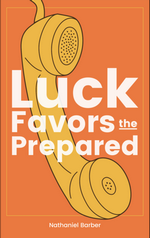
One word about Nathaniel Barber before I show you his very nice (and very orange) cover — I have miscommunicated, mis-remembered, and generally mishandled setting things up for today, and he has dealt with grace, professionalism and generosity throughout. All of which was worse, because I really liked his book, and wanted to put the best foot forward for it. Anyway, I’m just trying to say, the dude’s a mensch, check out his stuff.

Book Details:

Book Title:  Luck Favors the Prepared
Author: Nathaniel Barber
Category: Non-Fiction/Memoirs, 204 pages
Publisher: Take the Stairs Publishing
Release date: September 8, 2017

About the Book:

In his first collection of short stories, Nathaniel Barber allows a peek inside the life observant. Luck Favors the Prepared is a straightforward read, shifting from remote and comic documentary to lived-in memoir, dreamily recalling the absurd choreography of divorce, landlordship, role playing video games, misguided activism, customer service and sudden, unexpected wardrobe failures.

As a son of the Pacific Northwest, his stories are nestled in the mossy bosom of Washington, Oregon and Northern California. His characters are plucked from the past and set to life. They are belligerents and buffoons. They are the beautiful and the bewildering, plagued by dark and grotesque motives, juxtaposed with loving attention that suspends judgement for a world where no one is defined by their worst deeds.

Luck Favors the Prepared is an unforgettable tour through the ordinary and unconventional. This full collection is lovingly handcrafted by the hardest working nobody in the Pacific Northwest.

About the Author:

Nathaniel Barber’s writing is a deadpan examination of life’s banal cruelties. His stories bustle with compelling characters, rich dialogue and moving scenes narrated with an icy, satirical memoir, distilling comedy from otherwise devastating humorlessness.

His forthcoming collection of short nonfiction, Luck Favors the Prepared, recounts life as stumbling about a strange dark room, desperately patting the walls for a light switch. He is also completing a collection of fiction shorts and a book of adult poems for children.

He currently lives in the Pacific Northwest with his wife and daughter and cat and a collection of bicycles in various states of disrepair. He works in the warranty department for an ergonomic furniture company. He does not use semicolons or Oxford commas.

Website * Facebook * Twitter * Instagram

#Next Level Manners by Rachel Isgar, Ph.D.

#Next Level Manners#Next Level Manners: Business Etiquette For Millennials

by Rachel Isgar, Ph.D., Sarah Lane (Illustrator)
Kindle Edition, 78 pg.
Please Pass the Manners, 2017

Read: July 22, 2017


This isn’t a traditional etiquette book, its focus is on business manners for Millennials. It’s about equipping the reader so that they have

a solid set of manners at hand will give you a basic strategy for the type of interactions that will raise that bar [on your personal brand]. The right business etiquette will make you stand out in all kind of great ways.

Isgar does this by focusing on a variety of scenarios that people in the workplace (well, some of them, anyway) will encounter, giving tips, suggestions, and guidelines to equip the reader to navigate them in a way that will help them at work and lay a foundation for future progress. The writing is crisp, clear, with suggestions of humor — to keep the reader engaged, not to detract from the message. There’s not much more to say about that — the book has a simple focus and achieves it.

Like most writing on etiquette, a good deal of this seems like little more than common sense that someone jotted down — but, also like most writing on etiquette, when you stop and think about it, someone needs to be dispensing the common sense that doesn’t really seem all that common. For example, I frequently wondered if she was spending too much time talking about phone/tablet/etc. use. Then I spent some time at work, looking around and started to wonder if she talked about that enough.

Lane’s illustrations are a nice touch — they don’t distract from the text while making the book more attractive. Outside of illustrations in a children’s book or instructional manual, that’s all I ask.

Could the book have been longer, could it have included Millennials in a wider-range of jobs? Yes. But even things that aren’t directly applicable to most readers are easily made relevant to them. Is it too dependent on buzz words? Yes. But that doesn’t detract from the value. Do the frequent uses of emojis detract from the text? Yes, I think so. But I’ve never seen anything that wasn’t hurt by an emoji — color me a grumpy old man, if you will, I’m simply saying that you should take that note with whatever amount of salt you deem appropriate.

#Next Level Manners is a quick, frank, attractive read. There’s plenty of handy advice delivered in an easily digestible manner. Give it a shot.

Disclaimer: I received a copy of this book from the author in exchange for this post. I appreciate the opportunity.

—–

3 Stars

Christ and Covenant Theology by Cornelis P. Venema

Christ and Covenant TheologyChrist and Covenant Theology: Essays on Election, Republication, and the Covenants

by Cornelis P. Venema

eARC, 504 pg.
P&R Publishing, 2017
Read: July 23 – August 20, 2017


The doctrine of covenants is in many ways the heart of Reformed Theology, defining Reformed Christianity and marking the dividing line between it other forms of Protestantism. Which is not to say that after 400 years and change that we’ve managed to work out all the details. Even now controversies (of varying degrees of heat) over aspects of Covenant Theology keep blogs, twitter and theologians busy. This particular tome is a collection of essays by noted theologian and author, Cornelis P. Venema, on some of these issues. They’re all slightly re-worked articles originally published in various journals, books, etc. but in one handy collection for those who haven’t tracked them all down before.

Broken into three sections, the book covers the relationship between the Covenant of Works and the Covenant of Grace; the relation between Covenant and Election (particularly as applied to children of believers); and then “Covenant Theology in Recent Discussion,” which focuses on the Federal Vision and N. T. Wright’s view of justification.

In a nutshell — I found Part 1 to be the most intriguing, Part 2 to be the most helpful, and Part 3 didn’t do much at all for me. But that’s me, and I can’t imagine that my experience will be replicated. I’m not going to spend a lot of time summarizing his arguments — I couldn’t do a good job of that; it’s beyond the scope of this blog; and it’d take far too much time to read — he does a better job of it anyway (or just read Ferguson’s foreward, which gives an excellent overview).

Part 1, “The Covenant of Works and The Covenant of Grace” focuses on the a couple of problems surrounding the concept of the “Covenant of Works” — in chapter 1, he explores some criticisms of the concept, the history of its development and then defends it (at least in is Westminster Confessional form). Venema then moves on to look at the ways in which some contemporary Reformed theologians are seeing to find a “republication” of the Covenant of Works in the Mosaic covenant. He begins with building the case for Republication, drawn from some of the primary sources, and then critiques it. I won’t say I’ve read everything on this topic in print, but I’ve read enough to get the issues, and this is probably the fairest job I’ve seen describing the position. It’s also a pretty good critique, showing many of the problems inherent to it. This was very helpful to me, and I expect, for many.

Part 2 is wider in focus — he devotes two chapters to looking at Herman Bavinck’s understanding of Covenant, Election and the relationship between the two. Bavinck is becoming one of my favorite theologians and this study, pulling from many of his works, was useful focusing on these themes. Venema then spends two chapters on the teaching of the Canons of Dort about children of believers who die in infancy — there’s an overall pastoral tone to these chapters (and the Canons), with some good historical overviews of what lead to it and how the Canons have been used since their writing while dealing with grieving parents and others. These two chapters probably helped me more than any others in this book. Finally, leading from both of those, Venema applies the doctrine of the Covenant to the baptism of children. I read this in the original book it was published in, and it was one of the better chapters in that book — it’s still good now.

The third part dragged for me, I’ll admit. Venema does his characteristic thorough job laying out the issues with both the so-called “Federal Vision” and N. T. Wright’s ideas about justification as seen in his interpretation of Romans 5. I know better than to think that the issues surrounding the FV or NPP are dead, and I know that the issues are important enough that we need to keep exploring and expounding on them — but man, I devoted so much time and energy in the early 2000s to the FV in particular that unless he had something new to say, I just wasn’t going to get anything out of it. These chapters were a good overview and analysis, with some very good elements of critique. I do think that those who are newer to the topics, or haven’t spent a lot of time on them will profit from Venema’s work here.

What can I say about the writing? Venema’s very dry, very careful. When it comes to some of these topics, passions can flare, rhetoric can overtake even the more sanctified writers, getting them to say things more casually than they ought, even recklessly. Veneama avoid that, going out of his way to attempt to be fair to his opponents, while making it clear where he stands. This can be annoying if you’re looking for a quick answer to a controversy, but a great boon if you’re trying to understand it. It’s that care, that patience, that fairness that makes his critiques as effective. You don’t get the impression that he’s creating strawmen, or presenting the worst of his opponents, so the problems he points to are significant and deserving of your attention.

I know this book will not appeal to many — if the subtitle “Essays on Election, Republication, and the Covenants” doesn’t catch your interest, this book isn’t likely to do much for you. But if your ears perk up to just one of those areas, this is a very helpful book, a sure guide through some of the hotspots of the contemporary Reformed Church.

Disclaimer: I received this eARC from P&R Publishing via NetGalley in exchange for this post — thanks to both for this.

—–

4 Stars

The Vanishing American Adult (Audiobook) by Ben Sasse

The Vanishing American Adult (Audiobook)The Vanishing American Adult: Our Coming-of-Age Crisis—and How to Rebuild a Culture of Self-Reliance

by Ben Sasse

Unabridged Audiobook, 11 hrs., 9 Min.
Macmillan Audio, 2017

Read: July 24 – 26, 2017


I typically don’t like to do this, but in the interest of time, I’m just going to use the text from the publisher’s page to describe the book:
Raised by well-meaning but overprotective parents and coddled by well-meaning but misbegotten government programs, America’s youth are ill-equipped to survive in our highly-competitive global economy.

Many of the coming-of-age rituals that have defined the American experience since the Founding: learning the value of working with your hands, leaving home to start a family, becoming economically self-reliant—are being delayed or skipped altogether. The statistics are daunting: 30% of college students drop out after the first year, and only 4 in 10 graduate. One in three 18-to-34 year-olds live with their parents.

From these disparate phenomena: Nebraska Senator Ben Sasse who as president of a Midwestern college observed the trials of this generation up close, sees an existential threat to the American way of life.

In The Vanishing American Adult, Sasse diagnoses the causes of a generation that can’t grow up and offers a path for raising children to become active and engaged citizens. He identifies core formative experiences that all young people should pursue: hard work to appreciate the benefits of labor, travel to understand deprivation and want, the power of reading, the importance of nurturing your body—and explains how parents can encourage them.

Our democracy depends on responsible, contributing adults to function properly—without them America falls prey to populist demagogues. A call to arms, The Vanishing American Adult will ignite a much-needed debate about the link between the way we’re raising our children and the future of our country.
The first third or so is Sasse laying out the problems with the 30-and-younger set (and the parents and grandparents that got them and their society in the sorry state they’re in). The next two-thirds are his suggested solutions, what he believes parents can do to help raise a generation with the necessary rigor and grit to make it. Nothing here can be implemented like blueprints — these are all just things to get parents thinking. Even if the reader disagrees with Sasse (as I do frequently), you get the feeling that he’s more concerned with people and parents thinking about these ideas and doing something about them, even if it’s what he doesn’t think needs to be done.

There’s a chapter devoted to helping our children and teens become critical readers — talking about the necessity of being more than just functionally literate, but people that interact with books — good books, as well as entertaining books. People reading this blog should find a lot to love (and a little to demur with) in this chapter — I almost listened to it twice in a row it was so good.

The book is largely a-political. Yes, politics does enter into it. Yes, if you agree with him (before or after reading the book), it’ll likely lead to certain political moves — but people on all points on the political spectrum should be able to get something out of this book. Just because Sasse is a U.S. Senator, don’t think that this is a book about that. He does highly value “republican” values — but he usually goes out of his way to stress that it’s “small-R republican” he’s referring to. Ditto for the Christian point of view he writes from — Sasse’s very up-front about that, but goes out of his way to show how non-Christians (or even Christians from different traditions) can agree with much of the book, or disagree constructively.

There was problem with the audiobook — there’s no text to refer to. There’s so much that you want to go back and re-read, notes you want to take, quotations/citations you’d like to double check. The literature chapter alone needs to be re-read. And it’s just such a pain to do all that with an audiobook. Trust me, get the hardcopy. The audiobook is a very effective advertisement for the hardcover. It is good to hear Sasse read this himself.

There’s a lot of this book that I just don’t get — I’m not saying he’s wrong, necessarily, but I don’t think he’s always as right as he thinks he is. But I’m telling you, I thought a lot about what he talked about — I talked a lot about the content of this book. I’m looking for ways to put some of this into practice, and wish I’d done a better job of doing it years ago.

Agree with it or not, this is a book well worth reading.

—–

5 Stars

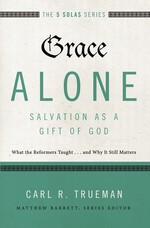
Christ Alone–The Uniqueness of Jesus as Savior by Stephen Wellum

Christ AloneChrist Alone–The Uniqueness of Jesus as Savior: What the Reformers Taught…and Why It Still Matters

by Stephen Wellum
Series: The 5 Solas Series
Paperback, 314 pg.
Zondervan, 2017
Read: June 11 – July 9, 2017

So, Stephen Wellum tackles the solus Christus Sola, the exclusivity and sufficiency of Christ as our Redeemer. It doesn’t get the press that some of the others do, but it’s as essential to the Reformation as the rest.

He begins with survey of the Biblical material surrounding the identity of Jesus Christ — as Messiah and as God the Son Incarnate. This was some solid work — I had a hard time engaging with his writing, I can’t say why, but he just didn’t hook me. It likely had to do with the fact that this book was on the heels of outstanding works on the same idea by Machen and Vos — and a related book by Crowe. Wellum demonstrated a lot of familiarity with contemporary scholarship on the topic — from all parts of the spectrum. Every few pages, I’d come across a paragraph or so that’d be really helpful. But the rest was just something I slogged through.

Part 2 focused on Christ’s Atoning work — the heart of the book, for sure. He spends two chapters defending and articulating the doctrine of the Penal Substitution. There is much to commend here — well, much to endorse, I think it could’ve been stated in a more interesting way. The biggest issue I had with his presentation here is that he reduces everything else recorded in the gospels to an “extended prologue” to the passion narratives. That’s not a characterization on my part — he states that.

The third Part focuses on the use of the doctrine in the Reformation and today, both in reference to Roman Catholicism and the wider contemporary culture. I think there was a lot of promise to this section and I wish is was better developed. As it was, it came across half-baked. Although, at this point, I’d pretty much given up on the book and maybe it was better than I thought.

On the whole, this series has been a disappointment to me — I’m going to finish it (I own one I haven’t read yet, and my series OCD is going to compel me to get the last). This one more than the others. I wouldn’t say don’t read it — there’s some really good bits here and there, and there’s nothing wrong anywhere, in fact, it’s pretty helpful. But, I don’t know, I just can’t tell anyone to go grab it, either.

—–

3 Stars

The Christ of Wisdom by O. Palmer Robertson

The Christ of WisdomThe Christ of Wisdom: A Redemptive-Historical Exploration of the Wisdom Books of the Old Testament

by O. Palmer Robertson

eARC, 432 pg.
P&R Publishing, 2017

Read: May 7 – 21, 2017


Robertson’s preface laments the way that the Wisdom Literature of the Old Testament is usually ignored in Redemptive-Historical studies —

…how do you fit these wisdom books into the flow of redemptive history that consummates in the Christ? By letting them be what they are in their own distinctiveness. They are, it should be remembered, canonical, divinely revealed, and authoritative writings that tell the world how and what to think about the deeper mysteries of human life. Rather than submitting to the moldings and bendings of modernity, these books broaden our understanding of the nature of redemptive history. Divine progress in the complete restoration of reality does not merely move in a purely linear fashion like the flight of an arrow moving across time and space without deviation until it reaches its target. This “third dimension” of redemptive history moves in a cyclical pattern. For certain aspects of God’s salvation perform according to a pattern of regulated repetition.

To ignore this dimension of redemptive history is to exclude a major portion of the old covenant canon—and that you do not want to do.

So how do you discuss these books from a RH point of view? This is what Robertson seeks to do in this book — not as a final answer, but as the beginning of a search for wisdom along these paths.

In one sense, Robertson could’ve made this easier to talk about this book — there’s not one central argument developed throughout. There’s a general discussion (brief) of wisdom, wisdom Biblically defined, that is. And then using that discussion, Robertson looks at the Wisdom Literature of the Old Testament (and Lamentations, which is not usually considered Wisdom Literature, but can function as such), summarizing each book, looking at the various forms of wisdom described and passed on through it.

Simply,

Wisdom is the ability to understand the basic principles inherent in God’s created order, and to live by those principles. Wisdom enables a person to summarize these basic principles in a succinct and memorable fashion. Wisdom is living out the whole of life with a constant awareness of accountability before a loving, gracious, and just Creator and Redeemer.

The work he does to get to this summary is well worth the time and effort to work through. Actually, that goes for everything in the book, but I’ll hold off on saying that kind of thing for a few paragraphs.

The chapter on Proverbs is, fittingly, the longest and most developed. He discusses various approaches to the book, to understanding its construction and from there trying to understand it:

A much more accurate view of the theology of Proverbs may be gained from a covenantal perspective. The wise sayings of the book are not presented in a vacuum. They are not purely moralistic aphorisms. Instead, they are steeped in theistic assumptions. These wise observations about how the world works assume that God the Creator is none other than Yahweh, the Lord of the Covenant.

This, right here, would help so much of what I’ve read about Proverbs over the last few decades. To get into everything that Robertson says about the pursuit of Wisdom, passing it on and living by it from this book would make this post unbearably long — but it builds the foundation for everything that comes. Proverbs covers Wisdom as a whole — the rest of the book deals with it in specific areas.

While dealing with the personification of Wisdom in Proverbs 8, Robertson gives an excursus, “Athanasius as the Champion of the opponents of Arianism,” that is just gold. I’d love to see this developed into something longer.

Following Proverbs, he moves on to Job. Job doesn’t give us the answers to the puzzling circumstances of life, but for those who understand the book, they learn how to puzzle through the circumstances, how to think about them — how to ask God about them. Yes, there are answers given in the book — not easy answers, not the answers anyone necessarily wants, but answers — answers tied to the hope of the Resurrection. But wisdom knows to look for those answers in the difficulties of life, with a sure faith that is willing to look at dark circumstances and say, “I don’t know why this is happening, but I trust in Him Who does.”

Ecclesiastes, is, naturally, a tricky chapter — Robertson threw me a curveball when setting aside the usual discussion of authorship of the book to note

But a related question of some significance for understanding the book has been generally neglected. This neglected question is the identity of the “target audience”of Ecclesiastes.

Chewing on this a little helps get through some of the discussion of authorship. There are so many divergent readings of Ecclesiastes that your head can swim just trying to get a sense of them, Robertson is a pretty sure guide through them before landing on his conclusion that Ecclesiastes presents a “realistic picture of life” — one that is a precursor to Paul’s discussion in Romans 8, where creation is subjected to frustration, but that this is being renewed. I do think this chapter could’ve been organized in a more straight-forward way, but I appreciate the way that Robertson makes you work through various considerations and themes before leading to his conclusions — which are all very helpful.

His discussion of Lamentations, summed up in the subtitle “How to Weep,” was one of the best things I’ve read on the book (an admittedly too-short list). You may think that’s a pretty easy thing to learn — but there’s a wise way, a godly way to weep over the tragedies that will come into our lives. The book of Lamentations teaches us that — and, here’s the RH emphasis coming through — there’s a hope tied to the wise weeping. A hope tied to faith in God’s commitment to preserving a repentant people to Himself.

Lastly, we get to the wisdom of “How to Love” (in a marital sense) in the Song of Songs. The way he reads the book is a “Redemptive-Historical” way, in

terms of the redemptive work of God in restoring humanity to the situation prevailing at the time of creation . . . a restoration of the initial blessing of man and woman in their relation to each other, just as when they first stood in each other’s presence “both naked” but feeling “no shame” (Gen. 2:25). This Song rejoices in the fullness of God’s redemption of the marriage relationship.

He concludes this chapter uniquely, with a script for a Dramatic Reading of the Song of Songs — I think there could’ve been a bit more instruction on how to approach such a Reading — and why — than he gave. But I really appreciated that part.

He could’ve used a conclusion to wrap things up — returning to the closing admonition of the opening chapter. But that’s probably just a taste thing on my part.

There’s a focus on the literary/poetic forms in each book tying in the themes and teachings of them to the way the author presents them. This kind of discussion — no matter the type of literature (inspired or not) always stretches me. I imagine I’m not alone in that — in fact, I bet many people will skip those parts. This is to their own detriment. Robertson discusses these matters in a way that takes some effort to understand, but it’s effort that pays off.

This is a truly helpful book — not full-fledged commentaries on any of the books, but helpful summaries pointed towards seeing the wisdom passed down in each book, and tied into the Redemptive work going on in history all around us. I found it interesting that the recent A Biblical-Theological Introduction to the Old Testament doesn’t approach some of these books the same way as Robertson — in some ways flatly contradicting him. I’d hoped for more overlap between the two works approaching this material from the same framework — but none of the contradictions or differences change the overall message of the Biblical material, just shadings. Honestly, in each case, I think Robertson’s readings are easier to square with the texts in consideration (and not just because he has more pages to develop his points, either).

Robertson, as always, delivers the goods with this book. The reader has to think about what he says, has to drag out their Bible and use the two books together, but will ultimately come out the better for it. I found this book to be incredibly helpful, insightful and something that drove me back to the fullness and fulfillment of all the wisdom of God — Jesus the Messiah. Just where Robertson wants his readers to focus.

Disclaimer: I received this eARC from P&R Publishing via NetGalley in exchange for this post — thanks to both for this.
N.B.: As this was an ARC, any quotations above may be changed in the published work — I will endeavor to verify them as soon as possible.

—–

4 Stars

Learning to Love the Psalms by W. Robert Godfrey

Learning to Love the PsalmsLearning to Love the Psalms

by W. Robert Godfrey

eARC, 263 pg.
Reformation Trust Publishing, 2017

Read: April 2 – 16, 2017


Godfrey’s Afterword begins:

In our study, we have made a beginning of learning to love the Psalms. We have looked at some of the attractions and difficulties of the Psalter. We have summarized the great themes, subjects, and emotions of these songs. We have examined some of the forms and uses of the Psalms. But this book is at best an introduction and invitation to growing in an appreciation of the Psalter. You need to carry on with what we have started together.

That right there is a great 80 word summary of the book — both in intention and execution. If that summary appeals to you, you’ll dig the book.

Godfrey starts with a few short chapters talking about the Psalter as a whole. He discusses his own personal history with the Psalms and what attracted him to them and the benefit he’s gained — then a very quick look at Psalms in Church History (notably their impact on the Reformation). Then he discusses why people are discouraged from getting into them, how to overcome that, how to approach the Psalms and some basic things to think about why studying them/using them for yourself. He gives 10 questions to use when coming to any Psalm that are easy enough for any rookie to put to use and also for any one who had studied the Bible for years to benefit from.

Following that he looks at each of the 5 collections or books or whatever you want to call the groupings of the Psalms that make up the whole Psalter. These would be:

  • BOOK ONE – THE KING’S CONFIDENCE IN GOD’S CARE: Psalms 1– 41
  • BOOK TWO – THE KING’S COMMITMENT TO GOD’S KINGDOM: Psalms 42– 72
  • BOOK THREE – THE KING’S CRISIS OVER GOD’S PROMISES: Psalms 73– 89
  • BOOK FOUR – THE KING’S COMFORT IN GOD’S FAITHFULNESS: Psalms 90– 106
  • BOOK FIVE – THE KING’S CELEBRATION OF GOD’S SALVATION: Psalms 107– 150
  • THE CONCLUSION OF THE PSALTER: Psalms 146– 150
  • In these parts, Godfrey explores the structure and themes of each and then looks at at least 5 psalms in that book — opening them up for the reader, seeing how they work together with the other around them, in some cases how they don’t fit the theme of the rest of the book. All of these are brief, but thorough, chapters (an overview chapter and then individual chapters on each Psalm) — insightful and helpful on their own — much more so when combined with the other chapters in that section or the book as a whole. But really, if you wanted help with, say, Psalm 78 (to choose at random) as a refresher for something — the chapter on that from this book would be a great way to start. Godfrey explains:

    The intention of this study is not to provide an exhaustive exegesis of each psalm considered, but rather to open a way to a growing understanding of the Psalms. God gave His people the Psalter so that we could more and more be defined by it, so that we could find our identity in it. We as the people of God today need to learn for ourselves what it means to live in the Psalms. In a real sense, they give us words to express what it means to live as a Christian. We should live in and out of the Psalms.

    “They give us words to express what it means to live as a Christian ” I love that line — as I have really started to explore the Psalms for myself over the last couple of years, that’s really what I’ve been seeing and will immediately start using that phrase to describe it.

    These sections of the book are the heart of it — as helpful as the initial chapters are. It’s not a commentary, as he states, but it does do a great job of jump-starting your individual study. I probably jotted down more quotations from these sections than I have from others lately, and the temptation to list them all is great. I’m going to limit myself to three, just so you can get a taste of Godfrey’s language and the variety of topics/themes he addresses:

    The difference between this praise song [based on Psalm 103] and the actual psalm [103] is striking. The song is repetitive in vague terms: He has done great things. The psalm, by contrast, is specific about the various blessings received. Taking the psalms as our standard of praise should warn us against the repetitiveness of many contemporary songs and lead us to praise that is much more pointed and specific. Genuine gratitude reviews in detail the wonderful gifts of our God.

    — Both a pointed critique and a challenge/encouragement for how to go express our gratitude biblically.

    From Psalm 73:

    Pictures that reconstruct the temple almost invariably misrepresent the scene as very clean and tidy. In fact, the altar must have been a rather horrible sight of blood and charred remains. It was surrounded with the odors of blood, burnt flesh, and death. Flies probably swarmed around. What the psalmist saw was what God intended His worshipers to see: that the wages of sin is death in all its horror. The altar testified that sin leads to destruction, and the only way to avoid the just consequences of sin is to find a substitute and sacrifice. The altar testified that the blood of a spotless substitute was necessary for sin to be forgiven. . .The altar and the sacrifices point to Jesus and His saving work. He is the true sacrifice and substitute for His people.

    From his discussion of Psalm 74:

    Here is a concern often repeated in the Psalter: Why does the Lord not act more promptly in response to the needs and prayers of His people? Why? First, we should notice that this questioning by the psalmist stands against the advice offered today by some well-meaning Christians who say that we should never ask why. Such advisers voice a kind of Christian stoicism, teaching that we must just grin and bear it. The psalmist, by contrast, gives strong expression to the depths of his emotions. Indeed, God, by the example of the psalmist, encourages His people to a refreshing honesty in prayer, including honesty in expressing our emotions. Fear, anger, frustration—all are emotions that we find poured out in the Psalter. But we must remember that they are emotions expressed by a believer who still trusts his God. It is immediately after these questions that the psalmist asserts his faith in the words of verse 12.

    Again, I could keep going, but I’m going to force myself to stop. But we have here gratitude, sacrifice, mercy, despair, fear, faith and that’s just in 3 Psalms — only bits of his explorations of 3 Psalms, actually. Godfrey’s guide to the Psalter touches on almost as many aspects of the Christian life as the Psalter itself does.

    I should note that this one of those books whose end-of-chapter discussion questions are actually worth reading and using. It’s such a rarity, that it needs to be pointed out when you do see it.

    I’m not going to say that this is a flawless work, there are a few places where my notes consist primarily of question marks or “that seems like a stretch.” But most of those are on comments about the structure of the Psalter as a whole, about the organization of the “books” of the psalms and that sort of thing — which isn’t to say I disagreed with anything he said there, it’s just that he didn’t convince me. But given my lack of study on this sort of thing, it’s very possible I just need to think about it all some more. Mostly my notes are along the lines of “excellent,” “great point,” or “why didn’t I have this book years ago to help me with topic/discussion X?”

    Earlier, I quoted from the Afterword, which could’ve been longer (most of the book could’ve been longer, really — but it would’ve become imposing, intimidating and less attractive for its target audience if it had) but was a great way to sum up the book and spur the reader on for further study, reflection and devotion in the Psalms. It served as a good call to action with some very handy tips.

    Now, I must admit I didn’t read this one the way I should’ve — it would’ve taken me a couple of months to do so and I really figure that Reformation Trust wanted something a bit more timely than that from a NetGalley offering. This is the kind of book to read with a Bible and notebook within reach and to use both of them frequently. It’s a book that takes study and time to get everything out of — and I fully intended to return to this book soon for just that purpose — which isn’t to say that it’s not approachable or that it’s difficult to read. Not at all, this is one of the least technical books I’ve read in a long time when it comes to Bible Study. There’s nothing here stopping anyone from profiting from the book. But to get everything out of the volume, you need to put in the time to read what Godfrey says and reflect on it while reading (or singing) the Psalms discussed and working through them on your own.

    All in all, this is a very helpful book — a good study, a good aid for individual/group use (I think it’d be great for family worship/devotions/whatever you call it), and an encouragement to dig into one of the more intimidating yet wonderful books of the Bible in order to find those “words to express what it means to live as a Christian”. I heartily recommend this book.

    Disclaimer: I received this eARC from Reformation Trust Publishing via NetGalley in exchange for this post — thanks to both for this, I benefited from this greatly.
    N.B.: As this was an ARC, any quotations above may be changed in the published work — I will endeavor to verify them as soon as possible.

    —–

    5 Stars

    Dave Barry’s History of the Millennium (So Far) (Audiobook) by Dave Barry, Patrick Frederic

    Dave Barry's History of the Millennium (So Far)Dave Barry’s History of the Millennium (So Far)

    by Dave Barry, Patrick Frederic
    Unabridged Audiobook, 4 hrs., 29 mins.
    Penguin Audio, 2007

    Read: April 10, 2017


    Back in high school, I worked at a public library (shock, right?), and I kept shelving this book — Dave Barry Slept Here, and eventually succumbed and took it home — several times. I fell in love with Barry’s humor, and read him a lot over the next decade — every book, as many columns as I could find, etc., etc. But I eventually stopped, for no good reason that I can think of (it’s probably not Harry Anderson‘s fault) — and have really only read his novels since then.

    Still, when I saw this audiobook on the library’s site, it was an automatic click — without even reading the description. This is essentially a reprinting of his “Year in Review” columns for the first few years of this millennium and a review of the previous 1,000 years of human history.

    It was hilarious. Just that simple. There’s nothing more to say, really.

    In the beginning Frederic played it straight — which surprised me a bit, but I liked the effect. A serious reading of Barry’s goofiness worked remarkably well. Later on, Frederic seemed to loosen up — he even did a couple of decent impressions. I really enjoyed his work on this.

    Yeah, the humor’s a bit dated, but funny is funny. This is a great look back at the early part of the 21st Century (and before). I laughed a lot, remembered a few things, and generally had a good time with this.

    —–

    3.5 Stars

    The Last Adam by Brandon D. Crowe

    The Last AdamThe Last Adam: A Theology of the Obedient Life of Jesus in the Gospels

    by Brandon D. Crowe

    Paperback, 215 pg.
    Baker Academic, 2017

    Read: February 19 – March 19, 2017


    I just don’t know how to sum up this book succinctly honestly. After a few attempts that are best never seen by anyone, I decided that no one does it better than Crowe does in the first three paragraphs:

    What is the purpose and significance of the life and ministry of Jesus in the Gospels? At one level, this may seem like an obvious question. The Gospels are all about Jesus. Moreover, given the structure of each of the four Gospels, it is difficult to miss the central role played by the Passion Narratives. And yet there is much more in the Gospels beyond the Passion Narratives. Jesus is amazingly active. He preaches, heals, exorcises, prays, rebukes, forgives, calls, authorizes, confounds, challenges, rejoices, weeps, blesses, curses, prophesies, and more. In addition, he consistently draws attention to himself as he does these things.

    And then there are the Christmas stories (that is, the infancy narratives). These are among the more familiar parts of the Gospels in today’s culture. But what is the relationship between the infancy narratives and salvation? Jesus appears to be quite passive lying in the manger as he is adored by shepherds, and we do not find him to be very active when the magi come and prostrate themselves before him in Matthew 2. But can we look even to the infancy of Jesus and say that Jesus was somehow already beginning to accomplish something of significance? To ask this question is to lead us back to the driving question of this volume, since Jesus did not bypass infancy, childhood, adolescence, or adulthood on his way to the cross. Why? What was it about the life of Jesus that was necessary for salvation—from the manger to the cross and everything in between? Do the Evangelists themselves give us any indications that this is a question they have in view as they write their Gospels? I will argue that they do.

    In this volume I will argue that we find a shared perspective among the diversity of the four Gospels that the obedient life of Jesus—in its entirety—is vicarious and salvific in character. More specifically, I will argue that Jesus is portrayed in the Gospels as the last Adam whose obedience is necessary for God’s people to experience the blessings of salvation. In pursuit of this thesis, I will consider what the Gospels themselves say about the lifelong obedience of Jesus, which concomitantly involves considering how Jesus’s life and ministry are related to his passion. By concentrating on the Gospels I do not intend to imply that these are the only documents in the New Testament that speak to this issue. I do believe, however, that a focus on the Gospels qua Gospels is important because of the way they narrate the life of Jesus, and because their testimony to the significance of Jesus’s life for salvation has often not been given sufficient attention. Thus a sub-aim of this book is to help us read and interpret the Gospels theologically.

    So, there’s his aim, rather, there are his aims. How does he go about it? Here’s the Table of Contents to give you a look at how he’s approaching his arguments (yeah, I’m quoting a lot here, but you try to tackle this book in a blog post rather than a dozen or so page review and see how easy it is):

    1. A Tale of Two Adams in the History of Interpretation
    2. The Last Adam and the Son of Man in the Gospels
    3. The Last Adam as the Obedient Son of God
    4. The Last Adam and the Fulfillment of Scripture
    5. The Glory of the Last Adam in the Gospel of John
    6. The Last Adam and the Kingdom of Righteousness
    7. The Death and Resurrection of the Last Adam
    8. The Last Adam and Salvation: Theological Synthesis and Conclusions

    This is primarily an exegetical work — dealing with the text of the Gospels directly. But Crowe leans upon historical and systematic theology as well (especially in Chapter 8). Outside of Chapter 5, he’s primarily dealing with the Synoptics — but not exclusively. It is not impossible to read for the dedicated layman — I’ve read more difficult works in the last few months, but it’s not something you can skim with profit. There are issues that I’m not sure I understand the purpose of addressing, as I’m not aware of all of the academic controversies he’s addressing, but even when you don’t understand everything about those portions of the book, you can still gain from working through them.

    I learned a lot. I thought about passages in a way I haven’t before — seeing things in a new light, or at least a different light. I really don’t have a lot to say about this particular book — primarily I just wanted to post about it to maybe get a reader or two to look at it that might not have otherwise. I loved it, even when I had to work a little harder than usual to get what he was saying, it was worth it. This is the kind of thing the Church needs more of.

    This is written from a Confessionally Reformed perspective, but not necessarily for the Confessionally Reformed any more than other Evangelical/Evangelical-ish readers. Although, the Reformed will be more used to thinking in some of the categories he uses than others (as Crowe indicates late in this interview).

    This is not an easy read, this is not a quick read, but it is a good read (why do I feel like Lewis’ Mr. Beaver now?). This is theology that will lead to doxology — as well as more theological and doxological reflection and study. I wasn’t sure what I expected to get out of this book, but Crowe delivered it and more. I’m not doing a good job summing things up here, just get this book and read it (as well as all the books Crowe writes that you can afford, I’m pretty sure I never got around to posting about his book on the General Epistles which was almost as good as this one (and easier to read)).

    —–

    4 1/2 Stars

    Page 53 of 62

    Powered by WordPress & Theme by Anders Norén