Category: Non-Fiction Page 9 of 62

Cover Reveal: An Icelandic Adventure by S. Bavey

I’m very pleased today to welcome the Cover Reveal for S. Bavey’s upcoming An Icelandic Adventure: One Family’s Mostly Successful Quest for Puffins, Pleasure and Perfect Pizza to this patch o’ cyberspace this morning! Before the main event, let’s learn a little bit about the story and author, shall we? It’ll just take a moment, and then we can all take a peak at the cover. Oh, I should mention quickly that Bavey’s Kookookaburras, Cuppas & Kangaroos is free on Kindle through the 10th.

Book Details:

Book Title: An Icelandic Adventure: One Family’s Mostly Successful Quest for Puffins, Pleasure and Perfect Pizza by S. Bavey
Publisher: josephtailor
Cover Illustrator: Ash Analambidakis
Cover Graphic Design and Book Layout: Bjørn Larssen
Publication Date: November 23, 2024

About the Book:

Join the Bavey family in the Land of Ice and Fire. Experience 24-hour daylight, waterfalls galore, a nail-biting super jeep trip up a mountain onto the largest glacier in Europe, a duck boat tour on an iceberg lagoon and many wildlife encounters.

The outpouring of lava from the recent volcanic eruption threatens to stop them from reaching the famous Blue Lagoon. Will they make it? And will they see any puffins before it’s time for them to depart?

‘A guidebook that reads like a story – or a story that reads like a guidebook!’
Jackie Lambert, author of the Adventure Caravanning with Dogs

‘Anyone wanting to go or just wanting to know about Iceland should read this book.’
Susan Jackson

‘Some great ideas here for a family trip around Iceland.’
Jules Brown, travel author of Don’t Eat the Puffin

Preorders are now available ~ ARC Signup ~ Goodreads link ~ Playlist of Icelandic indie music – just for fun ~ Accompanying photos

About the Author:

S. BaveySue Bavey is an English Mum of two, living in Massachusetts since 2003 with her husband, two teenage kids, a cat named Midnight, and a leopard gecko named Ziggy Stardust.

Author Links:

<

p style=”text-align: center;”>

Author website ~ Email (Emails are always welcome) ~ Facebook ~ BlueSky ~ Twitter/X ~ Instagram

and now…

The Cover

cover for An Icelandic Adventure by S Bavey

Doesn’t that look fun?
Irresponsible Reader Pilcrow Icon

On the Christian Life: A New Translation by John Calvin, Raymond A. Blacketer (Translator): A Shiny New Translation of Gold Standard

Cover of On the Christian Life by John CalvinOn the Christian Life:
A New Translation

by John Calvin, Raymond A. Blacketer (Translator), Anthony N. S. Lane (Editor)

DETAILS:
Publisher: Crossway
Publication Date: August 20, 2024
Format: Hardcover
Length: 65 pg.
Read Date: October 20, 2024
Buy from Bookshop.org Support Indie Bookstores

What’s On the Christian Life About?

These are excerpts from John Calvin’s The Institutes of the Christian Religion focused on the life of the Christian–they’ve been excerpted as such from the time of Calvin, and translated into English (and other languages) from before the final edition of The Institutes were published–then they were updated to match the following editions.

These are from chapters 6-10 of Book Three of The Institutes, setting out general principles to guide our lives–rather than stringent rules and extra-biblical commandments. Calvin starts by talking about ordering our lives correctly, looking for small progress throughout our lives, not perfection. There are some chapters on self-denial, focusing on Matthew 16. Then there’s a chapter focusing on the life to come–where our eyes and hearts should be focused, and the way to go about that. The last chapter is about the use and enjoyment of “the present life and earthly possessions.”

A New Translation?

I now have three copies of this–I had another edition, but I lost track of it somewhere along the line, I’m not sure which translator worked on it (which is a shame, it was a nice looking one). So I can’t compare and contrast as much as I want.

But I do have the translations by Henry J. Van Andel and Aaron Clay Denlinger. Denlinger’s translation reads pretty close to Blacketer’s, but there are differences. Van Andel’s comes across as stuffy and wooden…maybe staid?…in comparison to both (it’s also more than 50 years old, and I’m sure that plays a role, but even then…it’s so different than the other two).

Like I said, Blacketer and Denlinger read pretty similarly–but there’s something about the two that makes you very aware that while they’re on the same page, they’re different enough to justify their independent existences.

I don’t know enough French or Latin (read: practically none) to actually be able to tell you which is a better translation–for all I know Van Andel’s formality hits it better than these new kids. But I know in English, Blacketer comes across as precise, clear, and heartfelt. That’s good enough for me. Also, the footnotes are great (something the other editions could really use some help with)–both in terms of cross-references, and translation notes.

I thought of posting some quotations from the three versions for comparison (and maybe I should’ve), but without the Latin/French, it felt like that approach would be missing something.

Do we need this translation of the book? I don’t know, honestly. But as this is the first taste of Blacketer’s work with Calvin that the general public is getting while Crossway gets ready to publish his translation of The Institutes, it serves as a preview of that work. I, for one, am ready to buy it.

So, what did I think about On the Christian Life ?

I can’t tell you how many times that I’ve read this material–either in versions of this book, or in The Institutes. But every time, it strikes me as fresh, applicable, and useful. It generally feels like it could’ve been published within the last five years (whether I read it in 1996 or 2024).

Calvin never makes this out to be something we can generate within ourselves. This isn’t something we do to earn, or prove, our salvation or God’s affections/pleasure. This is, rather, what’s expected of those who have faith–what faith should look like–but something stumbling, something imperfect, something we strive to do better at. There’s both grace and motivation there–and it’s foolish to expect anything else (or want anything else).

I really do think I could go on and on here, but instead, I think I should point you at the work itself. It’s a mere 73 pages in this edition, if you include the introduction and indexes. But this isn’t the kind of thing you can gulp down in an hour–it’s not a difficult read in terms of complications or weighty arguments. But there’s a depth that belies the brevity.

It’s helpful. It’s encouraging. It’s challenging. I commend it–in any translation, but particularly this new one–to your attention.


5 Stars

This post contains an affiliate link. If you purchase from it, I will get a small commission at no additional cost to you. As always, the opinions expressed are my own.
Irresponsible Reader Pilcrow Icon

Reformation Sunday Repost: The Freedom of a Christian by Martin Luther, Translated by Robert Kolb: A Pastoral Gem from the Reformer

This worked last year, might has well give it a whirl this year…It’s Reformation Sunday—a totally made-up holiday (but which one isn’t?) to commemorate the day in 1517 when Martin Luther inadvertently started a revolution/reformation/revival. So, hey, while I continue to fight off this cold, let me repost this about one of my favorite of Luther’s works:

The Freedom of a ChristianThe Freedom of a Christian: A New Translation

by Martin Luther, Translated by Robert Kolb Carl R. Trueman (Foreward)

DETAILS:
Series: Crossway Short Classics Series
Publisher: Crossway
Publication Date: February 21, 2023
Format: Paperback
Length: 86 pg.
Read Date: February 26, 2023
Buy from Bookshop.org Support Indie Bookstores

Some Thoughts on the Series as a Whole

The point of this series is to take classic short works—sermons, tracts, articles—package them attractively, edit a bit (modernize language, eliminate footnotes, tweak grammar, etc.), and make them widely available. Each is given a short introduction to help the reader get the context and a bit of information about the author.

They published seven books in this series last year, and I discussed them here. Two have come out this year (so far), but I’m hoping for more.

What’s The Freedom of a Christian About?

A Christian is a free lord of everything and subject to no one.

A Christian is a willing servant of everything and subject to everyone.

This is Luther (early in the Reformation) laying out his vision for good works for the believer–how they are to be performed, why they are to be performed, and their place in the life of the believer. I’m sure there’s more to say, but that’s basically it.

That quotation gives his two theses–the rest of the book is his working out the thinking behind them. It’s penetrating, it’s convicting, and it’s inspiring to watch him work. Whoops, I seem to have stumbled into the next section.

So, what did I think about The Freedom of a Christian?

From all of this comes the conclusion that a Christian lives not in himself but in Christ and in his neighbor, in Christ through faith, in the neighbor through love. Through faith he rises above himself in God, from God he descends under himself through love, and remains always in God and in divine love. It is as Christ said in John 1[:51]: “You will see heaven standing open and the angels ascending and descending over the Son of Man.” Behold, that is the proper, spiritual Christian freedom, which liberates the heart from all sins, laws, and commands. This freedom exceeds all other freedoms, as high as heaven is over the earth. May God grant us that we truly understand that and retain it.

I wasn’t sure about reading this–it’s one of those works I’ve read so much about. I’ve seen it cited, heard descriptions of it in lectures, and read about it, but I haven’t gotten around to reading it. A lot of the times I read something that I know about like this, it doesn’t work out (I’ve never been able to get past page 40 of Postman’s Amusing Ourselves to Death, for example). But this is exactly what it should’ve been.

Martin Luther being pastoral is just great. Luther coming alongside those believers so often neglected in the Church and saying, here’s what to do–free of burden, free of guilt, free to live and love as they ought, as they’ve been called to.

This little read is a gem. I’m glad I took the chance on it and so glad that Crossway’s series brought it to us.

4 Stars

This post contains an affiliate link. If you purchase from it, I will get a small commission at no additional cost to you. As always, the opinions expressed are my own.

REPOSTING JUST CUZ: In the Fullness of Time: An Introduction to the Biblical Theology of Acts and Paul by Richard B. Gaffin Jr.: One of the Best Things I’ve Read in Years

I can’t put this one off any longer—if I could, I promise you I would. I’m out of my league here, but I’ve got nothing else to write about. And I really need to write something about this.


In the Fullness of TimeIn the Fullness of Time: An Introduction to the Biblical Theology of Acts and Paul

by Richard B. Gaffin Jr.

DETAILS:
Publisher: Crossway
Publication Date: May 3, 2022
Format: Hardcover
Length: 419 pg.
Read Date: September 4-December 25, 2022
Support Independent Bookstores - Visit IndieBound.org

What’s In the Fullness of Time About?

First, let’s look at what was on the Publisher’s Website:

An Exegetical Study of the Book of Acts and Pauline Theology

Christians often skip a crucial starting point when studying the apostle Paul: the foundations of his deeply nuanced theology. Some studies on the book of Acts attempt to touch on every major theme in Paul’s letters, making them difficult to understand or prone to leaving out important nuances. Christians need a biblical, theological, and exegetically grounded framework to thoroughly understand Paul’s theology.

In this book, Richard B. Gaffin Jr. gives readers an accessible introduction to Acts and Paul. Building on a lifetime of study, Gaffin teaches on topics including the redemptive-historical significance of Pentecost; eschatology; and the fulfillment of redemptive history in the death and resurrection of Christ. In the Fullness of Time is an exegetical “textbook” for pastors, students, and lay leaders seeking to learn more about Acts and Paul from a Reformed and evangelical perspective.

  • Explores the Foundations of Paul’s Theology: Offers a nuanced look at the core of Paul’s thinking
  • Wide-Ranging Audience: A valuable study for pastors, theology students, and lay leaders
  • Thorough Yet Accessible: An in-depth look at Pauline theology that’s accessible to readers

After reading the book, however, I’d offer a tweak or two to that description. For example, I’d add to that “for pastors, students, and lay leaders” lay people in general (or just swap out “leaders” for “people”).

Also, I’m not sure I’d include eschatology alongside those other topics. It seemed to me (on first read, anyway) that this was a book about Eschatology as presented by/understood through the New Testament—with a focus on understanding Pentecost and the fulfillment of redemption (and a couple of other topics) in light of that eschatology. That may seem like splitting hairs, and really, I’m guessing the good people at Crossway understand the book a bit better than I do. Still, I didn’t get the impression that the book thought of those ideas as equal (unlike the description).

The chapters in this book came from lecture notes for the class that Gaffin taught for years on Paul and Acts—a class I’ve heard several people mention over the years, and really wish I could’ve taken. Getting that material in written form is a blessing I didn’t expect and was more than happy to receive.

The Centrality of Eschatology

In Chapter 2, Gaffin writes:

for much Christian theology and preaching seeking to be faithful to the Bible as God’s inscripturated word, the rediscovery of eschatology can be seen as having a corrective significance that has resulted in laying hold of biblical teaching in a way that has not been fully appreciated in the past.

For instance, in a standard volume on systematic theology, “Eschatology” is the last chapter. More significantly, coming at the end of the volume, eschatology tends to be defined exclusively in terms of the “last things” having to do with what is still future for the church—Christ’s return and matters concomitant with his return, perhaps including as well some treatment of what occurs at death and the so-called intermediate state. Even more significantly, very often little, if any, attention is given to the relationship with what has preceded, to the integral connection between the future hope of the church and its present life and the practical relevance of the former for the latter.

What has become more and more clear is that in an overall presentation of biblical teaching, eschatology is not properly compartmentalized at the end. In particular, the New Testament teaches, as our own work will show, what is often termed a “realized eschatology.” Biblical eschatology is to be defined in terms of the first as well as the second coming of Christ. New Testament eschatology has a dual focus. In that respect it is elliptical, defined by two foci, present and future, the proverbial already-not-yet.

It’s this dual focus that characterizes so much of this book, and grounds the arguments Gaffin puts forth.

The Exegetical Portions

Throughout the book, Gaffin offers a lengthier exegesis of a particular passage as either a foundation for a chapter’s position or to show how something from earlier in a chapter is worked out through Paul or Luke’s work. These are the best parts of this book.

Period. It’s not even close.

For example, he uses a little more than two pages to exegete Philippians 2:12-13 while considering the indicative and imperative in Paul. I don’t remember a better example of writing leading to doxology recently.

I get—between this being based on the course, where he only had so much time and the design of the book—that he couldn’t have given us similar treatment for several more passages that he touched upon. But man, I wish he had. But that brushes up on the next section, so I guess it’s time to transition.

Could Use A Little More

In addition to wanting more exegetical portions, there’s something else I could use more of.

I think that despite the length of the book, it should’ve been longer—too much needs to be fleshed out a little more. Not much, but almost every point could be expressed more fully. More than once, Gaffin does a better job of clarifying what he’s not addressing or not saying than he does in making it clear what he is trying to say.

So, what did I think about In the Fullness of Time?

I read a chapter (or just a half of one) a week for a few months to carefully work through the book—and I’m sure I need to do the same (or slower) once or twice more to really get a handle on Gaffin’s arguments. But what I got this time around was about as good as anyone could ask for.

Reading this felt like I was sitting in a lecture hall featuring my favorite professor—in a strange way. I felt like I was a beginning student—almost like looking at some of these passages for the first time. Yet, while reading I simultaneously felt like I was understanding texts with a depth I’m not accustomed to. Reading Gaffin you’re frequently running into thinking more subtle and profound than a lot of what you’ve encountered previously—and that’s certainly the case here. Still, I thought this work was a bit easier to work through than some of his shorter works.

For me, this is the kind of work that you want to read alongside one or more others, so you can pause and talk things through from time to time—just to make sure everyone is understanding everything. Or at least you’re stupified with company.

Anyway, I don’t think I have anything else to say at this point—maybe on the eventual reread, I’ll be able to say something more substantive than this. Basically, you want to read this, wrestle with it, study it, and do it again.


5 Stars

This post contains an affiliate link. If you purchase from it, I will get a small commission at no additional cost to you. As always, the opinions expressed are my own.

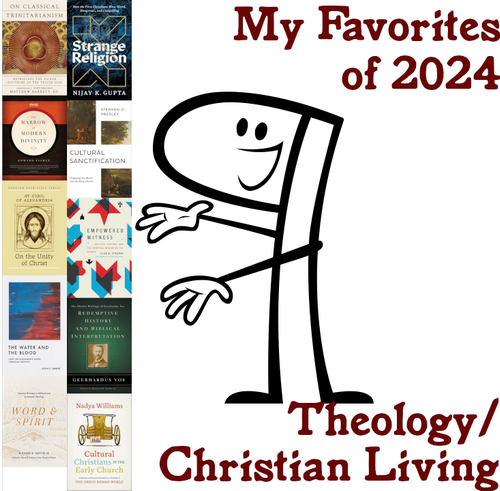
On Classical Trinitarianism: Retriving the Nicene Doctrine of the Triune God edited by Matthew Barrett. An Outstanding Defense/Explanation/Retrieval of the Vital Teaching

Cover of On Classical Trinitarianism by Matthew BarrettOn Classical Trinitarianism:
Retrieving the Nicene Doctrine of the Triune God

edited by Matthew Barrett

DETAILS:
Publisher: IVP Academic
Publication Date: October 1, 2024
Format: eARC
Length: 832 pgs.
Read Date: September 8-October 12, 2024
Buy from Bookshop.org Support Indie Bookstores

What Does The Cover Say About This?

There’s no way that I can do this justice easily, so I’ll just borrow the Publisher’s Website’s copy:
Modern theology claimed that it ignited a renaissance in trinitarian theology. Really, it has been a renaissance in social trinitarianism. Classical commitments like divine simplicity have been jettisoned, the three persons have been redefined as three centers of consciousness and will, and modern agendas in politics, gender, and ecclesiology determine the terms of the discussion. Contemporary trinitarian theology has followed the spirit of this trajectory, rejecting doctrines like eternal generation which were once a hallmark of Nicene orthodoxy and reintroducing subordinationism into the Trinity.

Motivated by the longstanding need to retrieve the classical doctrine of the Trinity, theologian Matthew Barrett brings together Protestant, Roman Catholic, and Eastern Orthodox scholars to intervene in the conversation. With over forty contributions, this ecumenical volume resurrects the enduring legacy of Nicene orthodoxy, providing a theological introduction that listens with humility to the Great Tradition.

In On Classical Trinitarianism, you find contributions from a wide range of scholars, including:

  • Katherin Rogers
  • Andrew Louth
  • Gilles Emery
  • Steven Duby
  • Gavin Ortlund
  • Adonis Vidu
  • Carl Trueman
  • Matthew Levering
  • Fred Sanders
  • Scott Swain
  • Karen Kilby
  • Amy Peeler
  • Thomas Joseph White

The distinct yet united voices of On Classical Trinitarianism summon the next generation to move past modern revisionism for the sake of renewing classical trinitarian theology today. Together, they demonstrate that Nicene orthodoxy can endure in the modern world and unite the church catholic.

Do NOT Follow My Example Here

I read this (until the last week or so) at a rate of 1-2 chapters a day (with the occasional day of 3 or 4 chapters) in a vain attempt to finish the book in under a month, so I could post about it before release day.

This should be read much slower—it wouldn’t hurt to read each chapter at the same pace I did, but only one at a time. Then you should go back and read it again, slower this time—maybe taking notes—and maybe one more time after that before moving on. That’s how I’m going to do it next time.

One thing I think I did do right was that I read this from front to back. Generally, this book builds from chapter to chapter. The first part, in particular, “Retrieving Nicene Trinitarianism” should be read before the rest—those 11 chapters dive deep into the historical material—with an emphasis on the first few centuries of the Church.

Highlights and Lowlights

Frequently when I talk about a book like this I’ll talk about the highlights, the chapters I liked more, or I thought were more convincing than others. And I’ll mention the ones that weren’t so successful in my eyes.

I don’t think I can do that with this one—they were all great. Some were more interesting than others, but…that’s really an “eye of the beholder” kind of thing and will probably vary each time I read the book. Some touched on things I’ve been reading lately, some were authors I wanted to read/read more of. That kind of thing.

Instead, I’ll talk about the difficulty in reading. Chapter 2, The Nicene Creed: Foundation of Orthodoxy could be given to any High School class. Carl Trueman’s “Reforming the Trinity? The Collapse of Classical Metaphysics and the Protestant Identity Crisis,” was only a little tougher. And the final chapter, Michael Horton’s “Biblicism and Heterodoxy: Nicene Orthodoxy, Ecclesiastical Accountability, and Institutional Fidelity,” was also pretty accessible.

Chapter 6 “Maximos and John Damascene: Mid-Byzantine Reception of Nicea” was so filled with Greek that I couldn’t get much out of it. But “The Unbegotten Father”, Chapter 22, was also Greek-rich, and I struggled, but I did get a lot out of it (but would translations in the footnotes have been so bad?). I thought Chapter 17, “Three Persons, One Will” was pretty hard reading, too—but so, so helpful. I don’t know if anything topped Chapter 6, but Chapter 25 “No Impassibility, No Eternal Generation: Retrieving a Pro-Nicene Distinctive” maybe came close. But it’s also one of my favorite chapters.

The rest of the chapters are somewhere in between those extremes, closer to the latter than the former set. None are unapproachable for the non-professional. But you do need to be prepared for some struggles.

So, what did I think about On Classical Trinitarianism?

I loved this book. I’ve been talking with friends about it for weeks (actually, some of us started talking about it months ago). It’s a real blessing for The Church and individual believers.

I learned so, so much—and know when I read it more slowly, I’ll learn so much more. I have notes throughout about looking into this idea or that idea some more. There are also a handful of books from the footnotes that I need to go buy (and that handful will likely multiply on my next read). I got some clarification on positions I already held or leaned toward—and I’m more convinced of them all now, and can explain them better. I was confronted by ideas I hadn’t reckoned with before—or ways of looking at tried and true subjects that I hadn’t considered before, and now can’t help but see everywhere.

I think the critiques of Social Trinitarianism, Eternal Functional Subordinationism (and related positions), attacks on Eternal Generation or the Impassibility of God and so on were so valuable—and the wide range of chapters and topics that led to them shows how large an impact these positions can have—and the way they are out of step with pro-Nicene Theology.

This book takes work—and it should—but it’s worth every ounce of effort you expend. You will be rewarded for your efforts—I have been already, and I took the easy way through it. I’ll be returning to these pages again and again—I heartily recommend this and encourage you to give it a read.

9.5 out of 5 stars. (It loses a half star for all the untranslated Greek)

Disclaimer: I received a copy of this book from IVP Academic—thanks to both for this.


5 Stars4 1/2 Stars

This post contains an affiliate link. If you purchase from it, I will get a small commission at no additional cost to you. As always, the opinions expressed are my own.
Irresponsible Reader Pilcrow Icon

On the Unity of Christ by Cyril of Alexandria, John Anthony McGuckin (Translator): A Powerful Dialogue on the Person of Christ

Cover of On the Unity of Christ by Cyril of AlexandriaOn the Unity of Christ

by Cyril of Alexandria, John Anthony McGuckin (Translator)

DETAILS:
Series: Popular Patristics Series, #13
Publisher: St Vladimir's Seminary Press
Publication Date: March 23, 2005
Format: Paperback
Length: 133 pg.
Read Date: August 25, 2024
Buy from Bookshop.org Support Indie Bookstores

What’s On the Unity of Christ About?

In a dialogue between characters creatively named A and B, Cyril advances–Scripturally, theologically, and philosophically–the classic case against Nestorius and his teachings, advancing what’s now received as the orthodox position on Christ’s nature as the god-man.

Uh, What?

I haven’t read a lot of the books in this series, but of the handful that I have read, this is one that had me scratching my head the most. There were a few times that I just had no idea why Cyril was addressing topics or making a certain argument. Those either were moved on from quickly, or I finally got the point–I don’t think this was a problem on his part–it’s just me not knowing the ins and outs of my Fifth Century theology, particularly the Christological conflicts.

There were even a couple of times where I was following Cyril, but I really didn’t think the argument was that sound or helpful–and both times, my notes tell me that within two pages, I’d come on board (well, largely).

It’s a good reminder that just because someone is a reliable teacher/writer–even an Early Church Father–they’re flawed people (flawed people who’ve had people reading them for centuries, sure). And while the smart thing to do is shut up and learn from them regardless, they still can stumble from time to time. You’ve still got to keep your brain engaged and to test the Spirits.

Tone

Hoo-ee, Cyril did not hold back what he thought of his opponents or those who differed from him:

What nonsense that is. Surely it is the clearest proof of delirious brain.

My goodness. I cannot imagine how stupid and intellectually superficial they must be who hold to such a conceptos. The whole thing is faithlessness and nothing else. It is the novelty of wicked inventions, the overthrowing of the divine and sacred kerygma which has proclaimed One Lord Jesus Christ, the Son of God, truly the Word of God the Father…

who is this serpant who has recently appeared? And what are these idiotic things he ser against the teachings of the truth?

What has happened to their brains and their intelligence—people who hold such opinions?

Do they have anything from the sacred scriptures to demonstrate for us the truth of their doctrine on such matters? Or are they innovating in the faith? “Speaking things from their own hearts and not from the mouth of the Lord,” as it is written (Jer 23:6). Perhaps they find themselves unable to say: “As for me, let me never boast save in the cross of Christ, through whom the world is crucified to me, and I to the world” (Gal 6:14).

It’s a different time. It’s a different atmosphere. The stakes (typically) in theological controversy aren’t quite as high for us as they were then. So we don’t usually talk like that. I’m not going to say whether Cyril was right or wrong in that–it’s just too hard to apply different cultural standards.

But let’s put it this way: you know where you stood with him. No doubt. It reminded me of reading Luther, to be honest.

So, what did I think about On the Unity of Christ?

So, I’m obviously not going to get into any kind of critique of Cyril’s thinking or writing–I know my place in history and his (I might get into something closer to that in a few weeks when I talk about a book about Cyril). So, this is focusing on this read.

This is a really easy read given how important it (and Cyril) is in history. The translator (like with the rest of this series) has got to be at least partially responsible for that.

Except for the moments I mentioned above, I had no trouble understanding his points–either what he claimed his opponents taught or his response to it. The text flows easily, the dialogue format helps you track what he’s saying (I don’t always appreciate that style, but I got into it with this).

I enjoyed this, I profited from it, and (if nothing else) it serves as a good motivation to get more from this series.


5 Stars

This post contains an affiliate link. If you purchase from it, I will get a small commission at no additional cost to you. As always, the opinions expressed are my own.
Irresponsible Reader Pilcrow Icon

BOOK SPOTLIGHT: On Classical Trinitarianism: Retrieving the Nicene Doctrine of the Triune God edited by Matthew Barrett

Ideally last week, or at least today, I’d have posted about this book. But I bit off a bit more than I can chew requesting it when I did from Netgalley. I’m hoping it’ll be up next week–but that won’t be easy. Still, with the publication date coming up on Tuesday, I wanted to get something up about it. So here’s a Spotlight post. (largely taken from the Publisher’s Webpage about the book, I really hope they don’t mind–or that they’ll forgive me if they do mind).


Book Details:

Title: On Classical Trinitarianism: Retrieving the Nicene Doctrine of the Triune God
Genre: Theology
Format: Hardcover/e-Book/Audiobook
Length: 832 pages
Publisher: IVP Academic
Publication Date: October 1, 2024
Cover of On Classical Trinitarianism by Matthew Barrett

About the Book:

Modern theology claimed that it ignited a renaissance in trinitarian theology. Really, it has been a renaissance in social trinitarianism. Classical commitments like divine simplicity have been jettisoned, the three persons have been redefined as three centers of consciousness and will, and modern agendas in politics, gender, and ecclesiology determine the terms of the discussion. Contemporary trinitarian theology has followed the spirit of this trajectory, rejecting doctrines like eternal generation which were once a hallmark of Nicene orthodoxy and reintroducing subordinationism into the Trinity.

Motivated by the longstanding need to retrieve the classical doctrine of the Trinity, theologian Matthew Barrett brings together Protestant, Roman Catholic, and Eastern Orthodox scholars to intervene in the conversation. With over forty contributions, this ecumenical volume resurrects the enduring legacy of Nicene orthodoxy, providing a theological introduction that listens with humility to the Great Tradition.

In On Classical Trinitarianism, you find contributions from a wide range of scholars, including:

  • Katherin Rogers
  • Andrew Louth
  • Gilles Emery
  • Steven Duby
  • Gavin Ortlund
  • Adonis Vidu
  • Carl Trueman
  • Matthew Levering
  • Fred Sanders
  • Scott Swain
  • Karen Kilby
  • Amy Peeler
  • Thomas Joseph White

The distinct yet united voices of On Classical Trinitarianism summon the next generation to move past modern revisionism for the sake of renewing classical trinitarian theology today. Together, they demonstrate that Nicene orthodoxy can endure in the modern world and unite the church catholic.

About the Editor:

Matthew BarrettMatthew Barrett is professor of Christian Theology at Midwestern Baptist Theological Seminary, the editor-in-chief of Credo Magazine, and Director of the Center for Classical Theology. He is the author of the award winning book, Simply Trinity: The Unmanipulated Father, Son, and Spirit, as well as the author of The Reformation as Renewal: Retrieving the One, Holy, Catholic, and Apostolic Church. He is currently writing a Systematic Theology. He is the host of the Credo podcast, where he talks with fellow theologians about the retrieval of classical Christianity today for the sake of renewing the church.

Editor Links:

Twitter ~ Center for Classical Theology ~ Credo Podcast ~ MBTS Page

Irresponsible Reader Pilcrow Icon

Reposting Just Cuz: This is Going to Hurt (Audiobook) by Adam Kay: It’s Funny Because It’s True. Also, Dispiriting Because It’s True

This is Going to HurtThis is Going to Hurt:
Secret Diaries of
a Junior Doctor

by Adam Kay

DETAILS:
Publisher: HarperAudio
Publication Date: March 7, 2022
Format: Unabridged Audiobook
Length: 5 hr., 47 min.
Read Date: May 17-18, 2022
Support Independent Bookstores - Visit IndieBound.org

Doctors must be psychologically fit for the job — able to make decisions under a terrifying amount of pressure, able to break bad news to us anguished relatives, able to deal with death on a daily basis. They must have something that cannot be memorized and graded; a great doctor must have a huge heart and a distended aorta which pumps a vast lake of compassion and human kindness.

What’s This is Going to Hurt About?

This book covers the years that doctor-turned-comedy writer Adam Kay spent as a junior obstetrics doctor in the NHS. I’m going to gloss over the various titles he had because it’s a different system than I’m used to, and I’d botch it—but basically, it’s the first few years post-medical school.

Essentially these are excerpts (details tweaked to everyone’s privacy) from his diaries from that time showing the day-to-day realities he faced. Told with a comedic bent, sure, but it’s just real life—a version of real-life that’s more exhausted, more stressed, and covered in more and various bodily fluids than most of us have, sure. It’s told very anecdotally, he’s not trying to construct a narrative here, just “here’s Day X, here’s Day X +2,” and so on.

He talks about preposterous situations he’s put in because of his low-ranking status and/or NHS regulations, he talks about funny situations with patients, ridiculous colleagues, unsympathetic friends, harrowing experiences, and just strange ones. Given his specialty, he deals with expectant mothers, newborns, clueless fathers-to-be, and heartbreak. We get the gamut here.

Bonus Material

The audiobook I listened to was released with the paperback release and contained some bonus material—a few more diary entries and an afterword. The afterword was essentially a rallying cry for people to support the NHS’s existence.

I don’t have a dog in this fight—but I found his arguments compelling, and I thought his support of the NHS throughout the book (while freely critiquing aspects of it) added some good and necessary grounding to the humor. The life and death aspect of the book did, too—obviously—but that’s common with medical memoirs, this is distinctive (at least in my limited experience)

So, what did I think about This is Going to Hurt?

Called to the Early Pregnancy Unit by one of the SHOs to confirm a miscarriage at eight weeks—he’s new to scanning and wants a second pair of eyes. I remember that feeling only too well and scamper over. He’s managed the couple’s expectations very well, and clearly made them aware it doesn’t look good—they’re sad and silent as I walk in. What he hasn’t done very well is the ultrasound. He may as well have been scanning the back of his hand or a packet of Quavers. Not only is the baby fine, but so is the other baby that he hadn’t spotted.

I audibly laughed—twice—during the Introduction, so I was instantly on board with this book. The laughs really didn’t let up. At times, I wondered if it was a little too jokey, and wished we got more of the narrative about his experience—but then he’d say something else funny and then I decided I didn’t care because he’s a good comedy writer. Bring on the jokes!

Like the best medical comedies (e.g., MAS*H (in all its forms), Scrubs), Kay intersperses the laughs with drama and tragedy—stories of hard-fought success and heartbreaking—even devastating—loss. That augments both ends of the spectrum—while you’re chuckling, you’re more open to feeling the empathy to appreciate the dramatic. When you’re reeling from a hard experience, you need the laughter. If Kay’s TV scripts are anything like this, I wish I could see some of his episodes.

Kay handles his own narration here and is great at it, wry detachment mixed with a no-nonsense delivery. He knows it’s funny, so he’s not trying to push the humor, he just trusts the material and lets it do the heavy lifting.

When the library told me that my hold for this was ready, I didn’t remember requesting it—wasn’t sure at all why I did. But I gave it a chance, and am so glad I did—it made for a very entertaining 5+ hours. I think you’ll find the same if you give it a try.


3.5 Stars

This post contains an affiliate link. If you purchase from it, I will get a small commission at no additional cost to you. As always, opinions are my own.

REPOSTING JUST CUZ: Gentle and Lowly by Dane C. Ortlund: An Encouraging Look at the Heart of Christ

Nothing against this book, but I don’t have a lot to say, but I promised myself I’d do better about posting in this genre, so here we go.


Gentle and Lowly

Gentle and Lowly: The Heart of Christ for Sinners and Sufferers

by Dane C. Ortlund

Kindle Edition, 224 pg.
Crossway, 2020

Read: January 3-10, 2021
Grab a copy from your local indie bookstore!

What’s Gentle and Lowly About?

We are not focusing centrally on what Christ has done. We are considering who he is. The two matters are bound up together and indeed interdependent. But they are distinct.

…It is one thing to know the doctrines of the incarnation and the atonement and a hundred other vital doctrines. It is another, more searching matter to know his heart for you.

Where most books on Jesus Christ focus on His work or nature, Ortland focuses on who He is—what He’s revealed to His people. As you might guess from the title, he focuses on Matthew 11:29 the phrase, “I am gentle and lowly in heart,” in particular. But he develops the idea through numerous Gospel passages.

Ortland does spend time on the Spirit and Father, showing how they are both revealed to have a similar heart. He follows that up with material from the Epistles, focusing on the Risen and Ascended Christ, still displaying the same care, the same heart for His people.

Standing on the Shoulders

In this study, Ortlund draws on insights from the Puritans Thomas Goodwin, Richard Sibbes, and John Owen (some others, including some relatively modern writers, too). Naturally, I found this material very rewarding. Ortland takes his cues from the best of the English Reformed tradition and it shows in his work.

I do sort of wish that the footnotes pointed to things other than various authors collected works, I think in some cases the material is available in other editions, and it’d be nice if it was easier to find, he makes you want to read more by these men on those topics. But that’s beside the point.

So, what did I think about Gentle and Lowly?

“Gentle and lowly” does not mean “mushy and frothy.”

But for the penitent, his heart of gentle embrace is never outmatched by our sins and foibles and insecurities and doubts and anxieties and failures. For lowly gentleness is not one way Jesus occasionally acts toward others. Gentleness is who he is. It is his heart. He can’t un-gentle himself toward his own any more than you or I can change our eye color. It’s who we are.

There’s nothing revolutionary to be found here, but there’s good, solid, reassuring material. It’s impossible to read this book and not be encouraged to draw near to Him and taking His yoke. It’s an easy read, very accessible, and one that’s well worth your time and attention.


3 Stars

This post contains an affiliate link. If you purchase from it, I will get a small commission at no additional cost to you. As always, opinions are my own.

REPOSTING JUST CUZ: Top 5 Tuesday – Top 5 Opening Lines

Today is turning out to be a bad day for me to post things, but I’ve been inspired by Witty & Sarcastic Bookclub’s thread on Twitter to revisit this post (and a similar one). So, why not repost it while I consider revising the list? From wayyyyyy back in 2020.


I love a good opening line. A solid opening paragraph or page is great, but an opening line that sells you on the next 200-500 pages? Magic. When I saw this list topic listed, these 5 jumped to mind—they may not be the best I’ve ever read, but they’re the most memorable.

(I tried, tried, tried to limit myself to the opening line, but I failed on a couple of them, couldn’t help myself.)

5 A Portrait of the Artist as a Young Man
A Portrait of the Artist as a Young Man by James Joyce

I remember in our English class in High School when we were assigned this book, pretty much no one was interested. When Mr. Russo passed out the paperbacks, a few of us flipped it opened and read these first words—and suddenly we were open to the idea (didn’t last long for all of us, but that’s beside the point, we’re focused on the opening lines here). It’s stuck with me for almost 30 years, that’s gotta say something.

Once upon a time and a very good time it was there was a moocow coming down along the road and this moocow that was coming down along the road met a nicens little boy named baby tuckoo….

4
Neuromancer by William Gibson

This sentence was love at first glance for me. Still love it. Naturally, no one knows what color this is referring to anymore.

The sky above the port was the color of television, tuned to a dead channel.

3
The Big Sleep by Raymond Chandler

Oft-parodied. Oft-imitated. Often-celebrated. Does it get better than this?

It was about eleven o’clock in the morning, mid October, with the sun not shining and a look of hard wet rain in the clearness of the foothills. I was wearing my powder-blue suit, with dark blue shirt, tie and display handkerchief, black brogues, black wool socks with dark blue clocks on them. I was neat, clean, shaved and sober, and I didn’t care who knew it. I was everything the well-dressed private detective ought to be. I was calling on four million dollars.

2
Harry Potter and the Sorceror’s Stone by J. K. Rowling

Why bother saying anything here?

Mr. and Mrs. Dursley, of number four Privet Drive, were proud to say that they were perfectly normal, thank you very much. They were the last people you’d expect to be involved in anything strange or mysterious, because they just didn’t hold with such nonsense.

1
The Hitchhiker’s Guide to the Galaxy by Douglas Adams

I’ll go on and on about this book next week, so I’ll just keep my trap shut here. But man…there was something about these lines that got into my blood.

Far out in the uncharted backwaters of the unfashionable end of the Western Spiral arm of the Galaxy lies a small unregarded yellow sun.

Orbiting this at a distance of roughly ninety-eight million miles is an utterly insignificant little blue-green planet whose ape-descended life forms are so amazingly primitive that they still think digital watches are a pretty neat idea.

Page 9 of 62

Powered by WordPress & Theme by Anders Norén