Category: Theology/Christian Living Page 11 of 32

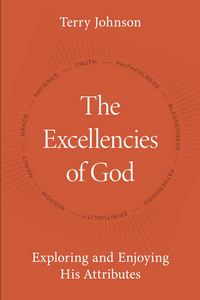
REPOSTING JUST ‘CUZ: The Excellencies of God: Exploring and Enjoying His Attributes by Terry Johnson: Not Quite as Good as Its Predecessor but Worth Your Time

The Excellencies of GodThe Excellencies of God:
Exploring and Enjoying
His Attributes

by Terry Johnson

DETAILS:
Publisher: Reformation Heritage Books
Publication Date: October 23, 2022
Format: Hardcover
Length: 347 pg.
Read Date: October 23-November 20, 2022

Support Independent Bookstores - Visit IndieBound.org

The Excellencies of God‘s Jacket Copy

God’s attributes is the most practical of subjects, inspiring and shaping the entire Christian life. Contemplating who God is and what He has promised to do can bring great comfort to the most despairing soul. Moreover, it brings immense delight to all those who recognize their chief end as the glory and enjoyment of God. In The Excellencies of God, Terry L. Johnson explores several aspects of the divine character and shows how they play a crucial role in our Christian experience. May God’s mercy and grace, His patience and wisdom, His truth and faithfulness, His spirituality and blessedness prove to be a blessing to all who peruse these pages.

The Table of Contents

That’s kind of vague, so let’s look at the TOC.

Preface
Introduction: The Christian and the Attributes
The Mercy, Grace, and Patience of God
1. The Mercy of God
2. The Grace of God
3. The Patience of God
The Truth and Faithfulness of God
4. The God of Truth
5. Liberating Truth
6. Pursue and Proclaim the Truth
The Blessedness of God
7. The Blessed God
8. Our Blessedness in God
The Fatherhood of God
9. God Our Father
10. Pleasing Our Father
11. Our Father’s Children
12. Our Father’s Care
The Spirituality of God
13. The God Who Is Spirit
14. Serving an Invisible God
15. Spiritual Mindedness
16. Spiritual Worship
17. True Worship
The Wisdom of God
18. God Only Wise
19. Wisdom and Folly
20. Seeking and Submitting to God’s Wisdom

So, what did I think about The Excellencies of God?

I struggled to write a post about Johnson’s The Identity and Attributes of God two years ago, and I find myself in a similar position now with this follow-up. I went with the bare minimum above because it fits the book—Johnson lays things out very matter-of-factly, and you get exactly what the TOC lists. He takes each thought and explains it using citations from Scripture, the Fathers, Reformers, and some contemporary writers—with some illustrations of hymns.

I have the impression that Johnson gives 50-60% of the text, and the rest are quotations (mostly a sentence or less). I did not (would not) try to verify that—and I’m pretty sure I’m wrong, but that’s my impression as a whole. I wanted more of Johnson and less of everyone else. I think this is about the same as the previous volume, and I had a similar thought about it—but overall it was so good, I didn’t care. This book was a little less impressive so it stuck out to me more.

I don’t think I get the selection of the major topics and how they flowed one from the other—the chapters within each topic, on the other hand, flowed nicely.

Is this a decent read? Yeah, but it tends to the dull-side with the repeated quotations. But beyond that, it’s a pretty straightforward and thorough look at the topics. It’s helpful, it should push you to look more into some of the ideas that you find more provocative (and the footnotes will help with that). It’s sound and measured, majoring on the majors and not really spending time on minor issues.

It’s a good book that I can recommend without hesitation, I just wanted more from it.


4 Stars

This post contains an affiliate link. If you purchase from it, I will get a small commission at no additional cost to you. As always, the opinions expressed are my own.

Who Chose the Gospels?: Probing the Great Gospel Conspiracy by C. E. Hill: Robert Langdon Might Have Been on the Wrong Track (shocking, I know)

Who Chose the Gospels?Who Chose the Gospels?:
Probing the Great Gospel Conspiracy

by C. E. Hill

DETAILS:
Publisher: Oxford University Press, USA
Publication Date: April 7, 2012
Format: Paperback
Length: 247 pg.
Read Date: September 10-24, 2023
Buy from Bookshop.org Support Indie Bookstores

All this presents a rather sticky problem. Recall that in Professor Ehrman’s political interpretation of church history it isn’t until the fourth century that the ‘orthodox’ party finally ‘sealed its victory over all of its opponents’, At that time ‘it rewrote the history of the engagement’, claiming that its views were passed down from Jesus’ apostles. And yet here is Irenaeus, nearly two centuries earlier, already ‘rewriting history’ long before the victory was sealed. At a time when, many prominent scholars insist, the issue was still very much in doubt, Irenaeus writes as if the church had been nurtured by these four Gospels from the time of the apostles.

The problem with Irenaeus is that he simply wrecks the popular paradigm. His views about the emerging New Testament canon, and about the four Gospels in particular, are simply too well-developed, too mature, to fit the scheme that many have invested themselves in today. As a second-century Christian author who argued that there are, and can only be, four legitimate Gospels—because they alone teach the truth about Jesus and because they alone had been handed down in the church from the time of the apostles—Irenaeus lies like a fallen Redwood in the path of those who would see the choice of the four Gospels as a late and politically motivated manoeuvre of the fourth century.

How do you solve a problem like Irenaeus?

What’s Who Chose the Gospels? About?

That last question in the quotation would work pretty well as an alternate title for the book—how do you solve a problem like Iraneaus? Or, more to the point, how do you ignore his (early date) recognition of only 4 gospels—Matthew, Mark, Luke, and John—despite what we’re told about the state of gospel availability and canonization by so many today.

Hill examines some of the time frames, uses, content, and provenance of some of the so-called competitor gospels (i.e., those that never were considered canonical) to compare them to both the canonical gospels and those early figures of the Church we see discussing the gospels. But primarily, Hill is concerned with the use of and testimony regarding the canonical gospels—and the evidence regarding their use by the Church and when it started. The overwhelming bulk of the book is focused there.

So, we may now ask, how did the Christian church, apparent drowning in a sea of Gospels, finally end up with only four? The educated reader of today may already have come to the conch. sion that the story was attended with a good bit of bullying intrigue, and skullduggery. Many perhaps picture councils of bad-tempered bishops voting on which books to include in the Bible one minute, and voting to execute heretics the next. As now widely believed, in any case, that the four canonical Gospels emerged into prominence only fairly late from a long and drawnout battle within early Christianity, a battle finally won in the fourth century after the establishment of the church by Constantine the Great. While academics might not, as Teabing does Dan Brown’s novel, attribute the collation of the Bible to ‘pagan emperor Constantine’, many even in the academic community insist that the question of which Gospels the church ought to endorse was still up for grabs in the fourth century.

He also looks a little bit at contemporary theories (both academic and popular) about the development of the canon—insofar as it focuses on the Gospels. He finds it wanting, and somewhat self-contradictory—and talks about that, too. But even as he does so, it’s not the main focus of the book—which is, as said earlier, the four gospels and how the second (and possibly first) century church regarded them, and how that changed (and mostly didn’t change) in the two centuries following.

The Tone of the Book

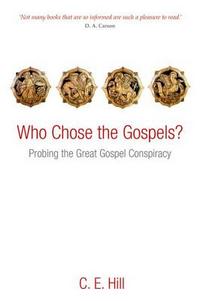
You probably can’t read it in the image above, but that top blurb is from D.A. Carson and it says, “Not many books that are so informed are such a pleasure to read.” I really didn’t pay much attention to it—and just figured he meant something about how nice it is to have such an informative read or something like that. If for no other reason, it was from Oxford University Press, who are not known for fun reads. I was super duper wrong.

This was a blast to read. Seriously, I had a lot of fun.

Not—and I want to stress, not—because he’s making jokes, being silly, or outrageous or anything like that. There’s just something about Hill’s style. He’s charming (seemingly effortlessly), not in a way that calls attention to itself, but it’s there—a little mild sarcasm, some wordplay, some other bits of humor along the way—but it’s nothing I can point to, and say “there it is!” But time after time while reading this, I found myself grinning for no apparent reason.

That’s just his style—the subject is serious, and frankly, pretty dry. But Hill keeps it from being dry without tuning down the seriousness of both the positive case he’s trying to build and the criticisms he makes toward the other side(s).

So, what did I think about Who Chose the Gospels??

In short, we have no evidence that the church ever sat down collectively or as individual churches and composed criteria for judging which Gospels (or other literature) it thought best suited its needs. On the contrary, the key realization which best explains our inability to find an ultimate ‘chooser’, which best explains why the church didn’t take the easy way out with some kind of singular Gospel and why it never cobbled together a set of criteria to apply to all the Gospel candidates, is that the church essentially did not believe it had a choice in the matter! The question ‘why did you choose these Gospels?’ would not have made sense to many Christians in the second century, for the question assumes that the church, or someone in it, had the authority to make the choice. To many, it would be like the question, ‘why did you choose your parents?

A few other books/chapters that I’ve read on the subject talk about the conclusions Hill draws, and refer to some of the evidence, but Hill’s the first one I’ve read who’s actually “shown the work,” as my math teachers/professors would say. His answers match other scholars, but I can actually see how he got them. For that alone, I enjoyed reading this book and profited from it.

Add in his style? Oh, buddy—now we’re cooking with fire.

Hill is careful and thorough, acknowledging challenges to his position about the emergence of the fourfold Gospel to the place it holds today. But he’s consistent in showing how those challenges don’t have the weight and merit that so many in our culture assume they do. Not to keep picking on it—but the authors/editors of Church History in Plain Language should spend time with this book and others like it before they finish the Sixth Edition—it would really help out with its particularly weak chapter on the Canon.

I think the concluding chapter could’ve been beefed up a little bit. Maybe after a few more readings, I can figure out what it was missing—I just felt it was weak here and there. Or another reading or two will show me that I could’ve paid better attention this time (entirely likely).

Regardless, Who Wrote the Gospels? is a book well worth time and attention—and it’ll repay both.


5 Stars

This post contains an affiliate link. If you purchase from it, I will get a small commission at no additional cost to you. As always, the opinions expressed are my own.

Irresponsible Reader Pilcrow Icon

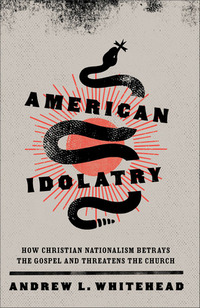
American Idolatry: How Christian Nationalism Betrays the Gospel and Threatens the Church by Andrew Whitehead

American IdolatryAmerican Idolatry:
How Christian Nationalism Betrays
the Gospel and Threatens the Church

by Andrew Whitehead

DETAILS:
Publisher: Brazos Press
Publication Date: August 15, 2023
Format: Hardcover
Length: 192 pgs.
Read Date: August 27-September3, 2023
Buy from Bookshop.org Support Indie Bookstores

Both parts of my identity* have led me to the same conclusion: Christian nationalism betrays the gospel and is a threat to the Christian church in the United States. It is from this perspective that I write this book. I want to make clear to my fellow white American Christians how much Christian nationalism threatens our faith—not only our individual expressions of it but also our organizations and institutions. It threatens our capacity to love our brothers and sisters in Christ who are minorities. It threatens our capacity to love and serve our brothers and sisters in Christ from countries around the world. It threatens our capacity to love and serve fellow bearers of God’s image at home and abroad who don’t share our faith at all. And it threatens how our organizations function, causing them to reproduce inequality and further harm the marginalized.

I am convinced that Christian nationalism makes us bad Christians.

* Those parts are a follower of Christ and a social scientist.

What’s American Idolatry About?

Essentially, this is an attempt to demonstrate the subtitle: “How Christian Nationalism Betrays the Gospel and Threatens the Church” (the above quotation does show he’s not talking about a threat to the throughout the world—or the future—but the contemporary church in the U.S., an important distinction).

It’s also a follow-up to the work he co-authored with Samuel Perry, Taking America Back for God: Christian Nationalism in the United States—this is a less-technical book (from what I can tell), to appeal to people who don’t enjoy digging through social science analysis and graphs. It also seems to be a “so what now?” response to that book—the earlier volume presented the data, and this is Whitehead’s suggested reaction to that data. I haven’t actually read the previous book, but from what Whitehead says in these pages and what I’ve read about the previous book, that’s my impression.

This doesn’t mean that Whitehead assumes a thorough knowledge of or familiarity with Christian Nationalism (he frequently appends “white” to that term for reasons he makes clear) going into this book, he spends two chapters outlining the basics of Christian Nationalism and how that impacts the Church. The next three chapters focus on what he calls “the three most powerful” idols of Christian Nationalism—power, fear, and violence—followed by three chapters describing alternatives to these idols, ways that are more faithful to the calling to which you have been called.*

* These are not exhaustive chapters, for more along these lines—see What Are Christians For? Life Together at the End of the World by Jake Meador. Some of the ideas in these books will align, but they will diverge, too. Yet, I would predict neither author would object to being read together.

A Disclaimer of Sorts

We have to look straight into the mirror and not try to hide or diminish the imperfections we see. Only then can we begin to imagine something new. Part of this work is recognizing that the God we worship has no particular interest in the greatness of the United States. The survival of any one nation over another is not paramount. The kingdom of God needs no global superpower in order to flourish….recognizing that human flourishing in the kingdom of God and in the United States (or any other nation) are not synonymous does not mean that Christians should not invest in the flourishing of a nation and its people. We can work toward peace, justice, and care for all who live and work within the boundaries of our home country. We can collaborate with God and those around us to create a more loving and liberating country for all our neighbors.

Whitehead returns to the idea frequently, but stresses it in the first two chapters—he is not calling for Christians to be anti-American, or even apathetic about our country. He’s not calling for them to remove themselves from the political process. His concern is how we see the country, how we view and treat our fellow citizens, and how we’re involved in the political process.

The choice is not Christian Nationalism or godless anarchy, or Communism, or Sharia law—and so on. His vision is for Christians to work alongside those of other faiths (or absence thereof) for the civil betterment of us all. While I think Whitehead’s politics tend toward the Left, he’s not calling for all Christians to embrace that—conservative and Republican Christians can agree with his arguments on the issues this book centers on.

The Idols of Christian Nationalism

There are many “idols” of CN, claims Whitehead, but the three he focuses on are the biggest problems in his view are power, fear, and violence. The heart of the book is devoted to this section (it’s not the longest, but it’s the most important), here he demonstrates how the devotion to and use of these characterize the movement and put it at odds with Christianity.

In these chapters, Whitehead begins by defining what he sees as the CN’s use of/dependence on the various idols. Then he’ll show how throughout our history—but particularly in recent decades/years how both political figures and religious leaders have tapped into and exploited these ideas for their own benefit and the detriment of other groups in the U.S. He’ll then look at Christ’s and/or early-Christian teachings on the same ideas, contrasting them with CN’s use (this is particularly effective on the ideas of power and violence).

The shortcomings (to put it mildly) of CN are on full display here. Frankly, I think the definition work done in chapter 2 is enough to turn someone off of this ideology, but chapters 3-6 really put the nail in the coffin.

So, what did I think about American Idolatry?

Over years of academic study and personal faith journey, I have become convinced that white Christian nationalism in the United States is fundamentally opposed to the ethics and teachings of Jesus. Through idolizing power, fear, and violence, white Christian nationalism betrays the gospel, in which Jesus’s sacrifice liberates us from our enslavement to sin as well as the destruction it causes through systems of oppression It betrays the gospel that realigned the power structures of society.

As a whole, I don’t see people who aren’t at least suspicious of CN responding well to this book—I think most of those who are suspicious will become more so after this—and those who are already pretty against it will have new reasons and will be strengthened in it. I’m not sure that those who have leanings or sympathies toward it are going to respond well. I could be wrong, and hope I am. That I don’t think it would reach the CN-leaning is the biggest flaw with the book (but if I’m wrong about the effectiveness, that flaw wouldn’t be that big).

Based on what little he indicated about his own theological positions, I don’t think Whitehead and I would agree on much. I think we’d probably agree on less when it comes to politics. But when it comes to the impact that CN is having on churches, our gospel witness, and the public perception of the Christian Church in the US? Well, we’re pretty much on the same page—which I think fits some of Whitehead’s points. He’s not really that concerned with the areas where he and I would disagree, in fact, he’d probably defend that ability. Where he is focused is the negatives that CN brings to political discourse and the work of the church.

On those points, I think he scored big in American Idolatry—showing the flaws, errant presuppositions, and wrong emphasis—and non-Christian attitudes of CN. I’m less sure that he was convincing in the last three chapters about healthy alternatives, but I do think what he offers there is better than CN, and he’s convincing to that point. Maybe not as far as he wants to be, however.

Crisp and clear writing, the text moves with the assurance of someone well-versed in the subject and clear-eyed about what they want to say about it. I recommend the book and thinking about the issues it raises.


3.5 Stars

This post contains an affiliate link. If you purchase from it, I will get a small commission at no additional cost to you. As always, the opinions expressed are my own.

Irresponsible Reader Pilcrow Icon

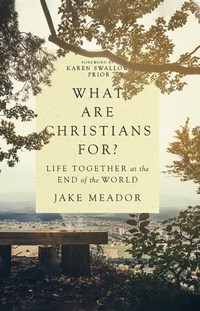
REPOSTING JUST CUZ:What Are Christians For? Life Together at the End of the World by Jake Meador: A View for Living in Culture and Nature

What Are Christians For?What Are Christians For?:
Life Together at the End of the World

by Jake Meador

DETAILS:
Publisher: IVP
Publication Date: February 21, 2022
Format: Hardcover
Length: 170 pg.
Read Date: March 27- April 3, 2022
Support Independent Bookstores - Visit IndieBound.org

God looks at this world and loves it, which is why we can and should do the same. This world is not something we should seek to escape through conquest or bend to our will through technique, power, or control. Rather, it is a gift given to us by God for our joy and his glory. Because God is love and his law is good, we can look at our neighbor and love him or her. Because God gave himself to us, we can give ourselves to others. We can confidently and joyfully enter into these debts of love that we build up over a lifetime of living in the world, and we can dispense them with extravagance, trusting that whatever wrongs we might experience today as a result of such living will be gathered up and made right in the glorious and perfect love of God.

The Back of the Book

What does a Christian political witness look like in our day?

Politics ought to be defined by fidelity to the common good of all the members of society. But our modern Western politics are defined by a determination to bend the natural world and human life to its own political and economic ends. This wholesale rejection of the natural order is behind the dominant revolutions in our history, and defines our experience in Western society today—our racialized hierarchy, modern industry, and the sexual revolution.

In What Are Christians For?, Jake Meador lays out a proposal for a Christian politics rooted in the givenness and goodness of the created world. He is uninterested in the cultural wars that have so often characterized American Christianity. Instead, he casts a vision for an ordered society that rejects the late modern revolution at every turn and is rooted in the natural law tradition and the great Protestant confessions. Here is a political approach that is antiracist, anticapitalist, and profoundly pro-life. A truly Christian political witness, Meador argues, must attend closely to the natural world and renounce the metallic fantasies that have poisoned common life in America life for too long.

Faithful Presence

In his discussion of the Christian response to those revolutions, Meador borrows a scheme from James Davison Hunter describing the four postures Christians have taken: defensive against, relevance to, purity from, and faithful presence.

He doesn’t spend a lot of space—but sufficient space—defining and then critiquing the first three, but gives more space to faithful presence. And actually, everything he argues for in the remainder of the book could fit in this category. I want to say I’d heard of Hunter’s categories before this, but I can’t remember where (in print or lecture). But first off, I really appreciated the schema in terms of describing how the American Church has responded. But even more, I appreciated Meador’s explanation of faithful presence and then his application of it.

Influences

Meador builds the arguments in this book on the work of Herman Bavinck—particularly his book, Christian Worldview. But he’s drawing on several other thinkers and writers from across the theological spectrum (a methodology borrowed from Bavinck). You can see the fingerprints of Lewis, Tolkien, Wendell Berry, John Paul II, Solzhenitsyn, Martin Bucer—and others. There’s a breadth of influences here that’s impressive and adds a lot to the arguments (and makes narrow-minded guys like me a little uncomfortable).

So, what did I think about What Are Christians For??

What did [Aleksandr Solzhenitsyn] propose as a way through the revolution? We must turn, our eyes upward to the heavens, he said, not as a place to conquer, as his compatriots in the space program believed, but as a reminder that our lives exist as a vapor in the wind, and then comes the judgment.

We do not conquer the heavens; we are judged by them. And if we fail to discover the sources of spiritual health, there is nothing else for us. Our spiritual lives will continue to be trampled on by the weight of our age. And if our spiritual lives are destroyed, no amount of wealth or power can atone for such a loss.

This seems like one of those books that I need to read a handful of times and then read some scholarly reviews—pro and con—before I can really say I have a handle on the strengths and weaknesses of the arguments. Thankfully, this isn’t that kind of blog.

How did it read? Very nicely. Meador’s writing is strong, it’s clear, and he’s able to express complex thoughts in a very digestible manner. Sure, I think I need to read it a few more times before I could say I mastered the thoughts—but that’s on me, not the text, this is just not the kind of thing I spend a lot of time thinking about. I appreciated Meador being critical of both the American Left and the American Right (you rarely see that in Christian literature), while putting forth a vision built on the best of the Christian traditions.

I don’t think Meador offers a perfect solution to the situation we find ourselves in, but there’s a lot of insight and wisdom to be found in these pages. And even if it’s not perfect, it’s a whole lot better than anything else I’ve found.


4 1/2 Stars

This post contains an affiliate link. If you purchase from it, I will get a small commission at no additional cost to you. As always, opinions are my own.

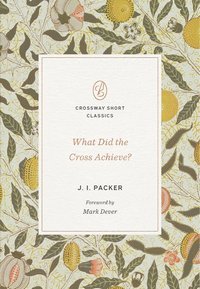
What Did the Cross Achieve? by J.I. Packer: A Beginning of an Answer to a Vital Question

What Did the Cross Achieve?What Did the Cross Achieve?

by J.I. Packer, Mark Dever (Foreword)

DETAILS:
Series: Crossway Short Classics Series
Publisher: Crossway
Publication Date: August 29, 2023
Format: Paperback
Length: 109 pg.
Read Date: August 27, 2023
Buy from Bookshop.org Support Indie Bookstores

Some Thoughts on the Series as a Whole

The point of this series is to take classic short works—sermons, tracts, articles—package them attractively, edit a bit (modernize language, eliminate footnotes, tweak grammar, etc.), and make them widely available. Each is given a short introduction to help the reader get the context and a bit of information about the author.

They published seven books in this series last year, and I discussed them here. Three have come out this year (so far), but I’m hoping for more in this series soon.

What’s What Did the Cross Achieve About?

This essay was originally a lecture Packer delivered but it lives on far after that time. It’s essentially a defense of the Penal Substitutionary Theory of the Atonement—and a critique of some alternate theories. Which is not to say that Packer doesn’t have some words of correction for other proponents of substitutionary atonement, nor is he without appreciation for alternate theories.

Packer holds that when people like Socinius attacked the Reformation’s preaching and teaching on the atonement, the Reformed (in particular) responded to his rationalistic arguments on the same grounds—and spent centuries refining things along those lines, losing the declaratory, doxological, and kerygmatic power of the doctrine. For this “preliminary survey,” he states:

My plan is this: first, to clear up some questions of method, so that there will be no doubt as to what I am doing; second, to explore what it means to call Christ’s death substitutionary; third, to see what further meaning is added when Christ’s substitutionary suffering is called penal; fourth, to note in closing that the analysis offered is not out of harmony with learned exegetical opinion. These are, I believe, needful preliminaries to any serious theological estimate of this view.

So, what did I think about What Did the Cross Achieve?

Can we then justify ourselves in holding a view of the atonement into which penal substitution does not enter? Ought we not to reconsider whether penal substicution is not, after all, the heart of the matter? These* are among the questions that our preliminary survey in this lecture has raised. It is to be hoped that they will receive the attention they deserve.

* And other questions that I snipped due to lack of context.

This was a good reminder to me of just how good J.I. Packer was—it’s been a long time since I’ve read a much by him, and it’s easy to remember really liking his writing and learning a lot from him, but to forget most of the details. And then you read him and are reminded why I spent so much of the 90s immersed in his work.

His approach to the idea was great and easy to follow. This wasn’t for a popular audience, but the language isn’t that difficult to follow. I appreciated and benefited from his argumentation—and thought his analysis and argumentation were spot-on (and would still be pretty sufficient for what I’ve seen for people today who struggle with penal substitution).

Essentially, this was a great way to spend an hour or so, one of the best of this series, and one I’ll return to again and again. I’d suggest you do the same.


4 1/2 Stars

This post contains an affiliate link. If you purchase from it, I will get a small commission at no additional cost to you. As always, the opinions expressed are my own.
Irresponsible Reader Pilcrow Icon

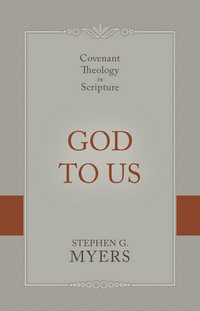
God to Us: Covenant Theology in Scripture by Stephen G. Myers: A Great Introduction to This Vital Idea

God to UsGod to Us:
Covenant Theology in Scripture

by Stephen G. Myers

DETAILS:
Publisher: Reformation Heritage Books
Publication Date: November 27, 2021
Format: Hardcover
Length: 310
Read Date: June 11-August 22, 2023
Buy from Bookshop.org Support Indie Bookstores

Disclaimer

Some friends and I read this book at the same time, getting together to talk about it periodically. So it’s entirely possible, even likely, that some of what I say in this post is a thought borrowed from someone else. This will particularly be true if I say something insightful or interesting.

What’s God to Us About?

This is, pretty simply, an introduction to Covenant Theology. Myers defines covenant in his introduction (with special focus on the words used, and meanings suggested, in the Old Testament, New Testament, and Septuagint). From there, he gives a brief history of the development of Covenant Theology throughout Church History, which is probably worth a book unto itself—but this chapter serves well enough.

From there he looks at the three predominant covenants in Scripture/Theology—the Covenants of Works, the Counsel of Peace, and the Covenant of Grace. He spends two chapters on the Covenant of Grace—one on understanding the covenant and then one on the circumstances surrounding the announcement of the Covenant and what we can learn from that (and this is one of those chapters worth the purchase price of the book alone). He then looks at the developing covenants that make up the Covenant of Grace—the Adamic, Noahic, Abrahamic, Mosaic, Davidic, and New Covenant. Myers then looks at Covenant Theology in the New Testament and then in The Church. The Mosaic Covenant is another Covenant that gets two chapters (the rest all get one)—the second looks at the ways the New Testament writers think about and use the Mosaic Covenant.

Highlights of the Book

I like to focus on one or two chapters that really stand out to me when talking about books like this. Myers made this very difficult for me—I’m tempted to say Chapters 2-12 were highlights, but that seems to be cheating. It’s true, though—there’s something in each of those chapters that made me sit up and pay attention in a way I didn’t expect.

I guess I would have to say that the chapter on the Noahic Covenant was particularly effective—usually, I tend to think (and think I’ve seen authors treat it this way) about the Noahic Covenant being something covered just to check a box between Adam and Abraham—it’s where the word covenant is first used, so we need to look at it, but it’s not that big of a deal. Myers won’t let you think that way, showing how it’s a pivotal step in Redemptive History—and I’ll not make that mistake again.

Chapter Nine, “The Mosaic Covenant in the New Testament,” is so vital and so important that I have to mention it. Not only does Myers help the reader understand what the NT is doing, but he also helps the reader avoid some of the more popular and prevalent errors regarding this understanding today. The same could be said for Chapter Eleven, “The New Covenant.”

And if I’m not careful, I’ll list the other chapters, too—so I’m going to move along.

Things I Wasn’t Crazy About

I’m not going into details, but Myers uses Gen. 6:18 extensively in his arguments about God establishing covenants in Genesis before the word “covenant” was used. He’s not the first to do so—O. Palmer Robertson mentions someone (some people? I don’t remember and am not going to go look it up) doing the same in a footnote in his 1987 book, The Christ of the Covenants. It seems to be a perfectly valid argument—but I wonder if Myers relies on it too much. Yes, he uses a multi-pronged argument, and Gen. 6 is just one of them—but it seems to be called to do more than it maybe can.

Secondly, and I know I didn’t catch this, that’d be one of the others I read it with. Myers uses the early chapters of Hosea to substantiate his position on what the exiles of the Northern and Southern Kingdoms mean for the Davidic Covenant (and the Covenant of Grace as a whole). There’s much to be commended for his position—but a lot of what he says about the early chapters of Hosea seems to differ from what Hosea says later on. Now, if I studied this portion of this book a bit more, I might have an easier time defending Myers’s position—but at first and second glance, he seems to stumble a bit here.

Lastly, and this is a very minor problem, the thirteenth chapter, “Covenant Theology and the Church,” is a bit of a letdown. Your results may (and likely will) vary. But for me, after twelve chapters with insights that impressed me when they didn’t teach me and/or helped me to think about Covenant Theology in a new way, to come across a chapter about the sacraments, Church membership, and related ideas that was as basic and straightforward as this just left me wanting more. I didn’t see any problems in what Myers said, but it all seemed a bit too obvious. He’s been sailing along

So, what did I think about God to Us?

I loved this book. I’ve read more books on Covenant Theology than I can easily count, and if this isn’t the best, it’s so close to it as not to matter. Myers gives his readers a thorough introduction to Covenant Theology as it came to the Protestant Church from the Reformation—particularly the English Reformation and the explanation offered by the Westminster divines and their contemporaries. His introduction is readable, clear, and helpful to the layman willing to put in a little work—but he’s not just repeating what the previous generations gave us, he’s looking at contemporary theology and insights as well.

Is it perfect? Nope. Are there more problems with it than those I mentioned above? Almost certainly. But it’s just so good that the flaws are forgivable. I learned a lot—even if it was just a better way to state what I’d already believed and understood—but I got much more than that from the book. It’s such a helpful work.

More than that—as all good theology should, it led me to doxology. That our Lord would condescend to His people in covenant is mind-blowingly gracious in the first place—that He does so to rebels in order that he could win them to Himself? That should drive us to worship. And the more we understand the gracious and remarkable nature of these covenants, the more we should be driven to it. Myers brings his readers to this point repeatedly—sometimes just by explaining something clearly—sometimes by applying his explanation to the reader to help us understand how it should make us reflect in worship.

I’ve tried to keep this brief and to resist the urge to dive deeply into some of the areas of the book that I would want to if this was the place for deep dives into Theology. But this is about books, so I’m not going to. I cannot say enough good things about God to Us. It’s just great. I’ve given it as a gift already, I will do so in the future as well as recommend it to anyone who asks for a good intro to the topic. Also, I commend it to whoever reads this post.


5 Stars

This post contains an affiliate link. If you purchase from it, I will get a small commission at no additional cost to you. As always, the opinions expressed are my own.

Irresponsible Reader Pilcrow Icon

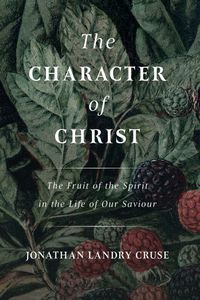
The Character of Christ by Jonathan Landry Cruse: The Fruit of the Spirit in Our Lord

The Character of ChristThe Character of Christ:
The Fruit of the Spirit in the Life of Our Saviour

by Jonathan Landry Cruse

DETAILS:
Publisher: Banner of Truth Trust
Publication Date: April 04, 2023
Format: Paperback
Length: 154 pg.
Read Date: August 6-13, 2023
Buy from Bookshop.org Support Indie Bookstores

The Goal/Design of the Book

The introduction is called “This Is Not A How-To Book.” This is vital, and this emphasis is likely why I bought this book* after hearing Cruse interviewed about it. Christian bookstores (wherever they may still exist) and websites are full of books on how to generate the Fruit of the Spirit in our lives, and are great ways to make yourself feel guilty when they don’t work.

Also, those books really miss the point anyway.

Cruse is clear about the need for believers to produce fruit—and he’s also clear about the way that happens. But that’s a secondary matter for this book—this book is about focusing on the Fruits of the Spirit and seeing how they were seen, manifested, and taught by our Lord.

This is a book about Christ, first and foremost. Following John Owen (and others) Cruse is convinced that as we see Him better, as we understand Him more, we will be transformed and those fruits will be seen.

* Given my appreciation for Cruse, that’s likely an overstatement–but I would’ve bought and read other books first.

What’s The Character of Christ About?

Okay, I just answered that—oops. After the Introduction, Cruse takes one chapter to look at each of the Fruits of the Spirit listed in Galatians 5: love, joy, peace, patience, kindness, goodness, faithfulness, gentleness, and self-control. The organization of each chapter varies—which is annoying for trying to sum it up briefly, but so nice when it comes to reading. It’d have been very easy for each of these chapters to have the same outline, just with different topics—and my eyes would’ve glazed over a lot.

Essentially, we get a good definition of each fruit along with examples of how we see that in the life of our Savior. Cruse will often show us what Christ Himself taught about the fruit, too. Each chapter ends with some sort of application—not in the “How To” sense. But here’s how you can display Christ, go to Jesus, and pray for this to be shown in your life as it applies to each fruit.

The book concludes with a reminder to look to Christ and how He has perfectly kept in step with the Spirit and borne the fruit. As we do so, as we are united to Him by the Spirit, we can be transformed as well.

So, what did I think about The Character of Christ?

This is too brief, not because Cruse was skimpy on details or needed to explain anything better. But each chapter could’ve been twice the length and not lost my interest, I could keep reading more and more about each of these ideas in this manner. Although I’m pretty sure if he did give us twice the length, I’d still be asking for more.

This was a great balance of doctrine and example/illustration. He’s careful not to let the reader focus too much on themselves as they ponder each idea but consistently points to the Author and Finisher of our Faith. It’s easy to read, wonderful to chew on, and truly helpful in the way that how-to books can’t be.

I strongly recommend this to your attention—not just for the content, but the manner in which Cruse presents it.


4 Stars
This post contains an affiliate link. If you purchase from it, I will get a small commission at no additional cost to you. As always, the opinions expressed are my own.
Irresponsible Reader Pilcrow Icon

REPOSTING JUST CUZ: The Christian’s True Identity by Jonathan Landry Cruse: An Introduction to the Glory that is Being “In Him”

Okay, I’m too tired to get something new ready. So instead of talking about Jonathan Landry Cruse’s newest book, let’s take a look at his previous one.


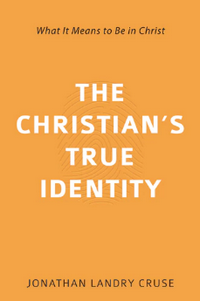
The Christian’s True Identity

The Christian’s True Identity:
What It Means to
Be in Christ

by Jonathan Landry Cruse

Kindle Edition, 144 pg.
Reformation Heritage, 2019

Read: March 21, 2021
Grab a copy from your local indie bookstore!

Many of us are raised believing that Jesus is simply the way to salvation. But no—He is salvation. He is the way, but He is also the life! He is both the giver and the gift. He is not a means to an end; He is the end. We are not to come to Christ looking for Him to give us something (like salvation, sanctification, a better life—or at least a better car), but instead we are to come to Christ looking for Him.

What’s The Christian’s True Identity About?

I’ve spent too much time trying to be clever or profound with this, it’s a short book, I can be brief here. The book’s point is pretty simple—despite all the noise and hubbub today about finding ourselves, choosing/shaping our identity. For the Christian, our identity comes from being rooted in Christ.

One of the—possibly the—greatest truths recovered by the Reformation was that union with Christ is at the core of all the blessings, all the amazing things that are true of the Christian, the Christian Life, and the Life of the World to Come. It’s all rooted and grounded in Him.

John calls it “abiding in” Christ. Paul repeatedly describes our blessings “in Him.” Cruse looks at ten passages from Paul’s epistles where he uses the phrase “in Him,” reviewing the passage, explaining how the passage reflects and teaches this truth about Christian identity, and applying it to the reader.

So, what did I think about The Christian’s True Identity?

Throughout this book we have considered how an identity in Christ far excels any identity the world might offer us. When we are in Christ we are chosen, forgiven, accepted as righteous, adopted into God’s family, placed in community, made new, and kept perfectly secure come what may. Our blessings in Jesus Christ are so expansive that it can truly be said that our union began in eternity with election and will forever continue in eternity with glorification.

That’s pretty much what’s covered in the book—done effectively, warmly, and clearly. Cruse has an easy-to-read, engaging style—he’ll draw you in and make you want to learn more. He skillfully uses writers from throughout Church History, contemporary scholarship, and current cultural examples to help bring these truths to life.

I think it could be deeper, I think it could be more detailed. But that’s not what the book aimed for—it’s an introduction or a refresher, that’s all. It’s supposed to drive the reader to further study, further reading. It accomplishes that goal while pointing to glorious, foundational truths. I commend it to you for that.


3.5 Stars

This post contains an affiliate link. If you purchase from it, I will get a small commission at no additional cost to you. As always, opinions are my own.

PUB DAY REPOST: Impossible Christianity by Kevin DeYoung: A Call for Assured Disciples

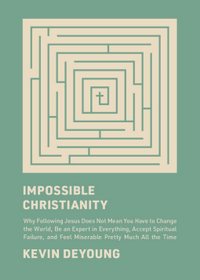
Impossible ChristianityImpossible Christianity:
Why Following Jesus Does Not Mean You Have to Change the World, Be an Expert in Everything, Accept Spiritual Failure, and Feel Miserable Pretty Much All the Time

by Kevin DeYoung

DETAILS:
Publisher: Crossway
Publication Date: August 15, 2023
Format: eARC
Length: 160  pg.
Read Date: July 23-30, 2023
Buy from Bookshop.org Support Indie Bookstores

What’s Impossible Christianity About?

On the one hand, the twenty-eight(!) words of the subtitle give a handy summary of what the book is about—but there’s still more to say. But it’s difficult to summarize outside of that without going on too long. Still, it’s worth a shot.

While exploring things like personal wealth, corporate guilt, and the call to individual holiness and sanctification, Kevin DeYoung reminds readers that our goal isn’t to change the world, it isn’t to achieve a perfection in behavior or ability, nor is it to wallow in our shortcomings and weaknesses. Rather, we are to press on when we stumble, ask God for forgiveness and help; keeping our eyes on our goal, see how far we’ve come; and rejoice in the work of grace in our lives—knowing that our Father is pleased with us.

There’s more to it than that (obviously, he spends eight chapters developing what I just used two sentences to convey). But that’s a decent thumbnail sketch.

The Highlights

In chapter 2, “Who Is It That Overcomes the World?,” we get an exploration of some of the more challenging material in 1 John. This treatment of 1 John and assurance is enough to justify picking the book up in the first place (for me, anyway. But I doubt I’ll be alone).

Where DeYoung will take these ideas from the epistle to encourage believers, to see signs of their faith and draw assurance from them, too many have taken the same words to use as tests of faith, to spur an attitude of “I must do more to earn God’s favor” or “I need to prove my devotion.”

While avoiding any kind of “cheap grace” (or whatever people call it today), DeYoung points to John’s heart in dealing with “little children” and encouraging their continuation in the faith.

He does something similar in Chapter 7 when reminding us of God’s Fatherhood and what the Scriptures tell us about Fatherhood. It’s an encouragement to fidelity and activity, not a whip to drive us to it. We’re called to virtues, not to-do lists—to reflect a character, not to change the world. The world (or at least things in our immediate vicinity) may be changed as a result, but that’s not our goal. Rather (as he argues in Chapter 8 ) is to live a quiet life of faithful discipleship.

I Could’ve Used a Bit More

DeYoung is known for frequently being on the pithy side with his books, and that’s certainly the case here. As it is characteristic of him, I don’t want to complain about that too much—I knew what I was getting into when I picked this book up.

Still, it felt a bit too brief. I wanted a little more from some of the chapters—a little more explanation, a little more depth, a little fuller idea of what he was trying to convey. It’s hard to explain while speaking broadly (and without citations because it’s an ARC), but I need 10-20% more of everything.

One thing, in particular, I wanted fleshed out was some criticisms he pointed at Christians who teach that we’re constant failures and should feel that weakness. I’d have appreciated less vagueness—direct citations, or at least references in a footnote would’ve been helpful so I could compare what he was arguing for to what he was arguing against.

So, what did I think about Impossible Christianity?

I think that’s my largest complaint—the book’s just a bit too brief. DeYoung was his typical engaging, clear (with the exception listed above), and helpful self in these pages. His illustrations and examples from his own life were amusing and helpful. If nothing else, I enjoyed reading the book.

On top of that criteria (in this type of book, it’s the least important), the book was helpful, encouraging, and gracious. Which is what it set out to be, so kudos for that. There was some material that was good to chew on, some healthy reminders of truths easy to forget or neglect, and a few moments to inspire a renewed activity.

Would I have appreciated more? Yes. Do I appreciate what DeYoung delivered? Also, yes. I’m afraid I come across as too critical, so let’s be clear—I wanted more of something helpful so it could’ve been more helpful.

From the smile-inducing opening illustration to the closing paragraphs of benediction (what a great addition to this book)—this was a pleasure to read. I do recommend this book and encourage others to pick it up.

Disclaimer: I received this eARC from Crossway via NetGalley in exchange for this post and my honest opinion—thanks to both for this.


4 Stars

This post contains an affiliate link. If you purchase from it, I will get a small commission at no additional cost to you. As always, the opinions expressed are my own.

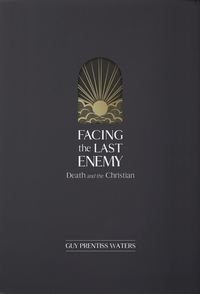
Facing the Last Enemy by Guy Prentiss Waters: A Good Primer on Preparing for the The End

Facing the Last EnemyFacing the Last Enemy

by Guy Prentiss Waters

DETAILS:
Publisher: Ligonier Ministries
Publication Date: June 29, 2023
Format: Hardcover
Length: 132 pg.
Read Date: July 30 - August 6, 2023
Buy from Bookshop.org Support Indie Bookstores

What’s Facing the Last Enemy About?

Chapter 1 beings,

We all have questions about death. “What is death? Why do we die? Why do we all die? Why is death so scary? Why did Christ die? Why do Christians have to die? How can I face the death of someone I love? How can I prepare for death? How can I help others prepare for death? What happens after death?”

Essentially, the book is his attempt to answer those questions—largely along Scriptural and theological lines, but he also addresses some more practical aspects of preparing for death.

But before he answers those questions, Waters addresses some obstacles that 21st Century people face when thinking and talking about death seriously. We live in a culture of distraction, he says, which is nothing new but “we have taken distraction to new heights” between sports, movies, streaming services, the Internet, etc., etc. Secondly, we live in a “a culture of distancing and denial. We have all sorts of ways to try to keep death at arm’s length.” As a general rule, people go through the final stages of dying and death itself in an institution or facility of some sort—not home, surrounded by family and friends.

Those are the cultural obstacles, but there are some ecclesiastical obstacles as well. He points to the Evangelical embracing of consumerism—we treat people attending churches as customers, so we want to give them what they want to hear (things other than death) so they keep coming back. Secondly, there’s the embracing of an entertainment mentality. Death and dying are not entertaining at all—so we don’t discuss those things. Lastly, is the trend to divide congregations by age and stage of life, resulting in “a whole generation of Christians is deprived of witnessing the truth of Scripture exemplified and lived out in the lives of older Christians.”

Given these obstacles, it’s all the more important that people take steps to think about, study, and discuss things like death and the preparation for it.

The book is broken down into three parts. Part 1 “Defining Death” covers things such as the definition of death, why death is part of the world, why Christ died—why those who’ve trusted in Him continue to die, and so on. Part 2, “Encountering Death,” focuses on how we face the death of others—friends, acquaintances, family, and so on. How do we prepare ourselves to deal with (and grieve over) their deaths, how can we help them (both practically and spiritually) as they walk through the valley of the shadow of death? Then he spends two chapters on preparing for our own deaths—again, both spiritually and pragmatically (wills, living wills, burial choices, etc.) Then in Part 3, “Beyond Death,” Waters focuses on personal eschatology—the Resurrection, the Intermediate State, Final Judgement, and Heaven and Hell.

So, what did I think about Facing the Last Enemy?

The best thing that I can say about the book is that this is a good introductory—just look at the list of topics covered—in 132 pages you can’t say a lot about any of them. He does give some suggestions for further reading in the endnotes, which is good. But I wanted more. This feels like a well-developed outline than a book exploring the topics. It’s very likely the notes (or transcripts) of classes he taught for Ligonier that they put into book form—and those chapters would probably work for the time of Ligonier lessons. But if you’re going to take the time to turn those things into a book, you should as least expand on them a little bit.

Aside from that, there’s a lot to commend—on the purely theological issues, Waters is expectedly careful and thoughtful (or at least as thoughtful as he can). When it comes to definitions and explaining concepts he’s in line with the Westminster Standards—and the Christian thought throughout Church History. When it comes to contemporary concerns and the practical things that will vary from culture to culture—he’s careful to give advice and suggestions. When things are a matter of wisdom, prudence, or liberty, Waters says, “here’s some good ideas” or “think about this,” going out of his way not to label other options as sinful or his as “right.”

I think a conclusion wrapping things up, recapping some themes, and tieing into Chapter 1’s Introductory material would’ve been helpful. But that’s a matter of taste, I think. And the number of times I’ve said something like that over the last couple of years suggests that I really need to get over the idea of a concluding chapter.

Did I want more? Yes, particularly from someone of the caliber of Waters. Did I appreciate what we were given? Yes. It’s a great introductory volume and will undoubtedly be helpful for many.


3 Stars

This post contains an affiliate link. If you purchase from it, I will get a small commission at no additional cost to you. As always, the opinions expressed are my own.
Page 11 of 32

Powered by WordPress & Theme by Anders Norén