Category: YA/MG/Children’s Books Page 35 of 42

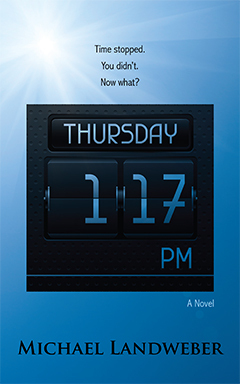
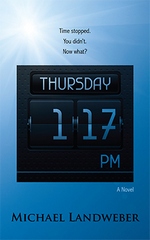
Thursday, 1:17 PM by Michael Landweber

Thursday, 1:17 PMThursday, 1:17 PM

by Michael Landweber

Kindle Edition, 208 pg.
Coffeetown Press, 2016

Read: May 18 – 19, 2016

Towel Day is tomorrow, so it seems apropos to start with a couple of Douglas Adams lines that I’d imagine Duck quoted to himself, assuming he read the book: “This must be Thursday . . .I never could get the hang of Thursdays.” and “Time is an illusion. Lunchtime doubly so.” Now, if anyone could empathize with Arthur and Ford, it’s Duck.

(like I need an excuse to quote Adams, really, but I’ll take one)

And you never know, maybe he had read Adams, after all:

We’d read Fight Club in Mr. Lorenzo’s Anarchy in Modern American Fiction class . . . And Lord of the Rings in Ms. Tutwell’s Geography of Fictional Lands seminar, which somehow got me Social Studies credit. Damn, I went to a really questionable high school.

So, earlier today, I posted something from the publisher with the idea behind this one. Basically, Duck’s head is nowhere near where it should be as he walks the busy streets of D. C. and he steps out in front of a car that doesn’t hit him. Not because of lightning-fast reflexes of the driver, nor because of fantastic brakes, or because some hero pulled/pushed/tackled him out of the way. Nope, none of those — but because faster than you can say “Rod Serling,” time stopped.

Now our 17-year-old protagonist has to figure out: what happened (if he can); how to survive in this Frozen World (if he can); and most importantly — how can he get things moving again (if he can).

Simple enough premise, right? Yup. One that seems like you’ve probably read/seen it a few times (seems that way, but I can’t remember once) — but Landweber executes it like he’s the first. It feels fresh, new and innovative — while being an old stand-by, figure out how he pulled that off and I’ll probably end up talking about your book, too.

As we talked about a little while ago, there are very strict rules governing this reality and Duck figures them out pretty fast (at least fast enough to survive awhile).

Now seems like a good place to explain what people feel like in the frozen world. Skin feels like skin, hair like hair, lips like lips. It’s one of those things that is almost normal. When no one moves, you expect them to feel like molded plastic, like mannequins, limbs swiveling on set pivots without much range. A secondary possibility was that everyone would feel rubbery, like the well-preserved fetal pig [Duck’s friend] Grace dissected for me. Wrong on both counts.

The inert water hung down from the showerhead like strands of silk caressing his body. I touched one and it came away from its cohorts, wet and liquid on my fingertips.

And, yes, that sounds kind of creepy going around touching skin, hair, lips, some dude’s shower water — but don’t worry, that’s only because it is creepy. And Duck would be the first to admit that (probably while blushing). One reason I liked the paragraphs I quoted was because, yeah, molded plastic is exactly how I’d have figured it to feel.

Duck composing a “Guidebook” to how to live in this kind of reality ticks off a few boxes: lets us see his personality, lets him talk about his experimentation to discover the rules in a slightly more objective way than the rest of his narration, and lets him give the readers an info dump — several, actually — without it feeling like one. A very nice move there.

Landweber gives us a few details a little at a time about this reality, what Duck’s been going through in the days/weeks/months leading up to stepping in front of the car (like where that nickname comes from — a tale that’s both tragic and funny). As little as he’s been paying attention to the outside world, it might as well have stopped. So one of the things he does during this time is figure out what’s been going on with his friends — between family crisis and adolescent male hormones, he’s missed a lot. He just hopes that he can make up for this time.

For the most part, this book comes across as light entertainment — but there are (at least) two big dramatic stories at play here in addition to the fun and games. There’s death, the nature of love (and reality of lust, teenage style), growing up, friendship, hurting others . . . and Duck coming to grips with all of these, and coping with them isn’t done in a heavy-handed, or overly serious manner. On the whole, while you’re chuckling about something he’ll slide right into a consideration of one of the heavier themes. Over and over again, Landweber does this seamlessly so you barely notice it. No mean trick to pull off.

In addition to that, Duck deals with some pretty deep ethical questions (and doesn’t always come up with the right answer). His father, a philosopher, had posited that:

there is no good or evil without time. Empirically, he argued, man’s actions in themselves are not right or wrong. It is only the interaction of those deeds with the passage of time and the judgments of others that leads to morality. If you were to freeze time at the instant of the act, and never allow for there to be recriminations or regret or accusations or revenge, then the act itself becomes a meaningless one. No matter what that act is. Merely a moment detached from all other moments. A moment without consequence.

Duck’s got more than enough of these detached moments, moments without consequences, to deal with. And watching him deal with these ideas and try to be moral (frequently) is a really nice touch that I don’t think I expected from the premise.

It’s told in a light tone — and never gets spooky or too tense, but that doesn’t stop what Duck is dealing with from being serious — and dealt with seriously (much of the time). Landweber balances that pretty well most of the time — while keeping Duck as believable as possible in this situation. It is a compelling read, a fun read, and a moving read. Breezy enough to keep the YA crowd engaged, and thoughtful enough to make it worthwhile.

You really want to go get your hands on this one, readers, you’ll enjoy it.

Disclaimer: I received a copy of this book from the author in exchange for an honest review.

—–

4 Stars

Thursday, 1:17 PM Book Tour

Thursday, 1:17 PMTime stopped. You didn’t. Now what?

Duck is 17. He will never be 18.

Tomorrow is his birthday. It will never be tomorrow.

Time stopped at 1:17 p.m. on a beautiful Thursday afternoon in Washington, DC. Duck is the only person moving in a world where all other living beings have been frozen into statues in an endless diorama. Duck was already in limbo, having lost his mother to cancer and his father to mental illness.

Now, faced with the unimaginable, he approaches his dilemma with the eye of an anthropologist and the heart of a teenager trying to do the right thing under the strangest of circumstances. Ultimately, he realizes that while he doesn’t understand the boundaries between friendship and love, that uncertain territory may be the key to restarting the world.

Trade Paperback – Available now
Publisher: Coffeetown Press
ISBN13: 9781603813570
208 pages

Coming up: We’ve got a Guest Post from Michael Landweber, a Q & A with him, too — and finally, my $.02 about the book. Come back and check these posts out (the links will work when the posts go up) — or just go get the book. Whatever.

Calamity by Brandon Sanderson

CalamityCalamity

by Brandon Sanderson
Series: The Reckoners, #3

Hardcover, 417 pg.
Delacorte Press, 2016

Read: March 30 – April 2, 2016

There was more connectivity between city-states in the Fractured States than I’d once assumed. Perhaps the Epics could have survived without any kind of infrastructure, but they tended to want subjects to rule. What good was it to be an all-powerful force of destruction and fury if you didn’t have peasants to murder now and then? Unfortunately peasants had to eat, or they’d go and die before you got a chance to murder them.

That meant building up some kind of structure in your city, finding some kind of product you could trade. Cities that could produce a surplus of food could trade for power cells, weapons or luxuries. I found that satisfying. When they’d first appeared, the Epics had wantonly destroyed anything and everything, ruining the national infrastructure. Now they were forced to bring it all back, becoming administrators.

Life was so unfair. You couldn’t both destroy everything around you and live like a king.

I really enjoyed Steelheart, the first novel in this trilogy — and Firefight was a lot of fun, if not as good — it wasn’t anything serious, weighty, or bogged-down with teenage drama. Just a fun story about super-powered individuals ruling over a post-apocalyptic dystopia and the non-super-powered rebels trying to take them down. So, how’d Brandon Sanderson wrap things up? In a very mixed bag — an ending that was honest, consistent, and fitting for the series, but one I really didn’t care for.

Which is going to take some explanation.

David’s voice is as friendly, upbeat, and nerdy in the way that charmed me in the beginning. Even weighted down with added burdens and losses, he’s hung onto his core personality. His metaphors are as painful as ever — his ability to get his teammates to go along with the biggest of hare-brained schemes is intact and still astounding.

I wanted answers. They were probably here somewhere. Maybe I’d find them behind that group of robotic war drones that were extending their gun arms from behind the freezers in front of me.

Oh.

But he isn’t the same kid we met on the streets of Newcago — he’s lost his drive for revenge, it’s evolved into something else (and/or been revealed or better understood to be something else). He’s not out for blood, not out for simply overthrowing the Epics. He still wants to stop them, to restore rule to non-Epics and free them from the tyranny they’re under. But it’s because of wrong and right, for deeper reasons, purer motives.

He’s not the only one who’s changed and grown — Megan, the love of his life and former foe, has greater understanding of herself and her powers, she’s gaining more and more control of both. Part of it is self-acceptance, part of it is David’s faith in her. Either way, she’s a more entertaining character — and a less threatening force (at least as far as The Reckoners are concerned).

Thanks to their travel and experience, David and the others have a better understanding of how the world works (see the above quotation for a hint) — and some of the Epics have had to make adjustments, if for no other reason to keep their subjects alive and working. From a surprising source, we learn how the Reckoners tech works — as do they — and it’s pretty odd (and interesting). Not only that — the source of Calamity, the source of the Epics’ powers is revealed. You really can’t ask for more than that.

Well, actually you can — one of the other things that comes out of the growth and development of David (and the rest) over the series, and especially over this book, are some underlying themes that come out. They’ve been there since the beginning if you knew how to look, but here, Sanderson makes them explicit. I really appreciated them as they surfaced — I’m not sure that a lot of the YA crowd that this is targeted for would as much as I did, but many would. The last scene is pretty heartwarming, really — something I wouldn’t have expected at pretty much any point in the series (and has nothing to do with romance, for the record).

So why am I lukewarm about this? While the execution was consistent, the tone was right on-pitch and Sanderson didn’t cheat anywhere along the way to the series conclusion, I just didn’t like it. I didn’t like the explanation given for the source of the powers. I didn’t like the way the last half of the book played out (mostly everything after the last battle with the Prof, really — so less than half, but the groundwork was laid at about the 50% mark). Sanderson told the story he wanted to, in a way that made sense to the rest of the series, and he never copped out or went for high drama over being true to his story. So I can’t judge it too harshly. I just didn’t care for the way it played out. Which pretty much just means that Sanderson wrote the ending he wanted and not the one I wanted. Sure, I think it’s tacky, but you can add that to the very long list of things that he didn’t ask me.

I wasn’t wowed, wasn’t thrilled with things in the end. But I really can’t complain about any of it. Fans of — or at least readers of — the series should check out the conclusion, just to get the closure it brings. Hopefully, you’ll get more out of it than I did.

—–

3 Stars

A Few Quick Questions With…Hagit Oron

Earlier, I posted a piece about Elphie and Dad go on an Epic Adventure by Hagit R. Oron and Or Oron. Hagit was nice enough to take part in a Q&A with me. I kept it short and sweet, because I’d rather she work on her next book than take too much time with me, y’know? Hagit gave some great answers, hope you enjoy this — and be sure to check out her books!

Good depictions of Fathers are pretty hard to come by, so I wanted to say thanks for that. What made you decide to tell as story about a Dad and his kid rather than the typical Mom?
Well, I love stories about fathers and sons. “Out Stealing Horses” by Per Petterson is one of my favorite books and it is truly an inspiration.

I was also inspired by the relationship between my Dad and his Dad. My grandpa was a strict uptight guy. As he grew older he left all that behind and became this soft mellow sweet person, somewhat like Elphie’s father at the end of the story.

By the way, the next book features Elphie’s Mom, but I guess she isn’t the typical picture book Mom as well. I like my characters to be different and unique.

Why elephants? Is there something deep going on — something symbolic maybe. Are they just fun to draw?
I was fortunate enough to view elephants in their natural habitat at Africa, and I fell in love with them. They are so complex. I mean, on one hand they are these huge heavy animals, but on the other hand they are delicate and sensitive. You expect to hear an elephant’s footsteps at the savanna, but you don’t hear a thing. They are so grace and walk very lightly. I knew I was going to write something about elephants after my visit to Africa, but I didn’t have anything concrete until I saw this episode of “the myth busters” a few years ago. They were trying to check if elephants are afraid of mice, (which was confirmed), and boom! I got the idea for the entire series of Elphie’s books.

My daughter, Or, who is the illustrator says that they are also fun to draw. J

Are you drawing on your own experiences for these stories? I see that Goodreads has this listed as the beginning of a series — how many do you have planned?
I guess a writer always writes about her own experience, one way or another. . .
There are currently 4 stories on Elphie’s books. All of them feature the same characters: Elphie, Dad or Mom, Elpie’s somewhat wild friend Phante, and Bravo – Elphie’s pet mouse which is introduced on the next book.

Each book tells a different story, which is told through Elphie’s eyes in first person.
These are all sweet little stories about a child daily experiences, but I do hope adults readers would enjoy them too. It’s like a kidlit with a wink.

Can you talk about your process a bit? What comes first — the words or the pictures? Is it more of a simultaneous thing?
I always start with the words. For some parts of the story it is a simultaneous. For this story, the pages about Elphie and his Dad return from the shop and fight a dragon, rescue a princess etc were simultaneous, because I wanted the illustrations to tell the story together with the words. So I wrote instructions for the illustrations as well.
In the writing of Elphie and Dad go on an Epic Adventure, what was the biggest surprise about the writing itself? Either, “I can’t believe X is so easy!” or “If I had known Y was going to be so hard, I’d have skipped this and watched more TV”.
The biggest surprise about this book was writing it. J

Usually, I plot a story in my head and I think about it for weeks before I write the first word, but this came out as a whole in one sitting completely unprepared.

“Elphie and Dad Go On an Epic Adventure” was actually the third book I wrote in this series. We were already working on illustrations for “Bravo Elphie”, but we liked this story so much and decided to make it our debut.

Elphie and Dad go on an Epic Adventure by Hagit R. Oron, Or Oron

Elphie and Dad go on an Epic Adventure Elphie and Dad go on an Epic Adventure

by Hagit R. Oron, Or Oron (Illustrator)
Series: Elphie’s Books, #1

Kindle Edition
, 25 pg.
Orons, 2016
Read: March 15, 2016


Picture books are not the usual fare around here, true. But Hagit Oron asked, and I figured, why not? Now, can I get this post up without using more words than the book did?

Elphie is a little elephant accompanying his dad on an errand — but his dad is one of the good ones, and instead of dragging Elphie along — he entices the child by promising an “epic adventure”. Wearing a cape and carrying a wooden sword, the two set out for a walk to the store.

Along the way, Elphie does battle with imaginary foes, and has one very close call that wasn’t imaginary enough. With some guidance from Dad, a great imagination, and a helpful store clerk — Elphie has an epic adventure indeed.

I really appreciated Dad — he’s not perfect (he gets distracted in a very real and relatable way), but he’s trying — and he recovers from a mistake well. A good guy, not a buffoon, not a super-hero. There’s not enough dads like that in books.

The art is great. The colors are vibrant, the drawings pop just right. It’s not fantastic, which I honestly get annoyed by in kids’ books. It’s friendly and eye-catching, very accessible, and engaging — enough so that you get drawn into it, but not so much that it detracts from the words. The art serves the story — and will keep the attention of those who can’t yet read.

It’s been a few years (almost ten) since I’ve read picture books on a regular basis. This is just the kind of thing I’d have liked then, and would’ve read — and then have been “compelled” to read again (and again and again). For those with kids — or grandkids — or who might have a kid nearby your Kindle, pick it up.

Disclaimer: I was provided with a copy of this book by the author in exchange for this post.

—–

3 Stars

United States of Books – The Absolutely True Diary of a Part-Time Indian by Sherman Alexie

The Absolutely True Diary of a Part-Time IndianThe Absolutely True Diary of a Part-Time Indian

by Sherman Alexie, Ellen Forney (Illustrator)

Author: Elisha at Rainy Day Reviews

Entertainment Weekly says about their Washington state pick– “Alexie grapples with serious issues through the not-always-serious voice of a 14-year-old caught between his life on the reservation and his entry into an all-white high school.”

Synopsis:

Bestselling author Sherman Alexie tells the story of Junior, a budding cartoonist growing up on the Spokane Indian Reservation. Determined to take his future into his own hands, Junior leaves his troubled school on the rez to attend an all-white farm town high school where the only other Indian is the school mascot.

Heartbreaking, funny, and beautifully written, The Absolutely True Diary of a Part-Time Indian, which is based on the author’s own experiences, coupled with poignant drawings by Ellen Forney that reflect the character’s art, chronicles the contemporary adolescence of one Native American boy as he attempts to break away from the life he was destined to live.

Review:

I was intrigued with this book once I learned that this story was based on the author’s own experience. I was not aware of the coarse language in the book until I began reading it; which in my opinion makes this read inappropriate for younger readers. However, that said, I did appreciate that even though this teenager saw a lot of heartache and injustice, including racism and death, there is a lot of laughs throughout the story.

I like the narration of the book, hence the title. That was different than the typical read. Gave it a different feel from a story being told. Even with the racial divide in the story that the boy dealt with, I think this story is very relatable to other young adults out there (tragedy in life, being bullied, and the instability that life can bring with its ever-changing twists that life tends to do to all of us. All in all, a good book and a quick read that I would definitely recommend to everyone to read.

* Disclaimer: language may be coarse for some readers*

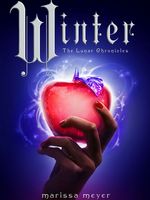
Winter by Marissa Meyer

WinterWinter

by Marissa Meyer
Series: The Lunar Chronicles, #4

Hardcover, 824 pg.
Feiwel and Friends, 2015

Read: January 19 – 22, 2016

So, the first book I really blog about is the conclusion to the tetralogy — not the best way to go about it, but it’ll have to do.

Primarily because I started this blog after I’d read the first two books in this series, and only slightly due to laziness, I’ve only blogged about one other of The Lunar Chronicles — the “.5” preceding this one, Fairest. Which makes this a little hard to do, but not that much. Basically, what Meyer has done is combining and intertwining the stories about Cinderella, Little Red Riding Hood, Rapunzel and Snow White; removing the magic, inserting computers, cybernetics, and space ships; and setting the entire thing in a future where Earth and the Moon are on verge of war. Couple that with Meyer’s voice and skill? This series is a crowd pleaser.

During Part I, I felt like The Grandson in The Princess Bride, “Is this a kissing book?” There was just so much smooching, significant looks, and avowals of affection that it got close to annoying. That said, it was so nice reading a YA book where (almost) everyone was open and honest about their attractions and (almost) everyone had their feelings reciprocated. Those that weren’t that open might as well have been, they were all pretty horrible at keeping things secret. Over all, it was sweet, it was cute, it was like a fairy tale.

What are the odds, right?

But after that? A great mix of character moments and action. On the one hand, Meyer takes her time setting things up — but on the other hand — she doesn’t have to take time and introduce anyone knew this time. All the players are known quantities, the relationships are set up between all of them, and there are two major goals at work — Stop Levana, or Stop Cinder. Everything else is frosting.

Clear directions, clear motives, it’s a crisp, well-paced adventure story at this point — yeah, there’s a little politics, there’s a little subterfuge — but basically, it’s “Let’s raise an army and storm the castle.” Which doesn’t mean everything’s a cake walk, of course. There’s some tension, real hardships and peril — am I allowed to say that there were a couple of times when thing seemed pretty Grimm?

This is based on a fairy tale, and that needs to be borne in mind as you read it. That being said, Meyer makes it very easy to forget that and by the time that the part of Winter that was the most-Snow White-y, I’d forgotten that’s what this novel was about. You’d have thought between a. the cover, and b. the time I’ve spent in the world of Indexing lately, I’d have seen it coming. But I didn’t until I was right in the middle of the scene — which made it much more effective for me.

Meyer is great with her characters, and you can get attached to even those we meet for the first time in these pages — for those who’ve been around since the beginning? Hate to say good-bye to them, especially Iko the android. In the end, I think this is one of the more emotionally satisfying series conclusions I’ve read recently.

—–

4 1/2 Stars

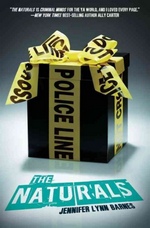
The Naturals by Jennifer Lynn Barnes

The NaturalsThe Naturals

by Jennifer Lynn Barnes
Series: The Naturals, #1

Hardcover, 308 pg.

Disney-Hyperion, 2013
Read: December 8, 2015


We’ve all heard of Quantico, VA, the small town that is home to the FBI Academy, Laboratory, NCIS, and so on. What most of us don’t know is that it’s also home to a secret training ground for teenagers who are so intuitively good at profiling and other forensically-inclined psychological skills that they’re described as “Natural.” Two FBI agents and one retired Marine run this program and house, using the teens to crack cold cases. Sharpening their skills in a safe environment, so that when the time is ripe, they’ll be Super Agents.

The Naturals opens with Cassie — being raised by her grandmother while her father’s off somewhere with the Armed Services. She’s seventeen and can read people like a Richard Scarry book, which makes her a great small diner waitress. Until she’s given the chance to join program and she jumps at it, becoming the fifth member of the team.

Cassie jumps into the training, and picks things up quickly. I really enjoyed reading those scenes — she and Dean, the other profiler, sound so much like Will Graham from NBC’s Hannibal that I really got into it. Outside Quantico, things are afoot that will keep this from being all training and cold cases — and I bet, for those who survive, the next books will also pretty fresh cases, too.

Walking into a two-guy, two-gal house — and, apparently, being more attractive than she’s aware — Cassie complicates things. Soon she’s part of at least one Romantic Polygon. It’s not too painful at the moment, but I could see it overtaking things in a book or two. It’s marketed as YA, so it was likely anyway — still, you should know it’s out there.

None of the characters — including Cassie — are much more than groupings of characteristics and tics at this point, but I’d be willing to guess that they could be within another book or two. For now, they’re good enough for what the book is. It really is a fun read

A fast, fun read with just enough suspense to keep you moving, but not as much as you’d get in a Thomas Harris or Val McDermid psychological thriller — a great way to cut your teeth on the subgenre. I’ll come back for more — and I’ll pass it off to my daughter, who will likely eat it up.

Thanks to DanySpike for the blogpost that convinced me to give this one a try. I owe ya one.

—–

3 Stars

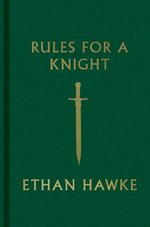
Rules for a Knight by Ethan Hawke

Rules for a KnightRules for a Knight

by Ethan Hawke

Hardcover, 169 pg.
Knopf, 2015

Read: November 30, 2015


So the story goes, Ethan Hawke is a descendant of a knight who died at the Battle of Slaughter Bridge in 1483. The night before the battle, this knight, Sir Thomas Lemuel Hawke penned a lengthy letter to his young children so that they’d have something to remember him by, and hopefully learn something from him. Ethan Hawke came into possession of this letter, and after a scholar translated it for him, modernized the language so that he could pass these lessons on to his kids. Given the fact that the “Hawke” surname was once “Hawker”, there’s an ornithological flavor to all of this.

The letter, or manifesto, consists of short lessons on a variety of virtues or characteristics that Sir Thomas wanted to pass along to his son and daughters (which are awfully feminist for the 15th Century): justice, solitude, generosity, discipline, love, humility, and so on. Virtues and ideals that are shared by many Western and Eastern cultures — something akin to what C. S. Lewis would call the Tao. The lessons combine personal vignettes from Sir Thomas’ life and training with fable-like stories (many of which are old and common — like the two dogs/wolves inside each of us fighting for control, you ought to feed the one you want to win).

Hawke’s wife, Ryan, provided the illustrations for this book. I wouldn’t say they’re dazzling, but they’re nice — and fit the material well.

This is a nice book, one that serves its purposes well. Short chapters, well (if somewhat heavy-handed) written. It’s not a must-read, but it’d be a good use of anyone’s time — particularly something for dads to read to young children.

—–

3 Stars

Hit by Delilah S. Dawson

HitHit

by Delilah S. Dawson
Series: Hit, #1

Hardcover, 324 pg.
Simon Pulse, 2015

Read: November 21, 2015


When I heard Dawson talk about this on The Once & Future Podcast this past Spring, I knew I had to read it. But like with about half the things I say that about when I listen to that podcast, I never got around to it. I’m so glad I finally remembered to grab it. This was a great read — a heckuva gut punch. A great immersive experience.

Sure, we’ve all read dystopian fictions that take place decades (at least) after the fall of whatever society preceded it. But have you ever wondered what it’s like to live in the opening minutes of a dystopia? Panem before the Capital City was wretched hive of scum and vanity? Well, that’s exactly what Patsy Klein is going through.

Yeah, Patsy Klein — some parents, right?

So Patsy is given a task: work as an indentured servant/debt collector for 5 days and collect from these 10 people. To collect, get their signature and record one of three choices: pay up everything you owe to the bank, now; become an indentured servant yourself for 5 days; or be killed, and here’s a 17-year-old with a 9mm to take care of that. Take your pick.

How can anyone get away with that? Well, Valor Bank (and a couple of smaller entities) has bought — lock, stock and barrel — the debt of the U.S. and every individual in it. Which is a lot of debt when you stop and think about it (all that’s required, really is, something like a California Rolling Stop to reach that conclusion). Valor Banks wants that debt taken care of pronto — and thanks to a subclause in that credit card application that no one ever reads, and some greased wheels in Congress, they can present these choices to pretty much every citizen. Patsy’s part of the first wave of these collectors, moving out before the majority of Americans have figured out what’s happening.

Killer concept, right? Utterly horrific — and yet almost utterly believable. Like I said before, when you plunge in and read this in a sitting or two it works great. If you take the time to think about some of the elements, I’m not sure it’d hold up nearly as well. But man, it was a fun read, even when it made you uneasy about what Patsy was doing.

And before I go any further, I just have to add that this is one of the best cover designs (front and back) I’ve seen this year. I hope someone got a promotion/bonus/raise out of this.

Again, I’m not sure how well this would hold up to examining various aspects of the world. It’s clear that there’s a pretty well-developed world supporting this, but the more we see of it, the more we understand the machinations that Valor Bank went through on both the macro and micro level — which it seems clear is where the sequel is going — the less I’m going to like it. A vague, nebulous Other doing horrible things is frequently better than seeing the Man Behind the Curtain. Right now, this is great — grabs the imagination, taps in to zeitgeist-y resentments towards banks/financial entities, and adds a deadly teenage girl. You explain everything, let us see what’s going on and I’m afraid we’ll end up with something like Allegiant (I’m convinced that was the biggest problem with the end of the trilogy, Roth explained too much).

A great read with some real weaknesses that easy enough to overlook if you want to. This’ll grab you, make you feel every hit, every shot and every regret.

—–

3.5 Stars

Page 35 of 42

Powered by WordPress & Theme by Anders Norén