Category: YA/MG/Children’s Books Page 37 of 42

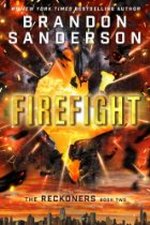
Firefight by Brandon Sanderson

FirefightFirefight

by Brandon Sanderson

Hardcover, 416 pg.
Delacorte Press, 2015
Series: The Reckoners, #2
Read: January 30 – February 2, 2015

…as she’d left, I’d glanced at her gun.
This time, when she’d pointed it at me, she’d flicked the safety on. If that wasn’t true love, I don’t know what was.

We’ve all been there, right?

In the months since David did the impossible by killing the Epic Steelheart, he and the rest of the Reckoners have continued their war against the Epics — successfully enough, that Newcago is beginning to rule itself (sure, with the puppet government that Steelheart allowed, but it’s starting to come into its own). The last few of these have been sent by the Epic that runs Babilar (Babylon Restored = Manhattan), Regalia. So, David, the Prof, and Tia leave the rest of the Newcago crew to keep order, and head to Babilar to see what they can do about Regalia.

Meanwhile, David’s trying to convince the Reckoners that Megan wasn’t a traitor and murderer, and while an Epic, she deserves a second chance. And not just because he’s gaga for her.

It’s possible that the city of Babilar is the happiest city in contemporary YA dystopias. It’s definitely one of the most upbeat depictions of Manhattan that I’ve ever read/seen. Which is saying something, considering that it’s pretty much flooded (and ruled by an Epic who can control water). But thanks to a religion/philosophy/frame of mind (depending who you ask) — possibly Epic-induced, possibly spontaneous — the people of Babilar are a lot more positive, have a certain joie de vivre, and are a lot less interested in the work of the Reckoners than anyone else we’ve heard of in this world (and poor Dave is rather befuddled by this). I don’t want to get too descriptive of it — Sanderson will do better than I ever could, anyway — so let me leave it with this: I’m not crazy about the water, and I might be persuaded to move to Babilar.

One thing I’d forgotten from Steelheart was Dave’s general goofiness and voice. I did remember how bad his metaphors were (particularly, as it was pointed out to him that they aren’t even metaphors at all), but I didn’t remember how fun Dave was as a character when he wasn’t being more driven and vengeful than a teen-aged Bruce Wayne. Maybe Sanderson didn’t stress it as much last time out, or given Steelheart’s death, he’s lightened up. My guess it was a failure of my memory — but I really enjoyed Dave’s voice here (think Peter Parker à la Bendis), and would’ve kept with the book just for it , even if I stopped caring about the rest of the story (little chance of that happening, I should say).

But even with Dave’s snappy narration and Babilar’s vibe, there’s a lot of suspense in Firefight. A lot of deception, treachery, and danger everywhere. In the brightest of moments lurks a real possibility of the world becoming a darker place than it has been since Calamity and the advent of the Epics. Sanderson attempted a real balancing act here, and pretty much pulled it off. Up to, and including a great cliffhanger that makes the wait for the final volume of this series all the worse.

The only other note I can think to say here is that Sanderson has the most creative use of Fortune cookies in fiction here. Inspired. Read it for yourself.

Fun, fast-paced, exciting tale of super-powered dictators and the people resisting them — give Firefight a read if you’ve already enjoyed Steelheart. But go back and grab Steelheart first if you haven’t.

—–

4 Stars

Review Catch Up: Beautiful Redemption; Breach Zone; Chasing the Prophecy; Fiddlehead

I’ve got a backlog of 40-plus reviews I’ve been meaning to write — some of them, I just have to admit aren’t going to get done. But I’m going to try my level best. The four books I’ve decided to tackle in one fell swoop are the concluding novels from series I enjoy, and yet I’ve had trouble reviewing them. On the whole, there’s no reason for it — I should’ve had at least a few paragraphs of material on these, but I can’t seem to muster it (especially given how much time has gone by).

But I do want to clear these off my to-do list, so, without further ado, a few words on these series finales:

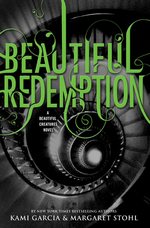
Beautiful RedemptionBeautiful Redemption

by Kami Garcia and Margaret Stohl

Paperback, 451 pg.
Penguin Books, 2012
Read: November 19 – 20, 2013

On the one hand, this was not at all like the rest of the series — and yet it was a very fitting conclusion. Garcia and Stohl wrapped up everything that needed wrapped up, answered every lingering question (not always as I expected), and generally, did so in an emotionally satisfying way. I wouldn’t have thought that this book would lead to a spin-off series, but it fits.

If you’re into Paranormal YA, this was a very satisfying conclusion, and probably the best of that genre I’ve read.
4 Stars

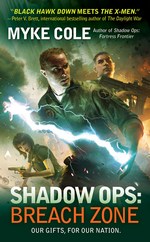
Breach ZoneBreach Zone

by Myke Cole

eBook, 384 pg.
Ace, 2014
Read: January 31 – February 04, 2014

I really, really liked all of Myke Cole’s Shadow Ops series — a gritty, believable mix of Contemporary Military and Fantasy, and yet, I’ve never reviewed one of his books. Don’t ask me why.

This, the conclusion to the trilogy, is just outstanding. You know how at the end of (pretty much) every fantasy novel, there’s this big, epic battle that takes up most of the last ¼ – ⅓ of the novel? That’s pretty much this entire book. Okay, not really — there’s plenty of backstory, character development and wrapping up the trilogy. But while reading, it sure felt like it was an epic fantasy battle on the streets and in the waters of New York. Somewhere in there, Cole looks gain at questions of patriotism, duty, ethics and morality — and how people of integrity can try to harmonize them all (and, more often, how those with integrity can’t harmonize them all). Seriously, awesome stuff.
4 Stars

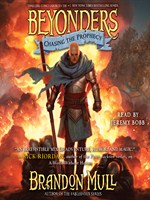
Chasing the ProphecyChasing the Prophecy

by Brandon Mull

Hardcover, 512 pg.
Aladdi, 2013
Read: December 2 – 5, 2013

Wow — Mull concluded his Beyonder’s trilogy in a fantastic fashion. Given the target audience, I couldn’t believe how many deaths there were in this book. But, not in a gory or exploitative way. Just a huge body count. But, the core of this book remained the same: these two Beyonders, Rachel and Jason, risking everything for the sake of Lyrian. There’s sacrifice, honor, loyalty, and courage — all the necessary elements of a tale full of heroes — natives and Beyonders, warriors and children, those with many lives and those with only one to lose. Which is not to say it’s not fun — there’s a lot of fun to be had by the characters and the readers. Great way to go out.
4 Stars

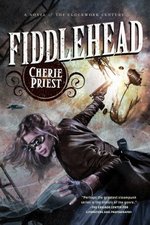
FiddleheadFiddlehead

by Cherie Priest

Paperback, 368 pg.
Tom Doherty Associates, 2013
Read: November 12 – 14, 2013

Nice looking book — love the cover, the layout and the graphics are great. I miss the brown ink — what gives, Tor? Sure, the content is the important thing, it’s just nice when the package it’s wrapped in is nice to look at. Speaking of content — this (like the rest of this group) is a fitting — and thrilling — conclusion to the series. Lincoln (wheelchair-bound following the unsuccessful assassination attempt at Ford’s Theater) and President Grant working together near the end of the Civil War to protect a freeman scientist who built an early computer — the eponymous Fiddlehead. Fiddlehead is the best chance to end the War without making everything worse. The presidents, with the assistance of Pinkerton agent Maria Boyd and intelligence from — well, everywhere else this series has focused — in order to begin to deal with the Rotters. I think it’s possible that Boyd is my favorite character in the series — in the Top 3, anyway.

I just didn’t want this series to end, I understand it needed to, but man…just didn’t want that.
4 1/2 Stars

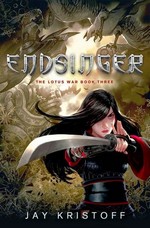
Endsinger by Jay Kristoff

Endsinger (The Lotus War, #3)Endsinger

by Jay Kristoff

Hardcover, 432 pg.
Thomas Dunne Books, 2014
Read: Dec. 16 – 23, 2014

Let me show you what one little girl can do.

Of course, if you’ve read the first two novels in The Lotus War, you’ll know the list of what this one particular little girl can’t do is probably much shorter. The only question at this point is, can one little girl survive?

Kristoff has quite the wringer to put you through before you get the answer to that. For example, within the first thirty pages — thirty — Kristoff reveals something about a character I’d grown to have a certain affection for, and pitied after what happened to them in the previous book which makes me question everything I thought about them. And then he does something to that character I’m not sure I’ll forgive him for (will still read him, don’t get me wrong, I’ll just bear a grudge).

On the other hand, Endsinger is filled with so many fist-pumping moments, and fun sentences — like

Hiro laughed like a man who’d only read about it in books.

that you can keep pressing on — and actually enjoy the book. Another example of this:

Michi’s foot connected with the Inquisitor’s groin like a redlining goods train. It was the kind of kick that made one’s testicles throw up their hands and move to a monastery in the Hogosha mountains. It was the kind of kick that made orphans of a man’s grandchildren.

I mean, that’s something that Bruce Willis should be saying as he takes on Hans Gruber’s second-cousin or whatever.

I’m not going to describe much plot-wise here. It’d be too difficult to do it justice at this point — if you haven’t read the first two books anyway, there’s not a lot you’ll understand here without a lot of effort on my part. And if you’ve read the first two, you don’t need that to be an inducement to read the this one. It’d be easy in a book like Endsinger to just point every character at the final battle, throw in an obstacle or two along the way and let that be that. Heck, just coming up with an excuse to have Yoshi and Buruu travel around for 70-100 pages as the best buddy comedy pair to come along lately would’ve been a very satisfying way of spending time before the big battle. Instead, we get character development — a lot of it. We get mysteries explained. We get new characters, we learn new things about characters that we’ve known really well since book one (or thought we did, anyway). And they’re all thrown at a couple of really big battles, with some obstacles to overcome along the way.

The themes of the first two books continue to be explored here. The two that stuck out the most for me were: what makes a hero, what do they look like and what’s worth fighting for — honor, family, love, something else. Heroes aren’t what you think they are, don’t look like you think they should like — even (especially) to themselves. But everyone knows one when they see and/or hear one. As for what’s worth fighting for? That’s different for every one.

You don’t think people should know what happened here?”
“Oh, I think they should know, no doubt. I just don’t think they’ll care.”
“How could they not?”
“Because it will be different next time. It always is.”
“Different?” Akithito frowned at the cloudwalker captain.
“Different,” the Blackbird nodded. “Whatever they fight over. It’ll have a different name or a different shape — religion or territory or black or white. People will look back on us and say ‘we could never be that blind.’ People don’t learn from history. Not people who count, anyway.”

There’s a measure of cynicism, realism and idealism in Kristoff’s exploration of these (and other) themes. It’s tough, and probably ill-advised, to try to pin one of these viewpoints on Kristoff. But it seems to me that idealism’s voice is a bit louder than the rest.

Kristoff is great at keeping you on your toes. Things are bleak, but you start to think that hope is on the horizon, that one cavalry or another is coming — and coming soon. And then the hope is dashed. Or you start to think that all hope is gone and things are going to fall to ruin, and this is going to turn into a YA historical dystopian series, but then a new source of hope, a new rabbit gets pulled from a hat. He blindsides you time after time, from every direction.

Kristoff is great at his pacing, there are many moments he lets breathe, lets the readers and the characters observe everything going on, taking in all the sensory information and the thoughts of everyone. But he’s also capable of throwing in a sudden scene to grab the reader. The quick scenes bouncing around between the various characters in the heat of battle really work well to keep the tension high (though that can be a bit confusing unless you force yourself to slow down and read carefully — which is the last thing you want to do at that moment).

After awhile — about three-quarters through the book, after all the death, destruction, and (seemingly) climactic confrontations and battles getting you to that point, you simply can’t believe Kristoff can keep it going. How can the book last so many more pages? Is he going to give us a Peter Jackson’s Return of the King-style multi-epilogue? Probably not, it really seem to be Kristoff’s style. And then Kristoff shows you how he’s going to fill the rest of the book, and you pity all his characters, even those you’ve grown to despise, because that’s just not right.

In the end, Endsinger is a very satisfying conclusion to one of my favorite series in recent years. It’d have been easy for him to go for a “Everybody lives, Rose” kind of thing, where Hiro and the Lotus Guild are destroyed, Yukiko and Buruu are universally hailed as heroes, the Kage take over, and happily ever after. But he doesn’t give us that. Instead, we get the kind of conclusion promised in the first two books: it was emotionally satisfying (and induced a wide range of emotions, and may have involved a Kleenex or two on my part), it gave characters real conclusions to their arcs (not all happy endings), it tied up what needed to be tied up and it pointed towards the future. I’m going to miss this world and most of these characters. But I’m glad Kristoff didn’t try to milk this longer — it’s great as it is.

—–

5 Stars

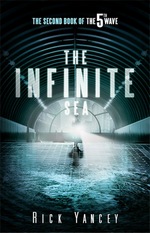
The Infinite Sea by Rick Yancey

The Infinite Sea (The 5th Wave, #2)The Infinite Sea

by Rick Yancey
Series: The 5th Wave, #2

Hardcover, 300 pg.
Putnam Juvenile, 2014
Read: October 4 – 5, 2014
Man, talk about trepidation. Did I want to pick up this book? Was there any chance it could live up to The 5th Wave? Slim to none. But man, I wanted to find out what happens to the Earth. I wanted to know if we ever figure out what the aliens want with the Earth, why they’re eliminating humanity in the way they are. So, prepared to be disappointed, I cracked the cover.

And Yancey doesn’t try to match — or even try to top — The 5th Wave. He writes a very different book. Not one that grabbed me as thoroughly, but one that works in its own way. Where The 5th Wave was a bullet train that you just tried to hang on to — The Infinite Sea was roller coaster you’re riding while blindfolded — the ride lopping, diving, screaming around a corner with no warning, leaving your stomach behind you.

Yancey can’t even give us a Prologue to reorient ourselves to this world, to get our feet under us so we can say, “Oh yeah, this is what’s going on…” before resuming the action. Sure, it starts to seem like that, but nope. He’s right there to pull the rug out from under us at the first possible moment, in a way that catches the reader just as off-guard as the bits of remaining humanity will be.

I read some criticism lately about The 5th Wave that complained about the lack of motivation given for the aliens to do what they’re doing — it makes no sense, and therefore the reviewer couldn’t buy into the book with a motive-less enemy. But to me, that’s why the book worked. Humanity doesn’t understand what’s going on, so there’s no reason we human readers should either. Try as they might, there’s just no figuring out what’s going on other then their great need to survive.

On the whole, we spend time with the characters we met in the first book, those that survived — and, in flashbacks, some that didn’t, Cassie, Sam, Ben/Zombie, and a few others I won’t name because I can’t be sure I won’t spoil something by doing so. We say good-by to some of them, too. We meet a few other characters, too. Some of which we’ll see again. It’s that kind of series. But we get to know almost all of them better, the last book was all about getting to know a couple of these characters really well. This time, we get backstories on everyone, even if it’s pages/paragraphs before they die. This is important, I feel more grounded in this world the more I get to know characters who aren’t Cassie, Evan or Ringer.

And we get some more mature, experienced — and in some cases, informed — hints at what’s really been going on. Still, not enough to placate that other reviewer, I bet — or, really anyone. At one point, Cassie’s complaining about her interactions since Day 1 with Evan.

Every time I edge too close to something, he deflected by telling me how much he loved me or how I saved him or some other swoony, pseudo-profound observation about the nature of my magnificence.

I chuckled as I read it, because this is pretty much Yancey’s modus operandi — just when you get close to learning something, being told something, a character figuring something out, etc. — something explodes or someone starts shooting. Or both. Not a way to tell a narrative that satisfies everyone or to show off brilliant world-building. But a it’s great way to keep pages turning.

I found this to be a very satisfying read. As I said, I didn’t expect to be as taken with this book as I was its predecessor, and I wasn’t — but in a way, I’m sucked into this series more than before. I really don’t know the last time I said “son of a — “* out loud at a book as much as I did with this one. It’s probably not since Butcher’s Changes that I’ve called a writer so many names as I’ve read. Yancey just keeps throwing me for loops. Not the best book I’ve ever read, not high literature, but edge-of-your-seat thrills, convincing characters, and honestly come by surprises. Really entertaining stuff. That’s all I ask for.

—–

* I seriously don’t finish the sentence, because I’m too busy shaking off whatever trauma is thrown my way and getting back into things to bother.

—–

4 1/2 Stars

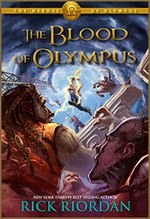
The Blood of Olympus by Rick Riordan

The Blood of Olympus (The Heroes of Olympus, #5)The Blood of Olympus

by Rick Riordan

Hardcover, 516 pg.
Disney-Hyperion, 2014
Read: October 25 – 28, 2014
Well, after ten novels, it’s time to say good-bye to Percy, Annabeth, Grover, and the other residents of Camp Half-Blood — not to mention their new-found allies and friends (when they’re not trying to wipe them out) from Camp Jupiter. But first they have to stop Gaea and her army of giants from wiping out the gods, humanity, and all life as we know it.

Just another day for these demi-gods, really.

As is the norm for Riordan’s books, our heroes are faced with a series of tasks which build up to a major confrontation — this time, a couple of them. It’s amusing as usual to see these kids outwit various minor gods, titans, etc. Good teacher that he is, Riordan gives his readers plenty of education about the Greek and Roman pantheons under the thin disguise of plot development.

The big epic battles that he’s been building for since the beginning of this series — well, they were epic. They were tension filled. And still managed to be funny. And will likely be read with breaths caught, and lumps in throats. Possibly the funniest visual in Riordan’s works appears in the midst of one of these battles, and for a second I was torn between enjoying it and turning the page to find out what happened next.

My one quibble was that the resolution to the Gaea story was a little too easy, a little too quick after all this build up. Still, the way he wrapped up the other story lines and conflicts was sufficient, so I was able to move past it easily. Riordan continues dabbling in themes I’d prefer not to see in MG books, but I know I’m in the minority on that.

At the end of the day, especially at this point in these series, it’s the characters that readers care about. I read this ahead of my son (who started these back when there were only three in the original series, and is now a good deal older than the target audience) and made a joke about something bad happening to Grover — and the glare he gave me probably took a year off my life. It’d that kind of dedication that Riordan instills in his fans. As such, there’s plenty of development and resolution given to these characters — Riordan doesn’t spell out their futures the way that Rowling did at the end of her series, but he gives us enough to be able to say good-bye.

Riordan does right by his characters — Reyna, Jason, and Frank particularly. Annabeth and Piper shine like neither has before. And Leo Valdez is even more of a star than he was before (if I’m going to talk about my son’s soft spot for Grover, I’d better be honest about my Leo-centric focus). I’m not saying they all survive, or are otherwise unscathed, but Riordan treats his characters with respect and keeps his readers turning the pages.

It’ll be odd not getting a new adventure with these characters next year, but I’m looking forward to seeing what Riordan does with the Norse pantheon (and learning about them, too).

—–

4 Stars

Opening Lines – Pickles and Ponies: A Fairy-Tale

We all know we’re not supposed to judge a book by its cover (yet, publishing companies spend big bucks on cover design/art). But, the opening sentence(s)/paragraph(s) are fair game. So, when I stumble on a good opening (or remember one and pull it off the shelves), I’ll throw it up here. Dare you not to read the rest of the book.

Yeah, yeah, I know…another modern fairy-tale intro. What can I say, I’m a sucker for ’em?

Once upon a time, in a land far away, a prince was in rather a pickle. Not a literal pickle, of course— prince-sized pickles are rather hard to come by. No, the type of pickle this prince was in was a thoroughly metaphorical one. To be honest, he might have preferred the vegetable.

from Pickles and Ponies: A Fairy-Tale by Laura May

Saturday Miscellany — 10/25/14

Odds ‘n ends over the week about books and reading that caught my eye. You’ve probably seen some/most/all of them, but just in case:

Opening Lines – The Westing Game

We all know we’re not supposed to judge a book by its cover (yet, publishing companies spend big bucks on cover design/art). But, the opening sentence(s)/paragraph(s) are fair game. So, when I stumble on a good opening (or remember one and pull it off the shelves), I’ll throw it up here. Dare you not to read the rest of the book.

—–

The sun sets in the west (just about everyone knows that), but Sunset Towers faced east. Strange!

Sunset Towers faced east and had no towers. This glittery, glassy apartment house stood alone on the Lake Michigan shore five stories high. Five empty stories high.

Then one day (it happened to be the Fourth of July), a most uncommon-looking delivery boy rode around town slipping letters under the doors of the chosen tenants-to-be. The letters were signed Barney Northrup.

The delivery boy was sixty-two years old, and there was no such person as Barney Northrup.

from The Westing Game by Ellen Raskin

Like any good novel (and this is a very good one), so much of the book is revealed in the opening paragraphs — not that we know that at the time, but in retrospect, it’s clear — we get the voice, we get themes, we get clues to the mystery (not that we know what the mystery is). As a kid, I got to that last line and was hooked. How could there not be such a person when the previous sentence said there was? What’s up with the Towers facing the wrong direction? What a strange book.

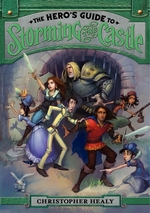
The Hero’s Guide to Storming the Castle by Christopher Healy

The Hero's Guide to Storming the Castle (The League of Princes, #2)The Hero’s Guide to Storming the Castle

by Christopher Healy

Hardcover, 477 pg.
Walden Pond Press, 2013
Read: Jun 17 – 20, 2014

This is not as good as The Hero’s Guide to Saving Your Kingdom, let me get that out of the way. But it’s hard to stay fresh with this time of humor. Still, it wasn’t stale, it was still a fun — sometimes very fun — adventure and a good story for the young — or those that can act young while reading a good book.

After their last adventure, the heroes find out that even in Fairy Tale Kingdoms, you only get 15 minutes of fame. No longer hailed as greats, their loser status has been restored and their lives are pretty much what they were before they banded together. So they all jump at the chance for further excitement, even if it comes in less-than-favorable ways. This time, the band is off to steal

We get all the characters from the first book back (at least the ones that anyone would notice), plus a few new faces — most of which I want to see again. In particuar, the character of Smimf the messenger was a great addition to the cast — he’s the proper mix of ridiculous and impossible. I could’ve used a little more of him — but not too much, I think he’s one of those characters that would grow old pretty quick.

I really enjoy Healy’s way of looking at the world and describing things, I know I posted some quotations last time, so I’ll limit myself to just one taste from this book where he explains the origin of the very nasty Warlord of Dar:

Some peole say Rundark was born out of a mad alchemist’s attempt to distill the essence of pure evil. Others claim he emerged fully grown form an erupting volcano. Although it’s also possible that he was the son of a used-cart salesman from Nebbish Village — they didn’t keep very good records in Dar.

I don’t care what age level you’re writing for, give me paragraphs like that, and I’ll read.

The last thing anyone should think about while reading this is Game of Thrones, but I couldn’t help myself. Someone needs to make a movie of this series, and they cast have to those of Maisie Williams and Rory McCann as Lila and Ruffian (quickly, before Williams grows up even more). If you watch the HBO series, I don’t know how you can read this without seeing the two of them with your mind’s eye as you read this.

I did chuckle at the tip of the cap The Princess Bride — so few in the target audience are going to get it, but for us Moms and Dads out there, it was a nice touch.

Last, but not least: Kudos to illustrator Todd Harris — his drawings are full of life and mirth. They’re the perfect accompaniment for the writing.

A lot of fun, almost as fun as the first book in the series, and well worth your time. I note there’s a third book in this series, and I really look forward to it.

—–

3 Stars

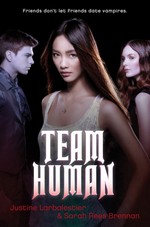
Dusted Off: Team Human by Justine Larbalestier, Sarah Rees Brennan

Team HumanTeam Human

by Justine Larbalestier, Sarah Rees Brennan

Hardcover, 352 pg.
HarperTeen, 2012
Read: Jul. 19-21, 2012

Much more than a Twilight spoof (although, that’s there) this is a heckuva read. Mel’s a spunky high schooler with a lot on the ball, her friends see her as a fixer, the one who can help them deal with whatever crisis they’re dealing with. It’s a role she relishes, it’s her way of identifying herself. Particularly this time, when she’s trying to stop one friend from falling for a vampire, while another is coping with her dad abandoning the family for a vampire lover. Vampires are pretty low on Mel’s list.

Mel’s a flawed hero, in an endearing way. She’s bullheaded, fierce, dives into things without looking, she makes mistakes, but picks herself up and charges back into the fray with a minimum of self-doubt.

The rest of the cast are almost as well-rounded, were I in high school, I’d love to hang out with them (they’d probably be a bit too wild for me, honestly).

A fun, emotionally-satisfying novel for teens and adults who don’t mind reading below their grade level.

—–

4 Stars

Page 37 of 42

Powered by WordPress & Theme by Anders Norén